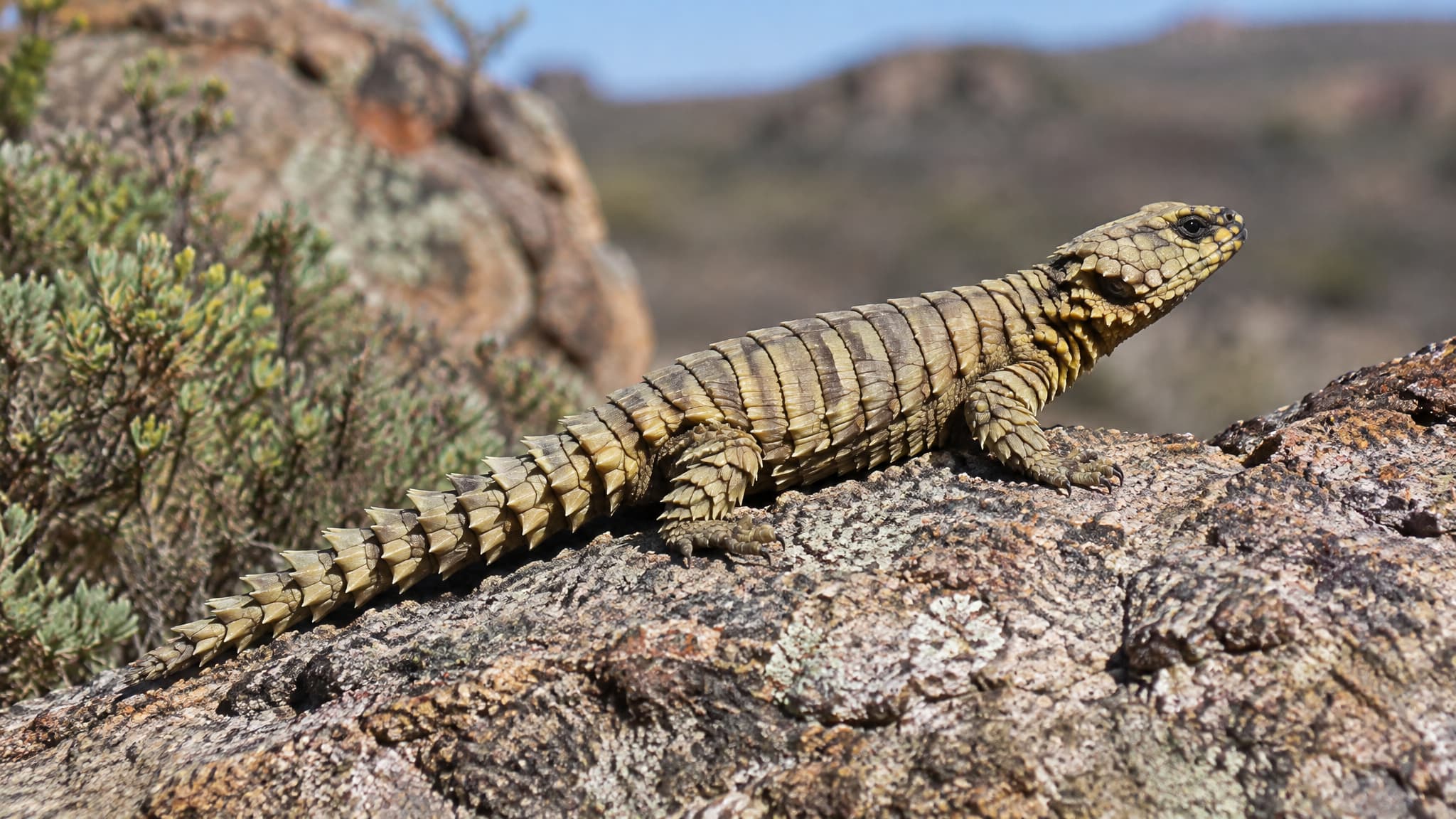
African spurred tortoise
Centrochelys sulcata
 AI-generated
An African spurred tortoise walks in profile across dry, sandy scrubland, with its domed, ringed shell, heavily scaled legs, and extended head clearly visible. The broad forelimbs and beaked mouth are prominent.
The African spurred tortoise (Centrochelys sulcata), also called the sulcata or Sahel tortoise, is the largest tortoise on any mainland and the largest in Africa, surpassed only by the giant tortoises of Aldabra and the Galápagos. Its broad, sandy-brown carapace has deep growth grooves around each scute, which likely gave the species its name (Latin sulcus, groove), and the front legs carry heavy, pointed scales. Adult males are clearly larger than females, with a straight carapace length of about 86 cm against about 58 cm, and males average around 81 kg, with some exceeding 100 kg. Hatchlings measure only about 4.4 cm and weigh about 40 g.
The species lives along the southern edge of the Sahara and across the Sahel, from Senegal and Mauritania east to Sudan, Eritrea and Ethiopia. It occupies hot, dry savanna, shrubland, stable dunes and grassy plains, often near seasonal streams. To escape daytime temperatures that can reach 49 °C, it digs deep burrows, sometimes several metres long, where it rests through the hottest hours and the driest months. These burrows stay far cooler than the surface and also shelter other animals.
The African spurred tortoise is a herbivore. In the wild it grazes on grasses and also eats flowers, weeds and succulent plants such as cacti. It is most active at dawn and dusk, warming itself in the early sun before retreating underground. It can go for weeks without food or water and, when it finds water, may drink up to 15% of its body weight at once. Adults above about 30 kg have almost no natural predators.
Mating peaks after the rainy season, mainly from September to November. About 60 days later the female digs several test nests before laying two or three clutches per season, each with roughly 14 to 40 eggs. In the wild the eggs can stay underground for about 8 months, while at a steady 30–31 °C they hatch in about 90 to 120 days; the sex of the young depends on incubation temperature. Sexual maturity comes at 10 to 15 years, and the wild lifespan is believed to exceed 75 years, with zoos reporting 80 to 100 years.
The IUCN lists the species as Endangered (2021 assessment). It now survives in only about 16.7% of its former range, often at very low densities. The main threats are habitat loss and urbanization, competition with livestock for grazing, wildfires, climate-driven drying of its habitat, hunting for meat and traditional medicine, and collection for the international pet trade. Reintroduction projects, such as those in the Ferlo region of Senegal, aim to restore wild populations.