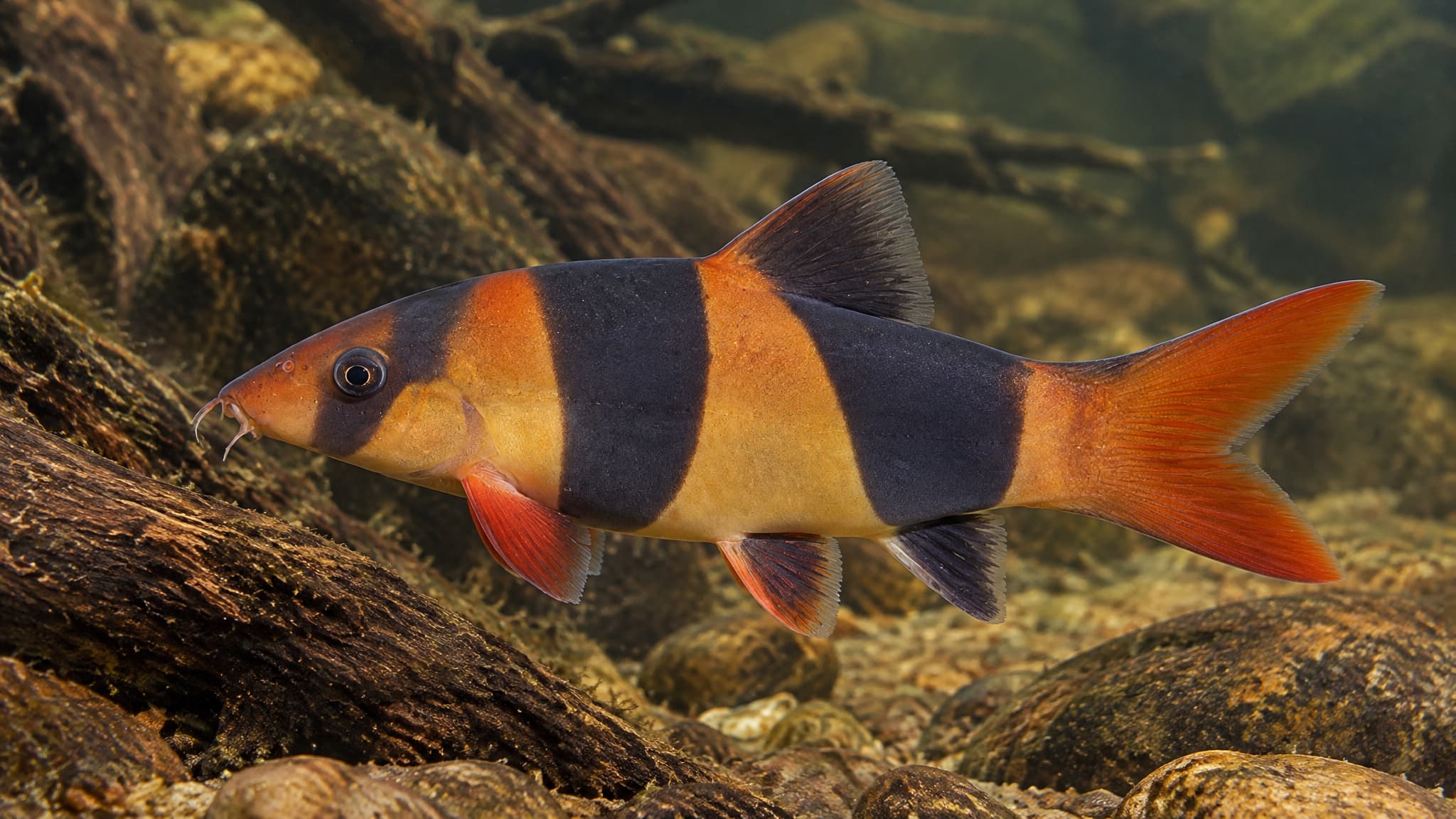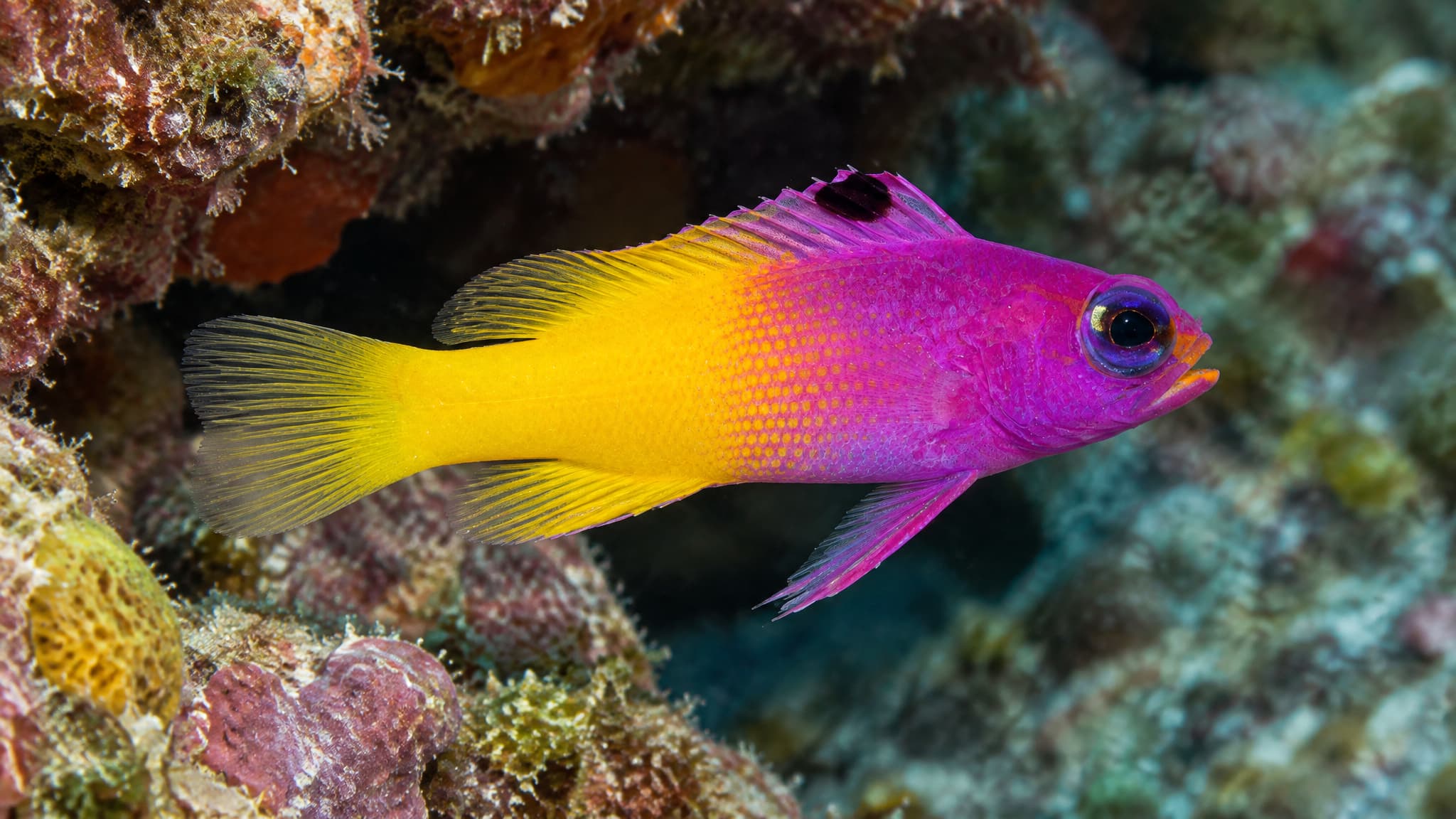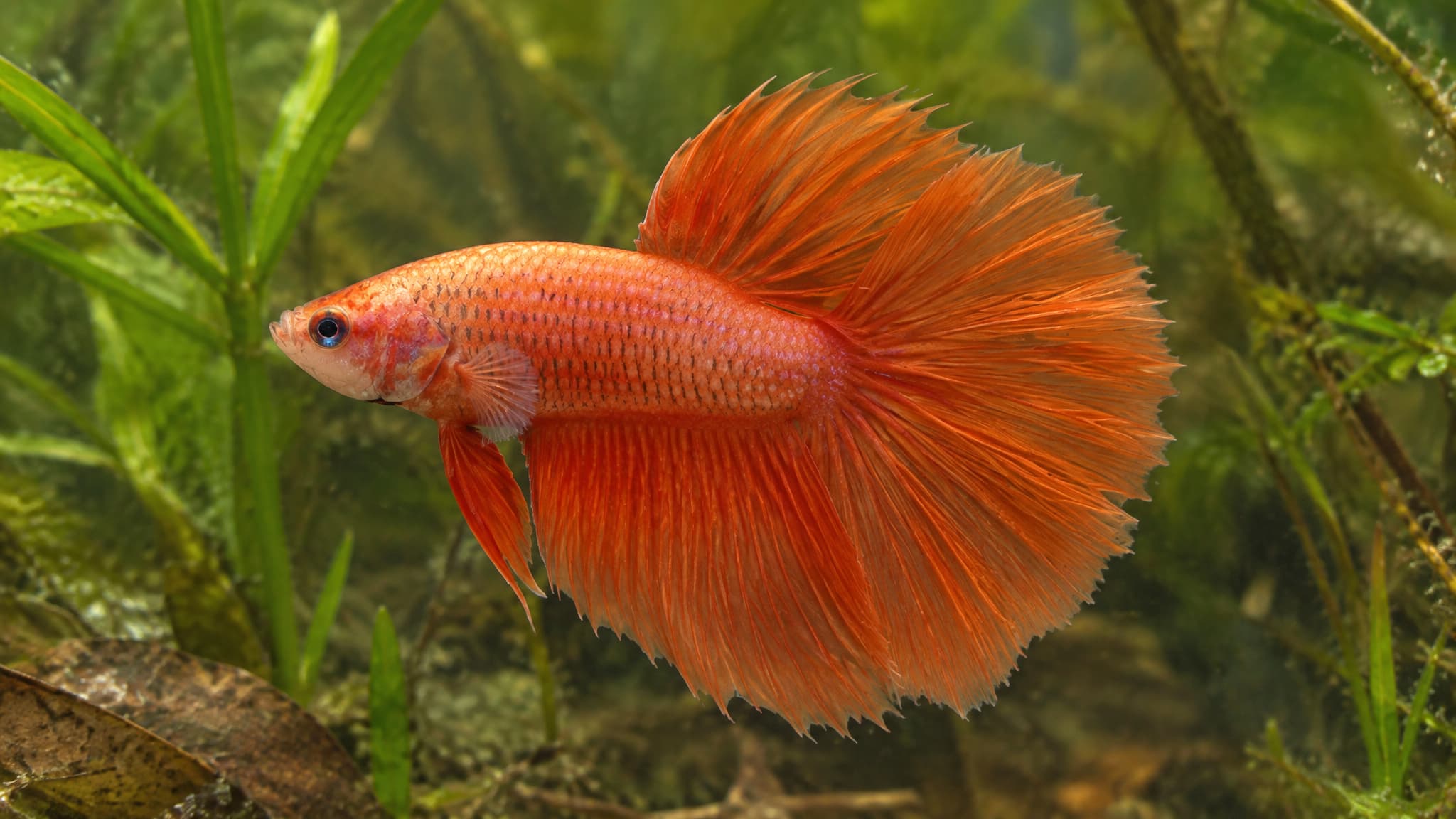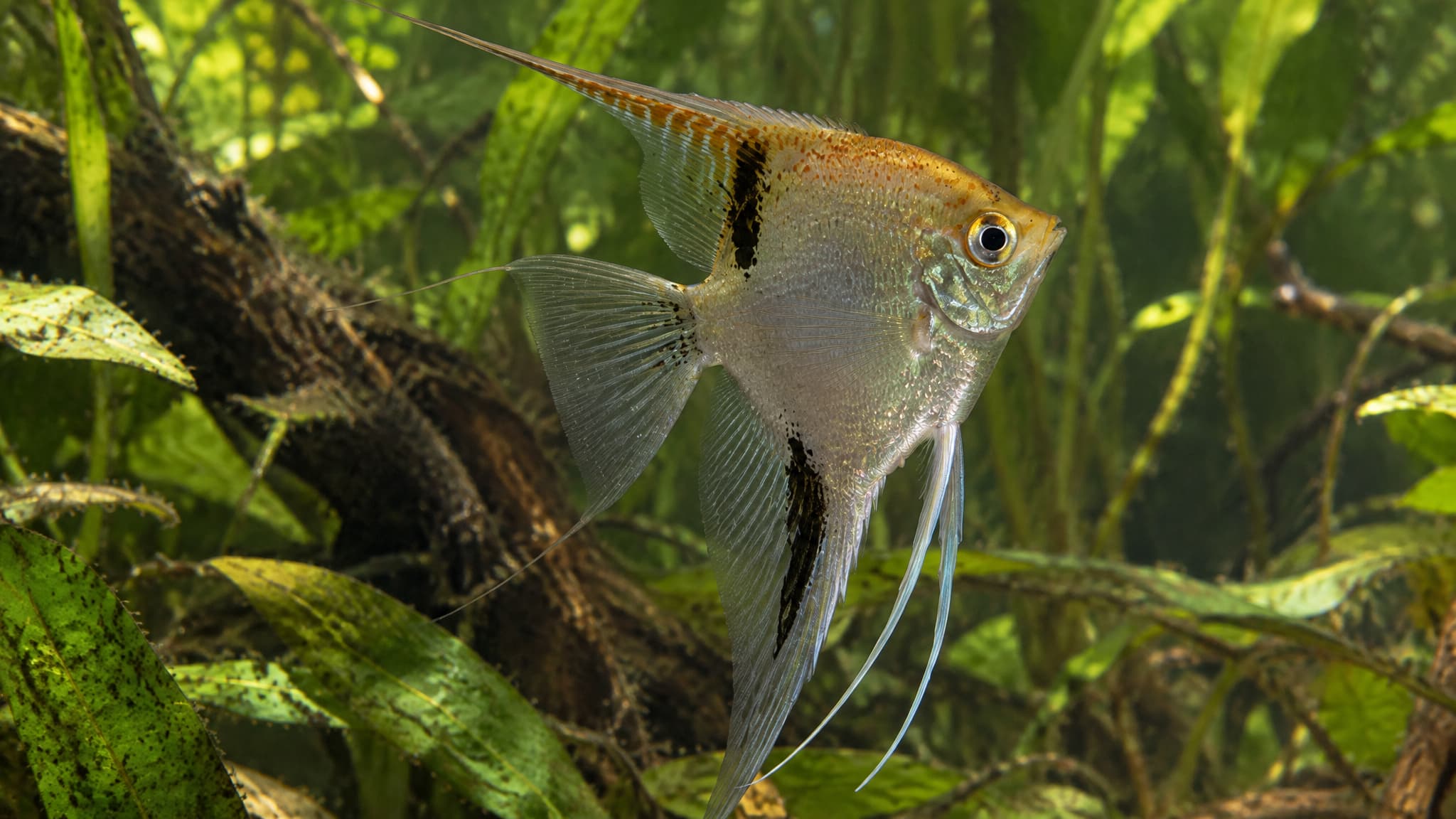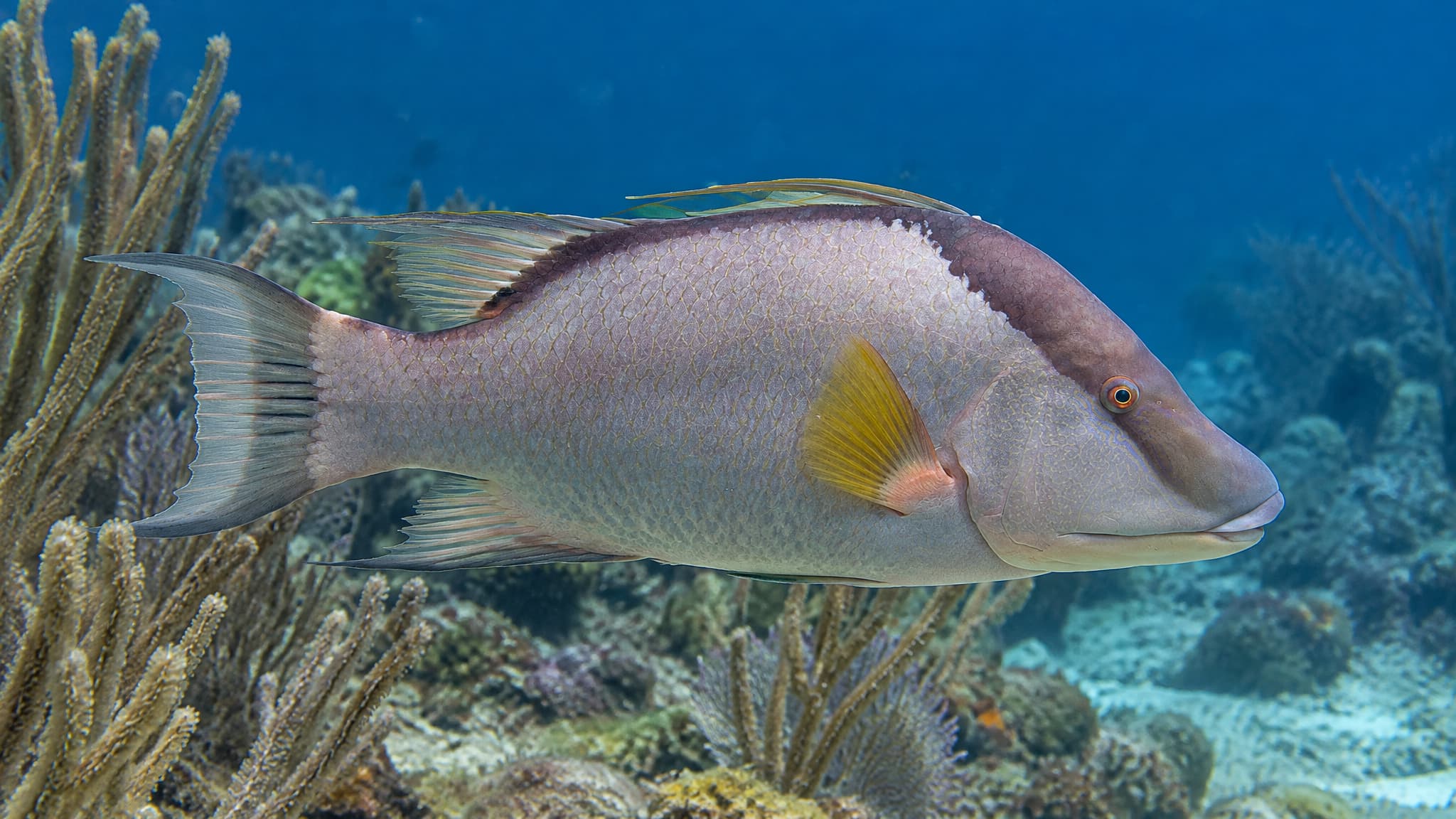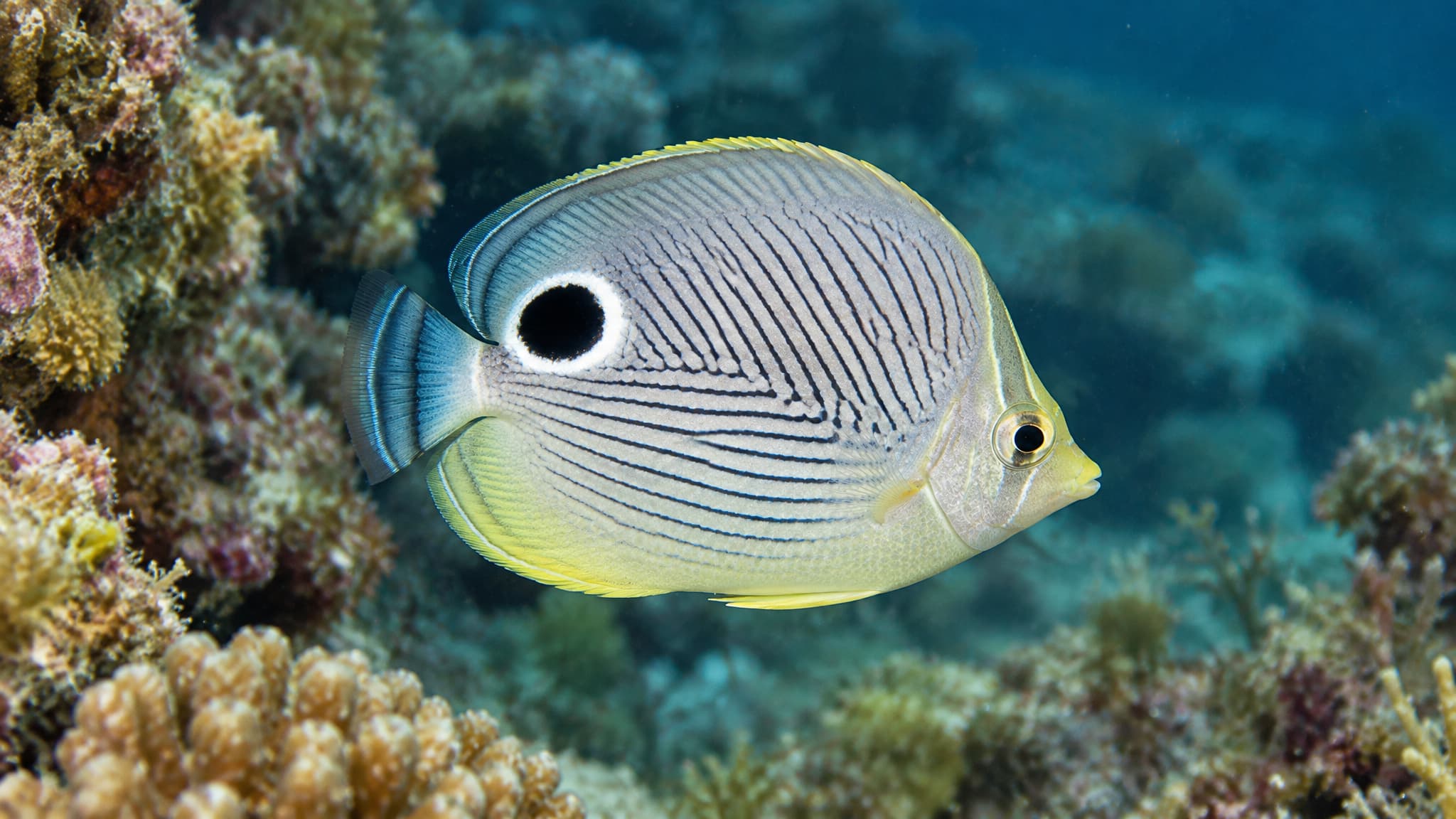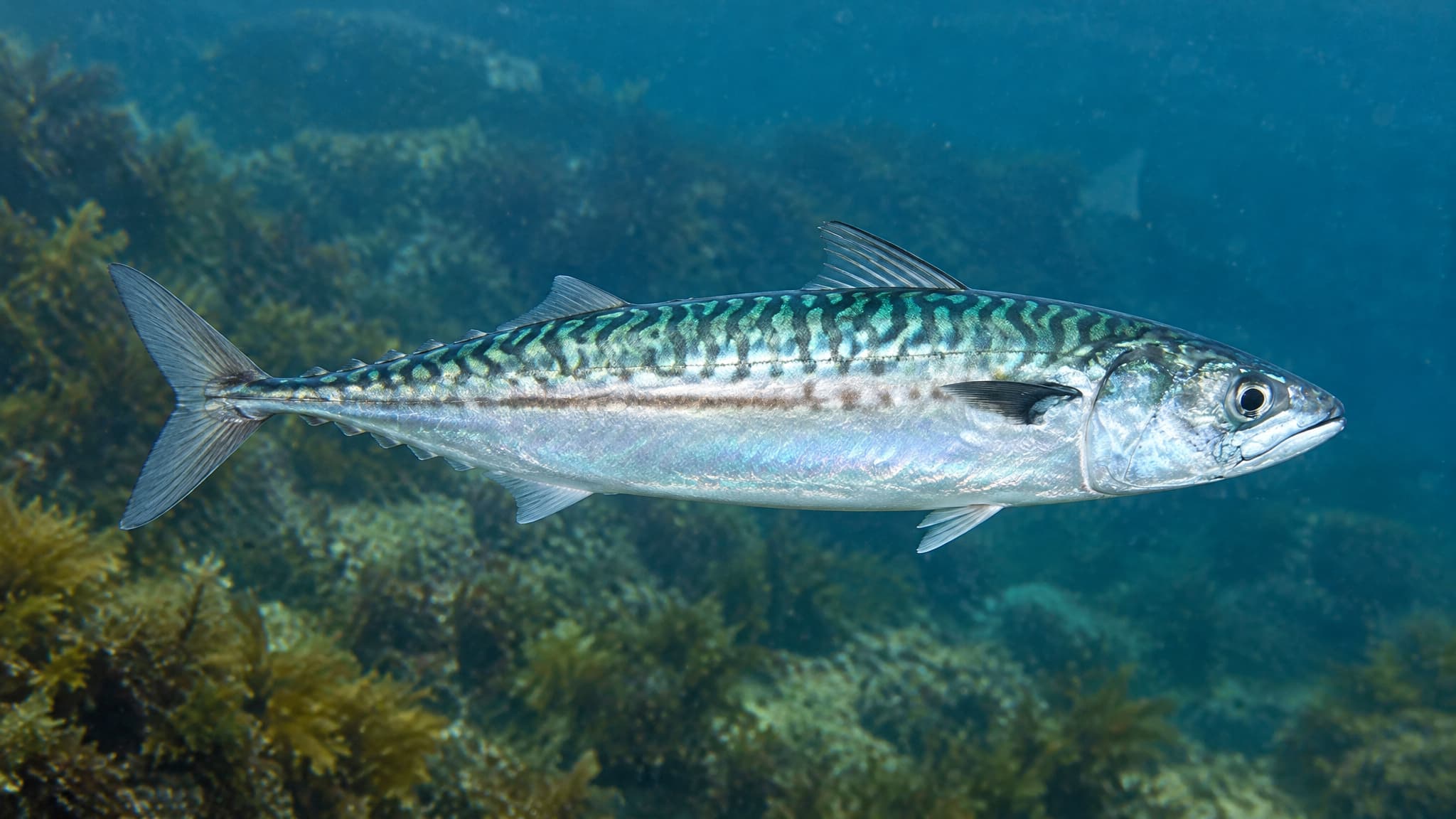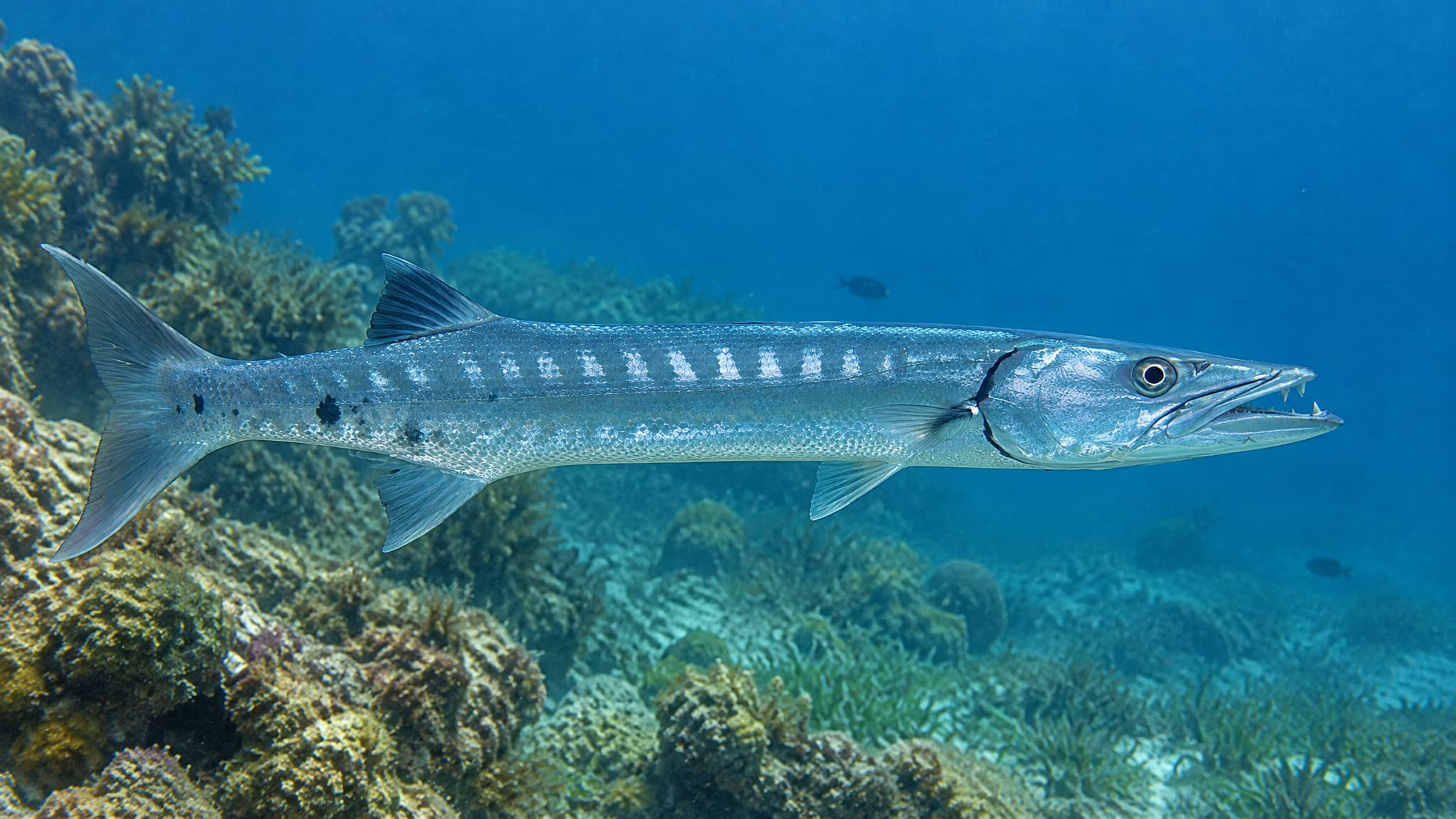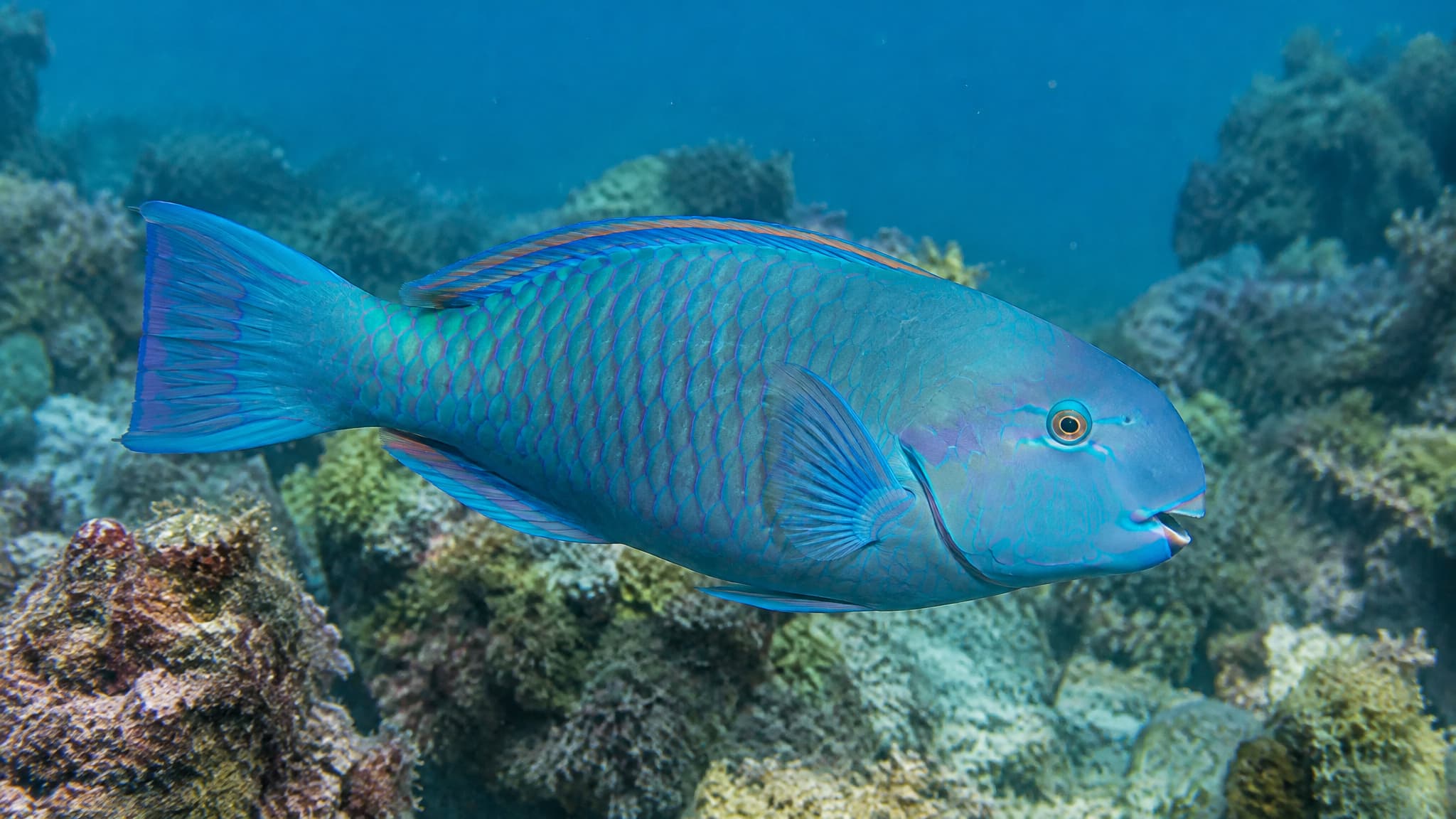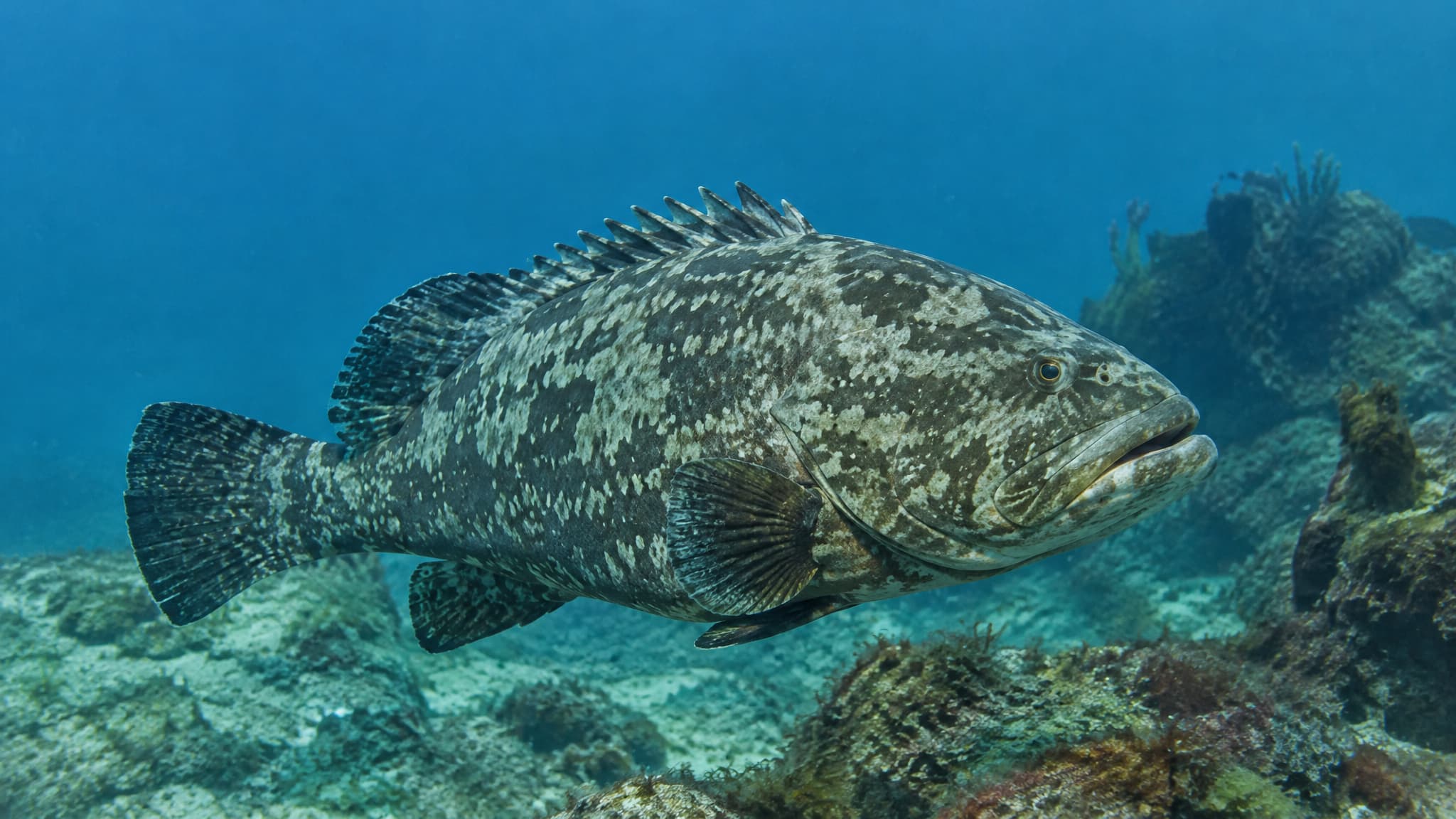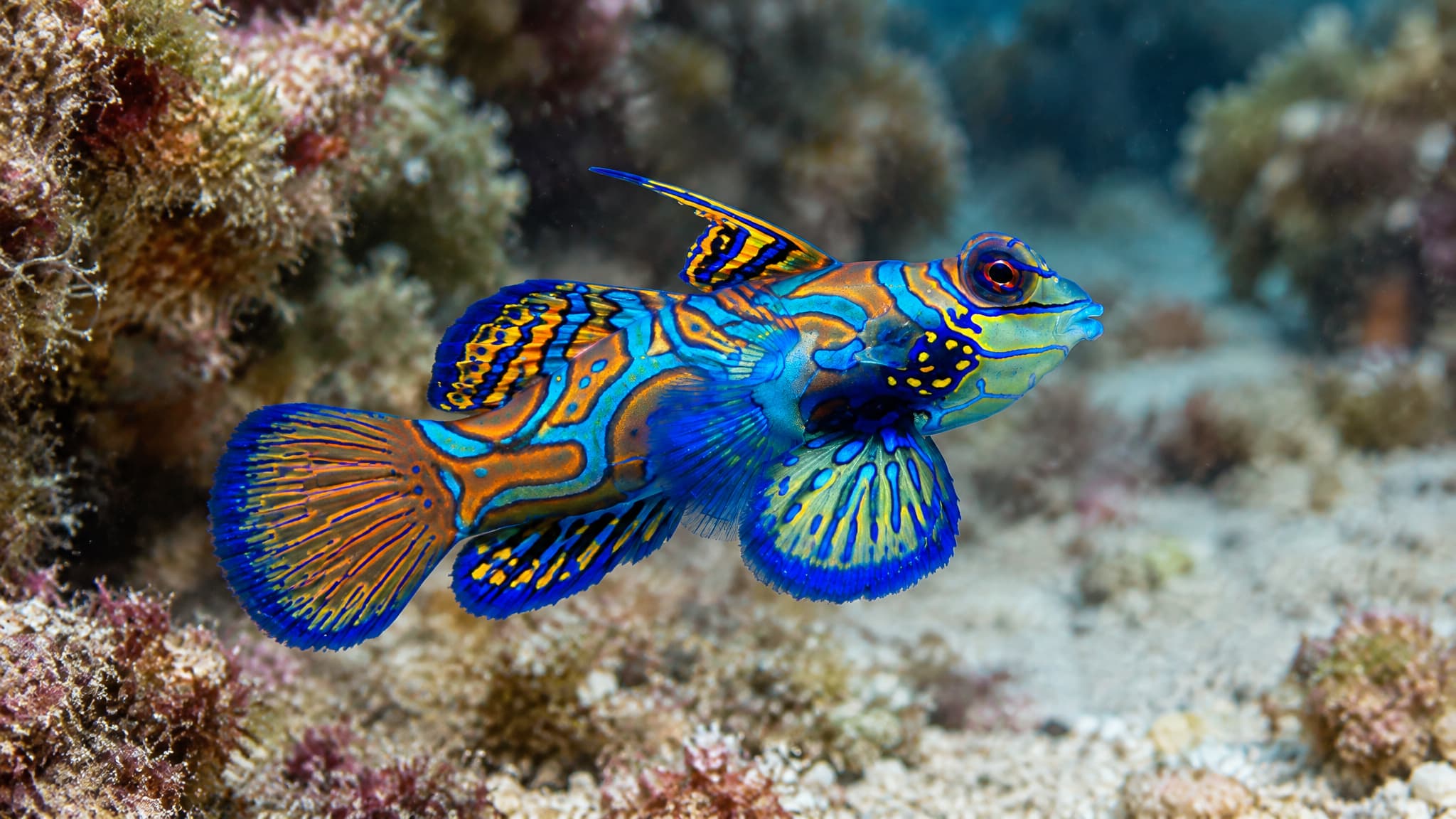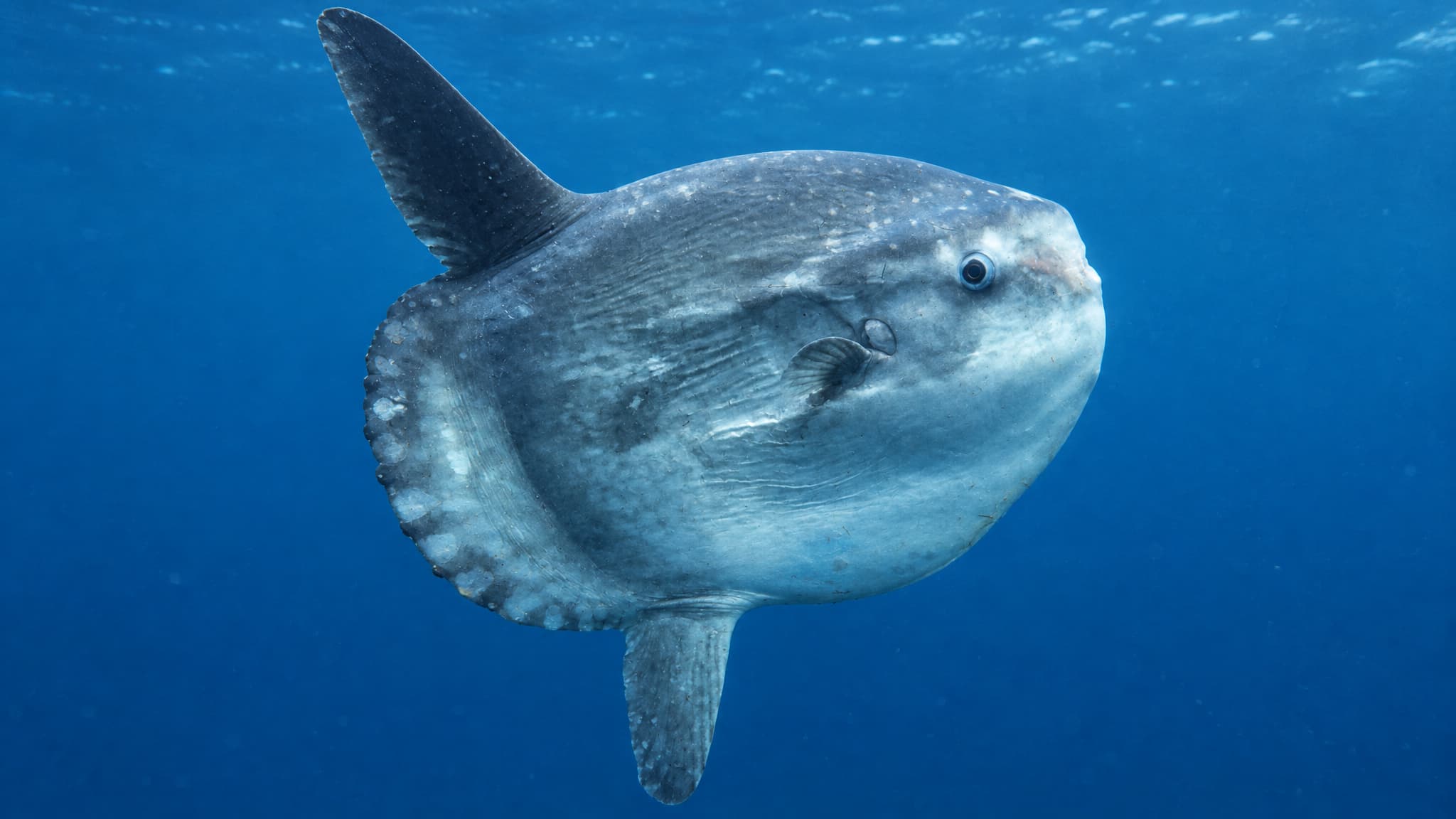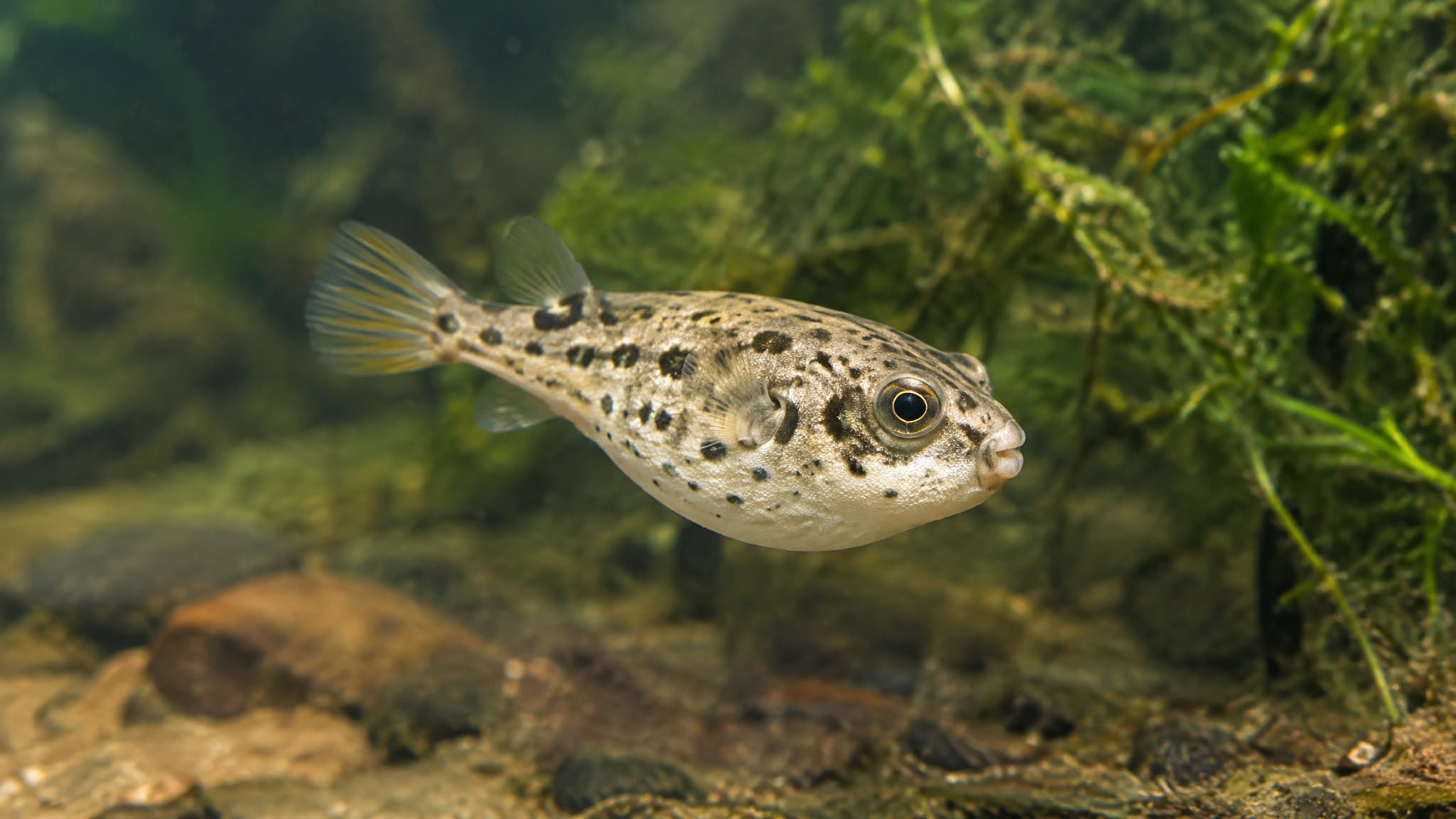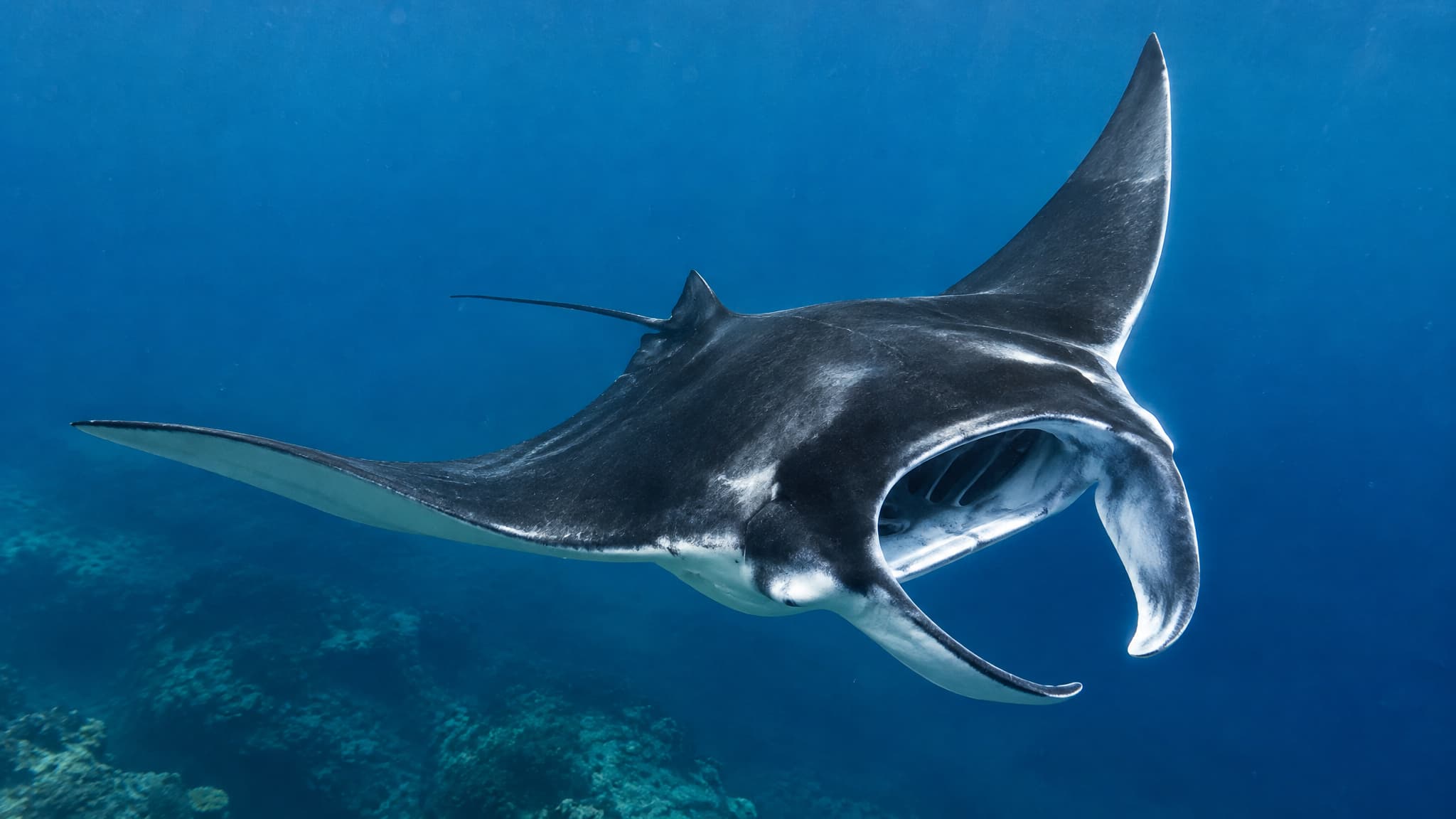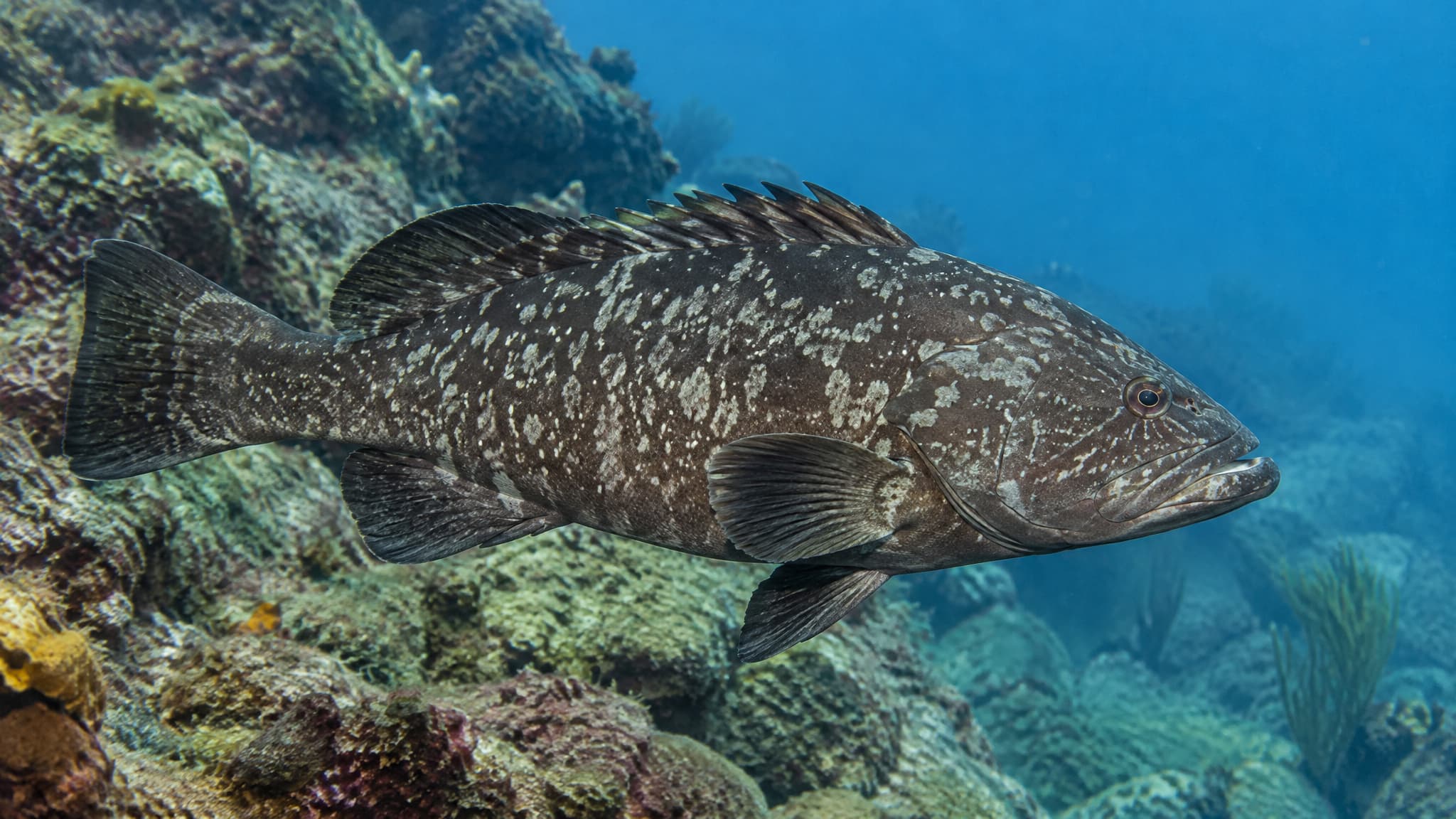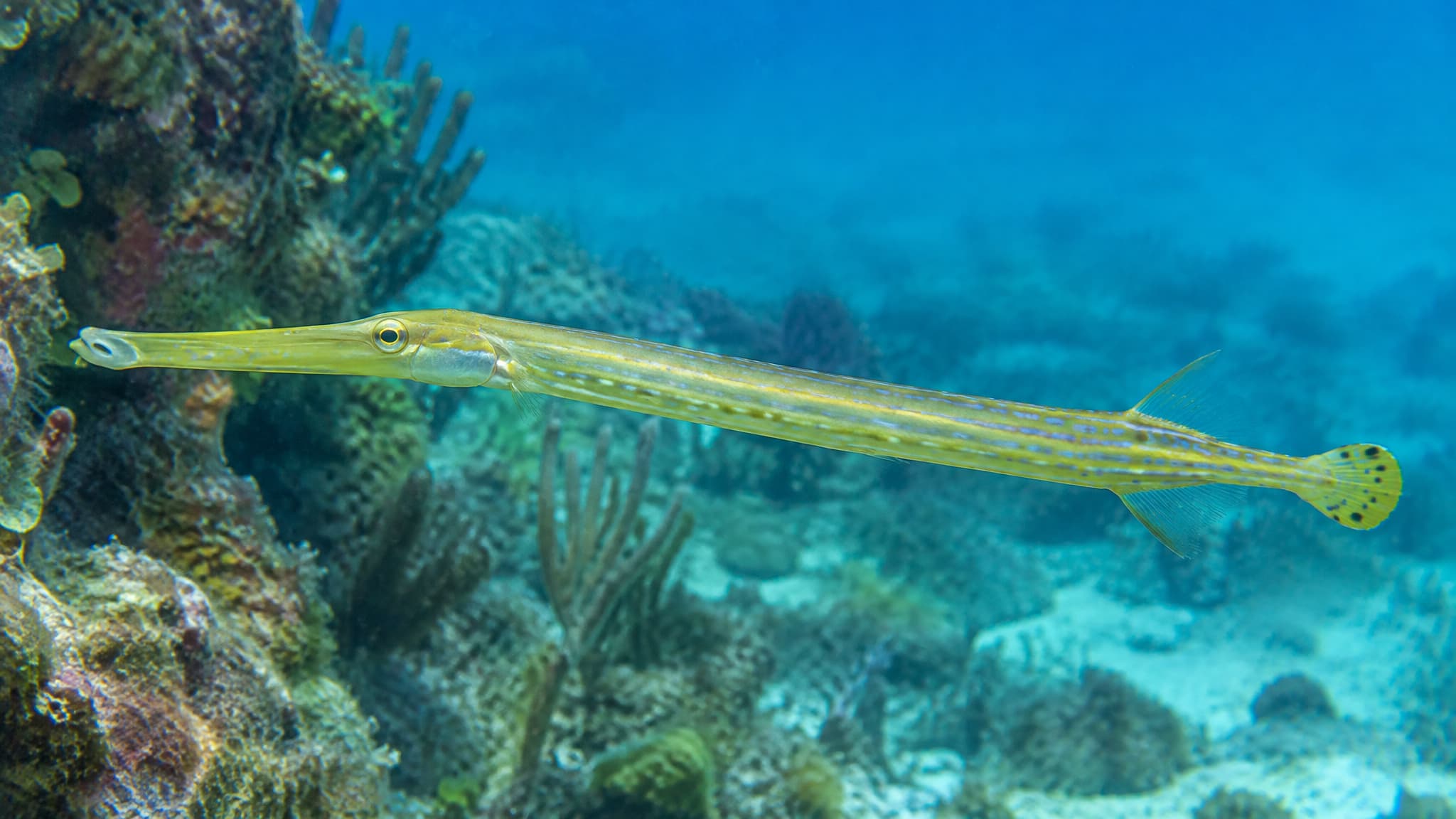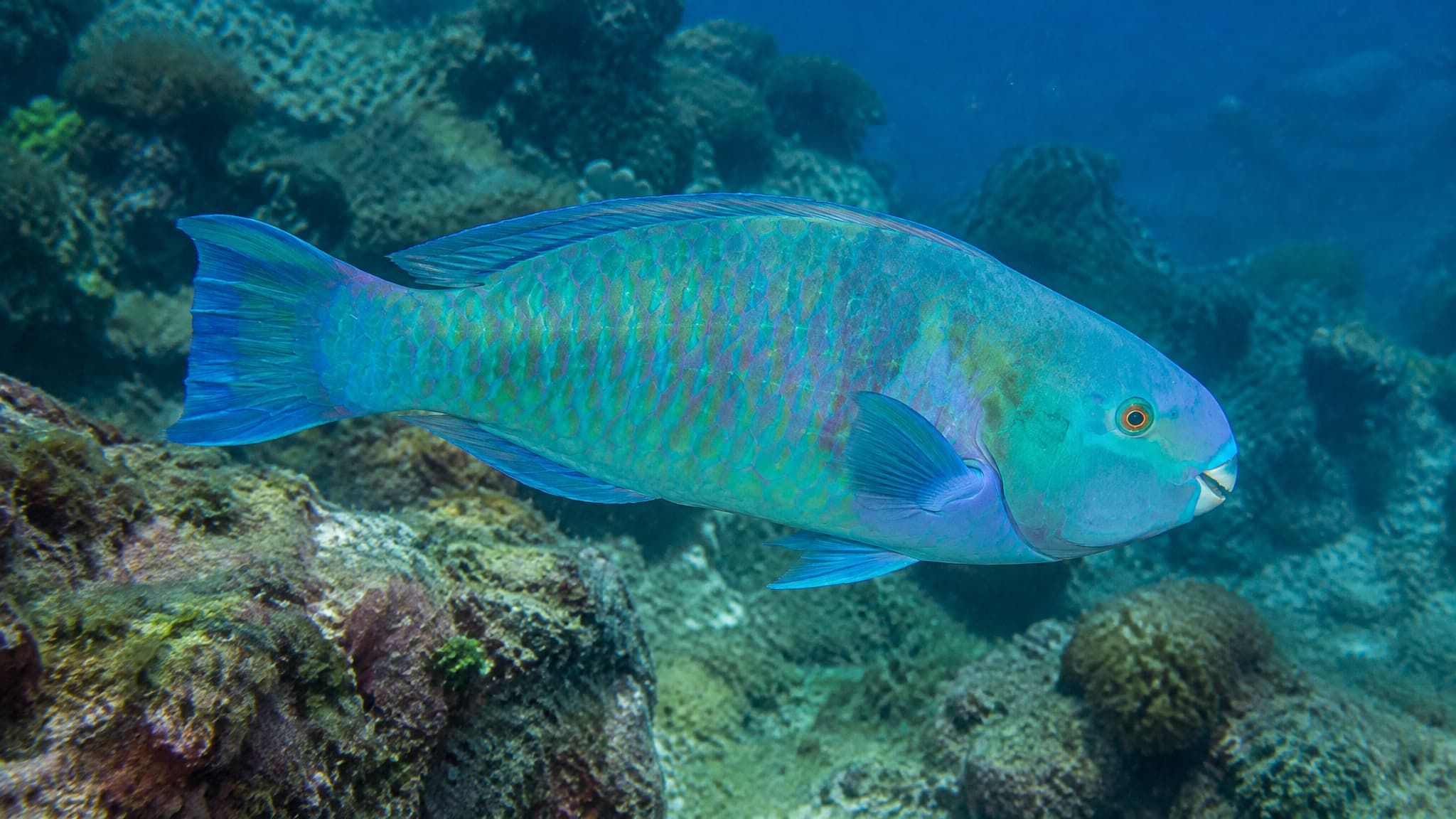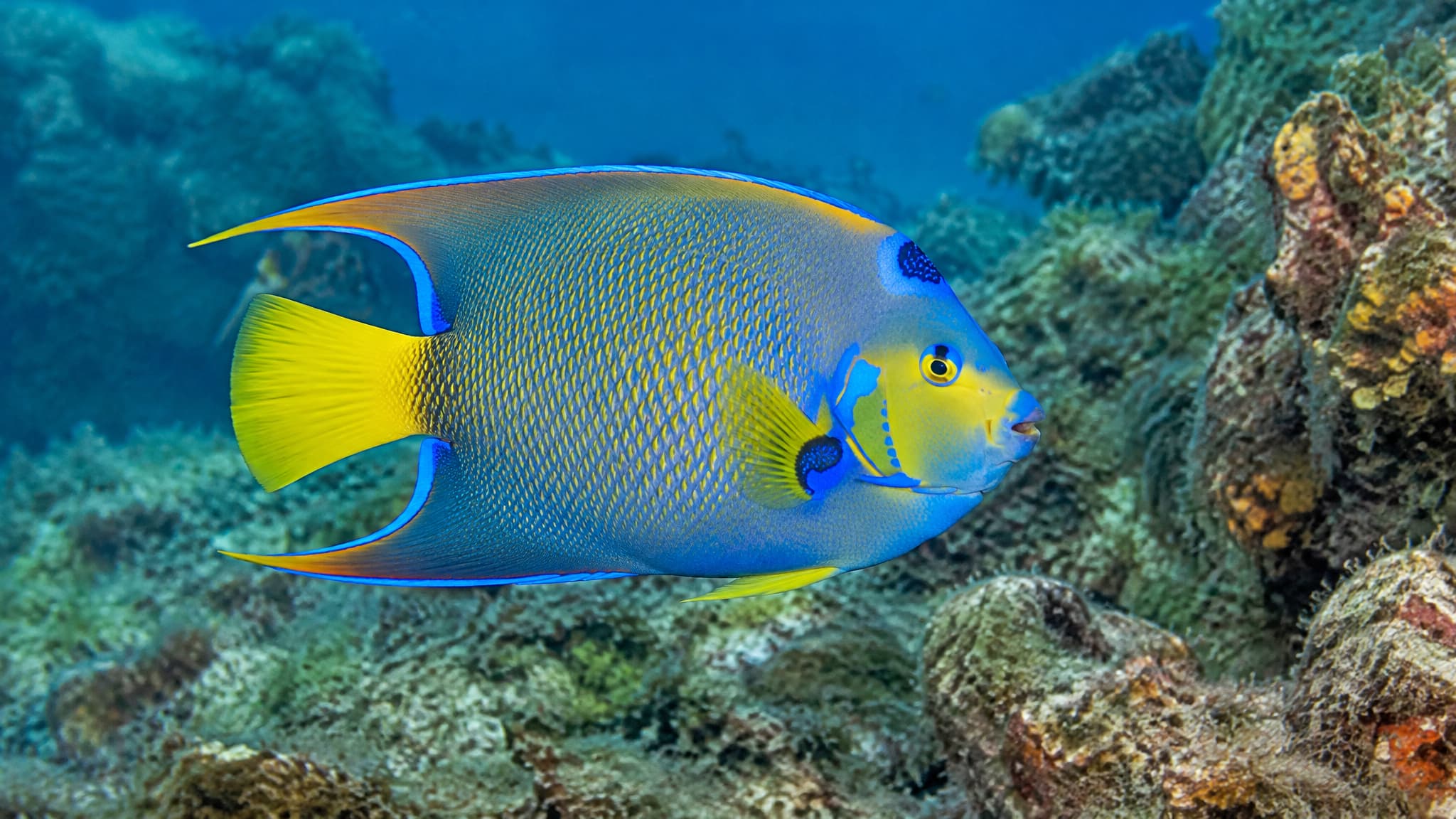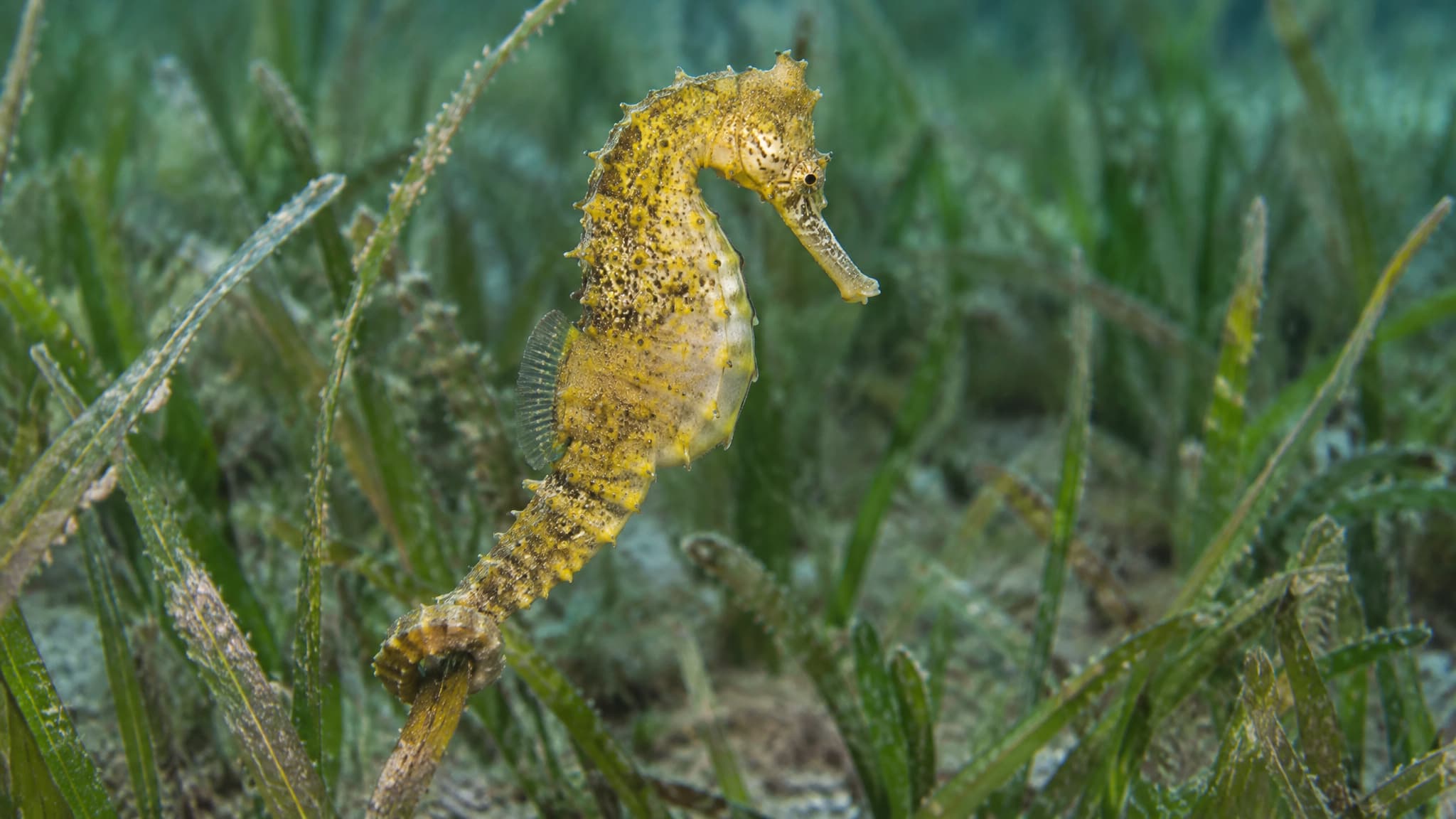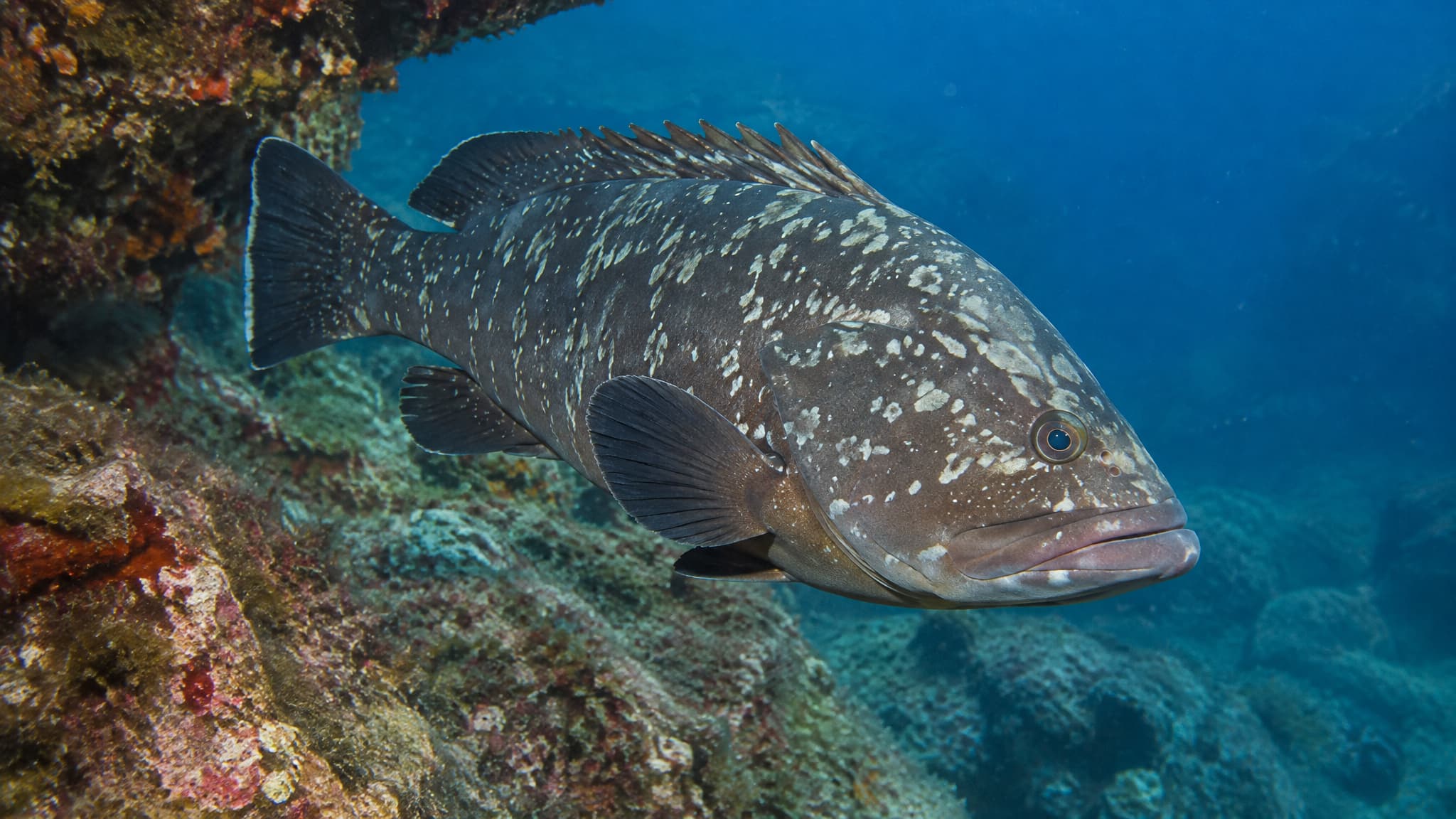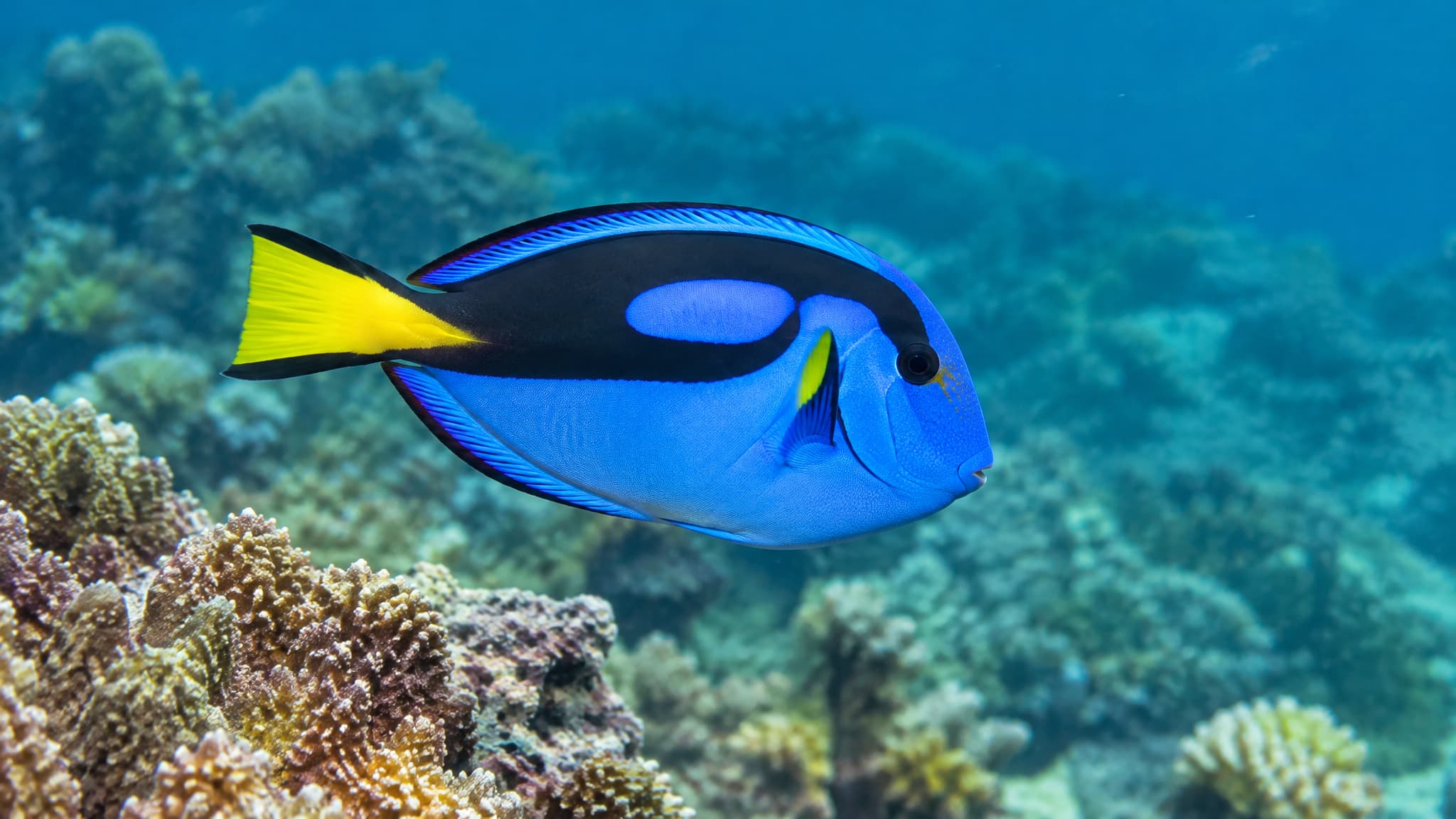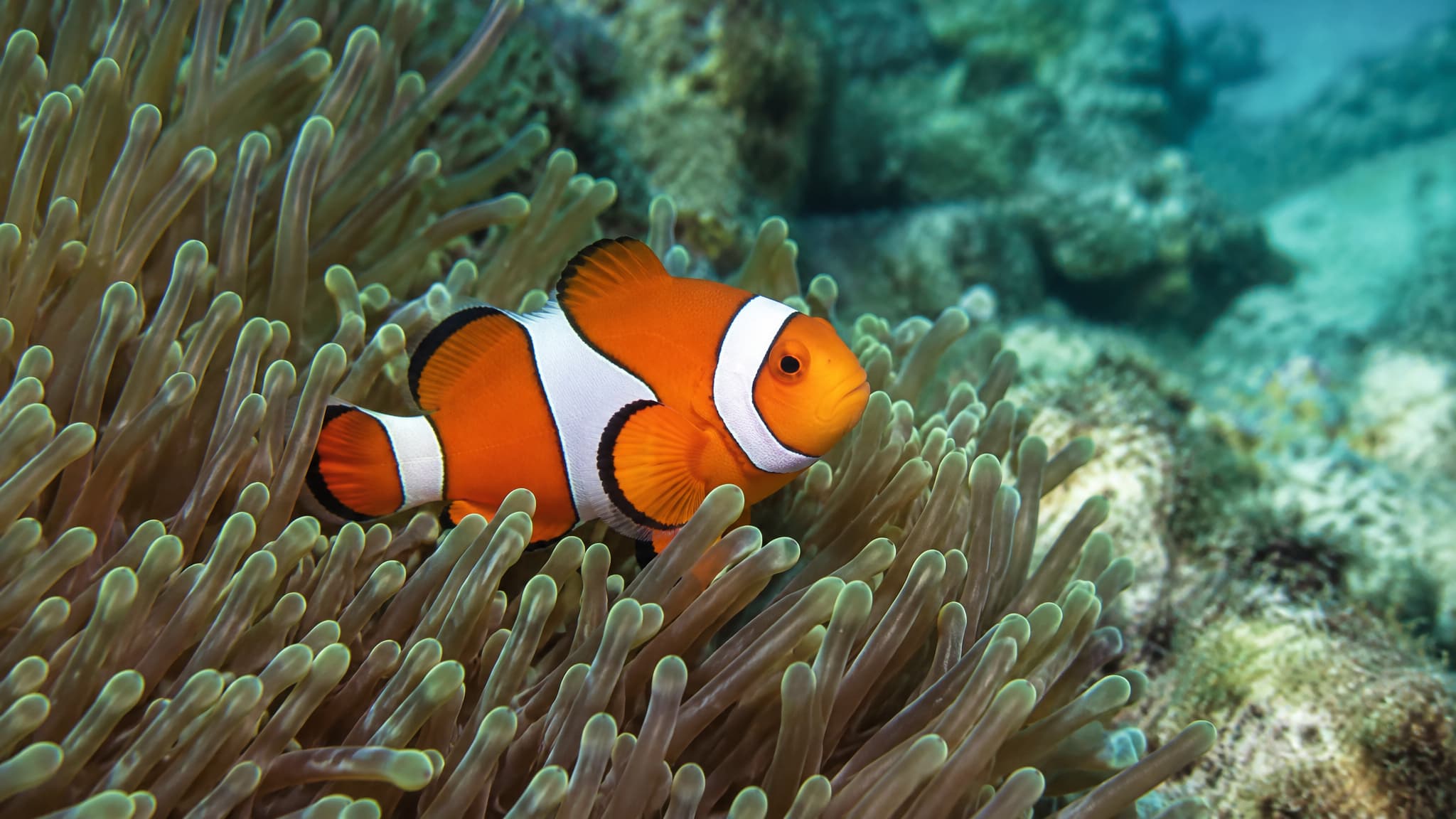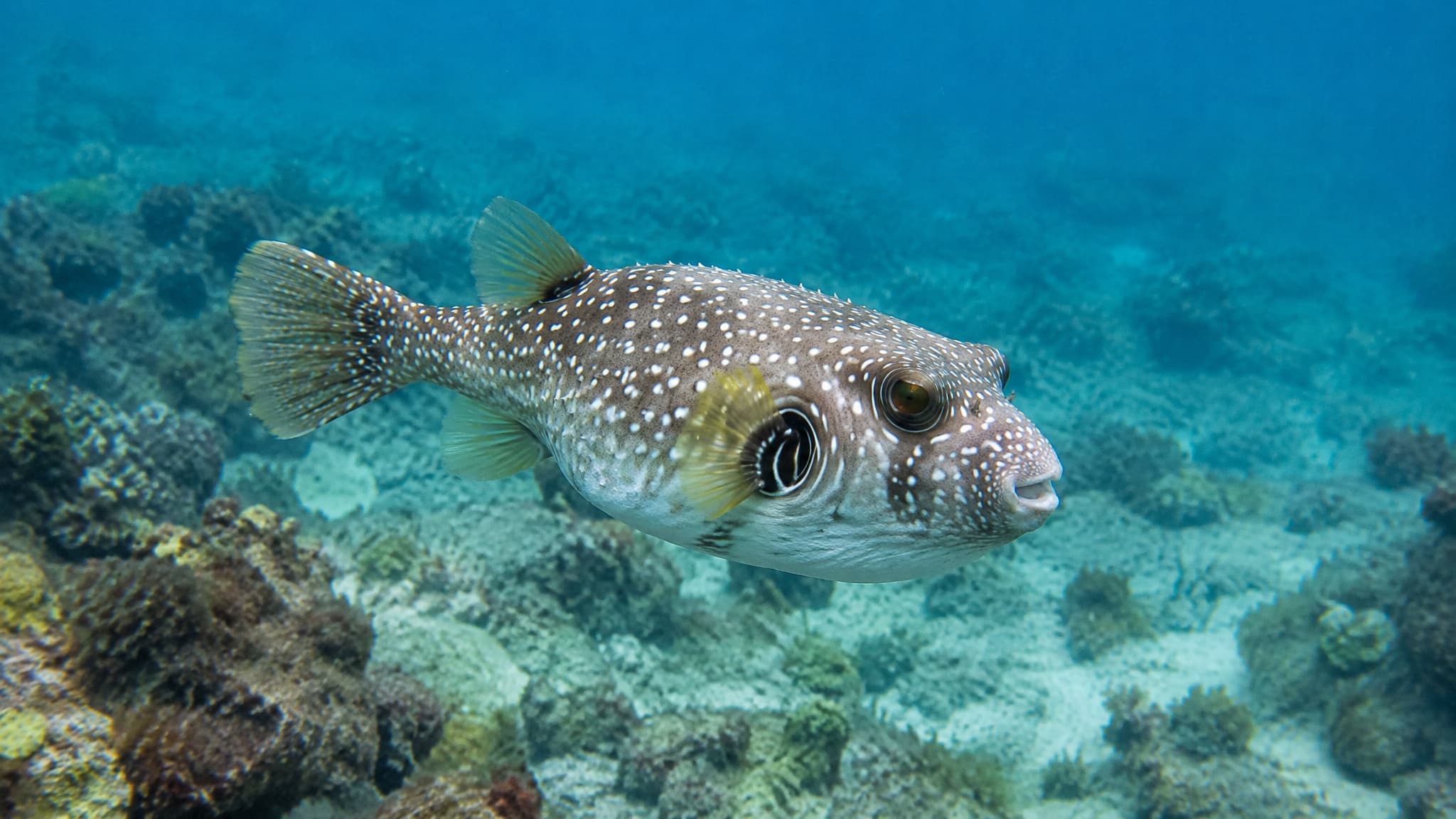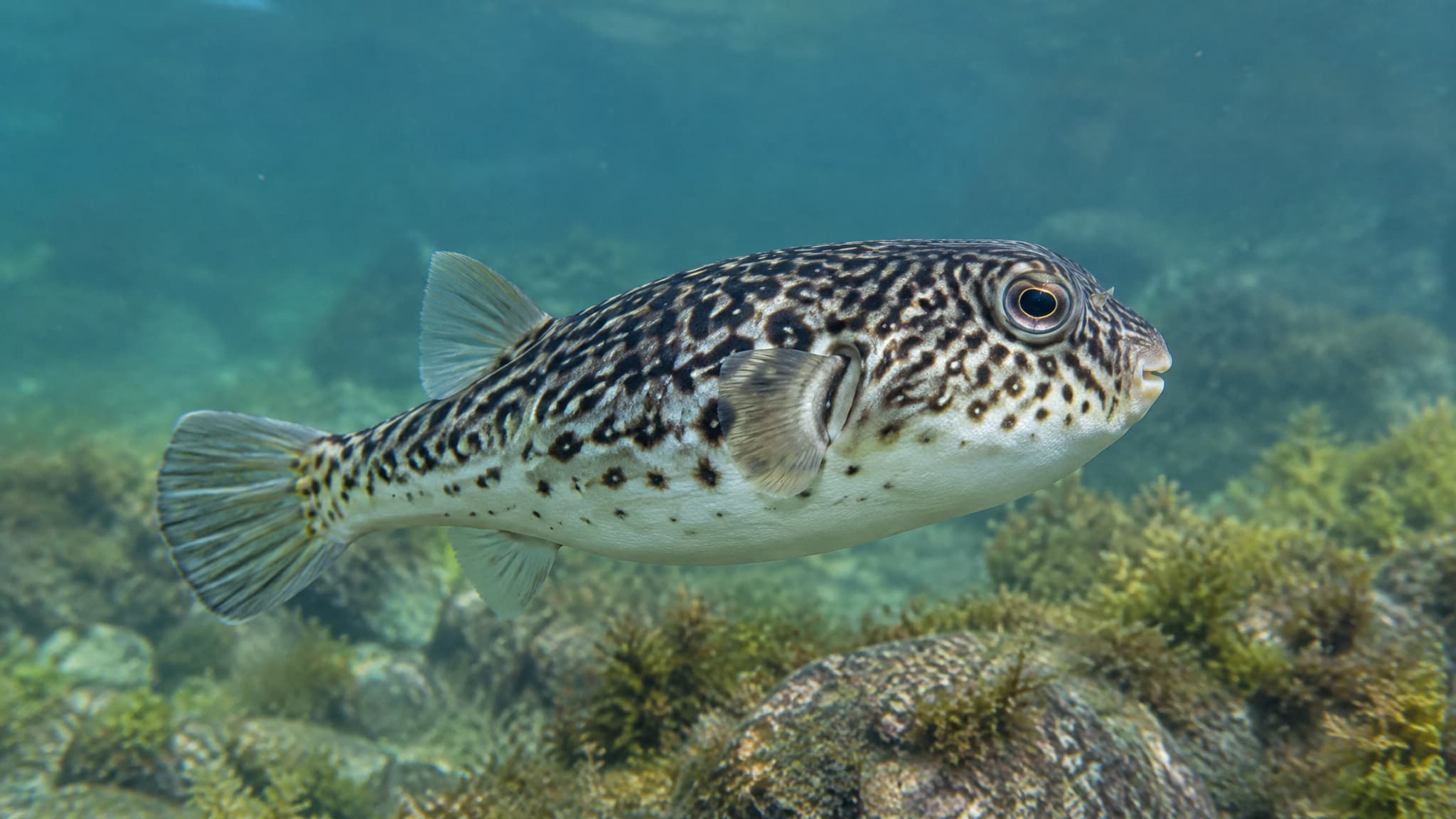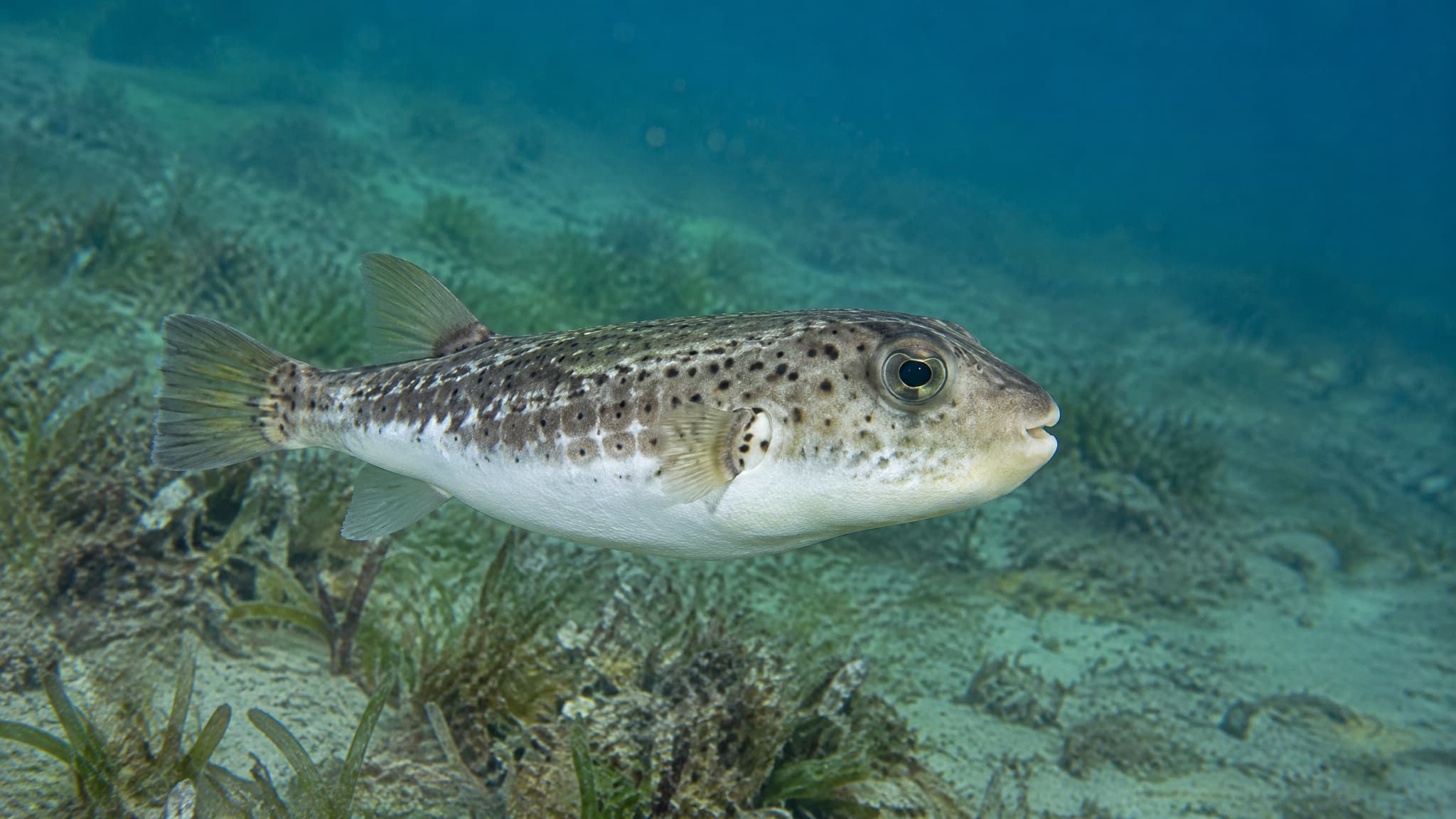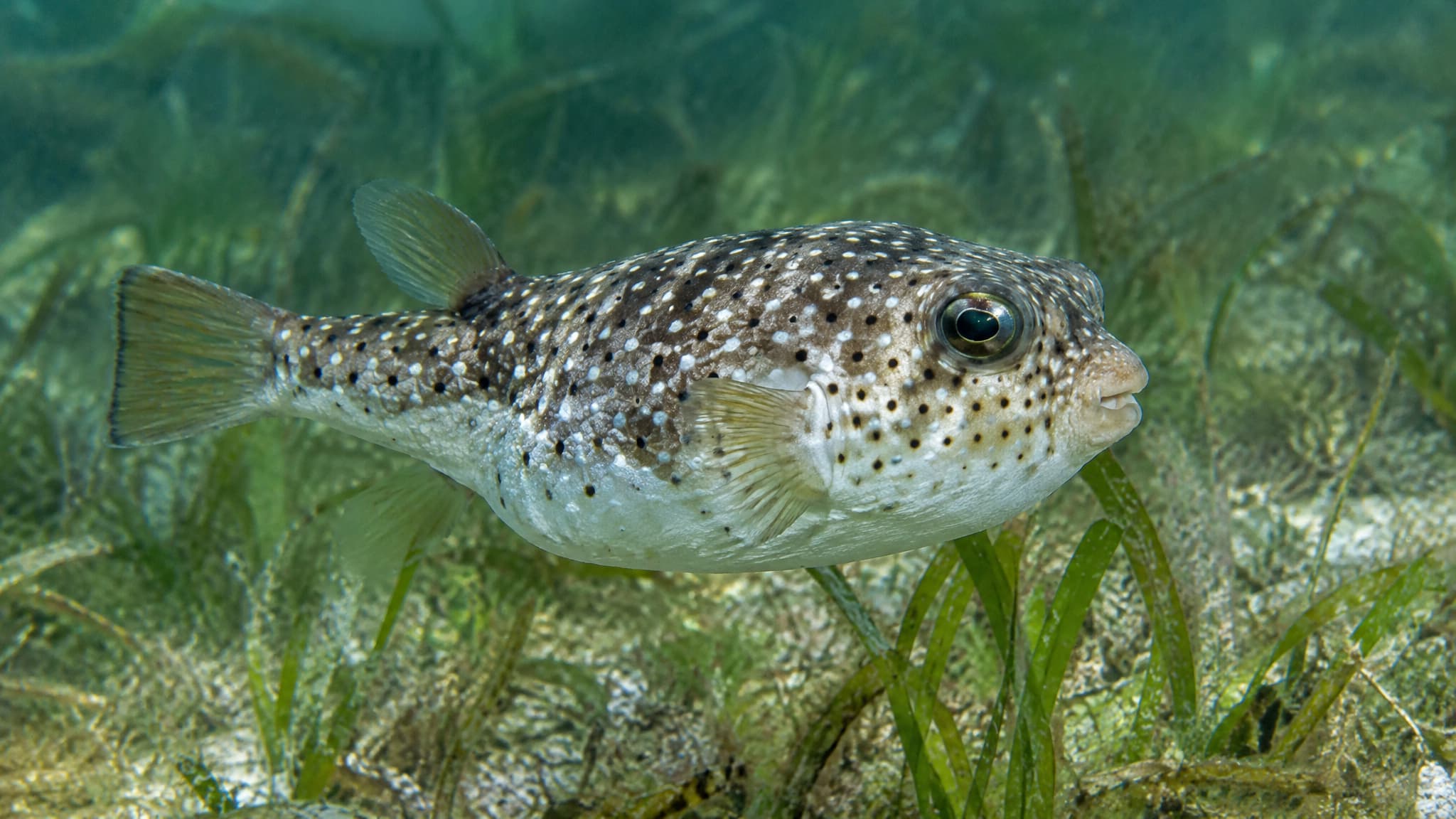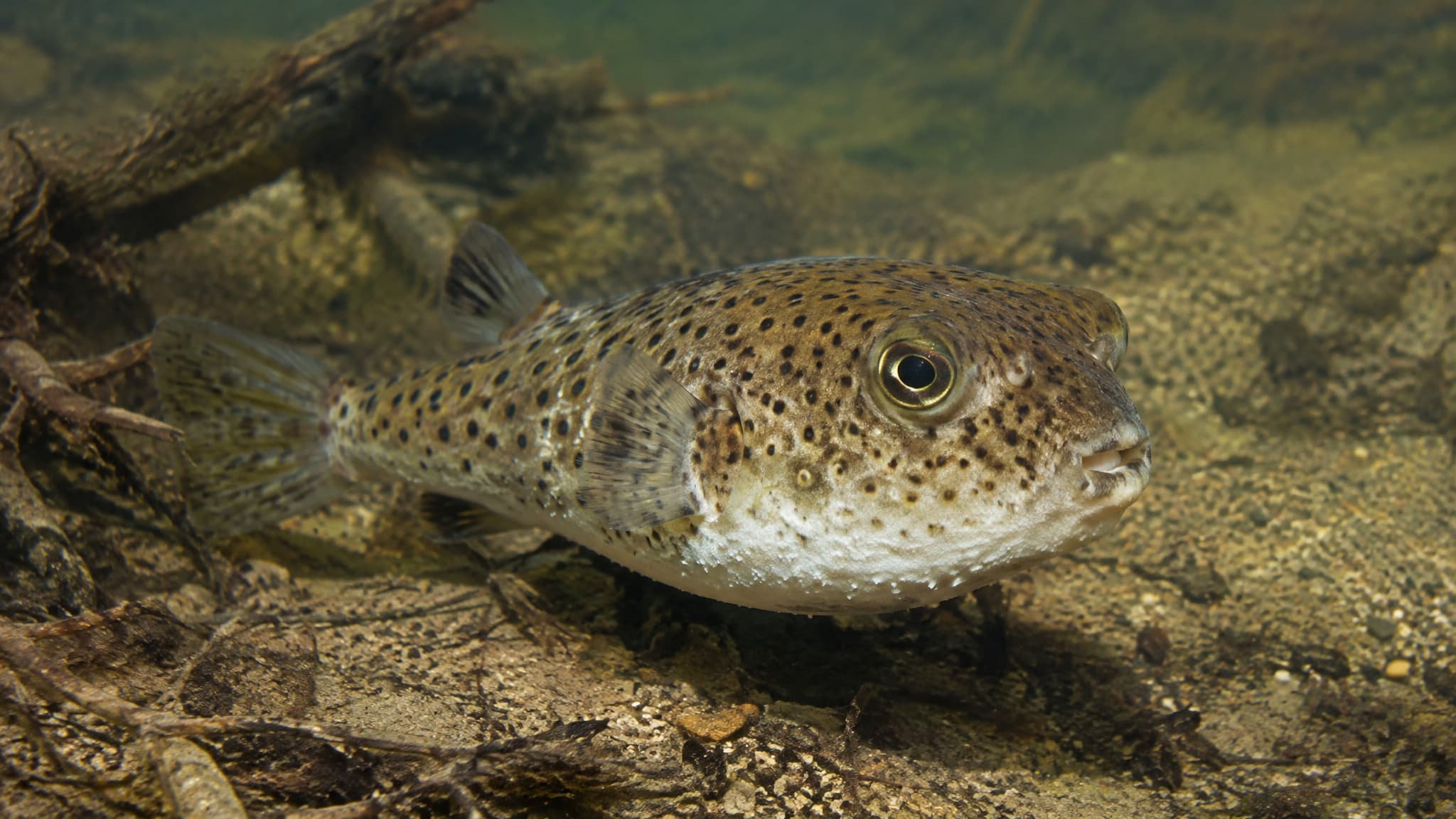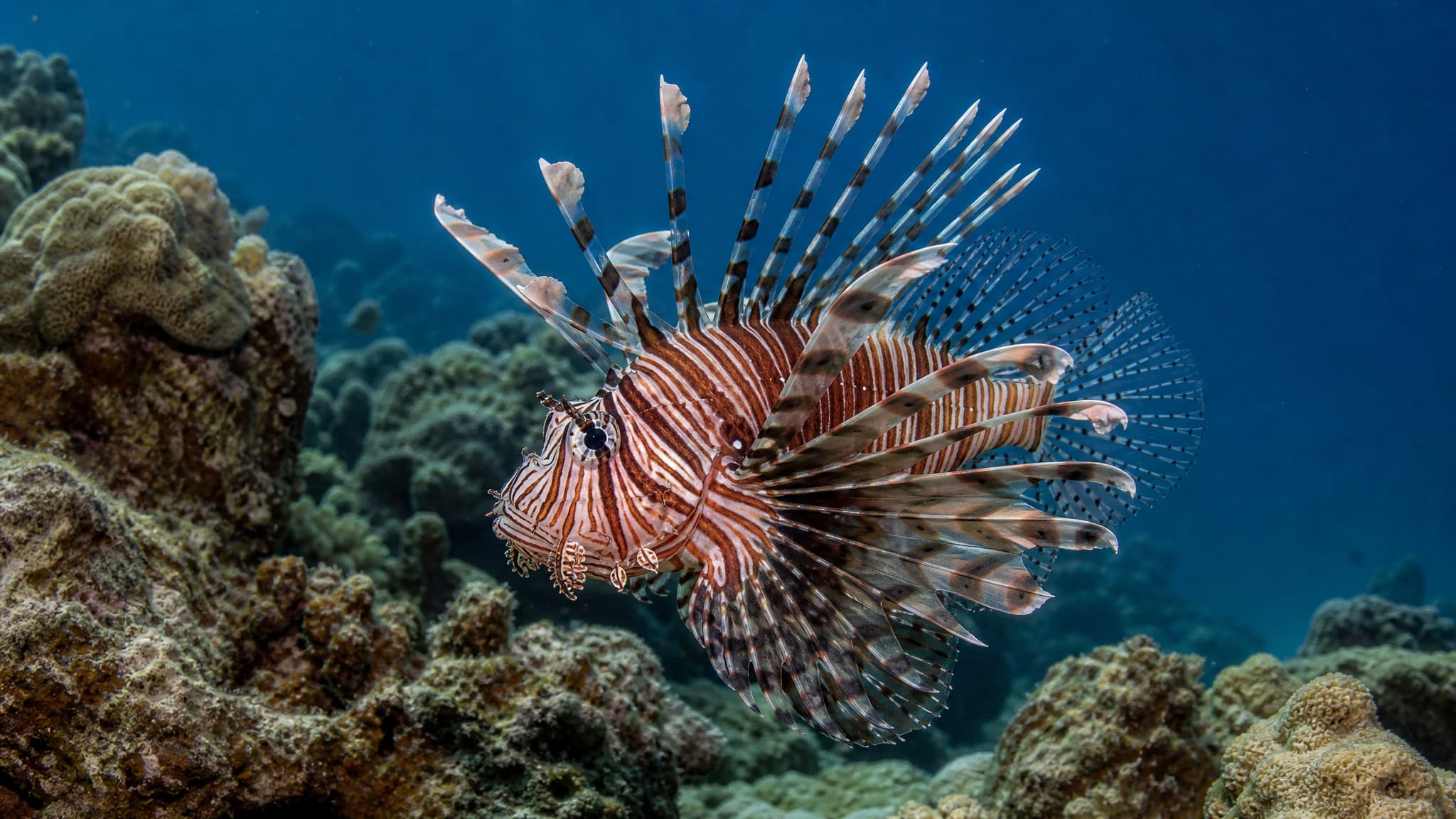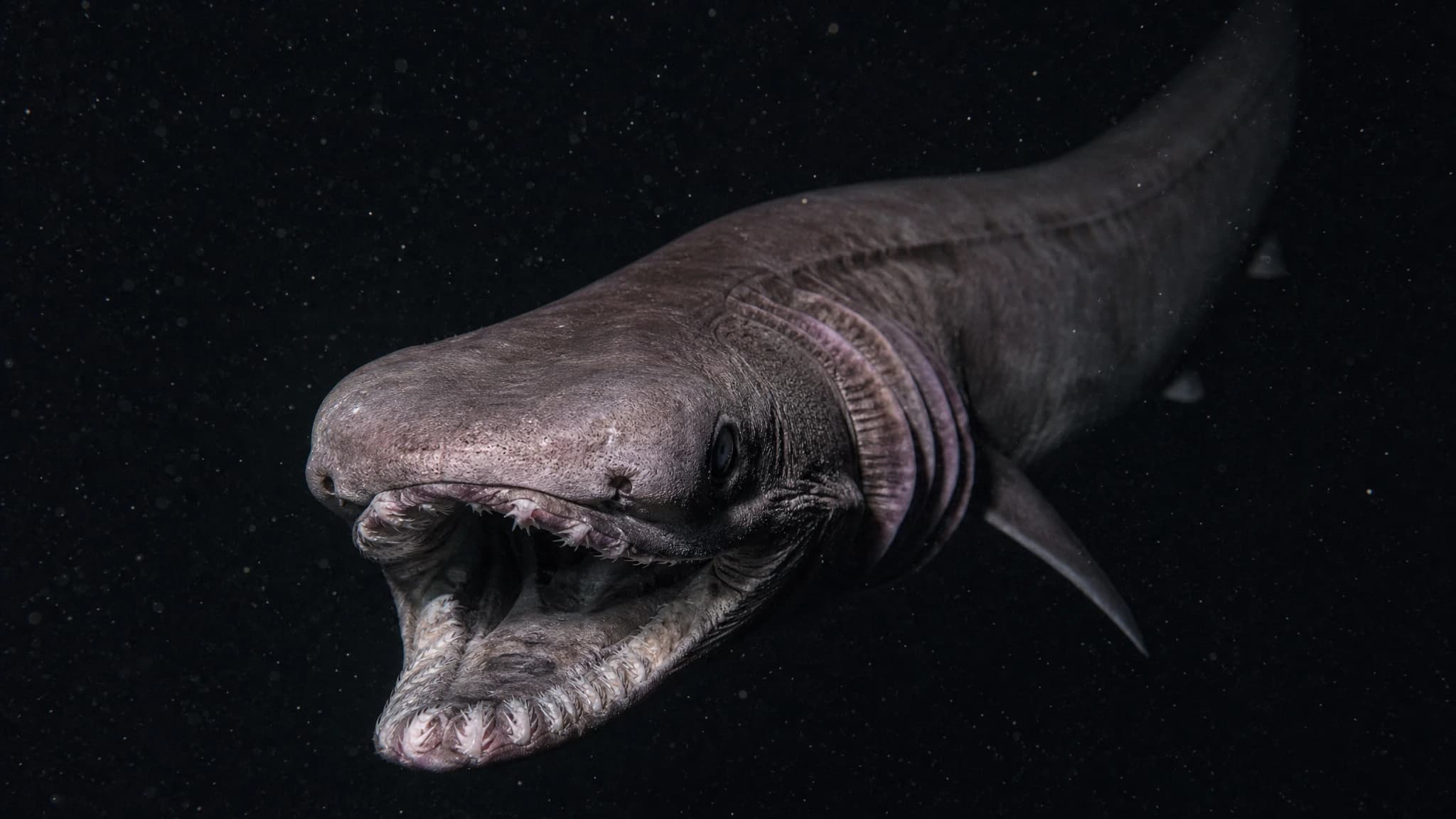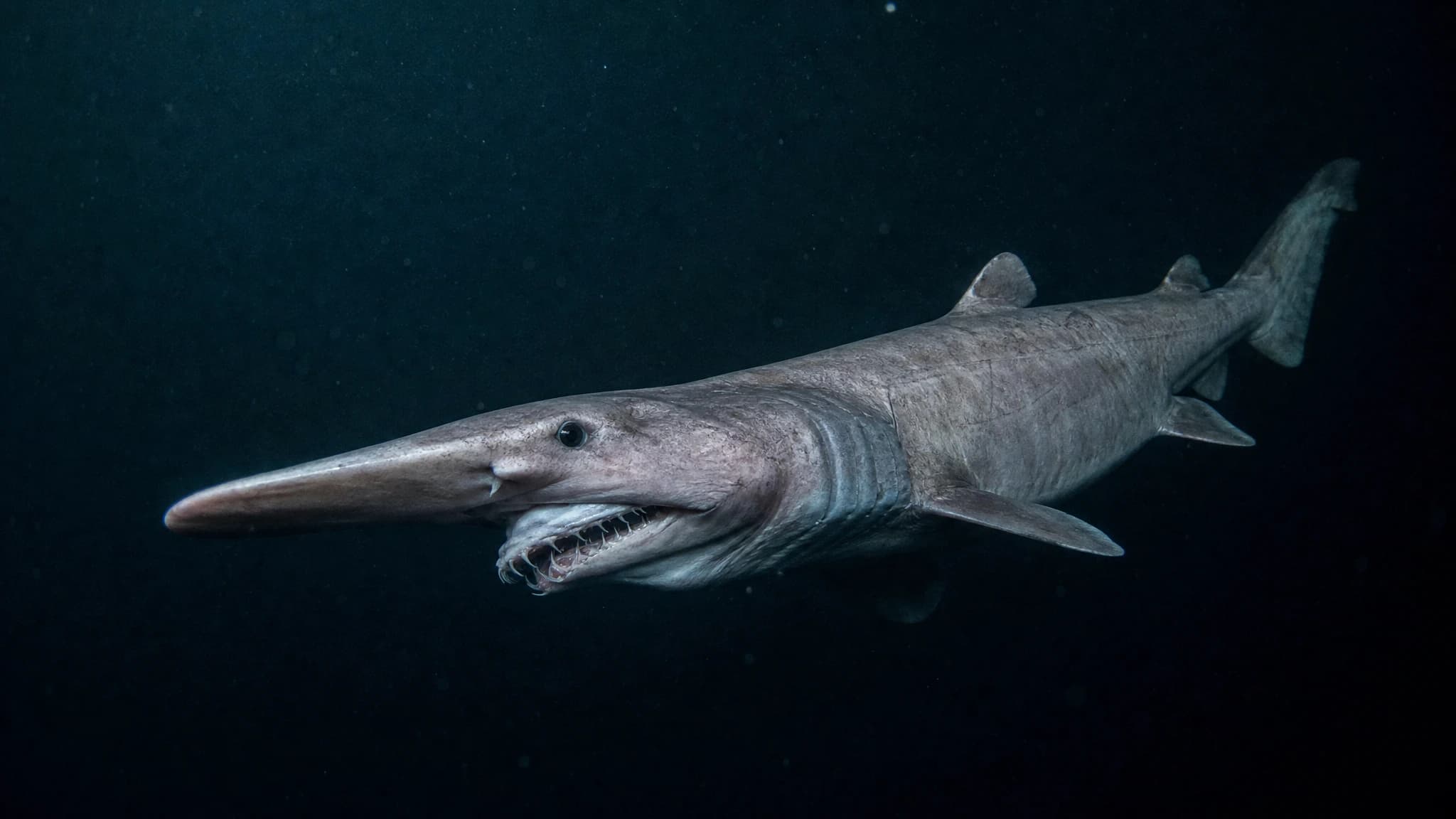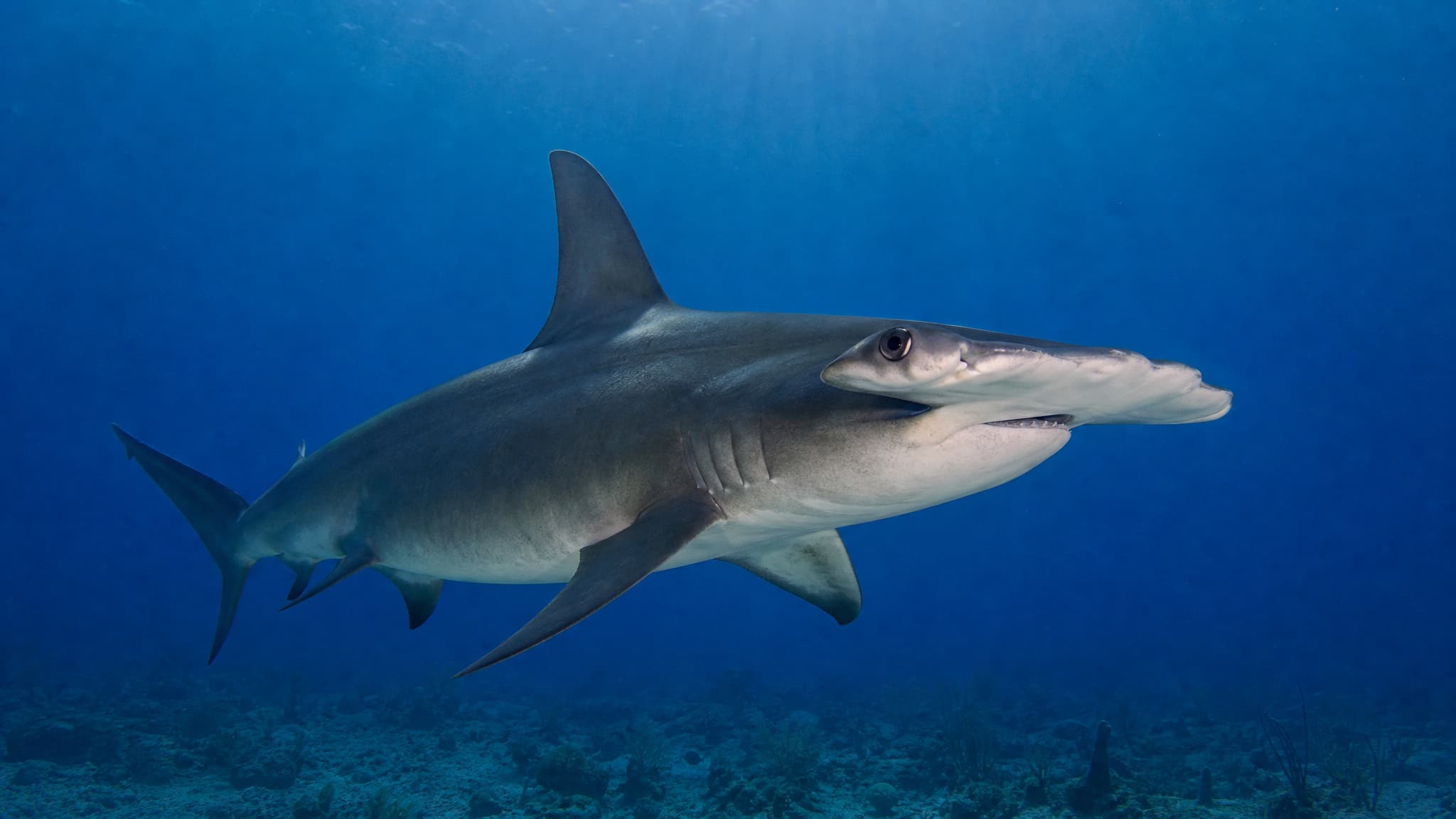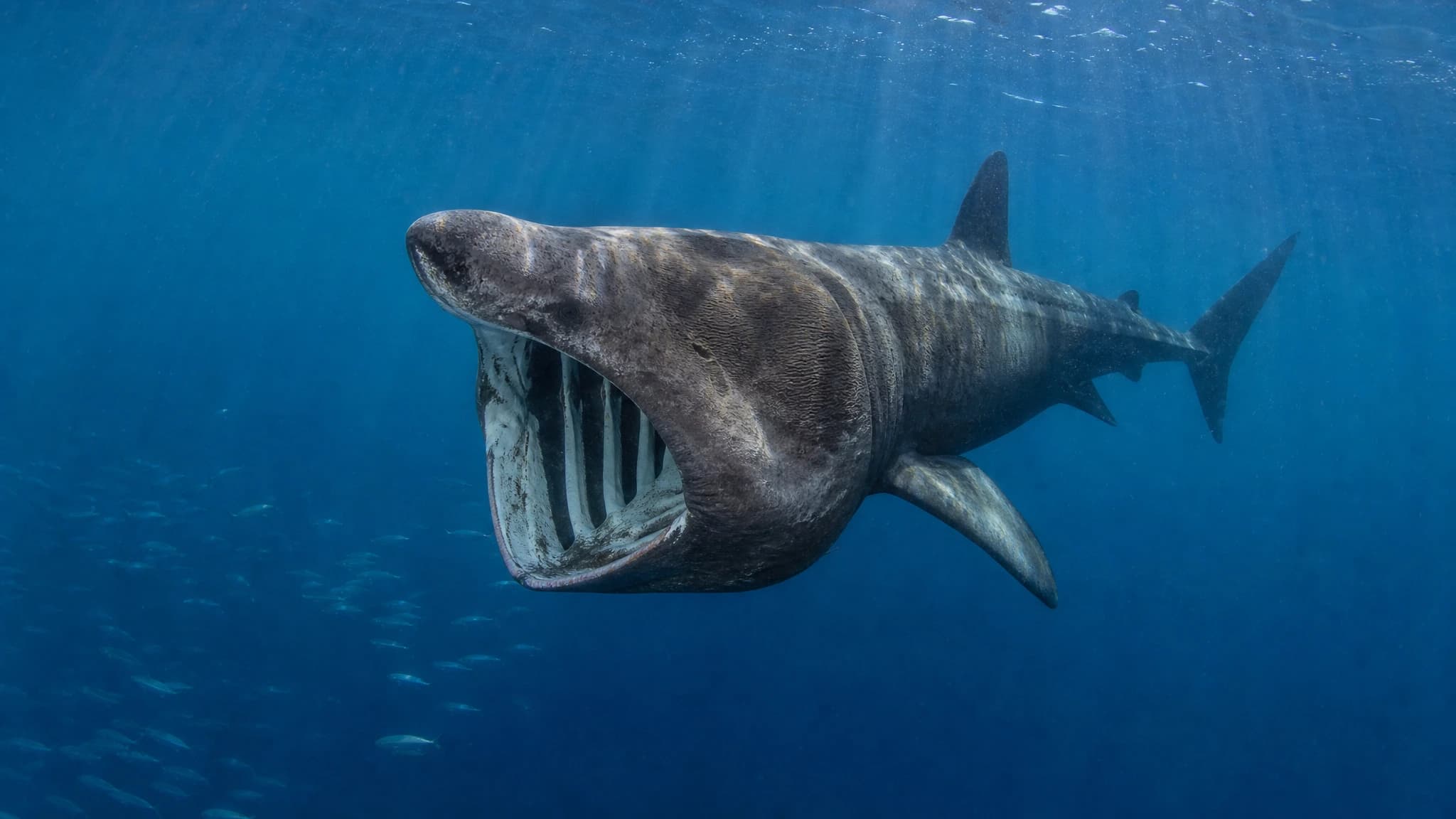
A Basking Shark glides through deep blue waters with its enormous mouth wide open, filtering plankton as sunlight streams down from the surface. Its massive body and distinctive gill structures are beautifully revealed in this underwater encounter.
Wildlife category

Fish

Aquatic vertebrates with gills

Published animals

104

Category

Fish

Slug

fish

Animals In This Category

Browse featured species, habitat clues, and discovery paths for the Fish category.

104 animals found

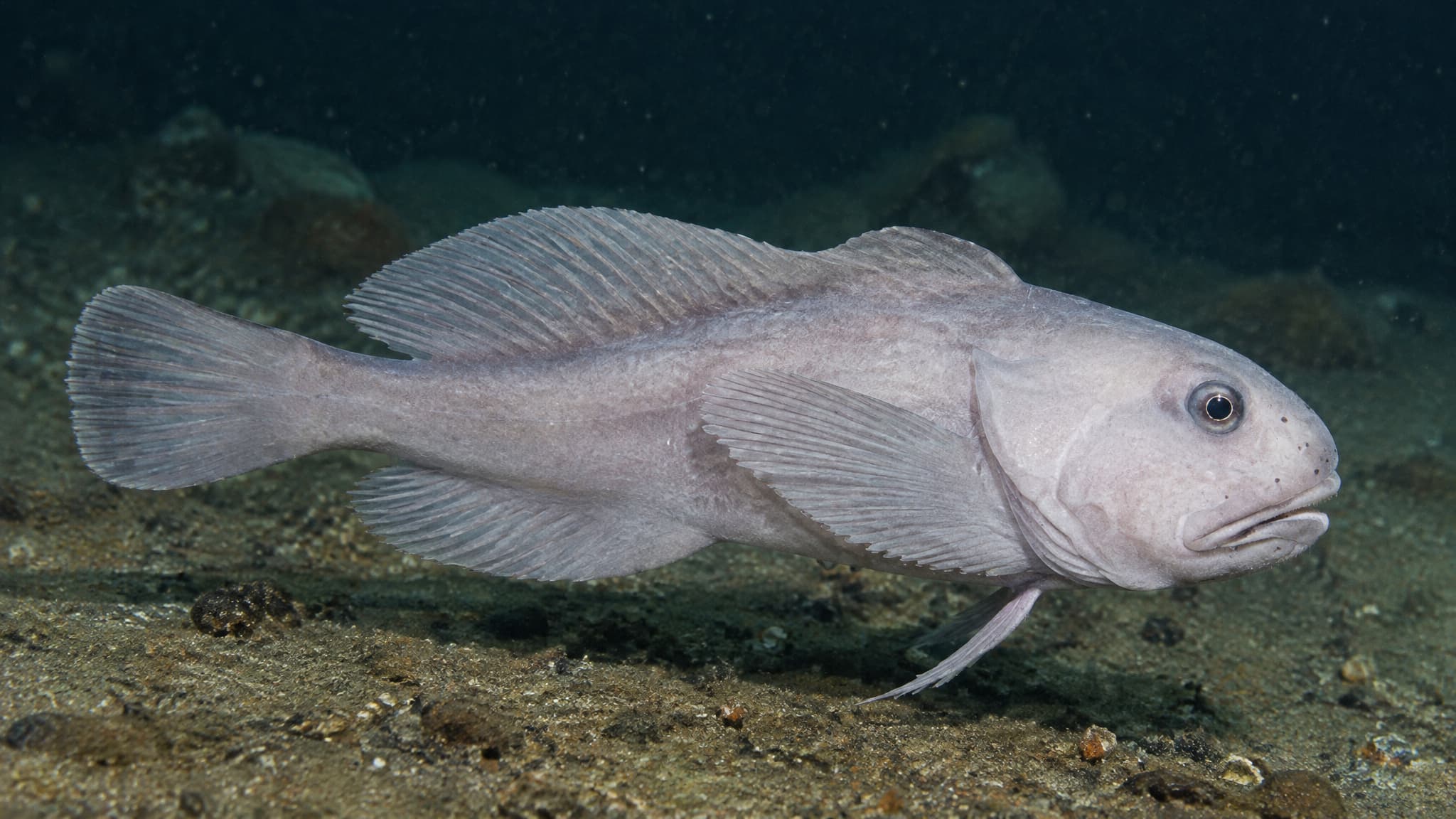
Smooth-head blobfish
Fish

Smooth-head blobfish

Psychrolutes marcidus

The smooth-head blobfish (Psychrolutes marcidus) is a deep-sea fathead sculpin of the family Psychrolutidae, first described by Allan R. McCulloch in 1926 as Neophrynichthys marcidus. It has a large, globe-shaped head, a blunt snout and a broad body that tapers and flattens sideways toward the tail. Its skin is smooth, scaleless, loose and flabby, and its colour is a uniform pale brown to grey. The species name comes from the Latin marcidus, meaning withered or weak, a probable reference to that loose skin. Most individuals are under 30 cm long, and the largest recorded size is 38 cm. The species is endemic to Australia. It lives on the continental slope from off southern Queensland to off Western Australia, including the waters around Tasmania, at depths of 600 to 1,200 m. At those depths the water pressure is 60 to 120 times that at sea level. Instead of a gas-filled swim bladder, the blobfish relies on a mostly gelatinous body with a density slightly lower than that of water, and it has relatively little muscle. This lets it hover just above the seafloor without spending energy on swimming. In its natural setting, held together by the surrounding pressure, it looks like an ordinary tadpole-shaped fish. When it is hauled to the surface, the rapid drop in pressure damages its tissues and it collapses into the drooping pink blob seen in famous photographs. The blobfish is a sit-and-wait feeder. It rests above the bottom and swallows edible matter that drifts in front of it, mostly deep-sea crustaceans such as crabs, along with other invertebrates such as sea pens. Little is known about its reproduction or lifespan. For blobfishes as a group, large egg nests tended by a parent have been reported. The species has not been evaluated by the IUCN. It is occasionally taken as bycatch in commercial trawls, and its fishing vulnerability is rated low. In 2013 the Ugly Animal Preservation Society named it the world's ugliest fish, which made it widely known.

View Details
Bargibant's pygmy seahorse
Fish

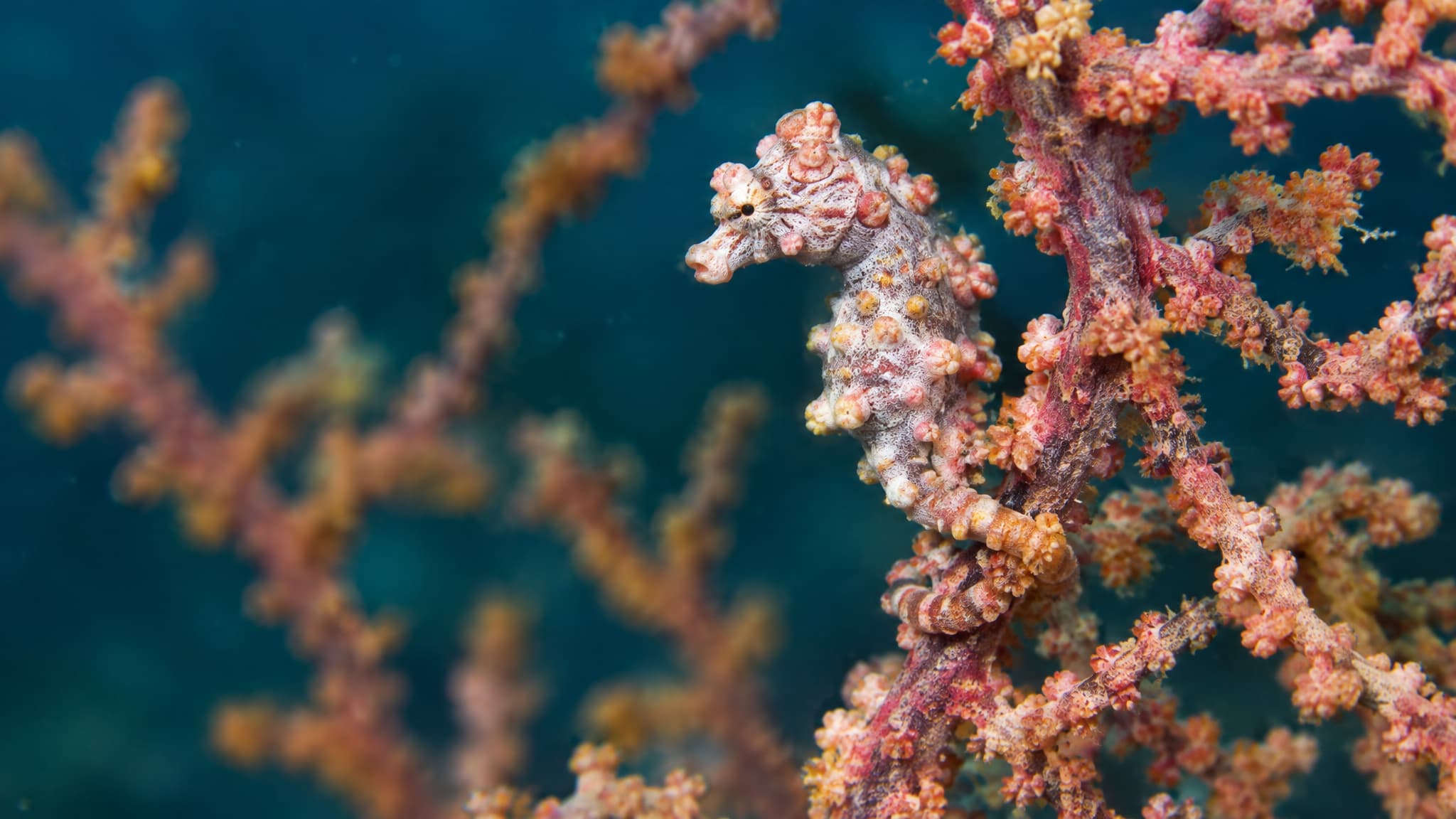
Bargibant's pygmy seahorse

Hippocampus bargibanti

The Bargibant's pygmy seahorse (Hippocampus bargibanti) is one of the smallest seahorses in the world and the first pygmy seahorse to be described, named by Whitley in 1970. It usually measures under 2 cm and reaches at most about 2.4 cm, maturing at around 1.3 cm. Its fleshy head and body carry large, rounded tubercles, it has a very short snout and a long prehensile tail. Two colour forms are known: pale grey or purple with pink to red tubercles, and yellow with orange tubercles. The species lives in the tropical Indo-West Pacific, from southern Japan through the Philippines and Indonesia to northern Australia, New Caledonia and Vanuatu. It is found on reefs and slopes at about 10 to 40 m, and breeding adults mostly occur deeper than 20 m. Adults live only on gorgonian sea fans of the genus Muricella, gripping the stem with the tail. The tubercles imitate the host's polyps so closely that the species was first noticed only after a gorgonian collected for study was examined in the laboratory. Pygmy seahorses are usually seen in pairs or in small groups of pairs, and up to 28 pairs have been recorded on a single gorgonian. The relationship with the sea fan provides shelter and does not harm the host. Little is known about the diet; sources describe small crustaceans such as copepods and amphipods as the likely prey, possibly picked from among the host's polyps. Breeding takes place all year. The pair is thought to be monogamous, and, as in other seahorses, the male carries the eggs in a brood pouch for about two weeks before giving birth. Broods of about 12 to 65 young have been reported, each only about 2 mm long, and one birth observed in the wild released 34 young. The newborns are dark miniatures of the adults and are independent from birth. Young fish may settle on several kinds of hosts, but breeding adults prefer red Muricella fans. Its lifespan has not been documented. The IUCN Red List assesses the species as Least Concern (assessment of December 2023). Its total dependence on a few gorgonian species makes it vulnerable to coral reef degradation, climate change and destructive fishing. Like all seahorses, it is listed in CITES Appendix II, and Australian populations are legally protected. It has proved very hard to keep in captivity, where many specimens and their host corals have died.

View Details
Atlantic mudskipper
Fish

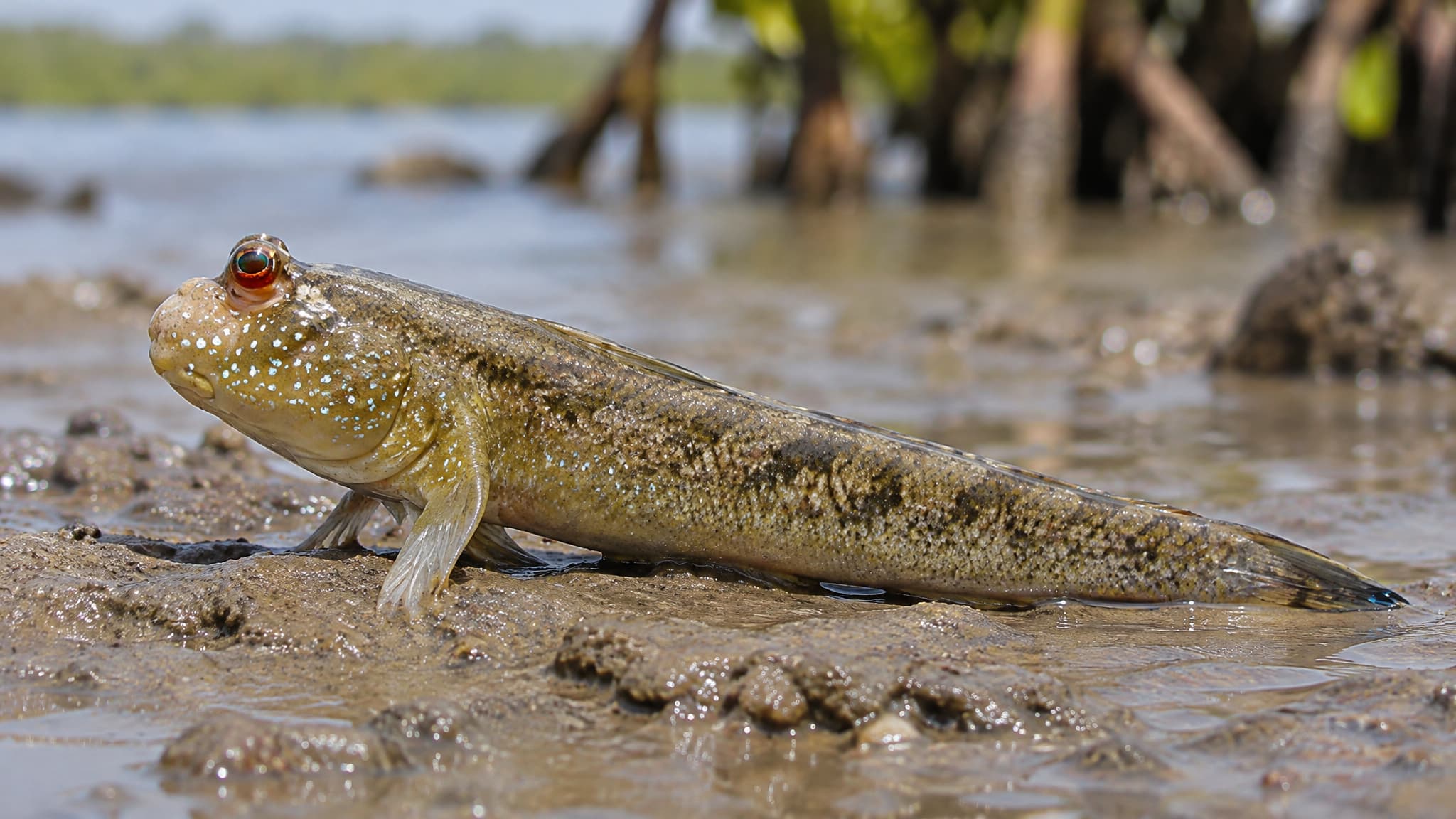
Atlantic mudskipper

Periophthalmus barbarus

The Atlantic mudskipper (Periophthalmus barbarus) is an amphibious goby from West Africa that spends much of its day out of the water on tidal mud. Its large head carries bulging eyes set high on top, which can move independently and be pulled down into their sockets to stay moist, since the fish has no eyelids. Muscular pectoral fins work like crutches on land, and the pelvic fins form a sucker that helps it grip. FishBase gives a maximum of 14.7 cm standard length and 16.5 cm total length, and treats older reports of 25 cm as probable misidentifications. The species lives along the Atlantic coast of tropical West Africa, from Senegal to Angola, including most offshore islands such as Bioko, São Tomé and Príncipe, with reports from Mauritania as well. It occupies muddy shores, brackish estuaries, lagoons and mangrove swamps, and sometimes enters fresh water, but always close to the coast. It tolerates wide swings in temperature and salinity. Out of the water it breathes partly through its moist skin and keeps a supply of water in its gill chambers. It is active by day and moves over exposed flats by crawling or by skipping with a flick of its tail. Adults hunt mainly crabs, insects and other small animals on the mud surface, and also take worms and small fish; FishBase also records white mangrove in the diet. Prey is drawn into the mouth with a pulse of water held in the mouth, sometimes called a hydrodynamic tongue. Individuals are strongly territorial and may raise low mud walls around their patch. Breeding takes place in burrows, which males dig up to 1 m deep in the mud; mating and care of the brood happen inside them. Spawning can occur through the year, with a peak from about February to May. Females lay thousands of eggs, but few young survive predation. Bioparc Fuengirola gives a lifespan of 5 to 8 years. The Atlantic mudskipper is a common predator of small invertebrates on mangrove mudflats, and because it lives in close contact with coastal sediments it is used as a bio-indicator of pollution. People catch it for food, bait and traditional medicine, and it appears in the aquarium trade. The IUCN lists the species as Least Concern. Local threats include overfishing, pollution, fishing with cyanide or electricity, and urban development along the coast.

View Details
European eel
Fish

European eel

Anguilla anguilla

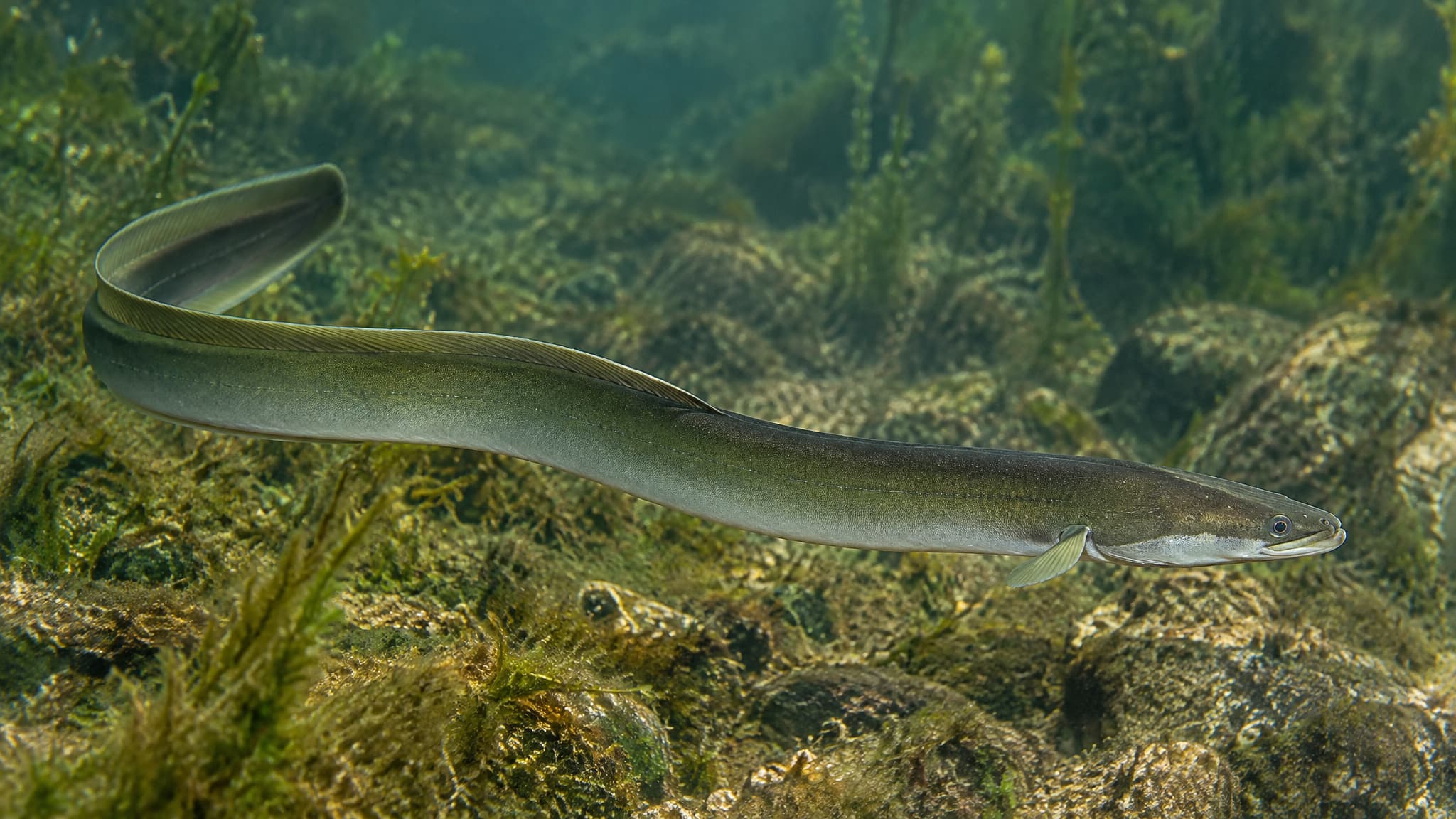
The European eel (Anguilla anguilla) is a long, snake-like fish of the freshwater eel family Anguillidae. Its body is slender and slimy, with a single fin running along the back, tail and belly. Yellow-phase adults usually measure 45–65 cm, rarely pass 1 m and exceptionally reach 133 cm; females grow much larger than males, and the heaviest published weight is 6.6 kg. The species lives along the Atlantic coast of Europe and North Africa, from Scandinavia and Iceland to Morocco, and in the Baltic, North, Mediterranean and Black Seas and the rivers that drain into them. It is catadromous: it grows in fresh or brackish water and returns to the sea to breed, and it occurs from the surface down to about 700 m. Inland it shelters among plants, in rock crevices and in soft mud. Eels are solitary, bottom-dwelling hunters that feed mostly at night and find prey largely by smell. They take worms, snails and other molluscs, crustaceans such as crayfish, insect larvae, carrion and fish, sometimes prey too large to swallow whole. They are also facultative air-breathers, able to take in air when needed. The life cycle is one of the most remarkable among fishes. Spawning is believed to take place in the Sargasso Sea, although it has never been observed in the wild. The leaf-shaped leptocephalus larvae drift toward Europe for about 300 days, turn into transparent glass eels at the coast, then into elvers that move upstream. After 5–20 years as brownish yellow eels they mature into silver eels with larger eyes and silvery flanks, stop feeding, swim back across the Atlantic, spawn once and die. Typical wild lifespan is 15–20 years, while some captive eels have lived more than 80 years. As both predator and prey, eels link marine and freshwater food webs; herons, cormorants, pike and larger eels eat them. The species is listed as Critically Endangered by the IUCN and on CITES Appendix II. The number of young eels reaching Europe has fallen by about 90% since the 1970s because of overfishing, dams and other barriers to migration, the swim-bladder parasite Anguillicola crassus, pollution and changes in ocean currents. It has not yet been bred through its full life cycle in captivity.

View Details
Electric eel
Fish

Electric eel

Electrophorus electricus

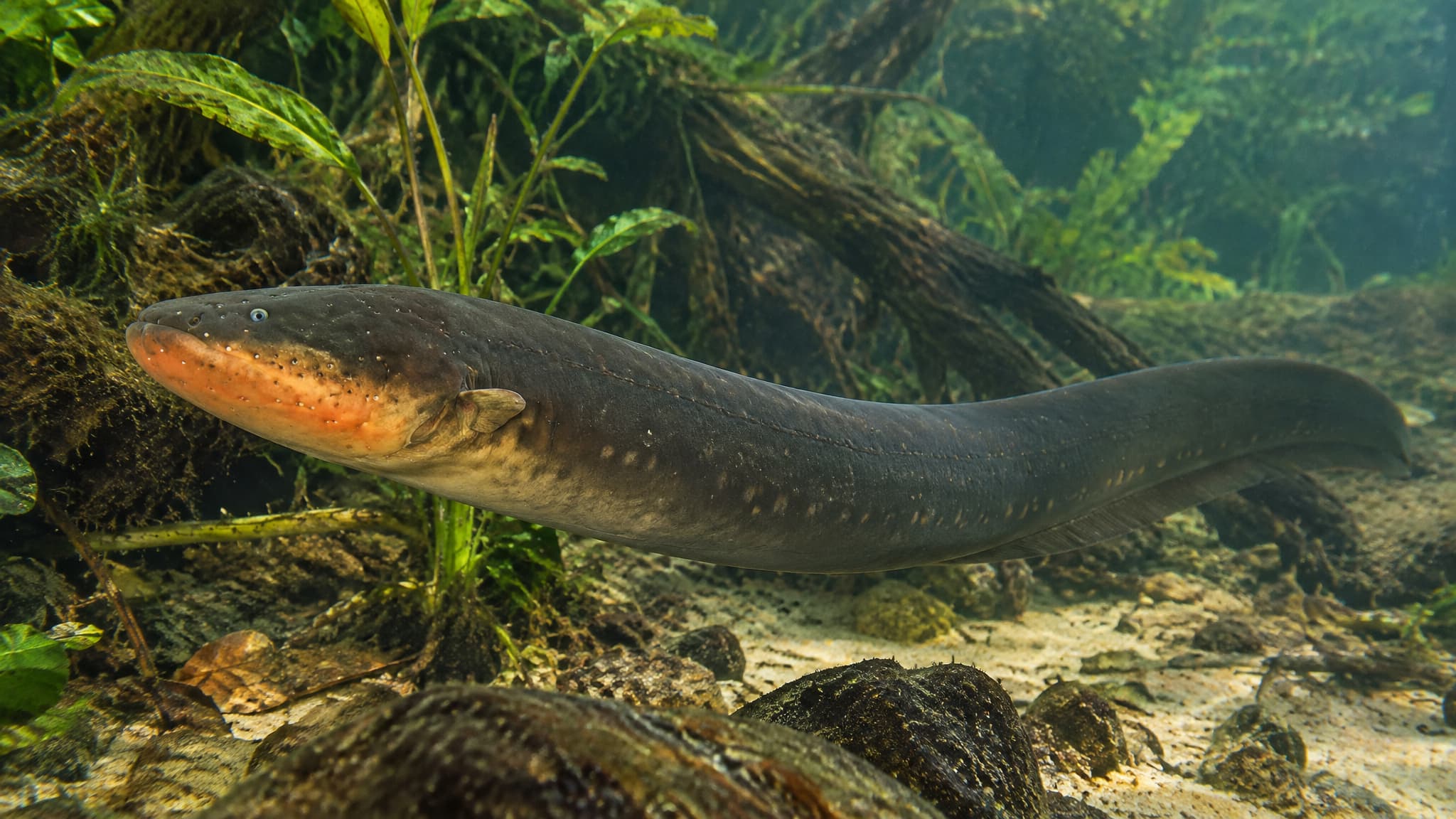
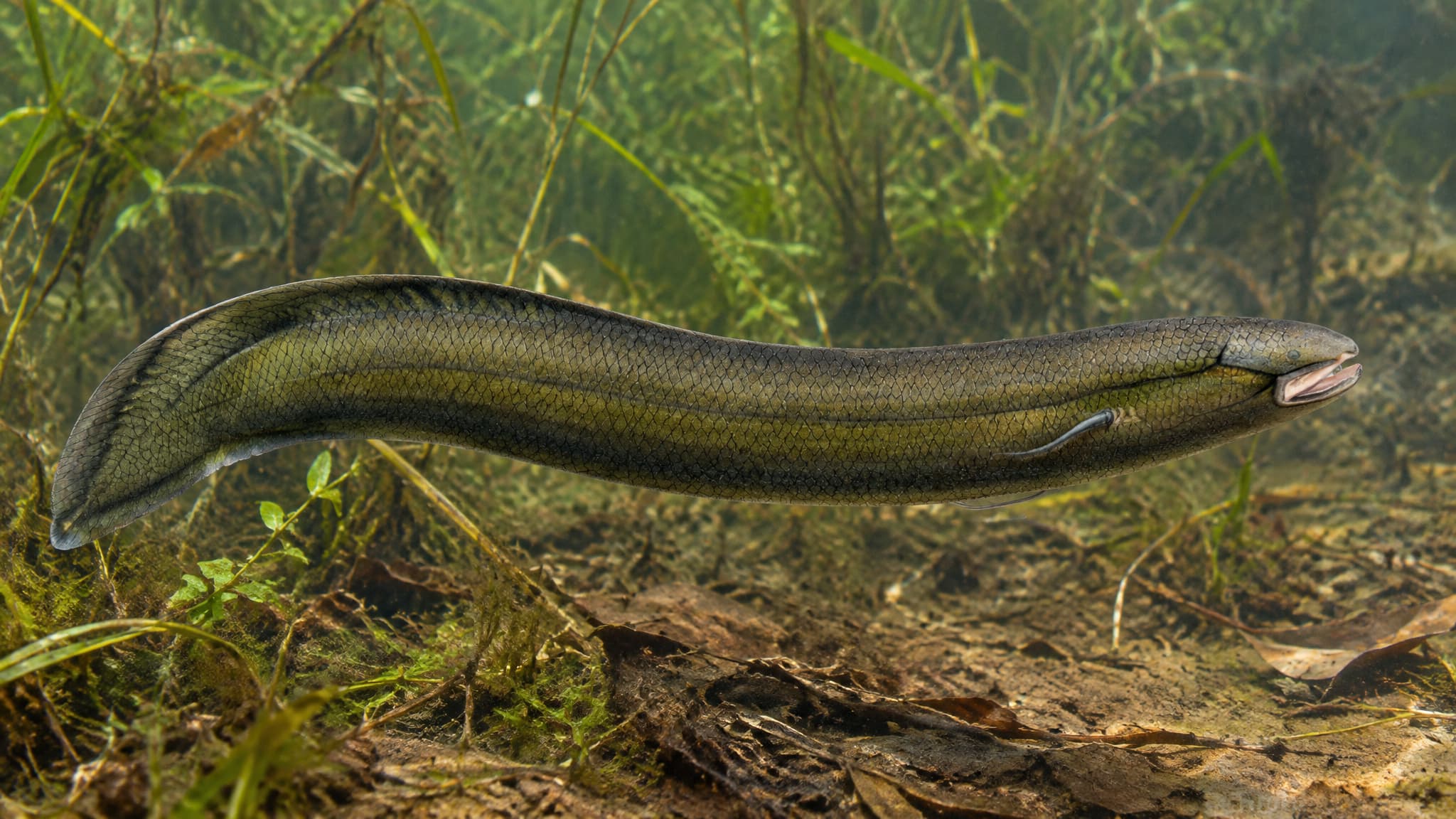
The electric eel (Electrophorus electricus) is not a true eel but a South American knifefish of the order Gymnotiformes and family Gymnotidae. Its long, eel-like shape explains the common name, and it can reach up to 2.5 m in length and about 20 kg in weight. Males are considerably larger than females. In 2019, a study by de Santana and colleagues split the old, single electric eel into three species; under those limits, E. electricus is the northern species, separated from E. voltai and E. varii mainly by genetics and ecology, since their external shape is very similar. In its current sense the species is restricted to the Guiana Shield, in Guyana, Suriname, French Guiana and the northern parts of the Brazilian states of Amapá, Amazonas and Roraima. It lives in upland waters of the shield, which lies above 300 m and has rapids and waterfalls with clear, well-oxygenated water low in dissolved salts. FishBase also records it in calm waters with muddy bottoms, such as swamps and creeks. The electric eel is nocturnal and an obligate air breather: it must rise to the surface to gulp air, roughly every two minutes, and it can survive for some hours out of water if its skin stays wet. Its electric organs produce weak discharges used for electrolocation and strong discharges used when attacking prey; a discharge of 500 V has been recorded from a 1 m specimen. The record of 860 V for the genus belongs to E. voltai, not to this species. Juveniles feed on invertebrates, while adults mainly hunt fish and also take amphibians and small mammals. Males outnumber females by about three to one. The male builds a foam nest and guards the developing larvae. A female can lay about 17,000 eggs, released in three successive batches during each spawning period. Electric eels kept in captivity have sometimes lived for more than 20 years. On the IUCN Red List, Electrophorus electricus is classified as Least Concern, in an assessment dated 2020.

View Details
West Indian Ocean coelacanth
Fish

West Indian Ocean coelacanth

Latimeria chalumnae

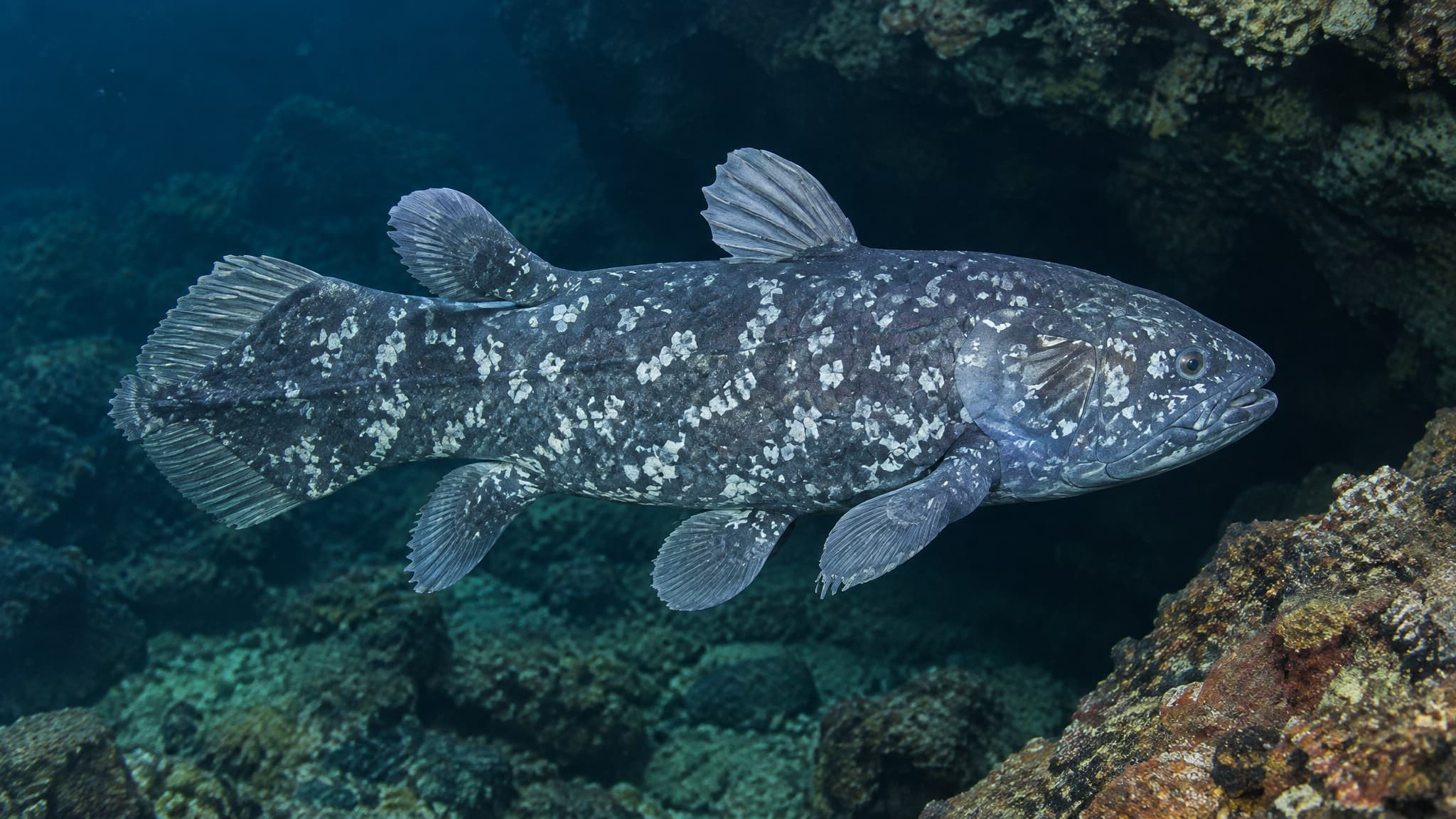
The West Indian Ocean coelacanth (Latimeria chalumnae) is one of only two living coelacanths, a lineage of lobe-finned fishes long known only from fossils. Females reach about 2 m in length and males about 1.68 m, with a maximum recorded weight of 95 kg. Living fish are deep blue with irregular white blotches whose pattern is unique to each individual; the colour turns brown after death. Seven of its fins have fleshy, limb-like lobes, and the paired pectoral and pelvic fins move in a diagonal sequence similar to the gait of a four-legged animal. A rostral organ in the snout is thought to sense electric fields. The species lives along the rim of the western Indian Ocean. Its best-known population is on the steep volcanic slopes of Grande Comore and Anjouan in the Comoros, and smaller groups are known from Kenya and Tanzania south to Mozambique, Madagascar and South Africa. By day coelacanths rest in lava caves at roughly 100 to 200 m depth, in water of about 16 to 22 °C, sometimes with more than a dozen fish sharing one cave. At night each fish leaves the cave alone to forage over the bottom at depths of 70 to 700 m and sometimes covering up to 8 km before returning at dawn. It is an opportunistic predator that snaps up fishes, such as Beryx splendens, and also takes squid and other molluscs. Some individuals have been seen performing headstands, apparently probing crevices for prey. Reproduction is ovoviviparous: eggs up to 9 cm across develop inside the female, who gives birth to between 5 and 26 fully formed young up to about 35 cm long. Gestation estimates range from about 13 months to 3 years. Growth is extremely slow; females are thought to mature only after more than 20 years, and a 2021 study suggests the species can live close to 100 years. The coelacanth became famous in 1938, when a specimen caught off East London, South Africa, reached museum curator Marjorie Courtenay-Latimer; ichthyologist J. L. B. Smith described it in 1939 and named it after her and the Chalumna River area. The IUCN lists it as Critically Endangered and it is on CITES Appendix I. The total population is believed to number only in the hundreds, and accidental capture in deep-set fishing gear and gill nets is the main threat.

View Details
Giant oarfish
Fish

Giant oarfish

Regalecus glesne

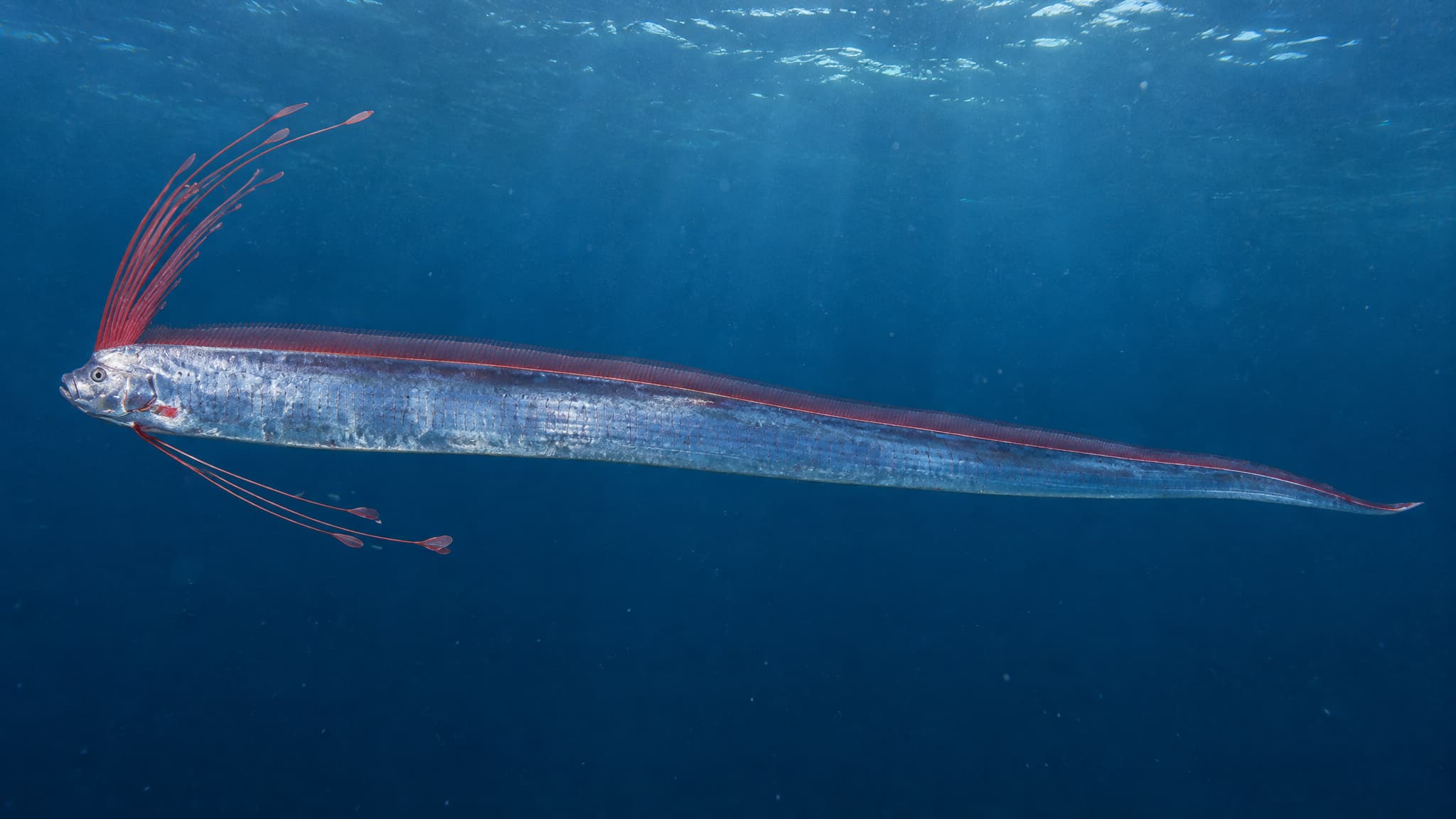
The giant oarfish (Regalecus glesne) is widely described as the longest bony fish alive. FishBase gives a maximum total length of 8 m and a maximum published weight of 272 kg, although most specimens measured are around 3 m. Its body is ribbon-like, strongly compressed from side to side and silvery, often marked with blue to blackish streaks, spots and wavy lines. A crimson dorsal fin with 414 to 449 soft rays runs from between the eyes to the tip of the tail, and its first 10 to 12 rays are lengthened into a red crest on the head. Each pelvic fin is a single long ray with a widened, oar-like tip, which gives the fish its common name. It has a small head, toothless protrusible jaws, no anal fin and no swim bladder. The species lives in the open ocean almost worldwide outside the polar regions, with records from 72°N to 52°S in the Atlantic (including the Mediterranean), the Indo-Pacific and the eastern Pacific. It is a pelagic, oceanic fish of the epipelagic and mesopelagic zones; FishBase records it at depths from 20 to 1000 m, and it is usually found well below the sunlit surface layer. The giant oarfish feeds mainly on krill and other small crustaceans, along with small fishes and squid. Lacking teeth, it sucks prey-laden water into its mouth and strains food with specialised gill rakers. It swims by rippling its long dorsal fin and often holds a vertical, head-up posture, which may help it spot prey silhouetted against the light above. It is occasionally found in pairs, but no schooling has been recorded. Spawning takes place from July to December. The species is a broadcast spawner with no parental care, and its eggs are round and covered in short spines. Larvae are nearly transparent with dark spots and have a small tail fin that adults lack. Throughout life the fish can shed the rear part of its body, a form of self-amputation that does not harm its vital organs, which sit toward the head. Its lifespan is unknown. No natural predators of adults have been documented, though the fish hosts parasites such as tapeworm larvae; one adult female carried at least 63 of them. Rare strandings and surface sightings, often of dying animals, have fed sea serpent legends for centuries. The giant oarfish is assessed as Least Concern by the IUCN. It is not targeted by commercial fisheries but is occasionally caught as bycatch, and FishBase rates its resilience as very low, with a population doubling time of more than 14 years.

View Details
South American lungfish
Fish

South American lungfish

Lepidosiren paradoxa

The South American lungfish (Lepidosiren paradoxa) is the only member of its genus and one of the few living lungfishes. Its body is long, slender and almost eel-like, with a flattened head, thread-like paired fins and a diphycercal tail. Adults are dark grey or black, while juveniles are marked with bright yellow or gold spots that fade as they grow. It can reach 125 cm in length. The species lives in the Amazon, Paraguay and lower Paraná river basins, with records from Brazil, Argentina, Bolivia, Colombia, French Guiana, Paraguay, Peru and Venezuela. It favours stagnant or slow-moving water such as swamps, weedy creeks and floodplain lakes, often shallow and poor in oxygen, and many of these places dry out completely in the dry season. Unlike most fish, it is an obligate air-breather: it must rise to the surface to gulp air with its lungs and can drown if it cannot reach it. When its pool dries up, it digs into the mud to a depth of about 30–50 cm, leaving small openings to the surface for air. There it seals itself in mucus and greatly slows its metabolism, a dormant state called aestivation, until the rains return. It is solitary and mostly inactive. Young lungfish feed on insect larvae and snails. Adults are omnivorous, taking snails, clams, shrimp, insects and small fish as well as algae and plant material, which they crush with heavy, mineralised tooth plates. Prey is captured by suction. Breeding starts with the rainy season. The pair builds a nest in a burrow lined with plant debris, and the male guards the eggs and young. During this period he grows feathery, blood-rich filaments on his pelvic fins that release extra oxygen into the nest water. The larvae resemble tadpoles and carry four external gills, switching to air-breathing at about seven weeks. Recorded lifespans average about 8 years, although captive fish have lived well over 20 years. The IUCN lists the South American lungfish as Least Concern. Beyond its role as a predator of snails and other invertebrates, it is of great scientific interest, because lungfishes help explain how vertebrates made the move from water to land.

View Details
Dwarf Gourami
Fish

Dwarf Gourami

Trichogaster lalius

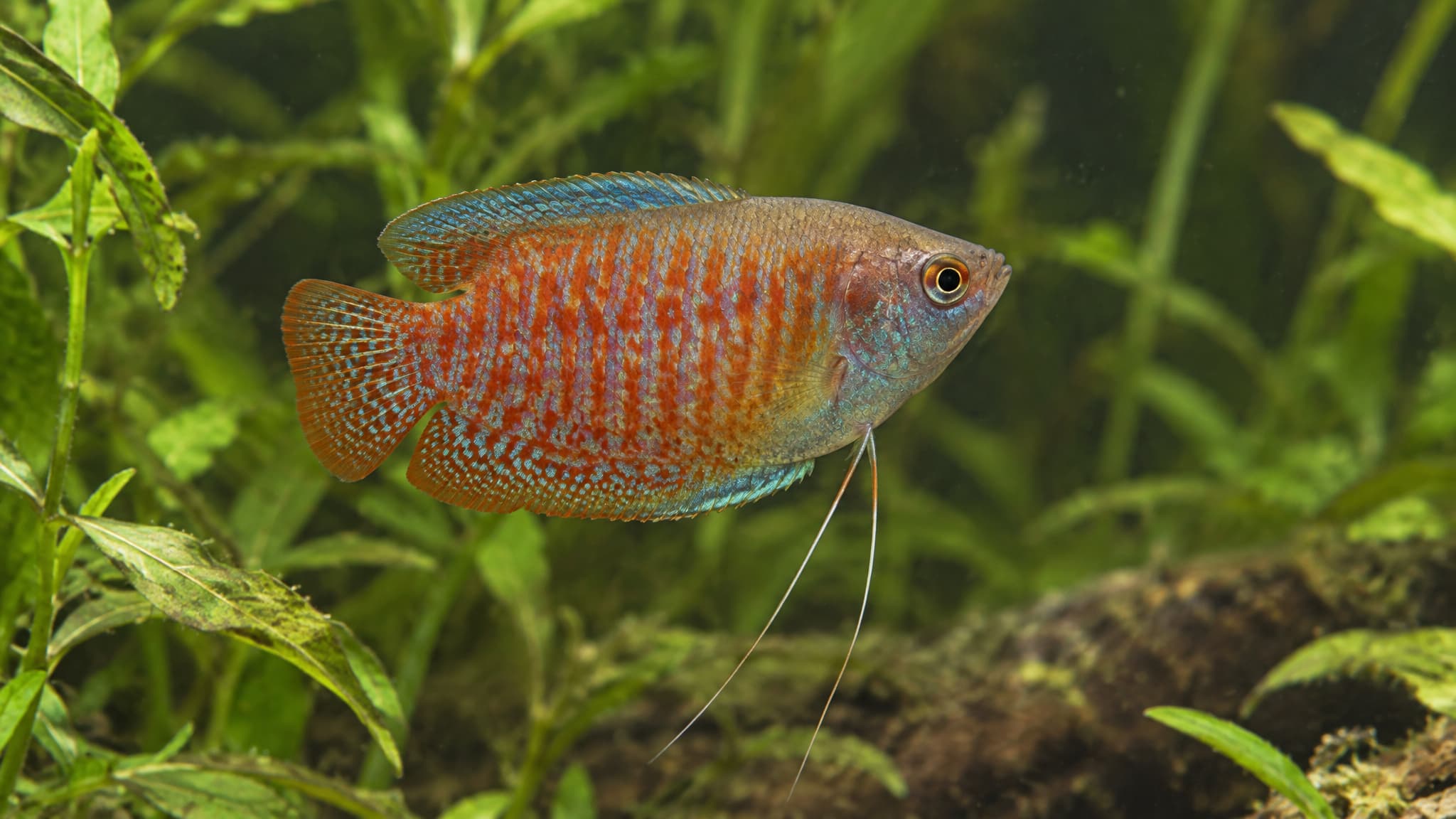
The dwarf gourami (Trichogaster lalius) is a small labyrinth fish of the family Osphronemidae and one of the best-known gouramis in the aquarium trade. It usually reaches about 8.8 cm, and FishBase records a maximum of 9.5 cm total length. Wild males carry diagonal blue and red bands and grow longer dorsal and anal fins as they mature, while females are smaller, plainer and silvery. Captive breeding has produced flame red, powder blue and neon blue forms. The species is native to Pakistan, India and Bangladesh. It lives in sluggish, heavily vegetated fresh water such as ponds, swamps, ditches, slow streams, lakes and irrigation canals. Like other gouramis it can breathe air at the surface, which helps it cope with warm, oxygen-poor water. Feral populations have been reported in Singapore, the United States and Colombia. In the wild the dwarf gourami is omnivorous, feeding on small invertebrates, algae and aufwuchs, the film of tiny organisms that grows on submerged surfaces. It is shy and territorial: males defend space and can harass females or rival males, so it is usually kept as a pair in a planted tank. Reproduction centres on the male, who builds a floating bubble nest held together with bits of plant. A spawning can yield around 600 eggs, which the male guards. The eggs hatch in 12 to 24 hours and the larvae swim freely after about three days. In aquariums most dwarf gouramis live about 4 to 6 years. The IUCN lists the species as Least Concern. Its main problem in captivity is dwarf gourami iridovirus, a highly infectious virus with no known treatment; one study found it in 22% of dwarf gouramis exported from Singapore, and it can spread to other fish sharing the same water. The scientific name is also under discussion: the Catalog of Fishes now treats T. lalius as a synonym of Trichogaster fasciata, following a 2022 revision.

View Details
Silver moony
Fish

Silver moony

Monodactylus argenteus

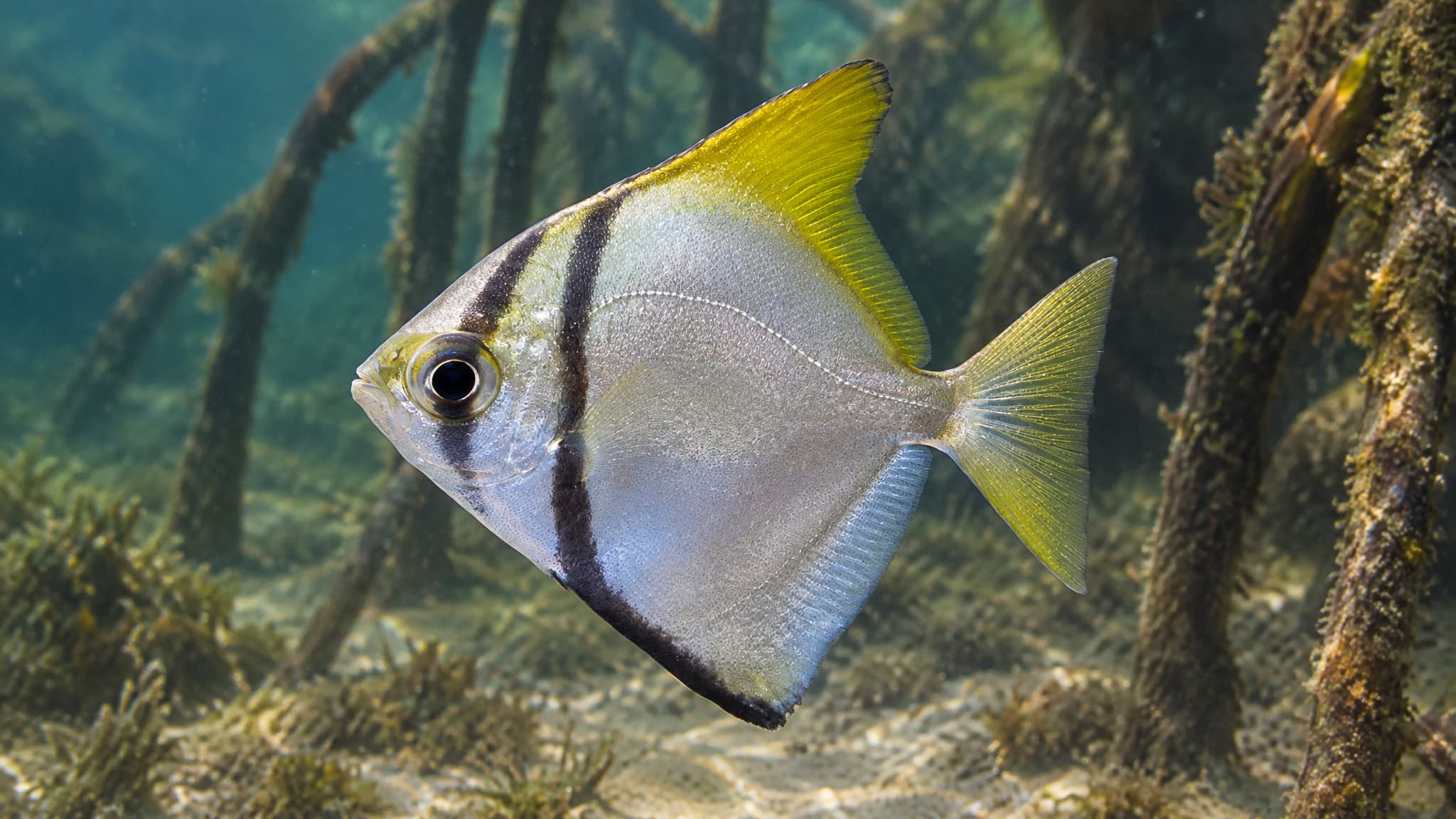
The silver moony (Monodactylus argenteus), also called the silver moonyfish, butter bream or diamondfish, is a tall, strongly compressed fish whose body forms an almost diamond-shaped outline. Adults are bright, mirror-like silver with yellowish fin margins and dark tips on the dorsal and anal fins. The dorsal fin carries 7 to 8 spines and 27 to 31 soft rays, the anal fin 3 spines and 27 to 32 soft rays. Juveniles are more yellow and show two vertical black bars, one through the eye and one just behind the gill cover, and their small pelvic fins shrink or disappear with age. The species reaches up to 27 cm in standard length, although 12 cm is a more common size. It lives across the Indo-West Pacific, from the Red Sea and the East African coast through the Persian Gulf to Samoa, north to the Yaeyama Islands of southern Japan and south to New Caledonia and Australia. It also reaches the tidal freshwater zone of the Mekong delta. Typical habitats are bays, mangrove estuaries, tidal creeks and the lower reaches of rivers, at depths of 0 to 12 m, with occasional visits to silty coastal reefs. The silver moony feeds on plankton, algae and detritus. It is euryhaline, able to cope with a very wide range of salinities, which makes it a model organism in salinity-tolerance research; juveniles are especially good at keeping their internal balance as estuarine conditions change. Adults usually move in large, fast schools, while small juveniles may be solitary or form small groups, and the species is also known to be territorial. Maturity is reached at about 13 cm. Adults migrate to open sea to spawn, releasing eggs and sperm into the water; the fertilised eggs drift with the currents, hatch into larvae, and the young later settle back into brackish estuaries. Usually only juveniles enter fresh water. Aquarium sources report that spawning has not been achieved in home aquariums, and males and females cannot be told apart externally. No reliable lifespan figure appears in the consulted sources. As a mid-level consumer of plankton and organic debris, the silver moony helps recycle nutrients in mangrove and estuarine food webs. It supports minor commercial fisheries, is caught with throw nets and is widely sold in the aquarium trade. In captivity it needs a group, plenty of swimming space and a gradual move from brackish to marine water as it grows. The IUCN lists it as Least Concern.

View Details
Green swordtail
Fish

Green swordtail

Xiphophorus hellerii

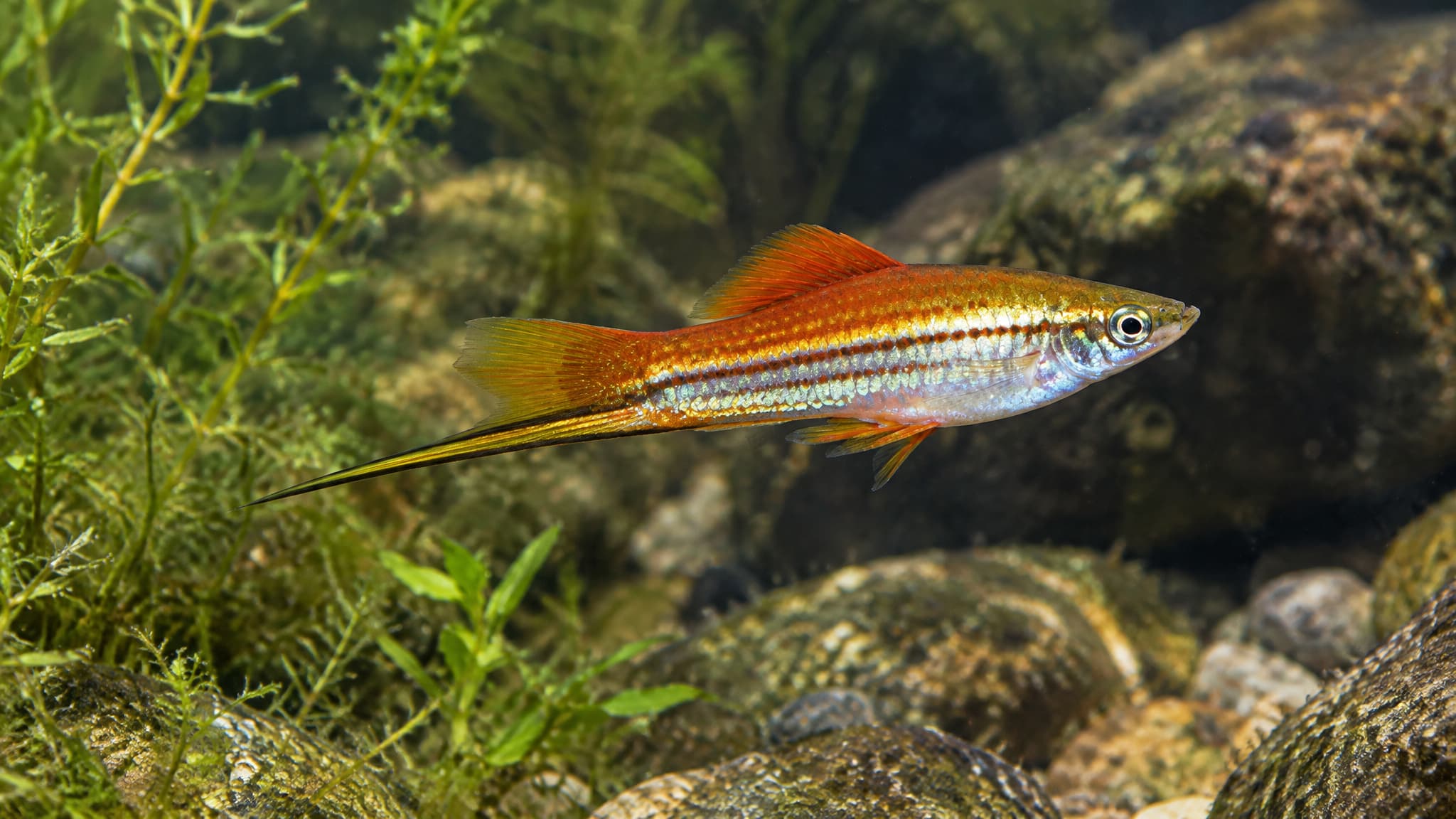
The green swordtail (Xiphophorus hellerii) is a small livebearing fish of the family Poeciliidae, described by Heckel in 1848 from Orizaba, Mexico. Wild fish are olive green with a red or brown stripe along the flank and speckles on the dorsal fin. Adult males carry the feature that gives the species its name: an extended lower lobe of the tail fin, the "sword", yellowish and edged in black below. Males reach up to 14 cm in total length and females up to 16 cm. The name is often misspelled X. helleri. The species is native to the Atlantic slope of Mexico and Central America, from the Río Nantla in Veracruz through central Guatemala and southern Belize to northwestern Honduras, from sea level to around 1,500 m. It lives in fast-flowing rocky streams and rivers, springs, canals, ditches and ponds, usually in water less than 1.5 m deep. Adults favour the current, while juveniles keep to quieter margins. The green swordtail is an omnivore that feeds on worms, small crustaceans, insects and other aquatic and terrestrial invertebrates, along with algae, plant matter and organic detritus. In confined spaces males form dominance hierarchies and can be aggressive towards one another. The species is a well-known laboratory model for studies of female mate choice and male competition. Like other poeciliids it bears live young. Males fertilise females internally with the gonopodium, a modified anal fin, and females can store viable sperm for months. After a gestation of 24 to 30 days a female gives birth to 20 to 200 young. Sources differ on age at maturity, from about 3 months to 8 to 12 months. Females can sometimes change sex to male. Lifespan is reported at up to 5 years. Selective breeding and hybridisation with platies have produced red, black and many other ornamental strains, making it one of the most popular aquarium fish. Escaped and released fish have founded feral populations on every continent except Antarctica, including Brazil, southern Africa, Madagascar, Hawaii and eastern Australia, where they breed quickly and harm native species and ecosystems. In its native range the IUCN lists it as Least Concern.

View Details
Glowlight tetra
Fish

Glowlight tetra

Hemigrammus erythrozonus

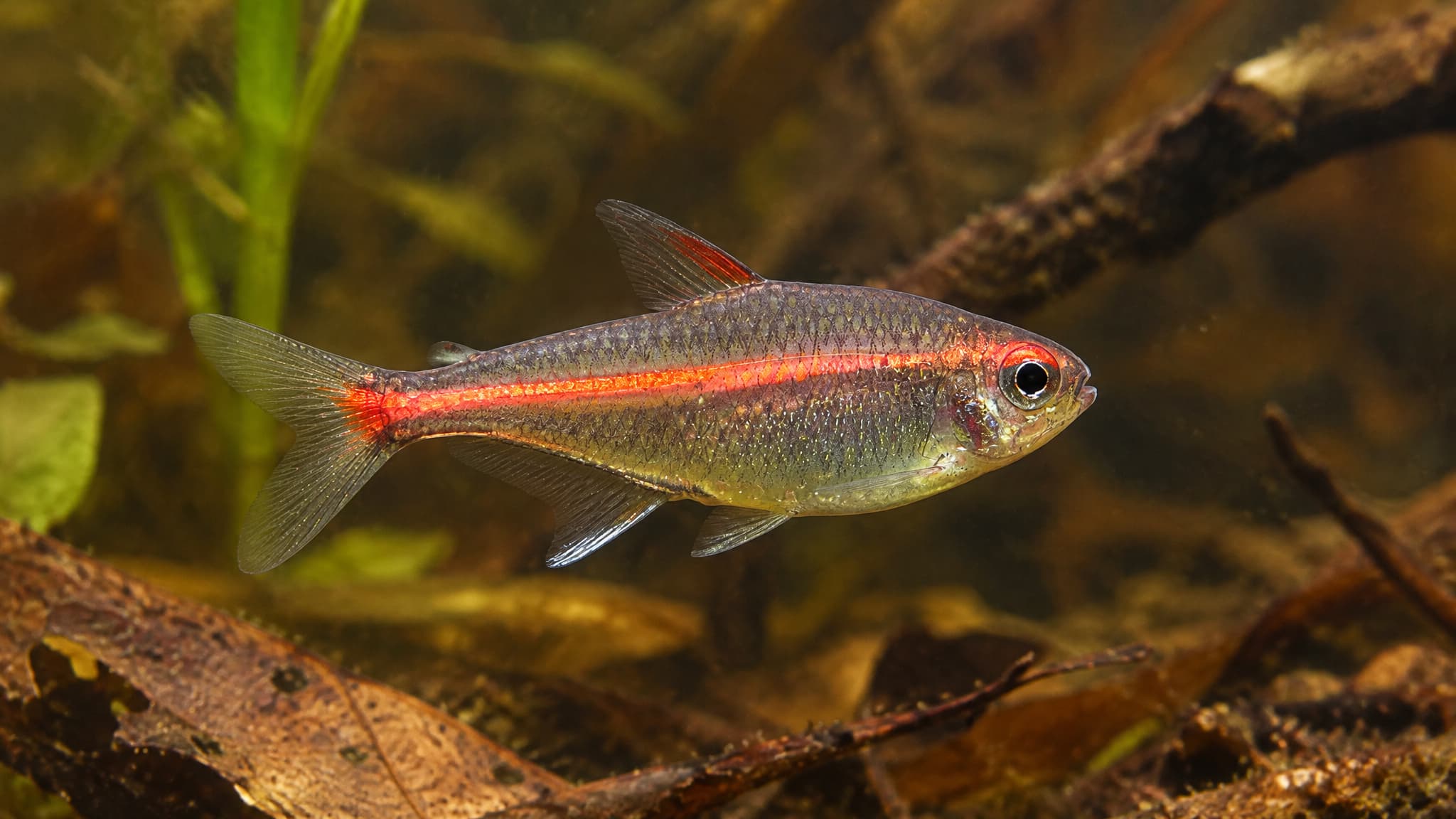
The glowlight tetra (Hemigrammus erythrozonus) is a small South American characin described by Marion Durbin in 1909 and one of the most familiar tetras in the aquarium hobby. It belongs to the order Characiformes and, under the 2024 reclassification of the American tetras followed by FishBase, to the family Acestrorhamphidae, although many aquarium references still list it under Characidae. The genus Hemigrammus is widely regarded as in need of revision, so its generic placement may change in the future. Its common name comes from the glowing orange-red stripe that runs along the flank from the snout to the base of the tail, set against a translucent silvery body; the other fins are silvery to clear. FishBase gives a maximum total length of 3.3 cm while noting that figure is questionable, and Seriously Fish gives a maximum standard length of 4 cm, with some sources citing up to 5 cm. Mature females are rounder in the belly and tend to grow slightly larger than males. In the wild the species is known mainly from the Essequibo River basin in Guyana, and Wikipedia also mentions the Courantyne River on the border with Suriname. It lives in forested tributaries away from the main channel, where the water is stained dark brown by tannins from decaying plant matter and is often strongly acidic. Wild fish are not exported; the fish sold in the trade are bred in large numbers on commercial farms. The glowlight tetra is a peaceful, lively shoaling fish that is best kept in groups. FishBase lists worms, small crustaceans and plant material in its diet, and Wikipedia notes that wild fish eat aquatic insect larvae, so it is treated as an omnivorous micro-predator. In aquariums it accepts almost any small food, from flakes and granules to live or frozen bloodworm, Daphnia and brine shrimp. It is an egg scatterer that gives no parental care, and adults readily eat their own eggs. A typical spawning produces 120 to 150 eggs, usually laid among fine-leaved plants in soft, acidic, dimly lit water. The eggs hatch in about 24 to 36 hours and the fry become free-swimming 3 to 4 days later. Lifespan figures come only from aquarium sources, which give 2 to 4 years or 3 to 5 years. The IUCN assesses the glowlight tetra as Least Concern. FishBase rates its resilience as high and its vulnerability to fishing as low, and because the aquarium trade relies on captive-bred fish, collection places little pressure on wild populations.

View Details
Spotted scat
Fish

Spotted scat

Scatophagus argus

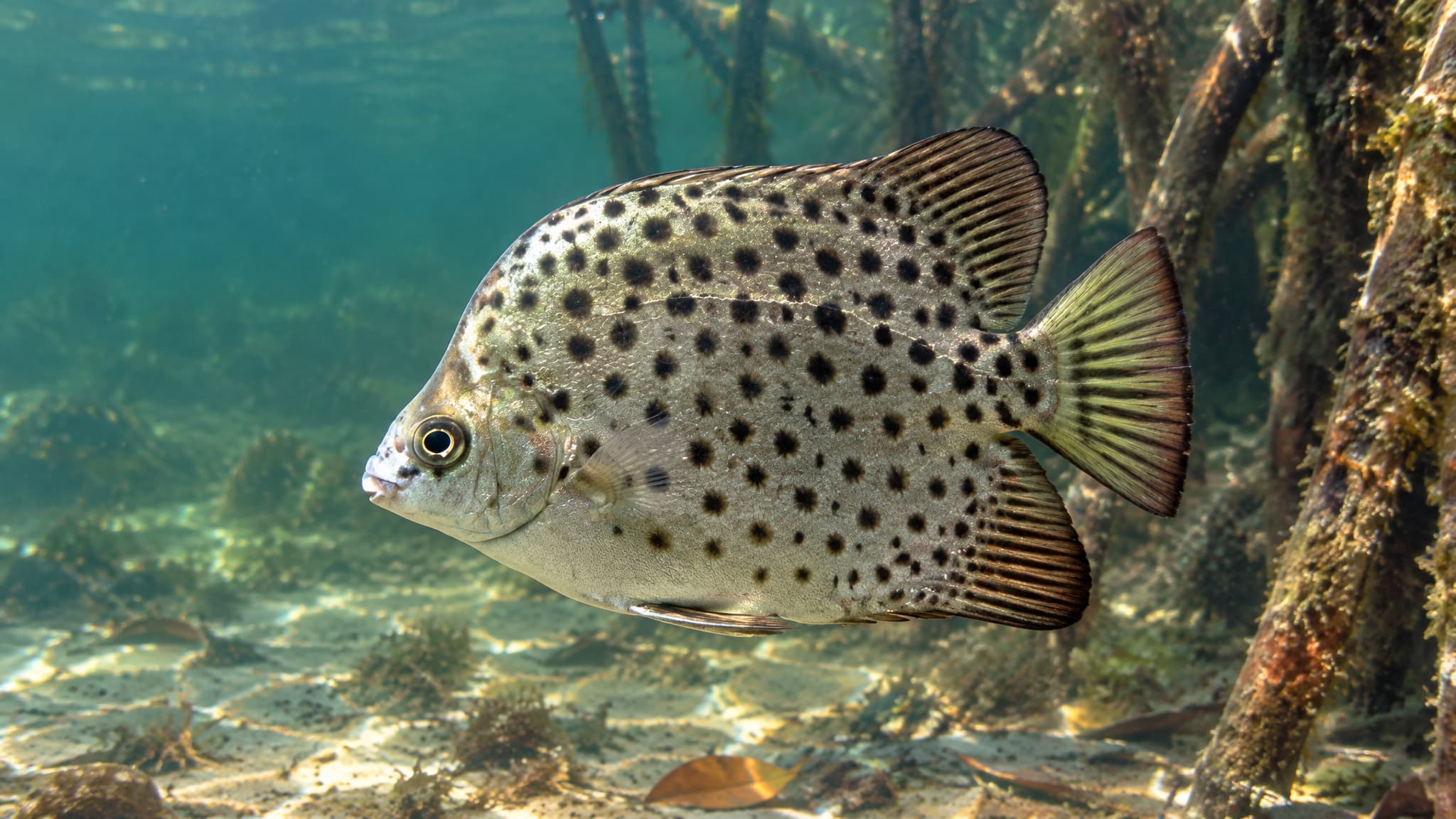
The spotted scat (Scatophagus argus) is a deep-bodied, strongly compressed fish of the family Scatophagidae, with an almost rectangular outline and a steep forehead. Adults are greenish-brown to silvery, often with a golden sheen, and are covered in brown to reddish-brown spots that can fade in very large fish. Juveniles look different, with a few large dark blotches or five or six broad vertical bars. Most adults are about 20 cm long, and the largest recorded fish reached 45 cm in total length. Aquarists know two colour forms, the green scat and the ruby or red scat. The species ranges widely across the Indo-Pacific, from Kuwait and the Persian Gulf along the coasts of South Asia to southern Japan, northern Australia, New Caledonia and Fiji, with records as far east as Samoa, Tonga and the Society Islands. It lives in sheltered, shallow water from the surface to about 5 m deep: harbours, bays, brackish estuaries, mangrove creeks and the lower reaches of freshwater streams. FishBase classes it as amphidromous, moving between fresh and salt water during its life. Scats are indiscriminate omnivores. Their wild diet includes algae, plant matter, detritus, worms, crustaceans, insects and other small bottom-dwelling invertebrates. A study in the Philippines found adults mostly herbivorous and juveniles preferring zooplankton. Despite the name, which means "dung eater", diet studies have not confirmed that they feed on offal. Adults gather in schools, while tiny juveniles are solitary and float in the surface film. Spawning in the Philippines is triggered by the monsoon rains of June and July, and the species spawns several times. Females mature at about 7 to 9 months and around 150 g, and males mature at a smaller size. The eggs are about 0.7 mm across, the larvae hatch about 20 hours after fertilisation at 1.8 mm long, and the young pass through a pelagic larval stage called the tholichthys. In aquariums, scats are reported to live 10 to 20 years with good care. The spines of the dorsal, anal and pelvic fins have venom glands at their base and can cause a very painful wound with dizziness, so the fish must be handled with care. As a grazer of algae and detritus and as prey for larger animals, the scat is part of the food web of mangroves and estuaries. It is a minor food fish sold fresh in parts of its range and a popular aquarium fish. Juveniles can be kept in brackish water, but adults do best in full-strength sea water. The IUCN lists it as Least Concern.

View Details
Banded archerfish
Fish

Banded archerfish

Toxotes jaculatrix

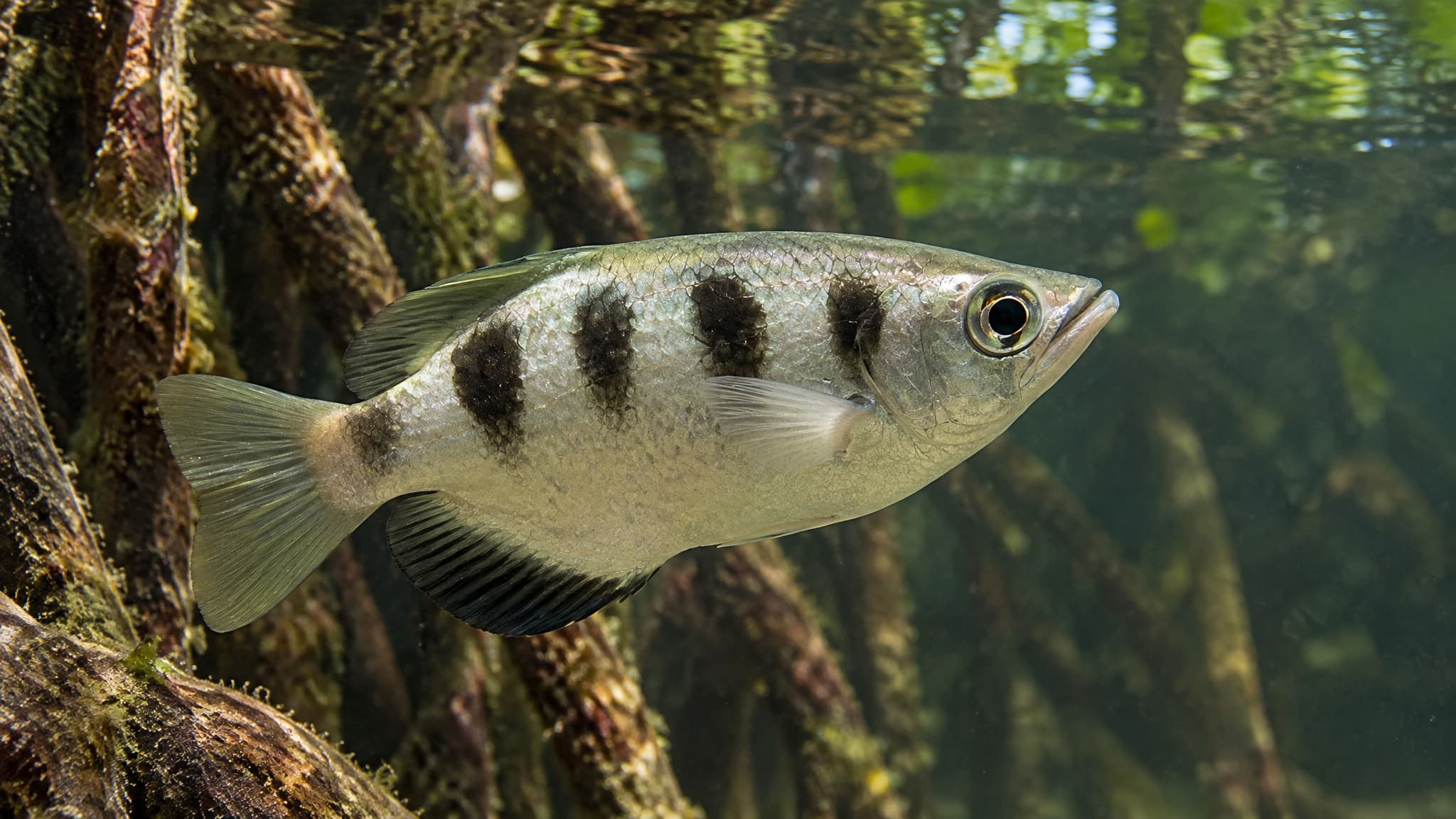
The banded archerfish (Toxotes jaculatrix) is famous for knocking insects off leaves with a precise jet of water. Described by Pallas in 1767, it usually measures about 20 cm, with a maximum length of about 30 cm. The body is deep and flattened, silvery, with an olive-green or brownish back and four to six broad black bars across the upper sides. The dorsal fin sits far back on the body, and the large, forward-facing eyes give it binocular vision for judging targets above the surface. The species ranges across the Indo-Pacific, from India east to the Philippines and south through Indonesia to Papua New Guinea, the Solomon Islands, Vanuatu and northern Australia. Its main home is brackish mangrove swamps and estuaries, usually in shaded water under dense overhanging vegetation, but it also enters rivers, streams, lakes and ponds. It moves between fresh and salt water and usually lives in small groups. Archerfish feed at the surface during the day. They take floating debris, plant matter and insects, and also eat crustaceans and small fish. To reach prey on branches, it fires a stream of water from its mouth, with a typical range of about 150 cm; large adults can reach 2 to 3 m. It can arrive at fallen prey within about 50 milliseconds, and it also leaps from the water to grab prey directly. Young fish appear to improve their aim partly by watching other archerfish. Breeding begins at a length of about 10 cm, and a female can release 20,000 to 150,000 eggs in a spawning. Breeding in captivity is rare, and details of spawning in the wild are still poorly known. In aquariums the species typically lives 5 to 8 years and occasionally 9 to 10. As an abundant surface predator of insects that fall from mangrove foliage, the archerfish links the forest canopy with the aquatic food web. The IUCN lists it as Least Concern, and it is fairly common. Loss of mangrove habitat and pollution are its main threats, and it is taken in small fisheries and for the aquarium trade. In captivity it needs warm brackish water of 25 to 30 °C, a large tank and a tight lid, since it jumps well.

View Details
Red-tailed black shark
Fish

Red-tailed black shark

Epalzeorhynchos bicolor

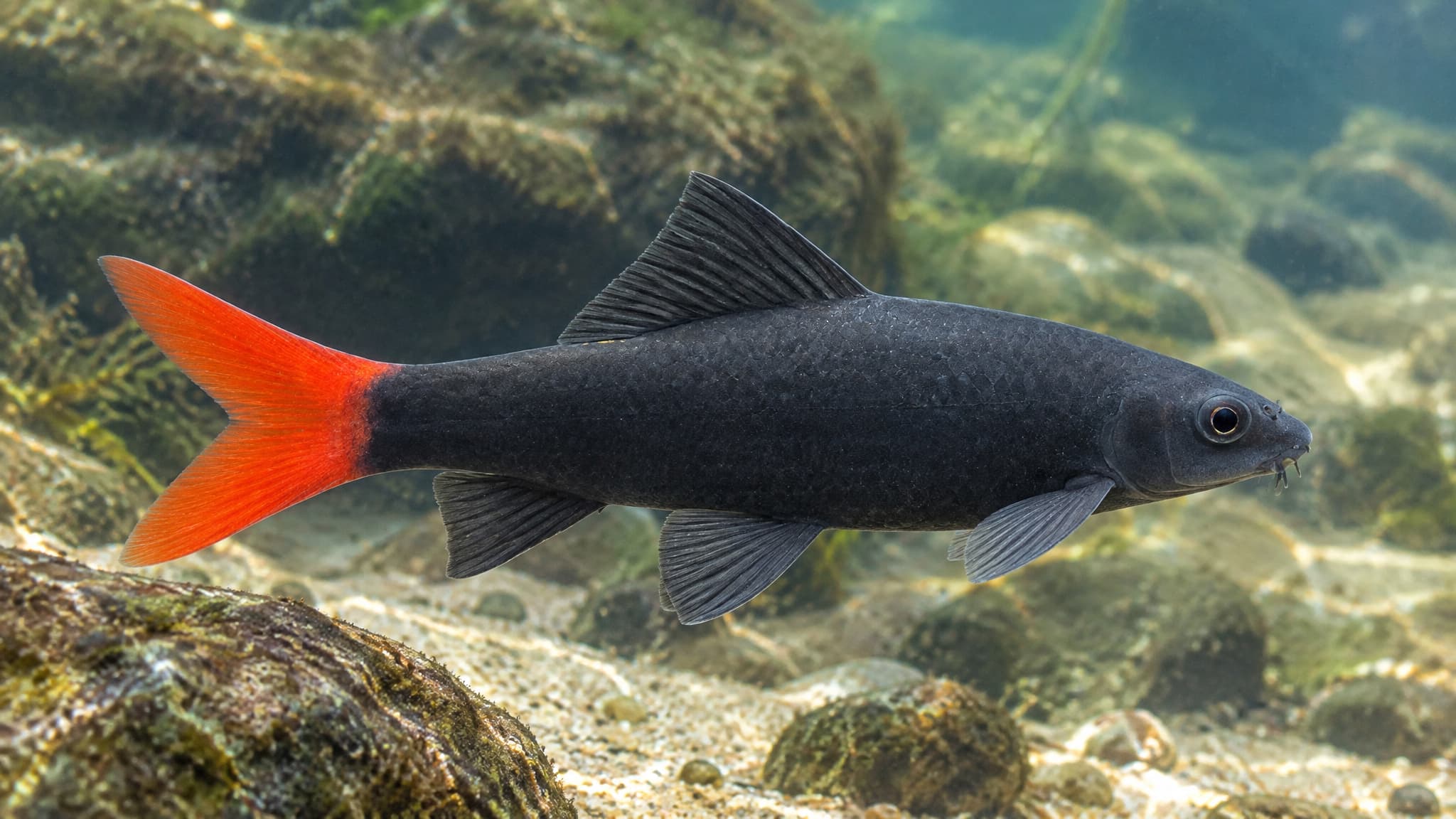
The red-tailed black shark is not a shark at all but a member of the carp family, Cyprinidae. It has an elongated, slightly compressed body that is velvety black, a tall triangular dorsal fin and a forked tail fin of bright red. The snout overhangs a downward-facing mouth with two pairs of barbels, an arrangement suited to grazing on surfaces. FishBase records a maximum of 13.0 cm total length, while aquarium fish typically reach about 16 cm. Females tend to be larger and fuller, and males slimmer with a more pointed dorsal fin. The species is endemic to Thailand, where it has been recorded from the lower Mae Klong, Chao Phraya and Bang Pakong river basins. It lives in lowland rivers, streams and floodplains, favouring clear, flowing water over sand and rocks. Hugh McCormick Smith described it in 1931 as Labeo bicolor, a name still widely used in the aquarium hobby. In the wild it is mainly a bottom-dwelling grazer of aufwuchs, the film of algae and tiny organisms that coats rocks, and it also takes small crustaceans, insect larvae, worms, detritus and plant matter. It is an active, mostly nocturnal swimmer and a good jumper. With age it becomes strongly territorial, especially towards its own kind and similar-looking fish, so in aquariums it is usually kept alone. It is an egg layer, but spawning in home aquariums is practically unknown. Commercial farms in Thailand and elsewhere breed it with hormone injections, and every fish in the trade today is captive bred. In captivity it usually lives about 5 to 8 years, and some sources report individuals living more than 15 years. The red-tailed black shark is listed as Critically Endangered by the IUCN. It was believed extinct in the wild from 1996 until 2011, when a small population was found in the Chao Phraya basin, and a single specimen was later collected in the Mae Klong system. Dam building, swamp drainage, road construction, pollution and siltation have degraded its habitat. Collection for the aquarium trade was once blamed for its decline, though this is debated.

View Details
White Cloud Mountain Minnow
Fish

White Cloud Mountain Minnow

Tanichthys albonubes

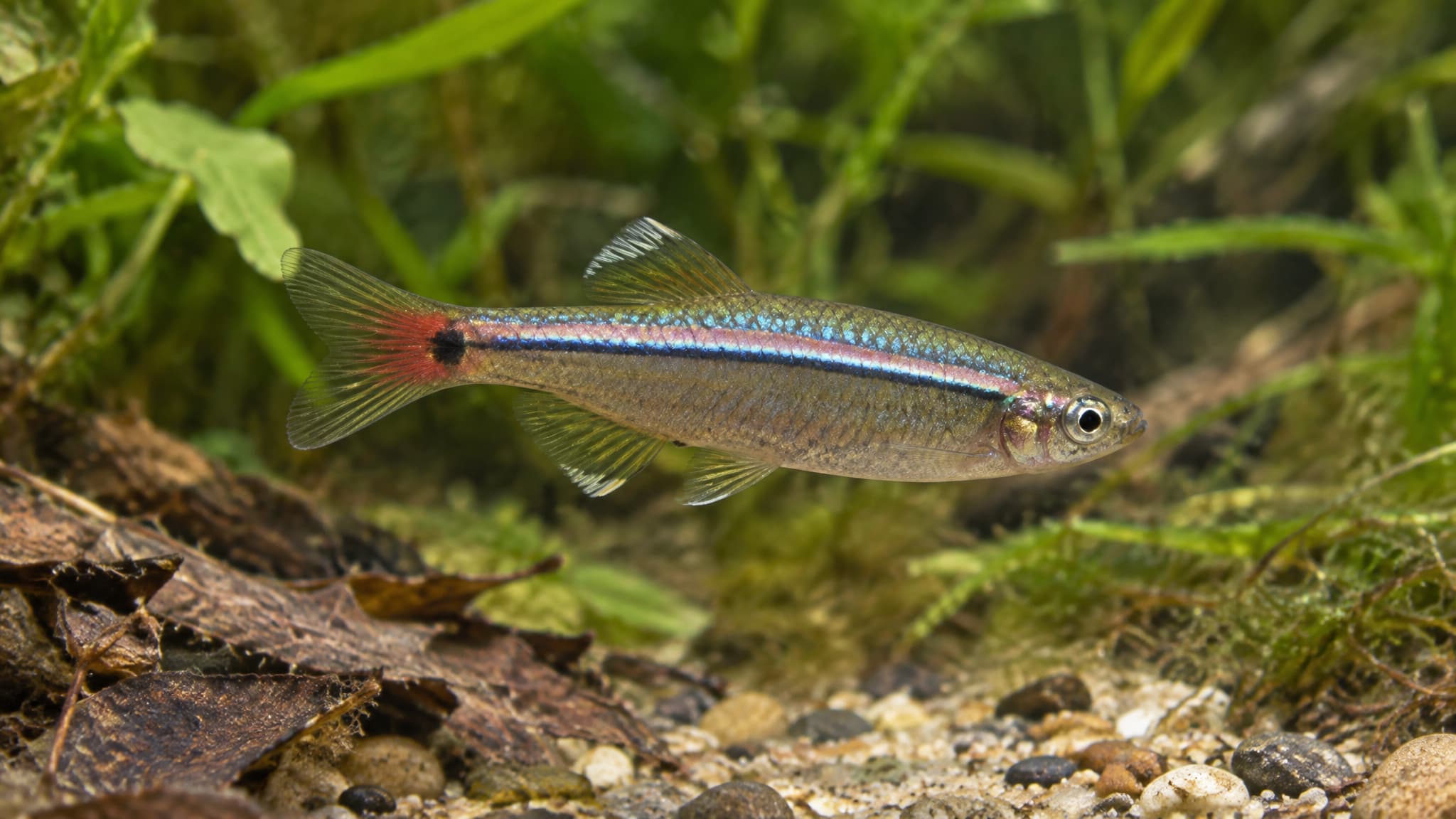
The White Cloud Mountain minnow (Tanichthys albonubes) is a small, slender freshwater fish described by S. Y. Lin in 1932 and today placed in its own family, Tanichthyidae, within the order Cypriniformes. Adults reach about 4 cm in length. The body is silvery green to bronze with a bright stripe along the flank, and the dorsal and tail fins are washed with red. Males are slimmer and more colourful, with broad, fan-shaped dorsal and anal fins, while females are rounder in the belly and have more triangular fins. Golden, pink and long-finned forms have been bred for the aquarium trade. The genus honours Tan Kam Fei, the Boy Scout leader who collected the first specimens, and the species name comes from the Latin for "white cloud", after White Cloud Mountain (Baiyun Shan) near Guangzhou in Guangdong, China. The species is native to southern China, including Guangdong and Hainan Island, with records from northeastern Vietnam. It lives in clear, shallow, slow-flowing streams with dense vegetation, often over sand, pebbles and leaf litter. These are cool subtropical waters: the usual range is 18 to 22 °C, and the fish can survive temperatures as low as 5 °C. It is a peaceful schooling fish that stays in groups near calm water and plants. In the wild it acts as a micropredator, picking up small insects and their larvae, worms, small crustaceans and other zooplankton, and it also takes detritus and some plant matter. Reproduction is by egg scattering. Pairs spawn repeatedly among fine-leaved plants, and the adults give no parental care. The eggs hatch in about 48 to 60 hours. Adults tend to leave the fry alone, though breeders often remove them after a few days to protect the eggs. In aquariums the species typically lives 5 years or more. As a small mid-water feeder, it is part of the food web of its streams, eating tiny invertebrates and being eaten in turn by larger animals. The IUCN Red List lists it as Data Deficient. In the wild it is rare and scattered: it was believed extinct for about 20 years before a population was found on Hainan, its type locality appears to have lost its population, and pollution and tourism have been blamed for its decline. China lists it as a nationally protected species. Almost all aquarium fish are farm-bred, and heavy inbreeding has weakened many strains.

View Details
Boeseman's Rainbowfish
Fish

Boeseman's Rainbowfish

Melanotaenia boesemani

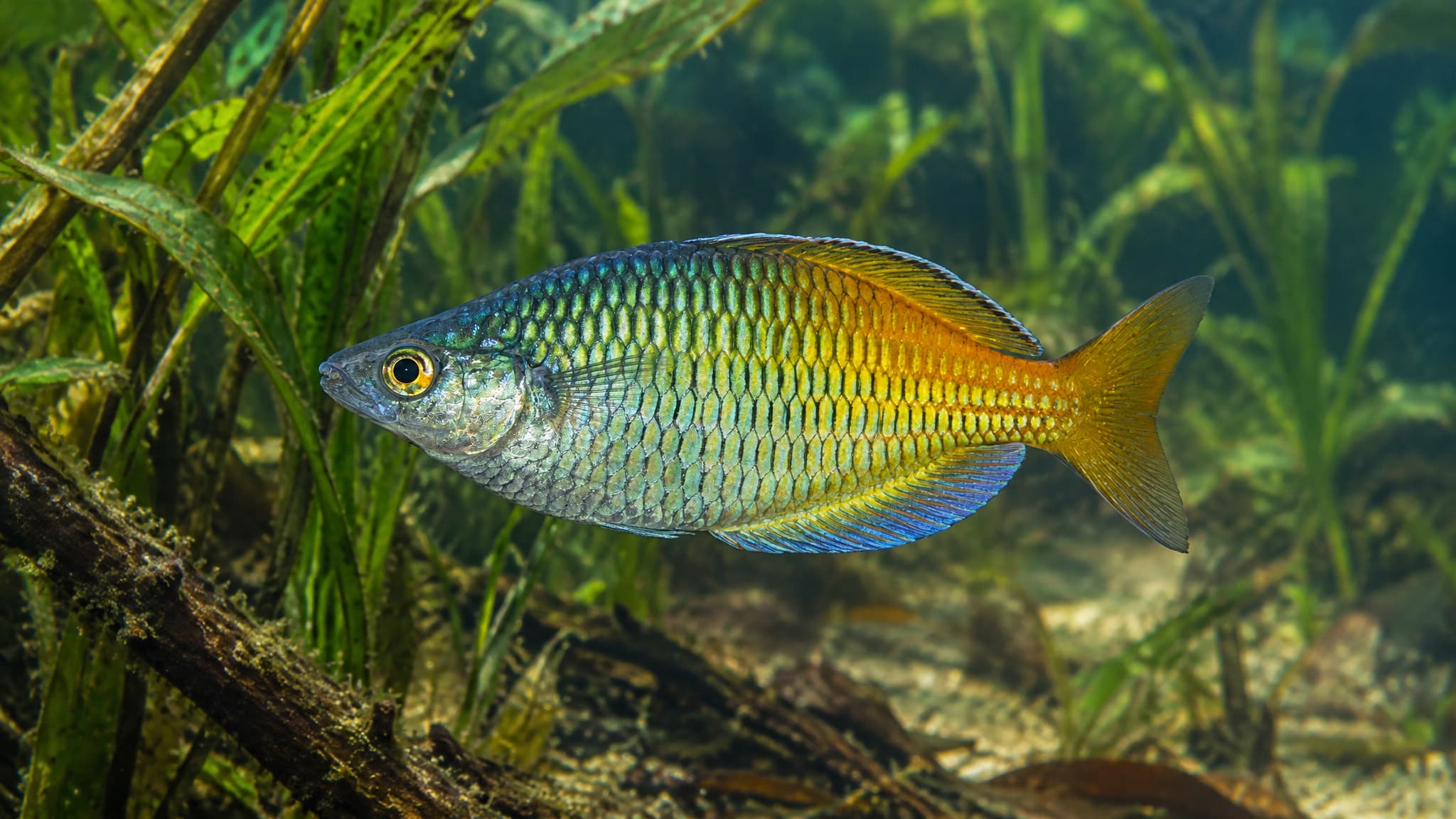
Boeseman's rainbowfish (Melanotaenia boesemani) is a small, deep-bodied rainbowfish from western New Guinea, described by Gerald R. Allen and N. J. Cross in 1980 and named after the Dutch ichthyologist Marinus Boeseman, who collected the type specimens. Its colour pattern is unmistakable: the head and front half of the body are blue-grey to purplish, while the rear half is bright orange, with two or three slender dark bars marking the boundary. The fins are usually orange with white edges. FishBase gives a maximum of 9 cm standard length for males and 7 cm for females, although well-fed aquarium specimens can exceed 10 cm. Mature males are larger, deeper-bodied and more vividly coloured than females. The species is endemic to the Ajamaru (Ayamaru) Lakes, nearby Lake Aitinjo and their tributaries on the Vogelkop (Bird's Head) Peninsula of West Papua, Indonesia. These are clear, alkaline lakes at the headwaters of the Ajamaru River, with dense aquatic vegetation. The fish gather in the shallow, weedy margins, and some populations also live in the small creeks that feed the lakes. In the wild it is an omnivore that feeds near the surface on small insects, including ants, as well as algae and small crustaceans. It is a peaceful schooling fish but can be skittish, and males become more aggressive toward each other during breeding, when they flash a white patch on the head. Fry and juveniles shelter in vegetation, because adults will eat them. Spawning takes place in the early morning, in pairs or groups, among plants. Females scatter small batches of about 10 to 20 adhesive eggs, which hatch after roughly 7 to 12 days depending on temperature. The newly hatched fry, about 4 mm long, first live on their yolk reserves. Wild lifespan is poorly known; in aquariums the species usually lives about 5 to 8 years. Within its lakes, Boeseman's rainbowfish is both a consumer of insects and algae and prey for larger fishes such as grunters, snappers and cardinalfishes, as well as for water birds, especially during droughts. Local communities have also eaten it. The IUCN Red List classifies the species as Endangered, mainly because its range is tiny and restricted to a few locations. Heavy collection for the aquarium trade drove its decline: in 1989 about 60,000 fish were reportedly caught and exported each month. Habitat degradation and introduced species add further pressure. Today most fish in the hobby are captive-bred, which reduces demand for wild stock.

View Details
Cockatoo dwarf cichlid
Fish

Cockatoo dwarf cichlid

Apistogramma cacatuoides

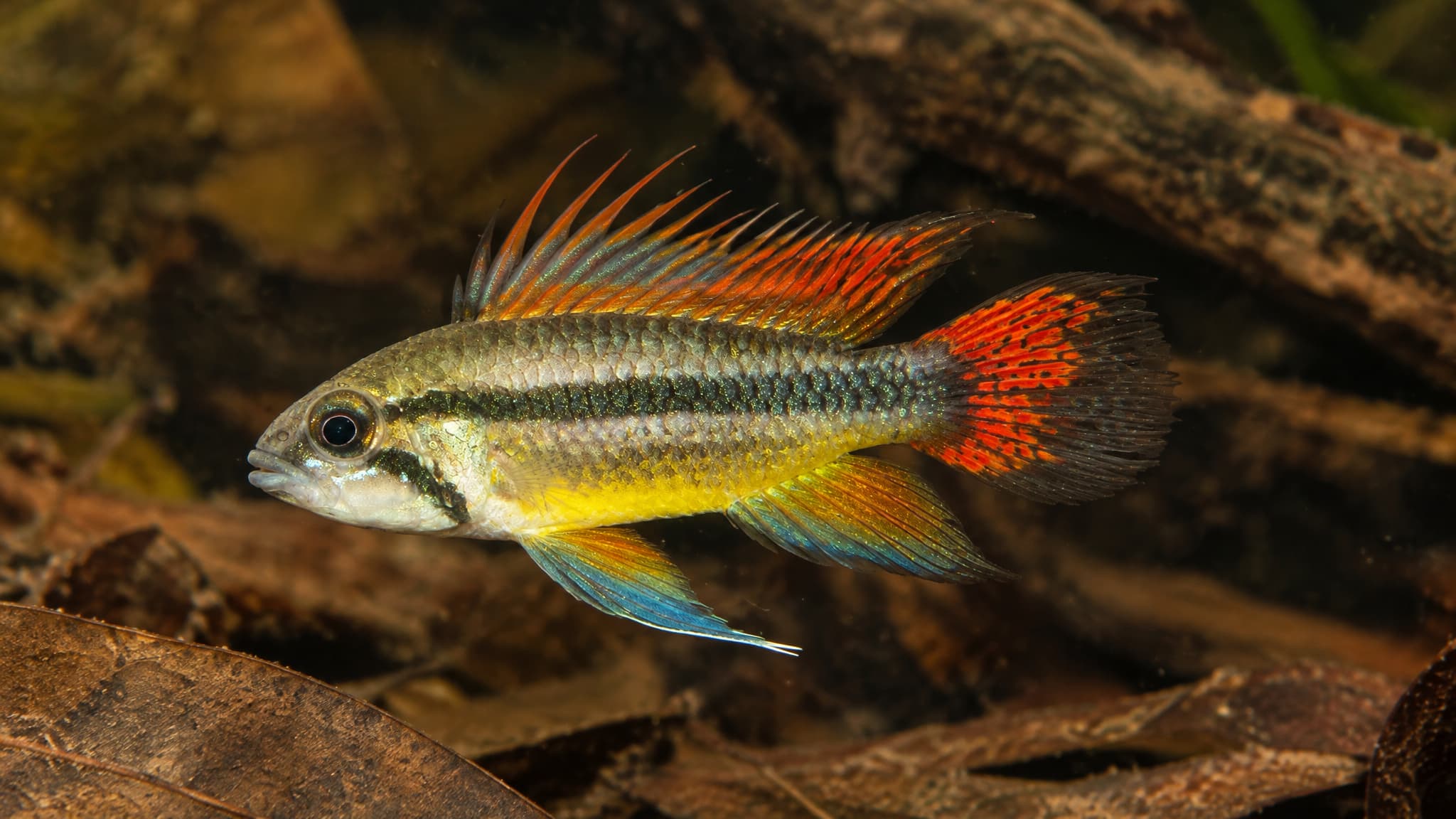
The cockatoo dwarf cichlid (Apistogramma cacatuoides), often simply called the cockatoo cichlid, is a small South American cichlid described by Hoedeman in 1951. Its name refers to the tall, crest-like front rays of the male's dorsal fin, which recall the crest of a cockatoo. The species was first said to come from Paramaribo in Suriname, but that locality was an error, and Kullander later placed its true origin in the Amazon basin. Males reach about 7.5 cm in standard length, while females stay near 5 cm, so an adult male can be roughly twice the size of a female. Males are also more colourful and carry longer, more extended fins. The aquarium trade offers many line-bred colour forms, such as 'double red' and 'orange flash'. The species lives in the upper Amazon basin, in tributaries of the Ucayali, Amazon and Solimões rivers from the Pachitea River to Tabatinga, in Peru, Colombia and western Brazil. It favours slow tributaries, backwaters, creeks and shallow lagoon-like waters in the rainforest, where fallen leaves pile up on the bottom and offer hiding places. Depending on place and season, the water may be black, white or clear. In the wild it is primarily carnivorous, picking mostly small bottom-dwelling invertebrates from the leaf litter and the substrate. Males are territorial and do not tolerate rival males. Smaller, submissive males can mimic the plainer look of females to slip into a territory and fertilise eggs, and they only grow full male finnage if the dominant male disappears. The female lays her eggs on the ceiling of a cave or under a leaf. FishBase records clutches of up to 80 eggs, and the female alone guards the eggs and the larvae, while the male patrols the wider territory. A brooding female can become very aggressive. In aquariums the cockatoo dwarf cichlid usually lives about 3 to 5 years; its lifespan in the wild is not documented. The IUCN lists the species as Least Concern. Most fish in the hobby are now captive-bred, and these are fairly tolerant of different water conditions, although some wild populations need soft, acidic water to breed.

View Details
Black phantom tetra
Fish

Black phantom tetra

Megalamphodus megalopterus

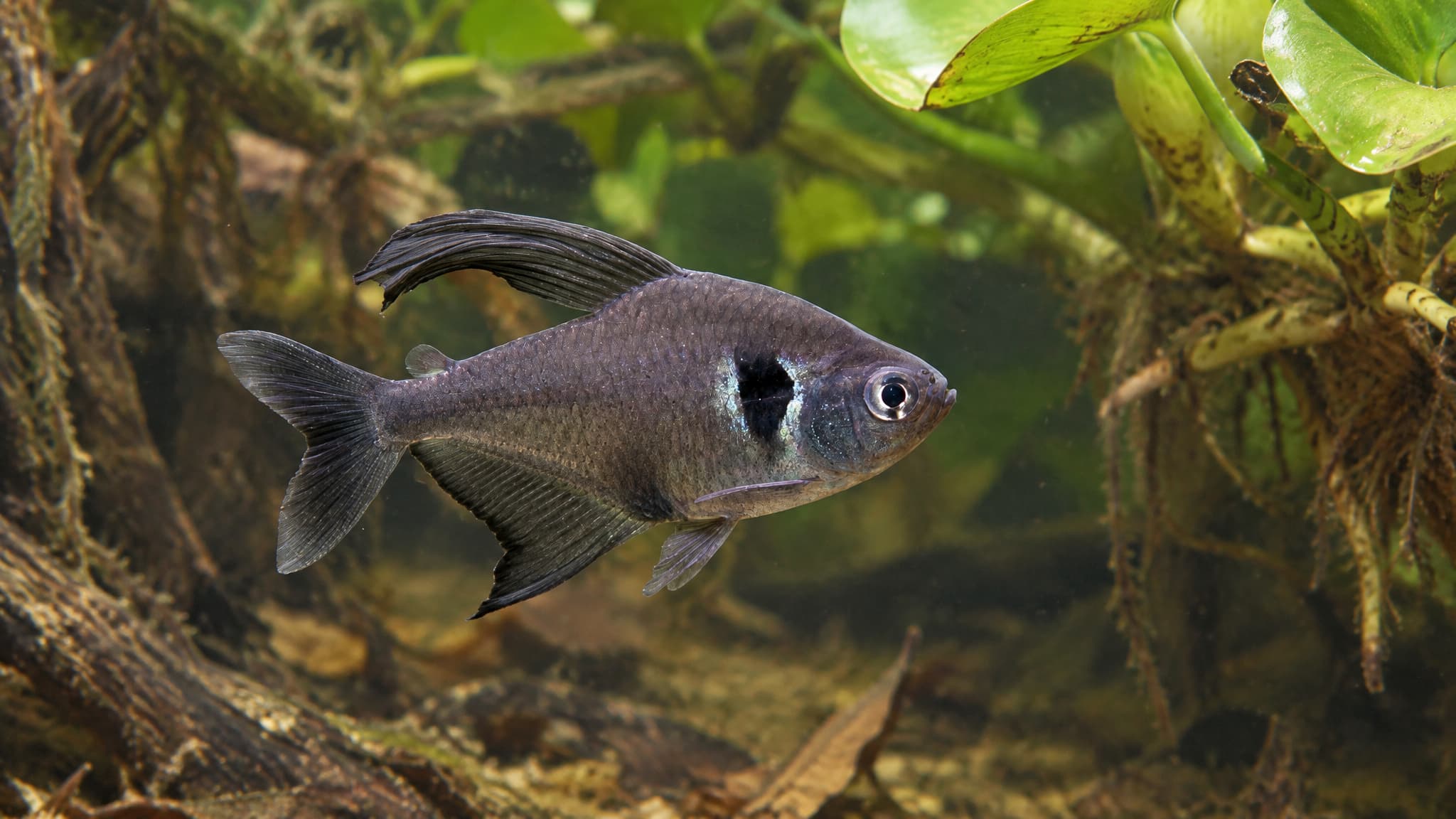
The black phantom tetra (Megalamphodus megalopterus) is a small South American characin long known in the aquarium hobby as Hyphessobrycon megalopterus. Described by Carl H. Eigenmann in 1915 from Cáceres, in Mato Grosso, Brazil, it was returned to the genus Megalamphodus in 2024 after phylogenomic work on the American tetras, and it is now placed in the family Acestrorhamphidae. Its species name means "large-finned", a fitting nod to the tall dorsal fin of the males. It is a compact, deep-bodied fish that reaches a maximum standard length of about 3.6 cm, although some sources cite up to 4.4 cm. The body is light grey to almost black, and a black shoulder blotch edged with iridescent silver sits just behind each gill cover. The sexes are easy to tell apart: males have black, enlarged dorsal, pelvic and anal fins with no red, while females are deeper-bodied and show reddish pelvic, anal and adipose fins. Wild populations vary in colour; the black form comes from the Guaporé basin, whereas fish in the southern Pantanal are naturally reddish. The species lives in the upper Guaporé (Iténez) and upper Paraguay river basins of Bolivia and Brazil, including the Pantanal wetland. It favours still or slow-moving water on floodplains, such as backwaters, ponds, small lakes and quiet tributaries, where it gathers among marginal vegetation, roots, fallen branches and floating water hyacinth. It is a peaceful shoaling fish that often forms mixed schools with other small characins, such as the serpae tetra (Megalamphodus eques), foraging near the shore. Its natural diet includes worms, small insects and crustaceans, and it has been described as omnivorous, possibly also taking filamentous algae and fallen fruit. Males form temporary dominance hierarchies and display to one another with spread fins. Breeding takes place in the wet season, when the floodplains fill. It is an egg-scattering free spawner that gives no parental care, and adults may eat their own eggs. In aquariums it usually lives about 3 to 5 years. The black phantom tetra is assessed as Least Concern by the IUCN. It is popular in the aquarium trade, but almost all fish sold are captive-bred, which limits pressure on wild stocks; a long-finned variety has also been developed by breeders.

View Details
Marbled Hatchetfish
Fish

Marbled Hatchetfish

Carnegiella strigata

The marbled hatchetfish (Carnegiella strigata) is a tiny South American characin with a deep, keel-shaped belly that gives the body a triangular, hatchet-like outline. It reaches a maximum standard length of about 3.5 cm, which still makes it the largest member of its genus. The body is golden silver, crossed by a pale stripe from head to tail, and the lower flanks carry a dark brown marbled pattern of diagonal bands. Colour, body depth and fin ray counts vary noticeably between populations. The species lives in the Amazon and Orinoco basins and in coastal rivers of the Guianas, with records from Brazil, Bolivia, Peru, Ecuador, Colombia, Venezuela, Guyana, Suriname and French Guiana. It appears to be restricted to blackwater habitats: soft, acidic streams stained tea-brown by humic substances, shaded by dense overhanging vegetation and floored with branches, roots and leaf litter. In the Rio Negro, where water levels can rise by up to 15 m in the wet season, the fish move into tributaries and flooded forest to feed and spawn. This is a pelagic, gregarious fish that swims in groups just below the surface. It is a surface predator of small invertebrates, taking terrestrial and aquatic insects, crustaceans and zooplankton. When threatened it can leap clear of the water, but it does not truly fly: studies show the large pectoral fins work only during the jump itself, and the fish can manage only one or two such escapes before it needs to rest. Females are larger and have a fuller abdomen than males. Eggs fall to the bottom or onto vegetation and hatch after about 36 hours at 25 °C. Breeding in captivity has rarely been recorded, so nearly all fish in the aquarium trade are caught in the wild, mostly in the Rio Negro basin of Brazil. The IUCN lists the marbled hatchetfish as Least Concern (assessed in 2020). The effect of the ornamental fish trade on wild subpopulations is not known. Several former subspecies are now treated as synonyms, but genetic work has found two distinct lineages in the Rio Negro that may one day be recognized as separate species.

View Details
Electric Yellow Cichlid
Fish

Electric Yellow Cichlid

Labidochromis caeruleus

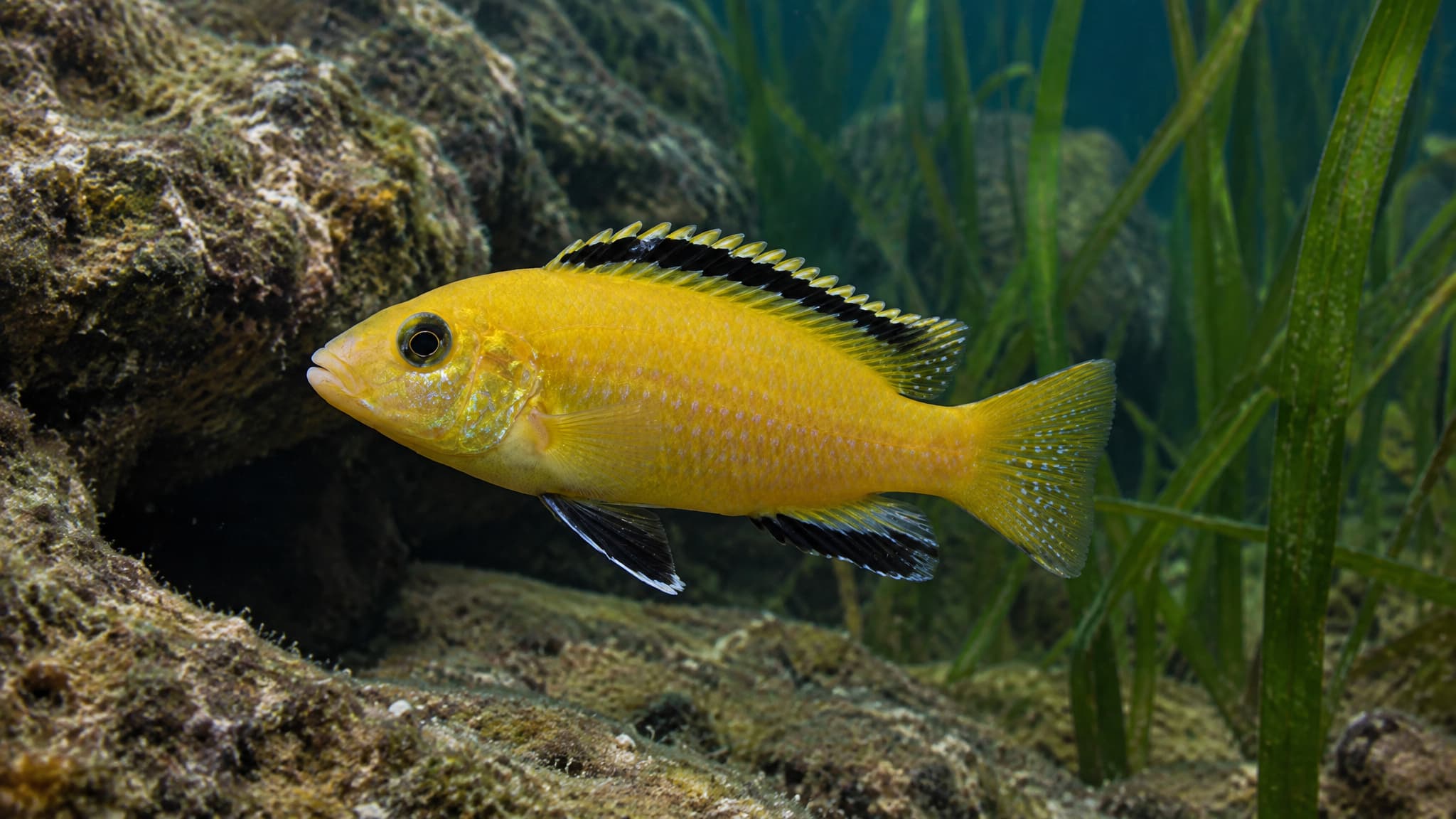
The electric yellow cichlid (Labidochromis caeruleus), also sold as the yellow lab or blue streak hap, is a small mbuna cichlid described by Geoffrey Fryer in 1956. FishBase gives a maximum of 8.1 cm standard length, while aquarium specimens are reported to reach about 10 cm. Wild fish are most often blue and white; the bright lemon-yellow morph that dominates the aquarium trade is rarer in nature. Mature fish show a black band along the dorsal fin and black markings on the anal fin, which become vivid only with age, and males are slightly larger than females. The species is endemic to Lake Malawi in East Africa, where it lives along the northwestern coast. It occupies two kinds of habitat: rocky shores with caves and crevices, and dense beds of Vallisneria plants. Reported depths range from about 10 to 30 m, usually around 20 m. The yellow form has been recorded only in a short stretch of coast between Charo and Lion's Cove. In the wild it feeds mainly on small invertebrates that live on and among rocks, such as snails, other molluscs, and insects and their larvae. By mbuna standards it is relatively peaceful, but males become territorial when breeding and dig a pit in the sand inside their territory. Like many Lake Malawi cichlids, it is a maternal mouthbrooder. The female spawns in the male's pit and takes the eggs into her mouth, where they are fertilized and incubated. Clutches usually hold about 10 to 30 eggs, depending on the female's size. She carries the brood for roughly three to four weeks and does not eat during that time. Young are released after about 25 days at 27 to 28 °C, or about 40 days at 23 to 24 °C, and reach sexual maturity at about 6 months. In aquariums, lifespans of about 6 to 10 years are reported. As an invertebrate feeder in a rocky lake habitat, it is part of the dense community of mbuna that crop the life growing on Lake Malawi's rocks. The IUCN Red List assessed it as Least Concern in 2018. It is widespread within its range and has no recognized major threats; most fish in the hobby are tank-bred rather than wild-caught. Different colour forms and other Labidochromis species can hybridize, so keepers are advised not to mix them.

View Details
Ram cichlid
Fish

Ram cichlid

Mikrogeophagus ramirezi

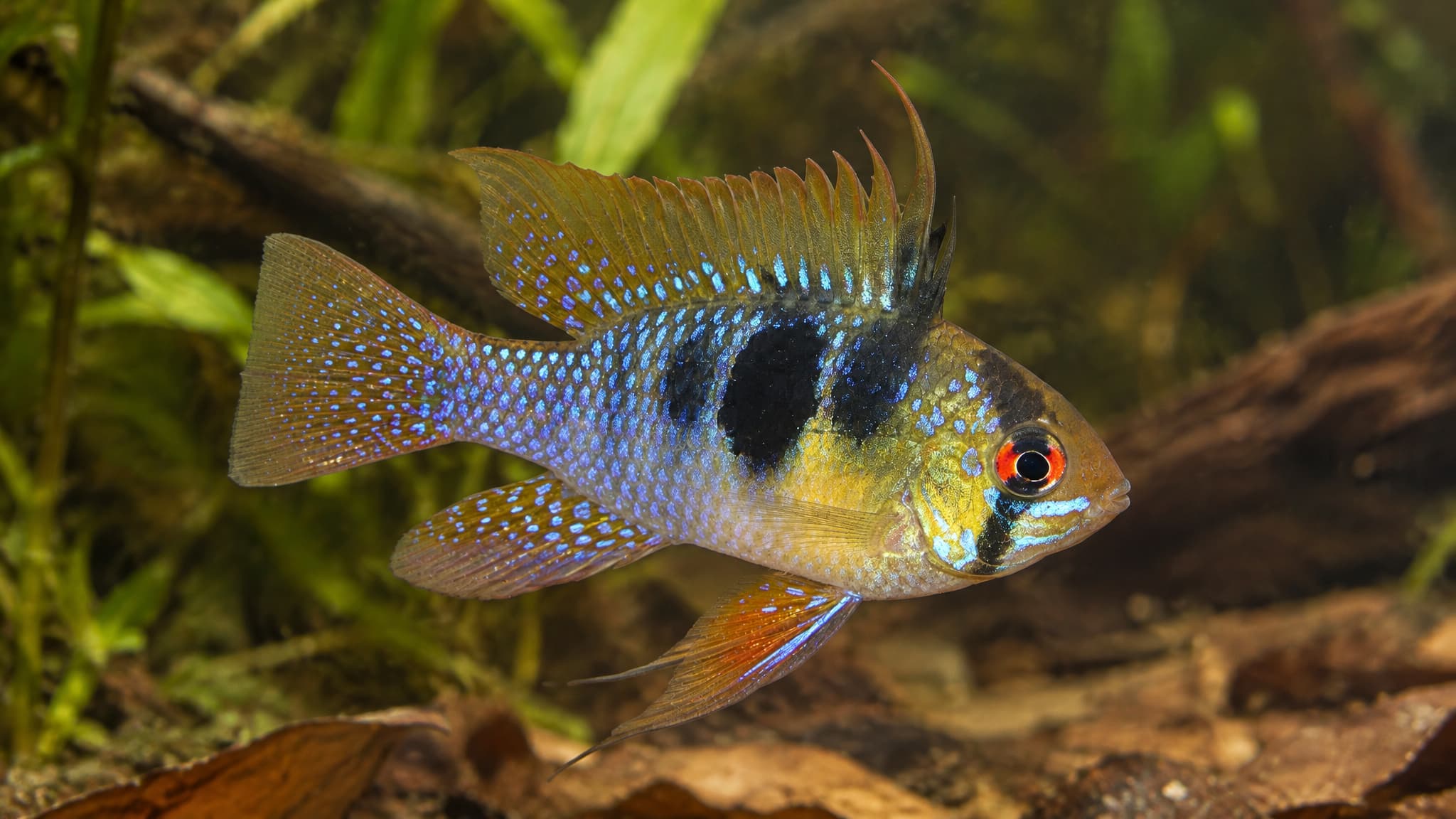
The ram cichlid (Mikrogeophagus ramirezi), also sold as the blue ram, German blue ram or butterfly cichlid, is a small South American cichlid described by Myers and Harry in 1948. It was first named Apistogramma ramirezi and has passed through several genera before settling in Mikrogeophagus. The name honours Manuel Ramirez, one of the first people to collect and import it for the aquarium trade. It is a compact, deep-bodied fish that reaches about 4 cm in standard length, with FishBase recording a maximum of 4.2 cm. Males are a little larger than females, carry longer, more extended dorsal fin rays and show more intense colour. Females usually develop a pink to red patch on the belly, especially as spawning approaches, and have a blue sheen around the dark spot below the dorsal fin. The species is endemic to the Orinoco River basin, in the llanos savannas of Venezuela and Colombia. This is a vast seasonally flooded landscape of grassland and gallery forest with marked wet and dry seasons. The fish lives in slow, warm, acidic and very soft water, clear or stained by tannins, usually where aquatic or submerged plants offer cover. Rams feed close to the bottom, taking mouthfuls of fine substrate and sifting out small food organisms. In aquariums it does best on live and frozen foods such as bloodworms, brine shrimp and water fleas. Juveniles live in groups, but adults form monogamous pairs that hold a territory, and males do not tolerate rival males. Both parents care for the brood. The female lays rows of adhesive eggs, 0.9 to 1.5 mm across, on a flat stone or in a pit in the gravel, and clutches usually hold 150 to 300 eggs, with up to 500 reported. Eggs hatch in about 40 hours at 29 °C, and the larvae stay in place for about five days before swimming in a school guarded by the parents. In aquariums, rams live up to about 3 years. The IUCN lists the ram cichlid as Least Concern. Most fish in the trade are bred in captivity, including gold, electric blue, long-finned and balloon-bodied strains, many of which have lower fertility, weaker health and poorer brood care than wild-type fish.

View Details
Peppered Corydoras
Fish

Peppered Corydoras

Hoplisoma paleatum

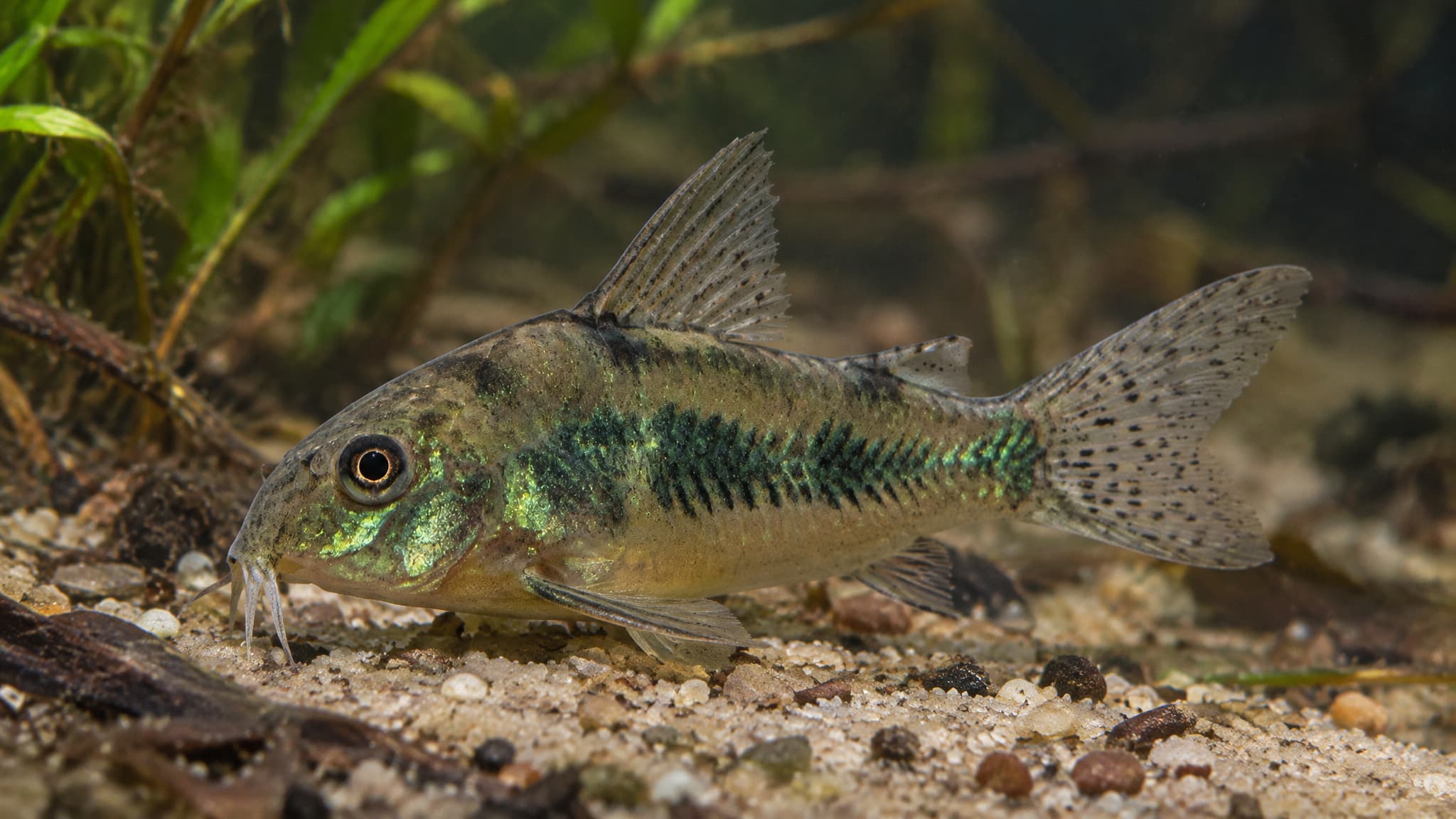
The peppered corydoras (Hoplisoma paleatum) is a small armoured catfish of the family Callichthyidae and one of the most familiar bottom-dwellers in community aquariums. Its stocky body is covered by overlapping bony plates rather than scales. The back is dark olive-brown to greenish, the flanks are yellowish-green with a metallic sheen and the belly is pale. Large irregular dark blotches, sometimes merging into bars, and many fine dark spots give the "peppered" look, while the grey fins carry rows of dark streaks. Females are larger and rounder, reaching about 7.1 cm in standard length against about 6.6 cm in males, whose dorsal and pectoral fins are relatively longer. An albino form is common in the aquarium trade. The species was described by Leonard Jenyns in 1842 from specimens collected by Charles Darwin during the voyage of HMS Beagle. For most of its history it was known as Corydoras paleatus, but a 2024 phylogenomic study of the subfamily Corydoradinae placed it in the revived genus Hoplisoma, a name meaning "armoured body". It is native to southern South America, in the lower Paraná River basin and coastal rivers of southern Brazil, Uruguay and Argentina, with records from Paraguay. It lives in rivers and their tributaries as well as standing waters such as ponds, pools and small lakes, in a subtropical climate with relatively cool water. Peppered corydoras are peaceful and social, foraging in groups over soft bottoms. They are opportunistic omnivores that sift the substrate for worms, small crustaceans, insect larvae and plant matter. They are facultative air-breathers: they dart to the surface to gulp air, which is absorbed through the gut as an extra source of oxygen. Males can produce sounds with their pectoral fins during courtship and when disturbed. During spawning the pair adopts a characteristic "T-position". The female then carries 2 to 4 eggs between her pelvic fins until they are fertilized and sticks them to plants, rocks or glass, repeating the process until about 100 eggs have been laid. The eggs hatch in about 3 days. A lifespan figure is not reported in the scientific sources consulted. As a bottom forager feeding low in the food web, it takes part in recycling organic matter and small invertebrates on the riverbed. The IUCN Red List assessed it as Least Concern in 2020, and nearly all fish sold in the hobby are captive-bred.

View Details
Clown Triggerfish
Fish

Clown Triggerfish

Balistoides conspicillum

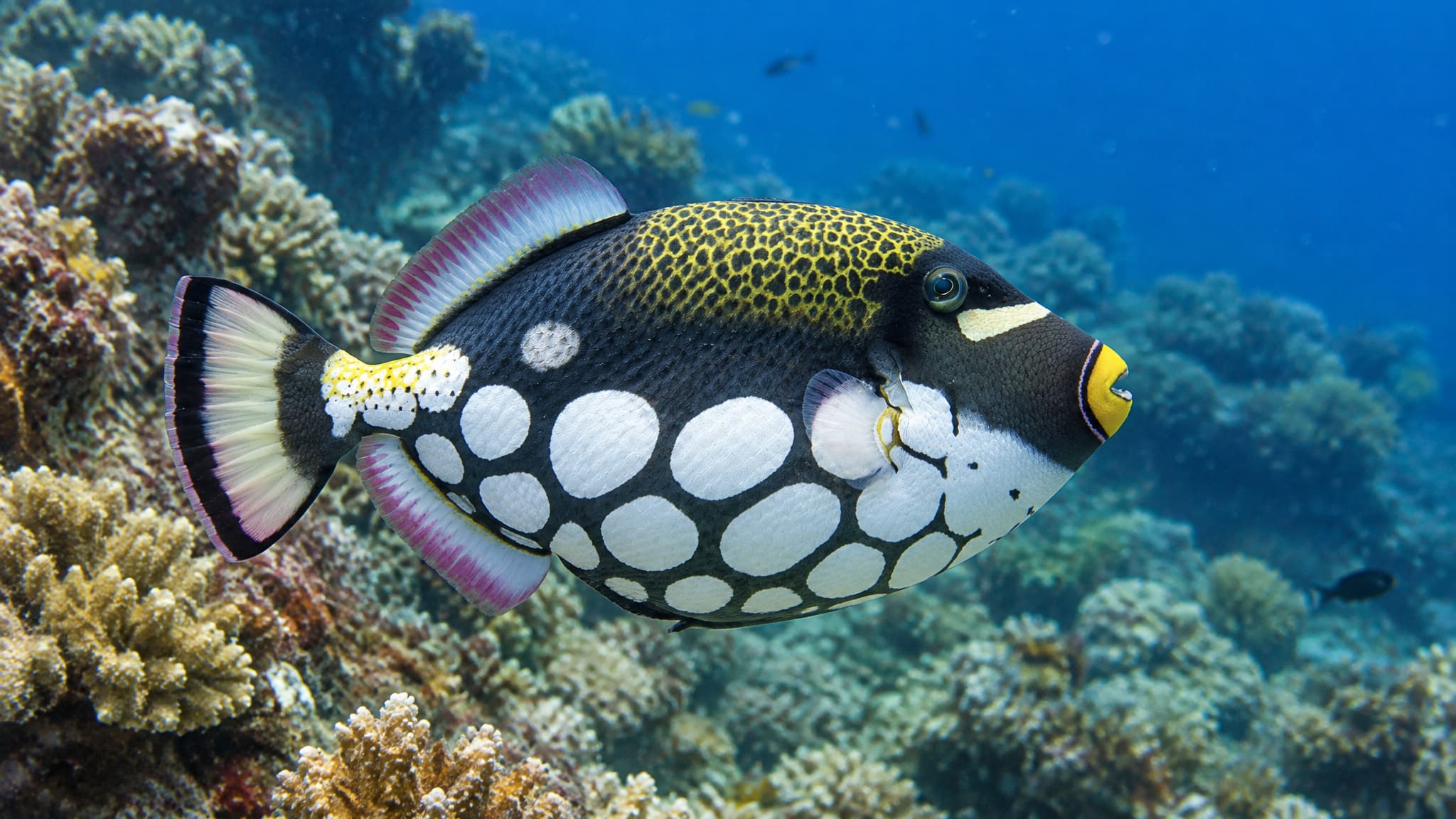
The clown triggerfish (Balistoides conspicillum), also called the bigspotted triggerfish, is one of the most striking reef fishes of the Indo-Pacific. Its body is mostly black, with large round white spots covering the lower half, a yellowish reticulated pattern on the back, a pale band across the snout in front of the eyes and bright orange-yellow lips. The tail is black with a broad pale band. Juveniles are black with white spots and a yellow snout. Adults reach up to about 50 cm in total length, and like other triggerfishes it has three dorsal spines, the first of which can be locked upright. This marine species ranges from East Africa eastward through northern Australia to Samoa, and north to southern Japan. It lives on clear seaward reefs, usually in coral-rich areas next to steep drop-offs, at depths of about 1 to 75 m. Although widely distributed, it is relatively uncommon on any single reef, and vagrants have been recorded as far south as Sydney. The clown triggerfish feeds on hard-bodied bottom invertebrates, including sea urchins, crabs and other crustaceans, mollusks and tunicates, which it crushes with strong jaws and teeth. It is usually seen alone and is very aggressive and territorial. When threatened, it dives into a hole or crevice and wedges itself in place by raising its locking dorsal spine. Its bold colors may advertise a well-defended territory. Detailed data on wild reproduction and lifespan are limited. Like other triggerfishes, it lays eggs on the bottom, and the female is reported to guard them. In aquariums it has lived at least about 8 years, and it is thought to be capable of living longer. As a predator of sea urchins and other invertebrates, it helps shape reef invertebrate communities. It is listed as Least Concern by the IUCN (assessed 2022). It is among the most prized marine aquarium fishes and is a minor commercial food fish, although ciguatera poisoning has been reported from eating it.

View Details
Foxface Rabbitfish
Fish

Foxface Rabbitfish

Siganus vulpinus

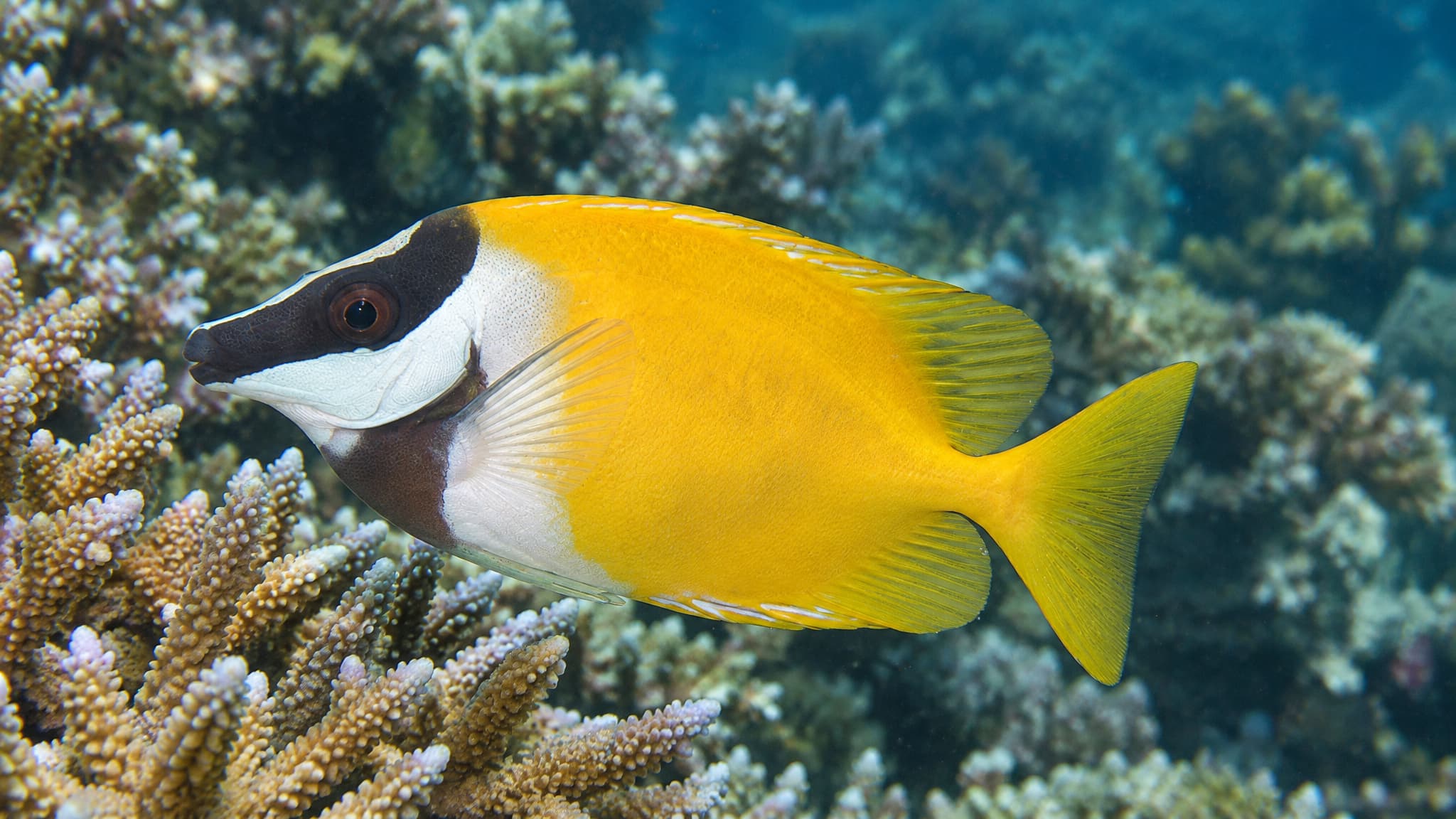
The foxface rabbitfish (Siganus vulpinus) is a marine ray-finned fish in the rabbitfish family, Siganidae. It is also called the foxface, the common foxface or the black-face rabbitfish. It was first described in 1845 as Amphacanthus vulpinus and has also been placed in the genus Lo. It is very similar to the blotched foxface (S. unimaculatus), which has a dark spot on its side, and some researchers think the two may be one species. Appearance The body is deep and flattened from side to side. The snout is long, the head profile is clearly concave, and the tail fin is only slightly forked. Most of the body is bright yellow-orange, while the head and front of the body are white. A dark chocolate band runs from the first dorsal spine through the eye to the chin, and the chest is also dark. Under stress or at night, the fish can quickly change to a mottled brown. It grows to about 25 cm, though 20 cm is more typical. Its stout fin spines carry venom and can give a very painful sting. Distribution and habitat The species lives in the tropical western Pacific and the far eastern Indian Ocean. Its range includes the western Philippines, Indonesia, New Guinea, northern Australia and the Great Barrier Reef, New Caledonia, and the Caroline and Marshall Islands. It is found in lagoons and on seaward reefs with rich coral growth, from the surface down to about 30 m. It is often seen among staghorn Acropora corals. Diet and behavior The foxface is mainly a grazing herbivore. It feeds on algae growing on the dead bases of branching corals and may also take some zooplankton. Juveniles and young adults can form large schools among Acropora corals, while adults usually live in pairs. By grazing, it helps keep thick mats of algae from smothering living coral. Reproduction and lifespan Little has been published about how this species breeds. FishBase estimates high resilience, with populations able to double in under 15 months. Breeding in captivity has not been reported. Aquarium specimens commonly live about 5 years. Conservation The IUCN lists the foxface rabbitfish as Least Concern (assessed in 2015). It is caught in small commercial fisheries and is popular in the aquarium trade.

View Details
Bicolor Blenny
Fish

Bicolor Blenny

Ecsenius bicolor

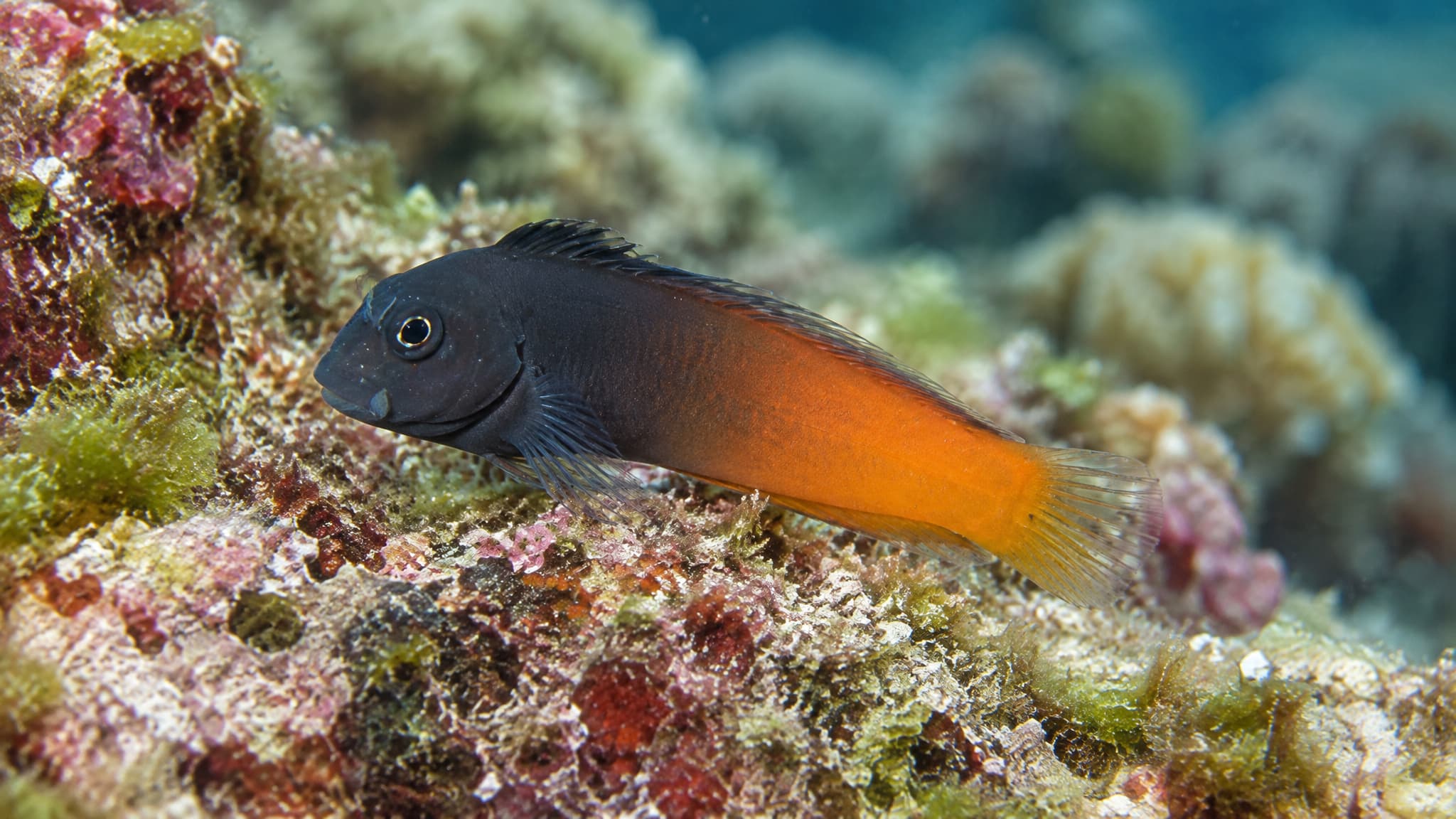
The bicolor blenny (Ecsenius bicolor), also called the bicolor combtooth blenny, is a small reef fish in the combtooth blenny family, Blenniidae. It has an elongated body and grows to about 11 cm in total length. It comes in three colour phases. The best-known phase is dark grey to black at the front and yellow to orange toward the tail. In the other two phases the fish is dark above, with a broad white band along the side and a dusky belly, and the tail may or may not be yellow. All three phases have a curved pinkish mark behind the eye. The species is widespread in the Indo-West Pacific. Its range runs from the Maldives and Myanmar through Indonesia east to the Phoenix Islands and Samoa, north to the Ryukyu Islands, and south to northern Australia, northern New Zealand and the Kermadec Islands. In Australia it is found from the central coast of Western Australia to northern New South Wales. It lives in clear lagoons and on seaward reefs with a mix of coral and algae-covered rock. It is usually found between 1 and 25 m deep, in places that are not exposed to heavy waves. E. bicolor feeds mostly on detritus. It uses its comb-like teeth to rake small particles of organic matter out of the turf algae that grows on top of coral heads. Often it feeds inside algae patches that territorial damselfishes keep and defend. Individuals often rest on their pectoral fins on top of coral heads (known as bommies). They also shelter in holes, crevices and empty worm tubes, and dart inside when alarmed. They live alone, in pairs or in small family groups, and between feeding sessions they chase one another around their territory. Like other combtooth blennies, this species lays eggs. In the wild, males and females form pairs and lay sticky eggs in a crevice, where the eggs are guarded until they hatch. Its lifespan in the wild has not been documented. Aquarium sources report that captive fish live for several years, with estimates of about 4 to 6 years when well cared for. By grazing on detritus and turf algae, the bicolor blenny helps recycle organic material on coral reefs. It is a hardy fish and is popular in the marine aquarium trade. The IUCN Red List classifies it as Least Concern because it has a broad range and is common. FishBase rates its resilience as high and its vulnerability to fishing as low.

View Details
Copperband Butterflyfish
Fish

Copperband Butterflyfish

Chelmon rostratus

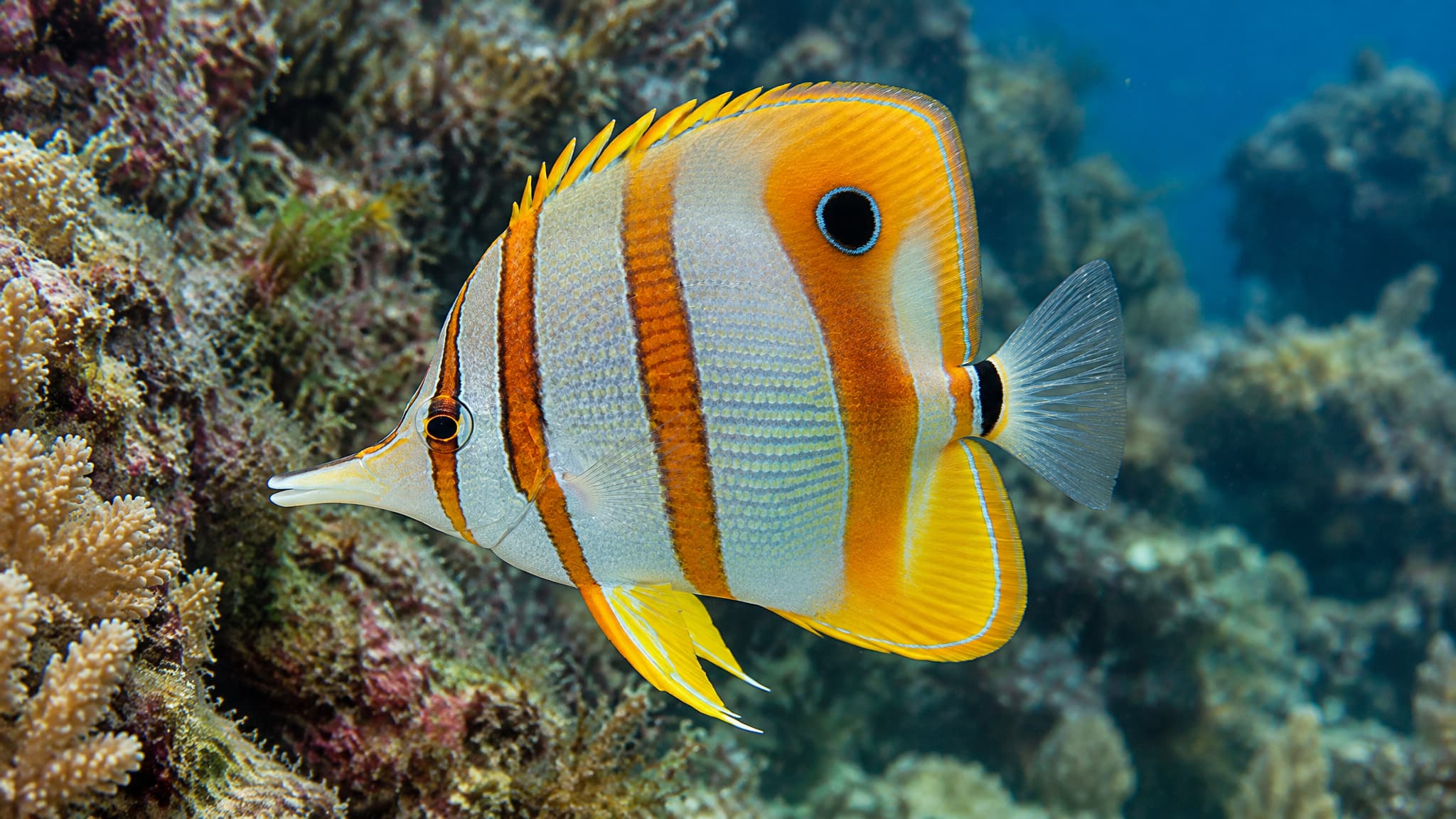
The copperband butterflyfish (Chelmon rostratus), also called the beaked coralfish, is a butterflyfish in the family Chaetodontidae. It is one of three species in the genus Chelmon, all of which have a long, beak-like snout. Adults reach about 20 cm in total length. Their body is tall, disc-shaped and flattened from side to side. The fish is easy to recognize. Its silvery-white body has broad vertical bars, orange to copper in color and edged in black. A narrower copper bar runs through the eye. At the base of the soft dorsal fin is a white-ringed black eyespot, and a thin black bar crosses the base of the tail. The false eye is thought to confuse predators about which end is the head. The species lives in the Western Pacific, from the Andaman Sea to the Ryukyu Islands and Australia. It is found on rocky shores, coral reefs, estuaries and silty inner reefs, usually at depths of 1 to 25 m. FishBase lists it as reef-associated and able to live in both marine and brackish water. Juveniles are more secretive than adults and stay in shallower water. The long snout lets the fish pick small bottom-dwelling invertebrates, such as worms and small crabs, out of crevices and holes in rock and coral. Adults are seen alone or in pairs, and the species is reported to form lasting pairs. By picking off small invertebrates, it helps shape the community of tiny animals living among reef rubble. The maximum reported age is about 10 years. The species has not been bred in home aquariums. It is popular in the marine aquarium trade but is hard to keep, and many wild-caught fish do poorly in captivity. The IUCN Red List classifies it as Least Concern.

View Details
Moorish Idol
Fish

Moorish Idol

Zanclus cornutus

The Moorish idol (Zanclus cornutus) is one of the most recognizable coral reef fishes. It is the only species in the genus Zanclus and the only living member of the family Zanclidae. Its body is deep, disc-shaped and strongly flattened from side to side. It is white at the front and yellow toward the rear, with two broad black vertical bars and a black tail. A long tubular snout has a yellow-orange saddle on top and ends in a small mouth with long, bristle-like teeth. The most striking feature is the third dorsal-fin spine, which forms a long white whip-like filament shaped like a sickle. The genus name comes from the Greek word for sickle. The epithet cornutus, meaning horned, refers to the small bony bumps in front of the eyes of adults, which are larger in males. Adults usually reach about 18–24 cm, and the largest recorded are about 30 cm long. Some Heniochus butterflyfishes look very similar. The species is widespread across the Indo-Pacific, from East Africa to the Hawaiian Islands, southern Japan and Lord Howe Island. It also occurs in the eastern Pacific from the Gulf of California to Peru. It lives in murky inner lagoons, reef flats and clear seaward coral and rocky reefs, from the shallows to about 180 m deep. A few individuals have been seen off southeast Florida, where the species is not native. Moorish idols are active by day and usually rest near the reef bottom at night. They are seen alone, in pairs or in small groups of two or three, and sometimes in large schools. They pick small encrusting animals off the reef, especially sponges, along with tunicates, other invertebrates and some microalgae. This makes them specialized grazers of reef surfaces. They spawn in open water, releasing eggs and sperm that drift with the currents. The larvae spend an unusually long time drifting in the open ocean and grow to about 7.5 cm before settling on the reef. This long drifting stage explains the species' huge range and why its color pattern is the same everywhere. Wild lifespan is not well documented. The Moorish idol is listed as Least Concern by the IUCN. It is popular in the aquarium trade, but it rarely survives in captivity because its specialized diet is very hard to provide.

View Details
Shortfin Mako
Fish

Shortfin Mako

Isurus oxyrinchus

The shortfin mako (Isurus oxyrinchus) is a large, streamlined pelagic shark found in temperate and tropical oceans worldwide. It has a metallic blue dorsal surface, white underside, pointed snout, and short pectoral fins that distinguish it from the longfin mako. Like other lamnids, it is regionally endothermic—it can maintain muscle temperature several degrees above surrounding water—supporting sustained high-speed swimming and making it one of the fastest sharks in the sea. Shortfin makos are apex predators of the open ocean, feeding mainly on fast pelagic fishes such as tunas, mackerel, and bluefish, along with squids, billfish, and occasionally marine mammals. They are largely solitary, highly migratory, and may travel thousands of kilometers while following prey and warmer water masses. Females give birth to live young after a long gestation of about 15–18 months, with litters typically of 4–16 pups; sexual maturity is reached late (around 8 years for males and 18 years for females). The species is heavily impacted by commercial and recreational fisheries, where it is targeted for meat and fins or taken as bycatch on pelagic longlines. IUCN assesses the global population as Endangered, with an estimated decline of roughly 47% over three generations driven by overfishing and slow recovery due to low reproductive output.

View Details
Flame Angelfish
Fish

Flame Angelfish

Centropyge loriculus

The flame angelfish (Centropyge loriculus, often spelled C. loricula) is a small pygmy angelfish of the family Pomacanthidae. Its body is a vivid orange-red that turns more orange-yellow toward the middle of the flanks. It has a tall black blotch behind the pectoral fin and usually five narrow black bars. The rear of the dorsal and anal fins carries alternating black and blue-purple streaks, which are stronger in males. Most adults measure about 10 cm, though lengths up to 15 cm have been reported. The species lives in the tropical western and central Pacific. Its range runs from Palau east to the Marquesas and the Hawaiian Islands, and south to the northern Great Barrier Reef and the Coral Sea. It is most common around Palau and the Caroline, Marshall and Society Islands. It lives in coral-rich areas on seaward reefs and in lagoons, usually 5 to 60 m deep, where sea temperatures range from about 23 to 30 °C. The flame angelfish mainly grazes on benthic algae and detritus. It is shy and seldom moves far from crevices and coral heads that give it cover. Reef surveys find it at only a modest share of sites, but where it does occur several individuals are often seen together. Grazing on algal films makes it one of the many small herbivores that help keep reef surfaces in balance. Like other Centropyge, it is a protogynous hermaphrodite. Individuals mature as females, and a larger, dominant fish can later change into a male. Each male defends a territory holding a harem of two or more females. Breeding in aquariums is difficult and rarely reported. Aquarium sources give a lifespan of about 5 to 7 years or more in captivity. The species is listed as Least Concern by the IUCN. It is one of the most popular dwarf angelfishes in the marine aquarium trade, and much of the supply comes from Pacific islands. Colour forms differ slightly between archipelagos, and genetic work has been done on how these populations are connected. In Hawaii, the USGS also lists a transplanted occurrence in Kāne'ohe Bay.

View Details
Yellowhead Jawfish
Fish

Yellowhead Jawfish

Opistognathus aurifrons

The yellowhead jawfish (Opistognathus aurifrons) is a small, slender burrowing fish of the tropical western Atlantic. Its head, nape and the front of the dorsal fin are a bright yellow that fades into a pale bluish-grey body sprinkled with tiny pale blue dots, and a pair of dark spots often marks the chin. Adults usually reach about 10 cm in total length, although lengths up to about 12.7 cm have been recorded. The species ranges from southern Florida and the Bahamas through the Caribbean to northern South America, and some sources extend the range across the Gulf of Mexico to Brazil. It lives on sand and coral-rubble flats near reefs in clear water, usually at depths of about 3 to 40 m, and often forms loose colonies of neighbouring burrows. Each fish digs its own burrow using its large mouth to carry sand, shell fragments and small stones, reinforcing the walls and the entrance with larger pieces; burrows can be up to about 30 cm deep. By day the jawfish hovers vertically just above its hole, picking zooplankton such as small crustaceans and drifting fish eggs from the water, and it retreats tail-first into the burrow at the first sign of danger. It defends its patch from small intruders by gaping its mouth at them. Pairs are reported to be monogamous. The male courts the female by swimming in an arched posture with spread fins, and spawning takes place inside his burrow. He then incubates the sticky ball of eggs in his mouth until they hatch after roughly a week, and the larvae drift in the plankton. Lifespan in the wild is not well documented; in aquariums, individuals commonly live around five years or more. As a plankton feeder and a prey item for larger reef predators, the yellowhead jawfish links open-water production to the reef floor, and its digging reworks sediment on sandy reef margins. The IUCN Red List assesses it as Least Concern, with no major threats identified, although it is collected for the marine aquarium trade, where it has also been bred in captivity.

View Details
Banggai Cardinalfish
Fish

Banggai Cardinalfish

Pterapogon kauderni

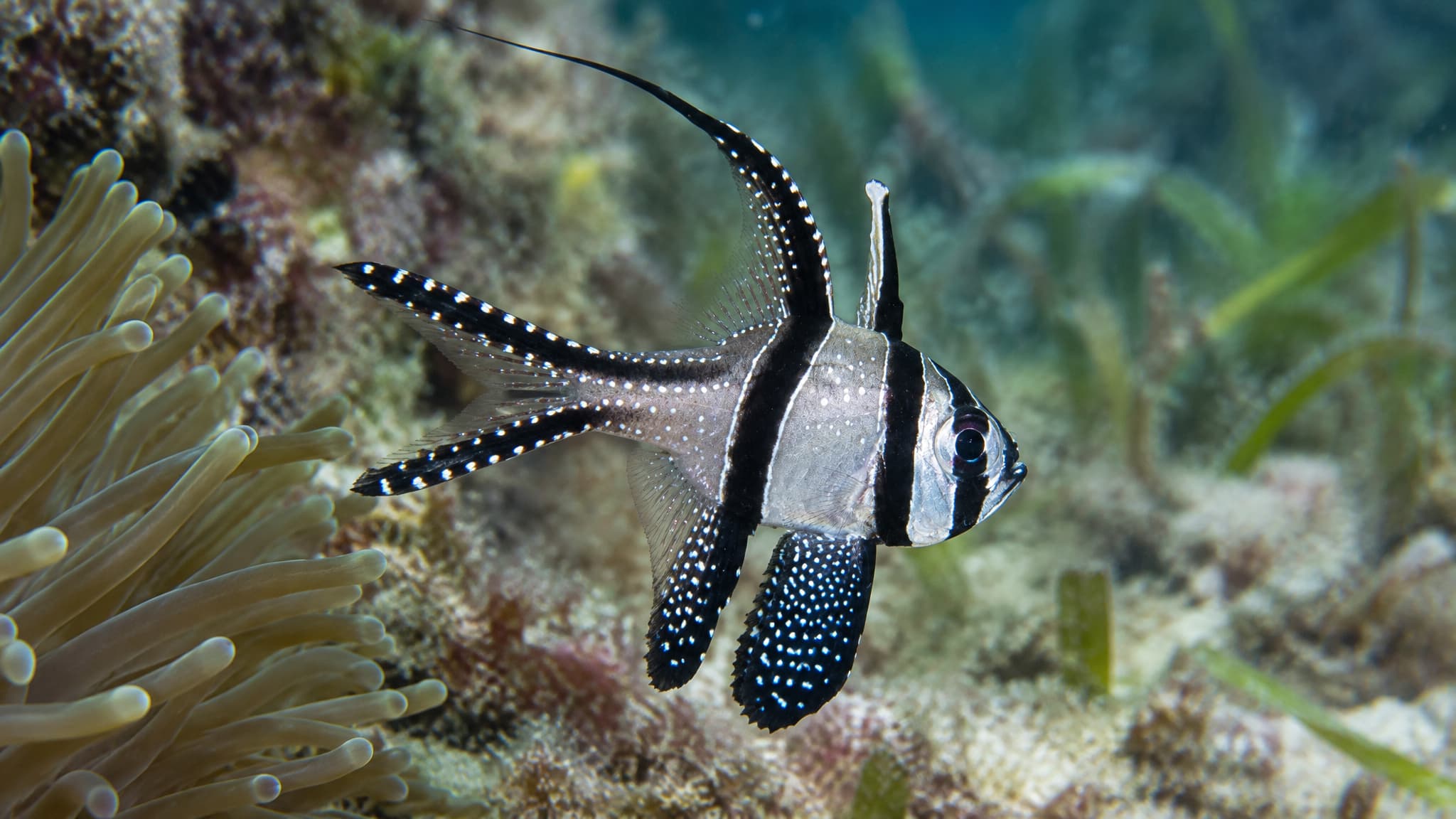
The Banggai cardinalfish (Pterapogon kauderni) is a small, striking marine cardinalfish and one of the best-known species in the family Apogonidae. Its silvery body is short, deep and flattened from side to side. Bold black bars run across it, and it is covered in whitish spots. Other cardinalfishes lack its combination of a tasseled first dorsal fin, long rays on the second dorsal and anal fins, and a deeply forked tail. Females reach about 8.6 cm in total length. The species is endemic to the Banggai Archipelago off central Sulawesi, Indonesia. A few populations also live on nearby small islands and along the Luwuk coast. Because it has no free-swimming larval stage, populations stay isolated from each other. It lives in very shallow water, usually 1–2 m deep and rarely below 16 m. It is found in seagrass beds and coral areas, where groups hover near long-spined sea urchins, sea anemones and corals and hide among the spines when threatened. Through the ornamental trade, it has also been introduced outside its native range. Unusually for a cardinalfish, it is active by day. It forms groups and returns to its home shelter when disturbed. It is an opportunistic carnivore that feeds mainly on copepods and also eats other plankton and small bottom-dwelling animals when they are plentiful. Reproduction is remarkable. Females often start courtship, and the male broods the eggs in his mouth. He then releases fully formed juveniles instead of larvae. Each clutch is small, with roughly 12–40 eggs, and fish mature at about 4 cm. NOAA reports a typical lifespan of 2.5–3 years, with a maximum of about 5 years. As a small plankton-feeder, it links tiny crustaceans to larger reef predators. It is also part of a shelter network that includes sea urchins and anemones. The IUCN lists the species as Endangered, and it has been listed as Threatened under the US Endangered Species Act since 2016. The main threats are heavy collection for the aquarium trade and the destruction of its shallow habitats. Its tiny range and low dispersal make it especially vulnerable. Captive-bred fish are now widely available to aquarists.

View Details
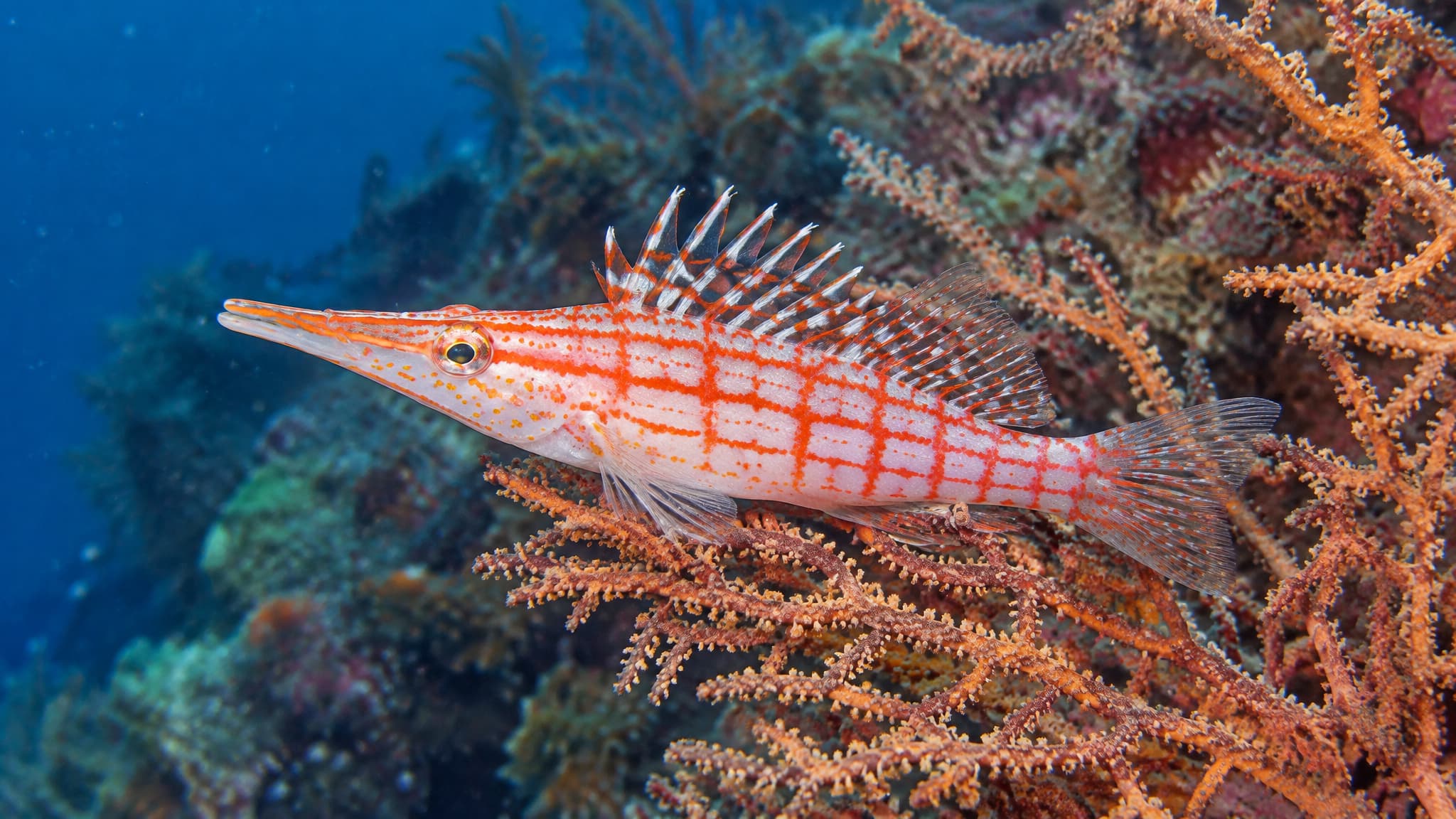
Longnose Hawkfish
Fish

Longnose Hawkfish

Oxycirrhites typus

The longnose hawkfish (Oxycirrhites typus) is a small reef fish in the hawkfish family Cirrhitidae. It is the only member of its genus. It grows to about 13 cm in total length. It is easy to recognise by its long, pointed snout and its pattern of red stripes and bars, which form a net-like grid over a whitish body. Like other hawkfishes, it has tufts of small cirri at the tips of its dorsal fin spines. The species is widespread but not often seen. In the Indo-West Pacific it ranges from the Red Sea and South Africa to Hawaii, north to southern Japan and south to New Caledonia and Australia. It also occurs in the Eastern Pacific, from the Gulf of California to northern Colombia and the Galápagos Islands. It lives on outer reef slopes at depths of about 10 to 100 m and is most common below 25 m. This bottom-dwelling hunter spends much of its time perched on the branches of gorgonian sea fans and black corals, often where currents are strong. From these perches it waits for small benthic and planktonic crustaceans and darts out to catch them. It is territorial. Despite its narrow snout, an adult can open its mouth wide enough to swallow small fish. Pairs form distinct bonds, and their monogamy has been described as both facultative and social. Spawning is pelagic: the pair rises a short distance (less than 0.25 m) above the bottom and releases eggs and sperm into the water in a burst that lasts only one or two seconds. Reliable figures for its lifespan have not been published. The longnose hawkfish is listed as Least Concern by the IUCN and has no known major threats. It is collected for the aquarium trade, but probably not in numbers that would hurt wild populations. Because it depends on gorgonians and black corals, damage to those corals from climate change or habitat destruction could reduce local numbers.

View Details
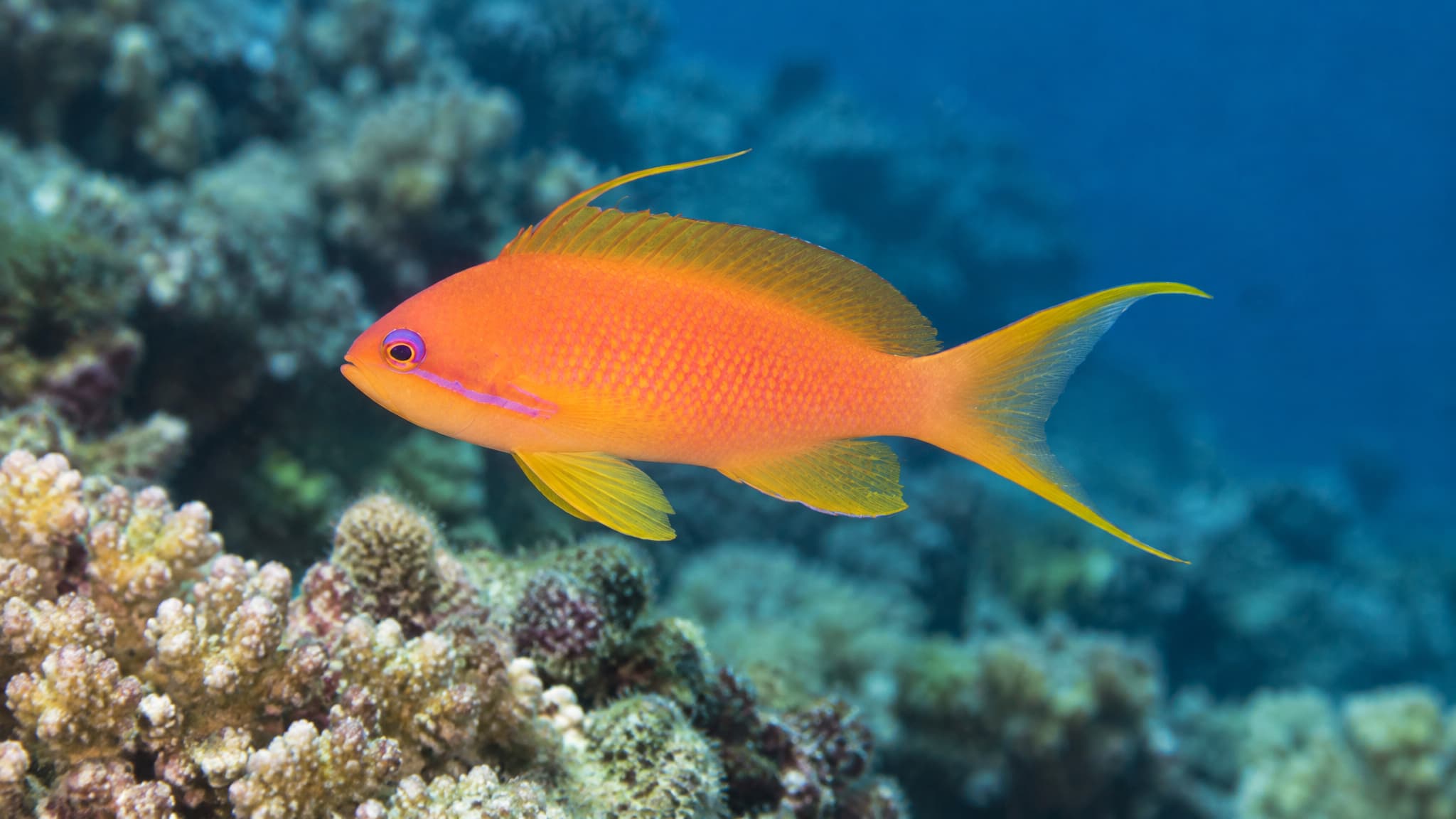
Sea Goldie
Fish

Sea Goldie

Pseudanthias squamipinnis

The sea goldie (Pseudanthias squamipinnis), also called the lyretail anthias, scalefin anthias or orange basslet, is a small, brightly coloured reef fish of the Indo-West Pacific. The sexes look very different. Females are yellow-orange, reach only about 7 cm and have an orange stripe running from the eye across the cheek. Males grow to roughly 15 cm, turn magenta to purplish, carry a reddish-purple patch on the pectoral fin and develop a long third dorsal-fin spine plus extended upper and lower tail lobes that give the lyre-shaped tail. The dorsal fin has 10 spines and 15–17 soft rays, and colour patterns vary from place to place. The species ranges from the Red Sea and Natal, South Africa, east to Niue, north to Japan and south to Australia, where it occurs from the Great Barrier Reef to New South Wales and Lord Howe Island. It lives over coral outcrops and patch reefs in clear lagoons, channels and outer reef slopes, from near the surface to about 55 m, mostly at 5–35 m. Some ichthyologists suspect that populations across this range may include more than one species. Sea goldies form large, shimmering aggregations above the reef, often along reef edges and drop-offs. They pick zooplankton from the water column and dart back into soft corals, holes and crevices when threatened. The species is a protogynous hermaphrodite: every fish starts life as a female. Groups are built from harems of females controlled by territorial males. When a dominant male disappears, a large female can change sex within about two to four weeks; sex change typically happens at around 5 cm. Males spawn nightly with successive females and release eggs and sperm into open water, with no parental care. FishBase gives a generation time of about 1.8 years. Lifespan in the wild is poorly documented, and aquarium sources report about 5–7 years in captivity. As abundant planktivores, sea goldies move energy from plankton into the reef food web. The IUCN lists the species as Least Concern. It supports minor commercial fisheries and is widely collected for the marine aquarium trade.

View Details
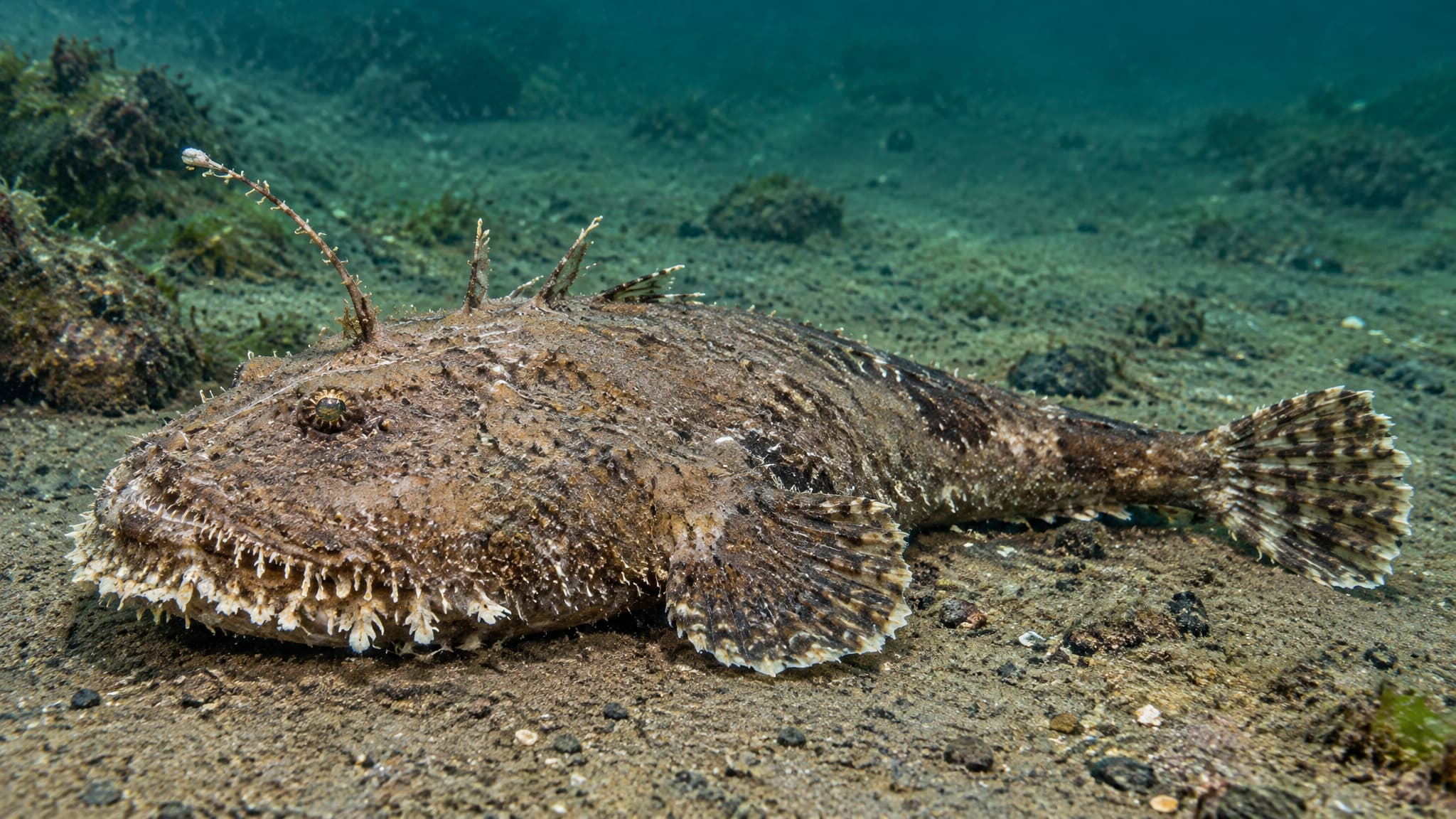
Angler (Monkfish)
Fish

Angler (Monkfish)

Lophius piscatorius

The angler, also called the monkfish or white anglerfish, is a large bottom-dwelling fish. Its head and body are flattened from top to bottom, and its huge, wide mouth is lined with sharp teeth. The skin is loose and has no scales. A fringe of leaf-like flaps runs along the edges of the head and body. Colour varies, but the back is usually brown or greenish-brown with reddish or dark mottling, and the belly is always white. The first spine of the dorsal fin is a movable 'fishing rod' with a fleshy lure at its tip. Adults commonly reach about 1 m and can grow to 2 m and nearly 58 kg. The species lives in the north-eastern Atlantic, from the south-western Barents Sea south to the Strait of Gibraltar, and also in the Mediterranean and Black Seas. It rests on sandy and muddy bottoms, and sometimes rocky ones, from shallow coastal water down to about 1,000 m. Depth changes with age, season, water temperature and available prey. North Atlantic angler tend to be larger and live in shallower water than those further south. The angler is an ambush predator. It lies half-buried in sediment, perfectly camouflaged, and waves its lure to attract prey. When something comes close, it opens its enormous mouth and swallows the victim almost instantly. It mainly eats other fishes and has occasionally been recorded taking seabirds. It breathes unusually slowly: a single breathing cycle can last more than 90 seconds. Fertilization happens outside the body, and the parents give no care. Females release their eggs in a floating, see-through jelly ribbon that can be over 10 m long. The larvae drift near the surface before settling to deeper water. Females grow larger than males and usually mature at about 55 cm. The oldest recorded age is 24 years. As a large predator, the angler helps control fish populations on the seabed. It is also a highly valued food fish, sold as monkfish, and supports important commercial fisheries. FishBase rates it as highly vulnerable to fishing because it grows slowly and matures late. Its global IUCN status is Least Concern, but fishing pressure and good management still matter for its long-term health.

View Details
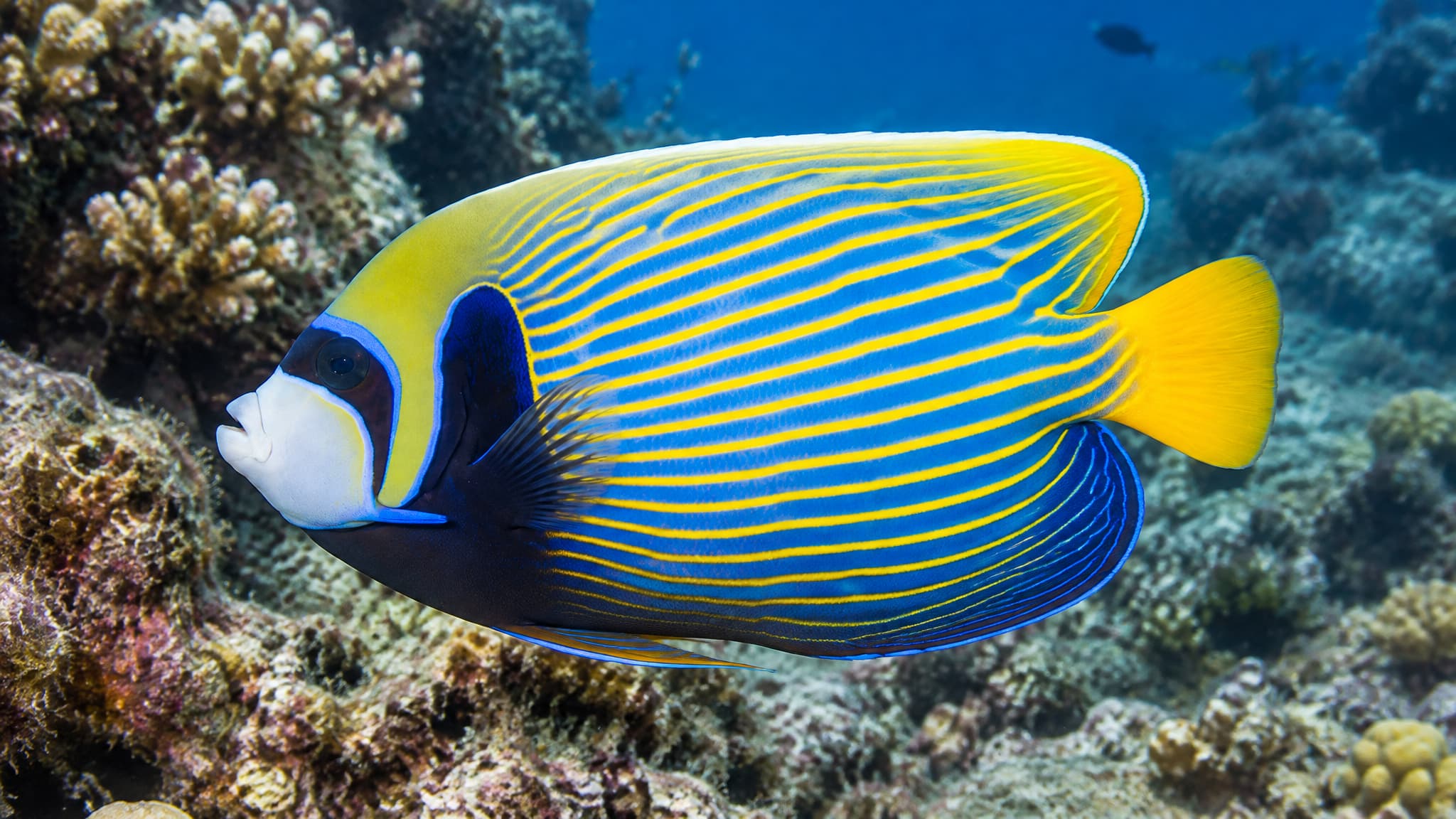
Emperor Angelfish
Fish

Emperor Angelfish

Pomacanthus imperator

The emperor angelfish (Pomacanthus imperator) is one of the largest and most recognizable marine angelfishes, reaching about 40 cm in standard length. Adults have a deep, laterally compressed body covered in alternating blue and yellow horizontal stripes, a dark mask across the eyes edged in pale blue, a dark patch behind the head, and a bright yellow-orange tail. Like other angelfishes, it carries a strong spine on each gill cover. Juveniles look so different that they were once mistaken for a separate species: they are dark navy blue with concentric white and electric-blue rings. The change to adult colours takes roughly two to two and a half years. This distinct juvenile pattern is thought to reduce aggression from territorial adults, allowing young fish to live within adult territories. The species is widespread across the tropical Indo-Pacific, from the Red Sea and East Africa east into the central Pacific. It is reef-associated and recorded from about 1 to 100 m deep. Juveniles shelter under ledges and in holes on outer reef flats, while adults favour coral-rich lagoons, channels and seaward reefs with caves and overhangs. Emperor angelfish are omnivores that feed heavily on sponges and tunicates, along with other small invertebrates, coral polyps and algae; juveniles have also been reported picking parasites off larger fishes. Adults are territorial and live alone or in pairs. Like other angelfishes, they spawn in open water, releasing pelagic eggs. FishBase records a maximum age of 14 years in the wild, and aquarium specimens may live longer. As grazers of sponges and invertebrates, emperor angelfish help shape reef communities. The IUCN lists the species as Least Concern, but it is heavily collected for the aquarium trade, and FishBase rates its resilience as low and its vulnerability to fishing as high. Coral reef degradation from climate change and pollution also threatens its habitat.

View Details
Green Chromis
Fish

Green Chromis

Chromis viridis

The green chromis (Chromis viridis), also called the blue-green chromis or blue-green puller, is a small damselfish of the family Pomacentridae. It grows to about 10 cm in total length and has a compact, oval body with a deeply forked tail. The body is an iridescent pale green to light blue. Unlike the similar black-axil chromis (Chromis atripectoralis), it has no dark spot at the base of the pectoral fin. The species ranges widely across the tropical Indo-Pacific. It is found from the Red Sea and East Africa east to the Line Islands and the Tuamotu Archipelago, north to the Ryukyu Islands and south to the Great Barrier Reef and New Caledonia. It is a marine, reef-associated fish usually found about 1 to 20 m deep. Adults gather in large schools above thickets of branching Acropora corals in sheltered lagoons and subtidal reef flats. Juveniles stay close to individual coral heads. The green chromis is a planktivore that picks small food items from the water column. Australian sources say it feeds on zooplankton, and FishBase also lists phytoplankton in its diet. Its schools stay closely tied to the branching corals they live above. Breeding takes place over sand and rubble. A male prepares a nest, and several females lay sticky eggs that rest on the bottom. The male guards the eggs and fans them with his fins until the larvae hatch, and he may eat eggs that fail to develop. Nesting males turn yellowish during spawning. Lifespan in the wild is poorly documented, but aquarium sources report that individuals can live five years or longer in captivity. The green chromis is abundant and lives in schools, and it feeds on plankton. This helps move energy from plankton into reef food webs, and the fish is also prey for larger reef predators. Because it depends on branching corals, its fate is closely linked to reef health. The IUCN lists it as Least Concern. It is one of the most popular fish in the marine aquarium trade and is considered hardy and peaceful when kept in groups.

View Details
Bluestreak Cleaner Wrasse
Fish

Bluestreak Cleaner Wrasse

Labroides dimidiatus

The bluestreak cleaner wrasse (Labroides dimidiatus) is a small, slender wrasse that grows to about 14 cm in total length. Adults are easy to spot. A bold black stripe runs from the tip of the pointed snout through the eye and widens into a wedge toward the tail. The forehead is greyish, the breast is white, and both shade into bright blue toward the rear. Larger adults may have a slight hook in the tail fin. Juveniles look different: they are mostly black with one neon-blue line along the back. The mouth sits at the very tip of the snout. This is the best way to tell it apart from its near-perfect mimic, the false cleanerfish (Aspidontus taeniatus), whose mouth is underneath. The species lives across the Indo-Pacific, from the Red Sea and East Africa to French Polynesia, including the Great Barrier Reef. It favors coral-rich inner lagoons, subtidal reef flats and seaward reefs. It is usually found at 1 to 30 m but has been recorded much deeper, and it sometimes turns up in tide pools. This wrasse is famous for its cleaning stations: fixed spots on the reef where other fish come to be serviced. Larger fish, including predators, hold still and open their mouths and gill covers. The wrasse picks off crustacean ectoparasites and also eats mucus and dead tissue. It swims in a distinctive bobbing, dancing way to attract clients. The relationship is a classic example of mutualism. A cleaning station may hold an adult pair, a group of juveniles, or a harem of females with one dominant male. The species is a protogynous hermaphrodite: if the male disappears, a female can become a functional male within a few weeks, and sex change in both directions has been confirmed. It spawns in open water, releasing eggs that drift as plankton. The maximum reported age is about 4 years. Cleaner wrasses matter to reef communities. Studies link their presence to greater fish diversity and better health among client fish. The IUCN lists the species as Least Concern, and it is common across most of its range. It is collected for the aquarium trade, but it often does poorly in captivity unless there are plenty of fish for it to clean.

View Details
Neon Goby
Fish

Neon Goby

Elacatinus oceanops

The neon goby (Elacatinus oceanops) is a tiny marine goby of the western Atlantic and the type species of its genus. It reaches only about 5 cm in total length and has an elongate body with a shark-like snout overhanging the mouth. Its dark body is marked by a vivid electric-blue stripe running from in front of the eye toward the tail, above a broad dark lower stripe, making it one of the most recognizable small reef fishes. This goby is a resident of coral reefs in southern Florida, including the Florida Keys, and parts of the western Caribbean toward Belize. It lives close to the bottom on coral heads, rocks and sponges at depths of roughly 1 to 45 m, usually staying within a few metres of a favoured spot in warm subtropical to tropical water. The neon goby is a specialised cleaner fish. Pairs set up cleaning stations on coral heads, signalling to larger reef fishes with short darting displays and then picking external parasites from their bodies. Even predatory fishes generally tolerate these services rather than eating the goby. When parasites are scarce, a hungry goby may occasionally nip mucus or scales, a form of cheating that can drive clients away. Neon gobies are usually encountered in male-female pairs. Eggs are laid in a sheltered crevice, empty shell or similar cavity and guarded by the parents until they hatch, after which the larvae spend a period drifting in open water before settling onto the reef. The species is short-lived, with a typical natural lifespan of about two years. By removing parasites from many other fishes, the neon goby plays a valuable role in the health of Caribbean reef communities. It is also a long-standing favourite of the marine aquarium trade, and captive-bred individuals are now widely available, easing pressure on wild populations. The IUCN classifies the species as Least Concern, although it depends on healthy reef habitat that faces broader threats.

View Details
Yellow Tang
Fish

Yellow Tang

Zebrasoma flavescens

The yellow tang (Zebrasoma flavescens) is a small surgeonfish in the family Acanthuridae, famous for its vivid lemon-yellow colour. Its body is tall, oval and strongly compressed, with high dorsal and anal fins and a pointed snout. A sharp, white, scalpel-like spine sits on each side of the tail base and is used in defence. Males and females look alike, and adults reach about 20 cm in total length. At night the colour fades to a duller, greyish yellow with a pale band along the lateral line. This reef fish lives in the tropical Pacific Ocean, west of Hawaii and east of Japan, including Hawaii, the Ryukyu, Mariana, Marshall, Marcus and Wake islands. It is reef-associated and occurs from about 2 to 46 m deep. Juveniles shelter among deeper corals, while adults move to shallower reef flats and slopes. Yellow tangs are diurnal herbivores that graze filamentous algae for much of the day, also taking some zooplankton. They may swim alone or in loose groups, sometimes mixed with other surgeonfishes, while juveniles are often territorial. Predators include larger fishes, crabs and octopuses. Spawning is external, in pairs or groups, with activity concentrated around the full moon. Eggs are released into open water and receive no parental care, and the larvae can drift long distances before settling on distant reefs. Females mature at roughly 4 to 5 years and males at 5 to 7 years. The species is remarkably long-lived: the oldest wild fish aged in Hawaii was 41 years old. By cropping algae, yellow tangs help keep turf from overgrowing corals. The IUCN lists the species as Least Concern. It is one of the most heavily collected marine aquarium fishes, so Hawaii regulates collection with size and bag limits, and captive breeding now supplies part of the trade.

View Details
Fire Goby
Fish

Fire Goby

Nemateleotris magnifica

The fire goby (Nemateleotris magnifica), also called the red firegoby, fire dartfish or firefish, is a small, slender dartfish that reaches about 9 cm in total length. Its head is yellowish and its front body is pale pearly white. Toward the rear the body turns orange-red, ending in a deep red tail, and the second dorsal, anal and tail fins are edged with black. Its most distinctive feature is a very tall, thread-like first dorsal fin. The species is widespread across the tropical Indo-Pacific, from the coast of East Africa to the Hawaiian Islands, and from the Ryukyu Islands south to the Austral Islands. It lives on the upper parts of outer reef slopes and is recorded from about 6 to 70 m deep, though it is usually found between 6 and 28 m. The species was described by Henry Weed Fowler in 1938 from a specimen collected in the Gulf of Tomini, Sulawesi. Fire gobies hover just above the bottom, facing into the current, and pick off passing zooplankton such as copepods and crustacean larvae. They constantly flick the long first dorsal fin back and forth, which is thought to act as a signal to others of their species. When threatened, they dart headfirst into a burrow or crevice in rubble or sand. They can wedge themselves inside using the raised fin. Adults usually live alone or in pairs, while juveniles often gather in small groups and may share the same hole. Pairs are monogamous and share a burrow, and the eggs are laid in the burrow or on the substrate. Scientific sources give little information on how long the species lives in the wild. As a plankton feeder, the fire goby helps transfer energy from drifting invertebrates to the reef food web, and it is prey for larger reef predators. The IUCN lists it as Least Concern because of its huge range. It is one of the most popular fishes in the marine aquarium trade, so collecting for that trade is the main human pressure on local populations.

View Details
Zebrafish
Fish

Zebrafish

Danio rerio

The zebrafish (Danio rerio), also called the zebra danio, is a small, slender freshwater minnow from South Asia. Its silvery body has several horizontal blue stripes running from the gill cover to the tail, which inspired its common name. FishBase gives a maximum standard length of about 3.8 cm, but captive fish have reached 64 mm. Males tend to be slimmer with gold tones, while females are rounder with a silvery or whitish belly. The species is native to Pakistan, India, Bangladesh, Nepal and Myanmar, and it has also been recorded in Bhutan. It is most common in the Ganges and Brahmaputra basins. Zebrafish live in shallow, clear, slow-moving or still water with silt bottoms and plenty of vegetation. Field studies found them more abundant in seasonal pools and mature rice paddies than in main river channels. Escaped or released aquarium fish have formed introduced populations in several countries. Zebrafish are active, social, diurnal fish that swim in schools. They are omnivores that feed mostly in the water column on zooplankton and aquatic insects, including mosquito larvae. They also take insects and spiders from the surface. Like other cypriniforms, they have no stomach or jaw teeth. Dominant individuals may defend spawning sites and food. Breeding mainly takes place during the monsoon, roughly April to August, over silty bottoms. Females can spawn every few days during the season, releasing up to several hundred eggs that hatch within two to three days. In the wild the species appears to be mostly annual and lives about one year. In captivity, lifespans average about three and a half years and can exceed five. Zebrafish are prey for snakeheads, catfish, spiny eels, herons and kingfishers, and they help link plankton and insect production to larger predators. They are also one of the world's most important vertebrate model organisms in genetics, developmental biology and toxicology, and they remain a popular aquarium fish. The IUCN lists the zebrafish as Least Concern because it has a broad range and is locally abundant. Collection for the aquarium trade is the main potential pressure, although FishBase notes that it is threatened in parts of India and Nepal.

View Details
Tiger barb
Fish

Tiger barb

Puntigrus tetrazona

The tiger barb, also called the Sumatra barb (Puntigrus tetrazona), is a small fish in the carp and minnow family (Cyprinidae). It grows to about 7 cm in total length. Its deep, flattened body is golden to silvery, with four bold black vertical bars: one runs through the eye and one sits near the base of the tail. The fins and snout often have red or orange tints. Bleeker described the species in 1855. It was later placed in Capoeta, Barbus, Puntius and Systomus before moving to Puntigrus, a genus created in 2013. Wild tiger barbs probably live only in central and southern Sumatra, Indonesia, with records from the Indragiri, Batang Hari and Musi river systems. Older reports from Borneo are now thought to refer to related species. It is a tropical freshwater fish that swims in the middle and lower water layers. Its natural habitat is poorly documented, but close relatives prefer forest streams with fairly clear water over sand, pebbles and rocks. Tiger barbs eat both animal and plant food, including worms, small crustaceans and plant matter. In aquariums they accept good-quality dried foods along with small frozen or freeze-dried prey such as bloodworms and Artemia. They are lively schooling fish and do best in groups of five or more. Kept in small numbers they can become territorial, and they are well known for nipping the fins of slow, long-finned tankmates. Like most small cyprinids, the species scatters its eggs and gives no care to its young. Aquarium sources report an average lifespan of about seven years. Almost all tiger barbs in the pet trade are farmed, and breeders have developed ornamental forms such as the moss-green tiger barb. It is still debated whether these farmed fish are the same as wild Sumatran stock, and inbreeding has left many of them weak or deformed. The IUCN lists the tiger barb as Least Concern. The aquarium trade has carried it to many countries, and it has become established in some, including Puerto Rico and Colombia, though no ecological harm has been documented. FishBase estimates its trophic level (its position in the food chain) at about 2.9, which makes it a mid-level feeder on both plants and animals in its native waters.

View Details
Oscar
Fish

Oscar

Astronotus ocellatus

The oscar (Astronotus ocellatus) is a large South American cichlid, also called the tiger oscar, velvet cichlid or marble cichlid. It has a short, deep, oval body, a large mouth with thick lips, and densely scaled bases on its dorsal and anal fins. Wild fish are dark with orange tones along the lower flanks and the edge of the gill cover. A black spot ringed in orange, called an ocellus, usually sits at the base of the tail. Scientists think this eyespot may help reduce fin-nipping by piranhas. Oscars commonly reach about 24 cm, with a record of about 46 cm total length and 1.6 kg. The species is native to the Amazon basin and nearby drainages, including the Orinoco. It has been recorded in Brazil, Peru, Colombia, Venezuela, Bolivia, Ecuador and French Guiana. It prefers quiet, shallow water over mud or sand, such as floodplain lakes, ponds and canals, often under floating plants. It has been introduced into reservoirs in northeastern Brazil, and feral populations are established in south Florida, Hawaii and Puerto Rico. Oscars are mainly carnivorous. They eat small fish, crayfish, shrimp, snails, worms and insect larvae, and they also take some plant material. They are territorial: they can form dominance hierarchies and chase rivals away. They also have a typical display called tail flutter. Aquarists value them for their personality and their habit of responding to their keepers. Oscars are biparental substrate spawners. A pair cleans a hard surface, such as a rock, lays its eggs there, and both parents guard the eggs and young. Sexual maturity comes at about 10 to 14 months. A single spawn can contain hundreds to around two thousand eggs. Wild lifespan is poorly documented, but oscars in aquariums typically live 10 to 20 years. As a mid-level predator, the oscar helps control populations of invertebrates and small fish. Researchers have tested it as a predator of mosquito larvae, and it hosts a wide variety of parasites. In Amazonia it is an important food fish for small-scale fishers. The IUCN listed the oscar as Least Concern in 2020. Its main conservation concern is not decline but its spread as an introduced species outside its native range.

View Details
Southern Platyfish
Fish

Southern Platyfish

Xiphophorus maculatus

The southern platyfish (Xiphophorus maculatus), also called the common platy or moonfish, is a small live-bearing fish in the family Poeciliidae. Günther described it in 1866. It has a deep, compressed body with an arched back, a small triangular head and an upturned mouth. Adults usually reach about 4 to 6 cm. Wild fish are fairly plain, with variable black markings. Aquarium breeding over more than a century has produced dozens of color forms, from red and gold to blue and black. Unlike their swordtail relatives, males never grow a sword on the tail. In males, the anal fin is modified into a pointed gonopodium, while females keep a fan-shaped anal fin. Distribution and habitat The species is native to the Atlantic slope of North and Central America, from around Veracruz in Mexico to northern Belize, with records from Guatemala and Honduras. It lives in warm springs, canals, ditches, creeks and swamps with slow water, silty bottoms and weedy banks. Releases from fish farms and aquariums have established it far outside its native range, including parts of the United States, Queensland in Australia, India and southeastern Brazil. Diet and behavior The platy is an omnivore. It eats worms, small crustaceans, aquatic and land insects, and plant matter. In streams in Queensland, introduced platies ate mostly crustaceans, especially atyid shrimp, along with insects. It is peaceful, active and often found among dense vegetation. Reproduction and lifespan Fertilization is internal, and females give birth to fully formed young. After a gestation of about 24 to 30 days, a female may produce 20 to 80 fry, and she can have several broods a season. Its population resilience is high, because it can mature in under a year. In aquariums, platies usually live about 2 to 4 years. Ecological role and scientific importance In its native waters, the platy eats small invertebrates and is prey for larger fish and birds. Where it has been introduced, it can harm local wildlife: it has been linked to the decline of native damselflies in Hawaii and can dominate fish communities in weedy habitats. It is also an important lab animal. It is used in genetics and cancer research, its genome was sequenced in 2013, and it has an unusual sex-determination system involving W, X and Y chromosomes. Conservation The IUCN lists X. maculatus as Data Deficient. It is widespread and very common in the aquarium trade, and its introduced populations are treated as a concern for invaded ecosystems.

View Details
Goldfish
Fish

Goldfish

Carassius auratus

The goldfish (Carassius auratus) is a member of the carp family, Cyprinidae, and one of the earliest fish ever domesticated. Wild-type fish are stocky and deep-bodied with large scales, a long dorsal fin and a stiff, serrated spine at the front of the dorsal and anal fins. Unlike the common carp, it has no barbels at the mouth. Wild and feral fish range from olive-bronze to gold or creamy white, while centuries of selective breeding in China produced countless ornamental forms such as comets, orandas and ryukins, all belonging to the same species. Most individuals reach 10–20 cm, though exceptional fish have been recorded near 48–59 cm. Goldfish are native to East Asia, including China, Korea and neighbouring regions, but releases from ponds and aquariums have established feral populations across North America, Europe, Africa and elsewhere. They favour stagnant or slow-moving fresh water — ponds, lakes, ditches, canals and well-vegetated, often eutrophic wetlands — at depths of up to about 20 m. The species tolerates temperatures from near freezing to about 41 °C, low oxygen and some salinity, which helps explain its success as an invader. This omnivore forages over vegetation and soft bottoms for plankton, benthic invertebrates, plant material and detritus, and will also eat fish eggs and larvae, including its own offspring. Goldfish are social, use chemical cues to locate food and avoid predators, and spawn in groups. Breeding is triggered as water warms in spring. Females release pheromones that stimulate males, then scatter adhesive eggs over submerged plants in shallow water, where males fertilise them externally. A single female may lay thousands to several hundred thousand eggs over multiple spawnings, and eggs hatch in roughly 2–9 days. Wild fish often live 6–7 years, while well-kept captive fish commonly reach 10–15 years; ages above 40 years have been reported. Ecologically, goldfish recycle nutrients and serve as prey, but where introduced they stir up sediment, increase turbidity, uproot plants, may encourage algal blooms and prey on the eggs of native fish and amphibians. The IUCN lists the species as Least Concern, and management efforts focus mainly on preventing releases and controlling invasive populations.

View Details
Kribensis
Fish

Kribensis

Pelvicachromis pulcher

The kribensis (Pelvicachromis pulcher), also sold as the krib or rainbow krib, is a small West African cichlid and the type species of the genus Pelvicachromis. It has an elongate, moderately compressed body with a dark stripe running from the snout along the flank onto the tail. The belly is often pink to red, and the dorsal and tail fins may carry spots or gold-ringed eyespots. Males are larger, reaching about 11 to 12 cm in total length, and have more pointed fins, while females stay near 7 to 8 cm, look rounder and show a brighter belly. The species is native to the coastal lowlands of eastern Benin, southern Nigeria and western Cameroon, including the lower Niger and Cross River basins. It lives in warm, soft to moderately hard, acidic to neutral water, in both slow and faster streams, but almost always where dense plants or roots give cover. FishBase also records it from brackish water. Aquarium releases have produced records in Singapore and the Philippines. Adults feed near the bottom on worms, small crustaceans and insects. A study on the Sombreiro River in Nigeria found that wild fish ate mostly diatoms, algae, plant matter and detritus, so the diet is flexible. Kribs dig in soft substrate and shelter in small caves under plants and roots. Many live in loose groups outside the breeding season, while breeding pairs defend a territory. The kribensis forms pairs and spawns in caves. The eggs are attached to the inside of a cavity, and the parents guard the brood and then the young fry. In aquariums, water pH has been linked to the sex ratio of broods. Aquarium references give a lifespan of about 5 to 8 years in captivity. As a mid-level omnivore, the kribensis links small invertebrates, algae and detritus to larger predators in its streams. It is listed as Least Concern by the IUCN (assessed 2019). Almost all fish in the aquarium trade are captive bred, which limits collecting pressure on wild populations. Its tolerance of a wide range of water conditions has made it one of the most common cichlids in the aquarium hobby since the 1950s.

View Details
Harlequin Rasbora
Fish

Harlequin Rasbora

Trigonostigma heteromorpha

The harlequin rasbora (Trigonostigma heteromorpha) is a small, deep-bodied freshwater fish in the family Danionidae, subfamily Rasborinae. It reaches about 5 cm in total length. Its body is a coppery to pinkish orange with a silvery sheen. The best-known mark is a dark, wedge-shaped patch on the rear half of the flank that narrows toward the tail base. This mark gives the genus its name, which comes from the Greek words for "three corners" and "signal". Compared with its close relatives T. espei and T. hengeli, this species has the deepest body and the broadest, darkest triangle. It was first described as Rasbora heteromorpha in 1904 and was moved to Trigonostigma in 1999. The species lives in Southeast Asia, from southern Thailand through Peninsular Malaysia and Singapore to Sumatra. The type locality is in the Malaysian states of Negeri Sembilan and Selangor. It lives in forest streams and peat swamp forests. Waterlogged soil there slows the decay of leaf litter, so humic acids leach into the water. The result is tea-stained blackwater that is soft, acidic and low in minerals. Harlequin rasboras are peaceful schooling fish that swim near the surface and in midwater. In primary peat swamps they have been recorded in schools of more than 100 fish. They feed mainly on worms, small crustaceans and insects. FishBase estimates a trophic level of about 3.3, which places them among the small predators of invertebrates in their streams. The harlequin rasbora breeds in a way that sets its genus apart. Most rasboras scatter their eggs, but this species lays adhesive eggs on the underside of broad leaves, such as those of Cryptocoryne or Aponogeton. The pair turns upside down beneath the leaf and releases about 6 to 12 eggs each time. They repeat this many times during one spawning. No one has measured the species' lifespan systematically, but well-kept aquarium fish are reported to live about five to eight years. The IUCN Red List classifies the species as Least Concern. FishBase rates it as highly resilient and only slightly vulnerable to fishing. The fish was first exported for aquariums in the early 1900s and is still one of the classic species of the hobby. In the wild it depends on intact peat swamp forests and the soft, acidic water they produce.

View Details
Pearl Gourami
Fish

Pearl Gourami

Trichopodus leerii

The pearl gourami (Trichopodus leerii), also sold as the lace or mosaic gourami, is a laterally compressed labyrinth fish reaching about 12 cm in standard length. Its brownish-silver body is densely covered with small pale, pearl-like spots, and a dark line runs from the snout along the flank, fading toward the tail. The pelvic fins are drawn out into long, thread-like rays that serve as touch and taste organs. Mature males have longer, more pointed dorsal and anal fins and develop a vivid orange to red throat and breast, while females are plainer and plumper. The species is native to tropical Southeast Asia, where it is recorded from Thailand, the Malay Peninsula and the Indonesian islands of Sumatra and Borneo. It lives in lowland swamps and slow streams, often among dense vegetation, and is associated with soft, acidic, tannin-stained blackwater habitats. Like other gouramis, it has a labyrinth organ that lets it gulp atmospheric air, and it is considered an obligate air breather, an advantage in warm, oxygen-poor water. It is one of the most peaceful gouramis, although males are territorial toward each other. In aquariums it is an unfussy omnivore that accepts most foods offered. Breeding involves a bubble nest: the male builds a floating mass of air bubbles stabilized with a mouth secretion, courts the female beneath it, then gathers the eggs into the nest and guards them. The species is fairly long-lived, with aquarium individuals reported to survive eight years or more. The IUCN assessed the pearl gourami as Near Threatened in 2019, mainly because of ongoing loss and degradation of its lowland swamp habitats. It is nonetheless extremely common in the aquarium trade, where most fish are mass-produced in captivity, and it is also used in commercial fisheries and aquaculture. Introductions in Florida and Hawaii failed to establish.

View Details
Clown Loach
Fish

Clown Loach

Chromobotia macracanthus

The clown loach (Chromobotia macracanthus) is a large tropical freshwater loach of the family Botiidae and the only member of the genus Chromobotia. Its torpedo-shaped body, oval in cross-section, is bright orange crossed by three broad black bars. This pattern has made it one of the most recognisable fishes in the aquarium trade. FishBase lists a maximum length of about 30.5 cm and a weight of up to 469 g, and some sources report wild fish approaching 40 cm. The species is endemic to Indonesia, where it lives in the river systems of Sumatra and Borneo. Adults mostly stay near the bottom of main river channels, sheltering under rocks, submerged wood or in mud cavities. Juveniles are commonly found on floodplains. Many of its native rivers carry soft, tea-coloured water through rainforest, although much of that forest has been degraded. Clown loaches are bottom-dwelling omnivores that eat worms, crustaceans and plant matter. This makes them mid-level consumers of invertebrates on the river bed. They are social fish, and in captivity they do best in groups of five or more, since lone individuals may become withdrawn. Their surroundings change with the seasons, because water flow, depth and turbidity rise sharply during the wet season. Breeding is tied to the rains. At the start of the wet season, adults migrate upstream into smaller tributaries and temporarily flooded areas to spawn. They appear to mature at roughly 12–15 cm standard length. Natural spawning in home aquariums has not been confirmed, and commercial breeding in Indonesia and Europe relies on hormone treatment. The clown loach lives a long time, and well-kept captive fish often pass 20 years. The IUCN Red List classifies the species as Least Concern. Even so, it is heavily harvested for the international ornamental trade, and this pressure on wild stocks has driven the development of artificial breeding techniques. Degradation of its rainforest rivers is a further concern. In aquariums it needs a very large tank and is especially prone to white spot disease (ich).

View Details
Royal Gramma
Fish

Royal Gramma

Gramma loreto

The royal gramma (Gramma loreto), also called the fairy basslet, is a small, brightly coloured reef fish in the basslet family Grammatidae. It reaches about 8 cm in total length. It is easy to recognise by its two-tone colour: the front half of the body is vivid purple to violet, and the rear half and tail are bright yellow. A dark line runs through the eye, and there is a black spot at the front of the dorsal fin. The species lives in the tropical western Atlantic, including Bermuda, the Bahamas, the Caribbean Sea and the coasts of Central America, south to northern South America. It is a reef-associated marine fish found from about 1 to 60 m deep, though usually shallower than 40 m. Royal grammas stay close to shelter. They gather around caves, crevices and the undersides of ledges on coral reefs. The royal gramma is a carnivorous planktivore. It feeds mainly on zooplankton and small mobile crustaceans, and it sometimes acts as a cleaner by picking ectoparasites off other fishes. One unusual habit is that it orients its belly toward the nearest surface, so under overhangs it is often seen swimming upside down. It can be timid but also territorial, and it may threaten members of its own species and other small fishes with an open-mouthed display. Its eggs are laid on the bottom, and its larvae drift in open water. Males prepare and guard nests in sheltered spots, often lined with bits of algae, where females lay their eggs. Public aquarium sources report a breeding season from about February to June. Lifespan in the wild is poorly documented. In aquariums, these fish commonly live around five years or more. The species has been bred successfully in captivity. On the reef, the royal gramma eats plankton and small invertebrates, and in turn it is prey for larger predatory fishes. Its parasite-picking behaviour may also help other reef fishes stay healthy. It is one of the most popular fishes in the marine aquarium trade. The IUCN Red List assesses it as Least Concern because it is widespread and common. Collection for the aquarium trade and the wider decline of Caribbean coral reefs are potential local pressures, but captive breeding helps reduce demand for wild-caught fish.

View Details
Siamese Fighting Fish
Fish

Siamese Fighting Fish

Betta splendens

The Siamese fighting fish (Betta splendens), widely known as the betta, is a small freshwater fish in the gourami family, Osphronemidae. Adults usually measure around 5–7 cm in total length; FishBase records a maximum of about 6.5 cm. Wild fish are fairly drab, with short fins and reddish or greenish tones. Centuries of selective breeding have produced the long-finned, brilliantly coloured males that are now among the most popular aquarium fish in the world, second only to the goldfish. Distribution and habitat The species is native to mainland Southeast Asia, including Thailand, Cambodia, Laos and Vietnam, around the Mekong basin. It lives in shallow, densely vegetated, still or very slow-moving waters such as rice paddies, floodplain marshes, ditches and stagnant pools. These waters are often warm and low in oxygen. Diet and behaviour Like other anabantoids, the betta has a labyrinth organ that lets it gulp air at the surface, so it can survive in oxygen-poor water. In the wild it feeds mainly on insects and insect larvae, especially those that fall onto the water surface. Researchers have described several feeding methods, including snapping, gulping, grazing, jumping and spitting. Males are famously territorial: they flare their gill covers and fins at rivals and will fight other males. Selective breeding for fighting in Thailand made this aggression even stronger. Reproduction and lifespan The male builds a bubble nest of mucus-coated air bubbles at the surface. After a courtship embrace, he collects the falling eggs in his mouth, places them in the nest and guards them. The fry hatch in about one to two days. FishBase gives a maximum reported age of about 2 years, which matches typical wild lifespans. Well-kept captive fish often live 2 to 5 years. Ecological role and conservation Bettas eat insects, including mosquito larvae, and are in turn eaten by larger fish, birds and other predators. Domesticated forms are common everywhere, but pure wild populations are declining because of habitat loss, agricultural change and pollution. The IUCN lists the species as Vulnerable.

View Details
Freshwater Angelfish
Fish

Freshwater Angelfish

Pterophyllum scalare

The freshwater angelfish (Pterophyllum scalare) is a South American cichlid known for its body shape. The body is strongly flattened from side to side and shaped like a disc. The dorsal and anal fins are tall and grow longer toward the back, and the first branched rays stretch into long trailing filaments. Wild fish are silvery with dark vertical bars. Juveniles have about seven bars and adults usually have four. Adults reach a maximum of about 15 cm total length. Males and females look very much alike. The species is native to the Amazon basin in Peru, Colombia and Brazil. Its range includes the Ucayali, Solimões, Amapá and Amazon rivers, and it also lives in the Oyapock in French Guiana and the Essequibo in Guyana. It lives in swamps and flooded areas with dense vegetation, in water that may be clear or silty. Its tall, narrow body helps it slip between submerged plants, roots and branches. The angelfish is an omnivorous predator. It eats small fish and fry, small crustaceans, worms, mosquito larvae and other aquatic insects, and it also takes some plant material. It usually swims in the middle of the water among cover. It is generally calm, but it can become territorial and aggressive when pairs are spawning. The species is a substrate spawner. Before spawning, a pair cleans a flat surface such as a leaf, stone or piece of wood, and the female lays her eggs there in rows. Both parents guard and fan the eggs and then look after the young. Captive fish can mature at six to twelve months old. Angelfish commonly live around 8 to 12 years in well-kept aquariums. The IUCN lists the freshwater angelfish as Least Concern. It is one of the most widely traded ornamental fish in the world, and captive breeding has produced many color and fin varieties. Released aquarium fish have been recorded outside the native range, including in Fiji, although the U.S. Fish and Wildlife Service rates its overall invasion risk as low.

View Details
Neon Tetra
Fish

Neon Tetra

Paracheirodon innesi

The neon tetra (Paracheirodon innesi) is a tiny South American characin and one of the most widely kept aquarium fishes in the world. Adults reach only about 2 to 3 cm in standard length, or roughly 4 cm overall. An iridescent blue-green stripe runs along each side from the eye toward the tail, above a vivid red band that covers the rear half of the lower body, while the rest of the fish is pale and partly translucent. The shimmer comes from light-reflecting guanine crystals in skin cells, and the colors dim to gray at night while the fish rests. The species is native to the upper Amazon basin of Peru, Colombia and Brazil, where it lives in blackwater and clearwater tributaries of the Solimões River. These forest streams are usually soft and acidic, with negligible carbonate hardness, and are often stained the color of tea by humic substances released from fallen leaves and wood. Its bright markings are thought to help shoal members keep sight of one another in such dim water. Aquarium releases have produced records in Singapore, and a short-lived introduction in Colorado hot springs during the 1980s failed. Neon tetras are omnivores that feed on worms, small insects, crustaceans and plant matter. They are peaceful, social fish that move in shoals, and aquarists are advised to keep them in groups of at least five in tanks no shorter than about 60 cm, with stable temperatures and no large tankmates that could eat them. Reproduction is by egg scattering, and the parents give no care to eggs or young. A female lays a relatively small number of eggs, which hatch in about 24 hours. Spawning in captivity is considered difficult because eggs and larvae need very soft, acidic, dimly lit water. Lifespan is typically around five years, and well-kept aquarium fish may live up to about eight years. As a small mid-level consumer, with a FishBase trophic level near 2.9, the neon tetra links aquatic invertebrates to larger predatory fish. FishBase rates its resilience as high, with a minimum population doubling time under 15 months, and the IUCN lists the species as Least Concern. Most fish in the trade are now farm-bred, but decades of commercial breeding have weakened some ornamental strains, which are vulnerable to neon tetra disease, a microsporidian infection that is very hard to treat once advanced.

View Details
Bronze Corydoras
Fish

Bronze Corydoras

Osteogaster aenea

The bronze corydoras (Osteogaster aenea), long known as Corydoras aeneus, is a small armoured catfish in the family Callichthyidae. In 2024, a phylogenomic revision of the subfamily Corydoradinae moved it to the resurrected genus Osteogaster. Adults reach about 7.5 cm, and females are slightly larger and broader than males. The body is protected by overlapping bony plates. Sharp spines in the dorsal and pectoral fins, together with barbels around the mouth, help identify it. Its colour is a metallic bronze-green with a pale belly, and an albino form is common in the aquarium trade. The species was described from Trinidad and is reported east of the Andes from Colombia and Trinidad south to the Río de la Plata basin. Such a wide range has led researchers to suspect a complex of similar species, so the identity of populations outside Trinidad is uncertain. It mostly lives in quiet, shallow waters with soft bottoms, but it also occurs in running water and in clear or muddy pools. This bottom-dweller sifts the substrate with its barbels for worms, crustaceans, insects and plant matter. It is social and gathers in schools of about 20 to 30 fish. It is a facultative air-breather: it gulps air at the surface and absorbs oxygen through its intestine, rising anywhere from once to 45 times per hour. This lets it survive in poorly oxygenated water. In the wild, spawning begins when rainy-season water changes the water chemistry. During courtship the pair takes the 'T-position' typical of corydoras, with the female's mouth pressed against the male's genital area. She then places the adhesive eggs on plants, rocks or other surfaces and does not guard them. The eggs hatch in about five days. In captivity a female can lay large numbers of eggs, and aquarists report a typical lifespan of about three to five years. As a scavenger of the river bottom, the bronze corydoras recycles organic matter and is prey for larger fish and other predators, which its locking spines help deter. It is one of the most widely traded aquarium catfish. It has been recorded as introduced in Hawaii, the Philippines and Mexico, but it is not reported as invasive there. The IUCN assessed it as Least Concern in 2018.

View Details
Guppy
Fish

Guppy

Poecilia reticulata

The guppy (Poecilia reticulata) is a small livebearing fish in the family Poeciliidae. It is also called the millionfish or rainbow fish, and it is one of the world's best-known aquarium species. The sexes look very different. Males are small and slender, with bright spots, stripes and blotches in red, orange, blue, green, yellow or black, and have large fins. Females are larger and deeper-bodied, with a plain grayish or silvery color. In males, the anal fin is modified into a gonopodium, an organ used for internal fertilization. The species is native to northeastern South America and nearby islands, including Venezuela, Trinidad, Barbados, the Guianas and northern Brazil. Wild guppies live in many kinds of habitat, from turbid lowland ponds, ditches and canals to clear mountain streams. They usually favor small, densely vegetated streams with little predation. They mostly live in fresh water but tolerate a wide salinity range, so they can also live in brackish water. They need fairly warm water, which limits where introduced populations can survive. Guppies are opportunistic omnivores that feed at the bottom, in midwater and near the surface. They eat small invertebrates such as insect larvae, plankton, algae and organic detritus. They are peaceful and social, and in captivity they do well in groups in planted tanks. Because males court and mate with many partners, guppies are a classic model organism for studying sexual selection, color evolution and genetics, especially in wild populations on Trinidad. Reproduction is fast. Fertilization is internal, and females can store sperm and produce several broods from a single mating. After a pregnancy of about three to four weeks, they give birth to live, fully formed young, and they can breed all year. Neither parent cares for the young, and adults may eat their own fry. Sexual maturity comes within a few months. Guppies usually live about 2 to 3 years, and up to 5 years has been recorded. Guppies have been introduced to every continent except Antarctica, mainly to control mosquitoes. Studies show they had little or no measurable effect on mosquito populations. Introduced populations can harm native fishes, such as small cyprinids and killifishes, through competition and predation. In its native range the species is abundant, and it is listed as Least Concern on the IUCN Red List.

View Details
Grey triggerfish
Fish

Grey triggerfish

Balistes capriscus

The grey triggerfish (Balistes capriscus), also spelled gray triggerfish, is a large ray-finned fish in the family Balistidae. Its body is tall, oval and flattened from side to side. It has a small mouth with strong jaws and thick, plate-like scales that make the skin very tough. The colour is mostly grey, greenish-grey or brownish. Faint, irregular dark bars run across the body, a narrow pale band crosses the chin, and small light-blue spots dot the upper body and fins. Like other triggerfishes, it can lock its first dorsal spine upright using a shorter second spine, the "trigger". It can reach 66 cm in total length and 6.2 kg, though about 44 cm is more typical. Distribution and habitat The species lives on both sides of the Atlantic. In the west it ranges from Nova Scotia and Bermuda to Argentina, including the Gulf of Mexico and the Caribbean. In the east it occurs along European and African coasts and in the Mediterranean. It lives in bays, harbours, lagoons and seaward reefs, as well as around rocky bottoms and wrecks, from the surface down to about 100 m. It is most common shallower than 55 m. Diet and behaviour Adults are mainly bottom feeders. They crush molluscs, crustaceans and other hard-shelled invertebrates with their strong teeth. Juveniles eat hydroids, barnacles and polychaete worms. Young fish often drift near the surface among floating Sargassum seaweed. Adults are usually solitary or live in small groups and can be territorial. When caught, the fish makes a grunting sound, which explains its Portuguese name peixe-porco ("pig fish"). Reproduction and lifespan Fertilisation is external. Pairs make nests in sand, and both parents guard the eggs, which hatch in about two days. Guarding adults can be aggressive toward intruders. Sexual maturity usually comes at around 17 cm in length. The maximum recorded age is 15 years. Ecology and conservation The grey triggerfish eats many benthic invertebrates. In turn, sharks, groupers and amberjacks prey on adults, and tunas, dolphinfish and billfishes eat juveniles. It is highly valued in commercial and recreational fisheries for its good flesh. The IUCN lists it as Vulnerable. In US waters, NOAA Fisheries and regional councils manage it with catch limits and seasonal closures to rebuild stocks that were overfished.

View Details
Hogfish
Fish

Hogfish

Lachnolaimus maximus

The hogfish (Lachnolaimus maximus) is the largest wrasse in the western Atlantic and the only living member of its genus. Its body is deep, strongly flattened from side to side and oval in outline. Adults have a long, pig-like snout. The first three spines of the dorsal fin are greatly lengthened into filaments, and there is a dark blotch near the rear of the dorsal fin. The tail has extended upper and lower lobes, and the iris is bright red. Adults can reach about 90 cm in length and roughly 11 kg in weight. The species is native to the western Atlantic, from Nova Scotia south through Bermuda, the Gulf of Mexico and the Caribbean to northern South America. Adults live over open sandy or rubble bottoms and around coral reefs, and they are often found where gorgonians (sea fans) are plentiful. Larvae drift in the plankton for about four weeks, then settle in shallow inshore nursery areas such as seagrass beds. Hogfish feed mainly on mollusks, and also eat crabs, sea urchins and other bottom invertebrates. They use their long snout to root through sediment for buried prey, and this rooting behavior gave the fish its common name. Like other wrasses, the hogfish can change color quickly. Researchers have found light-sensitive opsin proteins in its skin, which may help it track its own color changes. The hogfish is a protogynous hermaphrodite: every fish starts life as a female, and some later become males. A dominant male defends a territory and a harem of about 5 to 15 females, spawning with each one in the late afternoon. In Florida waters the breeding season runs from about November to June. The eggs float freely and get no parental care. Many fish live around 11 years, but stock assessments have recorded individuals as old as 23. As a predator of bottom invertebrates, the hogfish helps shape the invertebrate communities on reefs and hard bottoms. Its flesh is highly prized, so it is targeted by both commercial and recreational fishers, especially spearfishers. Eating it has occasionally been linked to ciguatera poisoning. Fishing pressure has led the IUCN to list it as Vulnerable, and catches in US waters are regulated.

View Details
Foureye Butterflyfish
Fish

Foureye Butterflyfish

Chaetodon capistratus

The foureye butterflyfish (Chaetodon capistratus) is a small reef fish from the western Atlantic. It is the type species of the genus Chaetodon, the group that gave the butterflyfish family its name. Its deep body is flattened from side to side, with a single dorsal fin and a small mouth full of fine, bristle-like teeth. The body is pale grey, sometimes tinged with yellow, and marked with many thin dark lines that form forward-pointing chevrons. A dark bar crosses the real eye. Near the tail on each side is a large black spot ringed in white. This spot is the false "eye" behind the common name. Adults reach about 15 cm, though most are smaller. The species lives from Massachusetts and Bermuda south through the Bahamas, the Gulf of Mexico and the Antilles to northern South America. Some sources extend the range to Brazil. It is one of the most common butterflyfishes in the Caribbean. Adults mainly live on shallow coral reefs, usually 2 to 20 m deep. Juveniles are often found in mangroves and seagrass beds. The foureye butterflyfish is a daytime browser. It picks at anthozoans, especially stony corals, sea anemones and zoanthids, and also eats polychaete worms, small crustaceans and fish eggs when they are available. At night it shelters in reef crevices. The false eyespot and the bar hiding the real eye are thought to confuse predators about which way the fish will flee. A cornered fish may turn to face the threat with its head lowered and dorsal spines raised. Adults usually travel in pairs, and pairs are believed to stay together for a long time, often for life. Where adults are crowded, loose foraging groups of up to about 15 fish have been seen. Spawning happens at dusk, when the female releases a few thousand small eggs into the water column. Like all butterflyfishes, the larvae pass through a tholichthys stage, with bony plates protecting the head. Juveniles carry an extra eyespot on the soft dorsal fin. Lifespan in the wild is poorly documented. One estimate puts it at about seven years. By feeding on coral polyps and small invertebrates, the species is part of the coral reef food web. It is also prey for moray eels, sharks and other large predators. It is collected for the aquarium trade. Because it depends on corals for food and shelter, the loss of reef habitat could affect local populations. Overall, the IUCN lists it as Least Concern.

View Details
Atlantic Mackerel
Fish

Atlantic Mackerel

Scomber scombrus

The Atlantic mackerel (Scomber scombrus) is a fast-swimming, streamlined schooling fish of the family Scombridae, the group that also includes tunas and bonitos. Its back is blue-green with dark, wavy transverse bars, while the flanks and belly are silvery white. Adults commonly measure around 30 cm in fork length, with a recorded maximum of about 60 cm; NOAA notes typical growth up to roughly 42 cm and 1 kg. The species lives on both sides of the North Atlantic and in the Mediterranean and Black seas. It is pelagic and neritic, most common over cold and temperate continental shelves at depths down to about 200 m, although it has been reported much deeper. Mackerel overwinter in deeper water and move toward the coast in spring as waters warm, undertaking long seasonal migrations between spawning and feeding grounds. Atlantic mackerel form huge, tightly coordinated schools near the surface and are mainly active by day. They feed heavily on zooplankton, especially copepods, krill and shrimp, and also take squid and small fish. Because they rely on ram ventilation, they must keep swimming to push water over their gills. Mackerel mature at about 2 to 3 years of age. They are batch spawners, releasing eggs several times per season in surface waters; depending on size, a female may produce from a few hundred thousand to nearly two million eggs. The floating eggs hatch within about a week, and larvae drift in the plankton. Individuals can live up to around 20 years, though most are caught much younger. Ecologically, the species is a key link that transfers energy from plankton to larger predators such as Atlantic bluefin tuna, other fishes and marine mammals. It is also one of the most commercially important fishes of the North Atlantic. The IUCN Red List classifies the Atlantic mackerel as Least Concern. Even so, some stocks have suffered from heavy fishing: the North Sea stock collapsed in the 1960s, and the US stock is still rebuilding under management. Climate-driven shifts in distribution are also changing where the species is caught.

View Details
Great Barracuda
Fish

Great Barracuda

Sphyraena barracuda

The great barracuda (Sphyraena barracuda) is the largest and best-known member of the barracuda family, Sphyraenidae. It has a long, nearly cylindrical, slightly compressed body, a pointed head, large eyes and a projecting lower jaw lined with large, sharp teeth. Adults are silvery with grey-green backs, around 20 dark oblique bars on the upper flanks and scattered black blotches on the lower sides; the tail is dark with white tips. Individuals commonly reach about 1.4 m and may grow to 2 m and 50 kg. The species lives in tropical and warm-temperate seas worldwide, including the Indo-Pacific and the Atlantic. In the western Atlantic it ranges from Massachusetts and Bermuda through the Gulf of Mexico and Caribbean to Brazil, while it is only a vagrant in the eastern Pacific. It uses coral and rocky reefs, seagrass beds, mangrove edges, lagoons and open coastal waters from the surface to depths of around 300 m. Great barracudas are ambush and pursuit predators that rely on vision and bursts of speed. They feed mainly on fishes such as mullets, jacks, grunts, herrings, anchovies and needlefishes, and also take squid, octopus and shrimp from both the bottom and the water column. Juveniles often gather in loose groups, whereas large adults are usually solitary, active by day and known for curiously shadowing divers. Spawning is thought to occur in deeper offshore waters from spring to autumn. Eggs and larvae drift in the plankton, and young fish settle into shallow, vegetated estuaries and mangroves that offer food and shelter. There is no parental care. Sexual maturity is reached at roughly two to four years of age, and aged specimens from Florida reached more than 18 years. As a top predator, the great barracuda helps regulate populations of smaller reef and coastal fishes, while juveniles are preyed on by sharks, groupers and other large predators. It is a valued game fish, but large individuals from some reefs accumulate ciguatoxins and can cause ciguatera poisoning, so their sale is restricted in some places. The IUCN lists the species as Least Concern because of its huge range and lack of evidence for global decline. Local pressures include recreational and commercial fishing and the degradation of mangroves and seagrass nurseries.

View Details
Mutton Snapper
Fish

Mutton Snapper

Lutjanus analis

The mutton snapper (Lutjanus analis) is a large marine snapper in the family Lutjanidae. Fishers in the western Atlantic value it highly. Its body is deep and flattened from side to side, and it has a big mouth lined with fine, brush-like teeth. Its long pectoral fins reach back about as far as the anus. Among its relatives, it stands out for having 13–14 soft rays in the dorsal fin, behind 10–11 spines. Adults commonly reach about 50 cm. The largest recorded length is 94 cm, and the heaviest published weight is about 15.6 kg. The species lives in the western Atlantic from Massachusetts and Bermuda south to southeastern Brazil, including the Gulf of Mexico and the Caribbean Sea. It is most abundant around southern Florida, the Bahamas and the Antilles. Young fish settle into shallow seagrass beds and estuaries near the coast. As they grow, they move to coral reefs and rocky bottoms farther offshore, down to about 95 m and possibly deeper. Once adults settle in an area, they tend to stay there. Mutton snappers are predators that feed both by day and at night. The larvae eat plankton, while juveniles and adults take crustaceans such as crabs and shrimp, along with molluscs and small fishes. Their diet shifts as they grow. Adults are wary and mostly solitary, or they occur in small groups. The fish can change its colour pattern, showing darker bars when feeding near the bottom. Outside the breeding season the species is fairly solitary, but each year it gathers in large spawning aggregations at predictable sites, especially in the Caribbean. It is a broadcast spawner with high fecundity. Hatchery studies suggest it matures at around three years of age. Lifespan can reach 29 years, and FishBase estimates the generation time at about seven years. As a mid- to upper-level predator, the mutton snapper helps link seagrass, mangrove and reef food webs. It depends on several connected coastal habitats during its life. The IUCN lists it as Near Threatened. The main threat is heavy fishing, especially at spawning aggregations, which are easy to target. Overfishing has been reported in parts of Brazil and Colombia, and loss of seagrass and reef habitat adds further pressure.

View Details
Atlantic Tarpon
Fish

Atlantic Tarpon

Megalops atlanticus

The Atlantic tarpon (Megalops atlanticus), often called the "silver king," is a large, bright silver fish with a greyish back. It has a long, flattened body and very large, thick scales. Other features include big eyes (the name Megalops means "great appearance"), an upturned mouth with a jutting lower jaw, a bony plate under the throat, and a deeply forked tail. The last ray of its single dorsal fin is stretched into a long filament. Adults can reach about 2.5 m in length and weigh up to 161 kg. The species lives on both sides of the Atlantic. In the west it ranges from about North Carolina through the Gulf of Mexico and the Caribbean to Brazil. In the east it is found from Senegal to Angola. It lives in warm, shallow coastal waters, bays, estuaries, mangrove lagoons, and rivers, and it can move between salt, brackish, and fresh water. The tarpon's swim bladder is connected to its esophagus and works like a simple lung. The fish rolls at the surface to gulp air, which lets it survive in warm, oxygen-poor water where many other predators cannot. What it eats changes as it grows. Adults mainly hunt schooling fish such as mullet and sardines, and they also take shrimp and crabs. Because its teeth are small, the tarpon swallows its prey whole. It often travels in small schools and makes long seasonal migrations, sometimes crossing international borders. Adults gather in schools of roughly 25 to 200 fish and move offshore to spawn, mostly in late spring and summer. They release eggs and sperm into open water, where fertilization takes place, and they give no care to their young. After two or three days the eggs hatch into transparent, ribbon-shaped larvae called leptocephali. Currents carry the larvae toward coastal nurseries such as mangroves and marshes. Tarpon grow slowly, mature late, and live a long time, with ages of up to about 55 years reported. Tarpon are important mid- to top-level predators along tropical and subtropical coasts. Large sharks are their main natural predators. The species supports a valuable catch-and-release sport fishery, and in some regions it is also caught for food. The IUCN lists the Atlantic tarpon as Vulnerable. Its main threats are commercial and subsistence fishing, loss and damage of habitat such as mangroves and estuaries, poor water quality, and deaths after anglers release them, including shark attacks on tired fish. Because the species grows slowly, matures late, and migrates widely, managing it well requires cooperation between countries.

View Details
European plaice
Fish

European plaice

Pleuronectes platessa

The European plaice (Pleuronectes platessa) is a right-eyed flatfish of the family Pleuronectidae, the righteye flounders. Its upper (eyed) side is smooth and dark green to brown, scattered with conspicuous orange spots that make it easy to tell apart from similar flatfishes, while the blind side is pale. Most adults measure about 25–45 cm, but the species can reach roughly 1 m and about 7 kg. It lives in the temperate northeastern Atlantic, from Arctic waters such as the Barents and White Seas south to the Mediterranean. A demersal fish of sandy and muddy bottoms, it occurs from the shoreline to about 200 m deep, usually at 10–50 m, and tolerates brackish water and temperatures of roughly 2–15 °C. Larvae feed mainly on plankton. Very small juveniles nip off the siphons of buried clams, which can regrow, and as the fish grow, bivalve molluscs and polychaete worms become the core of the diet. Adults make seasonal movements between feeding grounds and well-defined spawning areas. In the southern North Sea and Irish Sea, spawning takes place mainly from January to March, when large numbers gather. The eggs and larvae drift in open water before the young settle in shallow coastal nurseries. Maturity is reached at around 33 cm on average, and the maximum reported age is about 50 years. As a bottom-feeding predator, the plaice links benthic invertebrate communities with higher levels of the food web, and its eggs, larvae and young are eaten by many predators. It is also one of Europe's most important commercial flatfishes. The IUCN lists the species as Least Concern. Fishing pressure and the discarding of undersized fish are the main issues, and some major North Sea nursery areas were closed to large trawlers in 1995 to reduce bycatch of young plaice.

View Details
Lined Seahorse
Fish

Lined Seahorse

Hippocampus erectus

The lined seahorse (Hippocampus erectus), also called the northern or spotted seahorse, is one of the larger seahorses of the Atlantic. Adults usually measure about 15 cm, and some reach roughly 18 cm. Like all seahorses, it has an upright body covered in bony plates, a head that looks like a horse's, a tube-shaped snout and a tail that can grip. It gets its name from the fine pale lines that often run along its neck. Its colour varies widely, from grey and black to orange, red, green or yellow, and it can change shade to match its surroundings. The species lives along the western Atlantic. Its range runs from Nova Scotia and Cape Cod through the Gulf of Mexico and the Caribbean down to Brazil and Argentina. It is a strictly marine, bottom-dwelling fish. It lives in seagrass beds, floating and attached seaweed, mangrove roots, sponges and coral or rocky reefs. It is most common in shallow water but has been recorded down to about 100 m. The lined seahorse is active by day and swims weakly. It moves mainly by fluttering its dorsal fin and steering with its pectoral fins. Most of the time it holds onto seaweed or other structures with its tail. It hunts by ambush: when small crustaceans and other tiny invertebrates drift past, it sucks them in with a quick snap of its snout. Young seahorses feed almost nonstop and may eat thousands of tiny shrimp in a single day. As in all seahorses, the male carries the young. During courtship the pair make clicking sounds. The female then places a few hundred eggs, typically about 250 to 650, into the male's brood pouch. He fertilizes and protects them until fully formed miniature seahorses are born. The young get no further care after birth. Lifespan is short, generally about one to four years. As a small predator, it helps control populations of small crustaceans. In turn, it is eaten by larger fish, crabs and seabirds. It is also a useful sign of how healthy seagrass and other coastal habitats are. The IUCN lists H. erectus as Vulnerable. Threats include accidental capture in shrimp trawls, harvesting for the dried traditional-medicine trade and the live aquarium trade, and damage to seagrass and other coastal habitats. International trade is regulated under CITES Appendix II.

View Details
Atlantic Herring
Fish

Atlantic Herring

Clupea harengus

The Atlantic herring (Clupea harengus) is a small, streamlined schooling fish in the family Clupeidae. It is one of the most abundant and commercially important fishes of the North Atlantic. Its body is slender and slightly compressed, with a rounded belly, a small head, a protruding lower jaw and a forked tail. The back is blue to greenish-blue and the sides are bright silver. Adults usually reach about 30–35 cm, rarely up to 45 cm, and weigh up to about 1.1 kg. Distribution and habitat The species lives on both sides of the North Atlantic. In the west it ranges from Greenland and Labrador south to Cape Hatteras. In the east it reaches from the Bay of Biscay to Iceland, Spitsbergen and Novaya Zemlya, and it also enters the brackish Baltic Sea. It lives in open-water and coastal zones, usually at depths of about 10–200 m, though it has been recorded down to roughly 360–400 m. Diet and behavior Herring are plankton feeders. They eat mainly copepods, krill, other small crustaceans and fish larvae, often rising toward the surface at night to feed. They form huge schools, some of them enormous, and pack tightly together when predators approach. Many populations make long seasonal migrations between feeding, wintering and spawning grounds. Herring are also known to produce and detect sounds. Reproduction and lifespan Fertilization is external. Unlike many open-water fishes, herring lay sticky eggs on the seabed, on gravel, rock, sand or seaweed. Different stocks spawn in different seasons, and spawners often return to the same sites year after year. Larvae are about 6 mm long at hatching. Most fish mature at 3–4 years of age, and individuals may live about 20 years. Ecological role and conservation As a key forage fish, the Atlantic herring links plankton to cod, haddock, tunas, seabirds, seals and whales. Bottom-dwelling fishes also eat its eggs. The species is listed as Least Concern by the IUCN, but some stocks have collapsed in the past from overfishing. Today fisheries are managed with catch limits, and warming seas may shift where the fish are found.

View Details
Stoplight Parrotfish
Fish

Stoplight Parrotfish

Sparisoma viride

Stoplight Parrotfish The stoplight parrotfish (Sparisoma viride) is a large, colorful parrotfish of the tropical western Atlantic. Like other parrotfishes, its teeth are fused into a strong beak. In the genus Sparisoma, the lower teeth fit inside the upper ones. The species goes through distinct color phases. Juveniles are mottled. Initial-phase fish have a reddish belly and a pale, scaly-patterned body. Terminal-phase males are mostly green with bright yellow and orange marks, including the yellow spot near the pectoral fin that gives the fish its common name. Most adults are 30–50 cm long, and the largest recorded fish reach about 64 cm. Distribution and habitat The species ranges from Bermuda and Florida through the Gulf of Mexico and the Caribbean south to Brazil. It lives on coral reefs, usually in clear water 3–50 m deep. Adults are most common on shallow reef bases and slopes. Juveniles shelter among branching finger coral and sometimes in seagrass beds. Diet and behavior The stoplight parrotfish feeds almost entirely on algae. Instead of just scraping the surface, it bites into dead coral skeletons to reach the algae inside, and its teeth keep regrowing. Adults stay in one area. Males defend territories of roughly 100–300 m², and a fish's daily feeding range covers about 50–800 m². Reproduction and lifespan The species is a protogynous hermaphrodite: many individuals start life as females and later change into terminal-phase males. Spawning happens all year in deeper reef areas, and fertilization is external. Large males keep harems of about 3–7 females. Smaller primary males may spawn in groups. Fish mature at about four years old. Wild individuals typically live 7–12 years, and some have reached about 30. Ecological role and conservation The stoplight parrotfish is abundant, and its grazing keeps algae from smothering corals. Its feeding also wears down coral rock and turns it into sand. Predators include snappers, jacks and moray eels. People also fish it for food. The IUCN lists it as Least Concern, but fishing pressure and reef degradation are local concerns.

View Details
Atlantic Cod
Fish

Atlantic Cod

Gadus morhua

The Atlantic cod (Gadus morhua) is a large fish in the cod family, Gadidae. For centuries it has been one of the most important food fishes of the North Atlantic. It has a heavy body, a large head and a blunt snout. It is easy to recognize by the single barbel under its chin, its three dorsal fins and two anal fins, and a pale lateral line along each side. Its color ranges from greenish to sandy brown or golden, with many dark spots, and the belly is lighter. Most adults are under about 130 cm long, but the largest fish on record reached about 200 cm and nearly 100 kg. The species lives on both sides of the North Atlantic. In the west it ranges from Greenland to Cape Hatteras, North Carolina. In the east it occurs from the Bay of Biscay north to the Arctic, including the waters around Iceland, the North Sea and the Barents Sea, and it also enters the brackish Baltic Sea. Atlantic cod live near the seafloor in cold water, usually between 0 and 15 °C. They are often found along rocky slopes and ledges, from the shallows down to about 600 m, but usually at 150 to 200 m. They often form large schools. Their larvae eat copepods, krill and other small crustaceans. Adults are opportunistic predators that eat bottom-dwelling worms, crustaceans and other fish. Adults also readily eat young cod. Cod gather in large groups to spawn once a year, with most spawning in winter and spring. Many populations migrate to their spawning grounds. Eggs and sperm are released into open water and fertilized there. A large female can produce several million eggs in a season, and the floating eggs drift near the surface. Parents provide no care, so very few young survive. According to NOAA, cod can begin breeding at 2 to 3 years old and can live more than 20 years, and the oldest recorded fish were about 25. The Atlantic cod is an important predator in its ecosystem. It is also eaten by larger predators such as sharks and seals. After cod declined sharply in some regions, numbers of some of its prey animals rose quickly, which changed local food webs. Heavy fishing has caused severe declines. In the Northwest Atlantic, cod populations collapsed in the 1990s, and some have not recovered despite fishing bans. The IUCN lists the species as Vulnerable, based on an assessment that needs updating. Today, catch limits and rebuilding plans are used to manage the remaining stocks.

View Details
Atlantic Bluefin Tuna
Fish

Atlantic Bluefin Tuna

Thunnus thynnus

The Atlantic bluefin tuna (Thunnus thynnus) is the largest tuna and one of the biggest bony fishes in the ocean. Its body is massive, torpedo-shaped and nearly round in cross-section. The back is dark metallic blue and the flanks and belly are silvery. A row of small yellowish finlets runs toward the crescent-shaped tail. Most adults are 0.5 to 2 meters long, but exceptional giants approach 4.5 meters and weigh several hundred kilograms. The species lives in the Atlantic Ocean and its adjoining seas. In the west it ranges from Newfoundland and Labrador to the Gulf of Mexico, the Caribbean and as far south as Brazil. In the east it ranges from Norway to the Canary Islands and throughout the Mediterranean. It is mainly a fish of temperate waters near the surface, but tagging studies show it often dives to between 500 and 1,000 meters. Some individuals cross the entire Atlantic in about two months. Bluefin tuna are top predators. Their speed lets them chase down schooling fish such as herring, mackerel, anchovies and bluefish, as well as squid and crustaceans. They school by size rather than by species. A specialized countercurrent blood-vessel system keeps their body warmer than the surrounding water. This rare trait among fishes supports bursts of speed and lets them hunt in cold northern waters. Reproduction depends on long migrations to two main spawning grounds: the Gulf of Mexico, where spawning runs from mid-April to June, and the Mediterranean Sea. There the fish gather in large groups and release eggs and sperm into open water. A female can produce up to about 10 million eggs a year, and the eggs hatch in roughly two days. Bluefin grow more slowly than other tunas and mature at about 4 to 8 years old. They typically live 15 to 20 years or more, and some reach 30 years or older. Young bluefin are eaten by bluefish and seabirds. Adults fall prey to sharks, killer whales and pilot whales. Because bluefin both eat prey fish and feed large predators, they play a central role in ocean food webs. The species has extremely high commercial value, especially in the sashimi market, and suffered heavy overfishing during the twentieth century. Strict international quotas set by ICCAT have helped stocks recover. In 2021 the IUCN reclassified the species as Least Concern, but the western stock is still well below its historical levels and needs close management.

View Details
Blue parrotfish
Fish

Blue parrotfish

Scarus coeruleus

Blue parrotfish The blue parrotfish, Scarus coeruleus, is a large western Atlantic parrotfish recognized by its deep blue to greenish-blue adult coloration and its heavy, fused teeth. Those teeth form a conspicuous beak-like dental plate, used to bite and scrape food from hard reef surfaces. Juveniles are paler blue-grey and show yellow over the upper head and front of the back; this yellow pattern fades as they grow. Large individuals may develop a pronounced forehead hump and elongated tail-fin lobes. Reported maximum length reaches about 120 cm, although many adults are smaller. It occurs from the southeastern United States and Bermuda through the Gulf of Mexico, Bahamas, Caribbean, and along the Atlantic coast of South America to Brazil. The species is closely associated with shallow coral reefs and other hard-bottom habitats; juveniles may also use seagrass beds, including Thalassia habitat. Shelter, reef structure, and surfaces bearing benthic algae are important features of its habitat. This fish feeds chiefly by grazing and scraping benthic algae, while also taking small organisms associated with sand or reef surfaces. Its continual foraging makes it an important herbivore in reef food webs: by consuming algae, it contributes to the grazing pressure that can help keep reef surfaces available for other reef organisms. Like other parrotfishes, its beak and internal crushing structures are specialized for processing tough material collected from the bottom. The species is oviparous, with external fertilization and no parental care. It is reported to be protogynous, meaning that some individuals can change sex from female to male, and it may form spawning aggregations; breeding pairs have also been recorded. A well-supported maximum lifespan is not established in the consulted references. Its global IUCN status is Least Concern, but local populations can still be affected by reef degradation, loss of seagrass or hard-bottom habitat, and fishing pressure.

View Details
Atlantic goliath grouper
Fish

Atlantic goliath grouper

Epinephelus itajara

The Atlantic goliath grouper is an enormous, heavy-bodied reef fish and the largest grouper in the Atlantic. Adults are usually yellowish-brown, gray, or greenish, with irregular darker blotches and many small dark spots; young fish show more distinct oblique dark bars. Its broad head, small eyes, huge mouth, rounded tail, and robust profile make it unmistakable. It can reach about 2.5 m in total length and more than 400 kg. This species occurs on both sides of the Atlantic. In the western Atlantic it ranges from Florida through the Gulf of Mexico and Caribbean to southern Brazil; it also occurs along the west African coast from Senegal to Angola. Adults occupy shallow coastal waters around coral and rocky reefs, wrecks, artificial structures, and other hard-bottom habitat. Juveniles depend especially on sheltered estuaries and mangrove-root habitats, although they may also use nearby seagrass beds, docks, and jetties. A powerful ambush predator, the Atlantic goliath grouper eats fishes and large invertebrates, particularly crustaceans such as crabs and lobsters. Individuals often stay close to a home area and can defend shelter sites; they may produce a low-frequency booming sound with the swim bladder. By consuming sizeable prey and moving between mangrove nurseries and reef habitats through life, it is an important large predator in tropical coastal food webs. Adults gather at particular sites to spawn, a behavior that has made the species especially vulnerable to fishing pressure. It is long-lived—more than 30 years, with a reported maximum of 37 years—and its slow population recovery heightens that risk. The global IUCN assessment lists it as Vulnerable. Historical overfishing, capture at spawning aggregations, and loss or degradation of mangroves and reef habitat remain major threats; it is known in Brazil as mero and receives fishery protection there.

View Details
Mandarinfish
Fish

Mandarinfish

Synchiropus splendidus

Mandarinfish The mandarinfish, also called the mandarin dragonet, is a small, exceptionally colorful reef fish. Its body is decorated with winding blue, orange, red, and yellow-green markings; it has a broad, flattened head, large outward-facing eyes, and fanlike pelvic fins that help it perch and move across the seabed. Males are generally larger and can be recognized by an especially elongated first dorsal-fin spine. Adults reach about 7 cm in total length. It occurs in the tropical western Pacific, from the Ryukyu Islands southward to Australia, including parts of the Philippines, Indonesia, New Guinea, and nearby reef systems. Mandarinfish inhabit sheltered shallow lagoons and inshore coral reefs, usually at roughly 1–18 m deep. They stay close to coral rubble, live rock, sand, and crevices, where their patterned coloration helps break up their outline. This is a bottom-oriented predator that picks tiny animals from the reef surface. Its food includes small crustaceans such as copepods, amphipods, and isopods, as well as worms and other minute invertebrates. It is often shy and slow-moving, spending much of the day near cover. Instead of scales, it has a thick mucus coat; this secretion is thought to be distasteful or protective against some predators. Spawning commonly takes place around dusk. A male and female rise together above the reef and release eggs and sperm into the water, with no subsequent parental care. The species contributes to reef food webs by feeding on small benthic invertebrates and serving as potential prey. It is heavily known in the aquarium trade, where its specialized live-food diet can make long-term care difficult. Synchiropus splendidus is assessed as Least Concern, although reef degradation and poorly managed collection may pose local pressures.

View Details
Ocean sunfish
Fish

Ocean sunfish

Mola mola

Ocean sunfish The ocean sunfish, Mola mola, is a huge, deep-bodied marine fish with an unmistakable profile: its body is laterally compressed and nearly oval, with very tall dorsal and anal fins. Adults lack a conventional tail fin; instead, the rear of the body forms a stiff, rounded structure called a clavus, which functions largely as a rudder. Its small beak-like mouth, thick skin, and gray to silvery coloration add to its distinctive appearance. It is among the largest bony fishes: the biggest individuals approach 3 m between the fin tips and weigh up to about 2 tonnes. The heaviest sunfish on record, at about 2.7 tonnes, belonged to a related species, Mola alexandrini. This species occurs in tropical and temperate waters of the Atlantic, Indian, and Pacific oceans, including the Mediterranean Sea. It is primarily pelagic, living in open water, but may approach the surface, reefs, kelp areas, or coastal waters. Sunfish are famous for drifting or lying sideways at the surface, apparently helping restore body warmth after dives into colder water and sometimes allowing birds or fishes to remove parasites. Despite their bulky build, ocean sunfish can make long movements and repeated dives. They usually live alone, although several may gather at cleaning stations. Their food includes jellyfish and other gelatinous zooplankton such as salps, but they also consume small fishes, squid, crustaceans, mollusks, eel larvae, and algae. By feeding on gelatinous animals, they form part of open-ocean food webs; sharks, sea lions, and orcas can prey on them. Reproduction remains incompletely understood. They release pelagic eggs and larvae, and a female has been recorded carrying as many as 300 million eggs. Newly hatched young look markedly different from adults: they are rounder, have a tail, and bear defensive spines. Wild longevity has not been established with confidence. The IUCN assessment lists M. mola as Vulnerable; major concerns include incidental capture in fisheries and ingestion of floating plastic that can resemble jellyfish.

View Details
Malabar pufferfish
Fish

Malabar pufferfish

Carinotetraodon travancoricus

Identification. The Malabar pufferfish, also called the pea puffer, is a minute freshwater puffer with a compact, rounded body, large mobile-looking eyes, and a beak formed by fused teeth. It is usually under 2.5 cm long, though records reach about 3.5 cm total length. Its living coloration is variable but commonly greenish to yellowish above with irregular dark blotches or spots and a paler underside. The species is easily confused in trade with other Carinotetraodon, particularly C. imitator, so a trade name alone is not always sufficient for identification. Range and habitat. This species is endemic to southwestern India, in rivers draining the Western Ghats. It is a tropical, demersal freshwater fish associated with riverine habitats, including areas with dense aquatic vegetation. Vegetated margins provide cover, spawning substrate, and concentrations of small food organisms. Food and behavior. Feeding research indicates an omnivorous diet early in life, with adults showing a preference for locally produced animal prey—especially aquatic insects and crustaceans. Thus, this small fish links invertebrate production to higher levels of the freshwater food web. Its small size should not be mistaken for ecological insignificance: it is an active forager adapted to structurally complex, plant-rich waters. Reproduction and conservation. Studies from the Pampa River found mature fish in most months, with peak spawning from May through August during the southwest monsoon. Females mature at roughly 18 mm total length and produce relatively few eggs; eggs are deposited among vegetation. Lifespan in the wild is not well established. The IUCN status is Vulnerable. Habitat alteration and collection for the international aquarium trade are documented conservation concerns, making protection of connected, vegetated freshwater habitats important for the species.

View Details
Giant Oceanic Manta Ray
Fish

Giant Oceanic Manta Ray

Mobula birostris

The giant oceanic manta ray is the world’s largest ray, a highly mobile cartilaginous fish distinguished by its enormous diamond-shaped pectoral disc, broad terminal mouth, short whiplike tail, and paired, hornlike cephalic fins. These fins help direct water and prey into its mouth while feeding. Its upper surface is usually dark, often blackish, while the underside is pale with individually variable dark markings. Adults can reach about 7 metres (23 feet) in disc width, with exceptional records larger than this. This species occurs circumglobally in tropical, subtropical, and warm-temperate seas of the Atlantic, Indian, and Pacific oceans. It uses both coastal and open-ocean environments, including productive upwelling zones, reef and rocky coasts, oceanic islands, seamounts, offshore pinnacles, bays, and waters near river mouths. Although it may be seen at the surface, it has been recorded to depths of around 1,000 metres. Individuals can travel long distances, but regional groups may show fidelity to particular aggregation and feeding sites. Rather than hunting large prey, the manta ray is a filter feeder. It eats planktonic animals—especially small crustaceans such as copepods—as well as fish eggs and occasionally small fishes. It swims with its mouth open and cephalic fins extended, filtering concentrated prey from the water with specialised gill-filter structures. Mantas occur alone, in loose groups, or in seasonal aggregations where food is abundant. Their great size and fluid, winglike swimming make them important open-water consumers and visible members of marine food webs. Reproduction is exceptionally slow. Internal fertilisation is followed by aplacental live-bearing development: the embryo first uses yolk and later receives nourishment in the uterus. A female generally produces one pup, with births thought to occur only every several years; newborns are already more than a metre wide across the disc. A maximum reported age of 20 years exists, but the species’ slow growth and low reproductive output make recovery from population losses difficult. The giant oceanic manta ray is listed as Endangered on the IUCN Red List, and its population trend is decreasing. Fishing pressure, including targeted capture and bycatch in nets and other fisheries, is a principal threat; demand for gill-filter plates has also contributed to exploitation. Its sparse, locally vulnerable aggregations and very low reproductive rate increase the risk of local depletion. International trade and migratory-species protections support conservation, but effective fisheries management and protection of feeding and aggregation habitats remain essential.

View Details
Black grouper
Fish

Black grouper

Mycteroperca bonaci

The black grouper is a large, robust marine ray-finned fish of western Atlantic reefs. It is typically olive-gray to brownish gray, with irregular dark rectangular blotches and smaller bronze markings that can give the flanks a marbled appearance. The outer portions of the soft dorsal, anal, and tail fins are dark, and the tail is broadly squared. Individuals can alter their coloration, so field identification should also consider body shape and fin pattern. It can reach about 150 cm in total length and roughly 100 kg, although most encountered fish are much smaller. Its range extends from Bermuda and the Massachusetts area south through the Gulf of Mexico, Caribbean, and western Atlantic to southern Brazil. Adults occupy rocky bottoms, coral reefs, ledges, caves, and crevices, generally as solitary fish. Juveniles use shallower coastal nursery habitats, including mangroves, estuaries, seagrass beds, and nearshore reefs before shifting toward deeper reef habitat as they grow. An ambush-oriented reef predator, the black grouper feeds mainly on fishes as an adult; young fish consume a larger proportion of crustaceans. By preying on smaller reef animals, it helps transfer energy through reef food webs and is itself important to artisanal, recreational, and commercial fisheries. Its large size and reef association also make it a conspicuous component of healthy western Atlantic reef communities. Black groupers are oviparous protogynous hermaphrodites: individuals mature first as females, and some later change sex to male. They usually live alone but gather in spawning aggregations, a behavior that can make breeding adults especially susceptible to concentrated fishing pressure. Reported lifespan is up to 30 years. The global IUCN assessment lists the species as Near Threatened, reflecting exploitation risk; in Brazil it is classified as Vulnerable and receives seasonal fishery protection during its closed season.

View Details
West Atlantic trumpetfish
Fish

West Atlantic trumpetfish

Aulostomus maculatus

The West Atlantic trumpetfish is a remarkably long, laterally compressed reef fish distinguished by its very long, tube-like snout and a small barbel beneath the chin. Its first dorsal fin consists of widely separated, short spines, while the soft dorsal and anal fins sit opposite one another near the rear of the body. The rounded tail usually shows two conspicuous dark spots at its base. Individuals are commonly 60 cm long, although records reach 100 cm total length. Its coloration is highly variable: reddish-brown, gray-brown, or pale individuals may show light longitudinal lines and scattered dark spotting. This flexibility, combined with a habit of holding the body almost motionless and often head-down, makes the fish difficult to detect among gorgonians, corals, and other upright reef structures. Aulostomus maculatus occurs in the western Atlantic, from southern Florida and Bermuda through the Gulf of Mexico and Caribbean to northern South America; records extend to Brazil. It is a marine, reef-associated fish of clear coastal waters, using coral reefs, soft-coral stands, rocky areas, and seagrass beds. It is most often encountered in shallow habitat, though it has been reported from deeper water. A solitary carnivore, it ambushes small bony fishes and mobile crustaceans. It can stalk prey by blending with corals or by “shadowing” larger, non-predatory fishes—especially parrotfishes and tangs—using them as moving cover. At striking range, its mouth expands dramatically and produces rapid suction that pulls prey in. This makes the trumpetfish a mesopredator that helps link small reef fishes and crustaceans with larger reef predators. The species is oviparous and has separate sexes; available references indicate pelagic eggs and larvae. Courtship includes color changes and a display often described as a dance, but many details of spawning, development, age at maturity, and longevity remain poorly documented. It is assessed as Least Concern globally in the cited conservation references, has minor local fishery and aquarium-trade use, and depends on the persistence of healthy coastal reef and seagrass habitats.

View Details
Sergeant major
Fish

Sergeant major

Abudefduf saxatilis

Sergeant major The sergeant major, Abudefduf saxatilis, is a conspicuous Atlantic damselfish named for the dark vertical bars resembling military insignia. Its body is deep, oval, and strongly flattened from side to side. Adults are usually silvery to bluish below, with a yellowish wash across the back and upper flanks, and five bold dark bars. Individuals can shift into a darker gray-blue color phase when sheltering in crevices. It reaches about 23 cm in maximum length, though many individuals are smaller. This is a reef-associated marine fish of the Atlantic. Its native distribution spans the western Atlantic from the northeastern United States south through the Gulf of Mexico, Caribbean, and Brazil to Uruguay, and it also occurs around several central and eastern Atlantic islands and along the West African coast to Angola. It is chiefly an inshore species, using shallow coral and rocky reefs, jetties, tide pools, sandy reef margins, submerged structures, and floating objects. Juveniles may also use protected mangrove and nearshore nursery habitats. Sergeant majors are active by day and often feed in conspicuous schools, sometimes numbering hundreds of fish. They are flexible omnivores and planktivores: algae and tiny organisms in the water column are important foods, alongside small crustaceans and other invertebrate material. At night, schooling fish disperse into holes and reef crevices. By grazing and consuming plankton, they help transfer energy through shallow-reef food webs; juveniles have also been documented participating in cleaning interactions. Breeding males establish and defend nest sites on hard surfaces such as reef rock or wreck material. Females lay adhesive, bottom-attached eggs, and males remain to guard and fan the clutch, defending it vigorously from intruders. The eggs develop on the substrate, while later larval stages disperse in the plankton. The consulted references do not provide a dependable maximum lifespan for the species. The IUCN assessment listed by FishBase classifies A. saxatilis as Least Concern. It is common in many parts of its broad range and has minor fisheries and aquarium relevance. Nevertheless, its dependence on productive coastal reefs means local populations can be affected by reef degradation, pollution, warming seas, and damaging human activity in shallow coastal habitats.

View Details
Blue chromis
Fish

Blue chromis

Azurina cyanea

Blue chromis The blue chromis is a small, brilliantly blue damselfish of tropical western Atlantic coral reefs. Its body is laterally compressed and oval, with large dark eyes, nearly transparent pectoral fins, and a deeply forked tail. Adults can reach about 15 cm in total length, although many are smaller. A dark stripe and black edging along the dorsal and tail fins help distinguish it from similarly colored reef fishes. The name Chromis cyanea remains common in older references, but current FishBase and WoRMS treatment places the species in Azurina. It occurs from Bermuda and southern Florida through the Bahamas, Gulf of Mexico, Caribbean Sea, and Antilles. This non-migratory fish lives around lagoons, patch reefs, and especially outer reef slopes, from roughly 3 to 60 m deep, most often near 10–20 m. Coral heads, branching corals, crevices, and overhangs provide essential shelter from predators as well as sites for nesting. Blue chromis are daytime planktivores. They commonly hover above the reef, often in aggregations, and snap up copepods and other zooplankton carried past by currents; tunicates, shrimp larvae, siphonophores, fish eggs, and small crustaceans can also be eaten. Juveniles school more readily, whereas breeding males maintain and defend small territories. When threatened, the fish quickly retreat into coral cover and may darken in color near the substrate. Reproduction is oviparous. Females attach demersal eggs to a prepared hard surface, after which the male guards the clutch, removes debris, and fans water over the eggs to aerate them until hatching. Larvae subsequently spend a planktonic stage before recruiting to reef shelter. Captive individuals have lived for at least five years, but wild longevity remains poorly known. By transferring plankton-derived energy to larger predatory fishes, blue chromis are an important link in reef food webs. The species is assessed as Least Concern, though its dependence on healthy reef habitat means coral loss and degradation are relevant long-term risks.

View Details
Green moray
Fish

Green moray

Gymnothorax funebris

The green moray (Gymnothorax funebris) is a very large marine moray eel of the western Atlantic. It has an elongated, rear-compressed body, a pointed snout, strong canine-like teeth, and a dorsal fin that begins on the head and merges with the fin around the tail. Adults are generally uniform dark olive-green to brown; the green appearance is enhanced by yellowish mucus covering their skin. Individuals may reach about 2.5 m in total length and 29 kg, although many are smaller. It occurs from the northeastern United States and Bermuda through the Gulf of Mexico and Caribbean to Brazil, with records also reported in the eastern Atlantic. Green morays are chiefly bottom-dwelling residents of shallow coastal waters, especially coral and rocky reefs, but also enter mangroves, estuaries, and occasionally brackish habitats. They usually shelter in holes, ledges, and crevices, often showing only the head while repeatedly opening the mouth to move water across the gills. A solitary, mainly nocturnal carnivore, this eel hunts fishes, mobile crustaceans such as crabs and shrimps, and cephalopods. Its keen chemical senses help it locate prey in dark reef structure. As a sizable predator, it helps shape local food webs; it may also be cleaned by small fishes or shrimp that remove material from its skin. Reproductive details remain incompletely known. Fertilization is external, and eggs produce transparent, leaf-shaped leptocephalus larvae that live pelagically before transforming into juvenile eels and settling into benthic habitat. Species-specific longevity has not been established reliably. The green moray is assessed as Least Concern globally by the IUCN, although population trend is unknown and the assessment notes a need for updating. Local pressures can include reef and mangrove degradation, collection, and fishing; large individuals may accumulate ciguatoxins and should not be assumed safe to eat.

View Details
Buffalo trunkfish
Fish

Buffalo trunkfish

Lactophrys trigonus

The buffalo trunkfish is a marine ray-finned fish in the boxfish family, Ostraciidae. Its body is enclosed in a rigid carapace of fused, usually hexagonal bony plates, giving it a deep, angular, box-like profile and a noticeably humped back. The small mouth, short gill openings, rear-set soft dorsal and anal fins, and lack of pelvic fins are characteristic. Adults can reach about 55 cm in total length. It is generally greenish to tan with fine pale spots and dark-edged plates that create a honeycomb-like pattern. Smaller fish commonly show two darker, chain-like patches along the side; larger individuals may become more irregularly dark-reticulated. Juveniles are especially colorful, ranging from orange to lime green with white-ringed dark spots. This species occurs in the western Atlantic, from Massachusetts and Bermuda south to Brazil, including the Gulf of Mexico and Caribbean. It lives in shallow coastal marine environments, particularly seagrass beds, coral-rubble areas, and offshore reefs, and is commonly reported from shallow water to roughly 50 m deep. Its sturdy armor protects the trunk while the exposed fins and flexible tail provide propulsion and maneuvering. Buffalo trunkfish forage near the bottom on small invertebrates, including mollusks, crustaceans, worms, sea urchins, and sessile tunicates; seagrass can also form part of the diet. By consuming benthic animals it participates in reef and seagrass food webs. Sexes are separate, fertilization is external, and eggs are scattered without parental care. The consulted references do not provide a reliable species-specific maximum lifespan. It is assessed as Least Concern, although local populations can be affected by habitat degradation and collection or fishing pressure.

View Details
Greenbeak parrotfish
Fish

Greenbeak parrotfish

Scarus trispinosus

The greenbeak parrotfish is a large, robust-bodied Brazilian parrotfish and the largest herbivorous reef fish of the South Atlantic. Adults are generally blue-grey to dark blue, with blue fins, large scales, and a blue-green fused dental plate that gives the species its English name. Adult tail lobes become elongated, while juveniles resemble adults but show a yellowish area across the nape. It can be distinguished from the similar midnight parrotfish, Scarus coelestinus, by its more uniformly coloured flank scales and lack of a broad pale-blue throat-to-snout patch. This fish is endemic to Brazil in the southwestern Atlantic. Its principal range extends along the continental coast from Maranhão south to Santa Catarina, with the Abrolhos Bank holding an especially important remaining concentration. It uses shallow and deeper coastal reef systems, including coral, rocky, and algal reefs and algal beds. Smaller fish are associated chiefly with shallow inshore reefs, whereas larger, older fish are more frequent on deeper offshore reefs. Like other parrotfishes, it feeds primarily by grazing and scraping algae from hard reef surfaces with its beak-like teeth. This herbivory helps limit algal growth and can reduce competition between algae and reef-building corals. The species is chiefly active by day and may occur in groups; its feeding also contributes to reef bioerosion and the movement of carbonate sediment. It is an egg-laying fish that forms distinct breeding pairs. Research from Brazil indicates year-round reproduction with seasonal peaks, and individuals may not mature until roughly four years old. Longevity is high for a parrotfish: recorded ages reach about 22 years, making the species particularly slow to replace when large adults are removed. The greenbeak parrotfish is globally listed as Endangered. Heavy fishing pressure, including the selective removal of large individuals, is its major documented threat; habitat degradation compounds that pressure. Protecting nursery habitat alone is insufficient, because the species also depends on deeper reefs that support older and reproductive fish. Fisheries rules and local management plans in Brazil therefore remain important conservation tools.

View Details
Queen Angelfish
Fish

Queen Angelfish

Holacanthus ciliaris

Queen angelfish The queen angelfish is a large, deep-bodied marine reef fish with a strongly compressed, oval profile and long trailing dorsal and anal fins. Adults are vivid blue to bluish-green, with yellow-orange edging on many scales, a completely yellow tail, and a conspicuous dark forehead spot encircled and speckled with electric blue—the crown-like marking behind its common name. It can reach about 45 cm in total length. Juveniles look markedly different: they are darker blue with curved pale-blue and yellow bars, a pattern that helps distinguish young fish from adults. This species inhabits warm western Atlantic waters, ranging from Florida, Bermuda, and the Gulf of Mexico through the Caribbean to southern Brazil; it also occurs around Saint Peter and Saint Paul Rocks. It is associated with coral reefs and other structurally complex hard-bottom habitat, from shallow water to roughly 70 m deep. Individuals usually move alone or in pairs among corals, sea fans, sea whips, and sponges. Queen angelfish feed chiefly on sponges, supplemented by tunicates, hydroids, bryozoans, algae, plankton, and other small reef invertebrates. This specialized feeding makes them part of the ecological network that regulates sponge growth on reefs. Juveniles may establish cleaning stations, where they remove external parasites from larger fishes. Adults in turn may be eaten by larger reef predators. Spawning is external: pairs rise into the water column and release eggs and sperm, with no subsequent parental care. Eggs hatch quickly, usually within about a day, and planktonic larvae later settle on reefs after several weeks. Courtship groups may include a male and several females. A well-supported maximum lifespan has not been established in the sources reviewed. The species is assessed as Least Concern globally. It is collected for the aquarium trade and, in some places, for food; degradation of coral-reef habitat can also affect local populations. Its dependence on healthy reef communities makes reef protection important even though the species is not currently considered globally threatened.

View Details
Longsnout seahorse
Fish

Longsnout seahorse

Hippocampus reidi

The longsnout seahorse (Hippocampus reidi) is a distinctive western Atlantic ray-finned fish in the pipefish and seahorse family, Syngnathidae. Its upright body is encased in bony rings and ends in a grasping, finless tail used to anchor it to vegetation and other underwater holdfasts. Adults have a narrow body, a long, sturdy snout, a rounded or sometimes convoluted coronet on the head, and generally low, rounded spines. They may reach about 17.5 cm in height. Color is highly variable—black, yellow, orange, red, brown, or pale—and individuals commonly show dark spotting and small white dots, especially on the tail. This camouflage can change rapidly to match nearby structure. Its slender build and long snout help distinguish it from the lined seahorse (H. erectus), which is typically deeper-bodied and has a more angular, spiny coronet. The species occurs in the western Atlantic, from North Carolina and Bermuda through the Caribbean and along the coast of South America to southern Brazil. It occupies shallow coastal waters, including seagrass beds, mangroves, gorgonian and coral areas, macroalgal beds, estuaries, and floating Sargassum. A weak swimmer, it usually remains attached to a support and is most often active in daylight. Longsnout seahorses are ambush predators. Their toothless tubular snout produces suction that draws in small live prey, particularly shrimp, amphipods, mysids, zooplankton, and other small crustaceans; prey is swallowed whole. In turn, camouflage and bony armor may deter predators, although larger fishes and rays can eat them. By feeding on small crustaceans in structured coastal habitats, they form part of nearshore food webs. Pairs may maintain strong bonds, with elaborate courtship involving color changes, pouch displays, and coordinated swimming. The female transfers eggs into the male's brood pouch, where fertilization and development occur; after roughly two weeks, the male releases fully formed young. Reported lifespan is commonly one to four years. Globally, the species is Near Threatened because populations are declining under pressure from habitat degradation, bycatch, and collection for aquaria, curios, and traditional uses; all seahorses are included in CITES Appendix II.

View Details
Dusky grouper
Fish

Dusky grouper

Epinephelus marginatus

The dusky grouper is a large, robust reef fish with a broad head, powerful mouth, and rounded tail. Its body is usually dark brown, reddish brown, or gray above and more golden-yellow below, with pale irregular spots that may form vague vertical bands. Fine white edging on the tail and anal fins is often visible. It can reach about 150 cm in total length, weigh up to 60 kg, and has been reported to live as long as 60 years. It occurs in the Mediterranean and adjacent eastern Atlantic, along Atlantic coasts of Africa, in the southwest Atlantic from southeastern Brazil to Argentina, and in parts of the western Indian Ocean. Adults occupy rocky reefs, boulder fields, caves, ledges, and other structured seabed habitats, from shallow coastal water to roughly 300 m deep. Juveniles generally use very shallow, sheltered rocky areas and tide pools. Usually solitary and territorial, this grouper is an ambush predator. Crabs and octopuses are important prey, while larger fish consume increasing amounts of reef-associated fishes. By preying on mobile invertebrates and fish, it is a high-level reef predator and contributes to the structure of coastal food webs. The species is a protogynous hermaphrodite: individuals mature first as females, and some later change sex to male as they become older and larger. Mature fish gather to spawn, a behavior that can make them especially susceptible to fishing. Slow growth, longevity, late sex change, and targeted capture by commercial, recreational, and spear fisheries all increase its vulnerability. Epinephelus marginatus is globally listed as Vulnerable. Protecting large adults, spawning aggregations, and rocky reef habitat is particularly important because removal of large fish may disrupt reproduction as well as reduce the population's breeding capacity.

View Details
Palette surgeonfish
Fish

Palette surgeonfish

Paracanthurus hepatus

The palette surgeonfish—also called the Pacific blue tang, regal tang, or blue tang—is a vividly colored Indo-Pacific reef fish. Its laterally compressed body is bright blue with a bold black pattern along the upper side and rear of the body, while the tail is yellow with dark margins. Adults can reach about 31 cm in total length. It is the sole living species placed in the genus Paracanthurus. Like other surgeonfishes, it has a sharp, folding spine on each side of the caudal peduncle, the narrow area before the tail. This defensive “scalpel” can inflict painful wounds, and associated spines are venomous. Juveniles are often more secretive than adults; when alarmed, they may wedge themselves deep among branching corals. The species inhabits tropical, clear-water coral reefs and reef channels with appreciable currents, generally at depths of 2–40 m. Its native distribution spans the Indo-Pacific, from East Africa and the Mascarene Islands eastward to Kiribati, and from southern Japan south to the Great Barrier Reef, New Caledonia, and Samoa. Fish reported well beyond this range may be aquarium releases. Palette surgeonfish occur alone, in pairs, or in loose groups above the reef. They feed chiefly on zooplankton, while algae and other plant material can supplement the diet. By grazing algae from irregular reef surfaces, they contribute to the balance between algal growth and reef-associated organisms. Reproduction is by broadcast spawning: adults release eggs and sperm into the water column, where fertilization occurs externally; eggs may hatch in roughly 25–28 hours. Reported longevity exceeds 30 years in the wild, though aquarium survival is often shorter. It is listed as Least Concern, but coral-reef degradation and collection for the aquarium trade remain relevant pressures to monitor.

View Details
Clown Anemonefish
Fish

Clown Anemonefish

Amphiprion ocellaris

Amphiprion ocellaris, the clown anemonefish or false clownfish, is a small, reef-associated damselfish famous for its partnership with sea anemones. It is usually vivid orange to reddish orange, marked with three vertical white bands edged by narrow black lines. The body is laterally compressed and the tail fin is rounded. Some populations, especially in northern Australia, include dark brown to black individuals with the same pale bands. Adults reach about 11 cm total length; females are larger than males. This species occurs in the tropical Indo-West Pacific, from the eastern Indian Ocean and Southeast Asia to the Philippines, Taiwan, the Ryukyu Islands of Japan, and northwestern Australia. It occupies protected coral reefs and quiet lagoons, generally in shallow water from about 1 to 15 m deep. Rather than ranging widely across the reef, it lives closely associated with a host anemone, including Heteractis magnifica, Stichodactyla gigantea, and Stichodactyla mertensii. The fish feeds chiefly on zooplankton, including small crustaceans such as copepods, and also takes algae and other nearby food. Its skin mucus enables it to live among an anemone’s stinging tentacles after acclimation. The anemone provides shelter from predators and protection for the nest; the fish, in turn, may contribute nutrients and water movement around its host. This conspicuous mutualism makes the species an important small resident of shallow reef communities. Groups have a strict size-based hierarchy: the largest individual is the breeding female, the next-largest is the breeding male, and smaller fish are non-breeding males. The species is a protandrous sequential hermaphrodite, so a breeding male can change sex if the female disappears. A pair lays adhesive eggs on a cleared hard surface near the anemone. The male guards and fans the clutch until hatching, commonly after roughly a week; the larvae then enter a planktonic phase. Wild longevity is commonly reported at about 6–10 years, and captive individuals have reached 12 years. The IUCN assesses A. ocellaris as Least Concern globally, based on an assessment completed on February 3, 2021. Nevertheless, dependence on coral-reef habitat and host anemones leaves local populations vulnerable to reef degradation, pollution, warming-related bleaching, and unsustainable collection for the ornamental aquarium trade. Captive breeding can reduce pressure on wild fish when responsibly managed.

View Details
White-spotted puffer
Fish

White-spotted puffer

Arothron hispidus

The white-spotted puffer is a large, deep-bodied pufferfish distinguished by a greenish-brown to gray-brown body densely sprinkled with small white spots. Its underside carries pale bars, and the fish has a short blunt snout, conspicuous eyes, small gill openings, and fleshy paired nasal tentacles. Like other puffers, it has small skin spines and can inflate when threatened. Individuals may reach about 50 cm (20 in) in total length. Arothron hispidus occurs broadly in warm seas of the Indo-West Pacific, from the Red Sea and East Africa across the Pacific to southern Japan, Hawaiʻi, Lord Howe Island, and Rapa; it is also recorded in the eastern Pacific from Baja California and the Gulf of California to Panama. It is reef-associated, using outer reef slopes, lagoons, reef flats, coastal bays, and estuaries from very shallow water to roughly 50 m. Juveniles are especially associated with weedy estuarine habitat. Usually seen alone, this puffer is a benthopelagic forager that may defend space over sandy or rubble-bottomed reef areas. Its powerful fused teeth allow it to eat a notably varied diet: algae and detritus as well as mollusks, crabs, tube worms, sea squirts, sponges, corals, zoanthids, and other echinoderms. By grazing and consuming attached invertebrates, it participates in reef food webs and may influence the abundance of benthic organisms. The species is oviparous, meaning reproduction involves eggs, but accessible sources provide limited detail on its courtship, nesting, development, and natural longevity. Its wide range and use of several coastal habitats support a global IUCN status of Least Concern. Nevertheless, reef degradation, coastal habitat loss, and collection or incidental capture can affect local populations. It is listed as poisonous to eat, so it should never be treated as a food fish without expert, species-specific safety knowledge.

View Details
Tiger puffer
Fish

Tiger puffer

Takifugu rubripes

The tiger puffer, also called the Japanese pufferfish or torafugu, is a robust marine pufferfish of the northwestern Pacific. It has a thick, tapering body covered in small prickles and can reach about 80 cm in total length, although individuals around 40 cm are more typical. A conspicuous round black blotch, bordered in white just behind the pectoral fin, is a useful identifying feature. Its native range includes the western Sea of Japan, Yellow Sea, and East China Sea, extending north to Hokkaido, Japan. Adults inhabit coastal inlet waters and may enter brackish water. Young fish occur especially around estuarine river mouths, then tend to move farther offshore as they grow. This movement links shallow, variable-salinity nursery habitat with marine adult habitat. Tiger puffers are mainly predators of bottom-dwelling animals. Studies of young fish have recorded prey such as crabs, crab larvae, amphipods, mysids, fish lice, and snails; larger juveniles also feed readily on bivalves. By consuming these invertebrates, the species is part of coastal food webs and transfers energy from benthic prey to larger marine consumers and fisheries. Spawning occurs at sea, generally from March through May. Eggs are attached to rocks in shingly areas at roughly 20 m depth. Wild fish have been recorded at ages up to 12 years in one otolith-based study, though longevity can vary among populations and rearing histories. The species is highly valued in fisheries and aquaculture, but it can accumulate the potent neurotoxin tetrodotoxin in particular organs, making handling and food preparation a serious safety issue. The IUCN assessment lists the tiger puffer as Near Threatened. Historical fishing pressure is a central concern, while the species is also extensively cultured and subject to stock-enhancement efforts. Protecting coastal nursery areas, spawning habitat, and sustainable harvest practices is important for maintaining wild populations.

View Details
Smooth Puffer
Fish

Smooth Puffer

Lagocephalus laevigatus

The smooth puffer is a large, blunt-headed pufferfish of Atlantic coastal waters. Its elongated, deep-bodied form, small fins set far back on the body, strong beak-like teeth, and ability to inflate are typical of the family Tetraodontidae. Much of the skin is smooth, while small prickles occur mainly on the belly. It can reach about 100 cm in total length, although individuals around 60 cm are more usual. This species occurs on both sides of the Atlantic. In the western Atlantic it is reported from New England and Bermuda south to Argentina; in the eastern Atlantic it ranges from Mauritania to Namibia. It lives in marine and sometimes brackish water, especially in inshore and nearshore settings over sandy or muddy bottoms. Adults may travel in pelagic waters close to continental margins, while young fish are often found on coastal and offshore banks. Usually encountered alone or in small, loose groups, the smooth puffer feeds chiefly on fishes and shrimps. Its fused teeth form a robust biting beak suited to capturing and processing animal prey. As a mobile predator in coastal food webs, it transfers energy from smaller nekton and crustaceans to larger consumers; its eggs are benthic and its larvae have a pelagic stage. The species is oviparous, but its courtship, spawning season, age at maturity, and lifespan remain poorly documented in readily available sources. It is globally assessed as Least Concern, although this assessment dates to 2011. It is taken in minor commercial and recreational fisheries. Pufferfish toxins have been detected in specimens from southeastern Brazil, and consumption is unsafe without expert species-specific food-safety assessment.

View Details
Checkered puffer
Fish

Checkered puffer

Sphoeroides testudineus

The checkered puffer, Sphoeroides testudineus, is a stout-bodied pufferfish of the western Atlantic. Its upper body is greenish and its underside pale yellow to white. Pale lines and curved markings on the back create a distinctive maze- or checker-like pattern, while the beak-like teeth are fused into powerful plates for crushing prey. It commonly reaches about 20 cm in total length, though individuals up to 38.8 cm have been recorded. It ranges from Rhode Island in the United States through the Gulf of Mexico and Caribbean to southeastern Brazil. This is principally a very shallow coastal fish, living in bays, protected shores, tidal creeks, estuaries, brackish water, seagrass meadows, and mangrove habitats. It is generally uncommon on coral reefs and is especially associated with sheltered bottom habitats. Rather than schooling routinely, checkered puffers are often solitary, although large aggregations can occur. They forage near the bottom for bivalves, snails, foraminiferans, crustaceans, and other benthic invertebrates, breaking hard shells with their strong teeth. When threatened, they can inflate their bodies with water, becoming more difficult for predators to swallow; they may also hide in sand. Like other pufferfishes, this species is highly toxic and must never be regarded as safe food. Reproductive timing varies geographically. Studies from Florida report spawning from late spring into early fall, while a population in southern Brazil reproduced mainly from September through January; females there matured at roughly 10–11 cm. A dependable species-specific maximum lifespan has not been established in the consulted sources. By consuming hard-shelled bottom animals, the fish is part of the food web in seagrass and mangrove systems. The IUCN assesses it as Least Concern because of its broad range and local abundance, although the health of shallow estuaries, mangroves, and seagrass beds remains important to its habitat.

View Details
Amazon puffer
Fish

Amazon puffer

Sphoeroides asellus

The Amazon puffer is a small South American pufferfish, long known as Colomesus asellus. Modern phylogenetic work and current catalogues place it in Sphoeroides, but the older combination remains widespread. It has the compact, deep-bodied form typical of puffers, a pale underside, greenish upper body marked with dark transverse bands, and a conspicuous black mark on the underside of the narrow caudal peduncle. It reaches about 12.8 cm standard length. It occurs in tropical northern South America, chiefly across the Amazon basin from Peru to Marajó Island in Brazil, with records also from the lower Orinoco and Essequibo basins. The species is principally freshwater and demersal, living close to the bottom in rivers and streams; it can also tolerate brackish conditions, including coastal streams. Its fused, beak-like teeth are suited to taking small hard-bodied prey. A study in the Tocantins River found a diet dominated by benthic invertebrates—especially mayfly nymphs—and classified the fish as insectivorous. Other records include crustaceans, planktonic invertebrates, periphyton, and occasional small fishes. By feeding on river-bottom invertebrates, it forms part of the link between aquatic insect production and larger freshwater predators. Available evidence indicates rainy-season spawning in freshwater. The eggs are small, and early larvae drift downstream; captive work has shown that larval rearing conditions are demanding. Adults and juveniles may use river margins differently across the seasonal cycle. A dependable wild lifespan has not been established. The IUCN assessment lists the species as Least Concern, although freshwater habitats and local populations can still be affected by river alteration and water-quality pressures.

View Details
Lionfish
Fish

Lionfish

Pterois volitans

The lionfish (Pterois volitans), also called the red lionfish or red firefish, is a striking venomous marine fish of coral and rocky reefs in warm tropical seas. Its body is banded with reddish or golden-brown stripes over a yellowish background, and it is instantly recognizable by its long, fan-like pectoral fins and 13 venomous dorsal spines. Despite its flamboyant appearance in aquariums, this disruptive coloration helps it blend among coral branches, feather stars, and spiny urchins on the reef. Lionfish are largely nocturnal ambush predators. By day they hide in caves and crevices; after sunset they glide along the reef, using expanded pectoral fins to shield their approach and herd small fishes and crustaceans before striking with a rapid suction-feeding gulp. Adults are usually solitary and fiercely defend home ranges with their poisonous spines. They spawn in pelagic egg masses released near the surface, and pelagic larvae allow wide dispersal across the Indo-Pacific native range from Japan and Australia to the Marquesas Islands. Native populations are widely distributed and assessed as Least Concern by the IUCN, though the species has become a famous marine invader in the western Atlantic and Caribbean after aquarium releases and hurricane-related escapes. Dense invasive lionfish can suppress recruitment of native reef fishes, making them a focus of removal programs and public education about invasive species and safe handling of venomous spines.

View Details
Frilled Shark
Fish

Frilled Shark

Chlamydoselachus anguineus

The frilled shark (Chlamydoselachus anguineus) is a rare deep-sea shark with an eel-like body, six gill slits whose frilled margins give the species its name, and a mouth armed with roughly 300 slender, tricuspid teeth. It belongs to the ancient hexanchiform lineage and is often called a "living fossil" because its serpentine shape and extra gill slits resemble early sharks. Adults typically reach about 2 meters in length, with females growing larger than males. Frilled sharks inhabit outer continental shelves and upper slopes in temperate and tropical seas worldwide, usually between about 120 and 1,570 meters deep, though they are occasionally reported nearer the surface. Slow-moving and solitary, they ambush prey such as squid, other cephalopods, and deep-water bony fishes, and may also feed on carrion drifting down to the seafloor. Reproduction is ovoviviparous, with litters of about two to fifteen pups and an exceptionally long gestation that may last several years. Although rarely encountered by humans, the species is taken incidentally in deepwater trawls and longlines. The IUCN lists it as Least Concern because it remains wide-ranging and is not a major fishery target, though expanding deep-sea fishing and its slow life history could increase future pressure on populations.

View Details
Goblin Shark
Fish

Goblin Shark

Mitsukurina owstoni

The goblin shark (Mitsukurina owstoni) is a rare deep-sea lamniform shark and the only living member of the family Mitsukurinidae, often called a “living fossil” because its lineage dates back roughly 125 million years. It is instantly recognizable by its long, flattened snout packed with electroreceptors, soft pinkish skin (blood vessels show through translucent tissue), protrusible jaws, and slender fang-like teeth. Goblin sharks inhabit outer continental shelves and upper slopes in temperate and tropical oceans worldwide, usually at depths of about 270–960 m, though records extend from roughly 30 m to over 1,300 m. They are sluggish, ambush predators that detect prey by electroreception and smell, then rapidly extend their jaws to seize teleost fishes, squid, and crustaceans near the seafloor or in mid-water. Encounters with humans are extremely rare because the species lives in deep water and is known mainly from bycatch in deepwater fisheries. The IUCN lists it as Least Concern due to its wide distribution and low capture rates, though much of its life history remains poorly known.

View Details
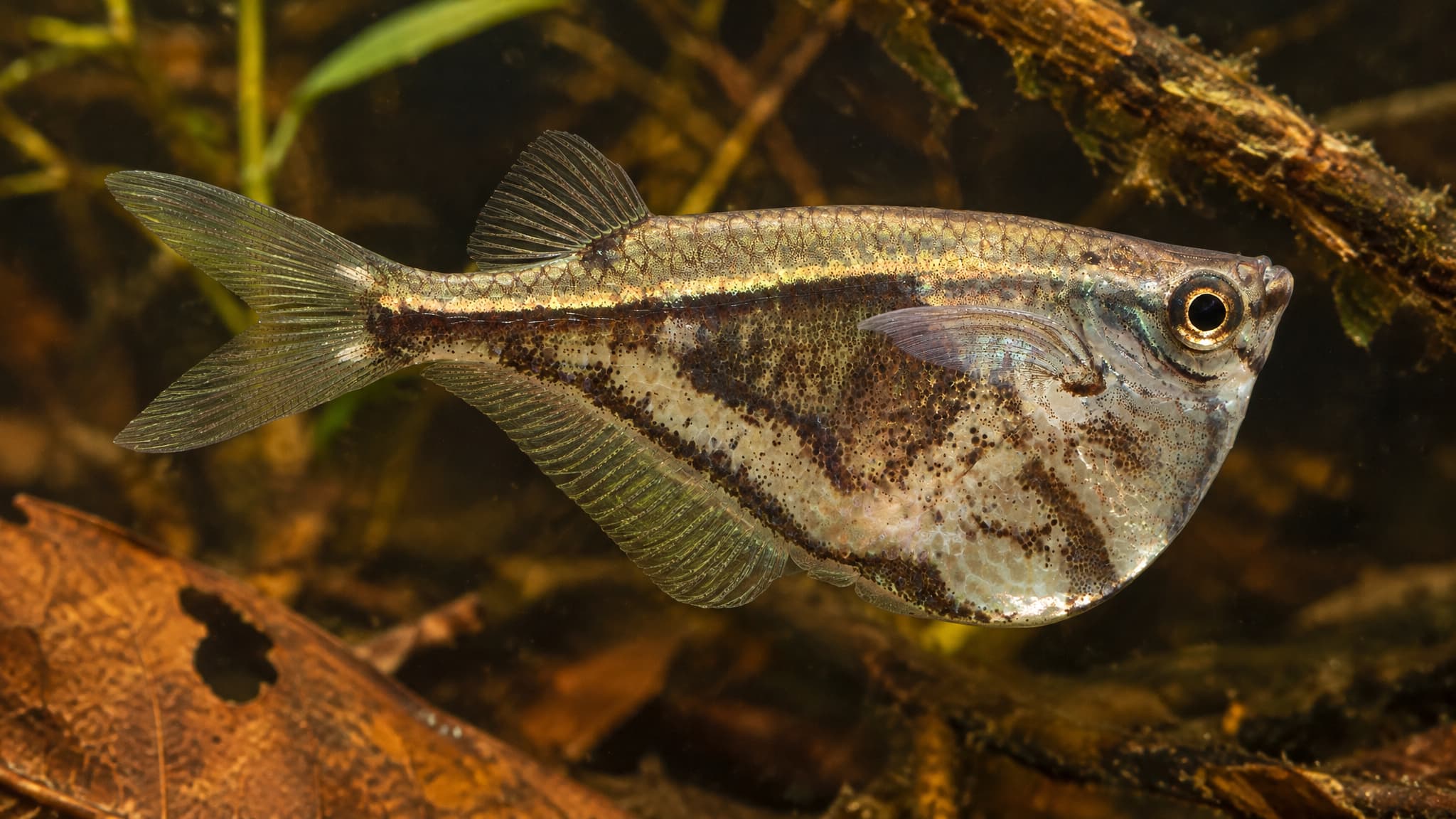
Basking Shark
Fish

Basking Shark

Cetorhinus maximus

The basking shark (Cetorhinus maximus) is the second-largest living fish, with adults commonly reaching 7–10 m in length. Despite its size, it is a gentle filter-feeder that cruises slowly with its huge mouth open, straining zooplankton—especially calanoid copepods—through specialized gill rakers. Enormous gill slits nearly encircle the head, and its gray-brown body often breaks the surface in calm seas, giving the species its common name. Basking sharks occur in temperate and boreal waters across the Atlantic and Pacific, from coastal shelves to the open ocean. They follow seasonal plankton blooms, feeding near the surface in summer and moving to deeper offshore waters in winter; tagging studies show they can travel thousands of kilometres and dive to great depths. They are ovoviviparous, mature late, and reproduce slowly, with long gestation and very low resilience to fishing pressure. Once heavily targeted for liver oil, fins, and meat, populations have declined across much of the range. The IUCN lists the species as Endangered, with ongoing threats from bycatch, entanglement, and vessel strikes. International protections include CITES Appendix II and CMS listings, and the shark supports ecotourism and research in regions such as Scotland, Ireland, and Cornwall.

View Details
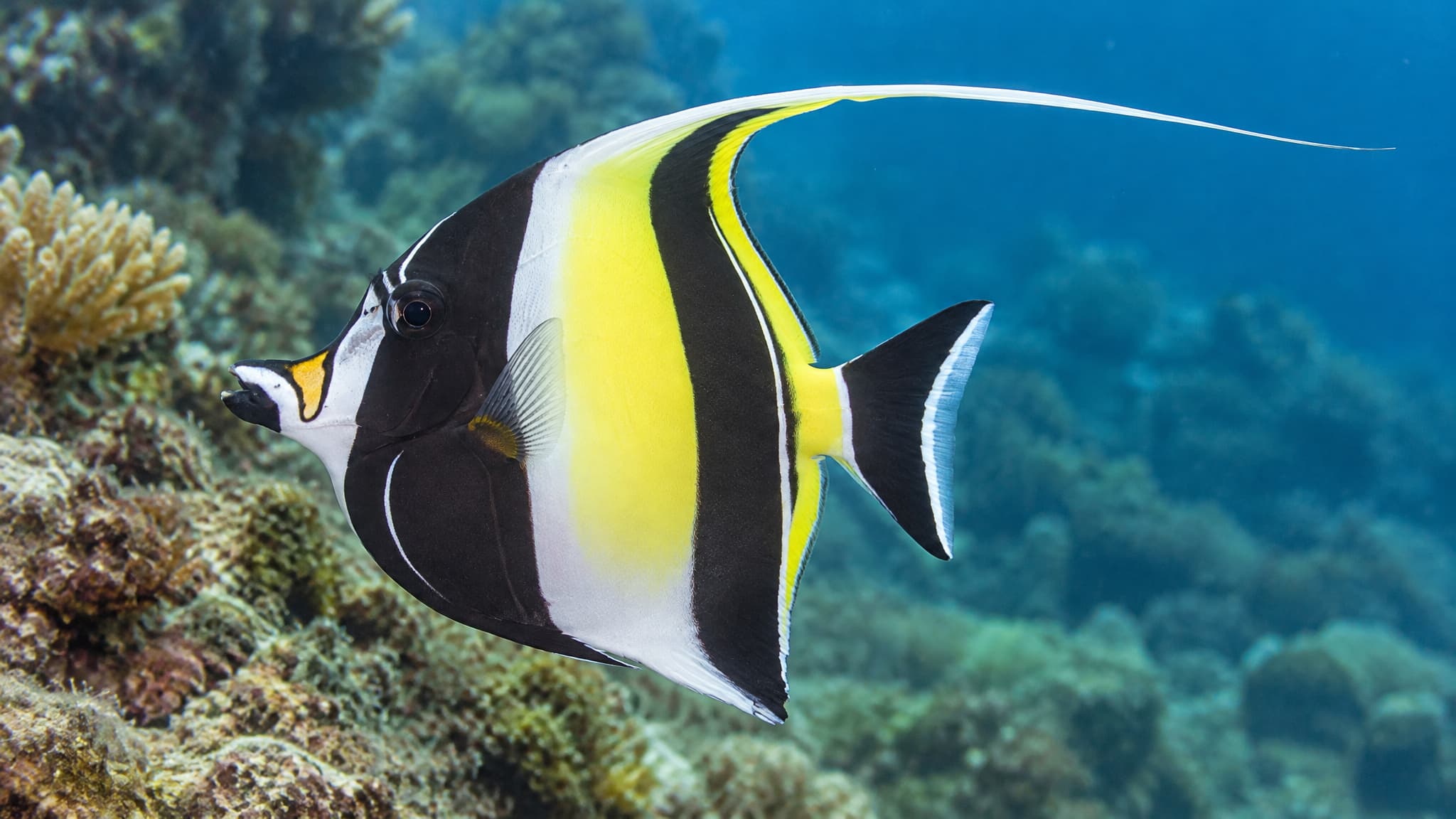
Smooth Hammerhead
Fish

Smooth Hammerhead

Sphyrna zygaena

The smooth hammerhead (Sphyrna zygaena) is the second-largest hammerhead shark and one of the most widely distributed, occurring in temperate and tropical seas around the world. It is named for its distinctive flattened cephalofoil—the hammer-shaped head—with a smooth, curved front margin that lacks the central notch seen in scalloped or great hammerheads. Adults typically reach 8–11 feet in length, with large females occasionally approaching 16 feet and 880 pounds. The species favors coastal bays, estuaries, and continental shelf waters, usually staying within about 65 feet of the surface though it can descend to several hundred meters. Smooth hammerheads are active carnivores that rely on keen eyesight and an acute sense of smell to hunt bony fishes such as herring, mackerel, and sardines, along with squid, stingrays, crustaceans, and occasionally other sharks. Although mostly solitary, they form large schools of hundreds or even thousands of individuals during seasonal migrations to higher latitudes in summer to feed, returning to warmer waters in winter to breed. Females are viviparous, giving birth to litters of 20–50 pups after a gestation of about 10–11 months in shallow coastal nurseries. The species is heavily targeted and caught as bycatch in longline, purse-seine, and gillnet fisheries worldwide, and its large fins are highly valued in the international shark-fin trade. The IUCN lists the smooth hammerhead as Vulnerable, citing an estimated global population decline of 30–49% over three generation lengths (~72 years). CITES Appendix II listing and regional fishing regulations offer some protection, but improved catch monitoring and enforcement remain critical for this wide-ranging predator.

View Details
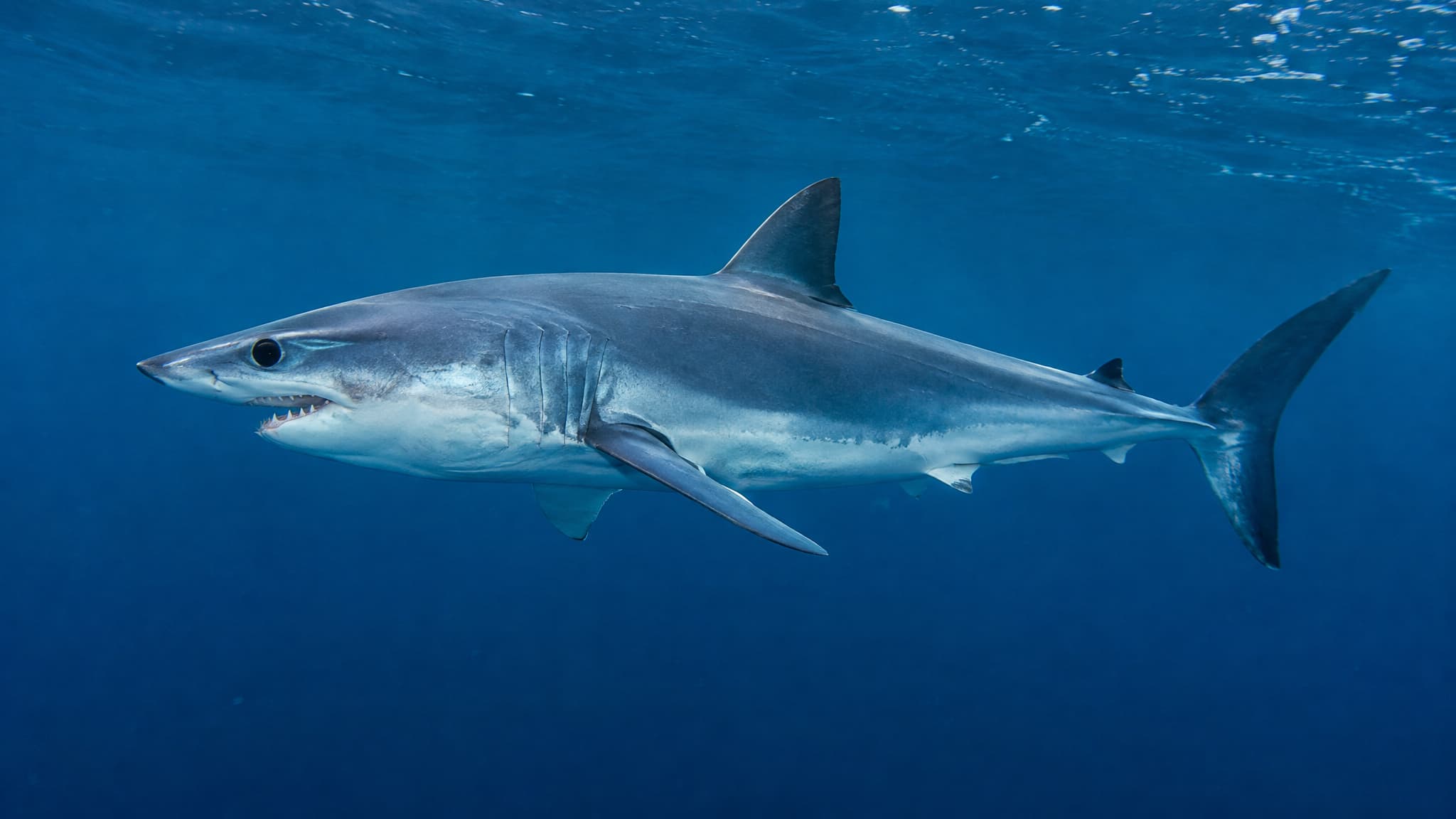
Scalloped Hammerhead
Fish

Scalloped Hammerhead

Sphyrna lewini

The scalloped hammerhead (Sphyrna lewini) is a cosmopolitan pelagic shark recognized by its hammer-shaped head (cephalofoil), which bears a small central notch and pronounced grooves along the front margin that give the species its “scalloped” appearance. Found in tropical and warm-temperate waters worldwide across the Atlantic, Indian, and Pacific oceans, adults typically show countershading with a gray dorsum, white underside, and dark-tipped pectoral fins. Females grow larger than males and can reach roughly 4.3 m (about 14 ft) in length. These sharks use a wide daily movement pattern, leaving offshore feeding areas at dawn to visit island shelves, seamounts, reefs, and estuaries. Females often form sexually segregated schools, while younger sharks also gather in large groups. Scalloped hammerheads hunt mainly at night, using electroreception, vision, and smell to find fish, cephalopods, crustaceans, and smaller sharks and rays. They are viviparous, giving birth to live litters of 12–38 pups after a gestation of about 9–12 months. Once among the most abundant large sharks on reefs, scalloped hammerhead populations have collapsed from intense fishing pressure and demand for fins in global trade. The IUCN lists the species as Critically Endangered, with estimated global declines exceeding 80% over three generations. Although some regional stocks show signs of stabilization under management, the species remains highly vulnerable to bycatch and unsustainable harvest.

View Details
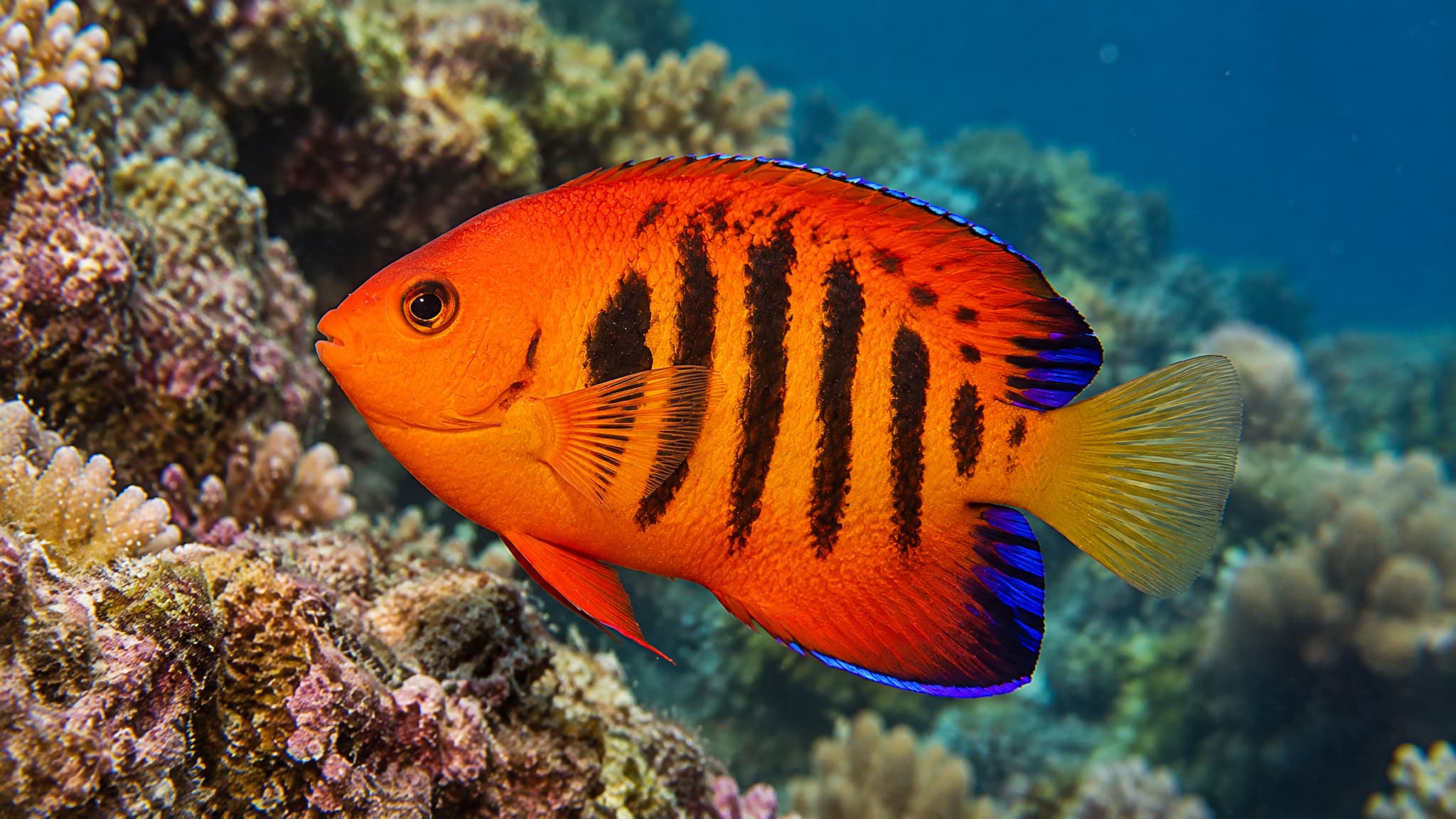
Great Hammerhead
Fish

Great Hammerhead

Sphyrna mokarran

The great hammerhead (Sphyrna mokarran) is the largest of the hammerhead sharks and one of the most distinctive predators in tropical and warm temperate seas worldwide. Its broad, nearly straight-edged cephalofoil—the hammer-shaped head—spreads electroreceptors and eyes across a wide arc, giving the shark enhanced ability to scan the seafloor and detect hidden prey such as stingrays buried in sand. Great hammerheads are solitary, highly migratory hunters that cruise coastal shelves, reefs, lagoons, and offshore waters, often at depths of about 80 meters but ranging from shallow inshore zones to 300 meters. They feed primarily on rays and skates, using their wide heads to pin stingrays before delivering precise bites, but also take bony fishes, squid, octopus, and other sharks. Females give birth to live young after an 11-month gestation, producing litters of roughly 6 to 42 pups that must fend for themselves immediately. Once circumglobal and common, the species has suffered severe population declines driven by targeted fishing for fins, high bycatch mortality, and a slow reproductive rate—females breed only about every two years. The IUCN lists the great hammerhead as Critically Endangered, with an estimated global reduction exceeding 80% over three generation lengths, though international protections such as CITES Appendix II listing aim to curb the fin trade.

View Details
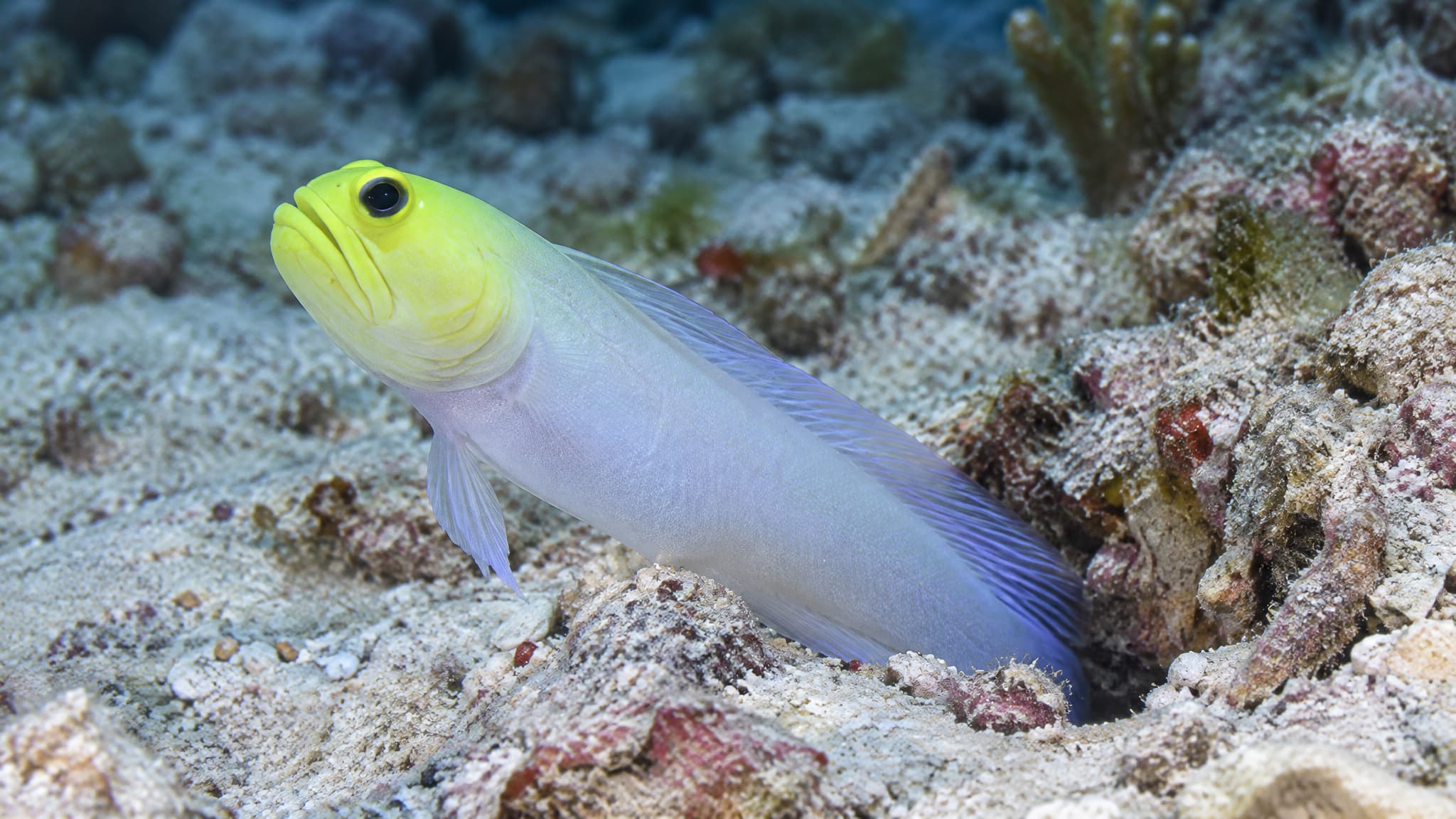
Longfin Mako Shark
Fish

Longfin Mako Shark

Isurus paucus
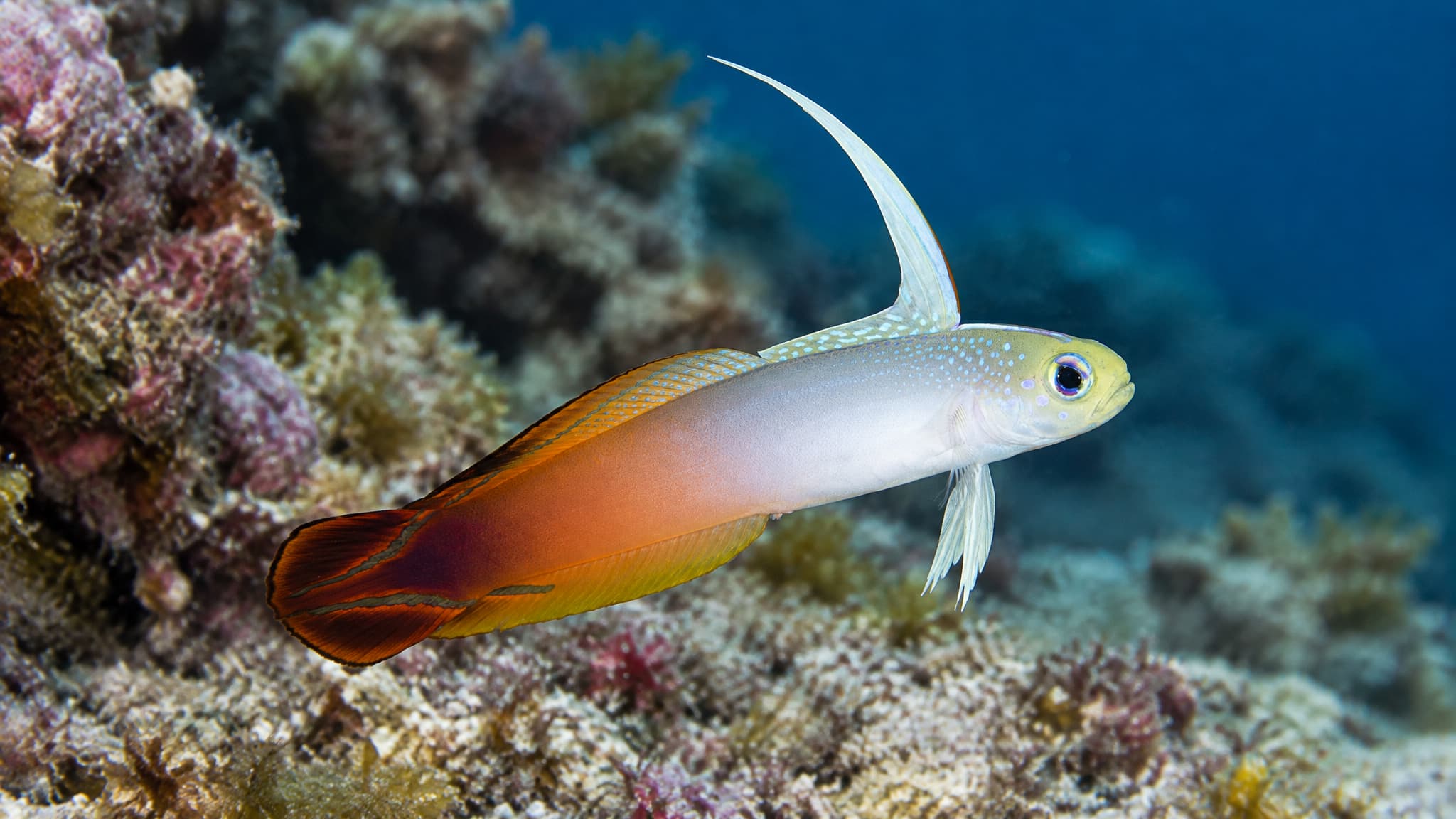
The longfin mako shark (Isurus paucus) is a large, elusive pelagic shark in the mackerel-shark family Lamnidae. Closely related to the shortfin mako, it is immediately recognizable by its exceptionally long, broad pectoral fins—often extending well past the gill region when laid back. Adults show deep blue-gray countershading above and a pale underside, with a streamlined body, pointed snout, and crescent-shaped tail adapted for fast open-ocean swimming. This circumglobal species inhabits tropical and warm-temperate offshore waters in the Atlantic, Indian, and Pacific Oceans, from the surface to roughly 460 meters depth. It is far less frequently observed than the shortfin mako and is often misidentified with its cousin, which explains the sparse scientific record reflected in its epithet paucus (“few”). Longfin makos feed mainly on pelagic schooling teleost fishes such as tunas and mackerels, along with oceanic squids, and reproduce through aplacental viviparity with oophagy, typically bearing small litters of about two pups after an extended gestation. The IUCN lists the longfin mako as Endangered, citing suspected global population declines driven by incidental capture in pelagic longline fisheries, retention for fins despite lower meat quality, and the species’ naturally low fecundity and late maturity. Both mako species are listed on CITES Appendix II, but continued bycatch mortality remains the primary conservation concern.

View Details