Argentine black-and-white tegu
Salvator merianae
 AI-generated
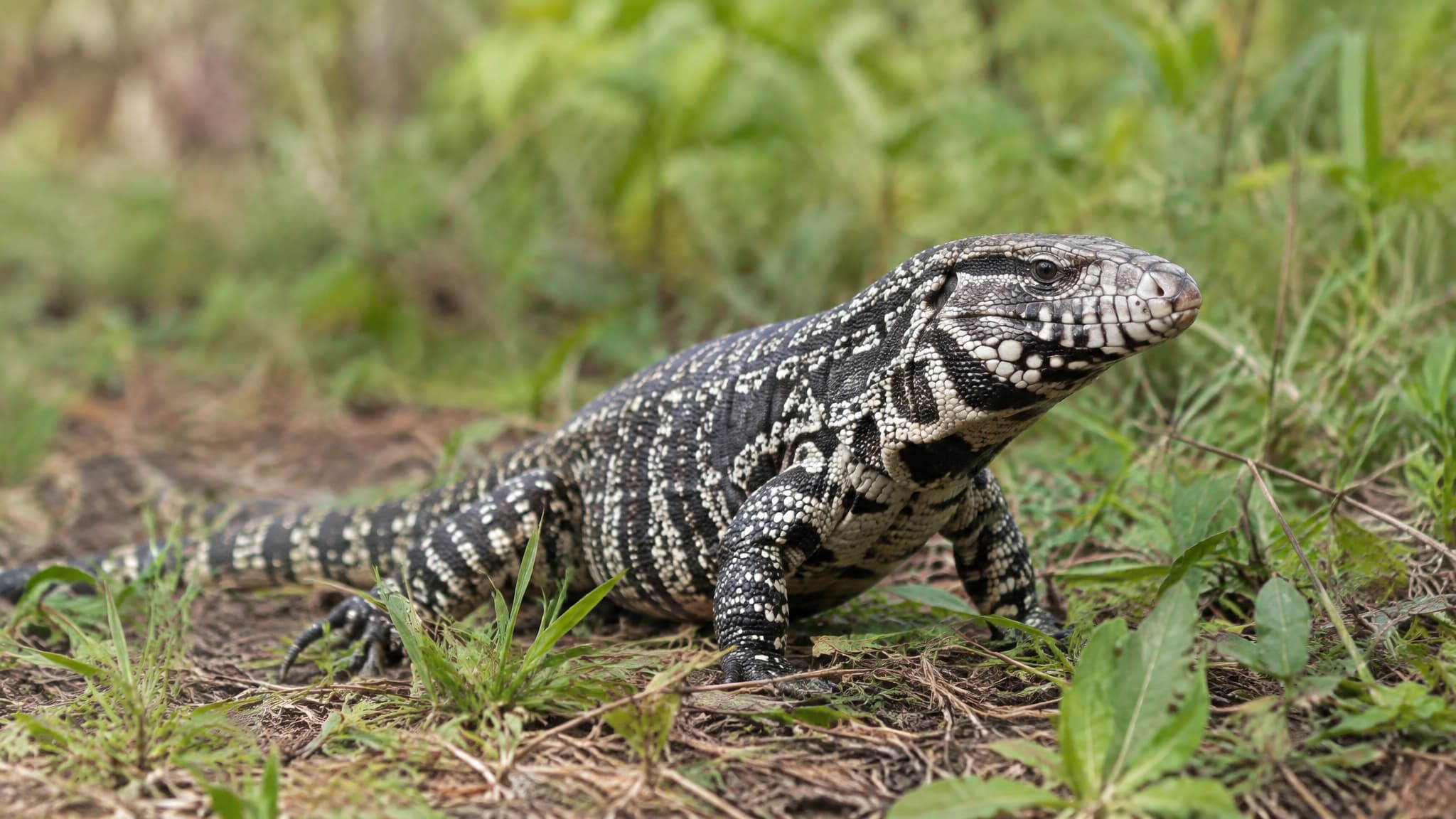
An Argentine black-and-white tegu rests low on the ground amid grass and leaf litter, facing right with its head raised and stout forelimbs extended. Its dark body is covered in conspicuous pale spotting, with a broad head, robust jaws, and a long banded tail visible.
Argentine black-and-white tegu
The Argentine black-and-white tegu is a large, sturdy South American lizard with a pointed head, powerful jaws, a long rounded tail, and a deeply forked pink tongue. Adults are typically patterned in black, gray, and creamy white bands or mottling; hatchlings and young animals often show a conspicuously greenish head that fades with age. It is among the largest lizards in the Americas and may exceed 1.2 m (4 ft) in total length.
Its native range includes Brazil, Bolivia, Paraguay, Uruguay, and Argentina. A flexible habitat generalist, it occupies forests, savannas, grasslands, wetlands, coastal settings, farmland, and disturbed ground. It is mainly terrestrial but can climb when needed, swims well, and uses burrows or other sheltered sites. In cooler periods it becomes inactive underground; this seasonal dormancy has helped it endure conditions beyond the warmest parts of its range.
This tegu is an opportunistic omnivore. Its food includes insects and other invertebrates, fruit, eggs, small vertebrates, and carrion. By eating fruit, it can contribute to seed dispersal, while its predation on eggs and small animals makes it an important ground-level predator. Females are oviparous and may lay roughly 30–35 eggs in a clutch or breeding season. Captive individuals have been reported to live about 17–20 years.
Across its native range, S. merianae is assessed as Least Concern in the cited Brazilian conservation context. Habitat alteration, persecution, and collection can still affect local animals. Outside South America, released or escaped pet-trade animals have formed breeding populations, especially in Florida; there they can raid nests of turtles, crocodilians, and ground-nesting birds, compete for shelter, and threaten native wildlife. Thus, a species that is a normal part of South American ecosystems can be a serious invasive predator when introduced elsewhere.