
Armadillo Girdled Lizard
Ouroborus cataphractus
 AI-generated
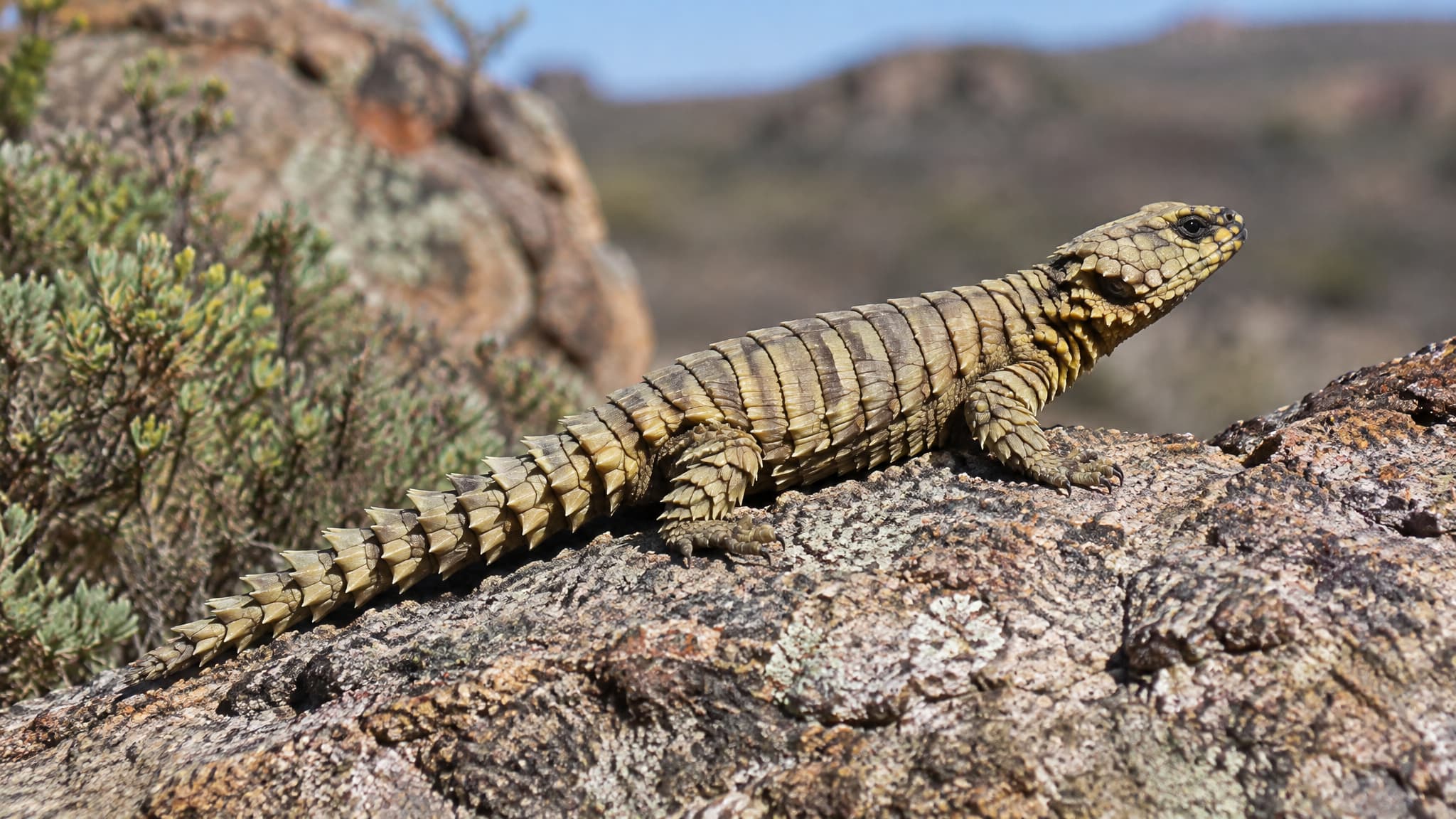
An armadillo girdled lizard rests in profile on a rocky outcrop, with a heavily armored body, keeled scales, and a ringed, spiny tail visible against succulent vegetation and distant mountains.
The armadillo girdled lizard (Ouroborus cataphractus) is a small, heavily armoured lizard of the family Cordylidae and the only member of its genus. Adults measure about 7.5 to 9 cm from snout to vent and reach a total length of about 15 to 20 cm, with the spiny tail roughly as long as the body or a little shorter. Its back is covered in thick, squarish scales in shades from straw yellow to dark brown, and the tail carries rows of sharp spines. The belly is yellowish with dark markings, especially under the chin.
The species is endemic to the Succulent Karoo of western South Africa, in the Northern and Western Cape provinces, from the Orange River and the Richtersveld south to the Piketberg Mountains. It is a strict rock-dweller that lives in horizontal cracks and crevices of rocky outcrops and mountain slopes, with a preference for sandstone and for rocky ground near termite mounds.
Unusually for a lizard, it is social. Groups of all ages share a crevice; most are small, but some hold up to 60 individuals. It is active by day, slow-moving and shy. When caught away from cover, it grips its own tail in its mouth and rolls into a spiny ball that shields its soft belly, a posture it can hold for up to an hour. This habit, reminiscent of the mythical ouroboros and of armadillos, gave the lizard both its scientific and common names.
The diet is mainly insects and other small invertebrates. Termites dominate, above all the harvester termites Microhodotermes viator and Hodotermes mossambicus, and the lizards often travel 4 to 20 m from their crevices to feed at termite mounds. Beetles, millipedes, scorpions and some plant material are also eaten. By preying on termites and other insects, it may help keep their numbers in check.
The species does not lay eggs. Mating takes place in spring and, once a year in autumn, the female gives birth to one or two live young; some females skip a year. Mothers may even feed their young, which is rare among lizards. Captive animals have lived up to 25 years, while the wild lifespan is not known.
The IUCN Red List classes the armadillo girdled lizard as Near Threatened. Collection for the international pet trade has been the main pressure, made easier because whole family groups shelter together. The species is listed on CITES Appendix II and protected in the Western Cape, and other threats include habitat degradation, invasive plants, poor fire management and climate swings that affect termite numbers.



