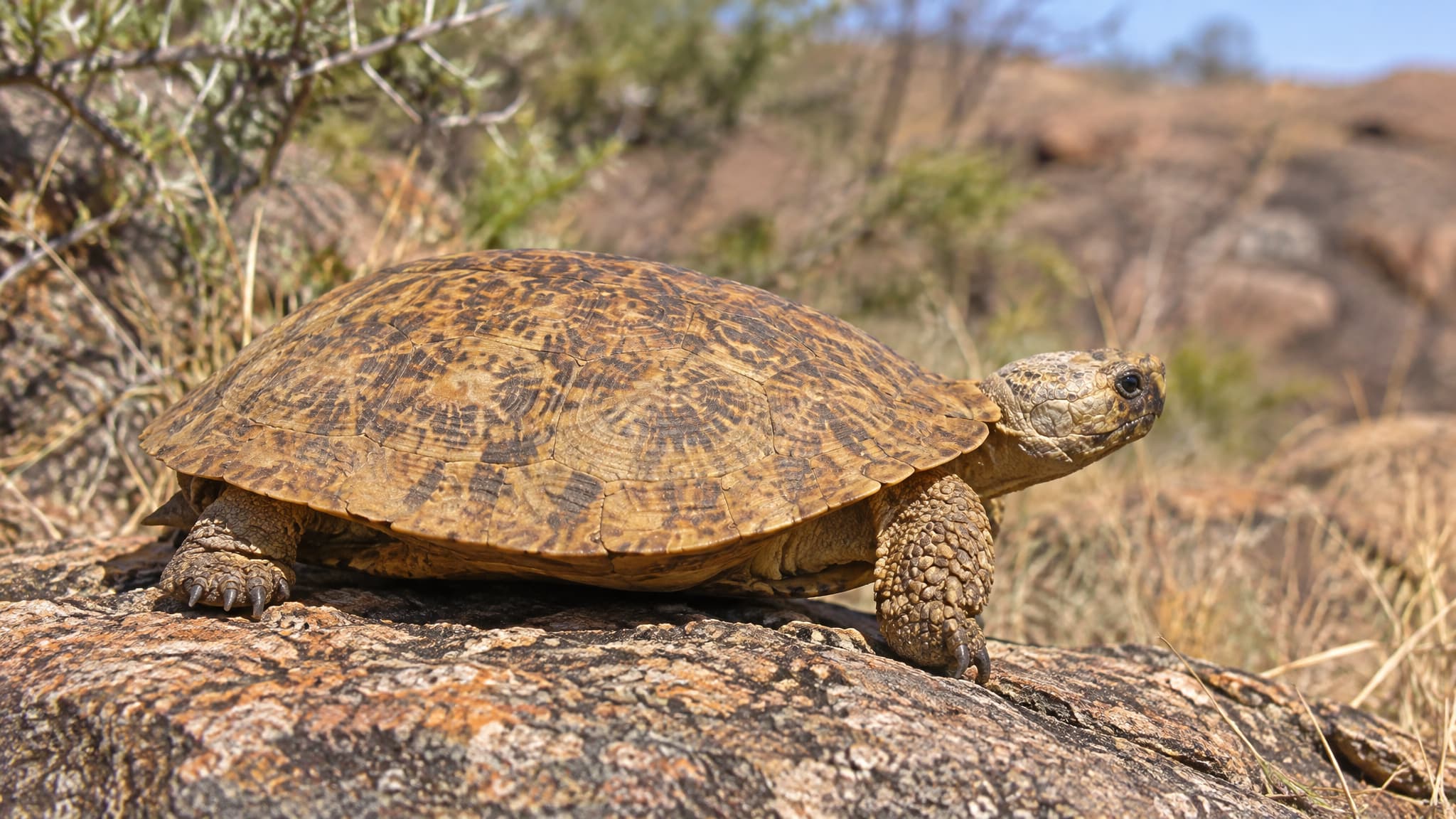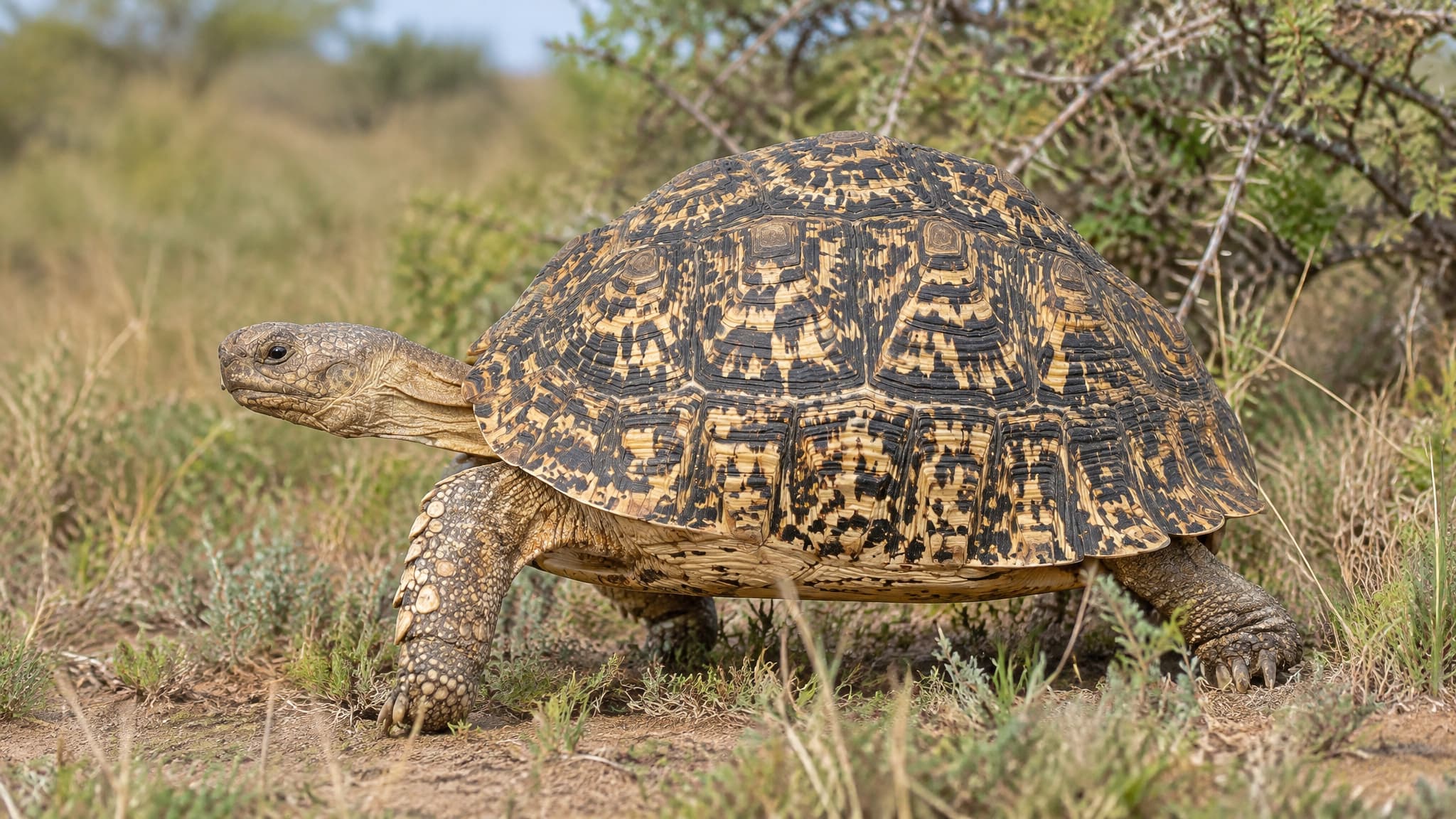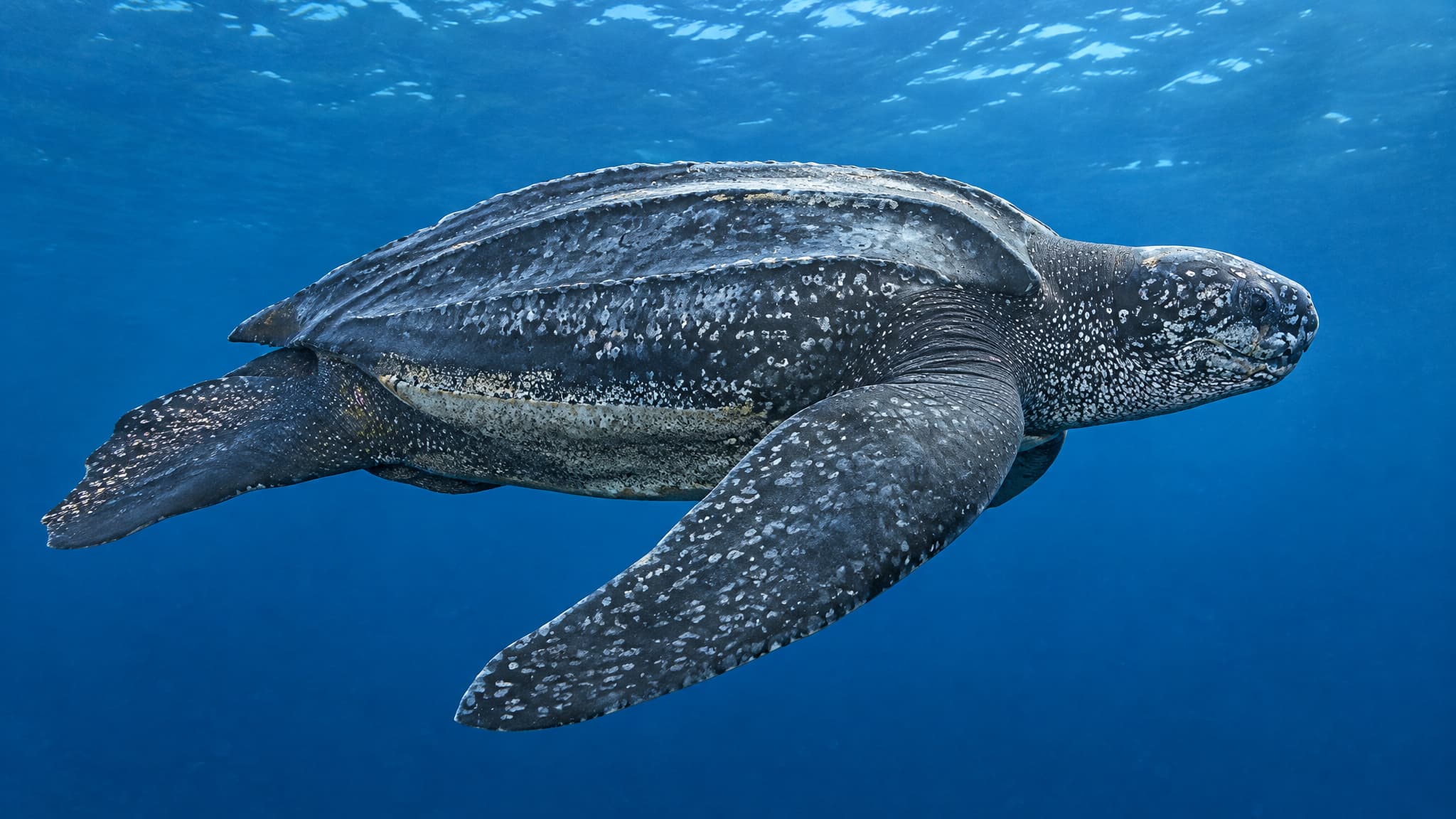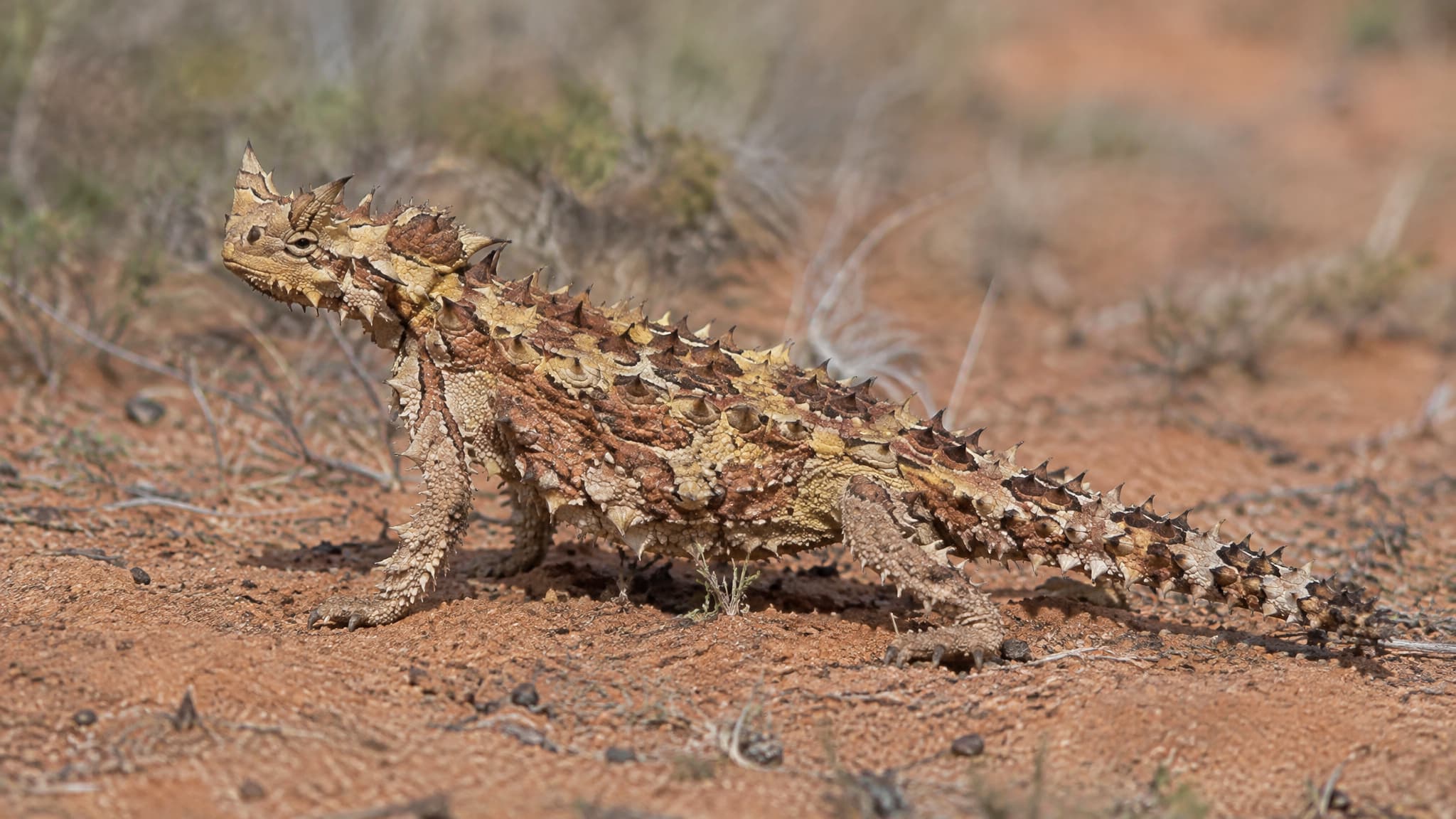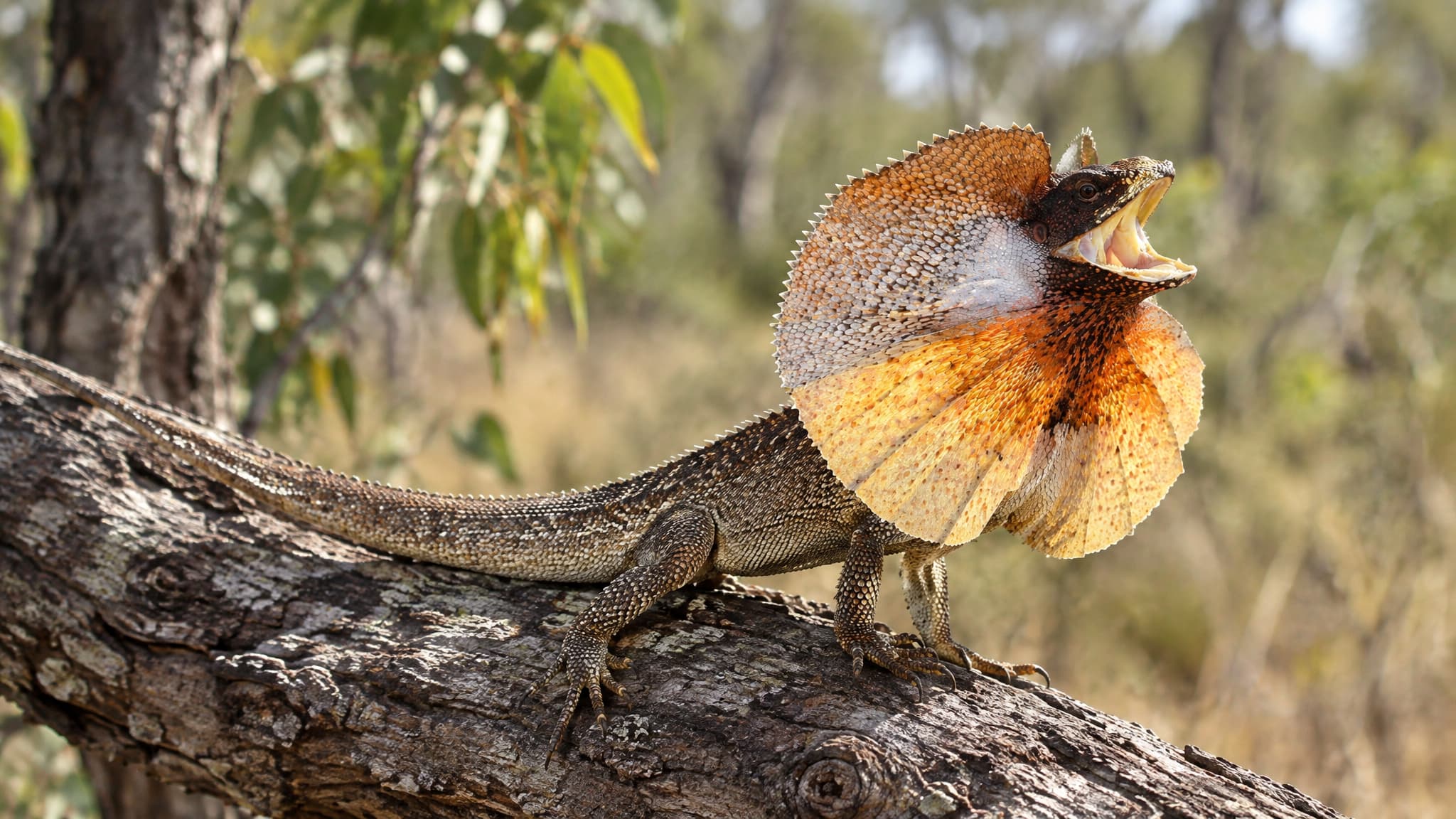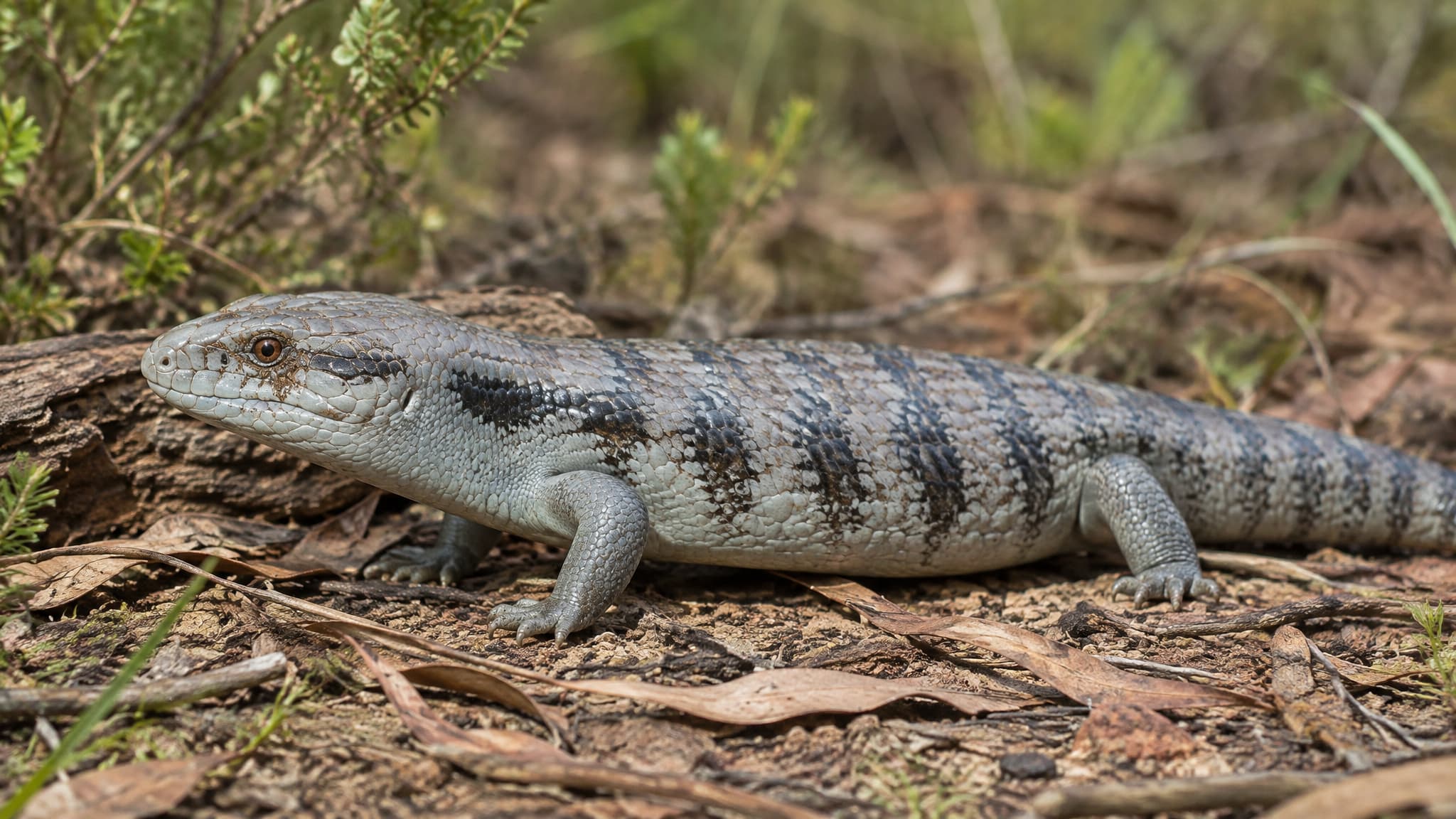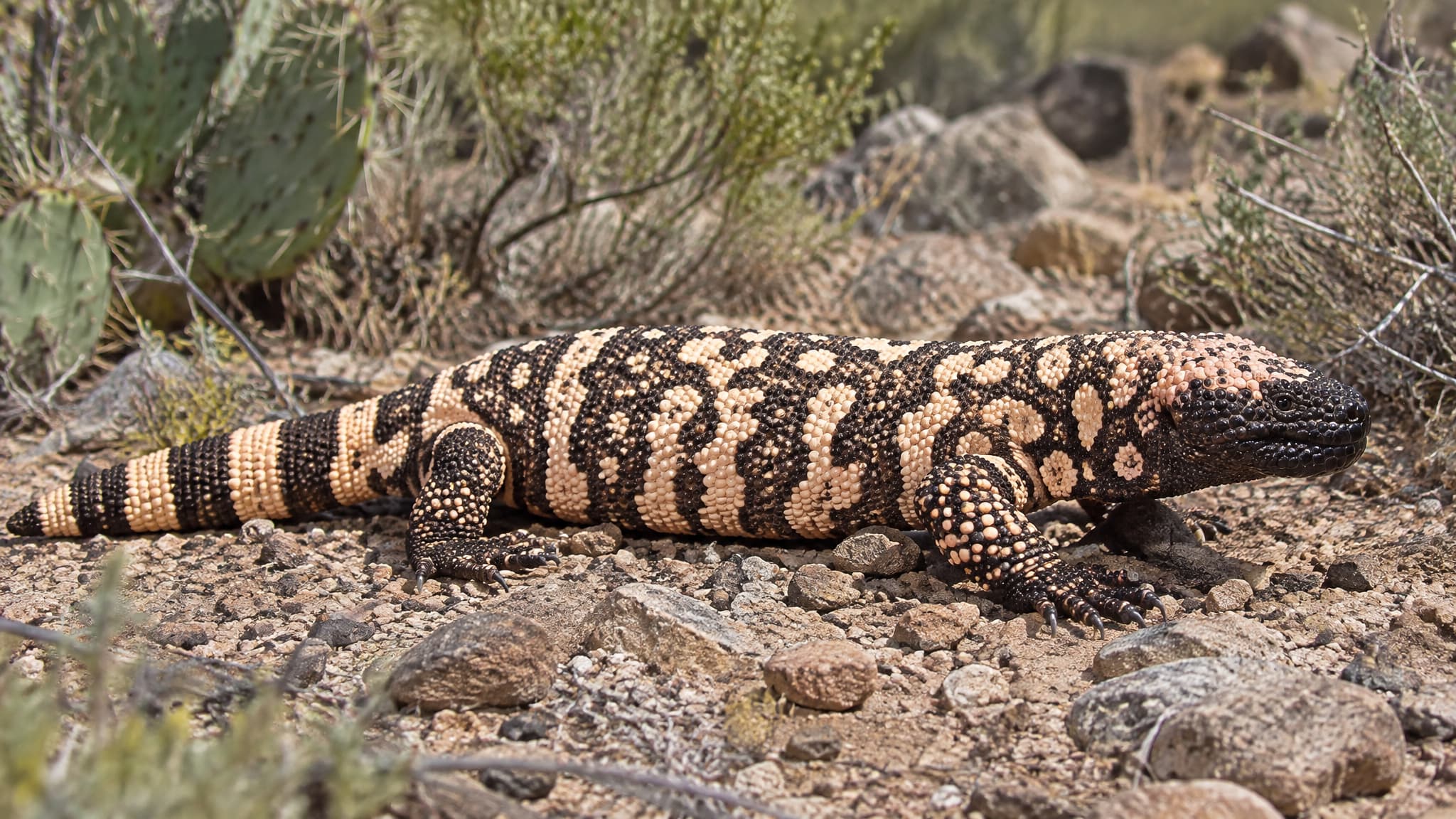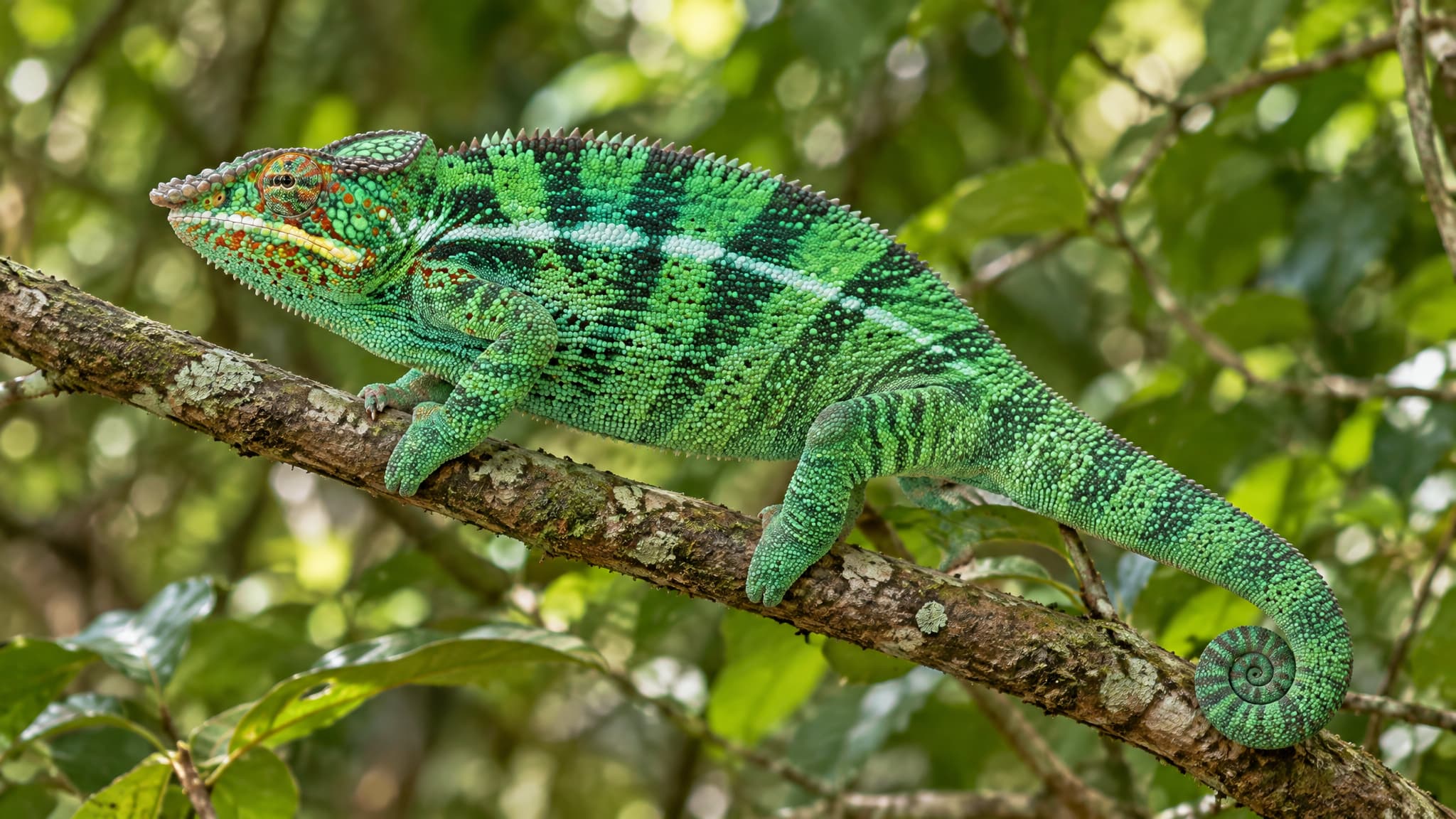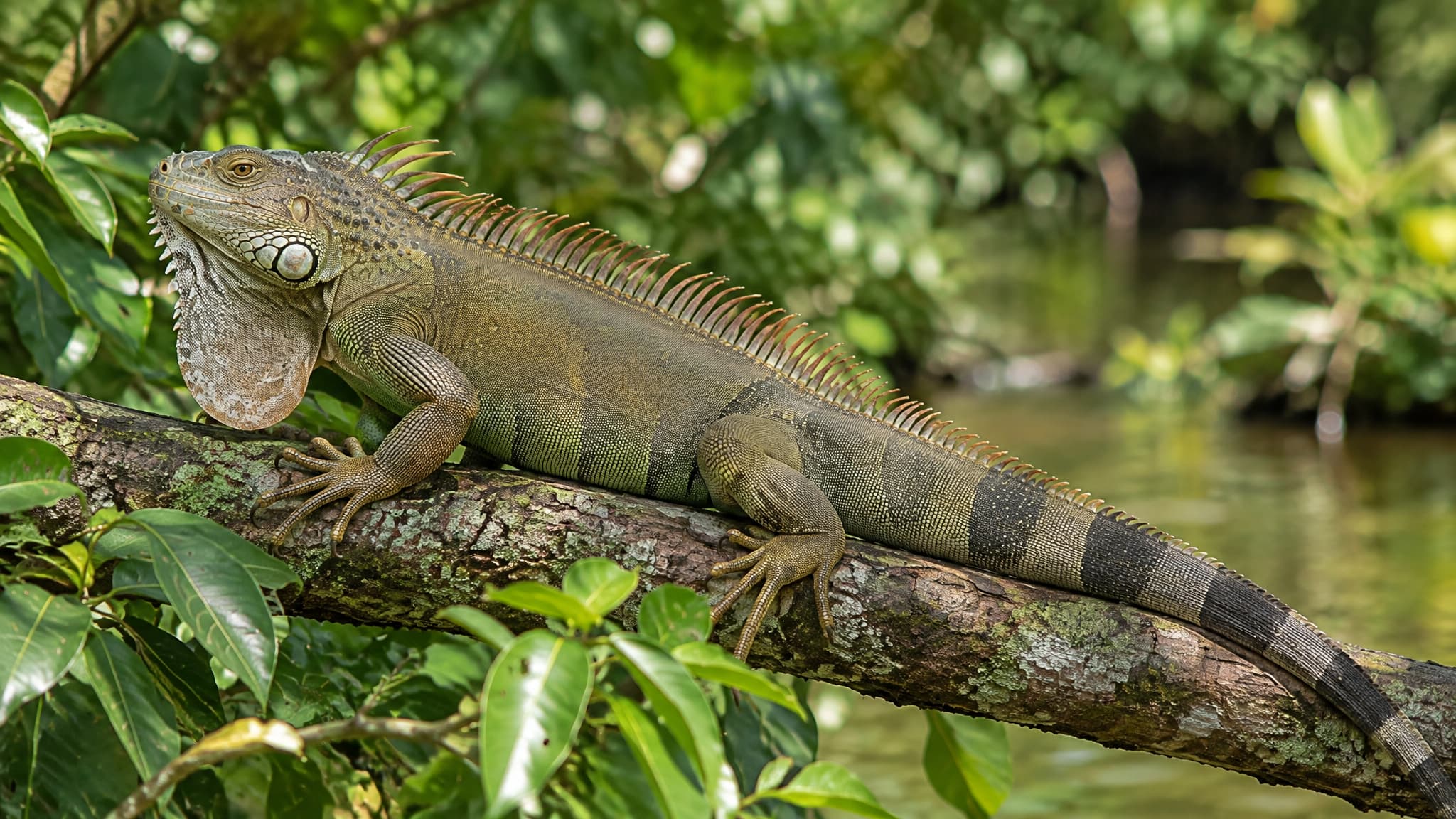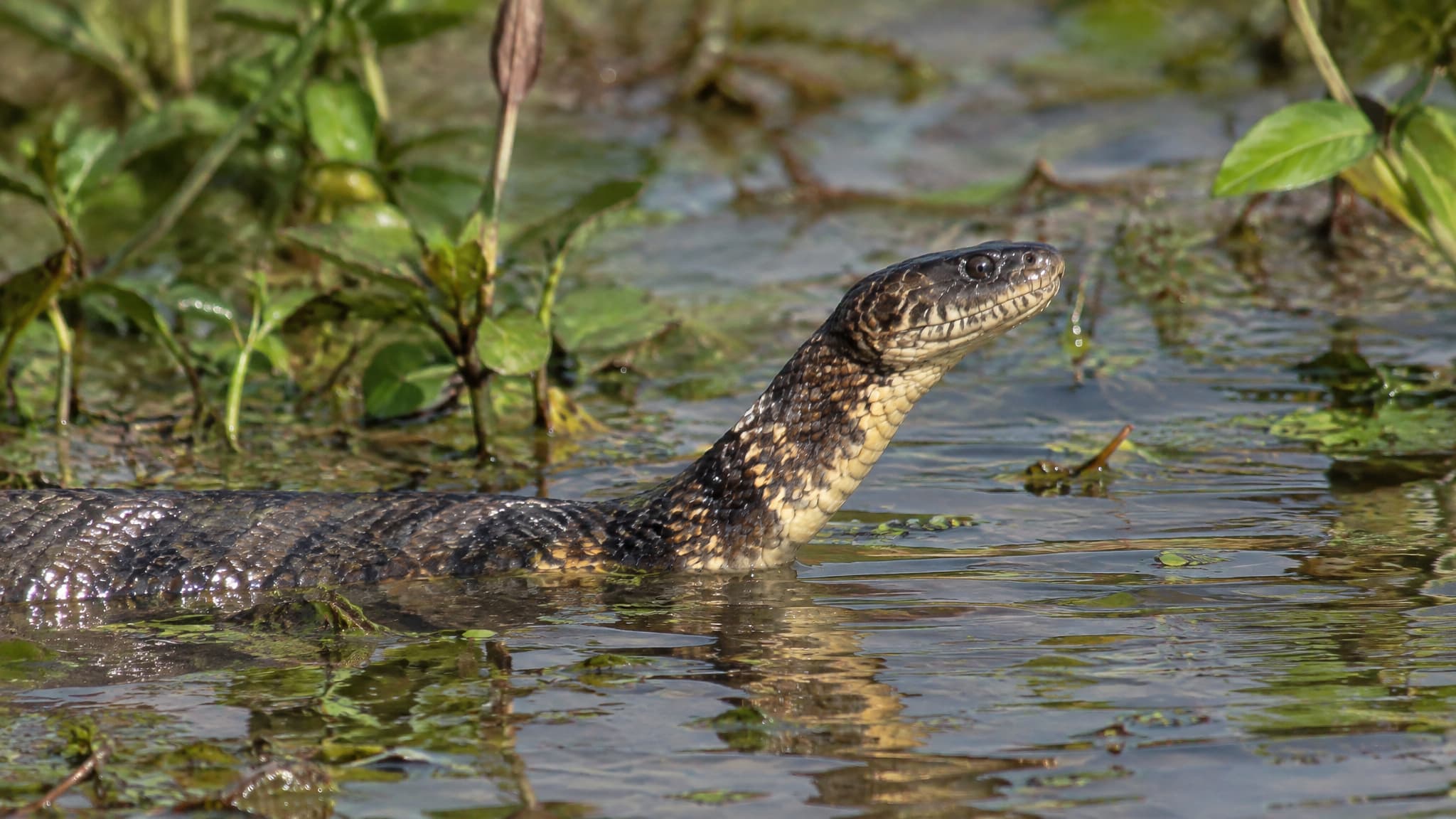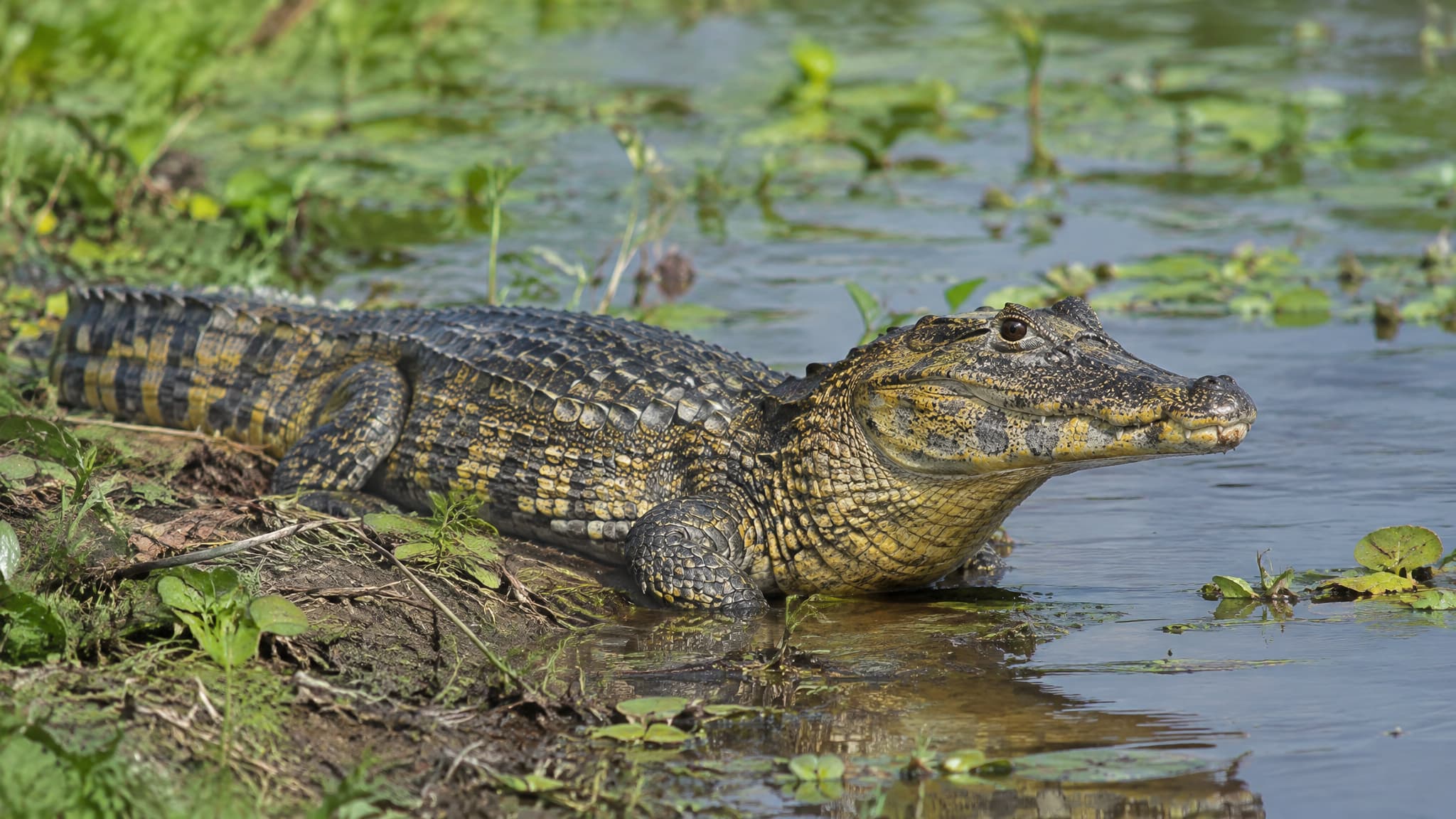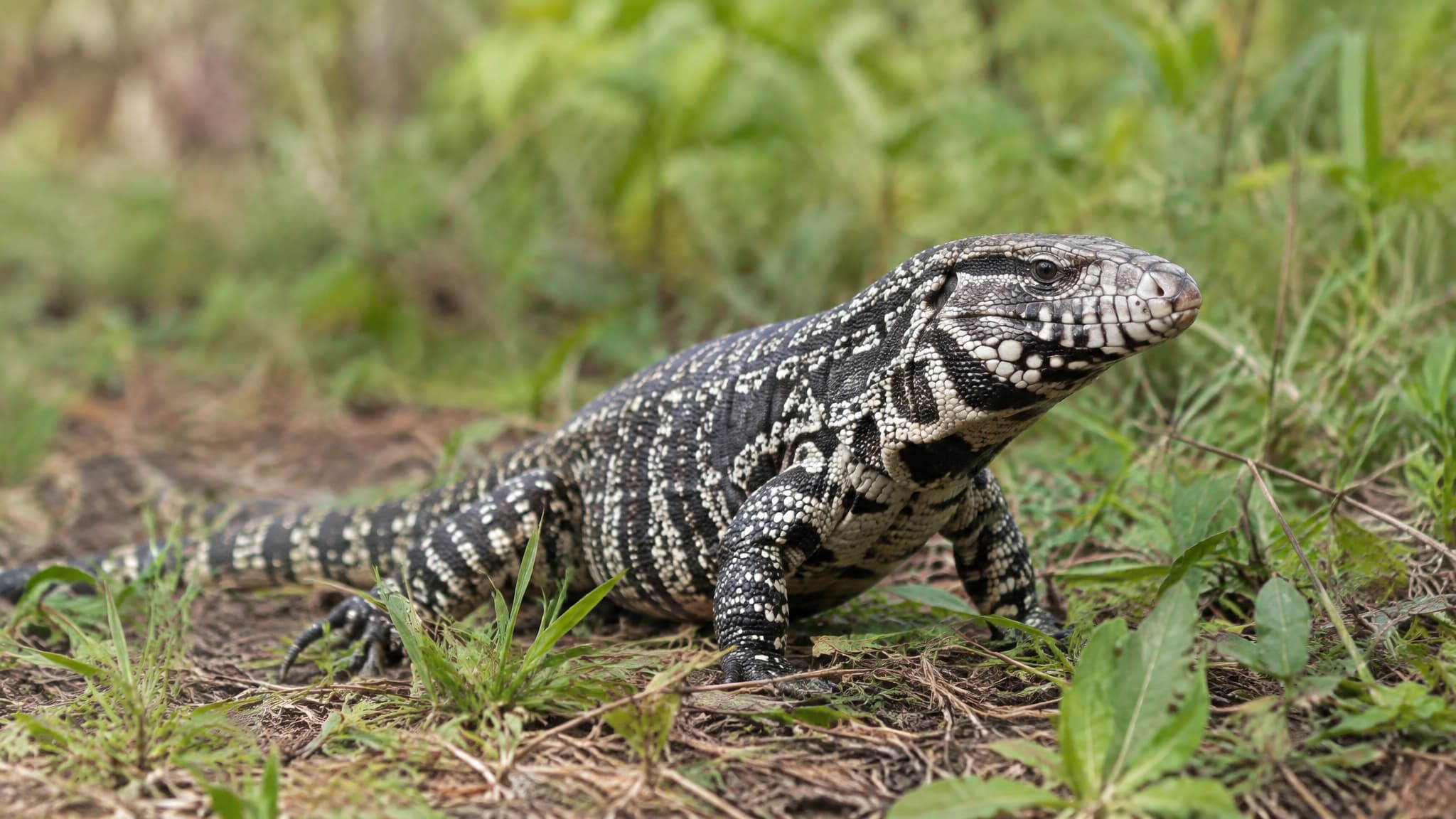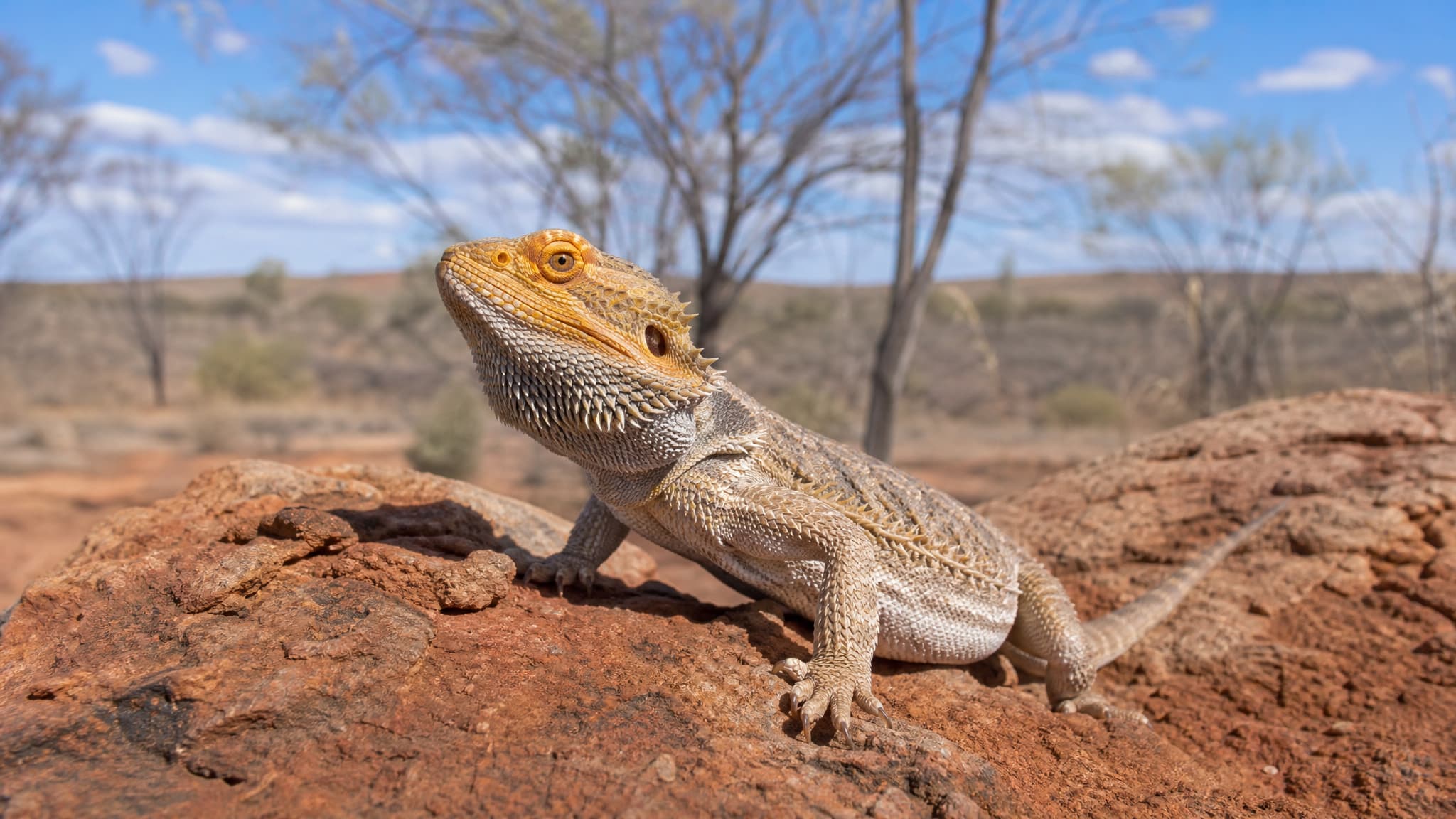
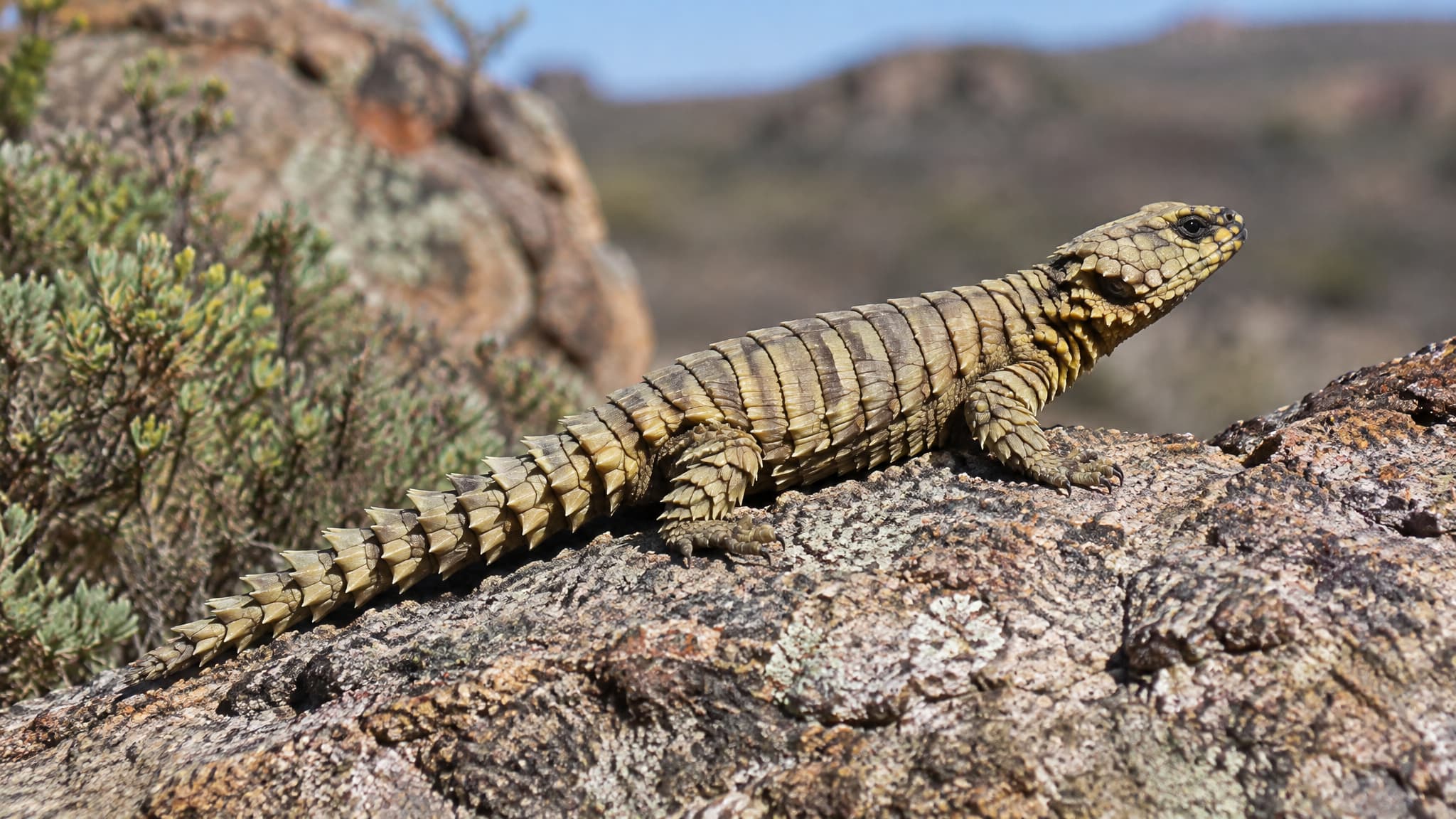
A bearded dragon rests on sunlit reddish rocks with its head raised and facing left. Its spiny beard, textured scales, sturdy limbs, and long tapering tail are visible against a dry, open landscape.
Wildlife category

Reptiles

Cold-blooded vertebrates with scales

Published animals

83

Category

Reptiles

Slug

reptiles

Animals In This Category

Browse featured species, habitat clues, and discovery paths for the Reptiles category.

83 animals found

Armadillo Girdled Lizard
Reptiles

Armadillo Girdled Lizard

Ouroborus cataphractus

The armadillo girdled lizard (Ouroborus cataphractus) is a small, heavily armoured lizard of the family Cordylidae and the only member of its genus. Adults measure about 7.5 to 9 cm from snout to vent and reach a total length of about 15 to 20 cm, with the spiny tail roughly as long as the body or a little shorter. Its back is covered in thick, squarish scales in shades from straw yellow to dark brown, and the tail carries rows of sharp spines. The belly is yellowish with dark markings, especially under the chin. The species is endemic to the Succulent Karoo of western South Africa, in the Northern and Western Cape provinces, from the Orange River and the Richtersveld south to the Piketberg Mountains. It is a strict rock-dweller that lives in horizontal cracks and crevices of rocky outcrops and mountain slopes, with a preference for sandstone and for rocky ground near termite mounds. Unusually for a lizard, it is social. Groups of all ages share a crevice; most are small, but some hold up to 60 individuals. It is active by day, slow-moving and shy. When caught away from cover, it grips its own tail in its mouth and rolls into a spiny ball that shields its soft belly, a posture it can hold for up to an hour. This habit, reminiscent of the mythical ouroboros and of armadillos, gave the lizard both its scientific and common names. The diet is mainly insects and other small invertebrates. Termites dominate, above all the harvester termites Microhodotermes viator and Hodotermes mossambicus, and the lizards often travel 4 to 20 m from their crevices to feed at termite mounds. Beetles, millipedes, scorpions and some plant material are also eaten. By preying on termites and other insects, it may help keep their numbers in check. The species does not lay eggs. Mating takes place in spring and, once a year in autumn, the female gives birth to one or two live young; some females skip a year. Mothers may even feed their young, which is rare among lizards. Captive animals have lived up to 25 years, while the wild lifespan is not known. The IUCN Red List classes the armadillo girdled lizard as Near Threatened. Collection for the international pet trade has been the main pressure, made easier because whole family groups shelter together. The species is listed on CITES Appendix II and protected in the Western Cape, and other threats include habitat degradation, invasive plants, poor fire management and climate swings that affect termite numbers.

View Details
Satanic Leaf-tailed Gecko
Reptiles

Satanic Leaf-tailed Gecko

Uroplatus phantasticus

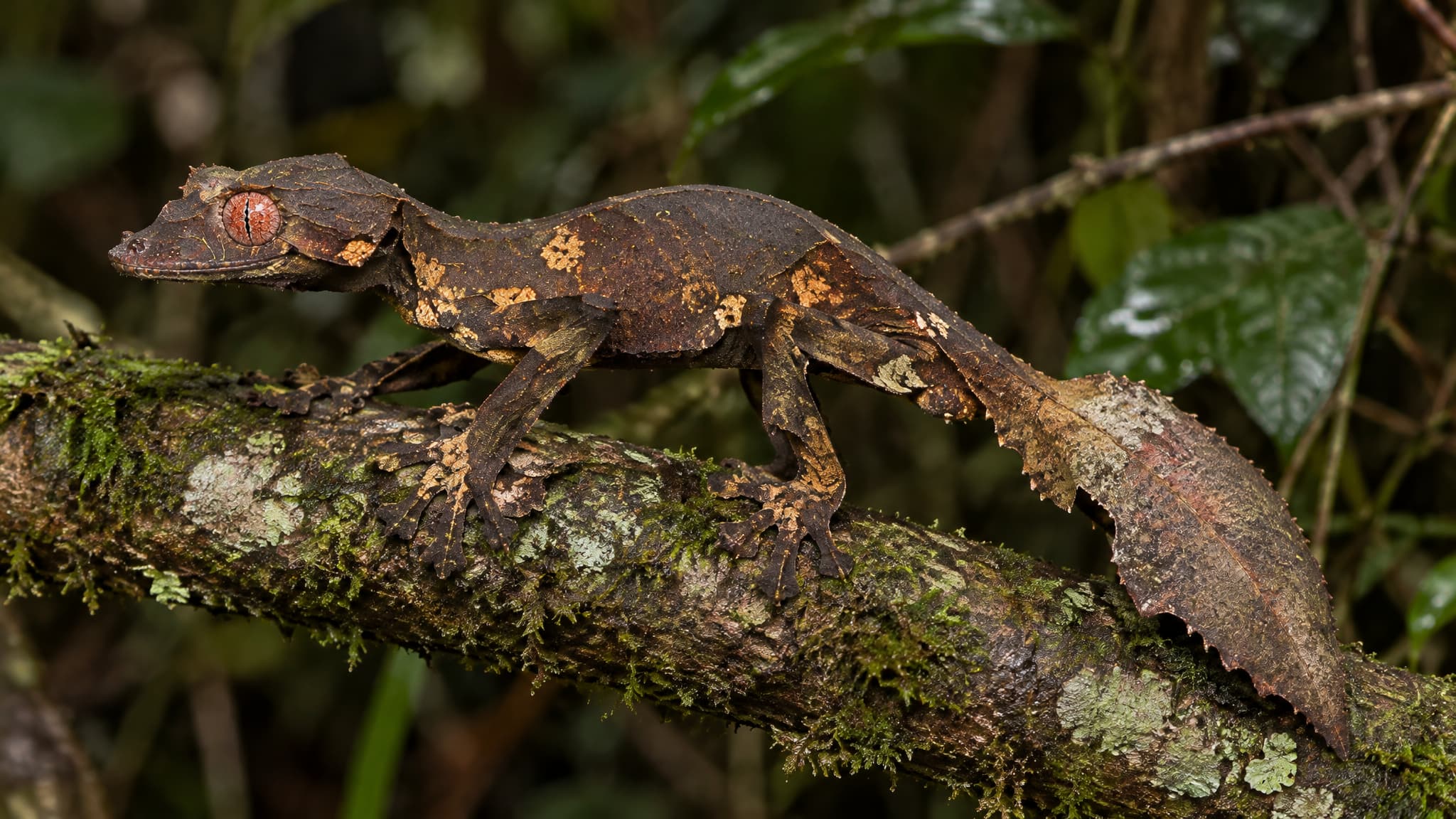
The satanic leaf-tailed gecko (Uroplatus phantasticus) is a small gecko from Madagascar, described by George Albert Boulenger in 1888. It is one of the smallest members of its genus, measuring about 7.5 to 10 cm including the tail. Its flattened tail has the outline of a withered leaf, often with notches that look like decay, and a spiny projection above each eye gives it the horned look behind its common name. Colour varies among individuals and can shift between light brown, grey, yellow, green and pink tones, usually with a mottled pattern. The species is endemic to Madagascar, where the Reptile Database places it in the east, southeast and south of the island, including the Andasibe (Perinet) area. It lives in tropical rainforest, spending its life among branches, twigs and dead leaves in the understorey. Females are slightly larger than males: males usually weigh 4 to 6 g, while females can reach 8 to 9 g. It is nocturnal and spends the day motionless, hidden by its camouflage among dry foliage. At night it hunts insects, with moths and crickets among its usual prey. Like other geckos it has no movable eyelids; a clear membrane covers each eye and the animal cleans it with its tongue. When threatened it flattens its body against the perch, raises its tail, opens its mouth to show a bright red lining and may give a loud whistle. It can also shed its tail to escape a predator. The species is oviparous. Breeding begins at the start of the rainy season, and females lay clutches of two spherical eggs hidden in leaf litter or dead leaves. In captivity eggs are laid about every 30 days and take 90 to 120 days to hatch, and hatchlings weigh less than 1 g. Captive animals are capable of living longer than 10 years; no wild lifespan has been published. As a nocturnal insect hunter of the forest understorey, it depends on intact forest and on its camouflage and defensive displays to avoid predators. The IUCN Red List assesses it as Least Concern, but it is listed in CITES Appendix II. Deforestation and habitat degradation threaten it, and it is collected for the international pet trade, sometimes illegally inside protected areas.

View Details
Veiled chameleon
Reptiles

Veiled chameleon

Chamaeleo calyptratus

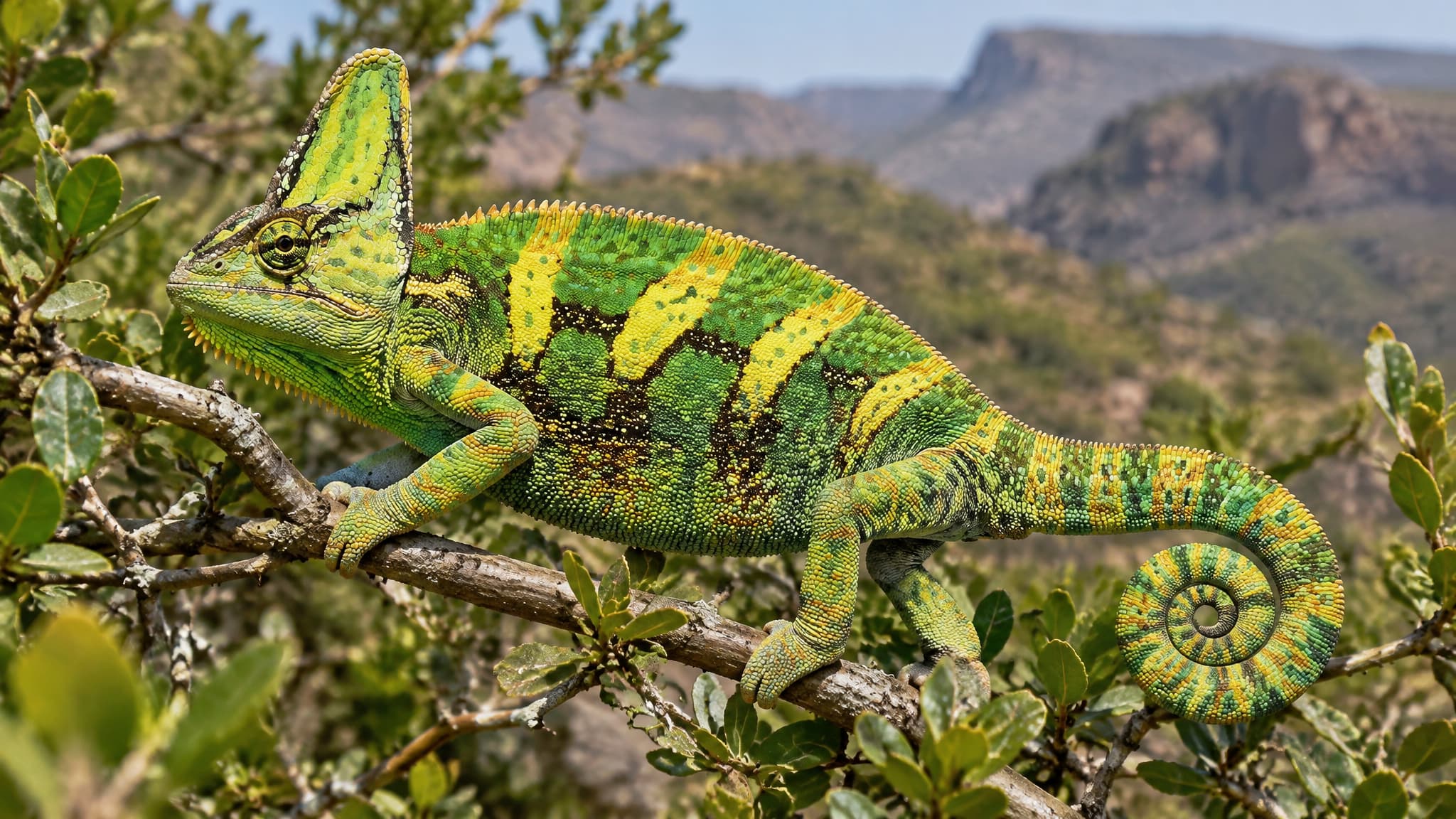
The veiled chameleon is a large chameleon from the south-western Arabian Peninsula, named for the tall helmet-like casque on its head. The casque is only a small bump in hatchlings but grows with age to about 5 cm in the largest adults, and it is thought to help channel dew and rain toward the mouth. Males measure 43 to 61 cm from snout to tail tip and carry small spurs on the hind feet from birth; females stay shorter, at up to about 35 cm, but are heavier-bodied and have a smaller casque. Hatchlings are pastel green. Adult females are green mottled with white, orange, yellow or tan, while males are brighter, with clear yellow or blue bands. Like other chameleons, it shifts its colours to signal aggression, social status, breeding condition and stress. Two subspecies are recognised: the nominate form and C. c. calcarifer. The species is native to Yemen and south-western Saudi Arabia, where it lives along escarpment foothills, mountains, plateaus and wadis up to 2,500 m. It is arboreal, climbing high in trees or lower in bushes and shrubs, and does best at about 24 to 35 °C. Escaped and released pets have founded wild populations in Florida and on Maui, Hawaii, where importing or keeping it without a permit has been illegal since 1992 because it eats native insects, birds, small lizards and plants. It is mainly an insectivore that catches prey with its long, sticky tongue, and green insects are a favourite. It also eats leaves and other plant matter, apparently as a source of water in the dry season. It is shy and solitary: when threatened it curls up, darkens and stays still. Males are strongly territorial and do not tolerate one another. Veiled chameleons mature fast, at 4 to 5 months. Within a day of a successful mating, the female darkens to blackish green with blue and yellow spots, and she lays 35 to 85 eggs 20 to 30 days later, up to three times a year. The embryos can pause their development for about 60 to 75 days before warmer ground temperatures restart it. Females live about 5 years and males up to 8 years. The IUCN lists the species as Least Concern. Wild populations face habitat loss and collection for trade, including live and dead animals sold for rituals and as souvenirs.

View Details
Spider tortoise
Reptiles

Spider tortoise

Pyxis arachnoides

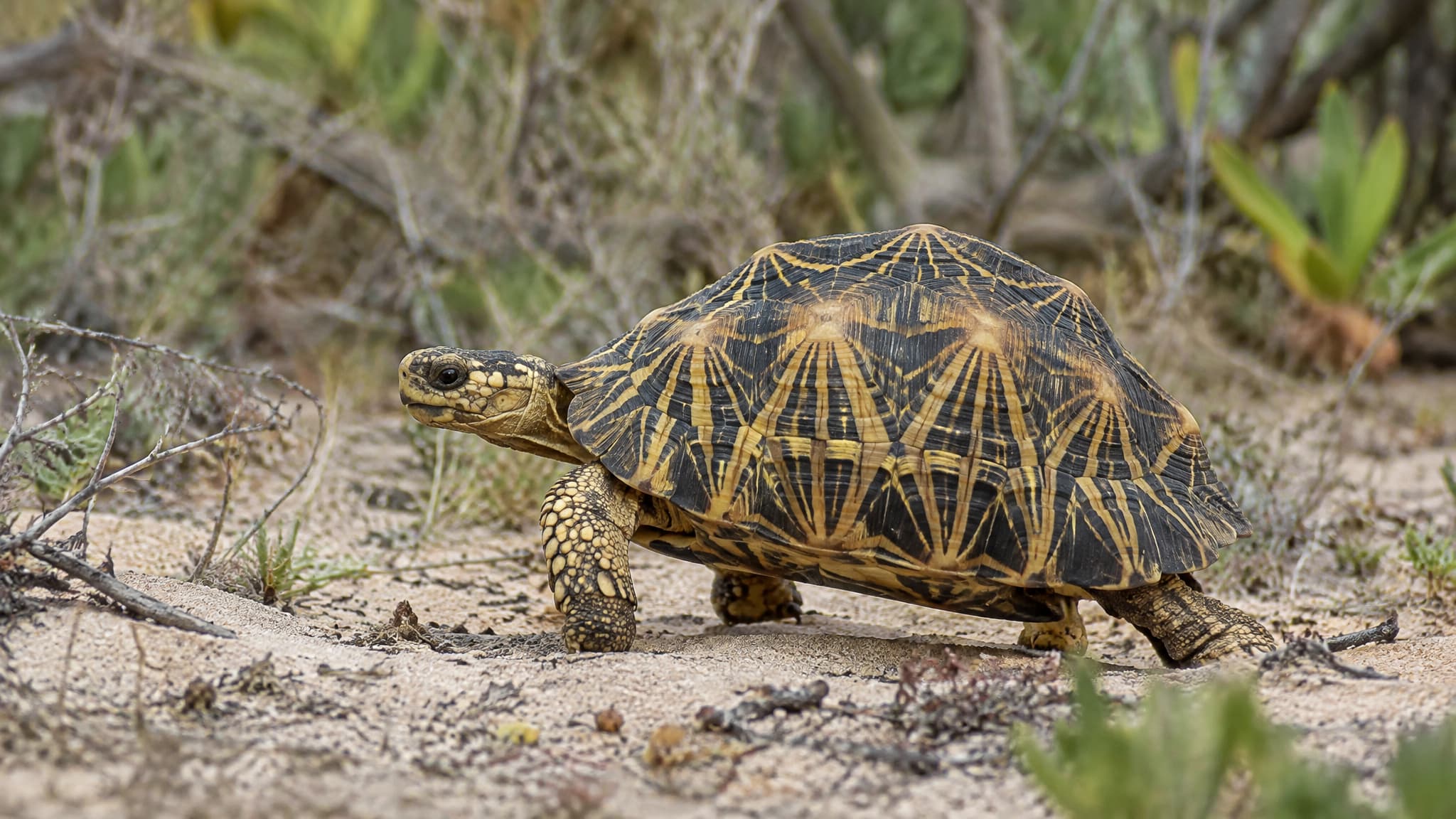
The spider tortoise (Pyxis arachnoides) is one of the smallest tortoises in the world. Its high-domed carapace is dark brown to black, crossed by a web of yellow lines that gives the species its common and scientific names. The head is dark with yellow spots, and the yellow plastron is partly hinged, so the animal can draw its head and front legs inside. Females are slightly larger than males, averaging about 12 cm against 11 cm; the largest recorded shells measure 15.7 cm in females and 14.4 cm in males. Males have longer, thicker tails. Adults usually weigh under 1 kg. The species lives only in Madagascar, in a narrow belt of dry spiny forest and coastal scrub along the southwestern and southern coast. It favours sandy ground with succulents and shrubs and about 30 to 50 percent canopy cover. Three subspecies are recognized: the common (P. a. arachnoides), northern (P. a. brygooi) and southern (P. a. oblonga) spider tortoises, which genetic work has confirmed as distinct lineages. Its range overlaps with that of the much larger radiated tortoise. In the wild it feeds mainly on grasses, young leaves and roots, and also takes insects and cow dung that contains insect larvae. It is most active in the wet season, from November to April, and shelters under vegetation during the hottest hours. In the dry season it may aestivate, burying itself in the sand. Little is known about its breeding. Mating begins when the rains return and dormancy ends. Females usually lay a single egg, occasionally two, in a shallow nest in sandy soil, and incubation lasts about 220 to 250 days. The species is thought to live up to 70 years, although there is no firm data. The spider tortoise is Critically Endangered on the IUCN Red List and has been on CITES Appendix I since 2005. Its spiny forest habitat is disappearing at about 1.2 percent a year through fires set for grazing land, charcoal production and invasive plants. It is also poached for the international pet trade and, as radiated tortoises become scarcer, hunted locally for meat.

View Details
Big-headed Amazon River turtle
Reptiles

Big-headed Amazon River turtle

Peltocephalus dumerilianus

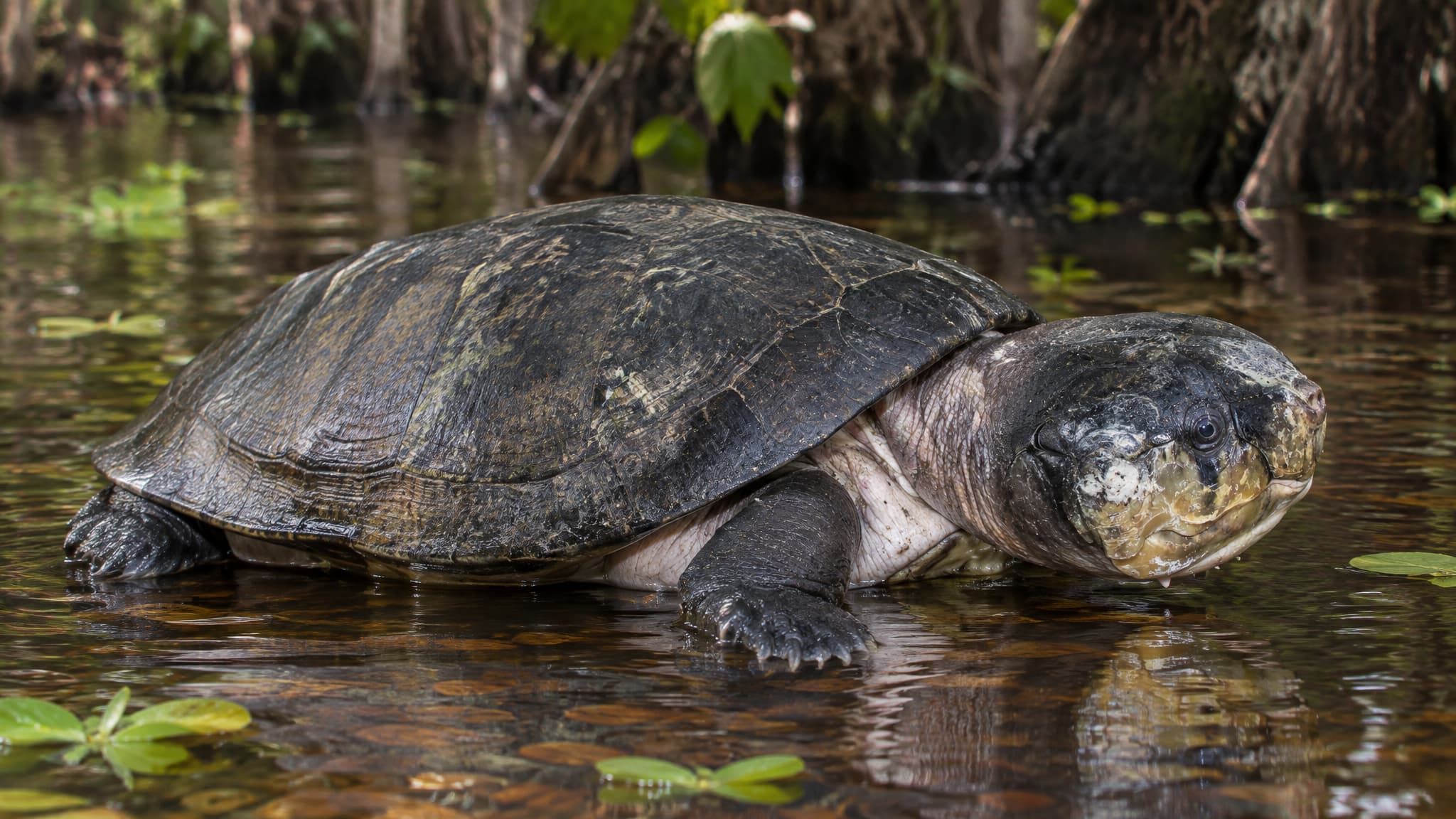
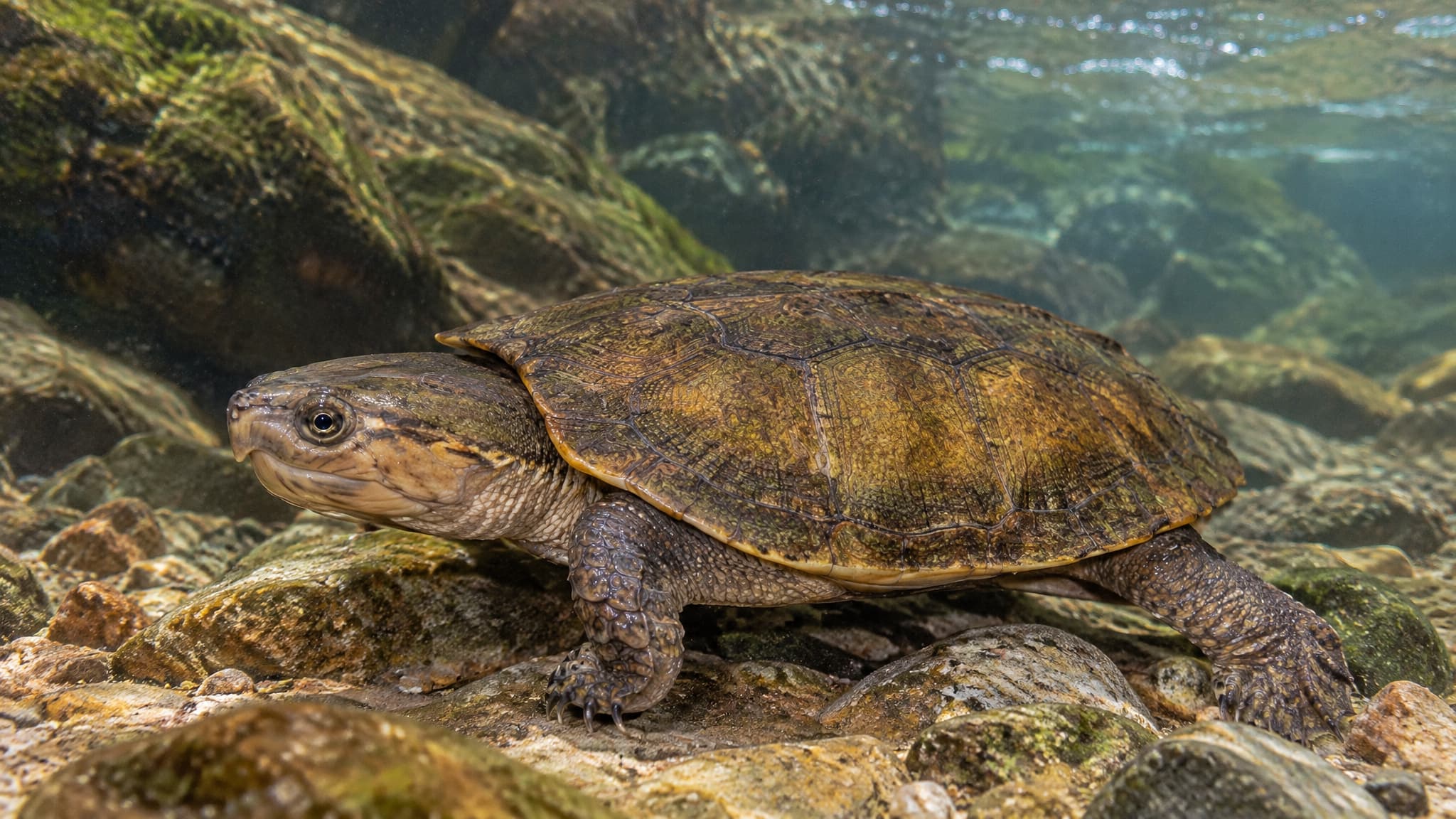
The big-headed Amazon River turtle (Peltocephalus dumerilianus), known in Brazil as the cabeçudo, is a side-necked turtle and the only living member of its genus. As its name says, it has a very large, broad head with a strongly hooked upper jaw, which gives it a powerful bite. The largest recorded shells reach 50.0 cm in straight carapace length in males and 47.0 cm in females, and the heaviest specimen on record weighed 15 kg. Males are larger than females, with wider heads and longer tails. Hatchlings have a mottled brown shell with black seams, cream-yellow edges to the marginal scutes and a single chin barbel. The species lives in the Amazon and upper Orinoco basins of Brazil (Amapá, Amazonas, Pará and Roraima), Colombia, Ecuador, French Guiana, Peru (Loreto) and Venezuela. It favours rivers and freshwater swamps, especially igapó flooded forest and other blackwater systems, and also small blackwater streams that run under the closed canopy of terra firme rainforest. It is an omnivore that relies mostly on plants: fruits and seeds can make up as much as 85% of its diet, yet it eats more animal food than any other member of its family. It prefers apple snails when they are available and also takes other molluscs, fish and insects, and scavenges carrion. Adults sometimes rest motionless underwater with the mouth open, waiting for prey. It swims less well than its relatives and generally does not travel far. It is not territorial, but its strong jaws can cause serious injuries to people who handle it. Unlike Podocnemis turtles, which nest together on open sand beaches, the cabeçudo nests alone and hides its nests near forest streams. In the Rio Trombetas Biological Reserve in Pará, nests were found in August and September no more than 2.5 m from the water, dug into clay, sand, termite mounds or ant nests. Clutches held 3 to 25 eggs, and newly laid eggs weighed 39 to 50 g. In one season the eggs hatched after a mean of 90 days of incubation, and hatchlings weighed 26.6 to 39.5 g. In Colombia nesting takes place about three months later, in December. Cool nests produced nearly equal numbers of males and females, which led researchers to suggest that sex may be set genetically rather than by temperature. Its lifespan has not been recorded. The cabeçudo is listed as Vulnerable on the IUCN Red List and on CITES Appendix II. People hunt it for food, and humans and tegu lizards raid its nests. Its habitat suffers from mining pollution, pesticides, deforestation and hydroelectric dams, and illegal gold mining is reported to displace more than 1,000 turtles a year, many of them sold.

View Details
Black spiny-necked turtle
Reptiles

Black spiny-necked turtle

Acanthochelys spixii

The black spiny-necked turtle (Acanthochelys spixii), also called Spix's sideneck turtle, is a medium-sized side-necked turtle of the family Chelidae. Its name comes from the prominent, horny conical tubercles that stud the top and upper sides of the neck. The adult carapace is mainly black, sometimes dark reddish-brown, elliptical and broader towards the rear, with a deep groove running down the middle of the back. The plastron is black or dark brownish-black, and the head, legs and tail are black, dark brown or grayish brown. The eyes have bright yellow irises, there are two short chin barbels, and the webbed feet carry five claws in front and four behind. Hatchlings are black with red or deep orange spots on the edge of each marginal scute and orange or red blotches on the plastron. The largest recorded animals in Brazil measure 180 mm in straight carapace length for females and 178 mm for males, and a Uruguayan female reached 202 mm and 1 kg. Cerrado populations are smaller, averaging 128 mm and 247 g in males and 139 mm and 330 g in females. Males have a concave plastron and a longer tail, while females have a deeper shell. The species lives in southeastern Brazil (from Bahia and Goiás to Rio Grande do Sul), Uruguay and northeastern Argentina (Corrientes), from sea level to 1082 m. It favors swamps, ponds and other shallow, slow or still water, often rich in submerged plants, and also turns up in rice fields, urban parks and residential areas. It is mainly nocturnal and becomes more active as air and water warm. When ponds dry out it can bury itself about 50 cm deep and presumably estivates underground. The diet is made up mainly of insects, especially aquatic ones, supplemented with tadpoles, fish, snails and spiders. In Brazil nesting runs from February to May, and in Brasília mating has been seen in the rainy season, between November and December. Clutches hold 4 to 8 nearly round eggs about 25 to 27 mm long, buried around 4 cm deep. Three eggs followed in captivity took 587 to 615 days to hatch, including a period of arrested development, which may be the longest incubation of any South American chelid. Hatchlings measure 31 to 32 mm and weigh about 5 g. Its lifespan has not been recorded. As a predator of aquatic insects and prey for larger animals, the turtle is part of the food web of shallow wetlands. TTWG 2025 lists it as Vulnerable on the IUCN Red List, up from Near Threatened in 1996. The main threats are habitat loss from urbanization, deforestation and farming, including rice cultivation around coastal lagoons in Rio Grande do Sul, as well as road deaths, illegal capture for the pet trade and exposure to agrochemicals. Only 34.8% of its Brazilian range still holds natural habitat.

View Details
Flatback sea turtle
Reptiles

Flatback sea turtle

Natator depressus

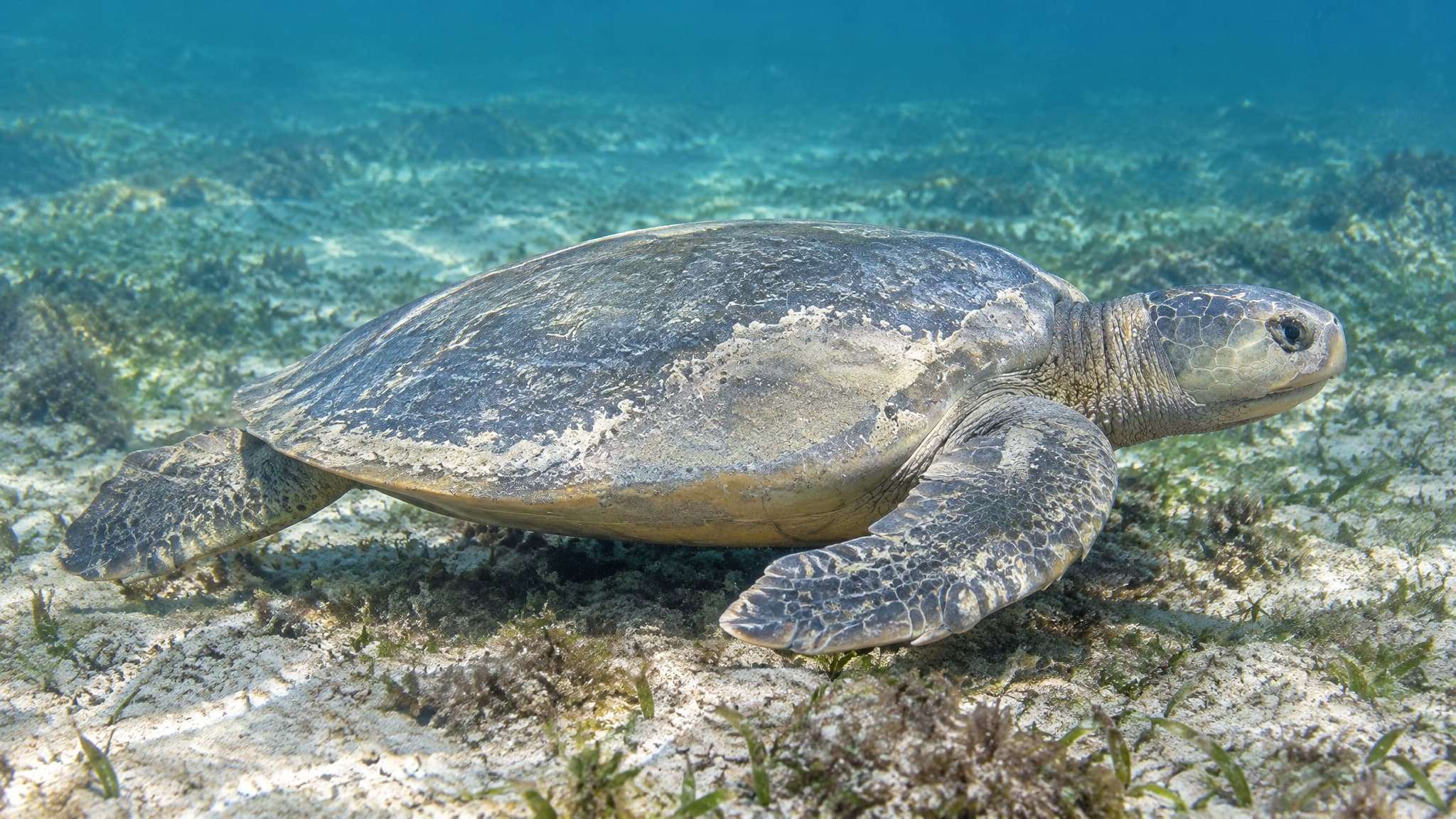
The flatback sea turtle (Natator depressus) is the only species in the genus Natator of the family Cheloniidae. It owes its name to its low, smooth shell, whose edges curl upward and which is much thinner than that of other sea turtles, so it can crack under fairly small pressures. The carapace is olive green or grey-green and the plastron pale yellow; the head has a single pair of prefrontal scales and the carapace four pairs of costal scutes. Adults usually measure 76 to 96 cm and weigh 70 to 90 kg, and the TTWG checklist gives maximum curved carapace lengths of 93.1 cm for males and 100 cm for females. Females grow larger than males and have shorter tails. It has the smallest range of any sea turtle. It lives in the coastal waters of northern Australia, from Western Australia through the Northern Territory and the Gulf of Carpentaria to the Torres Strait and eastern Queensland, and also reaches the coasts of Papua New Guinea and Indonesia. It stays on the continental shelf, in shallow soft-bottomed areas and inshore bays, typically in water 60 m deep or less, and nests only on Australian beaches. The flatback is mainly carnivorous. It hunts sea cucumbers, soft corals, jellyfish, shrimp, molluscs, bryozoans and other invertebrates in shallow water and only rarely eats seagrass. Adults rest near rocks or under ledges, and they can stay submerged for hours, though for less time when stressed. Females nest every 2 to 3 years and lay about three clutches per season, roughly 15 days apart. Each clutch holds about 50 eggs, the fewest of any sea turtle, but eggs and hatchlings are large, and hatchlings have a carapace of about 60 mm. Incubation takes about 42 days. Nests below 29 °C produce males and above 29 °C females. In southern Queensland nesting runs from October to January, with hatching from December to late March and a peak in February, while in the north it nests year-round; Mon Repos, near Bundaberg, is a major rookery. Maturity is reached somewhere between 7 and 50 years of age. Through its feeding the flatback likely shapes the invertebrate communities of shallow coastal seabeds, and it is food for many predators. Dingoes, red foxes, feral dogs and feral pigs dig up nests; crabs, seabirds and fish take hatchlings; and sharks and saltwater crocodiles prey on adults. On the IUCN Red List the species is Data Deficient, after being listed as Vulnerable earlier, and it is on CITES Appendix I. The Australian government lists it as Vulnerable. Threats include bycatch in trawls, gillnets, ghost nets and crab pots, coastal development and beach damage, vehicle ruts that trap hatchlings, pollution and climate change. Indigenous Australians may harvest eggs and meat for non-commercial purposes only.

View Details
Eastern long-necked turtle
Reptiles

Eastern long-necked turtle

Chelodina longicollis

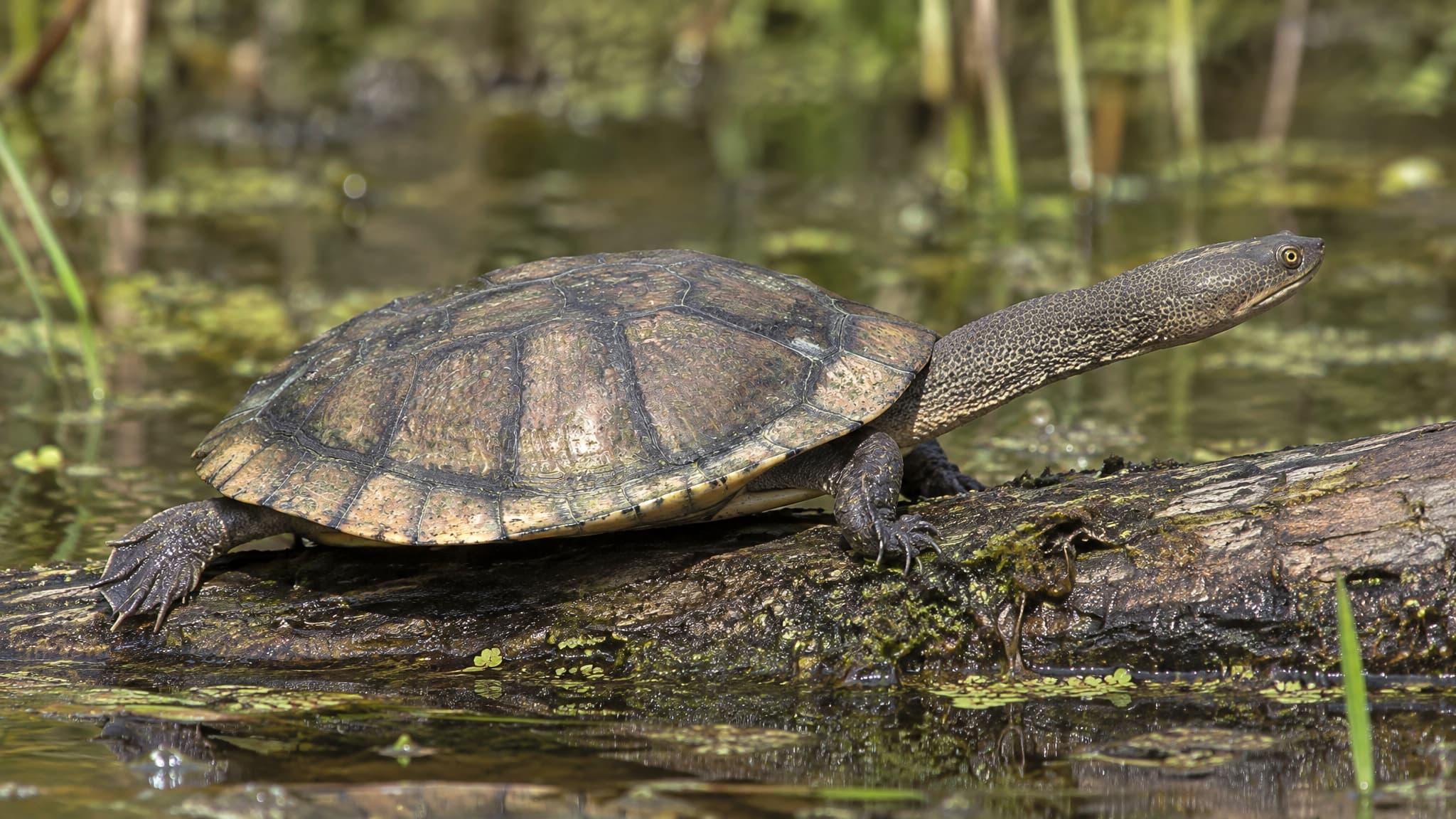
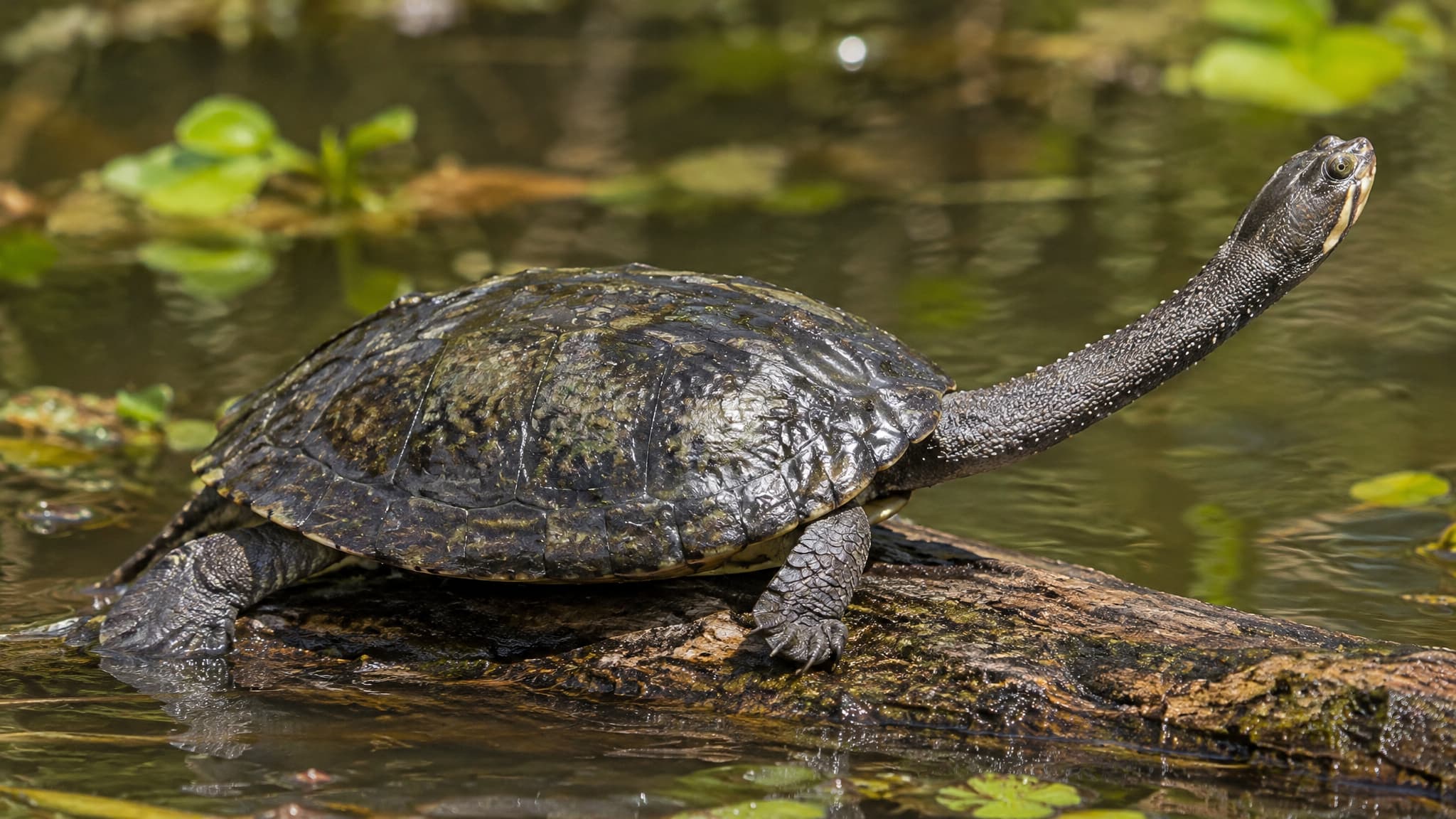
The eastern long-necked turtle (Chelodina longicollis), also called the common long-necked or snake-necked turtle, is a side-necked freshwater turtle of the family Chelidae. It was the first Australian freshwater turtle to be described, and it is the type species of the genus Chelodina. The neck is about 60% of the carapace length and is covered in small pointed tubercles; it folds sideways under the edge of the shell. The broad, flattened carapace is black to light brown with a deep groove down the middle, and the large plastron is cream with its seams broadly edged in black. Females grow larger and deeper-shelled than males: in the Murray Valley the largest recorded carapace lengths are 28.2 cm for females and 24.9 cm for males. When disturbed it releases a pungent yellow fluid from scent glands, which has earned it the nickname "stinker". The species ranges across southeastern Australia, from the Eyre Peninsula in South Australia through Victoria, New South Wales and the Murray-Darling basin north to the Fitzroy River drainage in Queensland. Introduced populations live in Tasmania and on islands in the Bass Strait. It uses rivers, lakes, farm dams, swamps and brackish wetlands, but is most abundant in shallow, temporary waterholes away from permanent rivers, often where no other turtles or fish compete with it. Mostly a bottom dweller, it is an opportunistic carnivore that eats insects, worms, crustaceans, molluscs, plankton, tadpoles, frogs, small fish and carrion, as well as land animals that fall into the water. It catches prey with a "strike and gape", sucking it into the mouth. It is famous for travelling overland when wetlands dry or after rain: treks of several kilometres and more than 40 days on land are known, and distances of 8 km have been reported. It can also bury itself in leaf litter and estivate on land, once for up to 480 days without returning to water. Mating usually happens in September, and nesting runs from October to January. Females may walk 500 m or more from water to nest and lay up to 3 clutches a year of 6 to 23 hard-shelled eggs, 14 on average. Incubation takes 110 to 150 days, and hatchlings of about 30 mm and 4 to 5 g emerge in autumn, black with bright orange markings. Sex is set by genetics, not by nest temperature. Males mature at about 7 to 8 years and females at 10 to 12. Captive turtles have lived 36 and more than 37 years, and wild adults have been recaptured at minimum ages of 31 to 34 years. The species is common and is listed as Least Concern. Its main threat is the introduced red fox, which destroys more than 90% of nests in some places and also kills adults, so some populations hold old adults but few juveniles. Road traffic, pest-proof fencing, water extraction in the Murray-Darling basin, salinisation and long droughts cause local losses, while new farm dams and urban ponds have given it extra habitat.

View Details
European pond turtle
Reptiles

European pond turtle

Emys orbicularis

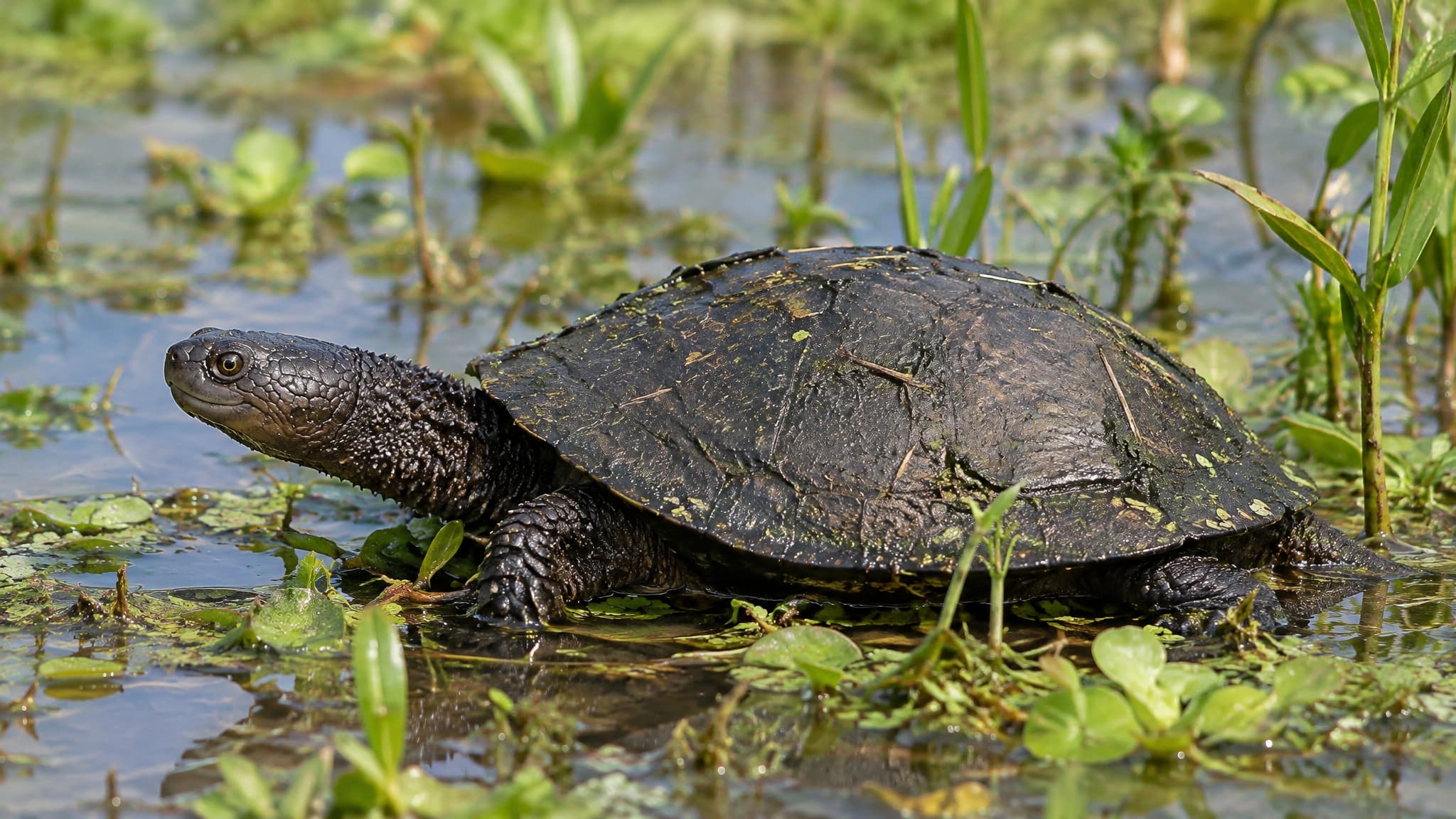
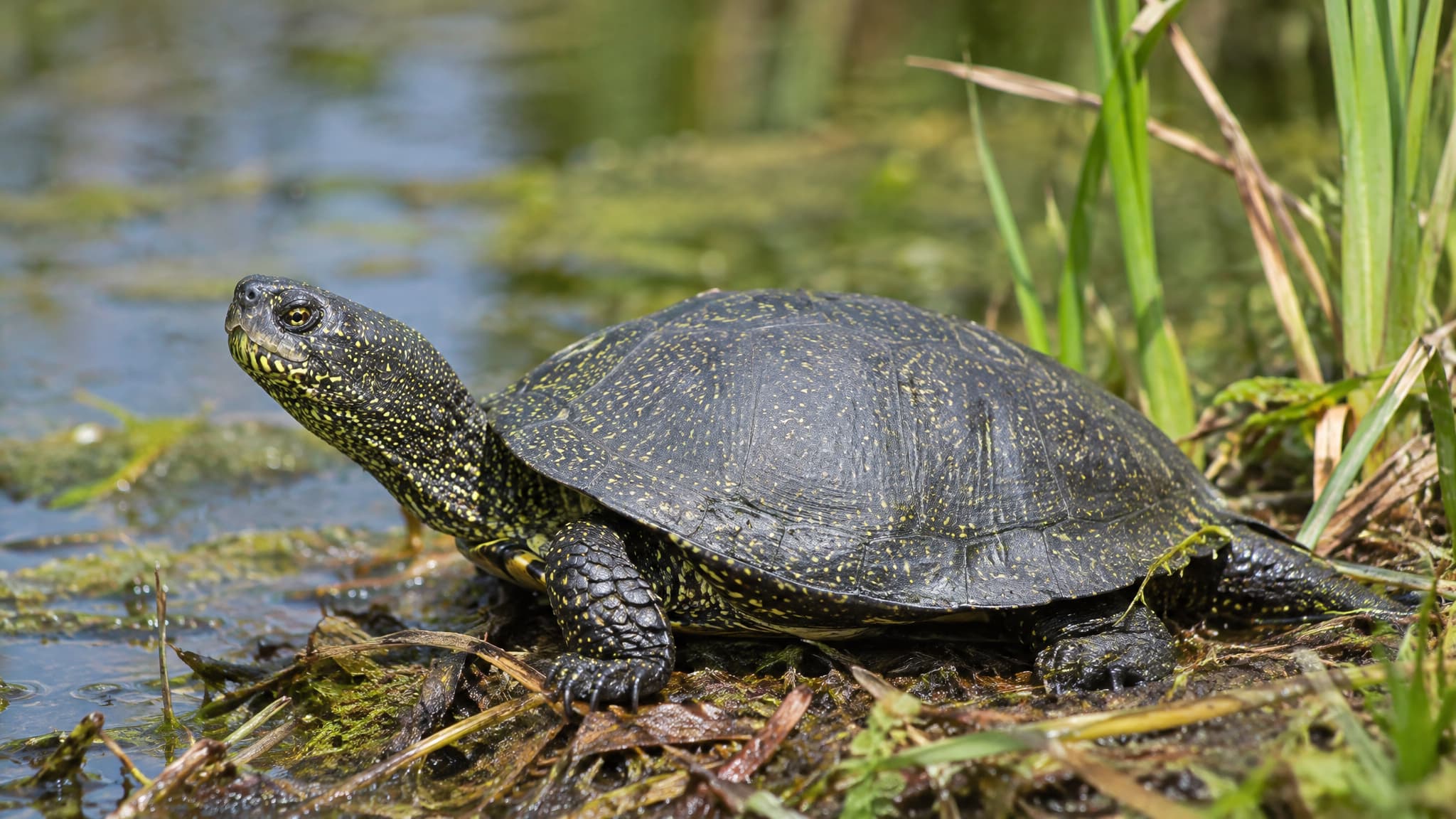
The European pond turtle (Emys orbicularis) is a small, long-lived freshwater turtle of the family Emydidae. Its carapace is dark brown to blackish, often with a greenish tinge, and is marked with yellow spots or fine streaks; the head, neck and limbs are dark with yellow dots, and the plastron is yellowish and hinged. Females are larger than males: the TTWG 2025 checklist gives a maximum straight carapace length of 21.0 cm for males and 23.2 cm for females, and adults weigh about 400 to 700 g. Hatchlings have a rounder, slightly keeled, uniformly dark shell. It is native to southern, central and eastern Europe, North Africa from Morocco to Tunisia, and western and central Asia east to Kazakhstan and Turkmenistan. It has disappeared from Belgium and Luxembourg and has been reintroduced in Switzerland, the Netherlands and the Czech Republic. It lives in ponds, lakes, marshes, slow-moving streams and other still waters, favouring shallow, food-rich wetlands surrounded by woodland, and it also enters brackish water. On land it may travel 1 km, and occasionally up to 4 km, from water. The species is active by day and spends long hours basking on logs, stones and banks, but in the wild it is extremely shy and cautious, and it can stay underwater for many hours. Adults feed mainly on animal prey taken in the water, such as aquatic insects, worms, tadpoles, frogs and small fish, and they also eat some aquatic plants. Juveniles are the most carnivorous. During the cold season it hibernates buried in the mud at the bottom of ponds, for up to seven months a year, and stops eating. Mating takes place from spring to early summer. Females leave the water to dig a nest in open, raised, sandy ground and often return to the same nesting site each year. A clutch holds about 8 to 10 eggs, each 15 to 25 mm long, and incubation lasts about 90 to 100 days; some embryos spend the winter in the nest and hatch the following spring. Sex depends on incubation temperature: eggs below 25 °C produce males and eggs above 30 °C produce females. Sexual maturity comes at about 5 to 6 years, and the usual lifespan is 40 to 60 years, rarely more than 100 years. As a predator of invertebrates, amphibians and small fish, the turtle is part of freshwater food webs, while its eggs and hatchlings feed herons, gulls, cormorants, foxes, rats and predatory fish. It is listed as Near Threatened worldwide and in Europe, and as Vulnerable in the European Union. Habitat destruction, roads, pollution, siltation, hunting, egg collecting and competition with introduced sliders (Trachemys) have caused steep declines; it is close to extinction in Germany and is considered France's most endangered reptile. Following the TTWG 2025 checklist, it includes seven subspecies, while the Sicilian pond turtle (Emys trinacris) is a separate species.

View Details
Painted turtle
Reptiles

Painted turtle

Chrysemys picta

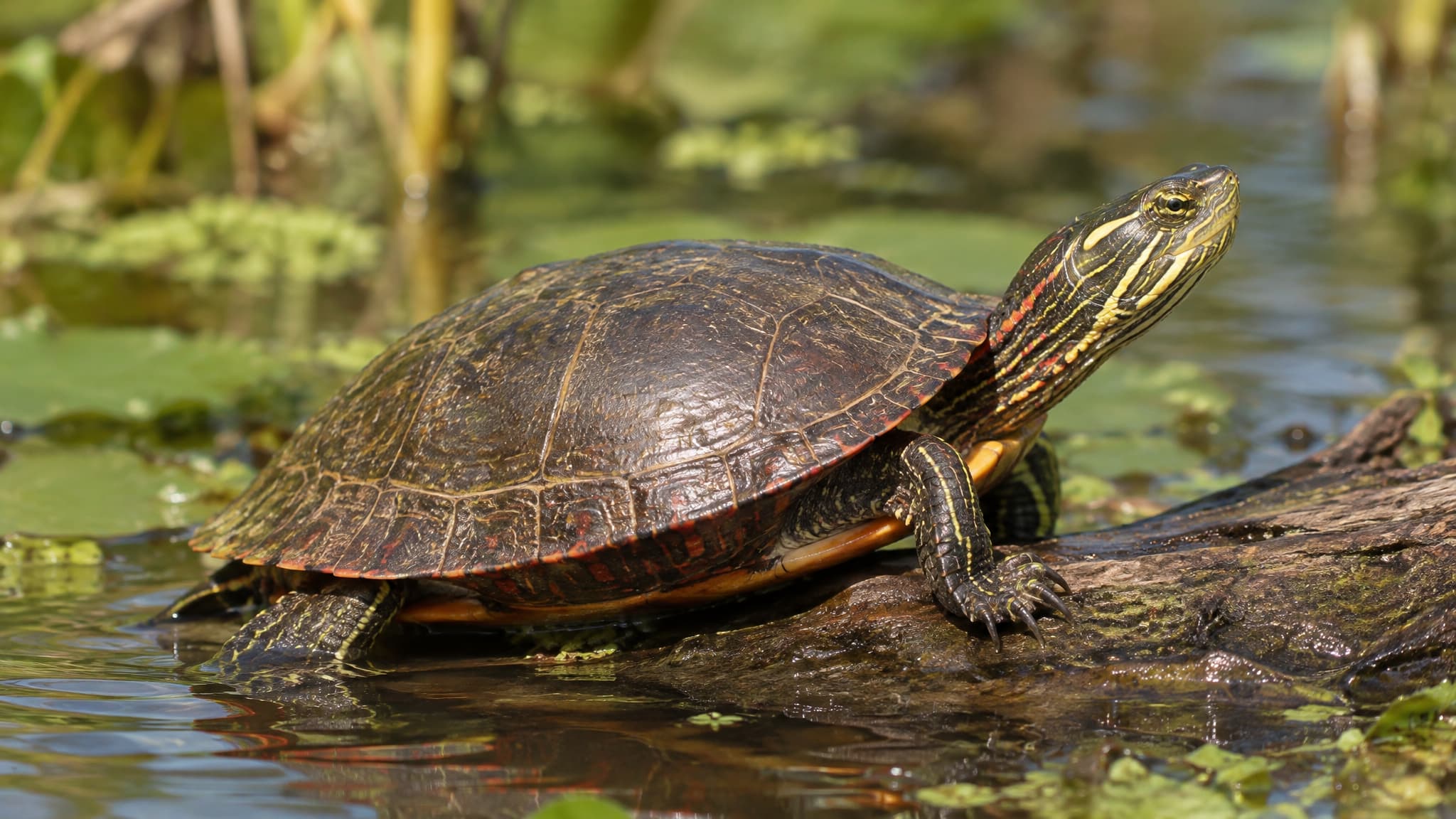
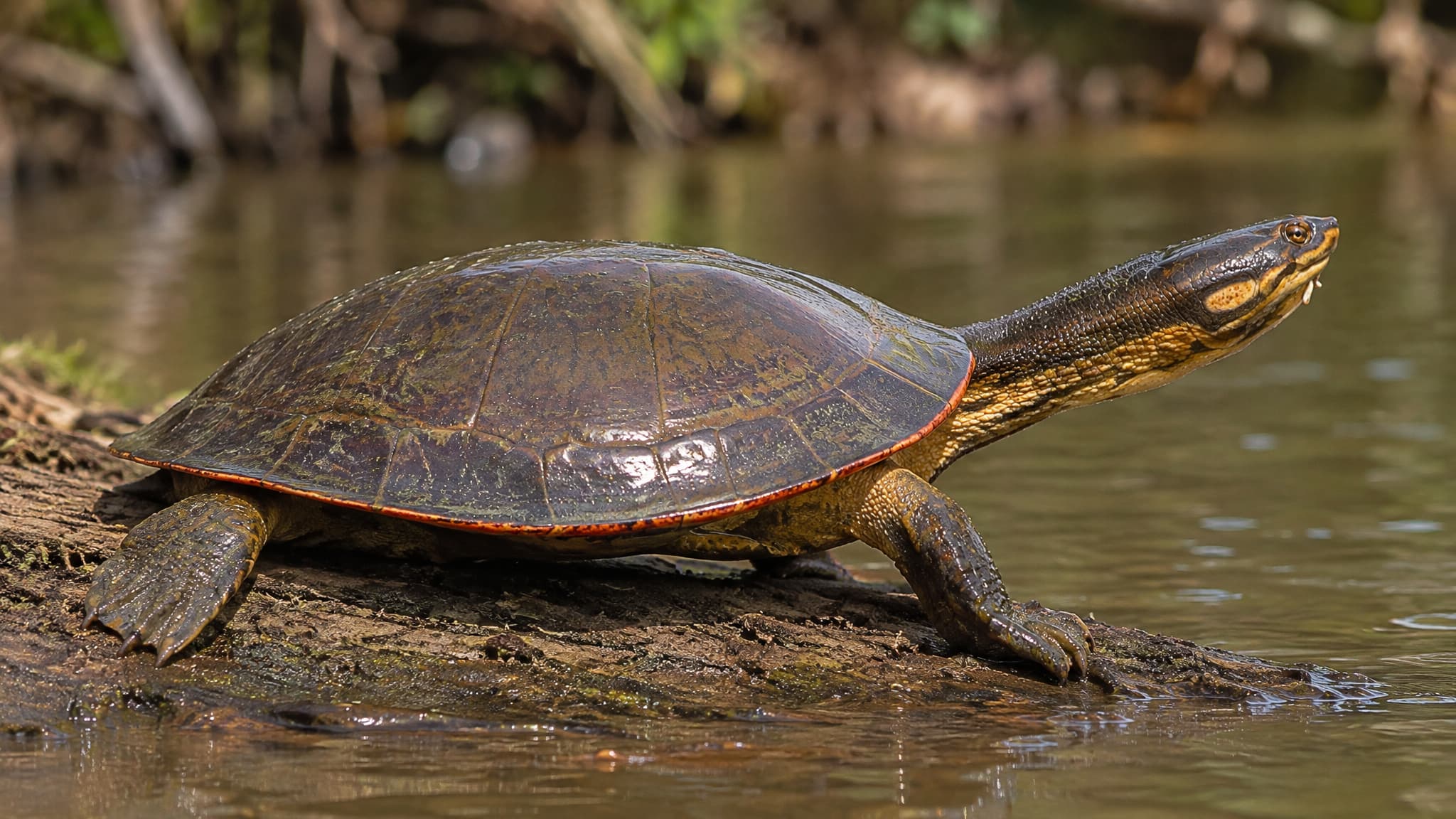
The painted turtle (Chrysemys picta) is a small freshwater turtle of the family Emydidae and the most abundant turtle in North America. Its smooth, rather flat dark carapace is edged with red markings, and the skin of the head, neck and legs carries bright yellow and red stripes. Adults usually measure about 13 to 25 cm in carapace length; females are larger than males, and the biggest recorded females, from the western subspecies, reach 26.6 cm. Average weight is about 500 g for females and 300 g for males. The 2025 checklist of the Turtle Taxonomy Working Group recognizes three subspecies: the eastern (C. p. picta), midland (C. p. marginata) and western (C. p. bellii) painted turtles, while the southern painted turtle is treated as a separate species, Chrysemys dorsalis. The species ranges from southern Canada across most of the United States to Chihuahua in northern Mexico, and western populations live as high as 1,800 m. It favours quiet, shallow and slow-moving fresh water with a soft muddy bottom and plenty of vegetation, such as ponds, lakes, marshes, swamps and the calm stretches of rivers and streams. Released pets have founded populations outside the native range, including in Germany, Spain, Indonesia and the Philippines. Painted turtles are omnivores. Adults eat aquatic plants and algae as well as insects, crustaceans, small fish and carrion, while juveniles are mostly carnivorous and become more herbivorous as they grow. They are well known for basking, sometimes with as many as 50 turtles crowded onto a single log. In winter they rest buried in the mud at the bottom of ponds and lakes, and they survive long periods without oxygen: about 170 days for the western subspecies, 150 for the midland and 125 for the eastern. Mating takes place in spring and autumn, and females dig nests on land between late May and mid-July. A clutch holds about 4 to 15 eggs, and a female may lay up to five clutches a year, two being a normal average. Eggs hatch after 72 to 80 days in the wild, and nest temperature determines the sex of the young. Females usually mature at 6 to 10 years, males earlier. Hatchlings can survive freezing thanks to supercooled blood and ice-resistant skin. Only about 19% survive from egg to their first birthday, but wild adults can live more than 55 years. As predators of small fish, crustaceans and other invertebrates, painted turtles play an important part in North American freshwater food webs, and they are themselves food for many animals. Raccoons, snakes and crows take eggs and hatchlings, and raccoons are also the main predators of adults. The species is listed as Least Concern by the IUCN, but the loss of ponds and wetlands and deaths on roads have reduced some local populations.

View Details
Spiny softshell turtle
Reptiles

Spiny softshell turtle

Apalone spinifera

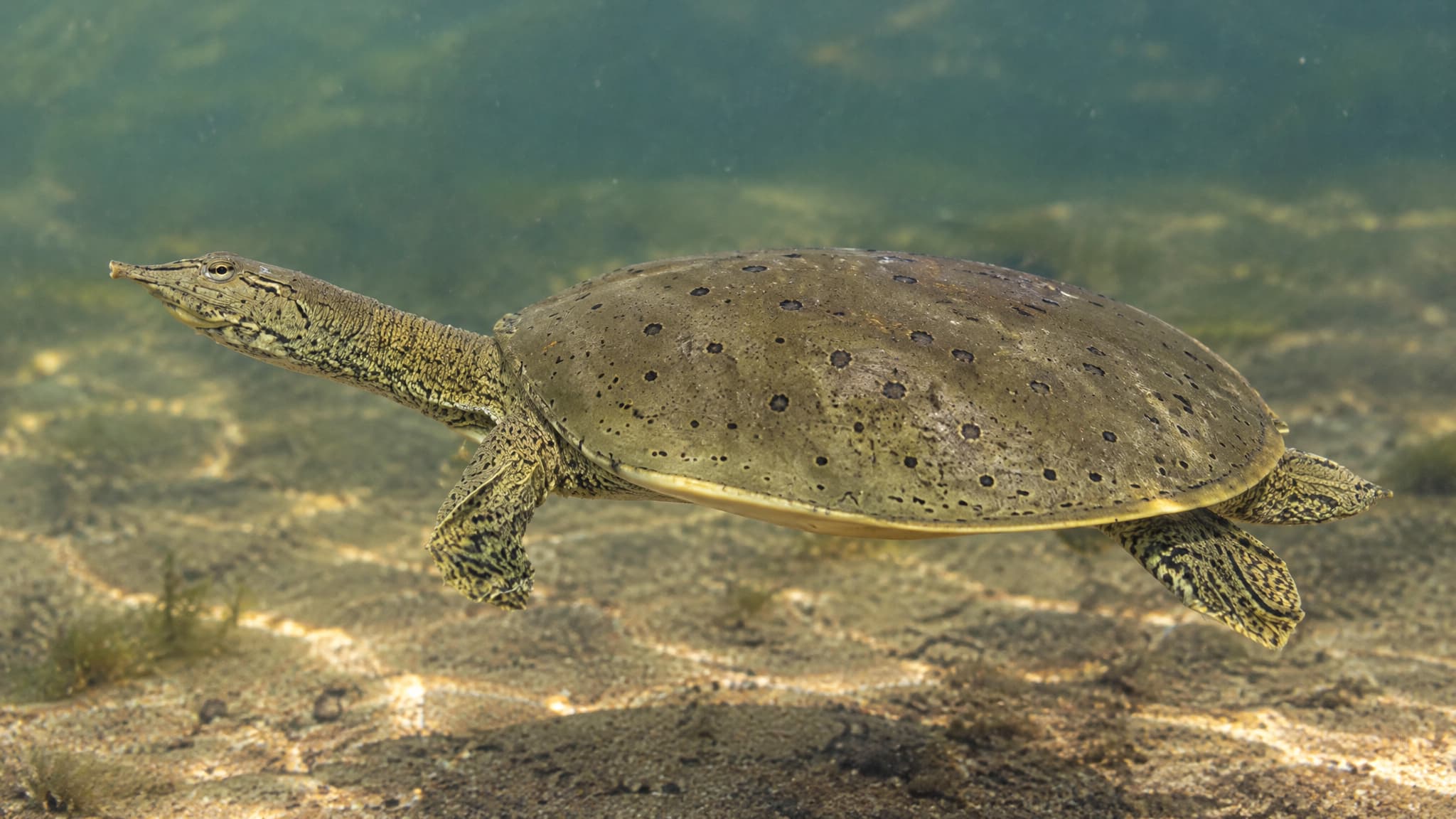
The spiny softshell turtle (Apalone spinifera) is a large North American softshell turtle of the family Trionychidae. Instead of horny scutes, its flat, rounded carapace is covered by leathery skin with flexible edges, and its front edge bears small cone-like projections that give the species its name. The carapace ranges from olive and tan to brown, the plastron is whitish or yellow, and the long, fleshy snout ends in C-shaped nostrils. Each webbed foot carries three claws. Females are much larger than males. Carapace length runs from about 18 to 54 cm, and the TTWG 2025 checklist gives maximum carapace lengths of 27.5 cm for males and 54.0 cm for females. Males keep the juvenile pattern of dark spots and eyespots, have rougher shells and longer, thicker tails, while females often turn mottled or darker with age. This is the most widely distributed softshell turtle in North America. It ranges across much of the central and eastern United States, southern Ontario and Québec in Canada, and northern Mexico, and has been introduced in several other states. It lives in rivers, streams, lakes, ponds, bayous and oxbows, usually in shallow water less than 1 m deep with sandy or muddy bottoms and little vegetation. Six subspecies are recognized. The spiny softshell is active by day, basking on logs and banks and foraging along the bottom. It hunts actively or buries itself in sand to ambush crayfish, aquatic insects, other invertebrates and, at times, fish. Besides breathing air, it can take up oxygen through its skin and the linings of its throat and cloaca, which lets it stay buried underwater during a winter dormancy that lasts from about October to April. Both sexes mature at 8 to 10 years and mate in deep water in mid to late spring. From around July, females dig flask-shaped nests on sunny sandbars or gravel banks and lay 9 to 38 round, hard-shelled eggs, sometimes nesting more than once a season. Incubation takes about two to three months, and sex is set genetically, not by nest temperature. Raccoons, skunks and foxes raid nests, and herons and large fish eat the young. A large female may live up to 50 years. As a common bottom predator, the species helps shape populations of crayfish and aquatic insects. It is listed as Least Concern by the IUCN, but local populations suffer from shoreline development, loss of nesting sites, fish poisons such as rotenone, and hunting. The black spiny softshell (A. s. atra) of Mexico's Cuatro Ciénegas basin is Critically Endangered.

View Details
Wood turtle
Reptiles

Wood turtle

Glyptemys insculpta

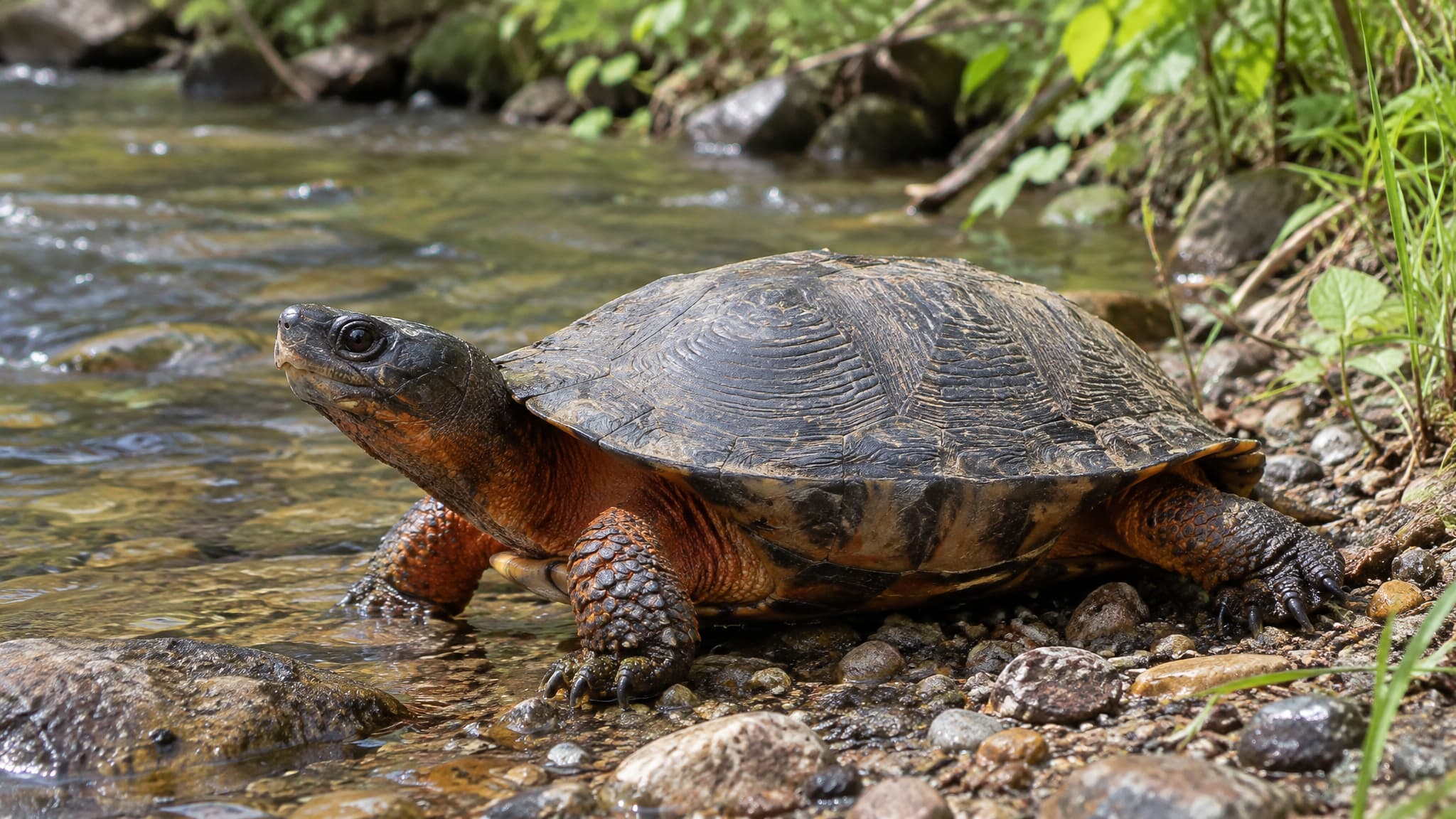
The wood turtle (Glyptemys insculpta) is a semi-aquatic turtle of the family Emydidae, described by John Le Conte in 1830 as Testudo insculpta. Its name comes from the Latin insculptus, "carved", after the deeply sculptured scutes of its shell. The genus Glyptemys holds only two species: this one and the bog turtle (G. muhlenbergii). The carapace is tan, grayish-brown or brown, with a low keel and rough, pyramid-like scutes marked by growth rings. The head is dark gray to black, while the chin, neck and legs are yellow, orange or red: yellow-orange tones dominate in the west of the range and orange to reddish tones in the east, and males are more vivid. Adults usually measure 14 to 20 cm, with recorded maxima of 24.4 cm for males and 22.5 cm for females, and weigh about 1 kg. Males have wider heads, a concave plastron and longer, thicker tails. Hatchlings measure 2.8 to 3.8 cm. The species lives in eastern Canada and the northeastern United States, from Nova Scotia and New Brunswick west to Minnesota and south to northern Virginia, with an isolated population in northeastern Iowa; about 30% of the population is in Canada. It is rarely found more than a few hundred meters from clear, flowing streams with sandy or gravelly bottoms, but in summer it also uses riverside forests, thickets, wet meadows, fields and beaver ponds. The wood turtle is diurnal, spends much time basking and hibernates underwater on stream bottoms where the water does not freeze. It is omnivorous, eating leaves, flowers, berries, mosses and fungi as well as slugs, snails, worms, insects, millipedes, eggs and carrion. Some populations stomp the ground with their forefeet or plastron to bring earthworms to the surface. Individuals keep linear home ranges of about 1 to 6 ha along a stream and show a strong homing ability. Males form dominance hierarchies, and maturity comes late, at about 14 to 20 years. Females nest in May or June on open, sunny sandy banks, laying one clutch of 3 to 18 eggs a year, and some skip years. Incubation lasts 47 to 69 days, and sex is not set by nest temperature. Wood turtles can live up to 40 years in the wild and 58 years in captivity. As a consumer of plants and small invertebrates, the wood turtle is part of the stream-edge food web, and its eggs feed raccoons, skunks and foxes; in one Michigan study 70% to 100% of nests were lost each year. It is listed as Endangered on the IUCN Red List and on CITES Appendix II. Habitat loss, roads, farm machinery, collection for the pet trade and raccoon populations boosted by people all threaten it, and its slow reproduction makes losses of adults hard to recover from.

View Details
Olive ridley sea turtle
Reptiles

Olive ridley sea turtle

Lepidochelys olivacea

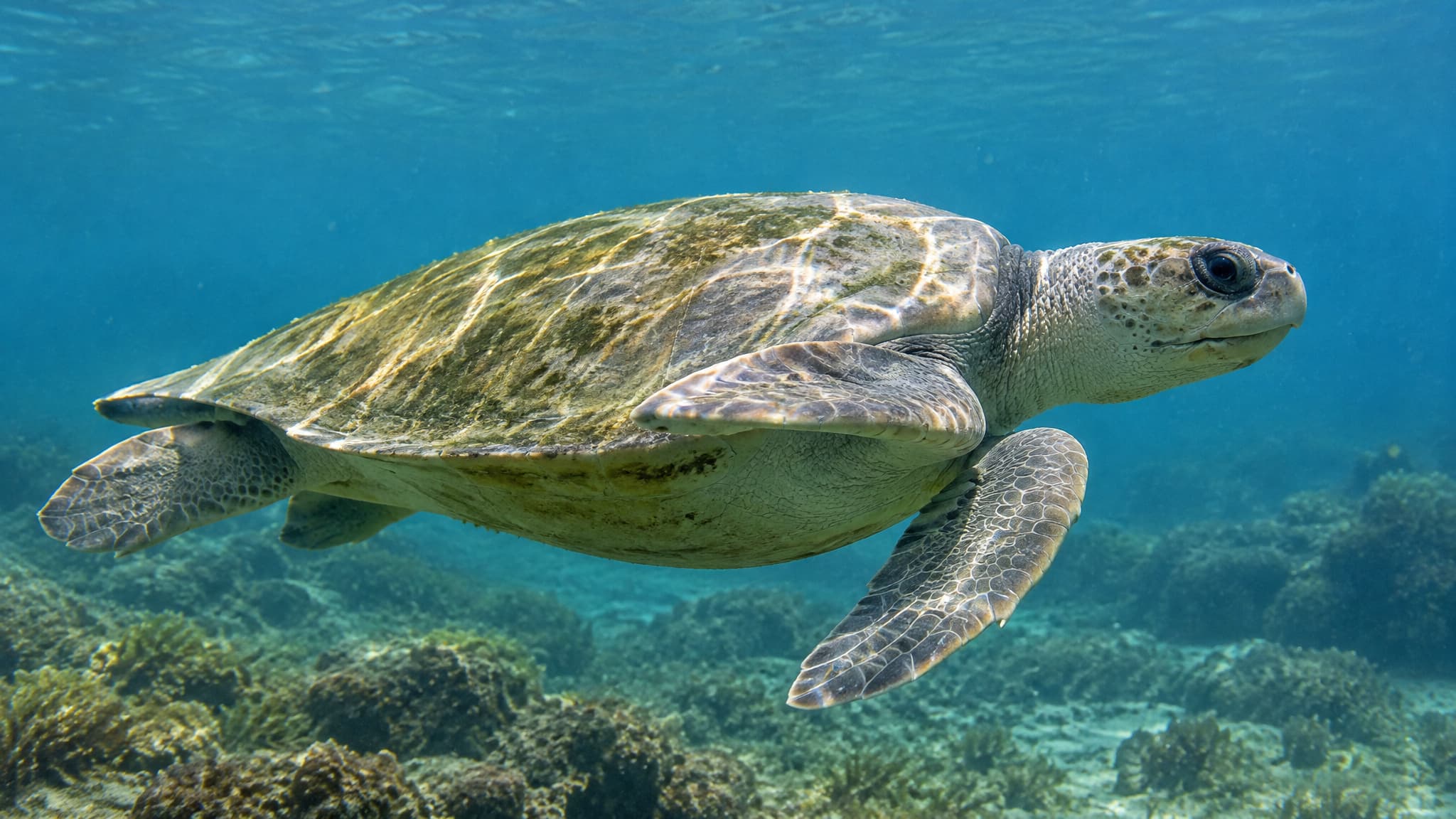
The olive ridley sea turtle (Lepidochelys olivacea) is one of the smallest sea turtles and belongs to the family Cheloniidae. Its heart-shaped carapace is olive to grayish green, and adults reach a curved carapace length of up to about 72 cm. Adults rarely weigh more than 50 kg; in a study in Oaxaca, Mexico, they weighed 25 to 46 kg. Hatchlings measure 37 to 50 mm and weigh 12 to 23.3 g. Its only living relative in the genus is Kemp's ridley (Lepidochelys kempii). The species is circumtropical, living in warm waters of the Pacific, Indian and Atlantic oceans and using the coastal waters of more than 80 countries. It spends most of its time within about 15 km of mainland shores, in sheltered, fairly shallow waters 22 to 55 m deep, but also travels through the open ocean. In Brazil, its main nesting area runs from southern Alagoas through Sergipe, which has the highest nest density, to the northern coast of Bahia, with about 10,500 nests per season. The olive ridley is mainly carnivorous. It eats tunicates such as salps, jellyfish, sea urchins, starfish, bryozoans, bivalves, snails, shrimp, crabs, lobsters, squid, fish and fish eggs, and turns to filamentous algae when other food is scarce. It can dive to about 150 m to forage on bottom-dwelling invertebrates. Females nest one to three times per season and lay about 100 eggs per clutch, with recorded clutches ranging from 30 to 168 eggs. Most nest alone, but the species is famous for its arribadas, synchronized mass nestings in which thousands of females come ashore on the same beach, as at Gahirmatha in Odisha, India. Incubation usually lasts 45 to 51 days and can stretch to 70 days in poor weather. Sex depends on nest temperature: 31 to 32 °C produces only females and 28 °C or less only males. Maturity comes at around 14 years, and lifespan is estimated at 30 to 50 years. As a predator of jellyfish, tunicates and other invertebrates, the olive ridley feeds both near the coast and in the open ocean, while egg losses in its mass nestings are enormous: at one arribada at Playa Nancite, Costa Rica, only 0.2% of 11.5 million eggs hatched, mostly because later females dug up earlier nests. Tiger sharks and crocodiles prey on adults, and jaguars attack nesting females on some beaches. The IUCN Red List classifies the species as Vulnerable, and it is listed on CITES Appendix I. In Brazil, the national list of the Ministry of the Environment also classifies it as Vulnerable. Bycatch in trawls, gillnets and longlines is the greatest threat, together with harvest of eggs and adults, loss of nesting beaches, artificial lighting that disorients hatchlings, vessel strikes, marine debris and climate change. Global numbers of nesting females fell to about 852,550 by 2008.

View Details
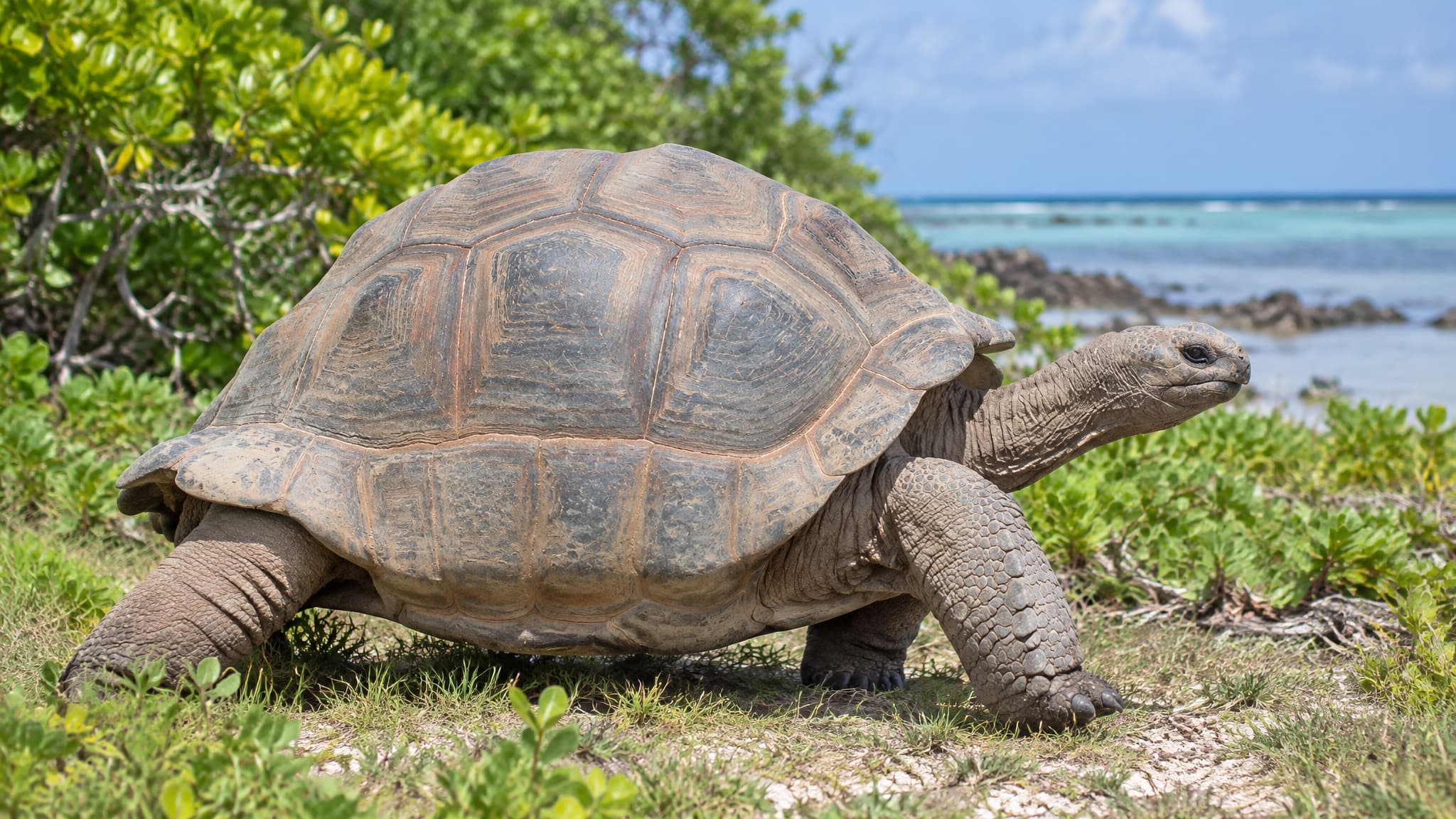
Common snapping turtle
Reptiles

Common snapping turtle

Chelydra serpentina

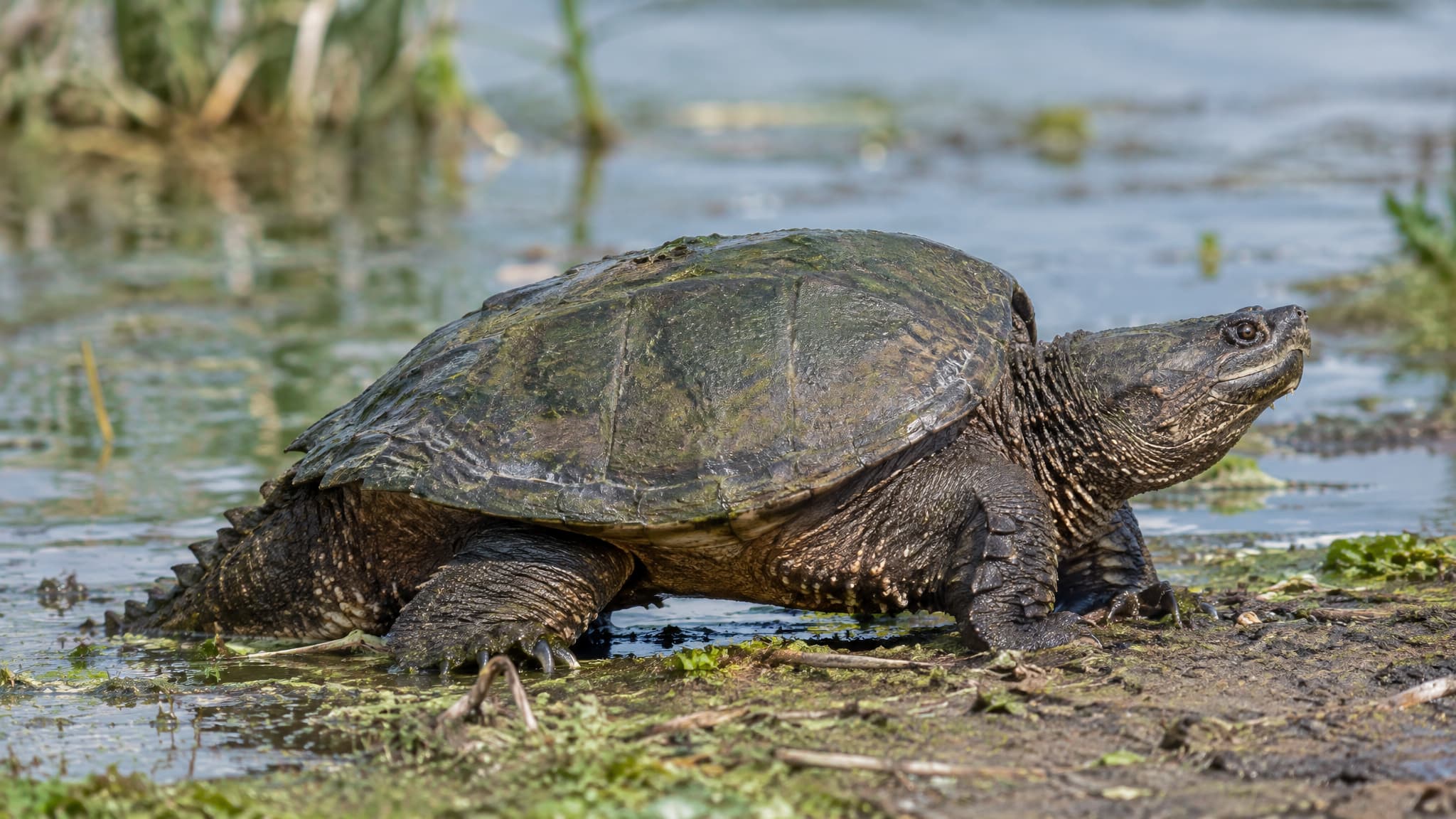
The common snapping turtle is a large freshwater turtle with a big head, a sharp hooked upper jaw and a powerful bite. Its carapace is dark, from tan or olive to brown or black, often coated in algae or moss, with a deeply serrated rear edge and three low keels that fade with age. The plastron is small and leaves much of the body exposed, and the tail is about as long as the shell and topped with saw-toothed, bony ridges. Adults usually have a carapace of 25 to 47 cm and weigh 4.5 to 16 kg; the heaviest wild animal on record weighed 34 kg, and males grow larger than females. The species is native to southern Canada, from Nova Scotia west to southeastern Alberta, and to the United States east of the Rocky Mountains, south to Florida and the Texas coast. Released pets have founded populations in the western United States, Japan, China, Taiwan and parts of Europe. It is a habitat generalist that lives in almost any permanent water body, preferring slow, shallow water with a soft muddy bottom and dense vegetation: ponds, lakes, marshes, swamps, streams and rivers. It also tolerates brackish estuaries and polluted urban wetlands. Snapping turtles are omnivores. They eat aquatic plants, which can make up about a third of the diet, along with insects, worms, crayfish, fish, frogs, snakes, smaller turtles, birds, small mammals and carrion. Many hunt by ambush, lying buried in mud with only the eyes and nostrils showing and lunging at passing prey. They are solitary, rarely bask out of the water and spend winter buried in mud or debris in shallow water. In water they tend to avoid people, but on land they defend themselves by striking hard. Mating takes place from April to November, and females can store sperm for several years. Most nests are dug in sandy or loose soil in late spring and early summer, with one clutch a year of roughly 25 to 80 eggs. Incubation lasts 9 to 18 weeks depending on temperature, and the nest temperature sets the sex: cool and very warm nests produce females, intermediate temperatures produce males. Maturity comes at about 7 to 20 years, later in the north than in the south. Wild adults commonly live about 30 to 40 years, and long-term studies in Ontario suggest some may pass 100. As omnivores and scavengers, snapping turtles help clean up carrion and keep fish, crayfish and insect numbers in check. Eggs and hatchlings feed raccoons, skunks, foxes, crows, herons, snakes and large fish, and predators can destroy up to 90% of nests in a year. Grown adults have few natural enemies. The IUCN lists the species as Least Concern, but it is protected as a species of special concern in Canada. Its main threats are road deaths of nesting females, habitat loss and pollution, harvest for meat and the pet trade, and nest predation. Because the turtles mature late and few eggs survive, the loss of adults can make local populations decline quickly.

View Details
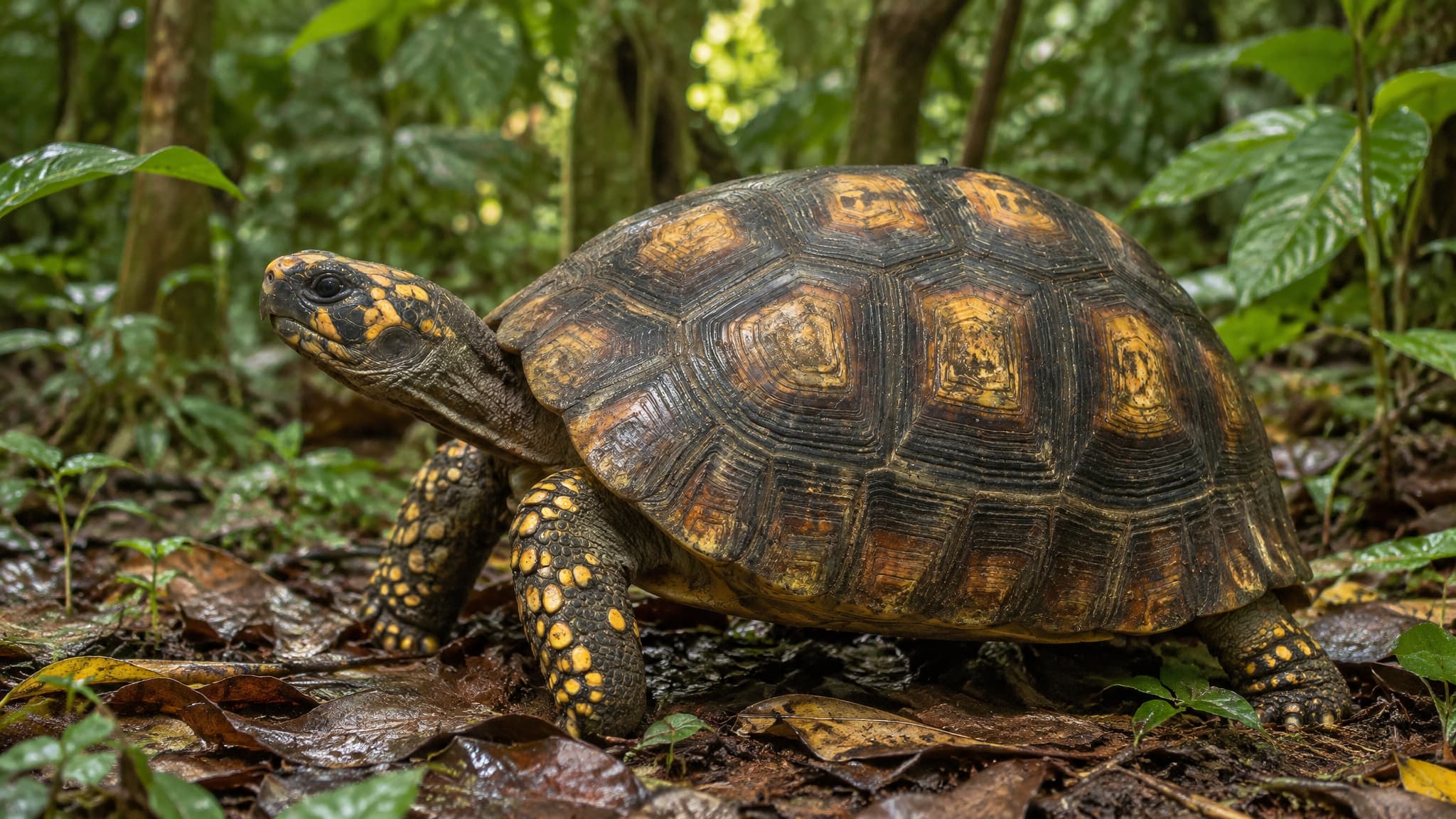
D'Orbigny's slider
Reptiles

D'Orbigny's slider

Trachemys dorbigni

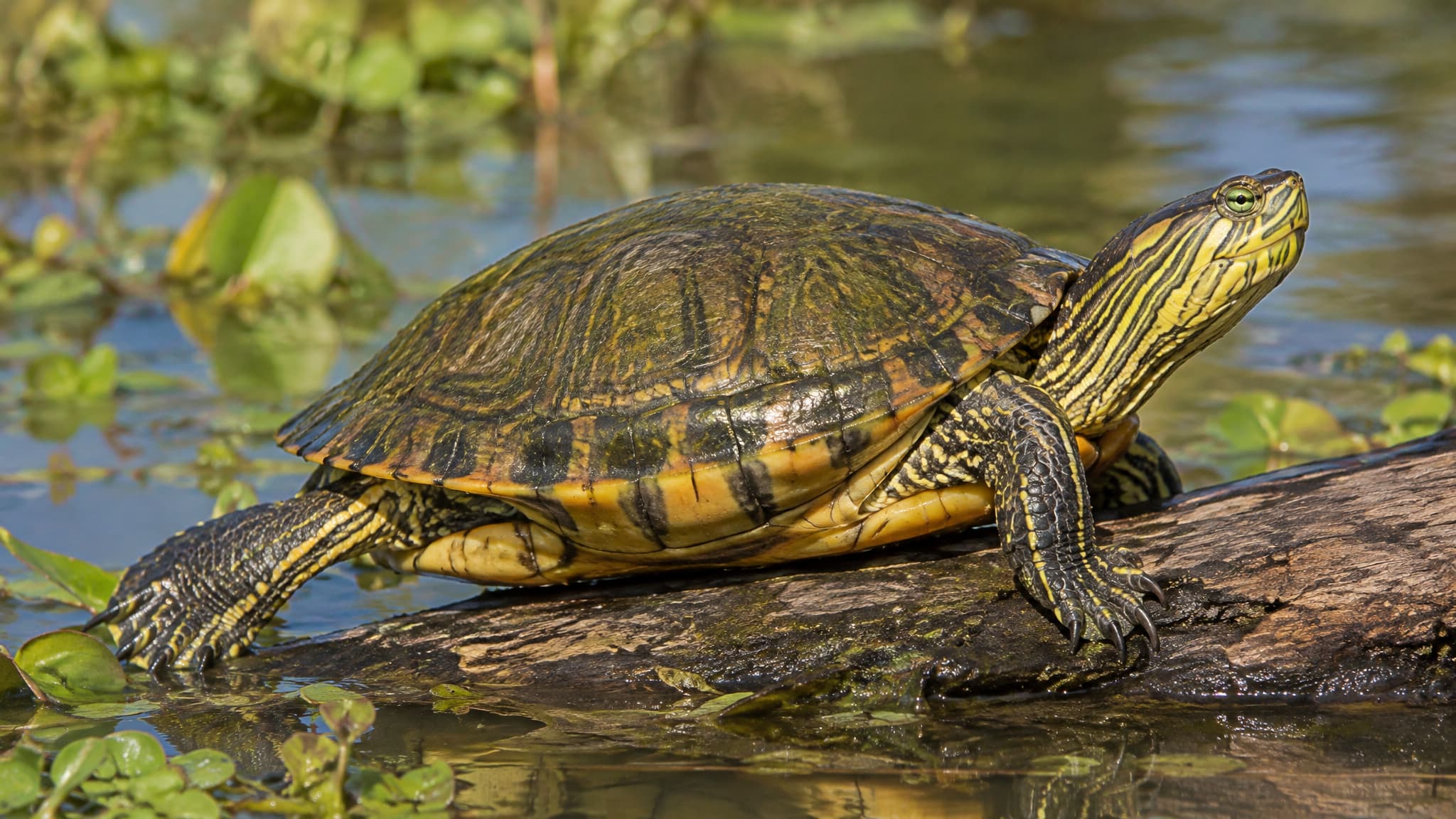
D'Orbigny's slider (Trachemys dorbigni), also called the black-bellied slider, is a freshwater turtle of the family Emydidae described by Duméril and Bibron in 1835 from Buenos Aires and named after the French naturalist Alcide d'Orbigny. It was long treated as a subspecies of the North American slider, Trachemys scripta, but is now recognised as a separate South American species. Juveniles have a green carapace with bright yellow or orange marks. Adults are olive green to brown, with yellow or orange bars on the shell and a yellow or orange stripe along the jaw and temple; females stay olive, while males darken with a melanism that begins around maturity. Females are the larger sex, reaching a maximum carapace length of about 25.5 cm and up to about 2.5 kg, against about 21.5 to 23 cm in males. Hatchlings measure about 3.6 cm. The native range covers Rio Grande do Sul in southern Brazil, Uruguay and northeastern Argentina, from lowlands up to about 170 m. It is the most abundant turtle of Rio Grande do Sul, living in ponds, reservoirs, lakes, lagoons, marshes, streams and slow rivers with soft bottoms, plenty of aquatic plants and basking sites, and it also persists in urban areas. Released pets have established it in many other Brazilian states and in Córdoba, Argentina. D'Orbigny's slider is an omnivore that leans heavily on plants: in one study vegetation made up 85.3% of the food eaten, including green algae and floating ferns such as giant salvinia. It also takes molluscs, worms, small crustaceans, fish and amphibians. Most active around dawn and dusk, it spends much time basking, especially in colder months, and moves within a home range of about 1.74 ha. Tegus and black vultures prey on it, and its varied diet links plant and animal food webs in the wetlands. Mating takes place from April to July, and females nest from September to February, laying up to two clutches a season about 43 days apart. Average clutches of 8.2 and 10.9 eggs have been reported, with up to 19 eggs, each weighing about 14.9 g. Nests are dug in sandy or clay soil, on average about 60 m from water. Incubation lasts 2 to 4 months, and warmer nests produce more females. Males mature at 4 to 5 years and females at 4 to 7 years. Lifespan has not been recorded for this species; the related red-eared slider has lived 41.3 years in captivity. The main threats are the pet trade, which takes eggs and juveniles, habitat loss and fragmentation, polluted rivers, cleared riverside forest and farming over nesting areas; protecting a strip of about 94 m from the water's edge would cover 90% of nests. Releasing the species into the wild is prohibited in Brazil. The 2025 IUCN turtle checklist lists it as Near Threatened in a new Red List assessment, after earlier Least Concern evaluations.

View Details
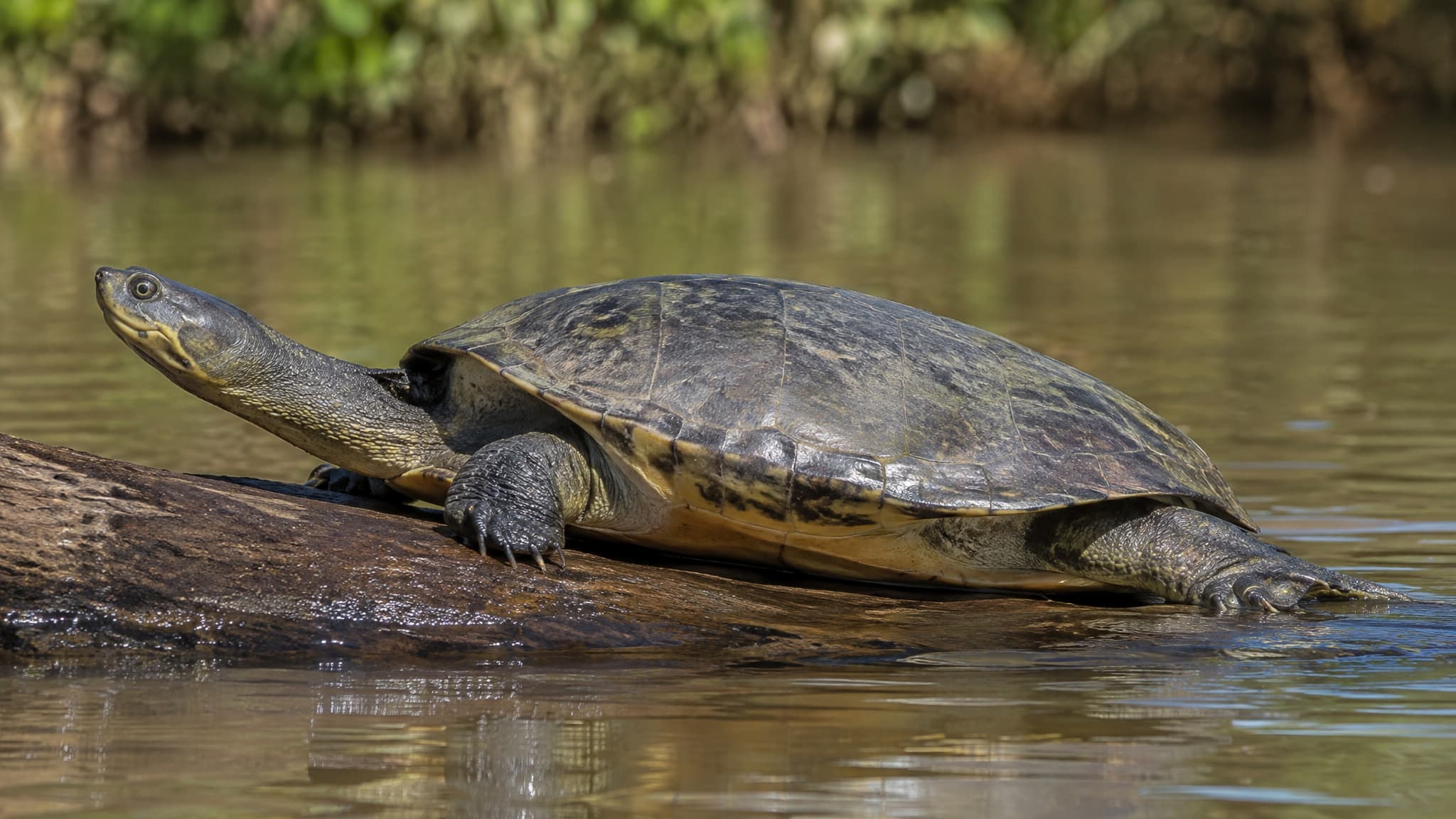
Geoffroy's side-necked turtle
Reptiles

Geoffroy's side-necked turtle

Phrynops geoffroanus

Geoffroy's side-necked turtle (Phrynops geoffroanus) is a freshwater turtle of the family Chelidae, described by Schweigger in 1812 and named after the French zoologist Étienne Geoffroy Saint-Hilaire. Like other side-necks, it folds its long neck sideways under the rim of the shell instead of pulling the head straight back. The carapace is broad and flattened, with a low midline keel, and ranges from dark brown to black, sometimes tinged with green. The plastron is usually pinkish red with irregular dark blotches. The head is wide and flat with a blunt snout, the underside of the head and neck is banded in black and white, and two white barbels under the chin help it find prey in murky water. Juveniles have a bold black-and-orange pattern that softens with age. Females are the larger sex. The largest straight carapace lengths on record are 46.3 cm for a female and 39.5 cm for a male. Males have a long tail and a slightly concave plastron, while females have a short tail, a flat plastron and a higher, more domed shell. This is the most widespread chelid turtle in South America. It ranges from Colombia, Ecuador and Peru through Bolivia, Paraguay and northeastern Argentina, and occurs in almost every Brazilian state. It lives in rivers, streams and lakes, often in muddy, low-visibility water, and is active by day. It also adapts well to people and is one of the turtles most often found in Neotropical cities. It is an opportunistic omnivore that eats fish, molluscs, arthropods, amphibians and small birds, and also takes aquatic plants and some fruit. It hunts by sight and smell, sucking in small prey and tearing larger items apart with its front feet. Sex is set by genes, not by nest temperature. On sandy beaches of the Upper Xingu River, in Mato Grosso, females nested during the low-water season. Nests there held an average of 13.1 eggs (9 to 17), and incubation took 76.5 days, much shorter than in the laboratory. Predators, mainly the crab-eating fox, wiped out 11 of 31 nests, and 60.8% of the eggs hatched in protected nests. Hatchlings had a carapace of about 38.3 mm and weighed about 9.1 g. The longest recorded lifespan is 37.5 years, in captivity. The species is rated Least Concern. Its wide range and tolerance of disturbed habitats help it, though local nest losses can be heavy. Genetic work published in 2022 found at least four lineages within P. geoffroanus, so the species may one day be split into several.

View Details
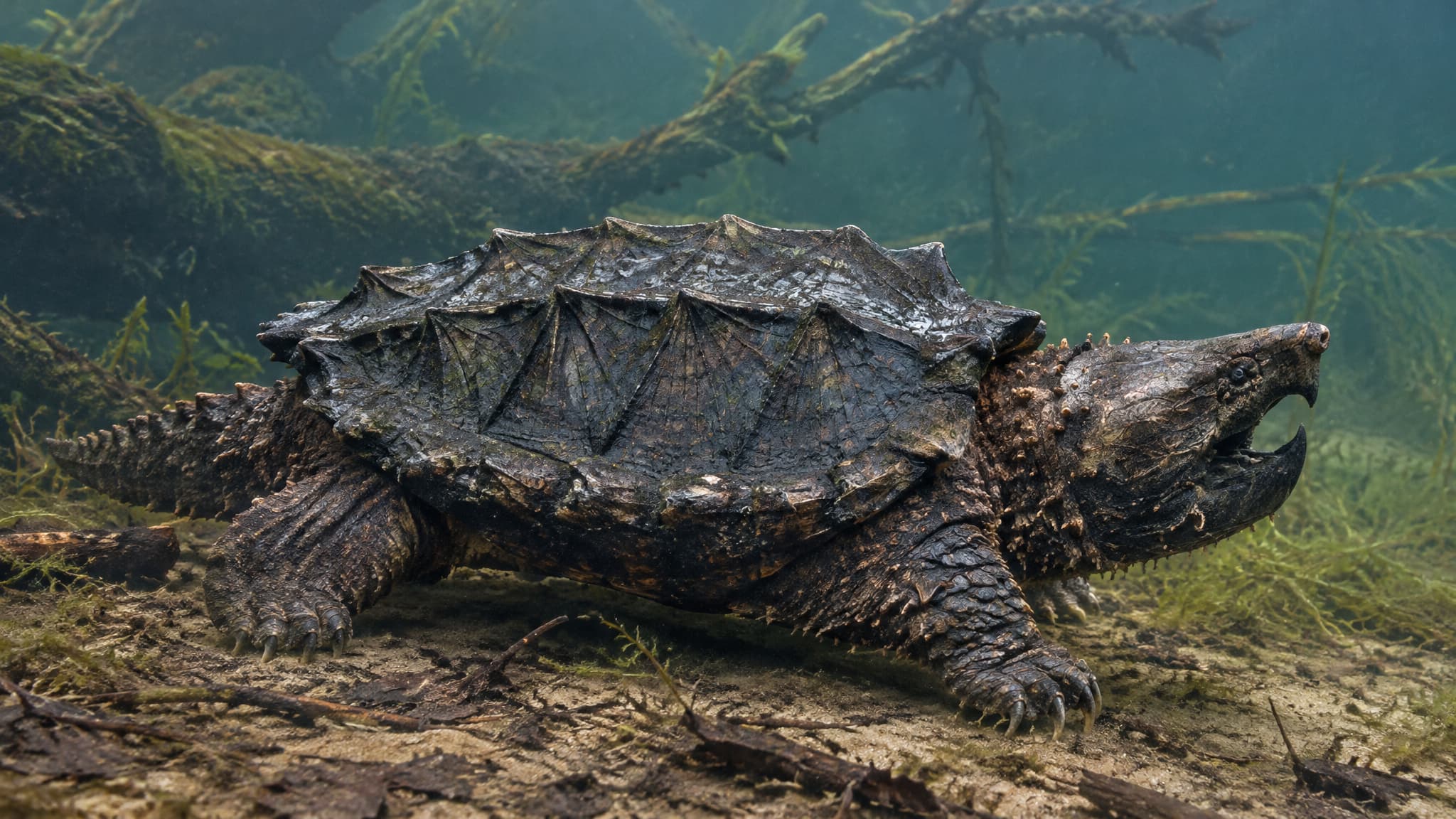
South American snake-necked turtle
Reptiles

South American snake-necked turtle

Hydromedusa tectifera

The South American snake-necked turtle (Hydromedusa tectifera), also called the Argentine snake-necked turtle, is a medium-sized side-necked turtle of the family Chelidae. Its very long neck folds sideways under the edge of the shell rather than pulling straight back. The maximum recorded straight carapace length is 30.6 cm in females and 28.4 cm in males, although most adults stay under 25 cm. The adult carapace is brown with dark brown to black spots, and in young animals the scutes are rough and ridged like a roof, which is what the name tectifera ("roof-bearing") refers to. The head, neck and limbs are dark grey, with a pale whitish band running back from the angle of the jaw on each side. The species lives in central and northeastern Argentina, most of Uruguay, southeastern Paraguay and southern and southeastern Brazil, from Rio Grande do Sul north to Minas Gerais and Rio de Janeiro. It is found from near sea level up to nearly 1,500 m. It uses streams, rivers, creeks, ponds, lagoons, marshes and dams, including man-made and polluted waters, and it also enters coastal estuaries, where some individuals carry barnacles on the shell. This is a highly aquatic and secretive turtle that rarely leaves the water and is thought to bask underwater. It breathes by pushing only the tip of its snout above the surface. It is carnivorous and feeds mainly on aquatic invertebrates such as snails, insect larvae and other arthropods, and also takes small fish and amphibians. It ambushes prey with a fast, harpoon-like strike of the neck combined with suction, a technique also seen in the mata mata. In the cold months it falls into a partial torpor but keeps feeding on warmer days. Mating has been seen in shallow water from late winter to early spring, and nesting takes place in late spring and early summer, mainly from November to January, on banks near the water. A clutch holds 5 to 15 elongated, white, brittle-shelled eggs, and reported incubation times range from 70 to 128 days. Hatchlings measure about 35 to 37 mm in shell length and grow slowly. Lifespan in the wild is unknown; zoo records reach 9 years and 6 months, and one captive female was still alive at 14 years or more. The turtle is not on the IUCN Red List, but the Tortoise and Freshwater Turtle Specialist Group considers it provisionally Least Concern. It tolerates polluted water better than its only living relative in the genus, Hydromedusa maximiliani, although urbanisation, industrial and agricultural pollution and the loss of wetlands affect some populations. Small numbers enter the international pet trade, and an adult has been recorded being eaten by a giant otter.

View Details
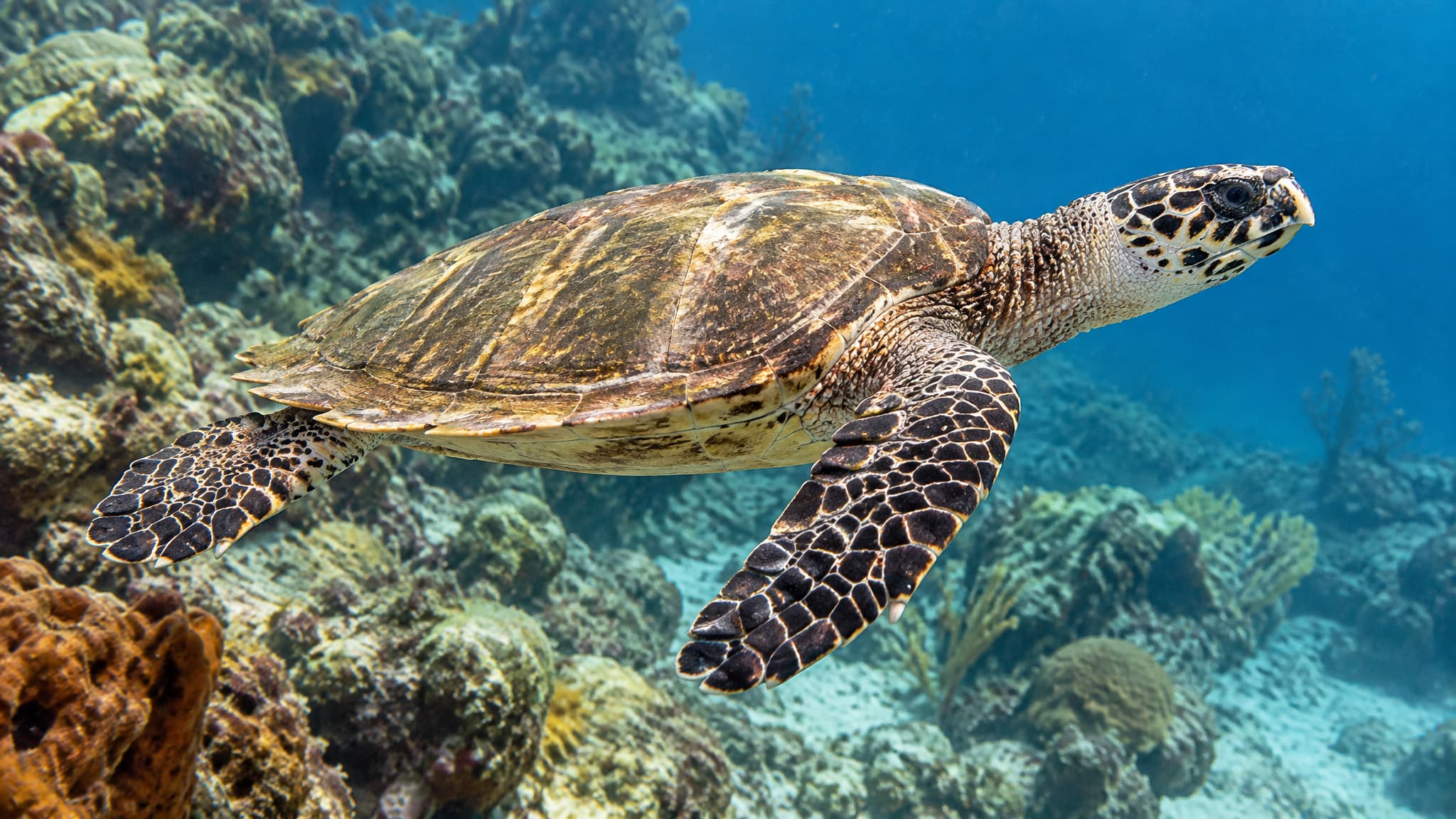
Big-headed Turtle
Reptiles

Big-headed Turtle

Platysternon megacephalum

The big-headed turtle (Platysternon megacephalum) is a small freshwater turtle named for its enormous, triangular head, which is so broad that it cannot be pulled back into the shell. Adults usually have a flattened carapace of 15 to 18 cm, reaching about 20 cm, and a total length of up to 40 cm including the long, scaly tail. The shell is yellowish to brown, the plastron is reduced and greyish-yellow, and the head ends in a strongly hooked beak. Juveniles are brighter, with an orange plastron and yellow stripes behind the eyes that fade with age. This entry follows the 2025 revision by Liang and colleagues, adopted by the Reptile Database, which splits the former species in three. In this narrow sense, P. megacephalum lives in southern and eastern China, including Hainan and Hong Kong, and in northern Vietnam. The Myanmar and Thailand populations are now a separate species, Platysternon peguense, and a lineage from western Guangxi was described as Platysternon baiseensis. The turtle occupies rocky hill and mountain streams with clear, shaded, fast-flowing water, often in pools along cascades, where the water stays cool at about 12 to 17 °C. It reportedly becomes dormant when temperatures fall below 10 °C. Big-headed turtles are mostly nocturnal and spend the day hidden under rocks or underwater. They are weak swimmers but capable walkers and climbers that can scale steep rock, and they hiss and bite hard when handled. Once considered a strict carnivore that eats fish, crabs, frogs, molluscs and worms, the species is now known to be omnivorous: its droppings hold both animal remains and plant matter, especially the stones of Machilus fruits. Eating both prey and fallen fruit, it links streamside forest and stream food webs. Little is known about its breeding in the wild. Females are reported to lay only one or two white, elongated eggs, about 37 by 22 mm. In captivity, a male lived about 15 years. The IUCN lists the big-headed turtle as Critically Endangered in a 2021 assessment that predates the 2025 split and covered both P. megacephalum and P. peguense. Heavy collection for food markets and the pet trade, illegal trade and habitat loss have made it rare across much of its range.

View Details
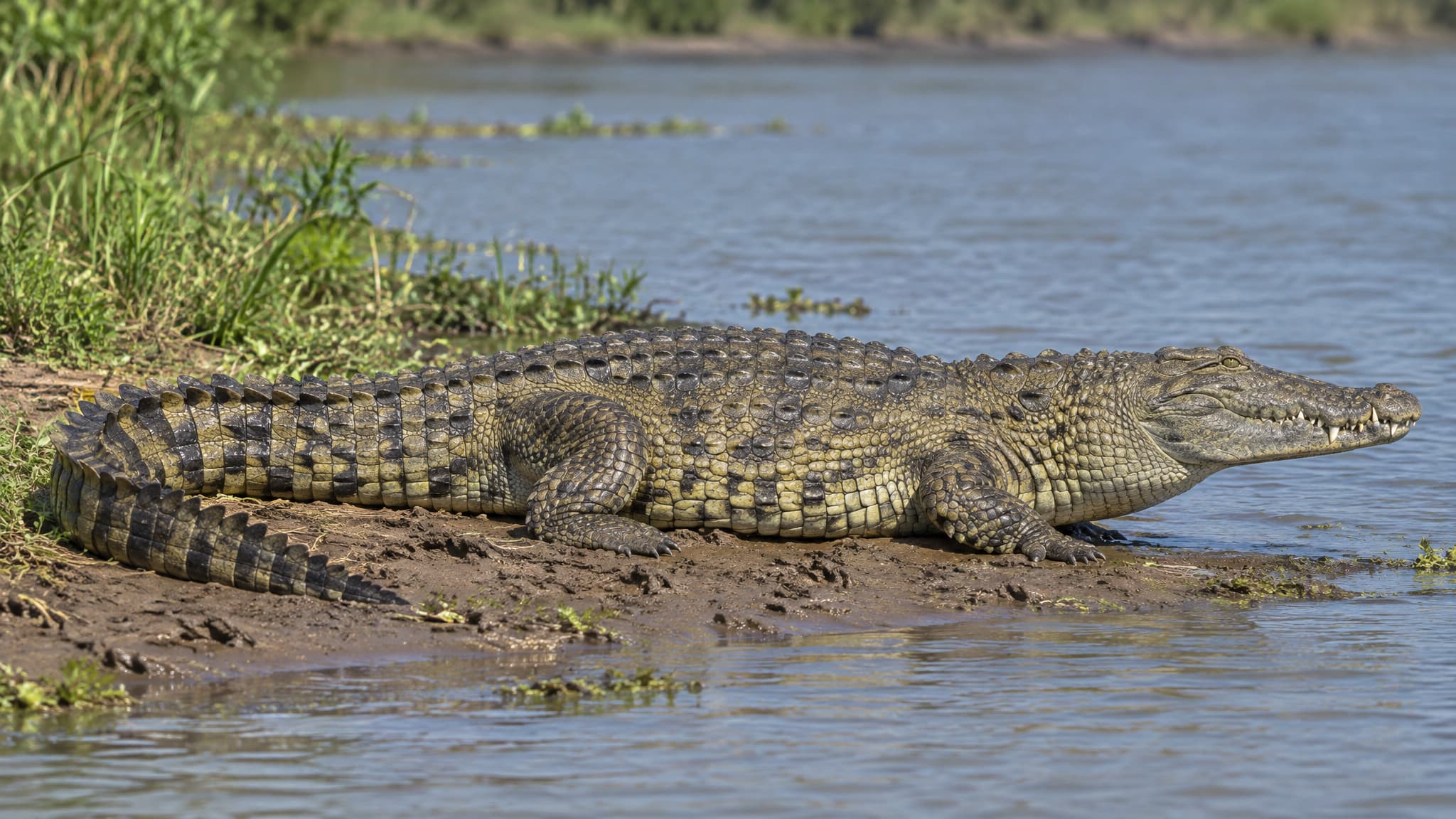
Asian forest tortoise
Reptiles

Asian forest tortoise

Manouria emys

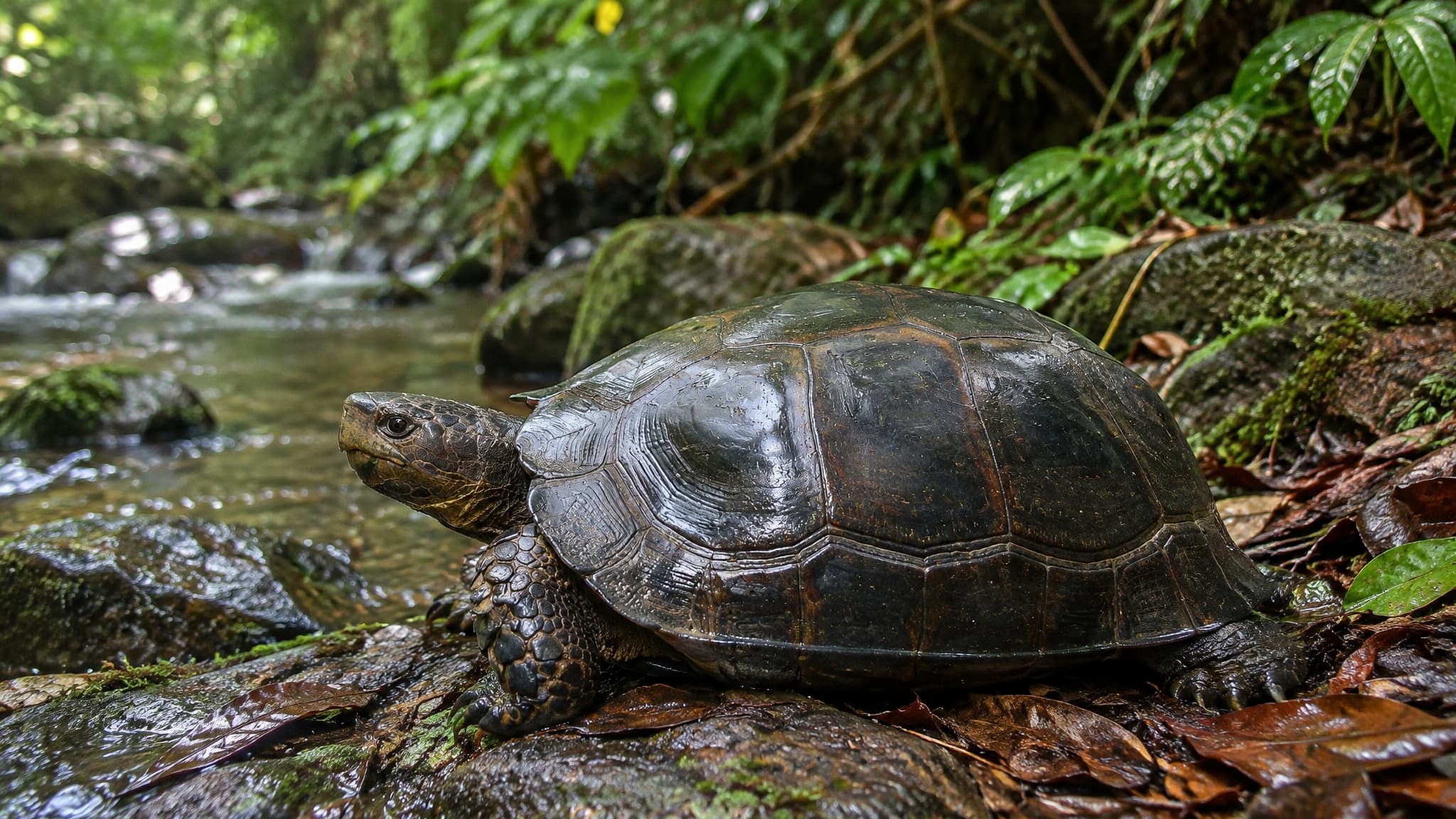
The Asian forest tortoise (Manouria emys) is the largest tortoise of mainland Asia. Adults reach a carapace length of about 50 to 60 cm, and the largest exceed 60 cm, with a body mass of 20 to 37 kg. The domed shell is mostly brown, and males have longer, thicker tails and a concave plastron. Two subspecies are recognized: the Asian brown giant tortoise (M. e. emys) and the larger, darker Burmese black giant tortoise (M. e. phayrei), which can weigh about 25 kg in the wild. They differ in the pectoral scutes, which are separated in emys and joined in phayrei. The species ranges from northeastern India (Assam, Nagaland, Mizoram), Bangladesh and Myanmar through Thailand and Malaysia to Sumatra and Borneo; phayrei occupies the northern part of this range and emys the southern part, and the tortoise has been extirpated from Singapore. It lives in hilly, wet tropical forest, usually close to cool flowing streams, where it often sits or forages in water and mud. It favors temperatures of about 13 to 29 °C and humidity of 60 to 100 percent, and in hot weather it burrows into damp soil and leaf litter. The tortoise is mainly herbivorous. In the wild it eats fungi and the shoots, leaves and stalks of forest plants such as Alocasia, its most frequent food, along with begonias, ferns, bamboo shoots, fallen fruit and wild ginger flowers. It occasionally takes small invertebrates, amphibians or carrion. It is slow-moving and mostly active at twilight, or by day when it is not too hot. It stays active through most of the year, although some individuals rest for up to two months in the cool dry season. Rival males settle disputes by vocalizing and shoving. Reproduction is unusual among tortoises. Instead of digging a hole, the female rakes leaf litter and forest debris into a mound with her front and hind legs, lays her eggs inside, and then stays near the nest, chasing off predators and intruders during the early part of incubation. Clutches of 21 to 53 eggs have been recorded from captive females, and the TFTSG reports up to 60 eggs per annual clutch. Incubation takes about 60 to 90 days, and nest temperature sets the sex of the hatchlings: warmer nests produce mostly females. Longevity is poorly documented. Animal Diversity Web cites a recorded captive longevity of 19.9 years and an unverified estimate of about 150 years in the wild. By eating leaves, fungi and fallen fruit and passing seeds in its droppings, the tortoise helps clear the forest floor and disperse plants. Its eggs are eaten by foxes and monitor lizards, and birds take juveniles. The species is assessed as Critically Endangered. It is hunted for food and traditional medicine and collected for the international pet trade, and its forests are being degraded and cleared. It is listed in CITES Appendix II.
View Details
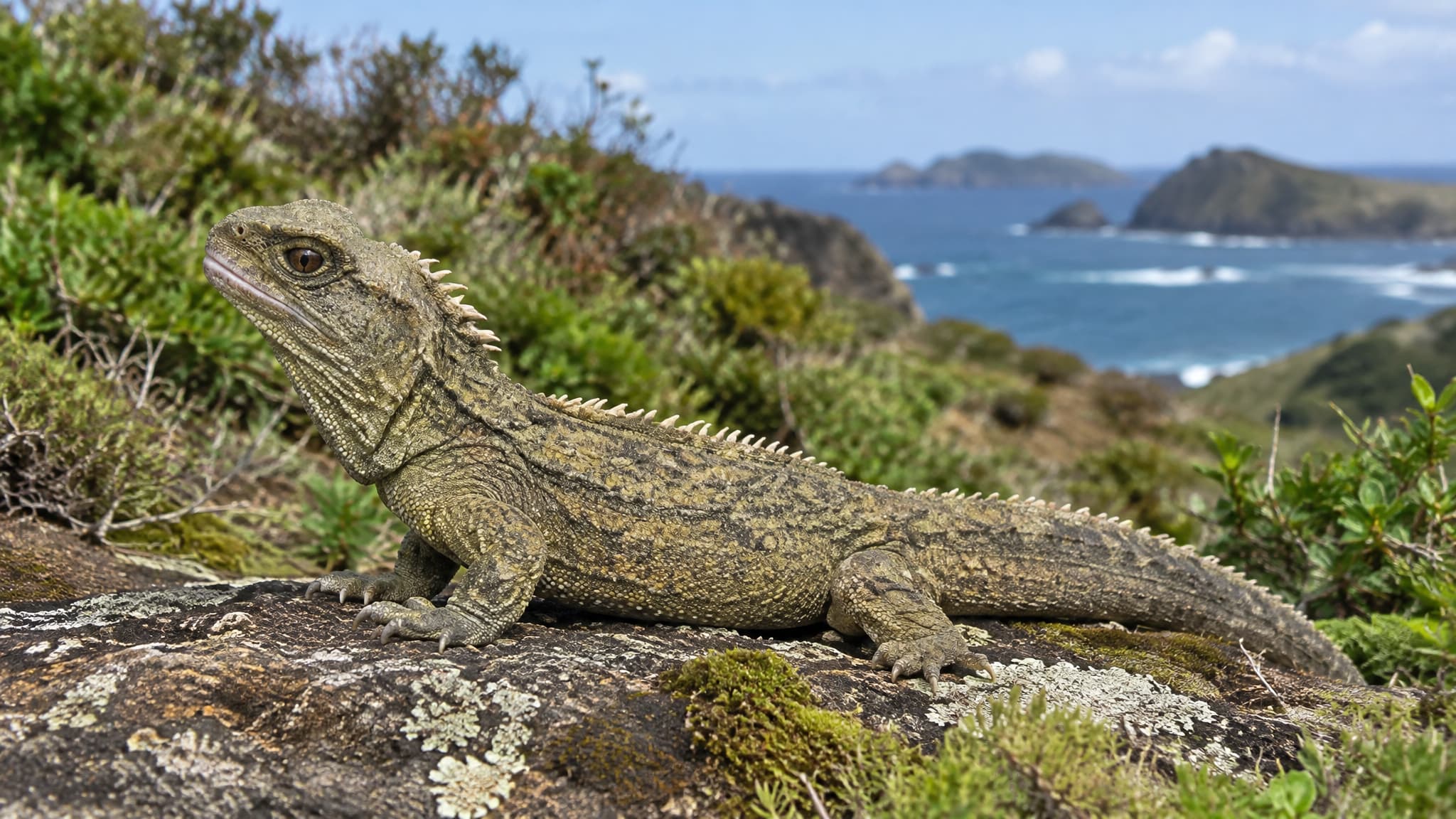
Pig-nosed turtle
Reptiles

Pig-nosed turtle

Carettochelys insculpta

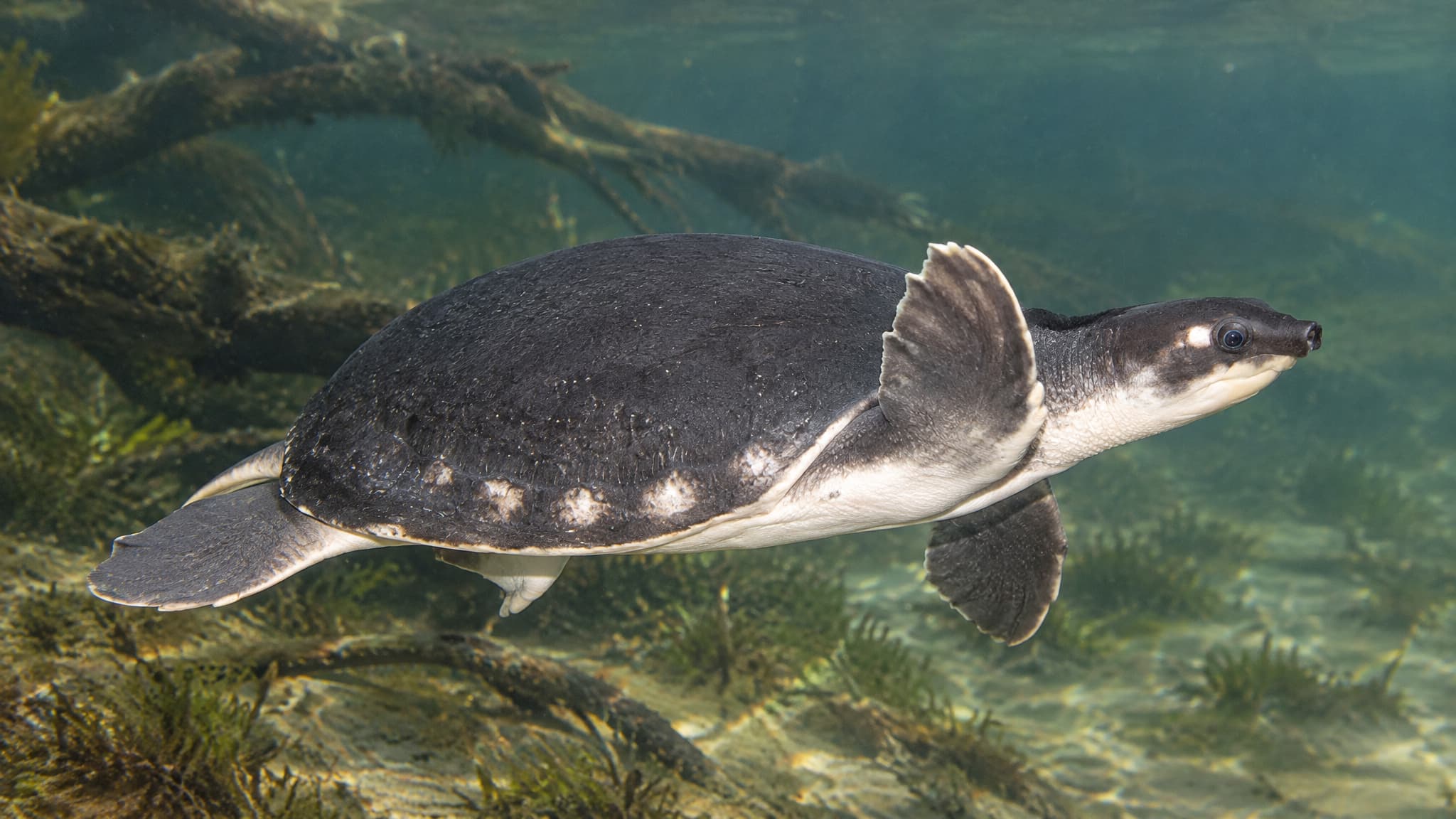
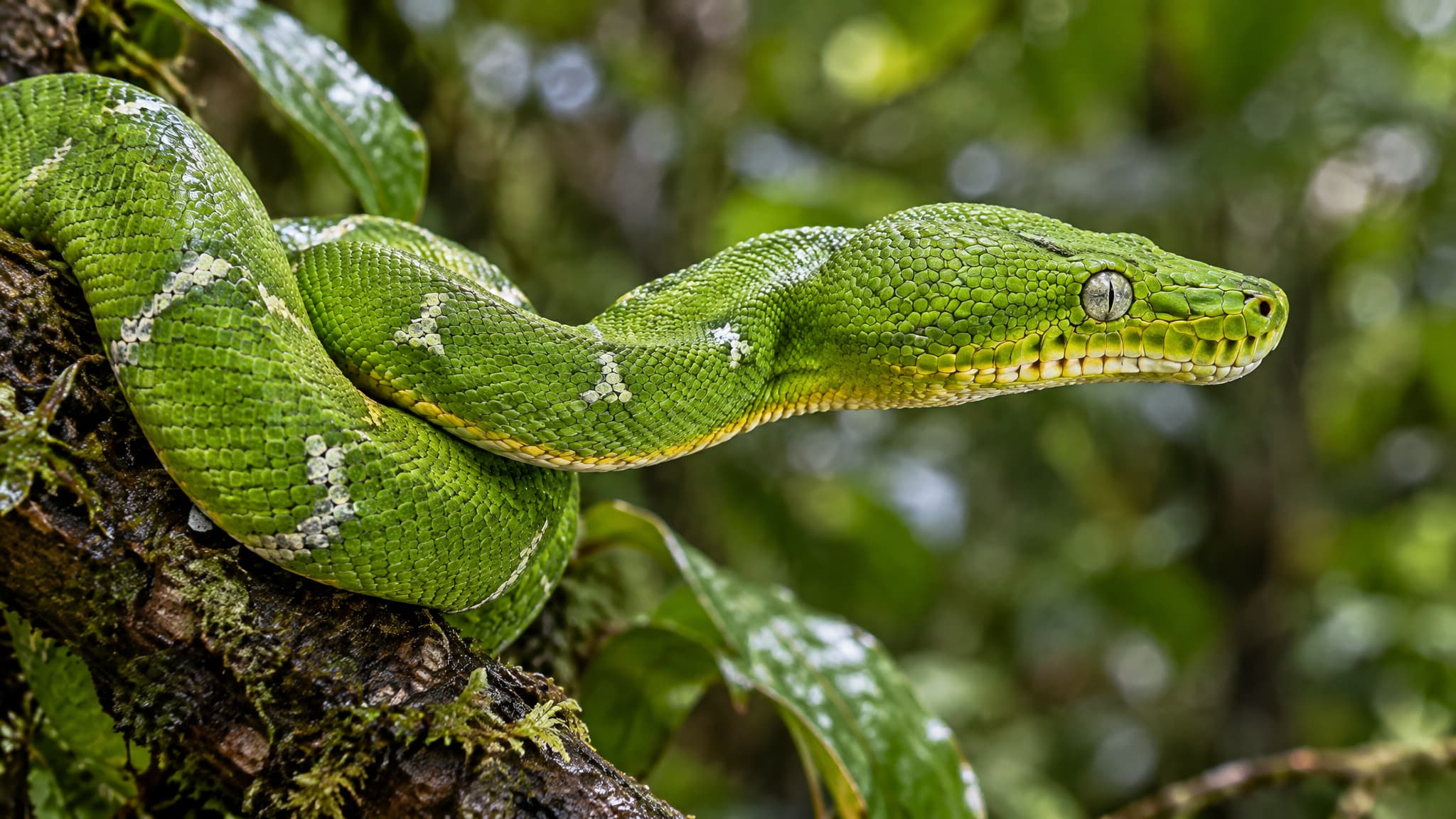
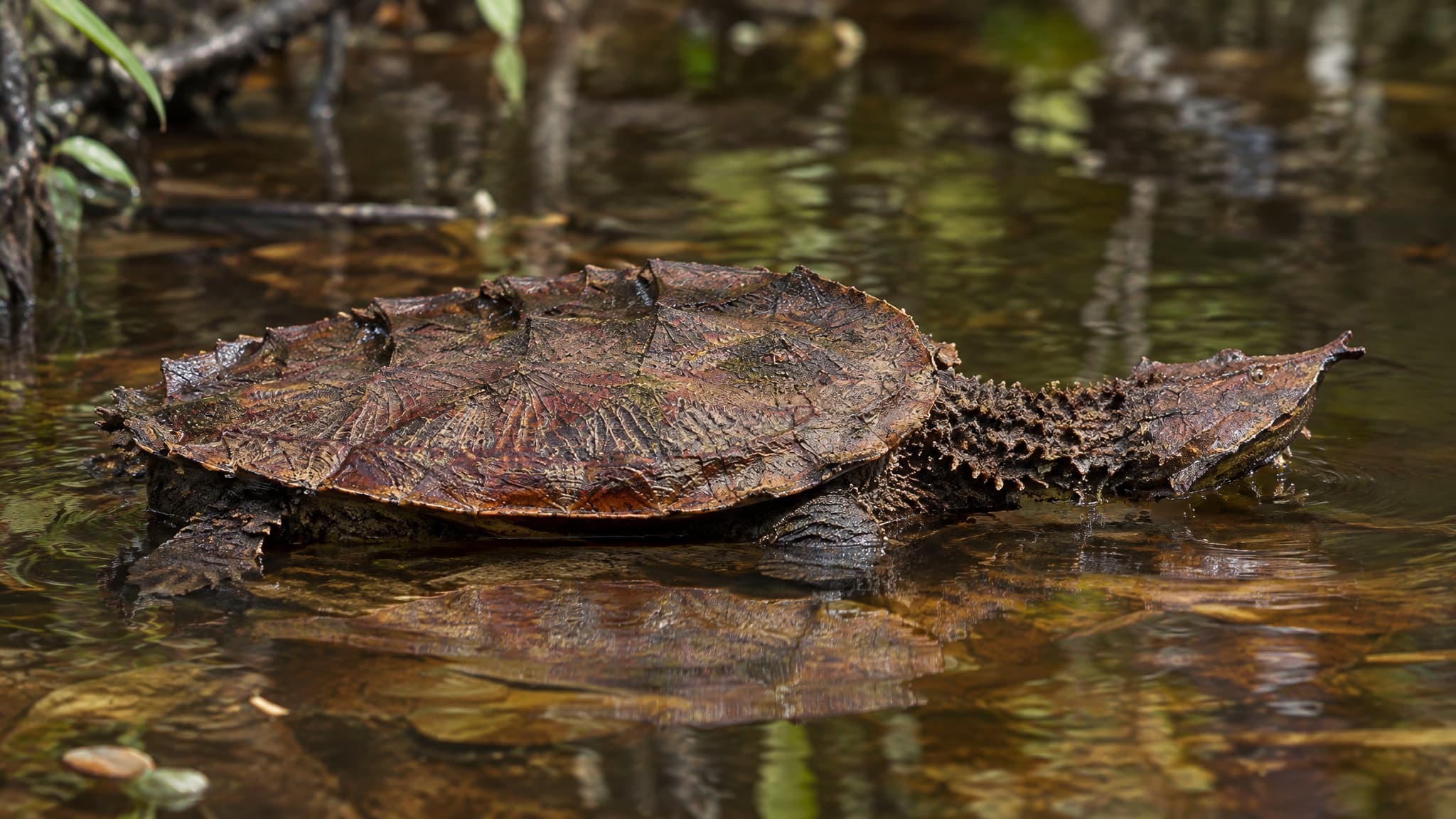
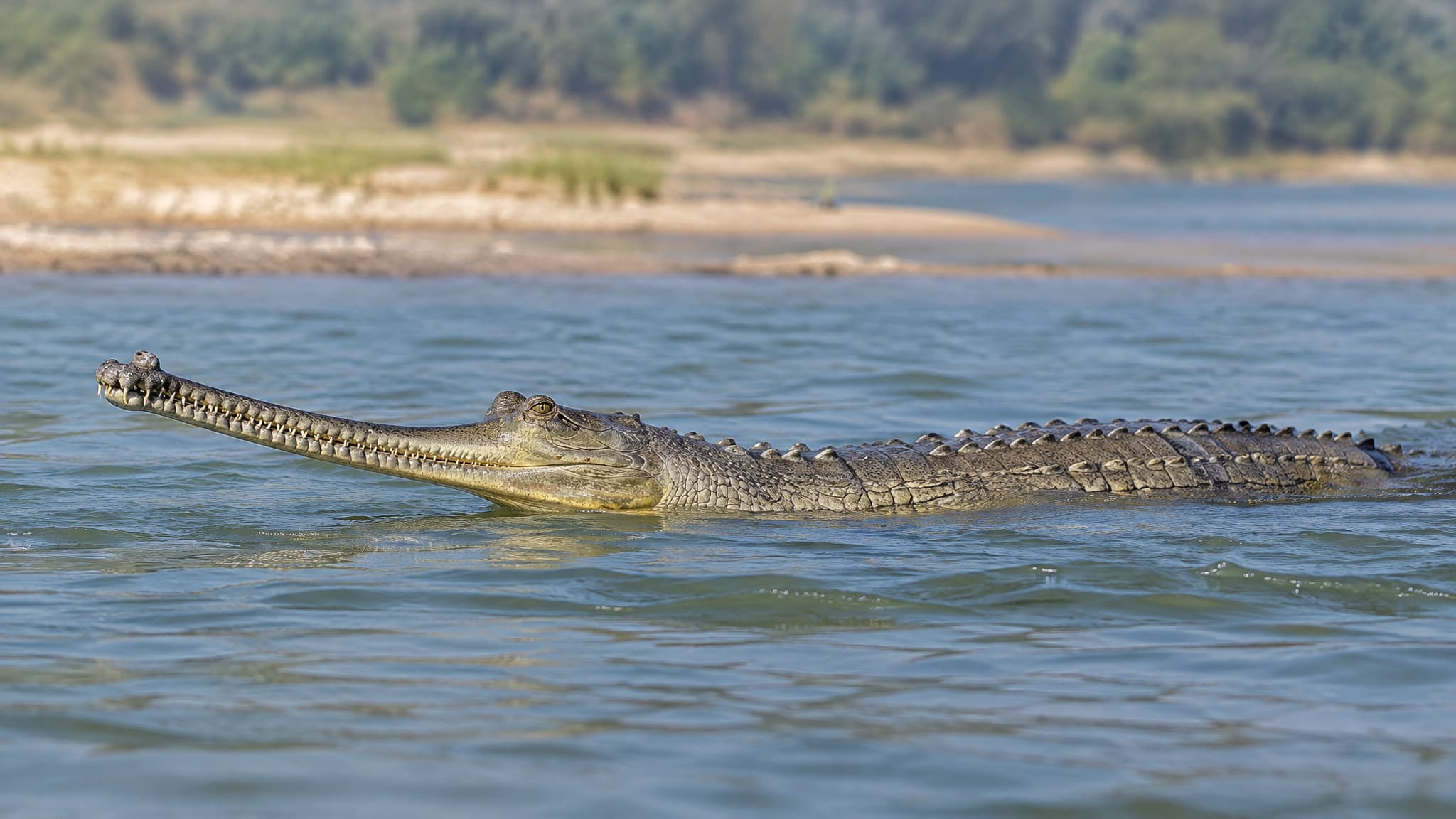
The pig-nosed turtle (Carettochelys insculpta), also called the Fly River turtle, is the only living member of the family Carettochelyidae. Adults reach a carapace length of about 70 cm and weigh more than 20 kg, with the heaviest animals recorded at up to 30 kg. Its domed, keeled shell is grey or olive above and cream below, and instead of horny scutes it is covered by a leathery, pitted skin. The fleshy snout ends in nostrils that let it breathe while keeping almost all of its body underwater, and its forelimbs are shaped like the flippers of a sea turtle. The species lives in freshwater rivers, lagoons, billabongs and lakes of southern New Guinea, in Papua New Guinea and Indonesian Papua, and in the northernmost river systems of Australia's Northern Territory, such as the Alligator, Daly and Victoria rivers. It favours soft-bottomed channels 1 to 3 m deep and also enters estuaries and brackish water. In the cool dry season turtles gather near warm thermal springs in the riverbed. It is an omnivore that eats mainly plant food, especially fallen figs and other fruit, flowers and leaves, and also takes molluscs, crustaceans and insects. Highly aquatic and clumsy on land, it rarely leaves the water except to nest. Groups form in the wild during the dry season, yet captive animals are notably aggressive and territorial toward one another. Nesting takes place late in the dry season on sandy riverbanks, where a female lays a clutch of 7 to 39 eggs. On the Daly River, females breed every second year and lay two clutches about 40 days apart in each breeding year. Nest temperature sets the sex of the young, with warmer nests producing females. After about 69 days the embryos are fully formed, but they can wait in the egg for up to 50 more days until wet-season floods lower the oxygen in the nest, which triggers a synchronized hatching. Males mature at 14 to 16 years and females at 20 to 22 years. Captive animals have lived up to 38.4 years. Pig-nosed turtles feed on aquatic invertebrates and riverside plants, loosen and aerate the soil when they dig their nests, and their eggs feed monitor lizards. The species is listed as Endangered by the IUCN and appears in CITES Appendix II. Numbers fell by more than half between 1981 and 2011, driven by the collection of eggs and adults for food and by a large illegal pet trade: more than 80,000 animals were confiscated in Papua New Guinea and Indonesia between 2003 and 2013. In Australia, feral water buffalo trample nests and damage river vegetation.
View Details
Yellow-spotted river turtle
Reptiles

Yellow-spotted river turtle

Podocnemis unifilis

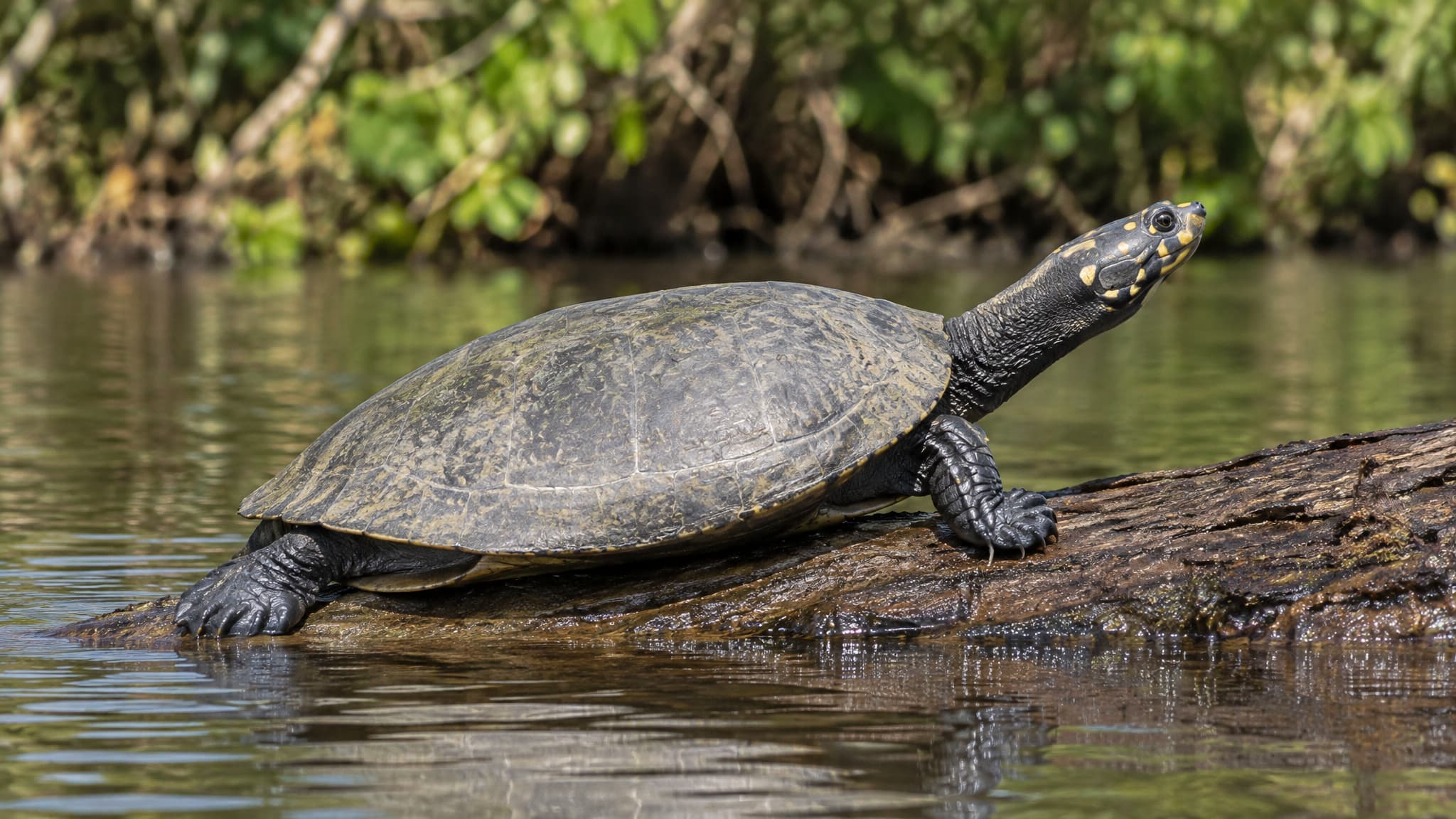
The yellow-spotted river turtle (Podocnemis unifilis) is a side-necked turtle of the family Podocnemididae, named for the bright yellow spots on the sides of its head. Like other side-necks, it tucks its head sideways under the edge of the shell instead of pulling it straight back. The oval carapace is brown to black with a low central keel and pale edges, the plastron is yellow and sometimes blotched, and the long olive-to-brown head ends in a distinct snout with a small barbel under the chin. The yellow spots are most vivid in juveniles and tend to fade with age, especially in females. Females are much larger than males. Adult females reach a carapace length of 38 to 52 cm, while males measure 21 to 39 cm, and large adults can weigh up to 8 kg. The species lives in the Amazon and Orinoco basins and the rivers of the Guianas, with records from Venezuela, Colombia, Ecuador, Peru, Bolivia, Guyana, French Guiana and the Brazilian Amazon; it occasionally drifts to Trinidad. It prefers calm water in large rivers, tributaries and lakes, moving into flooded forests, swamps and floodplain lakes when the water rises and returning to the river channels in the dry season. Groups often bask together on fallen trees and logs in mid-morning and afternoon. Adults feed mainly on plants: aquatic and floating vegetation, fruits and seeds that fall into flooded forest, with fish, worms, insects and other small animals taken opportunistically. Nesting is timed to the flood cycle. In the dry season females dig shallow nests on sandy or earthen riverbanks and lay 4 to 35 eggs; most lay one clutch a year, although some nest twice. The eggs hatch after 66 to 159 days, and incubation temperature sets the sex of the young: nests below 32 °C produce mostly males and warmer nests mostly females. Eggs and hatchlings are eaten by birds, snakes, large fish and mammals. Individuals have lived more than 30 years in captivity. The IUCN Red List classifies the yellow-spotted river turtle as Vulnerable, and it is listed in CITES Appendix II. The main threat is people: adults are caught by hand or with nets, especially when they come ashore to nest, and both meat and eggs are sold in local markets.

View Details
Loggerhead sea turtle
Reptiles

Loggerhead sea turtle

Caretta caretta

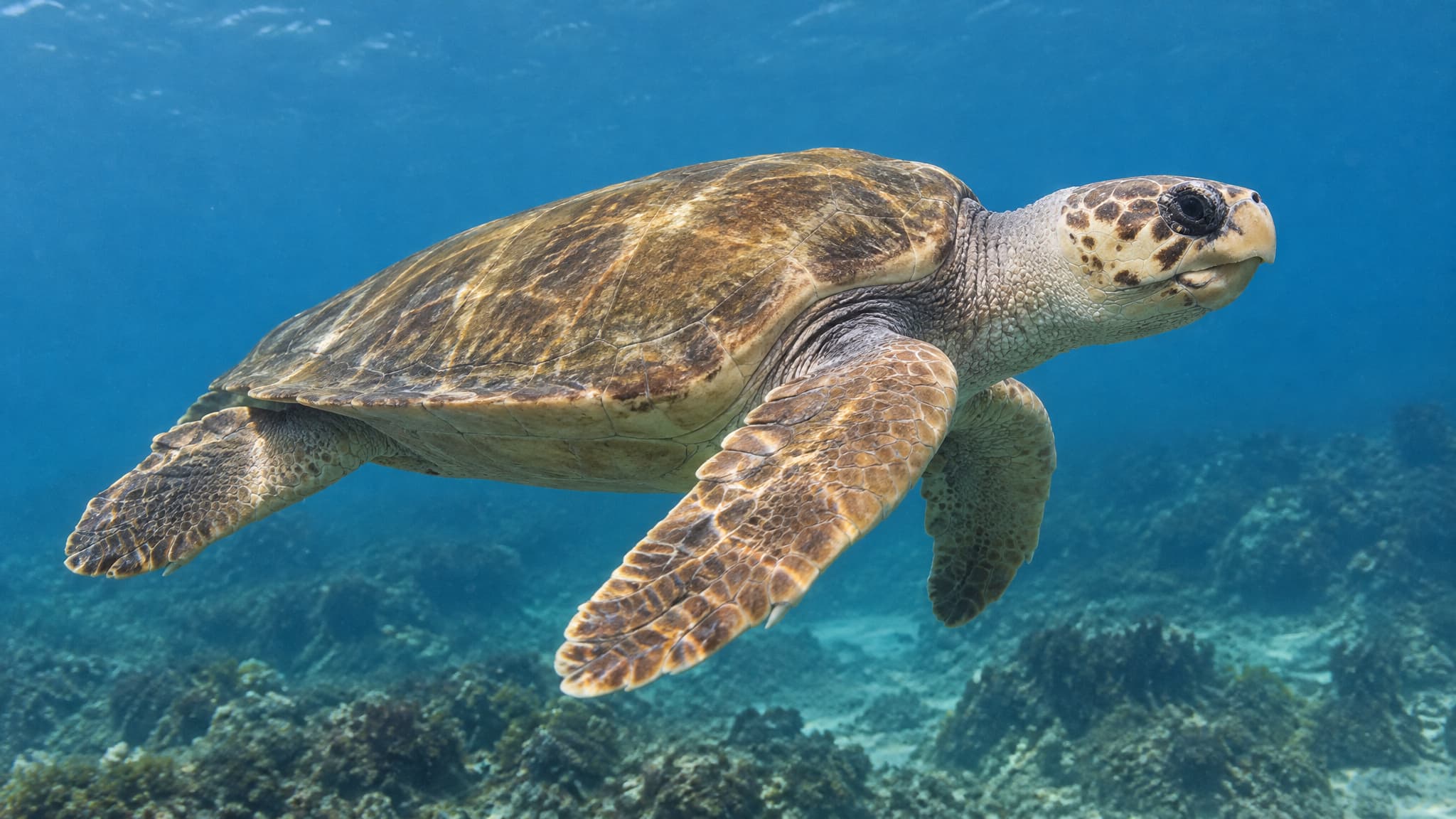
The loggerhead sea turtle (Caretta caretta) is a large hard-shelled sea turtle named for its oversized head and powerful jaws, which let it crush shellfish. Adults average about 90 cm in carapace length and about 135 kg, and in Brazil Projeto TAMAR records individuals of up to 136 cm curved carapace length and 180 kg. The slightly heart-shaped carapace is reddish brown, the underside is pale yellow, and hatchlings are dark brown. Adult males have longer tails and claws than females. Loggerheads live in subtropical and temperate waters of the Atlantic, Pacific and Indian oceans and the Mediterranean Sea, and the species has the widest nesting range of any sea turtle. Young turtles spend roughly 7 to 15 years in the open ocean, often drifting with floating Sargassum mats, before moving to continental shelves, bays and estuaries to forage. In Brazil, priority nesting areas lie on the northern coast of Rio de Janeiro, Espírito Santo, Bahia and Sergipe, with about 9,000 nests per season. Ocean-going juveniles eat jellyfish, salps, pyrosomes and other floating prey. Coastal juveniles and adults feed mainly on bottom-dwelling invertebrates such as whelks, conchs, bivalves, crabs and horseshoe crabs, and they occasionally take sponges, fish or algae. Loggerheads are mostly active by day, can stay submerged for long periods and make long migrations, with some Pacific turtles crossing the whole ocean. Maturity comes late, at roughly 17 to 35 years of age. Females return to nest near the beach where they hatched, usually every 2 to 3 years, and nest alone at night. Each season they lay 3 to 5 clutches about two weeks apart, with around 100 eggs per clutch, and incubation takes about 80 days. Nest temperature sets the sex of the hatchlings: warmer sand produces more females. Lifespan in the wild is estimated at 47 to 67 years. As a large predator of shellfish and other bottom invertebrates, the loggerhead is an important consumer in coastal seafloor food webs. The species is listed as Vulnerable by the IUCN and in CITES Appendix I. The main threat at sea is bycatch in longlines, gillnets and trawls. On land, coastal development, artificial lighting, beach erosion and egg predation reduce nesting success, while plastic debris, boat strikes and warmer sand that skews sex ratios add further pressure.

View Details
Red-footed tortoise
Reptiles

Red-footed tortoise

Chelonoidis carbonarius

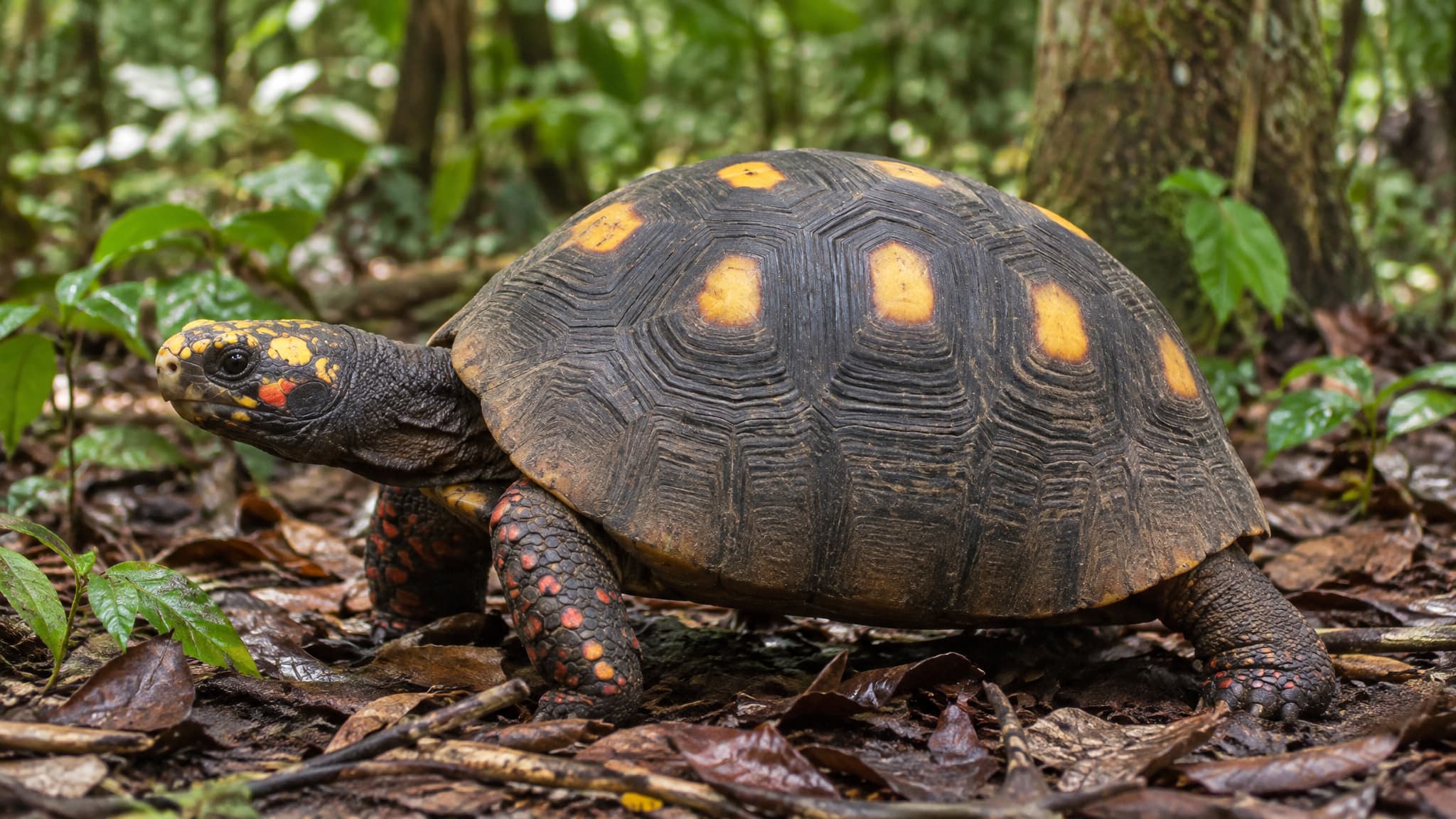
The red-footed tortoise (Chelonoidis carbonarius) is a medium-sized South American land tortoise of the family Testudinidae. Adults usually have a carapace of about 30 to 35 cm, individuals of 45 cm are fairly common, and the largest recorded specimen, from Paraguay, measured 60 cm and weighed more than 28 kg. The shell is dark brown to almost black, with a paler central patch on each scute, while the thick scales of the legs and tail range from yellow to deep red, the feature behind its common name. Males are on average slightly larger than females and have a more developed rear plastron and a wider angle between the anal scutes, which leaves the tail more mobile. The species lives east of the Andes, from southeastern Panama through Colombia, Venezuela and the Guianas to Ecuador, Peru, Bolivia, Brazil, Paraguay and possibly northern Argentina, with populations on several Caribbean islands, some probably introduced by people. In Brazil it is confirmed in 18 states and in the Amazon, Caatinga, Cerrado, Atlantic Forest and Pantanal biomes. It uses humid and dry forests, savannas and forest-savanna transitions, favoring humid, densely wooded ground and avoiding muddy areas. Although often called omnivorous, it feeds mostly on plants. In the wet season about 70% of the diet is fruit and 25% leaves and shoots; in the dry season fruit falls to about 40% and flowers make up about 23%, alongside leaves, fungi and a little animal matter such as carrion. Tortoises share shelters in fallen trees, hollow logs and burrows dug by armadillos and agoutis, mark them with scent trails, gather at food sites without defending territories, and may aestivate when food runs short in the south of the range. Sexual maturity comes at around 5 years of age. Each clutch holds 2 to 15 eggs, and a female may lay several clutches in a season. Incubation lasts 105 to 202 days, about 150 on average, and sex is set by temperature: females develop at or above 29 °C. Hatchlings measure 39 to 45 mm and weigh 22 to 30 g, and receive no parental care. Many wild individuals live 30 years or more, but precise data are lacking. By swallowing whole fruit and passing intact seeds, including those of figs and bromeliads, the red-footed tortoise is an important seed disperser. Jaguars are its main natural predator as adults. The species is listed on CITES Appendix II. Its global IUCN Red List assessment, submitted by the Tortoise and Freshwater Turtle Specialist Group, classifies it as Endangered, and in 2026 Brazil's national list classified it as Vulnerable. Habitat loss and fragmentation and heavy collection for food and the pet trade are the main threats.

View Details
Pancake tortoise
Reptiles

Pancake tortoise

Malacochersus tornieri

The pancake tortoise (Malacochersus tornieri), also called Tornier's tortoise, is the only member of its genus and one of the most unusual tortoises alive. Instead of a high dome, adults carry a thin, flat and flexible shell whose bones are full of openings, which makes the animal light and agile. The carapace reaches up to about 17.8 cm and is brown with yellow markings, often with dark radiating lines, while the plastron is pale yellow with dark seams. Adults weigh around 450 g. Hatchlings are only 2.5 to 5 cm long and start with a domed shell that flattens as they grow. The species is native to southern Kenya and northern and eastern Tanzania, with records also from Zambia and Malawi and a possibly introduced population in Zimbabwe. It lives in isolated colonies on rocky hills and outcrops, known as kopjes, set in arid thorn scrub, savanna and dry woodland, from about 30 to 1,800 m above sea level. Pancake tortoises are herbivores that feed mainly on dry grasses, along with succulents such as aloe, fallen fruit and most other vegetation. They are most active in the morning and in the late afternoon or early evening, leaving their crevice for about an hour at a time to bask and forage. When threatened they do not withdraw into the shell; they run, climb with surprising speed and wedge themselves into a narrow rock crack. Up to ten tortoises may share one crevice, and during the hottest months they may aestivate under flat rocks. Males fight for access to females in January and February. In the wild, nesting takes place mainly in July and August, when the female digs a hole 7.5 to 10 cm deep in loose, sandy soil and lays a single egg. She can lay again every 4 to 8 weeks, so several eggs may be produced in one season. Incubation lasts 4 to 6 months, sex is set by incubation temperature, and the young are independent from hatching. Zoos report a lifespan of 25 to 35 years or more in the wild. The pancake tortoise is listed as Critically Endangered by the IUCN and is on CITES Appendix I. Collection for the pet trade, which often targets juveniles, has emptied many colonies, and habitat is lost to farming in Kenya and to overgrazing by goats and cattle in Tanzania. Coordinated zoo breeding programmes in Europe and North America help keep a reserve population.

View Details
Leopard tortoise
Reptiles

Leopard tortoise

Stigmochelys pardalis

The leopard tortoise (Stigmochelys pardalis) is one of the largest tortoises in the world, ranked fourth by size. Typical adults reach about 40 cm in shell length and 13 kg, while animals from the far north and far south of the range are bigger and commonly weigh up to 20 kg. Exceptional individuals have reached 70 cm and 40 kg. The carapace is high and domed with steep sides. Hatchlings and juveniles show bold black blotches on a yellow background, a pattern that inspired the name, and these markings fade to brown or grey with age. The species ranges across eastern and southern Africa, from South Sudan and Somalia south to South Africa and Namibia, but it is generally absent from the humid forests of Central Africa. It occupies grassland, thorn scrub, bushveld and savanna from sea level up to about 2,900 m. It does not dig its own burrows except to nest; during extreme heat or cold it shelters in abandoned burrows of jackals, foxes or aardvarks, or in rock crevices and shade. Leopard tortoises are grazing herbivores. They feed on grasses, forbs, thistles and succulents, and eat berries and fruit when available. Succulent plants supply much of their water. To obtain calcium they gnaw on bones, ash and even dry hyena droppings. They are mainly active by day, become less active in hot weather and the dry season, and live solitary lives outside the breeding period. Breeding takes place from about May to October. Males compete by ramming and butting rivals and grunt while mating. Females dig a nest and lay clutches of 5 to 30 eggs, and may produce 5 to 7 clutches in a season. Incubation is unusually long, lasting 8 to 15 months depending on temperature, and hatchlings receive no parental care. Sexual maturity comes at 12 to 15 years, and individuals may live 80 to 100 years. Because seeds can pass through the gut undamaged, the tortoise helps disperse plants across the savanna. Eggs and hatchlings are taken by rock monitors, puff adders, jackals and crows, while adults have few natural enemies, though lions and hyenas have occasionally killed them. The IUCN lists the species as Least Concern, and it remains common over most of its range. It has been on CITES Appendix II since 1975. Agricultural burning, hunting for food and collection for the pet trade are threats, but they have not yet caused significant declines.

View Details
Gopher tortoise
Reptiles

Gopher tortoise

Gopherus polyphemus

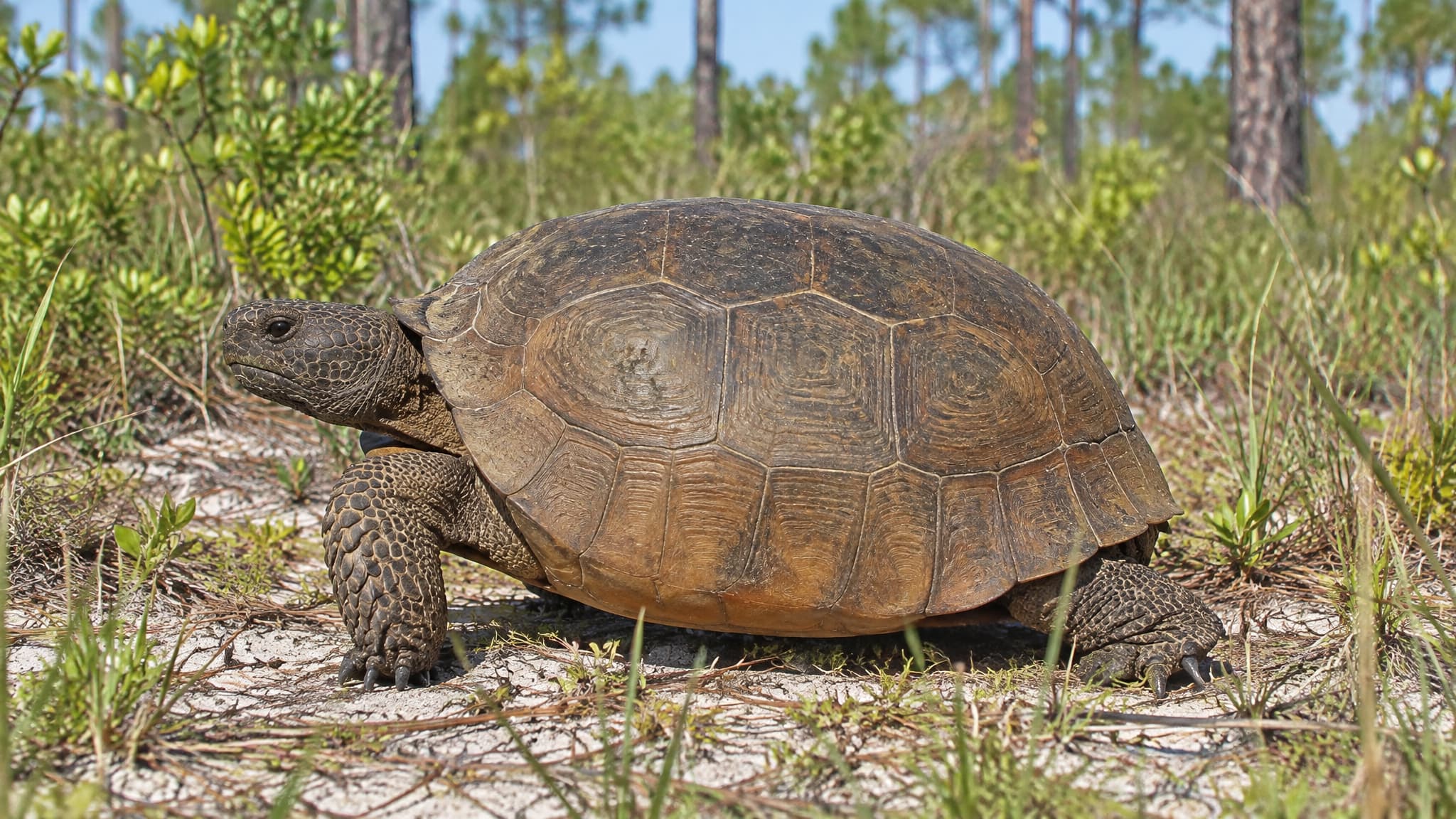
The gopher tortoise (Gopherus polyphemus) is a burrowing tortoise of the southeastern United States and the only member of its genus found east of the Mississippi River. Adults have an oblong, fairly flat carapace in brown, tan or grayish tones, usually 23 to 28 cm long and up to about 38.7 cm, and typically weigh 2 to 6 kg. The plastron is yellowish and has no hinge. Shovel-like front legs and stumpy, elephant-like hind feet are built for digging. Males have a more concave plastron and a longer gular projection under the chin. The species lives on the Coastal Plain from southern South Carolina through Georgia, Florida, southern Alabama and Mississippi to the eastern tip of Louisiana, with most of its range in Florida. It needs deep, dry, well-drained sand with an open canopy and plenty of low plants: longleaf pine savannas, sandhills, scrub, pine flatwoods, xeric hammocks and coastal dunes. Regular fires keep these habitats open. Each tortoise digs burrows that average about 4.5 m long and 2 m deep and can reach 15 m long and 3 m deep, and it may spend up to 80% of its time inside. The stable temperature and humidity of a burrow shelter about 360 other animal species, among them the gopher frog, the Florida mouse and the eastern indigo snake, which makes the gopher tortoise a keystone species. It is a grazing herbivore that eats more than 300 plant species, mostly grasses, wiregrass and legumes, along with fruits such as gopher apple, pawpaw, blackberries and saw palmetto berries; females occasionally take fungi, insects or carrion around the nesting period. Gopher tortoises mature late, at about 9 to 21 years of age. Females lay one clutch a year, usually 5 to 9 eggs and on average about 6, often in the sandy apron at a burrow's mouth. The eggs hatch after 80 to 100 days, and nest temperature decides the sex of the young. Raccoons, coyotes, skunks, snakes and fire ants take many eggs and hatchlings, and nest losses can reach 87%. Survivors can live 40 to 70 years in the wild and up to 86 years in captivity. Habitat loss to urban growth, farming, forestry and mining is the main threat, compounded by fragmentation, road deaths, upper respiratory tract disease and past hunting for meat. In July 2026 the IUCN Red List moved the species from Vulnerable to Critically Endangered. In the United States it is federally listed as threatened only west of the Mobile and Tombigbee Rivers, in Alabama, Mississippi and Louisiana, and it is listed on CITES Appendix II.

View Details
Hermann's tortoise
Reptiles

Hermann's tortoise

Testudo hermanni

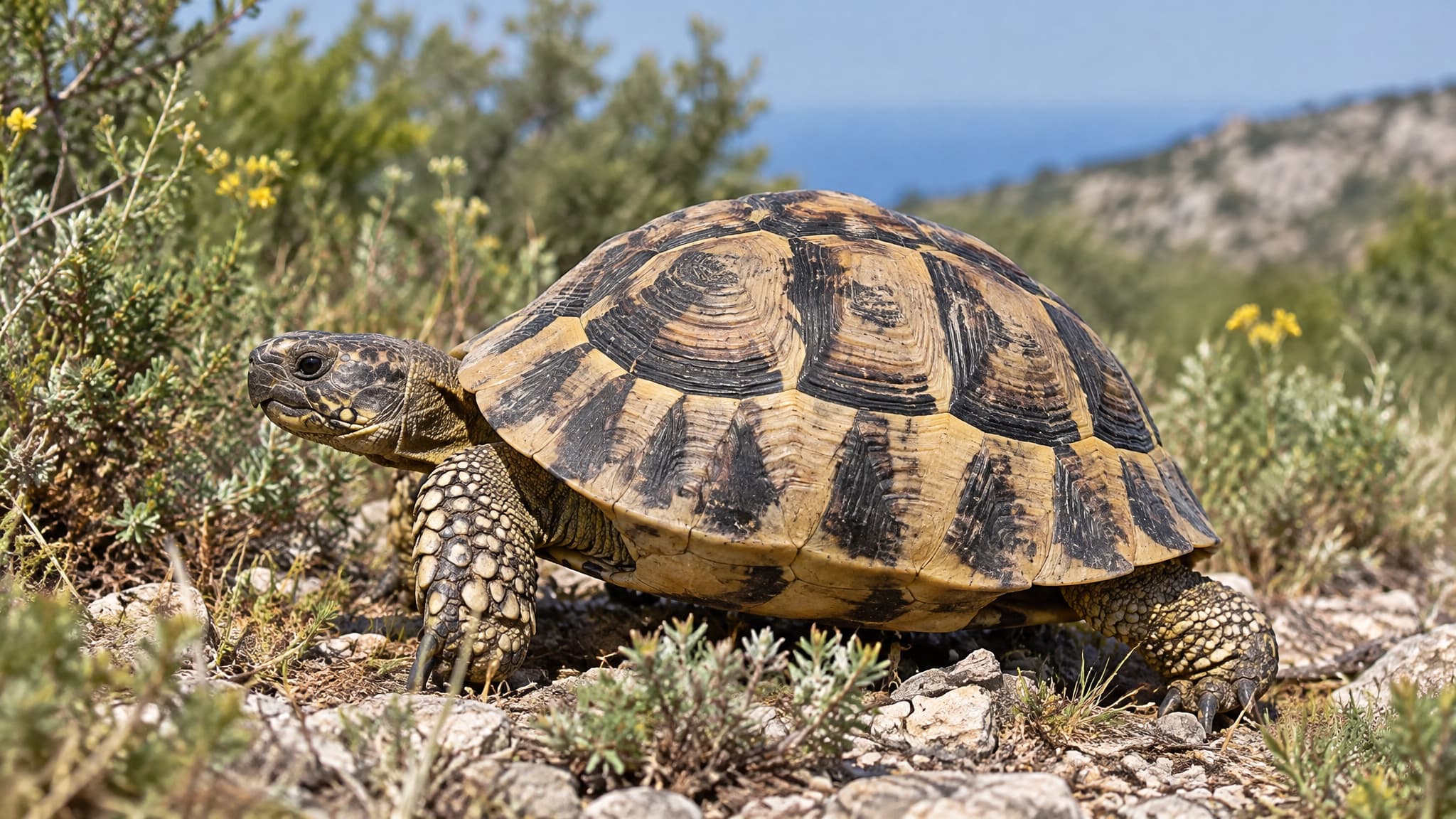
Hermann's tortoise (Testudo hermanni) is a small to medium-sized land tortoise of southern Europe. Adults usually have a carapace about 13 to 18 cm long, and females are on average about 12% larger than males. Western animals rarely exceed about 18 cm, while large eastern individuals can reach about 28 cm. The domed shell is yellowish to olive with dark markings; western tortoises tend to be brightly patterned and eastern ones duller. Dark bands run along the plastron, and the scute above the tail is usually divided, a useful feature for telling it apart from similar Testudo species. The species ranges from coastal north-eastern Spain and southern France through much of Italy and the Balkans to European Turkey, and lives on several Mediterranean islands such as Corsica, Sardinia and Sicily. Two subspecies are usually recognized: the western T. h. hermanni and the eastern T. h. boettgeri. It favors sunny, semi-open Mediterranean landscapes, especially stony hills with low, sparse shrubs and grass, and also uses woodland edges, dry grassland and farmland. Most populations live below 500 m, though eastern ones reach about 1,300 m. Hermann's tortoise is mainly herbivorous, grazing on grasses, leaves and wildflowers that it chooses largely by smell; snails, slugs and insects are eaten occasionally. It is active by day, basking in the early morning before feeding, sheltering under dense bushes in the midday heat and foraging again in the late afternoon. It spends the winter in hibernation, buried in leaf litter or soil, usually emerging around February, and may also aestivate in hot, dry summers. Home ranges are small, about 0.9 to 7.4 ha for females and 0.7 to 4.6 ha for males. Mating begins soon after hibernation, and males court females roughly by ramming and biting them. Between May and July females dig flask-shaped nests and lay one to three clutches a season. Clutches average about 3 eggs in the western subspecies and about 4 in the eastern, with up to 7 and 9 eggs respectively. Incubation takes about 90 days, and the sex of the young depends on temperature: around 26 °C produces males and around 30 °C produces females. Hatchlings appear from mid-August to September and receive no parental care. Adults often live about 30 years, and much longer lives have been suggested. As a grazer, the tortoise feeds on many Mediterranean plants, and its eggs and young are prey for rats, magpies, snakes, foxes, badgers, hedgehogs and wild boar. Adults have few natural enemies thanks to their shell, and annual adult survival is high, about 85 to 97%. The IUCN lists the species as Near Threatened, although that assessment is old. Habitat loss from farming, building and roads, wildfires, collection for the pet trade and increased predation by boars and carnivores threaten many populations, especially western ones.

View Details
Radiated tortoise
Reptiles

Radiated tortoise

Astrochelys radiata

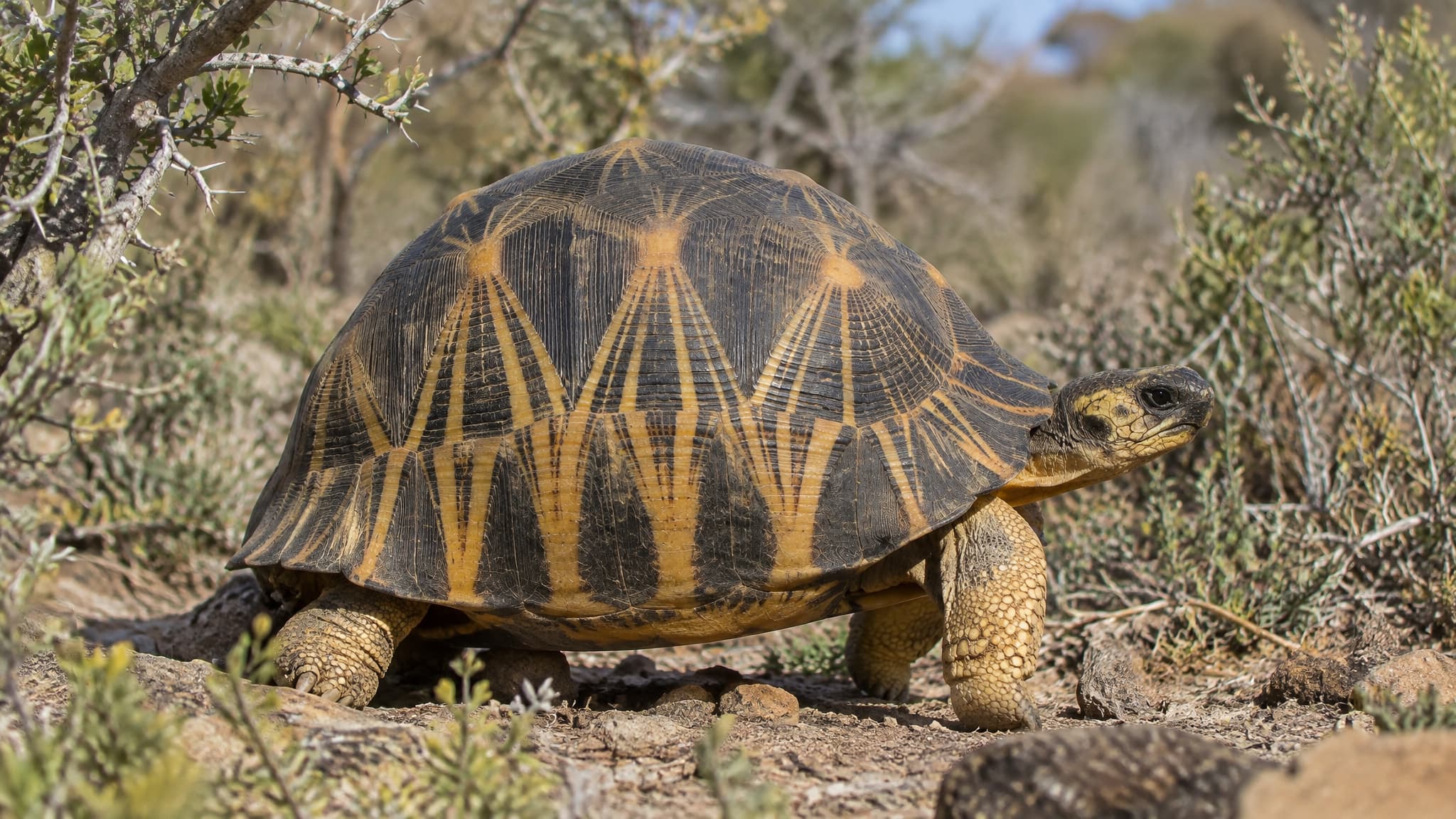
The radiated tortoise (Astrochelys radiata) is among the most striking tortoises in the world. Its high, domed carapace is dark brown to black, and each scute carries a star of bright yellow lines that radiate from a yellow centre, the pattern behind its common name. Adults usually measure 26 to 38 cm in carapace length and weigh 2.5 to 8.8 kg, although exceptional animals are larger: the biggest known specimen, a female in a Madagascar rescue centre, weighs 24 kg. The sexes look alike, but males tend to have longer tails with a more marked notch under the tail. Hatchlings are only 3.2 to 4 cm long and are white to off-white. The species is endemic to the far south and southwest of Madagascar, where it lives in dry brush, spiny thorn forest, scrubland, woodland and coastal dunes. It has also been introduced to Réunion and Mauritius. The radiated tortoise is a diurnal herbivore that spends most of its feeding time grazing on grasses, and it also eats flowers, fruit and succulents; the invasive Opuntia cactus is a favourite food. It prefers fresh new growth, which is richer in protein and lower in fibre, and turns to dried leaves when soft plants are scarce. Because individuals graze the same patches again and again, they keep the vegetation closely cropped and help shape the plant cover of their dry habitat. During courtship the male bobs his head, sniffs the female and may lift her with the front edge of his shell while hissing and grunting. Males first mate at about 31 cm in length, and females need to be somewhat larger before they breed. The female digs a nest 15 to 20 cm deep, lays 3 to 12 eggs and leaves them; incubation usually takes 145 to 231 days. The species is very long-lived: the oldest verified individual, Tu'i Malila, died at an estimated age of 188 years. The radiated tortoise is listed as Critically Endangered by the IUCN and on CITES Appendix I. Its population, once estimated at about 12 million animals, has collapsed because of habitat loss, collection for food and the illegal pet trade, made worse as local taboos (fady) that once protected it have weakened. In 2018 alone more than 17,000 tortoises were seized from traffickers, and conservation centres in Madagascar now care for close to 26,000 animals while reintroduction programmes return tortoises to the wild.

View Details
African spurred tortoise
Reptiles

African spurred tortoise

Centrochelys sulcata

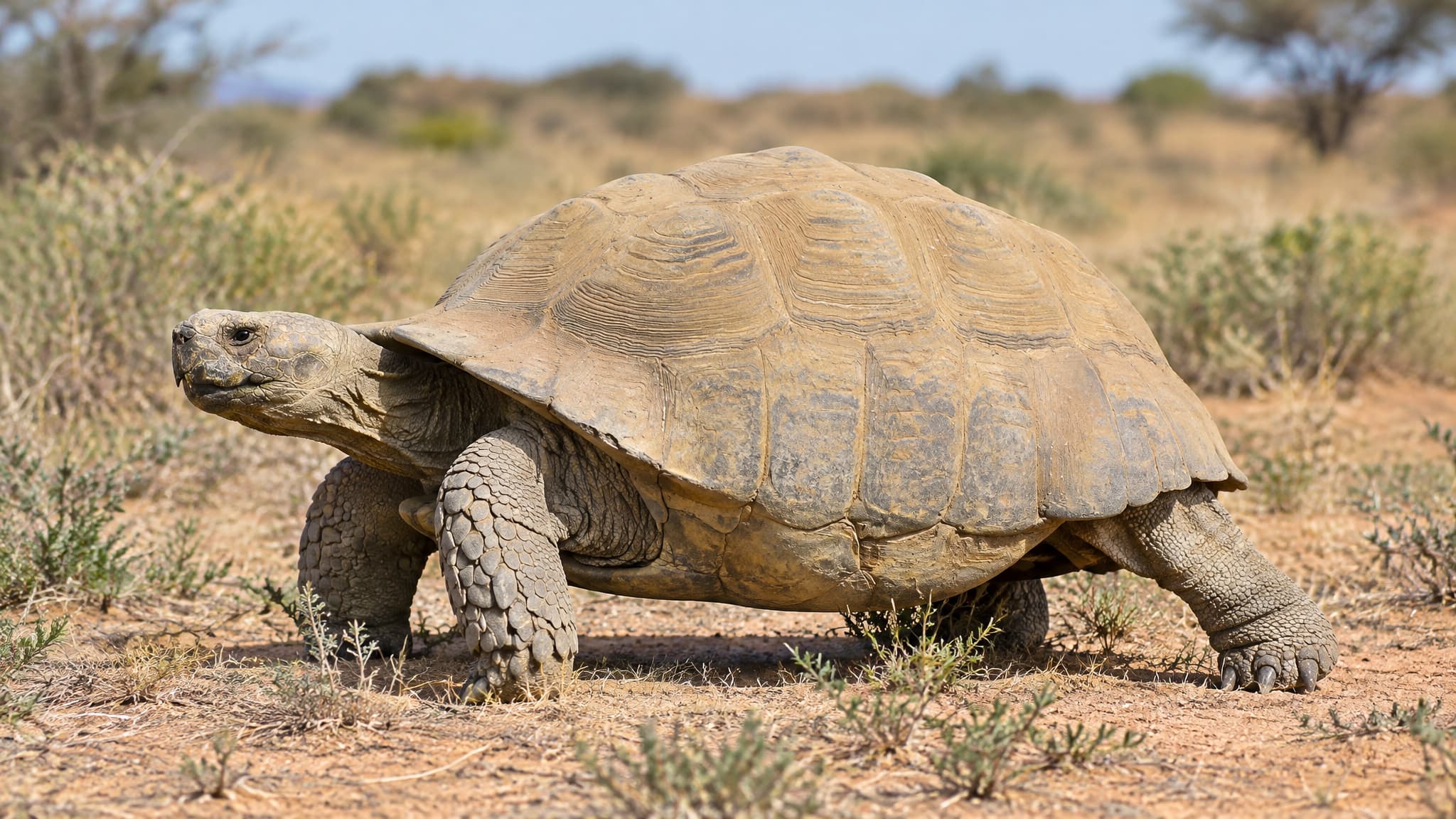
The African spurred tortoise (Centrochelys sulcata), also called the sulcata or Sahel tortoise, is the largest tortoise on any mainland and the largest in Africa, surpassed only by the giant tortoises of Aldabra and the Galápagos. Its broad, sandy-brown carapace has deep growth grooves around each scute, which likely gave the species its name (Latin sulcus, groove), and the front legs carry heavy, pointed scales. Adult males are clearly larger than females, with a straight carapace length of about 86 cm against about 58 cm, and males average around 81 kg, with some exceeding 100 kg. Hatchlings measure only about 4.4 cm and weigh about 40 g. The species lives along the southern edge of the Sahara and across the Sahel, from Senegal and Mauritania east to Sudan, Eritrea and Ethiopia. It occupies hot, dry savanna, shrubland, stable dunes and grassy plains, often near seasonal streams. To escape daytime temperatures that can reach 49 °C, it digs deep burrows, sometimes several metres long, where it rests through the hottest hours and the driest months. These burrows stay far cooler than the surface and also shelter other animals. The African spurred tortoise is a herbivore. In the wild it grazes on grasses and also eats flowers, weeds and succulent plants such as cacti. It is most active at dawn and dusk, warming itself in the early sun before retreating underground. It can go for weeks without food or water and, when it finds water, may drink up to 15% of its body weight at once. Adults above about 30 kg have almost no natural predators. Mating peaks after the rainy season, mainly from September to November. About 60 days later the female digs several test nests before laying two or three clutches per season, each with roughly 14 to 40 eggs. In the wild the eggs can stay underground for about 8 months, while at a steady 30–31 °C they hatch in about 90 to 120 days; the sex of the young depends on incubation temperature. Sexual maturity comes at 10 to 15 years, and the wild lifespan is believed to exceed 75 years, with zoos reporting 80 to 100 years. The IUCN lists the species as Endangered (2021 assessment). It now survives in only about 16.7% of its former range, often at very low densities. The main threats are habitat loss and urbanization, competition with livestock for grazing, wildfires, climate-driven drying of its habitat, hunting for meat and traditional medicine, and collection for the international pet trade. Reintroduction projects, such as those in the Ferlo region of Senegal, aim to restore wild populations.

View Details
Indian Star Tortoise
Reptiles

Indian Star Tortoise

Geochelone elegans

The Indian star tortoise (Geochelone elegans) is a medium-sized land tortoise named for the bold pattern on its high, domed shell: each dark scute carries yellow lines radiating from a pale centre, forming a star. The pattern works as disruptive camouflage among grass and shadows, and the steep dome helps an overturned tortoise roll back onto its feet. Females are much larger than males, reaching a carapace of 25–30 cm (a record female measured 38 cm), while males usually measure 15–20 cm. Adults weigh about 1 to 6.6 kg. Hatchlings lack the star and show yellow blotches on a dark shell instead. The species lives in three separate parts of the Indian subcontinent: western India and southeastern Pakistan, including the edge of the Thar Desert; southeastern India; and Sri Lanka, where animals tend to be larger with broader yellow markings. It occupies dry grassland, thorn scrub, semi-desert and moist deciduous forest from sea level to about 450 m, and sometimes farmland. Two subspecies are recognized, G. e. elegans and G. e. actinodes. It is mainly herbivorous, grazing on grasses, herbaceous leaves, fallen fruit and flowers, and only occasionally taking insects, carrion or dung. Solitary and ground-dwelling, it is most active in early morning and late afternoon during hot weather and shelters under vegetation at midday. Activity rises sharply in the rainy season, and in the north-west of its range it becomes inactive in cold winters. Rival males shove and ram each other, trying to tip the opponent over. Breeding coincides with the monsoon. A female lays 1 to 9 clutches a year, each with 1 to 10 eggs, and gives no care after nesting. Incubation lasts about 47 to 180 days, usually 90 to 170, and temperature sets the sex: about 28–30 °C yields mostly males and 31–32 °C mostly females. Females mature at about 7–12 years and males at 6–8 years. Lifespan in the wild has not been studied; Animal Diversity Web cites a typical range of 35 to 80 years. Where common, the star tortoise is an important grazer and may spread seeds of the fruit it eats. Jackals, foxes, mongooses, birds of prey, monitor lizards and snakes eat eggs and young, while adults rely on the shell. The IUCN lists it as Vulnerable, and in 2019 it was moved to CITES Appendix I, banning commercial international trade. Habitat loss and poaching for the pet trade are the main threats; an estimated 10,000–20,000 animals are taken from the wild in India each year, making it one of the most seized tortoises in the world.

View Details
Aldabra giant tortoise
Reptiles

Aldabra giant tortoise

Aldabrachelys gigantea

The Aldabra giant tortoise (Aldabrachelys gigantea) is one of the largest tortoises alive and a classic case of island gigantism. It has a high, domed carapace that is usually light to dark brown, a fairly narrow head and thick, scaly legs. Males are clearly bigger than females: they average about 122 cm in carapace length and about 250 kg, while females average about 91 cm and about 159 kg. A free-roaming individual of 305 kg is the heaviest on record. Males also have a concave plastron, which helps them mount females. The species is native to Aldabra Atoll in the Seychelles, in the western Indian Ocean, where the wild population is estimated at around 100,000 tortoises. Introduced or rewilded herds live on other Seychelles islands such as Frégate and Curieuse, on Changuu Island near Zanzibar, and in restoration projects in Mauritius and Rodrigues. On Aldabra it uses open grassland, scrub, mangrove swamps and coastal dunes, with the densest groups on flat grassy plains. Adults are mainly herbivores. They graze grasses and herbs, browse leaves and woody stems, eat fruit, and in the dry season rely more on fallen leaves. They occasionally take small invertebrates and carrion, including dead tortoises. Fresh water is scarce on the atoll, so they get most of their water from food and can draw water from shallow pools through their nostrils. They are most active in the morning and late afternoon and spend the hottest hours in shade, mud wallows or pools. Sexual maturity depends on size rather than age and is usually reached at around 25 years. Females dig shallow nests and lay clutches of 9 to 25 hard-shelled eggs, and a female in good condition can lay more than one clutch in a season. Incubation lasts about 110 days, nest temperature sets the sex of the young, and hatchlings receive no parental care. These tortoises often live more than 100 years. Very old ages, such as the 255 years claimed for Adwaita, who died at Kolkata Zoo in 2006, cannot be verified. As the largest animal in its habitat, the Aldabra giant tortoise acts as an ecosystem engineer, much like elephants on continents. Its grazing keeps a low lawn known as tortoise turf, its foraging knocks down small trees and opens paths, and it spreads seeds over long distances in its dung. The IUCN Red List classifies the species as Vulnerable, and it is listed in CITES Appendix II. Sailors and settlers hunted the giant tortoises of the Indian Ocean for food, and by 1840 Aldabra held the last wild population. Today the main threats are increasing drought, higher temperatures and sea-level rise, which could flood large parts of the low atoll.

View Details
Yellow-footed tortoise
Reptiles

Yellow-footed tortoise

Chelonoidis denticulatus

The yellow-footed tortoise (Chelonoidis denticulatus) is the largest tortoise living on the South American mainland. Adults usually measure about 40 cm in shell length, and the biggest specimen on record, a female, reached 94 cm; males can grow to about 82 cm. The carapace is a long oval, yellowish brown with darker brown to black edges on each scute, and it lacks a nuchal scute. The head and legs are dark, set off by yellow to orange scales around the eyes and on the limbs, which give the species its name. Males have a concave plastron, a slight "waist" in the shell and a longer, thicker tail. The species lives east of the Andes, across the Amazon Basin and neighbouring lowlands of Venezuela, Guyana, Suriname, French Guiana, Brazil, Colombia, Ecuador, Peru and Bolivia, with records from Trinidad and an introduced population on Guadeloupe. It is mainly a tortoise of dense tropical rainforest and also uses deciduous forest and seasonally flooded várzea forest, while largely avoiding open country, which separates it from its close relative, the red-footed tortoise (C. carbonarius). It feeds mostly on plants: fallen fruit, leaves, vines, roots, flowers and fungi. It also takes carrion, snails, worms and other slow invertebrates when it finds them. By swallowing fruit whole and travelling across the forest floor, it disperses the seeds of many forest plants. Courting males bob their heads rhythmically, and mating can take place throughout the year, although nesting is linked to the rainy season. Clutches range from 3 to 20 eggs but usually hold 1 to 8, and a female may lay up to four clutches in a season. Incubation averages about 4.5 months, and hatchlings are independent from birth, with no parental care. Sources disagree on age at maturity, giving about 8 to 10 years or 12 to 15 years for females. Lifespan is about 50 to 60 years. The IUCN Red List classifies the yellow-footed tortoise as Vulnerable, and it is listed in CITES Appendix II. It is one of the most hunted land vertebrates in Amazonia, taken for meat, eggs and the pet trade, and in 2026 Brazil's national list moved it to Endangered.

View Details
Giant South American River Turtle
Reptiles

Giant South American River Turtle

Podocnemis expansa

The giant South American river turtle (Podocnemis expansa), also called the Arrau turtle, is the largest side-necked turtle and the largest freshwater turtle in South America. It belongs to the family Podocnemididae. Like other members of the suborder Pleurodira, it pulls its head in by bending its neck sideways rather than drawing it straight back into the shell. The carapace is broad, flattened and oval, and it is wider toward the rear. Adults are olive-grey to brown, and algae growing on the shell often changes this colour. Females are much larger than males. They can exceed 80 cm in carapace length and weigh up to about 90 kg, while males usually measure about 50 cm. Distribution and habitat The species lives in large rivers of the Amazon and Orinoco basins in northern South America, including Brazil, Venezuela, Colombia, Peru, Bolivia and the Guianas. It uses main river channels, lakes and seasonally flooded forests. It is strongly aquatic and comes ashore mainly to bask and to nest on sandy beaches and sandbars exposed during the dry season. Diet and behaviour Adults are mainly herbivorous. They eat fallen fruits, seeds, leaves, roots and aquatic plants, and only occasionally take sponges, insects, crustaceans, molluscs or small fish. The turtles are active by day and migrate seasonally between flooded-forest feeding areas and nesting beaches. Because they eat fruit and pass the seeds, they help spread riverside plants. Reproduction and lifespan Females gather in large numbers to nest together on sandbanks in the dry season. Each female lays a clutch of roughly 50 to 150 eggs, and studies report an average of nearly 100. Incubation temperature determines the sex of the hatchlings: warmer nests produce mostly females. Hatchlings are only about 5 cm long. The species matures slowly and can live for several decades. Conservation For centuries, people harvested adults for meat and eggs for food and oil, and populations dropped sharply. Today the main threats are poaching of nesting females, egg collection, dams and habitat loss. Brazil's ICMBio lists the species as Near Threatened, and international trade is regulated under CITES Appendix II. Long-term programmes that protect nesting beaches have been key to its recovery in parts of its range.

View Details
Alligator Snapping Turtle
Reptiles

Alligator Snapping Turtle

Macrochelys temminckii

The alligator snapping turtle (Macrochelys temminckii) is the largest freshwater turtle in North America. Many people describe it as looking like a dinosaur. It has a huge head with a strongly hooked beak and a thick, heavy carapace with three tall, spiky ridges running from front to back. Its tail is long and also ridged. Unlike other snapping turtles, its eyes sit on the sides of its head. Large adults can reach about 80–100 cm in length, and the heaviest recorded animals weighed well over 100 kg. Distribution and habitat The species lives only in the United States. Its range runs from the Florida Panhandle and southern Georgia west through the Gulf states to eastern Texas, and north up the Mississippi basin to states such as Illinois, Iowa and Kansas. It lives in large rivers, oxbow lakes, bayous, swamps and other slow, deep water. The most stable populations are in big river systems such as the Mississippi. Diet and behavior This turtle is a classic sit-and-wait predator. It lies still on the bottom with its mouth open and wiggles a pink, worm-like flap on its tongue to lure fish within reach, then snaps its jaws shut. Besides fish, it eats frogs, snakes, snails, worms, clams, crayfish, other turtles and carrion, and sometimes aquatic plants. It is almost entirely aquatic. It can stay underwater for 40–50 minutes, and algae often grows on its shell. Reproduction and lifespan Adults mate in spring. About two months later, the female leaves the water to dig a nest and lays roughly 8–52 eggs. The eggs hatch after about 100–140 days. Nest temperature determines the hatchlings' sex. Turtles reach maturity at roughly 11–13 years. Wild individuals usually live about 11–45 years, and captive turtles have lived to about 70. Ecological role and conservation As a top predator and scavenger, the turtle helps control fish and invertebrate populations and cleans up carcasses. Fish, raccoons and birds eat the eggs and young, but adults have almost no natural predators other than humans. Populations have dropped because of overharvesting for meat and the pet trade, habitat degradation, and drowning on fishing gear. The 2025 IUCN Red List assessment classifies the species as Endangered. In the U.S., it has been proposed for federal Threatened status.

View Details
Hawksbill Sea Turtle
Reptiles

Hawksbill Sea Turtle

Eretmochelys imbricata

Hawksbill Sea Turtle The hawksbill sea turtle (Eretmochelys imbricata) is a small to medium-sized sea turtle in the family Cheloniidae. It is easy to recognize by its narrow head, which tapers to a sharp, curved point that looks like a bird's beak. This is where the name comes from. The scutes on its carapace overlap like roof tiles, which is what the epithet imbricata refers to. The shell is amber to brown with lighter, yellowish markings. Hatchlings have a heart-shaped carapace. Size and distribution Adults are usually about 90 cm long. In the Indian Ocean they typically weigh 45 to 70 kg, and some reach about 90 kg. Hatchlings in the US Caribbean measure about 42 mm and weigh only 13.5 to 19.5 g. This is the most tropical of the sea turtles. It lives mainly in tropical parts of the Atlantic, Pacific and Indian oceans and, less often, in subtropical waters. Habitat, diet and behavior Hawksbills are most often found on coral reefs and other hard-bottomed areas where sponges grow. Sea sponges make up most of their diet, and their narrow beak lets them reach into cracks in the reef to feed. Adults are usually solitary and active by day, searching reefs and continental shelves for food. They also migrate between feeding areas and nesting beaches. Reproduction and lifespan Females return to the beaches where they hatched about every two to three years to nest. In one season a female may dig three to five nests or more, each with about 130 eggs on average. The species grows slowly and lives a long time. In Brazil, sexual maturity is estimated at about 25 years and the generation time at about 35 years. Ecological role and conservation By eating sponges, hawksbills help shape reef communities. The species is listed as Critically Endangered by the IUCN and appears on CITES Appendix I. For a long time, people hunted females for their shell (the source of 'tortoiseshell') and collected their eggs. Today, accidental capture in fishing gear is a serious problem around the world. Rare hybrids with loggerhead turtles have been recorded in Brazil.

View Details
Nile Crocodile
Reptiles

Nile Crocodile

Crocodylus niloticus

The Nile crocodile (Crocodylus niloticus) is the largest crocodilian in Africa. It is a heavy reptile with a body like a lizard, four short clawed legs, webbed hind feet and a long, powerful tail. The tail makes up about 40% of its total length and has two raised ridges along the top. Its eyes and valved nostrils sit on top of the head, so it can watch and breathe while almost fully underwater. The skin is covered with rows of hard, often bony, keeled plates. Adults usually reach about 4–5 m in length and can weigh several hundred kilograms. Exceptionally large males may grow to around 6 m and weigh more than 1,000 kg. Hatchlings are greenish with irregular black markings and a pale yellow throat and belly. As they age they darken to a fairly even olive or grey, with a cream or yellowish underside. Distribution and habitat The species lives across much of sub-Saharan Africa and on Madagascar. It is found in rivers, lakes, swamps and marshes, and also in the brackish waters of eastern and southern Africa. Kenya's Lake Turkana holds one of the largest undisturbed populations. Crocodiles of West Africa are now often treated as a separate species, Crocodylus suchus. Diet and behavior Nile crocodiles are opportunistic carnivores. Young ones eat fish, crustaceans, amphibians and small reptiles. Adults eat a lot of fish but also take birds, reptiles and carrion, as well as large mammals such as antelopes and wildebeest that come to drink. They wait close to the surface, then lunge, grab the prey and drown it. They tear apart large prey by twisting their bodies, and groups sometimes work together to herd fish. They often bask on riverbanks to control their body temperature. Reproduction and lifespan Breeding happens in the dry season. The female lays about 25–80 eggs in a nest she dug and guards it for roughly three months, often without eating. After hatching, the young stay near their mother for some time and then gradually move away. Wild Nile crocodiles usually live about 40–60 years. Ecological role and conservation As a top predator and scavenger, the Nile crocodile helps control fish and other prey populations and removes carcasses from wetlands. The IUCN lists it as Least Concern, with an estimated 250,000–500,000 animals. Still, local populations face habitat loss, pollution, conflict with people and, in the past, heavy hunting for skins. The species is listed on CITES.

View Details
Black Caiman
Reptiles

Black Caiman

Melanosuchus niger

The black caiman (Melanosuchus niger) is the largest member of the alligator family (Alligatoridae) and the biggest predator in the Amazon basin. It is the only living species in the genus Melanosuchus. Adult males average about 4 m long. Specimens up to about 5 m are recorded, and some reports describe even larger animals. Its scaly skin ranges from charcoal to nearly jet-black. Paler bands, white to yellowish, cross the body and tail, and the lower jaw has grey or brown banding. Juveniles are lighter, with bright yellow bands that may remain into adulthood. Compared with other caimans, it has a larger, heavier head with a distinctive skull shape, and its powerful jaws hold 72 to 76 teeth. The dark colouring is thought to help camouflage it during night hunts and to absorb heat. The species lives only in the Amazon basin of South America. Its range includes Brazil, Bolivia, Colombia, Ecuador, Peru, Guyana and French Guiana. It favours slow-moving rivers, lakes, oxbows, black-water swamps, flooded savannas and seasonally flooded forest, and it often uses steep banks. The black caiman is mainly nocturnal and mostly solitary outside the breeding season. Hatchlings eat small fish, frogs, crustaceans and insects. As they grow, they switch to larger fish such as piranhas and catfish, which stay important prey for adults along with molluscs. Adults also take turtles, snakes, birds and mammals, including capybaras and deer. Studies suggest that the largest individuals may focus on mammals. Nesting takes place in the dry season. The female builds a mound of vegetation, mud and soil near the water and digs an egg chamber with her hind feet. She lays about 30 to 65 hard-shelled eggs, with an average near 40, which incubate for roughly two to three months. Nest temperature decides the sex of the hatchlings. Females usually stay near the nest, open it when the young emerge and watch over them for a time. Juveniles may fall prey to jaguars and green anacondas. Wild lifespan is poorly documented, and captive males have averaged about 13 years. As the top predator of the Amazon, the black caiman may act as a keystone species. During the 20th century, hunting for its valuable hide cut its numbers drastically, by up to 99% according to one estimate. Since protection began, many populations have recovered strongly, and the IUCN now lists it as Least Concern. Remaining threats include illegal hunting, collection of its eggs and killing for use as fishing bait.

View Details
Tuatara
Reptiles

Tuatara

Sphenodon punctatus

The tuatara (Sphenodon punctatus) is a medium-sized reptile endemic to New Zealand and the only living member of the order Rhynchocephalia, a lineage that flourished during the age of the dinosaurs. Although it looks like a lizard, it lacks external ear openings and other features typical of lizards. Its skin ranges from olive-green to brown or orange-red and may change color over a lifetime. Males carry a crest of spines along the neck and back, which they can raise during courtship or disputes. Its jaws hold teeth fused to the bone, with a double row on the upper jaw. Tuatara once lived across mainland New Zealand, but wild populations now survive mainly on about 30 small offshore islands, including islets off the North Island's northeast coast and in Cook Strait. They occupy coastal forest, shrubland and cliff-bound islands, sheltering in burrows that they dig themselves or share with nesting seabirds such as prions and petrels. Mostly nocturnal, tuatara also bask in the sun and stay active at cooler temperatures than most reptiles. Their metabolism is very slow, so they feed less often than other reptiles. The diet consists mainly of invertebrates such as beetles, weta and spiders, supplemented by lizards, seabird eggs and chicks, and occasionally smaller tuatara. Adults are territorial and will threaten and bite intruders. Reproduction is exceptionally slow. Individuals take roughly 10 to 20 years to reach sexual maturity, and females lay eggs only every few years. Eggs are laid in burrows away from the home burrow and need a long incubation; the hatchling may emerge more than two years after conception. Sex is determined by incubation temperature, and young receive no parental care. Tuatara grow slowly, live around 60 years on average, and can exceed 100 years. As a predator of large invertebrates and a partner of burrowing seabirds, the tuatara is an important part of island ecosystems. It is also a taonga (treasure) for Māori. Introduced mammals, especially the Polynesian rat (kiore) and other rats, caused its disappearance from the mainland. New Zealand gave the tuatara legal protection in 1895. The IUCN lists it as Least Concern, while New Zealand's Department of Conservation classifies it as At Risk–Relict. Ongoing threats include rodents, habitat loss, poaching and low genetic diversity, and conservation relies on predator-free islands, translocations to fenced sanctuaries and captive egg incubation.

View Details
Emerald Tree Boa
Reptiles

Emerald Tree Boa

Corallus caninus

The emerald tree boa (Corallus caninus) is a non-venomous, tree-dwelling constrictor from South America. Adults are usually about 1.5 to 2 m long and weigh roughly 1.5 to 2 kg. They are bright green on top, often with white scales forming a broken stripe or row of spots along the back, and the belly is pale yellow or white. The head is large, with gold or green eyes, vertical pupils and deep heat-sensing pits along both lips. Since a 2009 taxonomic revision, the name C. caninus covers only the populations of the Guiana Shield. That means Guyana, Suriname, French Guiana, southern and eastern Venezuela, and northern Brazil north of the Amazon River and east of the Rio Negro, at elevations up to about 200 m. The closely related Amazonian populations are now treated as Corallus batesii. The species lives in wet lowland rainforest and spends nearly all its time in trees. The boa hunts at night. By day it rests coiled over a branch with its head in the middle of the coil. After dark it anchors itself with its prehensile tail and hangs its head downward, waiting for prey passing below or birds landing nearby. Its lip pits sense the body heat of warm-blooded animals, and long, backward-curving teeth grip the prey before it is constricted. Its diet includes small mammals, especially rodents, plus birds, lizards and frogs. It lives alone outside the breeding season. The species gives birth to live young after a gestation of about 6 to 7 months, and females usually breed every other year. Litters average around 10 young but can reach about 20, and newborns may be up to 30 cm long. Hatchlings are red, orange or yellow, sometimes mixed with green. They turn green at about 10 to 12 months old. Sexual maturity comes later than in many other boas. Reported lifespans range from about 12 years to 15–20 years in human care. As a predator, the emerald tree boa may help keep rodent numbers in check. Its only documented predator is the crested eagle (Morphnus guianensis), though juveniles probably fall prey to many larger animals. The IUCN lists the species as Least Concern. It is covered by CITES trade controls, and the main concerns are forest loss and collection for the pet trade.

View Details
Mata Mata
Reptiles

Mata Mata

Chelus fimbriata

The mata mata (Chelus fimbriata), also called the Amazon matamata, is a South American side-necked turtle in the family Chelidae and one of the strangest-looking chelonians. Its broad, flat, triangular head is fringed with skin flaps and bumps, and its long, thick neck ends in a tube-like snout that works as a snorkel. The rough, oblong carapace is dark brown to blackish and is often covered in algae. Juveniles are more colorful, salmon-pink to reddish-brown with dark mottling. The species lives in the Amazon basin and the Mahury drainage. It is recorded from Brazil, Bolivia, Colombia, Ecuador, Peru, French Guiana and Suriname, and a pet-trade release has also been recorded in Florida. In 2020, genetic and morphological work split off the Orinoco and Rio Negro populations as a separate species, Chelus orinocensis. The mata mata prefers shallow, slow-moving, often murky water, including blackwater streams, swamps, marshes and river margins. It is almost entirely aquatic and rarely leaves the water. The mata mata is a sit-and-wait predator. It walks slowly along muddy bottoms rather than swimming well, and its shape helps it pass as leaf litter or debris. When a fish comes close, the turtle opens its mouth and expands its throat very quickly, creating suction that pulls in the prey with the water. It then expels the water and swallows the food whole, because it cannot chew. It sometimes herds fish into a confined space before striking. Adults are sexually dimorphic. Males have a concave plastron and long, thick tails. Females nest in the upper Amazon from about October to December. They often dig nests in decaying vegetation at the forest edge rather than on open sandbanks. Each clutch holds 12 to 28 almost spherical eggs about 3.5 cm across. Incubation lasts about 200 days in captivity, and the hatchlings get no parental care. Wild lifespan is poorly known, but captive individuals have lived for more than 35 years. As a camouflaged ambush predator, the mata mata helps regulate fish populations in Amazonian wetlands. It is widespread and generally considered Least Concern. Even so, demand from the international pet trade, including illegal trade, has led to closer scrutiny. The 2020 split of the genus was a key reason both Chelus species were proposed for CITES Appendix II.

View Details
Gharial
Reptiles

Gharial

Gavialis gangeticus

The gharial (Gavialis gangeticus), also called the gavial or Indian gharial, is one of the most distinctive living crocodilians. Its extremely long, slender snout is lined with many small, interlocking teeth, which makes it well suited to catching fish. It is among the largest crocodilians. Females reach about 3–4 m, and males can grow to roughly 5–6 m and weigh up to about 250 kg. Adult males grow a hollow, bulbous lump on the tip of the snout called a ghara, after the local word for an earthen pot. The gharial uses it in displays and vocal signals. The species is native to the northern Indian subcontinent. It historically lived in the Indus, Ganges, Mahanadi and Brahmaputra river systems and possibly the Ayeyarwady in Myanmar. Today it survives in only a few fragments of its former range, mainly in India and Nepal. The Chambal River holds the largest remaining wild population. Gharials prefer clear, fast-flowing rivers and gather at deep river bends where the current slows. The gharial is the most aquatic crocodilian and moves poorly on land. It usually leaves the water only to bask and to nest, often on sandbars in mid-river. Adults feed mainly on fish, catching them with quick sideways sweeps of the narrow snout. Young gharials eat more insects, crustaceans and frogs. Because its jaws are built for fish, the gharial is not considered dangerous to people. Gharials gather at basking and nesting sites but are otherwise mostly solitary. Mating takes place in the cooler months, and nesting follows in the late dry season, around March to May. A female digs a nest hole in a sandy bank and usually lays about 28–60 eggs, though very large females can lay close to 100. Incubation lasts about 60–90 days, and the temperature of the eggs determines the sex of the hatchlings. Females guard the nest and protect the young for several weeks, often until the monsoon floods arrive. Females mature at about 8 years and 3 m long. Males mature later, at about 15 years and 4 m or more. The only documented longevity record is a captive individual estimated at 29 years old. As a top fish predator, the gharial helps shape fish communities in large rivers and is a good indicator of river health. Its eggs are eaten by jackals, wild pigs, mongooses, rats and monitor lizards. The IUCN lists the gharial as Critically Endangered, with fewer than 1,000 adults thought to remain. Major threats include dams and barrages that fragment rivers, sand mining on nesting banks, drowning in fishing nets, pollution and past hunting. Captive breeding and release programs in India and Nepal, along with protected areas such as the National Chambal Sanctuary, are central to its recovery.

View Details
Leatherback Sea Turtle
Reptiles

Leatherback Sea Turtle

Dermochelys coriacea

The leatherback sea turtle (Dermochelys coriacea) is the largest living turtle and the only surviving member of the family Dermochelyidae. Unlike other sea turtles, it has no hard, scaly shell. Its teardrop-shaped carapace is made of tough, leathery skin over a mosaic of tiny bones. Adults usually weigh about 290 to 590 kg. Exceptional individuals can approach 900 kg, with a carapace up to about 2.4 m long. Hatchlings look mostly black from above, and their flippers have white edges. This turtle lives in oceans worldwide and is the most pelagic of all sea turtles, spending most of its life in the open sea. It travels farther north than any other sea turtle. It can keep its body several degrees warmer than the surrounding water, which lets it forage in cold temperate seas far from the tropical and subtropical beaches where it nests. Leatherbacks feed almost entirely on jellyfish and other soft-bodied marine animals. Off Virginia, for example, moon jellyfish and sea nettles are favored prey. Their jaws are weak and cannot crush hard prey, so they are suited to gelatinous food. Adults have few natural enemies, although sharks, killer whales and jaguars have been reported to injure or kill them. Mating takes place in the water just offshore from nesting beaches. Males never come ashore. Females crawl onto sandy beaches at night, lay their eggs in a nest and cover it, and give no further parental care. As in other sea turtles, nest temperature during incubation sets the sex of the hatchlings: cooler nests produce mostly males and warmer nests mostly females. Lifespan in the wild is poorly known and is estimated at around 30 years or more. As a large predator of jellyfish, the leatherback helps control gelatinous zooplankton in the ocean. Globally the species is listed as Vulnerable by the IUCN, and it is federally endangered in the United States. In Brazil it is classed as Critically Endangered. Major threats include bycatch in fisheries, egg poaching and the killing of adults, coastal development, pollution, marine debris and climate change.

View Details
Thorny Devil
Reptiles

Thorny Devil

Moloch horridus

The thorny devil (Moloch horridus), also called the mountain devil, thorny lizard or simply moloch, is a small Australian lizard in the family Agamidae. It is the only species in the genus Moloch. Adults reach about 20 cm in total length, and females are generally larger than males. The whole body is covered in conical spines, and the neck carries a large spiny lump. The short legs, short tail and small head give it a squat, unmistakable outline. Its colors provide strong camouflage in shades of brown, olive, yellow, grey and rich orange-red, and they change with temperature. Individuals tend to be darker or olive in the cool morning and turn paler yellow as the day warms. When it moves, the thorny devil walks with a slow, rocking gait. The species is endemic to arid and semi-arid Australia. Its range covers much of Western Australia, South Australia, the Northern Territory and parts of Queensland. It lives in sandy deserts and dry scrublands, where finding water is a constant challenge. To drink, it stands on wet sand or in moisture, and capillary grooves between its scales carry the water to the corners of its mouth. The thorny devil is an obligate ant specialist, and its teeth are adapted to this diet. Because ants are low in nutrients, an adult may eat several hundred ants a day; one estimate is about 750. It usually feeds beside ant trails, picking ants off one at a time. Activity is bimodal, with active seasons in autumn and spring and quieter periods during the hottest and coldest months. Breeding takes place mainly from late winter to early summer (August to December), once a year. The female digs a burrow up to about 22 cm deep and lays 3 to 10 eggs, with 8 being typical. She then fills the burrow and smooths the surface to hide it. Incubation lasts about 90 to 132 days. Wild individuals live roughly 6 to 20 years. As a specialist ant predator, the thorny devil is part of the food web of Australia's arid zone, and birds and other predators eat it in turn. Introduced cats and foxes are probably among its predators. Even so, it faces no major known threats, and the IUCN lists it as Least Concern.

View Details
Plumed Basilisk
Reptiles

Plumed Basilisk

Basiliscus plumifrons

The plumed basilisk (Basiliscus plumifrons), also called the green basilisk, double-crested basilisk or 'Jesus Christ lizard', is a large lizard in the helmeted lizard family Corytophanidae. Adults are bright green, sometimes with a blue tint, and often have pale or bluish spots along the back and sides. Their eyes are bright yellow. Males have a tall lobe on the head and sail-like crests along the back and tail, while females have much smaller crests. Most of its length is tail, and it can grow to about 90 cm in total. The species is native to Central America. The Reptile Database lists Honduras, Nicaragua, Costa Rica and Panama, and the species was first described from Sipurio, Costa Rica. It lives mainly on the Caribbean (Atlantic) slope in warm, humid lowland rainforest, from sea level to about 775 m, and is almost always found near rivers, streams or other water. It lives partly in trees and partly in water, often resting on branches above the water. A study on a working cacao farm in Costa Rica found that individuals used areas of about 1,700 to 1,900 square metres. The plumed basilisk is famous for escaping predators by running upright on its hind legs across the surface of water. Flaps of skin on its long hind toes, together with its speed, keep it from sinking for a short distance. After that it swims well and can stay underwater for more than ten minutes. It is active by day and basks in the sun to warm up. It eats mostly insects and other invertebrates such as spiders, crayfish and snails. It also takes small vertebrates, including smaller lizards and small mammals, and some fruit or other plant matter. The species lays eggs. Females lay about 10 to 20 eggs at a time in moist soil or leaf litter, often in shallow burrows near water, and the eggs hatch after about two to three months. Hatchlings are on their own from the start and can climb and swim right away, relying on camouflage and speed to survive. Young become able to breed at about 18 to 24 months. In captivity they commonly live about 7 to 10 years. Their wild lifespan is less well documented and is probably shorter. The plumed basilisk is a common mid-sized predator of insects along rivers, so it helps keep invertebrate numbers in check, and larger predators eat it in turn. The IUCN lists it as Least Concern. It survives in some altered habitats such as cacao plantations, but clearing of forests, especially along rivers, can affect local populations. It is also widely kept in zoos and as a pet.

View Details
Texas Horned Lizard
Reptiles

Texas Horned Lizard

Phrynosoma cornutum

The Texas horned lizard (Phrynosoma cornutum) is a squat lizard with a wide, flattened body and a crown of horns on its head. It is the largest-bodied and most widely distributed of the North American horned lizards. Two long horns stand out at the back of the skull, and rows of spiny scales run along its sides. Its coloring blends in well with dry soil. Dark bars run from the eyes toward the horns, and dark blotches with pale edges cover the back. A single light stripe runs down the spine. Females are larger than males and can reach about 14 cm, while males reach about 9–10 cm. Adults weigh roughly 25–90 g. Distribution and habitat The species is native to the south-central United States, from Kansas and Oklahoma through Texas and New Mexico, and to northern Mexico. It lives in arid and semi-arid open country with sparse vegetation and loose soil, from Chihuahuan Desert scrub to grassland. Small populations brought in through the pet trade exist in parts of the southeastern United States, usually on sandy coastal dunes. Diet and behavior This lizard is an ant specialist. Harvester ants make up about 69% of the prey found in its stomach, and it adds termites, beetles and grasshoppers when it can. One lizard may eat from 30 to more than 100 ants a day. A factor in its blood plasma protects it from harvester ant venom, and it coats swallowed ants in mucus to subdue them. It hibernates underground from about October to late March. Its main defense is camouflage, but it can also puff up its body or squirt blood from its eyes at predators. Reproduction and lifespan The species lays eggs, and each female produces one clutch a year. About six weeks after mating, she digs a tunnel and lays 14–37 leathery white eggs, with larger females laying more. She does not guard them. The eggs hatch after about 40–61 days. Captive animals typically live about 7 years, but lifespan in the wild is not well documented. Ecology and conservation As a major predator of harvester ants, it is part of a tight ecological link with them. It also hosts a parasitic roundworm whose life cycle passes through those ants. The IUCN lists the species as Least Concern, but it has declined across parts of its range. Texas lists it as a threatened state species. The main threats are habitat loss, pesticides, collection, and invasive red imported fire ants, which push out native harvester ants.

View Details
Tokay Gecko
Reptiles

Tokay Gecko

Gekko gecko

The tokay gecko (Gekko gecko) is one of the largest living geckos. Adults usually measure about 25–35 cm in total length. Its body is stout, round in cross-section and slightly flattened on top. It has a large head that stands out from the neck, strong jaws and big eyes with vertical pupils. Like other true geckos, it has no movable eyelids: a clear fused scale protects each eye. The skin is usually bluish grey with orange to red spots, and it can lighten or darken slightly to match the surroundings. Males are more brightly colored than females. The species is native to South and Southeast Asia, from northeastern India, Nepal, Bhutan and Bangladesh through Indochina to the Philippines, Indonesia and western New Guinea. It lives in tropical rainforest, on tree trunks and rocky cliffs, and often inside villages and houses. People have introduced it to places such as Florida and Hawaii. Its toe pads carry millions of tiny hair-like structures called setae, which let it run up walls and cling upside down. Tokays are nocturnal ambush hunters. They mostly eat large insects such as cockroaches, crickets, grasshoppers and locusts, and sometimes small vertebrates. They live alone and fiercely defend their territory against other geckos. They are known for a strong bite. The male's loud, barking to-kay call gives the species its name and is used to claim territory and attract mates. When grabbed, a tokay can drop its tail and later grow a new one. The breeding season lasts about four to five months. During that time, females lay small clutches of usually one or two eggs at intervals of about a month. The eggs are sticky at first, harden, and are glued to bark, rock or walls. Adults may guard them, but the young get no care after hatching. Incubation takes about two to six months, and hatchlings are roughly 5–8 cm long. In captivity, tokays live about 10 years on average, and the recorded maximum is about 23.5 years. As a predator of insects, the tokay helps control pests in homes and farms, and it is in turn eaten by snakes, birds and other predators. The IUCN lists it as Least Concern because it has a wide range and adapts well to human settlements. However, huge numbers are taken from the wild for traditional medicine and the pet trade. Because of this, the species was added to CITES Appendix II in 2019 to regulate international trade.

View Details
Marine Iguana
Reptiles

Marine Iguana

Amblyrhynchus cristatus

The marine iguana (Amblyrhynchus cristatus) is the only living lizard that feeds in the sea. It is grey to black, with a row of pyramid-shaped dorsal spines and a short, blunt snout suited to scraping algae off rocks. Adults are usually about 0.6–1.3 m long in total, and the largest males reach the top of that range. During the breeding season, males on some islands become much brighter in color. The species is endemic to the Galápagos Islands of Ecuador. It lives on the rocky volcanic shores of the archipelago and in the shallow waters next to them. Populations differ in appearance from island to island, and several subspecies are recognized. There is only one confirmed record of a marine iguana outside the Galápagos. Its diet consists almost entirely of marine algae, both green and red. Small individuals graze on algae in the intertidal zone, while large males dive into the sea. They have been recorded diving to about 30 m and staying underwater for 30 to 45 minutes. Because the water is cold, marine iguanas spend long periods basking on dark rocks to warm up. They also sneeze out concentrated salt through special nasal glands. Mating takes place on leks, and males defend small territories with head-bobbing displays. Each female digs a burrow in sand and lays one to six eggs. She guards the nest for a short time and then leaves. The eggs hatch after about three to four months, and the young receive no parental care. In the wild, the species usually lives about 5 to 12 years. As a large grazer of algae on rocky shores, the marine iguana plays an important part in the coastal ecosystem. It is also prey for Galápagos hawks and herons. One striking adaptation is that adults can shrink: during food shortages caused by El Niño, they lose up to 20% of their body mass and later grow back. The IUCN lists the species as Vulnerable. Its main threats are El Niño events, which are likely to become more frequent with climate change; introduced predators such as rats, cats and dogs; oil spills; and plastic pollution. The species is listed in CITES Appendix II and is fully protected under Ecuadorian law.

View Details
Frilled Lizard
Reptiles

Frilled Lizard

Chlamydosaurus kingii

The frilled lizard (Chlamydosaurus kingii), also called the frill-necked lizard or frilled dragon, is one of Australia's best-known dragon lizards. It belongs to the family Agamidae and is the only species in its genus. Identification This is a large lizard. It averages about 85 cm in total length and reaches about 90 cm, and most of that length is tail. Males are bigger and more heavily built than females. The body is fairly robust, with long limbs and a moderately long tail. It is mostly grey-brown, and the tail has faint stripes and a dark tip. The lizard's best-known feature is a wide fold of skin around the neck. This frill normally lies flat against the body, but the lizard can spread it out like a ruff, showing patches of red, orange, yellow or white. The lining of the mouth is pink or yellow. Distribution and habitat The species lives across northern Australia, in Western Australia, the Northern Territory and Queensland, and in southern New Guinea. It is found in subhumid to semi-arid grassy woodlands and dry sclerophyll forests, where it spends much of its time on tree trunks and low branches. Behavior and diet The frilled lizard is active by day and mainly lives in trees. It often waits on a trunk and then drops to the ground to catch prey. Insects make up most of its diet, especially ants and termites, along with beetles and spiders. It sometimes eats small vertebrates. When threatened, it spreads its frill, opens its mouth wide and hisses to bluff the attacker. If that fails, it may run off on its hind legs. Its diet, growth, habitat use and activity all change markedly between the wet and dry seasons. Reproduction and lifespan The species lays eggs. Breeding takes place during the wet season, from about October or November to February or March. Males defend territories and appear to use the frill when courting. Females lay 4 to 13 eggs, usually about 8, in sunny, sandy soil. The eggs hatch after about 70 days, and the young get no parental care. Captive lizards average about 10 years, and some have lived longer. Ecology and conservation Frilled lizards help control insect populations, including termites and ants. They are in turn eaten by snakes, owls, birds of prey and dingoes. The IUCN lists the species as Least Concern.

View Details
Common Blue-tongued Skink
Reptiles

Common Blue-tongued Skink

Tiliqua scincoides

The common blue-tongued skink (Tiliqua scincoides) is a large, heavy-bodied lizard of the family Scincidae, named for its broad cobalt- to violet-blue tongue. It has a long, stout body, a broad head, short legs and smooth, overlapping scales reinforced by small bony plates. The back is usually grey to brown crossed by darker bands, and adults can exceed 60 cm in total length and 1 kg in mass. Three subspecies are recognized: scincoides, intermedia and chimaerea. The species is native to eastern and northern Australia, with the subspecies chimaerea found on islands to the north of the continent. It lives in a wide range of habitats, including semi-arid areas, woodland, scrubland, grassland, forest edges and suburban parks and gardens, sheltering under logs, leaf litter and debris. Blue-tongued skinks are ground-dwelling and move with a slow, waddling gait. They are omnivores that forage for snails, slugs, beetles, caterpillars and other slow-moving invertebrates, and also eat flowers, berries and fallen fruit. Strong jaws allow them to crush snail shells. When threatened, a skink puffs up its body, hisses and flashes its blue tongue, a display that makes it look larger and warns predators. Mating takes place in spring, and the species is viviparous: females give birth to fully formed live young in late summer, usually from about 5 to 25 per litter. The young are independent and begin feeding soon after birth. Blue-tongued skinks are long-lived, often surviving more than 20 years, and a captive individual reached about 26.6 years. As predators of garden invertebrates, these lizards help control snails, slugs and insects and are in turn eaten by larger animals such as brown snakes. The IUCN lists the species as Least Concern. Local threats include snail baits that poison their prey, predation by pets, road traffic and habitat loss, while export of native wildlife from Australia is restricted by law.

View Details
Gila Monster
Reptiles

Gila Monster

Heloderma suspectum

The Gila monster (Heloderma suspectum) is a heavy-bodied, slow-moving lizard. It is one of only a few venomous lizards in the world, and its close relatives are the beaded lizards of Mexico and Central America. It is the largest lizard native to the United States and reaches a maximum length of about 56 cm. Its skin is covered in rounded, bead-like scales in a pattern of black mixed with pink, orange or yellow. The head, chin, neck and legs are mostly black. It has a broad head, small dark eyes with round pupils, and a short, fat tail where it stores fat. The species lives from extreme southwestern Utah, southern Nevada and nearby parts of California, through western and southern Arizona and southwestern New Mexico, and south into Sonora and northwestern Sinaloa in Mexico. It is found from sea level up to about 1,500 m. It prefers dry, semi-arid land with scattered cacti, shrubs, mesquite and grasses, and it uses rocky slopes, arroyos and canyon bottoms. It tends to avoid open flats and farmland. Gila monsters are carnivores and look for prey that cannot escape or defend itself. They eat newborn rodents and rabbits, nestling birds, small lizards, and the eggs of birds, lizards, snakes and tortoises. They sometimes also take insects and carrion. An adult can eat about a third of its body weight in one meal. Because its metabolism is very slow, it can live on just a few large meals a year. It spends about 90–95% of its life in burrows or rocky shelters and hibernates roughly from late November to February. Its venom comes from glands in the lower jaw and is chewed into a victim, mainly as a defense. It is a shy animal, and bites to people almost always happen when someone handles or provokes it. Mating usually takes place in May and June. Males may wrestle each other for access to females. In southern Arizona, females lay an average of about 5 leathery eggs, but up to 12, in burrows from late June to mid-August. The eggs develop through the winter, and the young hatch the following spring at about 16 cm long. Gila monsters live about 20 years in the wild and much longer in captivity. As a predator of nests and young animals, the Gila monster helps shape small vertebrate populations in desert ecosystems. Compounds in its venom, such as exendin-4, have led to medicines used to treat type 2 diabetes. The IUCN lists the species as Near Threatened. Its main threats are habitat loss from urban growth and farming, illegal collection for the pet trade, and persecution by people. It is protected by state law in its range and is listed on CITES Appendix II.

View Details
Panther Chameleon
Reptiles

Panther Chameleon

Furcifer pardalis

The panther chameleon (Furcifer pardalis) is a large, strikingly colorful chameleon described by Georges Cuvier in 1829. Its genus name refers to the forked shape of its feet, on which the toes are fused into opposing groups of two and three for gripping narrow branches, while the species name alludes to leopard-like markings. Males are notably bigger than females and can reach roughly 50 cm including the tail; their coloration varies dramatically between localities, ranging from blues and greens to reds and oranges, whereas females are smaller and more subdued in tone. The species is native to the northern and eastern parts of Madagascar, and introduced populations live on Réunion and Mauritius. It is a habitat generalist, occupying tropical forests and shrubland, where it lives mostly among the branches of trees and bushes. Panther chameleons are diurnal, arboreal and solitary. Their eyes move independently, giving a nearly all-round field of view, but lack adaptations for night vision. They feed mainly on insects, captured with a projectile tongue that can extend well beyond the length of the body; small vertebrates such as reptiles, amphibians or birds are taken only rarely. Males are territorial and display intense colors toward rivals and potential mates. Mating behavior consistent with serial polygyny has been reported, and in some areas females can breed several times per year. After a gestation of two to three weeks, the female digs a burrow and lays roughly 10 to 46 eggs, then buries and disguises the nest; there is no further parental care. Eggs may take from six months to a year to hatch. Wild individuals typically live only one to three years, while captive animals average about five years, and females tend to be shorter-lived because of the demands of egg production. As an insect predator the panther chameleon helps regulate local invertebrate populations. The IUCN lists it as Least Concern because populations appear stable, but it is one of the chameleons most heavily collected for the international pet trade, and habitat loss and climate change are considered potential threats.

View Details
Green Iguana
Reptiles

Green Iguana

Iguana iguana

The green iguana (Iguana iguana), also called the common green iguana, is one of the largest lizards in the Americas. Males can be more than 2 m long including the tail. They have a large dewlap (a flap of skin under the throat) and a crest of soft spines running from the neck down the back. The tail is long and strong and has dark bands. Despite the name, colour varies a lot by age, sex and region. Adult females tend to stay greenish, while males are often more brightly coloured. The species is native from Sinaloa and Veracruz in Mexico, through Central America, to Paraguay and southeastern Brazil. It lives mainly in the canopy of tropical forests, usually near rivers and other water. It can also adapt to more open areas. People have introduced it to Florida, Puerto Rico, the Dominican Republic, Hawaii and several Caribbean islands, where it is considered invasive. Adults are almost entirely herbivorous. They eat leaves, buds, flowers and ripe fruit, especially figs. Juveniles eat more insects and other small animals, and their diet shifts to mostly plants as they grow. Green iguanas are active by day and spend much of it basking to warm up, because low temperatures reduce both their appetite and their digestion. They climb well and swim well, using the tail to push through the water. When frightened, they usually freeze, hide or drop into water. If grabbed by the tail, they can shed it. The green iguana lays eggs, and males mate with several females. Females dig burrows in the soil, lay their eggs there and leave the nest. Hatchlings are about 17 to 25 cm long and get no care from their parents. Lifespan is often given as about 15 years. In captivity, poor housing and diet can shorten it considerably. As large plant-eaters, green iguanas help shape the vegetation and spread seeds. Juveniles in particular are food for many birds of prey, snakes and mammals. The IUCN classifies the species as Least Concern, and the whole genus is listed in CITES Appendix II. Local populations still face hunting for meat and eggs, collection for the pet trade and habitat loss. Some genetic studies suggest splitting the species into several, but the Reptile Database still treats it as a single species.

View Details
False water cobra
Reptiles

False water cobra

Hydrodynastes gigas

Hydrodynastes gigas, the false water cobra, is a large South American snake named for its dramatic defensive display rather than for a close relationship to true cobras. When alarmed, it can broaden and flatten its neck and anterior body into a hood-like shape, held horizontally. It is a rear-fanged snake with Duvernoy’s-gland secretions; it should not be handled, as bites can be medically significant. (nationalzoo.si.edu) This primarily terrestrial but strongly semi-aquatic species occurs across a broad portion of South America, with records from the Guianas and Brazil through eastern Bolivia, Paraguay, and northern Argentina. It uses humid tropical and subtropical landscapes, particularly river floodplains, streams, marshy areas, and other wetlands. Active chiefly by day, it is an adaptable mover that swims, climbs, and burrows. (nationalzoo.si.edu) False water cobras are generalist predators. Tadpoles, fishes, frogs, and other amphibians are important prey, but reptiles, birds, and mammals may also be eaten. By taking a variety of wetland animals, this snake is an important mid-to-large predator in floodplain food webs and may help regulate populations of smaller vertebrates. (nationalzoo.si.edu) The species is oviparous. Females may lay more than one clutch in a year; reported clutches commonly contain about 14–24 eggs, and hatchlings are darker than adults. A dependable wild lifespan has not been established in the consulted references. The IUCN lists H. gigas as Least Concern, citing its broad range, probable large population, apparently stable trend, and no major threats identified at the global assessment scale; nevertheless, its wetland ecology and still-incomplete natural-history record make habitat research valuable. Molecular and morphological work also supports treating the formerly named Hydrodynastes melanogigas as a synonym of this species. (doi.org)

View Details
Broad-snouted caiman
Reptiles

Broad-snouted caiman

Caiman latirostris

Broad-snouted caiman The broad-snouted caiman is a medium-sized South American crocodilian distinguished by its notably wide, flattened snout. Adults are generally dark brown, olive, or greenish, often with darker markings; the throat and underside can show yellow coloration, inspiring the Brazilian name jacaré-do-papo-amarelo. Males are usually larger than females. Reported maximum length is about 3.5 m, although many individuals are smaller. It occurs in Bolivia, Brazil, Paraguay, Uruguay, and northern Argentina. Within Brazil it is associated with the Caatinga, Cerrado, Atlantic Forest, and Pampa, and has also been introduced to the Pantanal. It favors still or slow waters and vegetated wetlands, including marshes, ponds, oxbow lakes, mangroves, and sometimes human-modified waters such as drainage channels and livestock ponds. An ectothermic, semi-aquatic ambush predator, it feeds mainly on aquatic snails, fish, amphibians, crustaceans, insects, and other small animals. Larger caimans can take larger vertebrate prey. Its broad jaws are useful for crushing mollusks. By preying on animals in wetland food webs, it is part of the ecological balance of these aquatic systems. Breeding is seasonal and commonly coincides with rainy periods. Females build and guard nests, laying roughly 20–50 eggs; hatching occurs after about 70 days. As in other crocodilians, incubation temperature affects the sex of the hatchlings. Nest and hatchling protection has been recorded, and parental care may continue briefly after emergence. A maximum lifespan of 22 years has been reported in captivity, while wild longevity is less certain. The species is assessed in Brazil as Least Concern, reflecting its broad distribution and ability to use some altered habitats. Nevertheless, wetland drainage, deforestation, water pollution, fragmentation, egg collection, and illegal hunting can harm local populations and reduce connectivity between them. Protection of wetlands and enforcement against illegal harvest remain important for its long-term conservation.

View Details
Argentine black-and-white tegu
Reptiles

Argentine black-and-white tegu

Salvator merianae

Argentine black-and-white tegu The Argentine black-and-white tegu is a large, sturdy South American lizard with a pointed head, powerful jaws, a long rounded tail, and a deeply forked pink tongue. Adults are typically patterned in black, gray, and creamy white bands or mottling; hatchlings and young animals often show a conspicuously greenish head that fades with age. It is among the largest lizards in the Americas and may exceed 1.2 m (4 ft) in total length. Its native range includes Brazil, Bolivia, Paraguay, Uruguay, and Argentina. A flexible habitat generalist, it occupies forests, savannas, grasslands, wetlands, coastal settings, farmland, and disturbed ground. It is mainly terrestrial but can climb when needed, swims well, and uses burrows or other sheltered sites. In cooler periods it becomes inactive underground; this seasonal dormancy has helped it endure conditions beyond the warmest parts of its range. This tegu is an opportunistic omnivore. Its food includes insects and other invertebrates, fruit, eggs, small vertebrates, and carrion. By eating fruit, it can contribute to seed dispersal, while its predation on eggs and small animals makes it an important ground-level predator. Females are oviparous and may lay roughly 30–35 eggs in a clutch or breeding season. Captive individuals have been reported to live about 17–20 years. Across its native range, S. merianae is assessed as Least Concern in the cited Brazilian conservation context. Habitat alteration, persecution, and collection can still affect local animals. Outside South America, released or escaped pet-trade animals have formed breeding populations, especially in Florida; there they can raid nests of turtles, crocodilians, and ground-nesting birds, compete for shelter, and threaten native wildlife. Thus, a species that is a normal part of South American ecosystems can be a serious invasive predator when introduced elsewhere.

View Details
Yacare caiman
Reptiles

Yacare caiman

Caiman yacare

Yacare caiman The yacare caiman is a medium-sized crocodilian of central South America. Its dark brown to olive body is protected by prominent bony scutes, while yellowish bands are especially visible on the tail. The long, relatively narrow head and exposed, irregular-looking teeth give it the alternate name piranha caiman. Adults are commonly about 2–2.5 m long, although large individuals can approach 3 m; males generally grow larger than females. It occurs in Argentina, Bolivia, Brazil, and Paraguay, with a strong association with the Pantanal and the Paraguay–Paraná drainage. A semiaquatic reptile, it uses rivers, lagoons, marshes, swamps, seasonal floodplains, and other freshwater wetlands. During seasonal changes in water level, individuals may shift among available water bodies and wetland refuges. Yacare caimans are ectothermic ambush predators. Young animals eat many aquatic invertebrates, while larger caimans take snails, crustaceans, fish, insects, and, opportunistically, birds and small mammals. Their diet makes them important consumers in wetland food webs; they are also prey for large predators such as jaguars, and their eggs and hatchlings are vulnerable to numerous nest predators. Females build mound nests from vegetation near water and lay clutches often numbering around 25 eggs. They guard the nest during incubation, which lasts roughly two to two and a half months. As in other crocodilians, incubation temperature influences offspring sex. Sexual maturity is generally reached at about 10–15 years. Wild longevity is estimated at around 30 years, while captive animals may live about 50 years. Historically, intensive hunting for hides severely affected the species in parts of its range. It is currently listed as Least Concern, supported by its broad distribution and substantial populations, but wetland loss, pollution, illegal harvest, and poorly regulated trade can still threaten local populations. Protecting functioning floodplain and marsh habitats remains central to its long-term conservation.

View Details
Green Sea Turtle
Reptiles

Green Sea Turtle

Chelonia mydas

The green sea turtle, Chelonia mydas, is the largest living hard-shelled sea turtle. Adults typically measure about 1–1.2 m in carapace length and commonly weigh roughly 113–181 kg, although larger individuals occur. Its smooth, oval shell is usually olive, brown, gray, or darkly mottled, with a pale yellowish-to-white underside. A relatively small, rounded head, serrated beak edges, and a single pair of large scales between the eyes help distinguish it from other sea turtles. Its English name refers not to the shell, but to the greenish body fat beneath it. This species occupies tropical and subtropical waters of the Atlantic, Indian, and Pacific oceans, as well as the Mediterranean Sea. Young turtles spend an oceanic phase offshore, while older juveniles and adults often feed in shallow coastal habitats: seagrass meadows, algal beds, bays, reefs, lagoons, and estuaries. Green turtles are capable of long migrations between feeding grounds and nesting beaches. Females come ashore only to nest, usually returning to beaches within the broader region where they hatched. Unlike most other sea turtles, mature green turtles are largely herbivorous. They crop seagrasses and graze algae, although juveniles and some populations may also eat jellyfish, sponges, or other invertebrates. This feeding makes them important ecosystem participants: grazing can influence the productivity and structure of seagrass and algal communities. Like all sea turtles, they breathe air and must surface regularly, but they can rest underwater for extended periods. Females dig nests in dry beach sand with their rear flippers and lay clutches commonly containing around 100–125 eggs; they may nest repeatedly during a breeding season. Incubation lasts roughly two months, depending strongly on conditions. Nest temperature also influences hatchling sex, with warmer nests tending to produce more females. Hatchlings immediately travel to the sea, but only a small fraction survive to adulthood. Sexual maturity is slow, often taking decades, and lifespan is estimated at 70 years or more. The IUCN Marine Turtle Specialist Group lists the species globally as Least Concern following its 2025 assessment, but this does not mean all populations are secure: some regional subpopulations remain Endangered, Vulnerable, or Near Threatened. Principal pressures include accidental capture in fishing gear, direct harvest of turtles and eggs, coastal development and loss of nesting habitat, vessel strikes, marine debris, pollution, disease such as fibropapillomatosis, and climate-driven changes to beaches and nest temperatures. Continued protection of nesting beaches, foraging habitat, and migratory routes remains essential.

View Details
Southern coral snake
Reptiles

Southern coral snake

Micrurus frontalis

Micrurus frontalis, the southern coral snake, is a venomous elapid of south-central South America. In Brazil it is often called cobra-coral, coral-verdadeira, boipinima, or coral-de-cara-preta. It has a small, blunt head that is not strongly distinct from the neck, smooth glossy scales, and fixed front fangs. Its body is typically patterned in broad red rings separated by repeated triads of black rings, with narrow pale—usually white—rings between the black. The snout and crown are predominantly black with pale-edged facial scales. Adults are often around 0.5–1.4 m long; an exceptional captive male reached 1.70 m. The species occurs in central and southeastern Brazil, eastern Paraguay, and northeastern Argentina. It uses a varied mosaic of savanna and open formations, seasonal and semideciduous forests, Atlantic Forest localities, pasture or secondary vegetation, and sandy or rocky ground. Much of its life is spent concealed in loose soil, burrows, galleries, leaf litter, and other sheltered sites. This secretive, terrestrial and partly fossorial way of life explains why an animal with a broad regional range is seldom seen. Southern coral snakes are active by day and at night, with records suggesting greater activity in warm, rainy months. They specialize on elongated, hidden vertebrates: amphisbaenians, small fossorial or cryptozoic snakes, and lizards form important prey, and cannibalism has also been reported. As a predator of burrowing reptiles, it helps link below-ground and leaf-litter food webs. Its venom is medically significant and may cause serious neurotoxic envenomation; it should never be handled or approached. Like other coral snakes, M. frontalis is oviparous. Available studies indicate a seasonal reproductive cycle, although females may develop yolk-bearing follicles over an extended period and basic reproductive data remain incomplete. Wild longevity is not well established. A documented male lived for eight years in captivity, showing that the species can be relatively long-lived under managed conditions. The IUCN lists it as Least Concern globally because of its broad distribution and lack of a known major range-wide threat, but habitat conversion and uncertainty surrounding populations and taxonomy warrant continued monitoring.

View Details
Lichtenstein’s green racer
Reptiles

Lichtenstein’s green racer

Philodryas olfersii

Lichtenstein’s green racer (Philodryas olfersii) is a slender, long-tailed South American snake, often known in Brazil as the green vine snake. Adults commonly exceed 1 m in total length. Its intense green upper surface and yellowish underside provide effective camouflage in foliage; it also has an elongated head and large, round-pupilled eyes. Colour and markings can vary among individuals and across its extensive range. This species occurs broadly in South America, with records from Brazil and neighbouring countries including Colombia, Venezuela, the Guianas, Peru, Bolivia, Paraguay, Uruguay, and northern Argentina. It uses a range of wooded and shrubby environments, including forest edges and other vegetation-rich landscapes. It is notably arboreal, moving readily through bushes and trees, but may also be encountered on the ground. An active, mainly daytime hunter, it feeds chiefly on frogs and other anurans, while small mammals, lizards, and young birds can also be taken. It uses constriction together with venom to subdue prey. The venom is delivered by enlarged rear teeth, so the species is opisthoglyphous; it is not an animal to pick up or handle. As a predator of small vertebrates, it is part of food webs in the forests, savannas, and human-modified green spaces where it persists. P. olfersii is oviparous. In a studied subtropical Brazilian population, females produced clutches of 4–11 eggs, and larger females tended to carry more eggs. Females are generally larger-bodied than males, whereas males have proportionally longer tails. Its wild lifespan has not been well established in reliable species-specific sources. The IUCN assessment listed the species as Least Concern, but habitat conversion, road mortality, and persecution of snakes can still affect local populations.

View Details
Tropical chicken snake
Reptiles

Tropical chicken snake

Spilotes pullatus

The tropical chicken snake, Spilotes pullatus, is a large, slender colubrid snake of the Neotropics. It is often called a chicken snake or yellow rat snake in English and is readily recognized in much of its range by a bold black-and-yellow pattern. Patterning is variable: pale markings may form diagonal bands, crossbands, or a net-like design on a predominantly dark body. Adults commonly exceed 2 m and can reach about 2.5 m; the head is distinct from the neck and the pupils are round. Its distribution extends from southern Mexico through Central America and across much of South America, including Brazil, to northern Argentina; it also occurs on Trinidad and Tobago. This adaptable snake uses forest, forest edge, disturbed vegetation, and areas near water. It is semi-arboreal—capable of moving through trees and hunting on the ground—and is primarily active by day. In Brazil it occurs in all major biomes except the Pampas. An active, wide-ranging predator, it eats chiefly small mammals and birds, including nestlings and eggs, but amphibians and reptiles may also be taken. Research in Brazil found rodents, marsupials, bats, and birds among recorded prey. By preying on small vertebrates both on the forest floor and in vegetation, it is part of the food-web link between terrestrial and arboreal habitats. When threatened, it may raise its head, flatten or expand the neck, tongue-flick, and strike defensively. It is not considered medically venomous to people, but it should never be handled. Females lay eggs. In one southeastern Brazilian population, reproductive activity was seasonal: mating occurred around the dry-season/rainy-season transition, eggs were laid mainly in the early rainy season, and clutches contained 5–11 eggs. Incubation in observed captive clutches lasted 101–117 days. Males may engage in ritualized combat, raising their forebodies while entwining. Wild longevity is poorly documented; captive-care references report that individuals may live up to about 15 years. The IUCN assesses the species as Least Concern because of its broad range and apparent tolerance of disturbed habitats, though habitat loss, roads, and intentional killing can still affect local populations.

View Details
Brazilian lancehead
Reptiles

Brazilian lancehead

Bothrops moojeni

Bothrops moojeni, the Brazilian lancehead, is a large, venomous pit viper of the family Viperidae. It has the broad, triangular head and heat-sensing loreal pits characteristic of lanceheads. Adults are generally grayish to brown, marked with darker, roughly triangular side blotches; the underside is usually pale and comparatively unmarked. Young snakes often have a whitish or yellowish tail tip, which becomes darker with age. It occurs chiefly in central and southeastern Brazil, with records extending into eastern Bolivia, eastern Paraguay, and northeastern Argentina. Within the Cerrado region it is especially associated with gallery forest, wet grassland, flooded open ground, and other vegetation bordering watercourses, though it can occasionally use drier savanna habitats. This species is mostly terrestrial and is commonly active at night, although daytime activity is documented. It is an ambush predator that uses venom to subdue prey. Its diet changes markedly as it grows: juveniles chiefly take ectothermic prey such as frogs and lizards, while larger adults consume more mammals—especially rodents—and sometimes birds, snakes, or other prey. The light tail tip of juveniles is used in caudal luring, helping attract potential prey. Females grow larger and heavier than males, a difference linked to reproductive output. The species gives birth to live young rather than laying shelled eggs. Reproduction is seasonal: ovarian activity begins in the dry season, and births are concentrated in the rainy season, commonly around December and January in the Cerrado study area. Recorded litters ranged from 3 to 32 offspring and increased with female size. Wild lifespan has not been reliably established. As both predator and prey, the Brazilian lancehead participates in food webs of Cerrado wetlands and riparian forests, notably by preying on small vertebrates. It is assessed as Least Concern, reflecting its broad distribution, but local populations can still be affected by conversion and fragmentation of Cerrado and streamside habitats. It is medically important: bites from this snake require urgent professional medical care and should never be managed with home remedies.

View Details
Jararacussu
Reptiles

Jararacussu

Bothrops jararacussu

The jararacussu, also called jararacuçu, is a large, heavy-bodied South American pit viper. It is the largest species currently placed in the genus Bothrops, with some individuals reported to reach about 2.2 m in total length. Its camouflage varies with age and sex, helping it blend into leaf litter and dense vegetation. Like other pit vipers, it has heat-sensitive facial pits and solenoglyphous fangs that fold back when the mouth is closed. It is venomous and should never be handled. This snake is associated principally with the Atlantic Forest and occurs from southern Bahia through southern Brazil, as well as in adjoining Paraguay and northeastern Argentina. Records also extend to southeastern Bolivia. It uses humid forest environments, including dense and seasonal forests, stream margins, forest interiors and edges; it may also occur in disturbed or open vegetation near forest. It is chiefly terrestrial and can be difficult to detect because its cryptic pattern and low local densities conceal it well. Jararacussus are ambush predators active both by day and at night, though they are often described as mostly nocturnal. Their food changes as they grow. Young snakes feed especially on frogs and may wiggle the tail as a lure to draw visually oriented prey within striking range. Adults take small mammals, frogs and lizards, and occasionally other snakes. By preying on vertebrates, this viper is both a predator within Atlantic Forest food webs and a link transferring energy from small animals to larger consumers. Reproduction is live-bearing: embryos develop within the female and young are born rather than laid as eggs. Females grow substantially larger than males and larger females generally produce more offspring. Mating is concentrated in autumn; females can store sperm, and births occur from summer into autumn. Reported litters are large, with published figures ranging roughly from 13 to 73 young. Wild longevity has not been well established. The IUCN and Brazil’s national assessment have listed the species as Least Concern, but Atlantic Forest habitat loss, fragmentation and deliberate killing remain relevant pressures, while important gaps in population knowledge persist.

View Details
Rainbow boa
Reptiles

Rainbow boa

Epicrates cenchria

Epicrates cenchria, the rainbow boa or Brazilian rainbow boa, is a nonvenomous Neotropical boa distinguished by extraordinarily iridescent scales. Microscopic ridges on the scales refract light, producing a rainbow sheen that is especially striking after shedding. Adults are usually reddish brown to orange-brown, with three dark head stripes, dark dorsal rings or blotches, and rounded lateral markings. They are medium-sized boas, commonly about 1.2–2.0 m long; females generally become longer and heavier-bodied than males. This species occurs across much of northern and central South America, including the Amazon Basin and parts of the Brazilian Atlantic Forest. Verified records extend through Bolivia, Brazil, Colombia, Ecuador, French Guiana, Guyana, Peru, Suriname, and Venezuela. It occupies humid tropical forest, forest edges, and sometimes nearby savannas. Although largely terrestrial, it also uses low shrubs and branches, making it a semi-arboreal hunter in many settings. Rainbow boas are solitary and chiefly active at night. They locate prey using chemical cues, vision, and heat-sensitive facial pits, then ambush and kill it by constriction rather than venom. Their diet includes rodents and other small mammals, birds and eggs, lizards, amphibians, and other small vertebrates. As predators of rodents and other vertebrates, they contribute to food-web balance in tropical forests and adjacent habitats. Females retain developing young internally and give birth to live young, rather than laying externally incubated eggs. Breeding is seasonal; males may engage in ritual combat for mating access. Litters vary widely, with roughly 1–30 young reported, and newborns are relatively well developed. Sexual maturity is linked strongly to body size and is often reached after several years. Wild lifespan has been estimated at roughly 7–12 years, while animals in human care may live 20 years or longer. The species is assessed as Least Concern because of its broad distribution, apparently stable populations, and occurrence in protected areas. Nonetheless, local pressures can include forest conversion, road mortality, and collection for the pet trade. Its brilliant coloration has made it a frequent captive species, so preventing illegal trade and never releasing captive snakes are important safeguards.

View Details
Urutu
Reptiles

Urutu

Bothrops alternatus

Urutu Bothrops alternatus, the urutu or crossed pit viper, is a large, stout-bodied venomous snake of southern and central-eastern South America. It is a pit viper: a member of the viper family with heat-sensitive facial pits used in detecting warm-blooded prey. Adults commonly remain below 1.5 m (about 5 ft), though larger individuals occur. Its ground-color pattern combines gray, brown, black, and cream, with a row of dark, alternating, hook-like side markings. Some individuals show a cross-shaped mark on the crown, inspiring names such as “cruzeiro.” The species occurs in Brazil, Paraguay, Uruguay, and much of northern and central Argentina. It is mainly terrestrial and uses moist, open environments—grasslands, savannas, wetlands, rocky fields, and woodland near watercourses—but may also persist in agricultural, rural, suburban, and urbanized landscapes. Its cryptic pattern helps it remain concealed among vegetation and leaf litter. Urutus are ambush predators with a notably mammal-focused diet. Studies of wild specimens found that rodents and other small mammals form the overwhelming majority of recorded prey; birds and amphibians are taken only occasionally. This makes the snake an important predator of small mammals, including rodents in natural and modified habitats. Like other venomous pit vipers, it should never be handled: bites can be medically serious and require prompt professional treatment. Reproduction is live-bearing rather than egg-laying. In a subtropical Brazilian study, females produced litters of five to 20 young, averaging 12. The species’ lifespan in the wild has not been established well enough in the consulted references to give a dependable figure. It is assessed as Least Concern globally, reflecting its broad distribution, but wetland drainage, habitat conversion, road mortality, and persecution of snakes can create local risks.

View Details
Painted coral snake
Reptiles

Painted coral snake

Micrurus corallinus

Painted coral snake Micrurus corallinus is a slender, highly venomous coral snake of the family Elapidae. It is commonly called the painted coral snake in English and coral-verdadeira, cobra-coral, or boicorá in Brazil. Its body is marked with conspicuous red, black, and pale rings, an aposematic pattern that advertises its chemical defenses. Adults are medium-sized; published studies describe a maximum snout-to-vent length near 95 cm, although many individuals are smaller. The head is relatively small and not strongly distinct from the neck. This species is associated chiefly with the Atlantic Forest and adjoining forested landscapes of southeastern South America. Verified records extend through much of eastern and southern Brazil, from Rio Grande do Norte south to Rio Grande do Sul, as well as northeastern Argentina and Paraguay. It is semi-fossorial and cryptic, spending much of its time in leaf litter, beneath fallen wood or stones, and in underground spaces rather than moving conspicuously in the open. The painted coral snake is primarily an active predator of elongated, mostly ectothermic vertebrates. Amphisbaenians are especially important prey, and it also eats lizards, caecilians, and other snakes. Observations include a snake taking an amphisbaenian from within a burrow. By preying on these secretive animals, it forms part of the forest-floor food web and links subterranean prey communities with larger predators. It is oviparous. Female reproduction is seasonal, with egg-laying reported during the wet season, from late spring into early summer; clutches documented for the species contain roughly 2–12 eggs. Its lifespan in the wild is not well established. The IUCN assessment lists M. corallinus as Least Concern, reflecting its broad range and occurrence in remaining forest areas, but local populations can still be affected by forest loss and fragmentation. Its venom can cause severe envenomation, so any suspected coral snake should be left undisturbed and handled only by qualified professionals.

View Details
South American rattlesnake
Reptiles

South American rattlesnake

Crotalus durissus

The South American rattlesnake, Crotalus durissus, is a venomous pit viper recognized by the keratinous rattle at the end of its tail. It is usually a robust, brownish to grayish snake with darker dorsolateral markings that often form diamond-like shapes. Adults may exceed 1.5 m in some populations. The rattle is a warning device, not an age counter: segments are added with skin sheds and may also break off. This species occurs broadly in South America, with records from countries including Argentina, Bolivia, Brazil, Colombia, Guyana, Paraguay, Suriname, Uruguay, Venezuela, and French Guiana; its precise range and classification have been revised as members of the wider C. durissus group were separated. In Brazil, it is the country’s only rattlesnake species. It is strongly associated with open habitats, including Cerrado and Caatinga vegetation, grasslands, savannas, pasture, and some agricultural landscapes. It is mainly terrestrial and nocturnal. Like other pit vipers, it detects prey using heat-sensitive facial pits as well as chemical and visual cues. It feeds chiefly on small mammals—especially rodents—while lizards, birds, marsupials, and other reptiles may also be taken. A central-Brazil dietary study found rodents made up roughly three quarters of recorded prey. By consuming rodents, the snake is an important predator in open-land food webs. Breeding is seasonal and varies across its range. Males may perform ritualized combat, rising and pressing against rivals rather than normally biting them. Females give live birth after internal development; litter size and timing differ among populations, with published Brazilian accounts reporting an average of about 14 young and a Costa Rican study reporting a higher mean. A documented captive longevity record is 19.8 years, while wild lifespan is less well quantified. The IUCN lists the species as Least Concern, but habitat conversion, killing by people, and localized population declines remain concerns. Its venom can cause severe medical emergencies, so people should keep their distance and seek urgent professional care after any suspected bite.

View Details
Boa constrictor
Reptiles

Boa constrictor

Boa constrictor

The boa constrictor (Boa constrictor) is a large, nonvenomous New World snake with a muscular, heavy-bodied build. Adults are commonly about 2–3 m long, though exceptionally large individuals may exceed 4 m; females are generally larger than males. Its ground color ranges from cream to brown, overlaid with dark saddle-like blotches that often become richer reddish brown toward the tail. Dark side markings and characteristic head stripes add to its variable pattern. This species occurs principally in northern and central South America, including the Guianas, Venezuela, Colombia, Peru, Bolivia, Brazil, Paraguay, and northern Argentina, as well as Trinidad and Tobago and some nearby islands. It uses rainforest edges and clearings, woodland, savanna, dry forest, scrub, riverside habitats, and agricultural landscapes. Boas can climb, especially when young, but also travel effectively on the ground and may shelter in mammal burrows. Usually solitary and most active at dusk or at night, a boa constrictor is an ambush predator. It detects chemical cues with its forked tongue and vomeronasal organ, then strikes and coils around prey. Rather than using venom, it subdues prey through constriction before swallowing it whole. Mammals and birds form much of the diet, but amphibians, reptiles, eggs, and bats may also be taken. By preying on rodents and other small vertebrates, it is an important regulator within many tropical food webs. Females retain developing young internally and give birth to live, fully formed offspring. Breeding often coincides with the local dry season; gestation lasts roughly 5–8 months, and litters can range from about 10 to 64 young. Newborns are independent almost immediately. Wild individuals may live around two decades, while well-kept captive animals can live substantially longer. Habitat conversion, road mortality, killing by people, skin harvest, and wildlife trade can affect populations. The species is listed here as Not Evaluated by IUCN, although international trade regulation and the conservation needs of distinct populations remain important.

View Details
Green Anaconda
Reptiles

Green Anaconda

Eunectes murinus

The green anaconda is a huge, heavy-bodied, nonvenomous constrictor of tropical South America. Called the sucuri-verde in Brazil, it is generally regarded as the world’s heaviest snake. Its back is olive to dark green, marked with large rounded brown-black blotches; the underside is yellowish. Small eyes and nostrils sit high on the head, an adaptation that lets the animal watch and breathe while most of its body remains submerged. This species occurs east of the Andes, from Colombia and Venezuela through the Guianas and Amazonian countries to northern Bolivia, Paraguay, and Trinidad; it is also widespread in Brazil. It is closely associated with freshwater environments, including slow rivers, lakes, swamps, marshes, flooded forest, and seasonally inundated savannas. It swims powerfully but also rests and hunts along muddy banks and dense waterside vegetation. A patient ambush predator, the green anaconda detects prey using chemical cues, vibrations, vision, and heat-sensitive pits. It eats fish, amphibians, reptiles, birds, and mammals, with larger individuals capable of taking sizeable prey such as caimans, capybaras, and peccaries. It seizes prey with recurved teeth and kills chiefly by constriction before swallowing it whole. By preying on many vertebrates—and serving as prey when young—it is an important part of wetland food webs. Females are substantially larger than males. During the breeding season, several males may coil around one female in a “breeding ball.” The species is ovoviviparous: embryos develop inside the female, which gives birth to live young after roughly seven months. Litters commonly contain dozens of independent newborns. Wild longevity is often reported around 10 years, while captive animals may exceed 30 years. Habitat conversion, persecution, collection for trade, and local hunting may threaten populations, though the species is listed in CITES Appendix II and does not have a global IUCN assessment in the consulted references.

View Details
South American bushmaster
Reptiles

South American bushmaster

Lachesis muta

The South American bushmaster, Lachesis muta, is a very large, venomous pit viper and the best-known representative of the bushmaster genus. Adults are usually under 2.5 m long, although much larger individuals have been reported. Its ground-colored body may be tan, reddish brown, or pinkish, marked with dark rhombus-like blotches. Strongly keeled, rough-looking scales, a dark stripe behind the eye, heat-sensing facial pits, and a small spine-like tail tip help distinguish it. This snake is associated chiefly with humid lowland forests east of the Andes, including much of the Amazon Basin, the Guianas, parts of northern South America, and Trinidad. It spends most of its life on the forest floor, using leaf litter, roots, fallen wood, and animal burrows as cover. Modern taxonomic research separates the Atlantic Forest bushmaster, Lachesis rhombeata, from L. muta; consequently, older accounts that give L. muta a broad Atlantic Forest range should be interpreted cautiously. A secretive, mostly crepuscular and nocturnal ambush predator, the bushmaster waits near routes used by prey and strikes rapidly at close range. Small mammals—especially rodents and sometimes marsupials—form the core of its diet; other small vertebrates can also be taken. As a large forest-floor predator, it contributes to food-web regulation by preying on small vertebrates, while young snakes may themselves be vulnerable to birds of prey and other snakes. Unlike most New World pit vipers, bushmasters lay eggs rather than giving live birth. Females place clutches in protected sites, often burrows, and may remain to guard the eggs until they hatch. Reported clutch sizes vary among studies, and captive animals commonly live about 12–18 years, with a record of 24 years; longevity in the wild remains unknown. The species is listed as Least Concern globally, but dependence on intact forest and low population density make local populations vulnerable to deforestation, fragmentation, and killing by people.

View Details
Northern king cobra
Reptiles

Northern king cobra

Ophiophagus hannah

Northern king cobra Ophiophagus hannah is a very large, highly venomous elapid snake, commonly called the northern king cobra or hamadryad. It is not a true cobra of the genus Naja, although it can spread the neck into a hood when threatened. Adults may be olive, brown, greenish, or nearly black, often marked with pale crossbars or chevrons; young snakes are usually glossy black with bold pale bands. It is the world’s longest venomous snake, with most adults around 3–3.6 m and exceptional individuals exceeding 5 m. A 2024 taxonomic revision narrowed O. hannah to populations from eastern Pakistan, northern and eastern India, the Andaman Islands, Indo-Burma, Indochina, southern China, and approximately central Thailand. It uses forests, bamboo thickets, scrub, mangroves, and nearby agricultural mosaics, generally where cover and watercourses are available. Earlier sources may show a much broader range because they treated several now-recognized king cobra species as one. Its genus name means “snake eater,” accurately reflecting a diet centered on other reptiles—especially snakes, including rat snakes, pythons, kraits, and other cobras. The northern king cobra is mainly active by day and usually avoids people, but a cornered animal or a female defending a nest can make an emphatic defensive display, raising the front of the body, expanding its hood, and hissing. Its potent neurotoxic venom makes close approach dangerous. Females are unusual among snakes in constructing a nest: they gather leaves and other vegetation into a mound, whose decomposition helps warm the eggs. Clutches often contain a few dozen eggs, and the female guards the nest; recent observations in China also documented more than one individual near nests. Captive and field-based references suggest a lifespan that can approach about 20 years. As a predator of other reptiles, it helps shape local food webs, but it is threatened by forest loss and fragmentation, deliberate killing, and collection or trade. It is listed as Vulnerable, while post-revision conservation assessment remains important.

View Details
Burmese Python
Reptiles

Burmese Python

Python bivittatus

Burmese python The Burmese python is a huge, heavy-bodied, nonvenomous constrictor. Its ground color is usually tan, gray, or yellowish brown, overlaid with broad dark brown to olive blotches edged in cream or gold. These irregular markings often resemble connected puzzle pieces. A dark arrow-like marking on the head is another useful field character. Adults commonly measure about 3–4.9 m (10–16 ft), with females generally larger than males; exceptional individuals may be longer. Native populations occur across parts of South and Southeast Asia, including northeastern India, Nepal, Bhutan, Bangladesh, Myanmar, Thailand, Laos, Cambodia, Vietnam, southern China, and parts of Indonesia. The species uses rainforest, grassland, marsh, swamp, rocky foothills, and agricultural landscapes, and is especially associated with wetlands and other water-rich habitats. It is a capable swimmer and is often described as semi-aquatic. A patient ambush predator, the Burmese python detects prey with chemical cues, vision, and heat-sensitive pits around its mouth. It grips prey with backward-curving teeth, coils around it, and constricts before swallowing the animal whole. Mammals, birds, and reptiles all form part of its diet. By consuming rodents and other vertebrates, it can influence food webs and may contribute to natural rodent control in its native ecosystems. Breeding generally occurs in early spring. Females mature at roughly four to five years of age and lay clutches commonly numbering 30–60 eggs, though larger clutches are recorded. Unlike many snakes, the female remains coiled around the eggs and can generate warmth through muscular contractions during incubation. Hatchlings are independent immediately after hatching. Wild longevity is poorly known; individuals in human care commonly live about 20–25 years. The species is assessed as Vulnerable. Native populations face pressure from hunting for skin and meat, killing by people, and habitat loss. In sharp contrast, released or escaped animals have established an invasive population in southern Florida, where Burmese pythons prey on native wildlife, including species of conservation concern. This difference underscores that a species may be threatened in its native range while causing serious ecological harm where introduced.

View Details
Puff adder
Reptiles

Puff adder

Bitis arietans

The puff adder is a large, strongly built terrestrial viper with a broad, triangular head, keeled scales, and a conspicuous series of pale and dark chevrons across its back. Its colors range through buff, brown, reddish, and occasionally very dark tones, providing excellent camouflage against soil, leaf litter, grass, and scrub. Adults commonly measure around 80 cm, although substantially larger individuals have been recorded. This species has one of the broadest distributions of any African snake. It occurs widely across Africa south of the Sahara, reaching parts of North Africa, and is also found in southwestern Arabia. It occupies varied warm habitats where shelter and water are available, including savannas, grasslands, open woodland, forest edges, semi-arid country, and some rainforest settings; records extend to about 3,500 m in elevation. A solitary, mostly ground-dwelling ambush predator, the puff adder often remains motionless for long periods until prey comes within striking range. Rodents make up much of its diet, but it also eats birds, amphibians, lizards, other snakes, and occasionally larger vertebrates; young snakes additionally take insects. Its cryptic coloration and low-movement hunting strategy make it difficult to notice. When disturbed, it may inflate its body and produce the forceful hiss that inspired its common name. It is venomous and should always be observed from a safe distance. Puff adders give birth to live young rather than laying exposed eggs. Mating is seasonal in studied southern populations, and litters commonly contain about 20–40 offspring; newborns are independent immediately. Captive animals have lived nearly 16 years, whereas wild longevity is not well documented. By preying heavily on rodents, puff adders contribute to food-web balance and may help limit agricultural pest populations; they are also prey for snake-eating birds, mammals, and other snakes. The species is assessed as Least Concern, reflecting its extensive range, though local animals can be harmed by persecution and habitat change.

View Details
Black mamba
Reptiles

Black mamba

Dendroaspis polylepis

The black mamba is a large, slender, highly venomous African snake. Its name refers not to its body—which is usually gray, olive, brownish, or khaki—but to the blue-black interior of its mouth. When threatened and unable to retreat, it may raise the front of its body, spread a narrow neck-flap, gape, and hiss as a warning. Adults commonly measure about 2–3 m long, and their elongated, coffin-shaped head and smooth scales give them a distinctive profile. It occurs widely across much of sub-Saharan Africa, from eastern and southern regions to parts of central and western Africa. Black mambas favor wooded savanna, rocky slopes, riverine woodland, and other warm terrestrial habitats with secure refuges such as hollow trees, crevices, termite mounds, or abandoned burrows. Although capable climbers, they spend much of their time on the ground and may repeatedly use a familiar shelter. This is chiefly a diurnal, solitary predator. It hunts mainly small mammals—including rodents, squirrels, and hyraxes—and also takes birds. It uses venom to immobilize prey, then swallows it whole. By consuming small vertebrates, black mambas help regulate prey populations, particularly rodents. They generally avoid people where escape is possible, but their potent neurotoxic venom makes any bite a medical emergency requiring immediate professional treatment. Breeding is seasonal. Males compete for access to females, and females lay clutches of roughly 6–17 eggs in protected sites; hatchlings receive no parental care. Incubation is reported at about 80–90 days. Wild longevity remains poorly documented, while captive records include an individual living up to 11 years. The species is assessed as Least Concern, reflecting its broad range, but local animals can still be affected by habitat disturbance and deliberate killing driven by fear of venomous snakes.

View Details
Jararaca
Reptiles

Jararaca

Bothrops jararaca

Bothrops jararaca, commonly called the jararaca or jararaca lancehead, is a venomous pit viper of eastern and southern South America. It is a medium-sized, stout-bodied snake with a broad, distinctly triangular head, vertically elliptical pupils, and heat-sensing pits between the eyes and nostrils. Females are usually larger than males and can approach 1.5 m in total length. Its coloration is notably variable: brown, olive, gray, yellowish, or greenish backgrounds may carry a series of dark, horseshoe-like side markings. The species is closely associated with the Atlantic Forest region. Its range extends through southeastern and southern Brazil, from southern Bahia to Rio Grande do Sul, with occurrences in adjacent northeastern Paraguay and Argentina’s Misiones Province. It uses forest, forest edges, dense secondary vegetation, and some modified landscapes, including plantations and rural surroundings. Adults are chiefly terrestrial, whereas young snakes more often climb into low vegetation or other elevated cover. Jararacas are primarily ambush predators. They often wait coiled and motionless, especially after dark, before striking quickly at prey. Diet changes markedly with age: juveniles commonly take amphibians, lizards, and large arthropods such as centipedes, while adults feed mainly on small mammals and may also eat birds. As a predator of small vertebrates, the species is part of the Atlantic Forest food web; it is also preyed upon by other animals, including birds and some mammals. Reproduction is live-bearing: embryos develop inside the female, and newborns are independent and already venomous. Mating and reproductive timing are seasonal, with births commonly recorded from late summer into autumn in southern Brazil. Litters vary, but roughly 8–14 young are often reported. Females invest heavily in reproduction and may not breed every year. Reliable longevity data are limited; individuals have been documented living at least 6.5 years in captivity. The jararaca is assessed as Least Concern, reflecting its broad distribution and continued presence in a range of habitats, although deforestation, fragmentation, road mortality, and persecution can affect local populations. It is medically important because its venom can cause serious envenomation. Encounters should be managed from a safe distance: people should never attempt to handle or kill a suspected jararaca, and any bite requires immediate emergency medical care.

View Details
Corn snake
Reptiles

Corn snake

Pantherophis guttatus

The corn snake, also called the red cornsnake or red ratsnake, is a non-venomous North American colubrid. Adults are usually orange-brown, tan, or reddish, with a series of orange, red, or brown dorsal blotches edged in black. A pale spear-shaped marking commonly appears on the head and neck, while the underside is often patterned in black-and-white checks. Adults commonly measure about 76–122 cm long, although larger individuals occur. Young snakes are typically browner and less vivid than adults. Captive breeding has produced many color and pattern morphs, but these do not represent separate wild species. Its native range lies chiefly in the southeastern United States, from New Jersey south through Florida and west to parts of Louisiana; records and range limits should be distinguished from those of related rat snakes. Corn snakes use varied terrestrial habitats, including pine woods, hardwood forests, rocky areas, fields, wetland edges, agricultural land, and suburban sites near suitable cover. Logs, stumps, rock crevices, burrows, and other sheltered places provide refuge, egg-laying sites, and overwintering cover. They are capable climbers and may hunt in shrubs or trees as well as on the ground. A solitary ambush-and-search predator, the corn snake detects chemical cues with its tongue and vomeronasal organ and can also sense ground-borne vibrations. It feeds mainly on small mammals, especially rodents, and also takes birds, eggs, lizards, amphibians, and occasionally other snakes. Prey is subdued by constriction rather than venom. Activity is generally daytime-oriented but may shift toward dawn, dusk, or nighttime during hot weather. In cooler portions of its range, it shelters through winter and becomes active again in spring. Breeding usually follows winter inactivity. Males locate females through pheromones and may engage in combat-like dominance displays. Females generally lay one clutch annually, commonly 10–15 eggs but sometimes up to 30, in warm, humid, concealed sites such as rotting logs or burrows. Hatchlings are independent immediately after emerging. Sexual maturity may be reached at roughly 16–18 months under favorable conditions. Captive individuals have lived for more than 32 years; longevity in the wild is less well documented. By consuming rodents and other small vertebrates, corn snakes contribute to food-web balance and can help limit local rodent populations. They are prey for larger snakes, raptors, and carnivorous mammals, relying mainly on camouflage and escape to avoid danger. The species is assessed as Least Concern globally, although local populations can be affected by habitat conversion, road mortality, and persecution by people who mistake non-venomous snakes for dangerous species. A defensive bite is possible if handled or cornered, but corn snakes normally avoid confrontation.

View Details
Western diamondback rattlesnake
Reptiles

Western diamondback rattlesnake

Crotalus atrox

The western diamondback rattlesnake is a large, heavy-bodied venomous pit viper recognized by the chain of dark, pale-edged diamond marks along its back. Its background may be tan, yellowish gray, bluish gray, or pinkish. A broad, triangular head, heat-sensitive pits between the eyes and nostrils, and a conspicuously banded black-and-white tail ending in a keratin rattle are key features. As with other rattlesnakes, rattle segments are added during shedding but can break off, so they do not reliably reveal age. This species occurs from the south-central and southwestern United States—especially Texas, Oklahoma, New Mexico, Arizona, southeastern California, and nearby areas—south through much of northern and central Mexico. It uses deserts, scrublands, grasslands, rocky slopes, washes, and other dry landscapes with cover. Rock crevices, brush piles, debris, and burrows made by mammals provide shelter from heat, cold, and predators. Western diamondbacks are chiefly solitary ambush predators. They use camouflage, chemical cues, and infrared-sensitive facial pits to locate prey, taking mostly rodents and other small mammals; birds, lizards, amphibians, and other small animals may also be eaten. Their venom subdues prey, which is generally released and then tracked before being swallowed whole. By limiting populations of rodents, they play an important ecological role in arid food webs; they are also prey for such animals as raptors and kingsnakes. They are often most active at night during hot weather, though activity shifts with temperature and season. A rattle is principally a warning signal, and the snake generally relies first on concealment or retreat; however, it can bite in defense if surprised, cornered, or handled. Its venom can cause a medical emergency, so people and pets should keep a safe distance and allow the animal an escape route. Mating commonly follows seasonal activity in spring, and competing males may engage in ritualized combat. Females give birth to live young in late summer or fall rather than laying exposed eggs. Litters often contain roughly 10–20 offspring, and females may remain with newborns through their first shed before they disperse. Sexual maturity is reached at about three years; documented captive lifespans average more than two decades. The species is assessed as Least Concern, although local animals can still be harmed by deliberate killing, roads, and loss of sheltering habitat.

View Details
Indian cobra
Reptiles

Indian cobra

Naja naja

The Indian cobra, also called the spectacled cobra, is a highly venomous elapid snake. It is a medium-to-large, smooth-scaled cobra, commonly about 1.8–2.2 m long. Its color is variable—black, brown, gray, yellowish, or pale cream—and many individuals have a conspicuous spectacle-like pattern of linked pale markings on the expanded hood. Pattern and color alone can vary considerably across its range. When alarmed, it raises the forebody, spreads the long neck ribs into a hood, and faces the threat. This is principally a defensive display, but the species can strike and deliver medically dangerous venom if threatened or handled. It should never be approached, captured, or identified at close range. Naja naja occurs across much of the Indian subcontinent: Pakistan, India, Nepal, Bhutan, Bangladesh, Sri Lanka, and possibly eastern Afghanistan. It uses a broad range of terrestrial settings, including grassland, scrub, forest, cultivated land, and areas close to settlements. Rodent-rich agricultural landscapes and buildings can bring it into frequent contact with people. It is a carnivorous predator that takes rodents, frogs, lizards, and other suitably sized vertebrates. Prey is subdued with venom and swallowed whole. By consuming rats and mice, the cobra is an important predator in food webs and may help limit rodent populations around farms and homes. The species is oviparous. Females lay clutches reported at roughly 6–22 eggs, often in protected cavities or underground sites, and may remain with the eggs during incubation. Young are independent and venomous upon hatching. A documented average captive lifespan for females is about 23.9 years; longevity in the wild is less certain. It is assessed as Least Concern, although local animals can be harmed by persecution, road mortality, habitat change, and collection.

View Details
Ball Python
Reptiles

Ball Python

Python regius

The ball python, also called the royal python, is a compact, nonvenomous constricting snake native to Africa. Its scientific name is Python regius; “regius” means royal. It has a notably muscular body, a relatively narrow neck, and a broad head. Wild animals usually display irregular dark-brown to nearly black blotches separated by lighter brown or tan markings, with a pale cream belly. The species is famous for its defensive posture: rather than fleeing or striking repeatedly, it often curls into a tight ball and shelters its head within its coils. Adults commonly measure about 0.9–1.5 m (3–5 ft), although larger individuals occur. Females tend to become larger than males. Like other pythons, it is ectothermic and has heat-sensitive pits along its lips that help it detect warm-bodied prey. Many striking color and pattern forms exist in captivity, but these selectively bred morphs should not be mistaken for naturally distinct species. Its native range extends across much of West and Central Africa, from Senegal eastward through countries including Ghana, Togo, Benin, Nigeria, Cameroon, and into parts of central Africa. Ball pythons use savannas, grasslands, open woodland, farmland with cover, and burrow systems. They are mostly terrestrial and frequently hide in mammal burrows or other sheltered spaces, though they can climb. Activity is often greatest around dusk and dawn or at night. This ambush predator feeds chiefly on small mammals, especially rodents. It strikes quickly, grips prey with rear-curved teeth, and uses constriction before swallowing the animal whole. By preying on rodents, it contributes to food-web balance and can help limit agricultural pests. Adults are generally solitary except during breeding; young snakes may be vulnerable to birds of prey, carnivorous mammals, other snakes, and people. Ball pythons lay eggs. A female coils around her clutch and remains with it during incubation, providing protection and helping regulate conditions through muscular activity. Clutches may contain roughly 1–11 eggs, and hatchlings are independent after emergence. Wild longevity is often reported at about 10 years, while captive individuals commonly live around 20 years and sometimes substantially longer. The species is listed as Near Threatened, with habitat change, persecution, and intensive collection for the pet trade among important pressures in parts of its range.

View Details
Crested gecko
Reptiles

Crested gecko

Correlophus ciliatus

The crested gecko is a medium-sized, nocturnal gecko endemic to New Caledonia. It is recognized by the fringed rows of enlarged scales running from above each eye along the head and back, giving it an eyelash-like or crested appearance. It has large lidless eyes, adhesive toe pads for climbing, and a partly prehensile tail that can help it grip vegetation. Individuals may shed the tail when threatened, but unlike many geckos, this species does not regenerate a lost tail. Wild animals occur in several natural color and pattern forms, while captive breeding has produced many additional morphs.

View Details
Madagascar day gecko
Reptiles

Madagascar day gecko

Phelsuma madagascariensis

The Madagascar day gecko is a large, conspicuously coloured, diurnal arboreal gecko endemic to Madagascar. Adults are usually vivid green to bluish green, often with a reddish or rust-coloured stripe running from the nostril past the eye and darker markings along the back. Like other day geckos, it has enlarged adhesive toe pads with lamellae that allow it to climb smooth vertical surfaces. It is an active, visual hunter by day and is also known to consume sugary plant foods. The species reaches roughly 24–25 cm in total length in the currently recognized forms, although older literature and names sometimes confound it with the larger, separately recognized Phelsuma grandis. Its range includes eastern Madagascar, with introduced populations reported in Florida, United States.

View Details
Komodo Dragon
Reptiles

Komodo Dragon

Varanus komodoensis

The Komodo dragon (Varanus komodoensis) is a very large monitor lizard and the world’s largest living lizard. It has a heavy, low-slung body, powerful limbs with long curved claws, a muscular tail, an elongated neck, and a broad, flattened head. Adults are generally stony gray to brown, with rough skin covered in prominent scales; younger animals are more boldly patterned. Males are usually larger and more robust than females. Verified exceptional individuals have exceeded 3 m in total length, although most wild adults are smaller. This species is endemic to Indonesia’s Lesser Sunda Islands. Its surviving natural range is restricted to Komodo, Rinca, Flores, Gili Motang, and Nusa Kode; it has not been recorded on Padar since the 1970s. Komodo dragons occupy tropical savanna woodland and move across a range of settings, from coastal areas to ridges. They are chiefly terrestrial and active by day, sheltering in burrows, particularly at night and during intense heat. Young dragons spend much more time in trees, a habit that helps them avoid predation and cannibalism by larger dragons. Komodo dragons use their long, yellow, forked tongues and vomeronasal (Jacobson’s) organs to detect chemical traces in the air. This sense is central to locating carrion and prey, while vision is especially useful for detecting movement. Adults are apex predators and scavengers. Their diet includes carrion and vertebrate prey such as deer, wild pigs, goats, and smaller reptiles; juveniles eat insects, small lizards, eggs, birds, and small mammals. Large prey may be ambushed and bitten, then followed if it escapes. The dragon’s serrated, backward-curving teeth tear flesh, and venom produced by glands in the lower jaw contributes anticoagulant and shock-inducing effects. The once-popular claim that lethal mouth bacteria are the principal killing mechanism is not supported by later venom research. Individuals may overlap in range and congregate at carcasses, where feeding order is strongly influenced by size and dominance. Males compete for mates by rearing up and wrestling. Mating occurs roughly from May to August. Females lay clutches of about 30 eggs in excavated sites or in megapode nesting mounds; incubation lasts about nine months. Hatchlings receive no known parental care. The species can also reproduce by facultative parthenogenesis: females have produced offspring without mating, although normal sexual reproduction is the usual mode. The Komodo dragon is classified as Endangered on the IUCN Red List. Its limited, fragmented island range makes it vulnerable to habitat change, declines in prey, human disturbance, and climate-change-driven sea-level rise. Protection in Komodo National Park, anti-poaching measures, and management of habitat and prey populations are important conservation tools. It is also listed in CITES Appendix I, so international commercial trade is tightly controlled.

View Details
Leopard Gecko
Reptiles

Leopard Gecko

Eublepharis macularius

The leopard gecko (Eublepharis macularius) is a small, ground-dwelling lizard native to dry and semi-desert regions of Afghanistan, Pakistan, northwest India, Iran, Iraq, and Nepal. Its yellow body marked with irregular black spots gives the species its common name. Unlike most geckos, it has fully movable eyelids and clawed toes rather than adhesive toe pads—traits well suited to rocky, terrestrial habitats in arid landscapes. These nocturnal and crepuscular geckos shelter in burrows and rock crevices during the day, emerging at dusk to hunt insects and other small invertebrates such as crickets, locusts, and mealworms. They store fat in a thick, segmented tail that can be dropped and regrown if grabbed by a predator. Females lay clutches of one or two eggs, and incubation temperature influences the sex ratio of hatchlings. Since the 1970s the leopard gecko has become one of the world's most popular pet reptiles, with many selectively bred color morphs available in captivity. Wild populations remain widespread across South and Central Asia and are considered stable, earning the species a Least Concern IUCN rating, though localized habitat loss and historical collection for the pet trade remain concerns in some areas.

View Details
Bearded Dragon
Reptiles

Bearded Dragon

Pogona vitticeps

The bearded dragon (Pogona vitticeps), also called the central bearded dragon, is a medium-sized agamid lizard native to eastern and central Australia. Its name comes from the expandable throat pouch lined with spiny scales—the “beard”—which both sexes can darken and inflate during displays. Adults reach roughly 13–24 inches including the tail, with a broad triangular head, stout legs, and coloration that varies from dull brown to tan with red or gold highlights depending on local soil. These diurnal, semiarboreal lizards occupy deserts, dry forests, and scrublands, often basking on fallen branches, fence posts, or rocks. They are opportunistic omnivores, eating insects, leaves, flowers, and occasionally small vertebrates when food is scarce. Social signals include head bobbing, arm waving, and beard flaring; females may also wave to avoid aggression from males. Since the 1960s Australia has banned export of native wildlife, yet captive breeding has made this species enormously popular in the pet trade. The IUCN lists Pogona vitticeps as Least Concern: it remains common and abundant across its range and occurs in many protected areas.

View Details