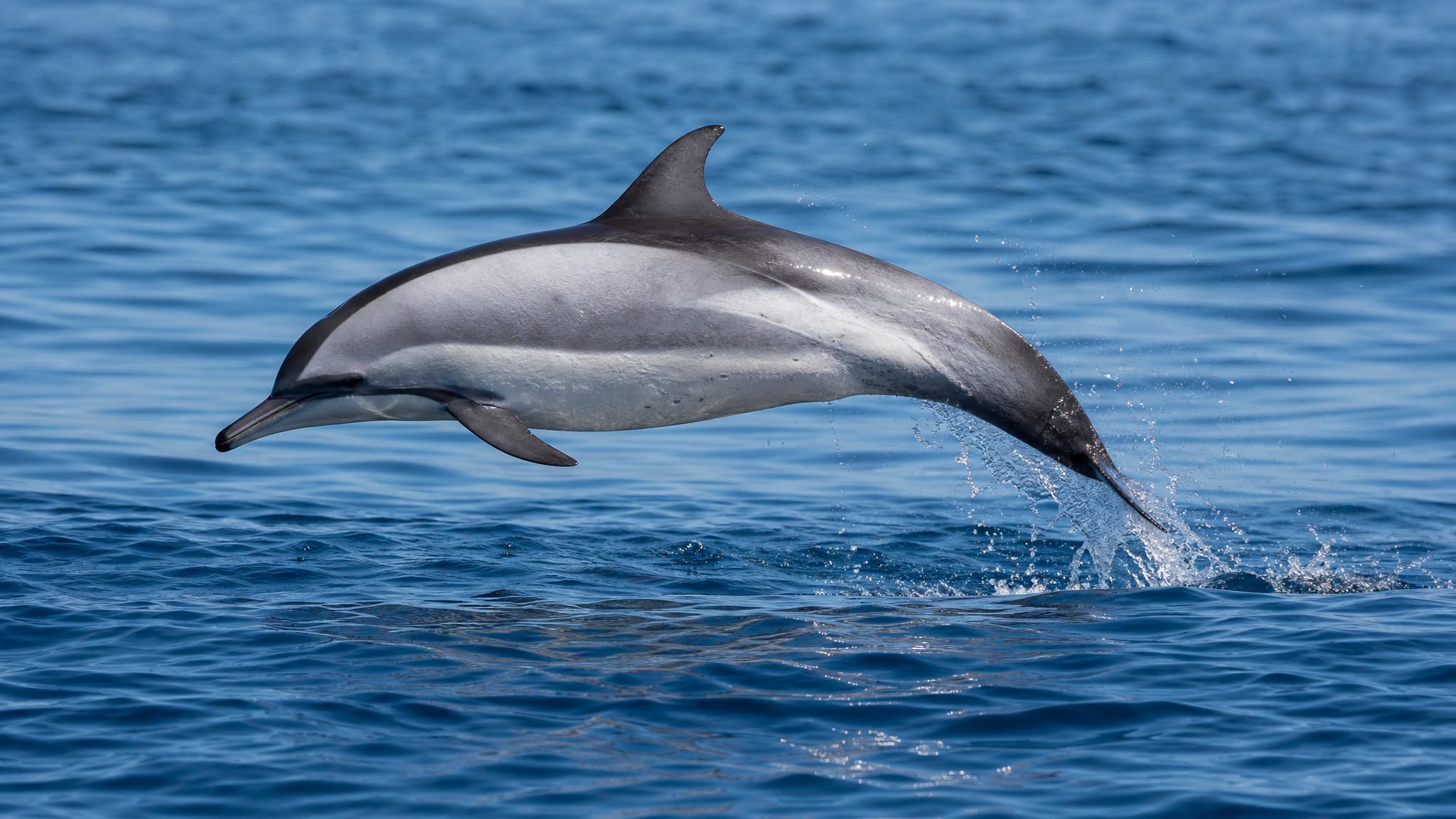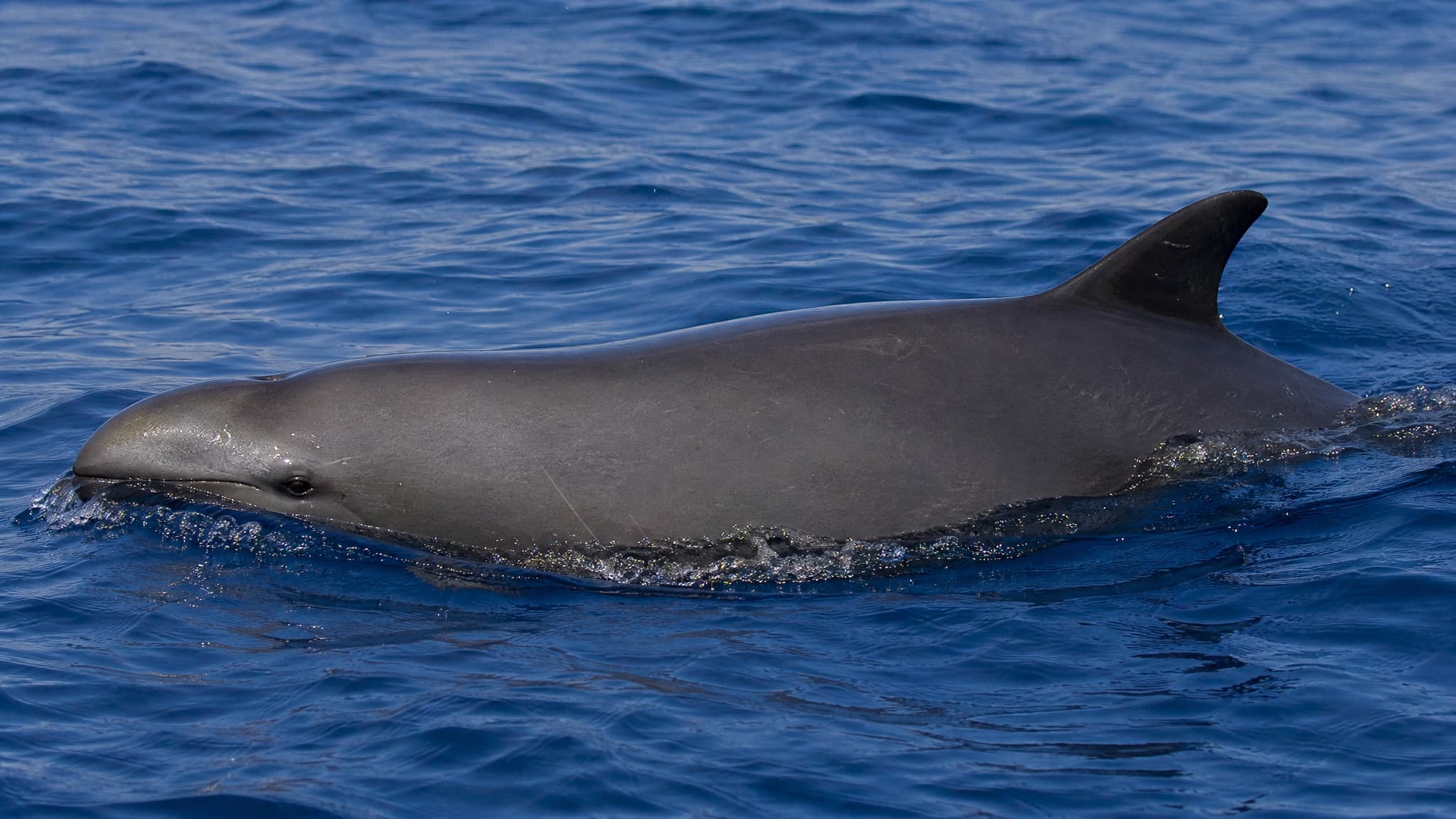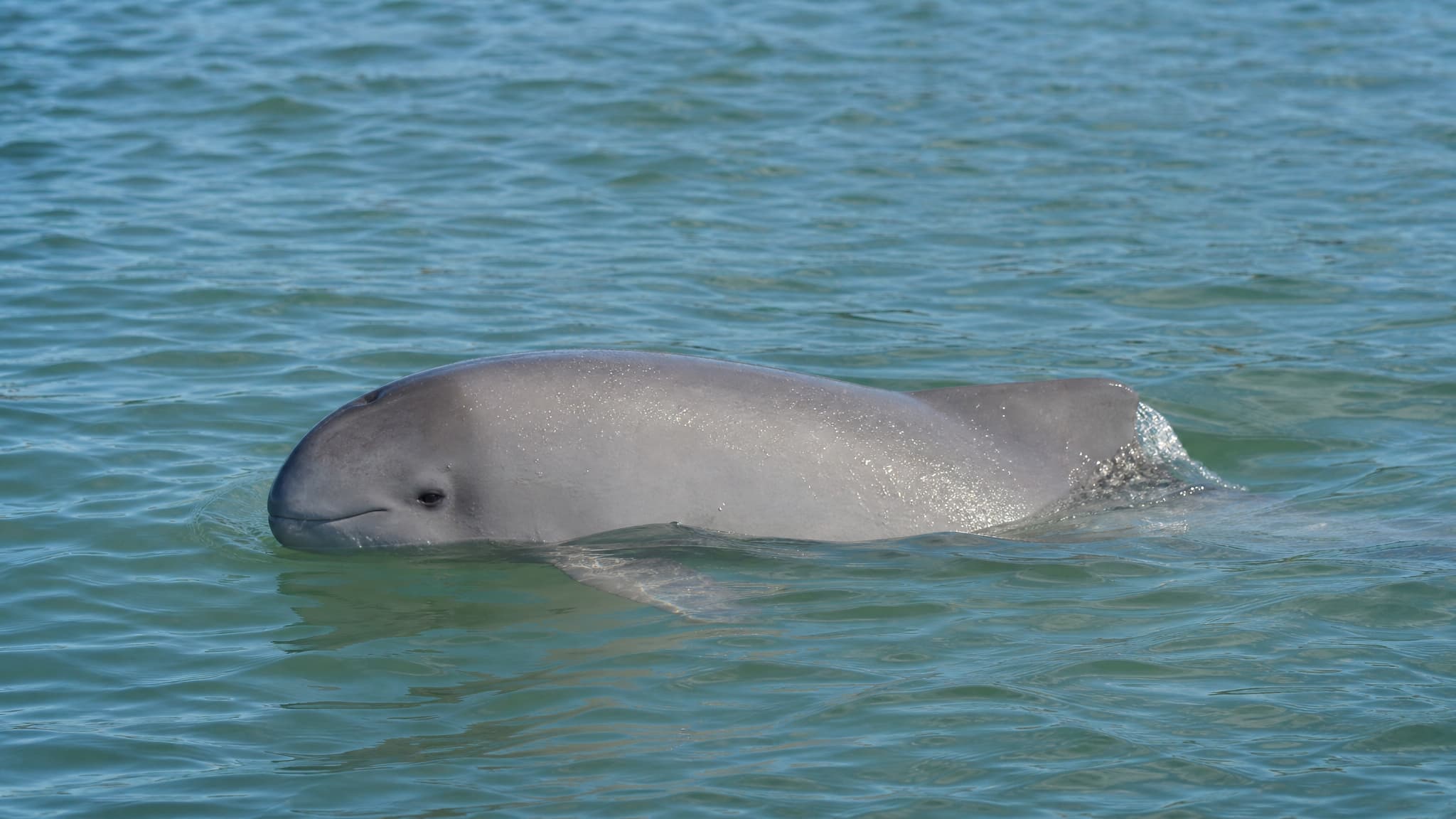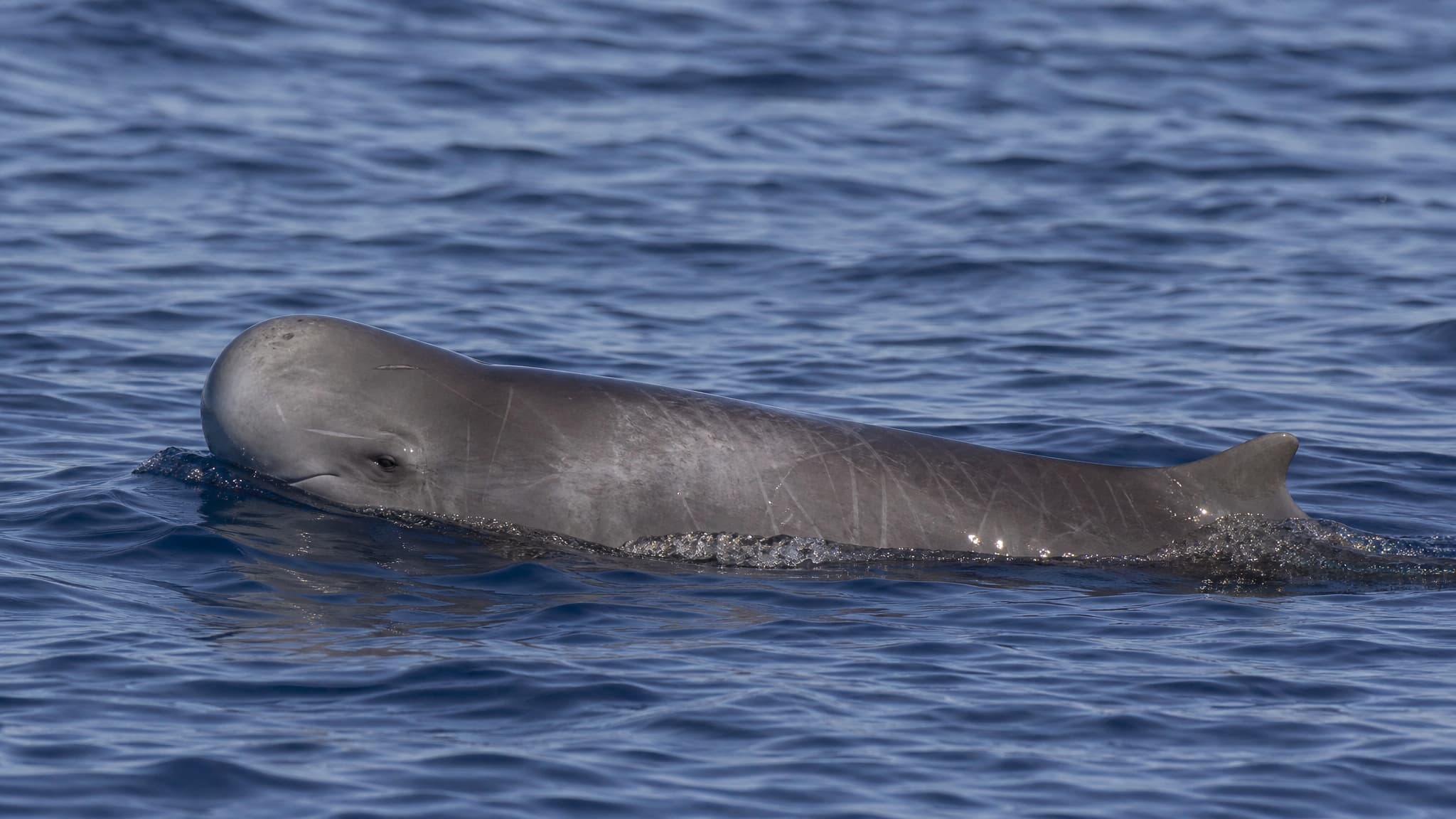
A family herd of African savanna elephants (Loxodonta africana) walks across the golden African grasslands, with adults and calves moving together beneath a dramatic sky in the warm light of sunset.
Wildlife category

Mammals

Warm-blooded vertebrates with hair or fur

Published animals

126

Category

Mammals

Slug

mammals

Animals In This Category

Browse featured species, habitat clues, and discovery paths for the Mammals category.

126 animals found

Honey Possum
Mammals

Honey Possum

Tarsipes rostratus

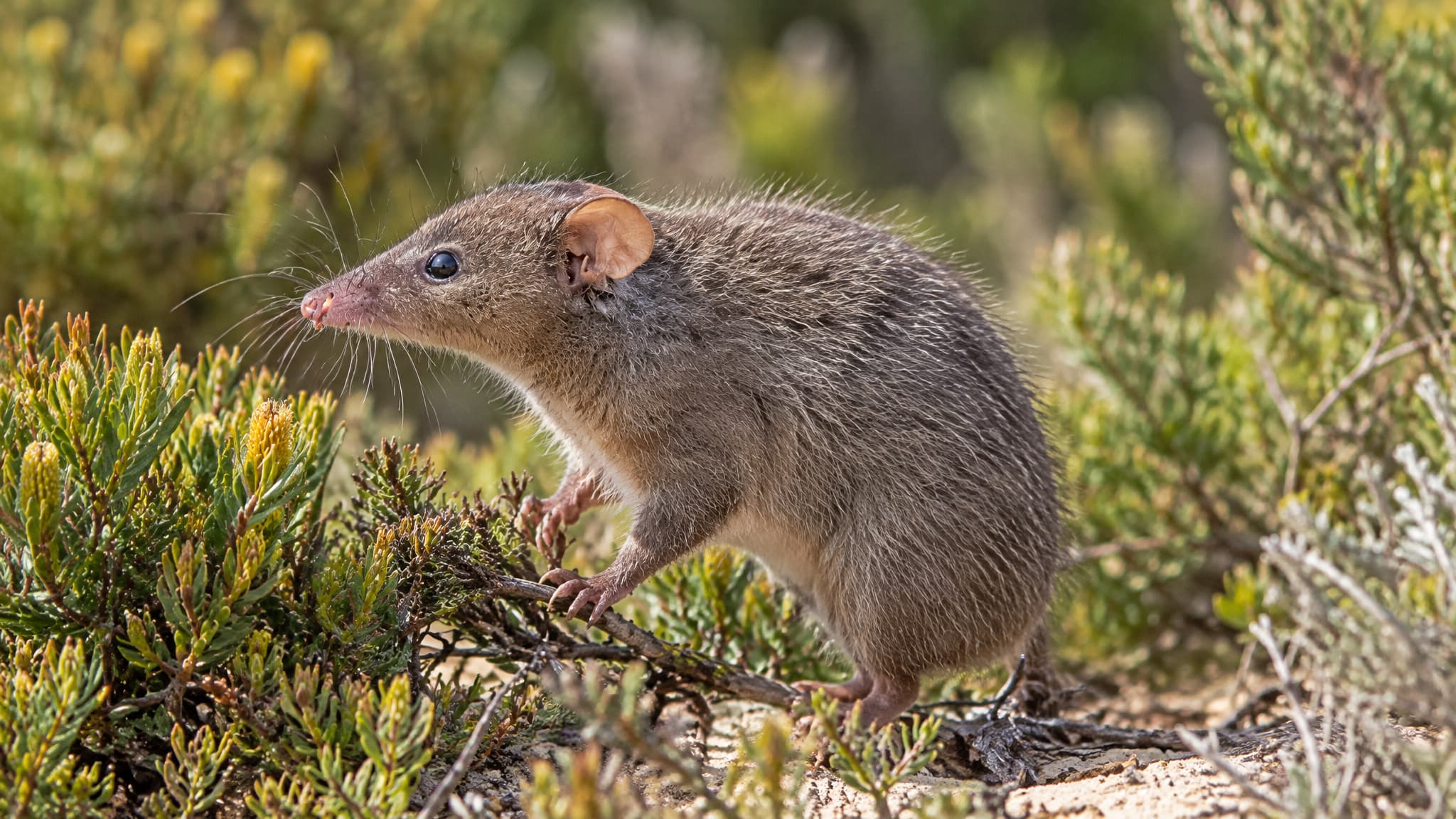
The honey possum or noolbenger (Tarsipes rostratus) is a tiny marsupial from southwestern Australia and the only living member of the family Tarsipedidae. Mouse-sized, it has an exceptionally long, pointed muzzle and a prehensile tail that is longer than its body. Adults measure 65–85 mm from head to rump, with a tail of 70–100 mm. Females are heavier than males: males weigh 7–11 g and females 8–16 g. The fur is grey and brown above and cream below, shading to rufous on the flanks, and three brown stripes run down the back, the central one darkest. The species is endemic to the southwest of Western Australia. It lives in heath, shrubland and woodland, especially on coastal sandplains, and is most common where plants of the protea family are diverse, as in Banksia woodlands. The honey possum feeds almost only on nectar and pollen, and it is the only mammal other than bats that lives wholly on them. It visits flowers of Banksia, Adenanthos, eucalypts and other plants, probing them with a long tongue tipped with brush-like bristles. Its teeth are greatly reduced, the molars shrunk to tiny cones. An individual of about 9 g needs roughly 7 ml of nectar and 1 g of pollen a day. It is mainly nocturnal, climbs nimbly with its feet and tail, and sleeps in tree hollows, rock crevices or old bird nests. In cold weather it can drop into torpor to save energy. Outside the breeding season individuals hold territories of about 1 ha. Breeding can happen at any time of year, depending on how much nectar is available, and females mate with several males. Males produce the longest sperm known in mammals, about 365 µm. After a gestation of about 28 days, a litter of two to four young is born; the newborns are the smallest of any mammal. They stay in the pouch for about 60 days. Embryonic diapause lets a female carry a dormant embryo that resumes growth once the pouch is empty. Honey possums usually live only one to two years. As a pollinator the honey possum is a keystone species of southwestern heathlands. It is an important pollinator of Banksia attenuata, Banksia coccinea and Adenanthos cuneatus, and the principal pollinator of nodding banksia (Banksia nutans). Predators include barn owls, black-shouldered kites, red foxes and feral cats. The IUCN lists it as Least Concern, but it depends on a year-round supply of flowers, so it is threatened by the plant disease Phytophthora cinnamomi, frequent or intense fires and climate change.

View Details
Walrus
Mammals

Walrus

Odobenus rosmarus

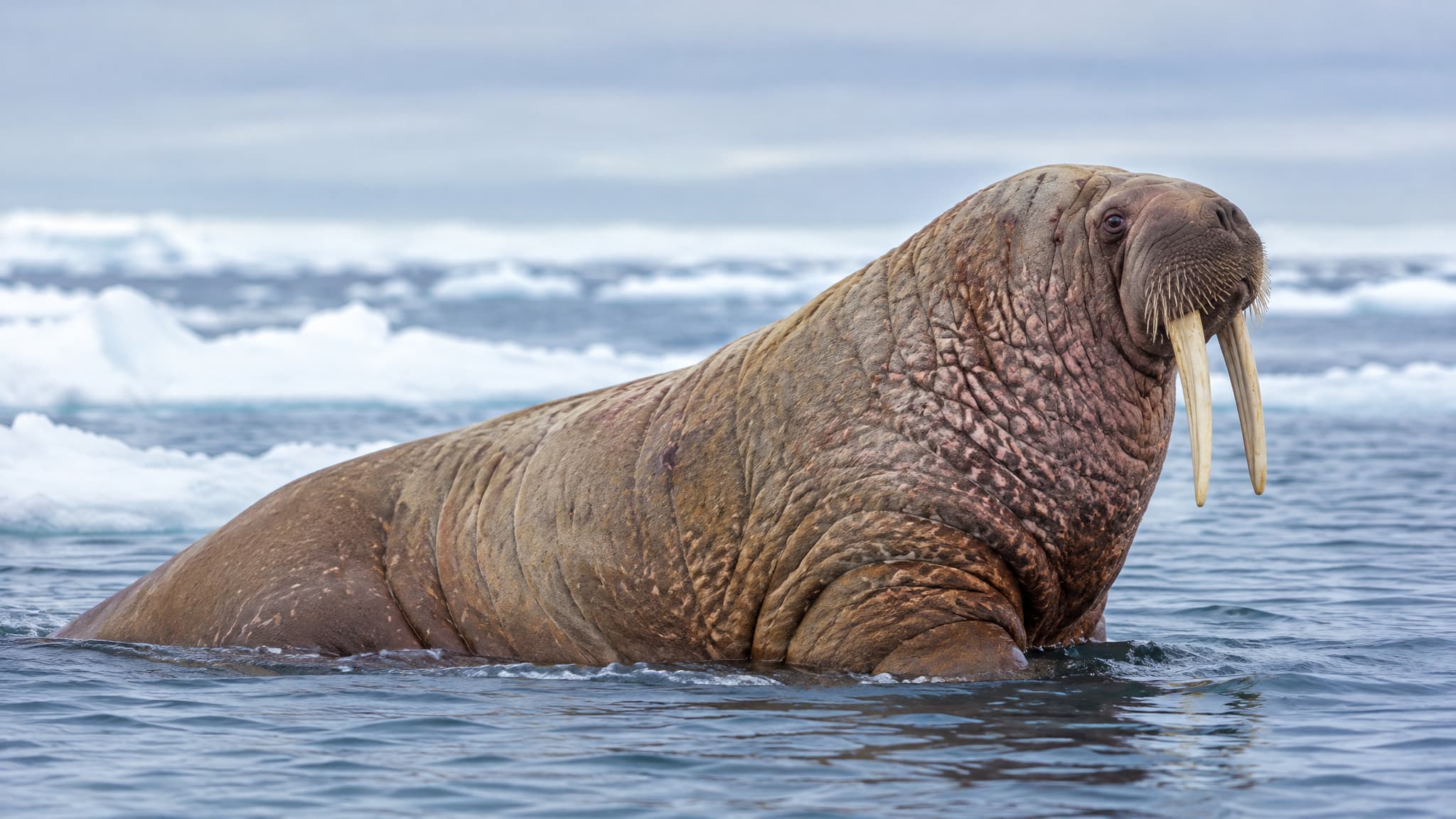
The walrus (Odobenus rosmarus) is a massive, flippered marine mammal of the Arctic, classified in the order Carnivora and the family Odobenidae. Adults measure 2.2 to 3.5 m long. Pacific males can reach 2,000 kg, though most weigh 800 to 1,700 kg, while Pacific females average about 800 kg; Atlantic animals are smaller, with males averaging 900 kg and females 560 kg. Its wrinkled skin is 2 to 4 cm thick, and both sexes carry long ivory tusks that can grow up to 1 m and weigh up to 5.4 kg. The species lives in a discontinuous ring around the North Pole, in the Arctic Ocean and subarctic seas, mostly over shallow continental shelves and often on sea ice. Atlantic walruses (O. r. rosmarus) range from the Canadian Arctic across Greenland and Svalbard to western Arctic Russia, while Pacific walruses (O. r. divergens) spend the summer in the Chukchi and Beaufort Seas and the winter in the Bering Sea. Females tend to stay on the ice, whereas males often haul out on sand or boulder beaches. Walruses are highly social and gather in herds of hundreds or even thousands, with the sexes usually apart outside the breeding season. They feed on the seafloor, sweeping it with their snout and sensitive whiskers and sucking the soft tissue out of shells. More than 60 genera of marine animals have been recorded in their diet, but bivalves, especially clams, are preferred, and benthic invertebrates make up about 97% of the Pacific walrus diet. Dives usually last 5 to 20 minutes, and seals and seabirds are taken only occasionally. The tusks serve in fights, dominance and display, and can break through ice up to 20 cm thick. Breeding takes place from January to March, peaking in February. Gestation lasts 15 to 16 months, including 3 to 4 months of delayed implantation, and the single calf, weighing 45 to 75 kg, is born between April and June. Nursing lasts more than a year, and young may stay with their mothers for up to five years. Females give birth at most every two years, the lowest reproductive rate of any pinniped. Males mature at about 7 years but usually do not mate until around 15. Wild walruses live about 20 to 30 years; a captive individual reached 49. As heavy consumers of seafloor invertebrates, walruses are regarded as a keystone species of the Arctic marine region, and they are hunted by only two natural predators, orcas and polar bears, which mostly target calves. Commercial hunting in the 18th and 19th centuries nearly wiped out the Atlantic subspecies. The IUCN lists the walrus as Vulnerable, with about 112,500 mature individuals estimated in 2018. Today the main threat is the loss of sea ice due to climate change, which reduces resting areas, stresses calves and has been linked to deadly stampedes on crowded Chukchi Sea beaches.

View Details
Naked mole-rat
Mammals

Naked mole-rat

Heterocephalus glaber

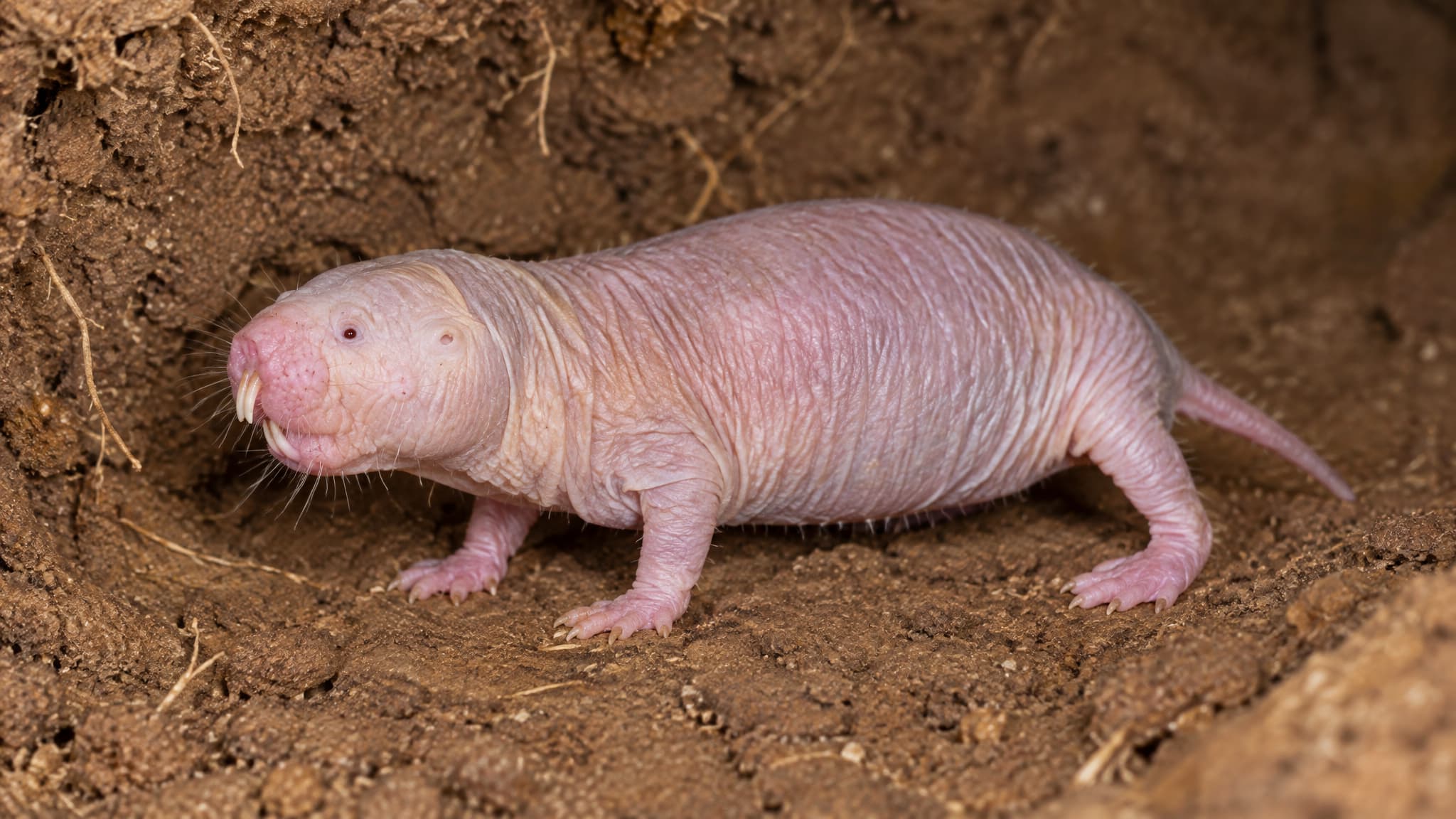
The naked mole-rat (Heterocephalus glaber) is a small burrowing rodent of the Horn of Africa and the only living member of its genus. Most individuals measure 8–10 cm and weigh 30–35 g, though breeding females often exceed 50 g and the heaviest recorded animal reached 80 g. Its pink to brownish skin is almost hairless and loosely wrinkled, the eyes are tiny, and it relies on touch, hearing and vibration. Four large incisors are its main digging tools: about a quarter of its muscle mass serves to close the jaws, and nearly a third of its somatosensory cortex is devoted to these teeth. The species lives in the drier tropical grasslands and semi-arid savannas of Djibouti, Ethiopia, Kenya and Somalia, spending its whole life underground. Colonies dig tunnel systems that can add up to 3–5 km in length and reach about 2 m deep. The animals dig cooperatively in an assembly line, and they are most exposed to predators when pushing loose soil out onto the surface. Naked mole-rats are herbivores that feed mainly on roots, bulbs and large tubers found while tunnelling; a single big tuber can feed a colony for months or even years. They do not drink, taking all their water from food, and they eat their own droppings to extract more nutrients from fibrous plant matter. Unlike most mammals, they cannot keep a steady body temperature, which rises and falls with the burrow around them. The species is one of the few eusocial mammals. A colony averages 75–80 individuals and can exceed 300, but only one queen and one to three males breed; the rest are workers that dig, forage, care for pups and defend the burrow. Gestation lasts about 70 days, and a litter averages about 12 pups weighing roughly 2 g each, with up to about 30 recorded. Lifespans of more than 37 years are known, the longest of any rodent. Its physiology has made it a model animal for research. Naked mole-rats are highly resistant to cancer, feel no pain from acid on the skin and tolerate very low oxygen: they survive at least 5 hours in air with 5% oxygen and about 18 minutes with none at all. By digging, the species turns over and aerates the soil, and it is prey for snakes such as the rufous beaked snake (Rhamphiophis oxyrhynchus), honey badgers and birds of prey. It is assessed as Least Concern: it is widespread and numerous, with no major threats, although sweet potato farmers often treat it as a pest.

View Details
Fennec fox
Mammals

Fennec fox

Vulpes zerda

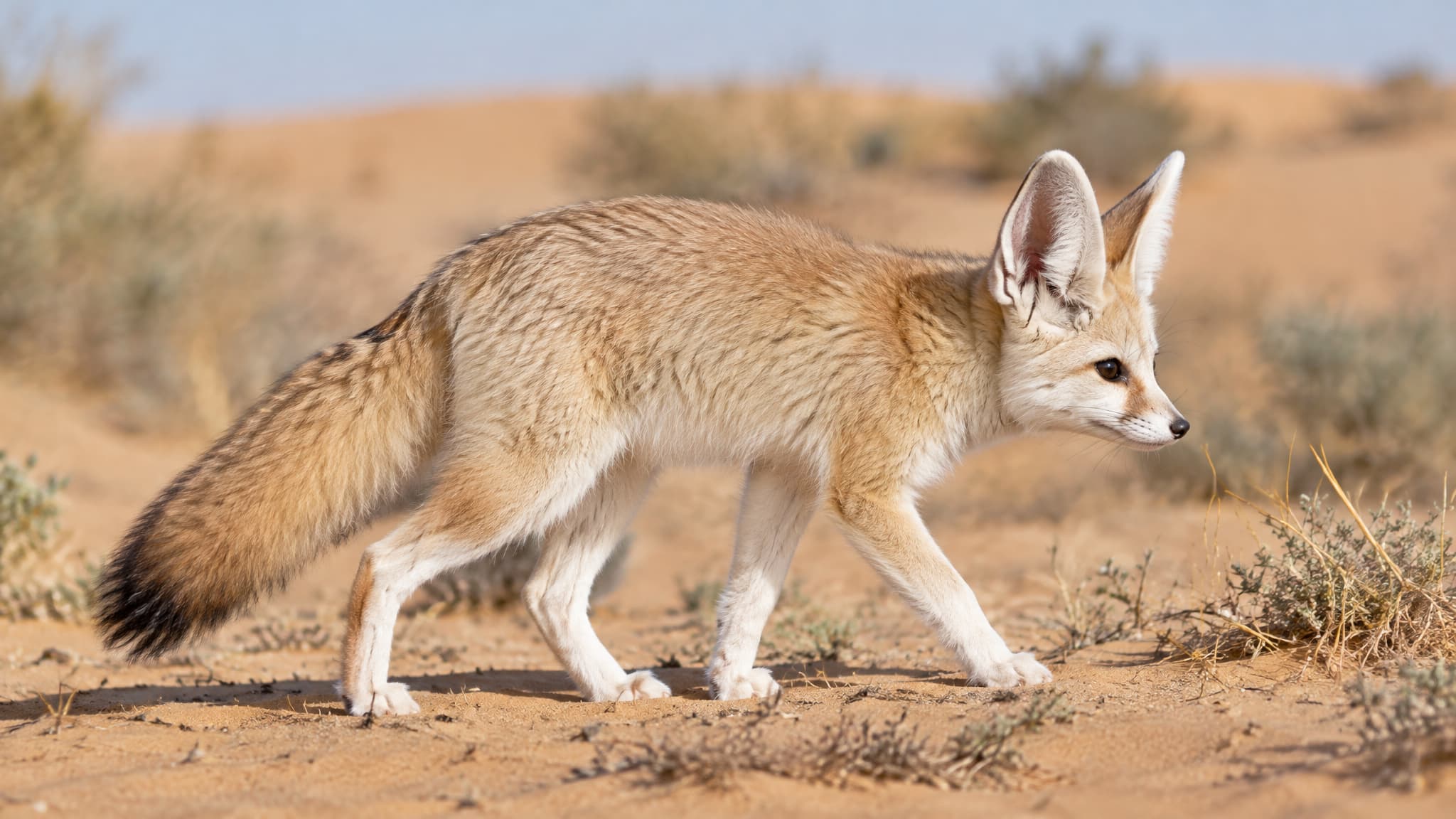
The fennec fox (Vulpes zerda) is the smallest species of the dog family, Canidae. It has a head-and-body length of 30–40 cm, a bushy tail of 18–30 cm and a weight of about 0.8–1.5 kg. Its most striking feature is a pair of enormous ears, up to about 15 cm long, which help it hear prey moving under the sand and shed body heat. The thick, sand-coloured coat camouflages it against the dunes. First described as Canis zerda in 1780, it was long placed in its own genus, Fennecus, but molecular studies place it in Vulpes, close to Blanford's fox. The fennec lives across the Sahara, from Morocco, Western Sahara and Mauritania east to northern Sudan, Egypt and the Sinai Peninsula, with records reaching Kuwait. It favours small sand dunes and open sandy ground with sparse grasses, sedges and shrubs, in areas where yearly rainfall is under 100 mm in the north and about 300 mm in the south. It is mainly nocturnal and spends the hot day in burrows. In compact soil a den can cover up to 120 m² and have up to 15 entrances, while dens in loose sand are simple. Fennecs live in family groups of up to 10 animals and mark territories with urine and feces. They are omnivores: they dig for small rodents, lizards, insects, small birds and eggs, and also eat fruit, leaves, roots and tubers. Moisture from food lets them go without free water for long periods, and they cache surplus food. When overheated, a fennec can raise its breathing rate from 23 to 690 breaths per minute. Pairs are monogamous. Mating takes place from January to April, and gestation usually lasts 50–52 days. One litter of 1–4 pups is born per year, between March and June. The pups open their eyes after 8–11 days, are weaned at 61–70 days and reach sexual maturity at about 9 months. Fennecs live about 10 years in the wild and up to 14 years in captivity. In desert ecosystems, the fennec is a predator of small mammals, birds, reptiles and insects. The IUCN Red List classifies it as Least Concern (2015 assessment), and it is listed in CITES Appendix II. Its main threats are trapping for exhibition or sale to tourists, especially in North Africa, and habitat loss from settlements, roads, mining and oil fields. It is legally protected in Morocco, Algeria, Tunisia and Egypt.

View Details
African wild dog
Mammals

African wild dog

Lycaon pictus

The African wild dog (Lycaon pictus), also promoted as the painted wolf, is a lean, long-legged canid and the only living member of its genus. Adults measure 75–110 cm in head-and-body length, with a tail of 30–40 cm, stand 60–75 cm at the shoulder and weigh 18–36 kg. Its coat is a patchwork of brown, black, yellow and white that is unique to each animal, and the tail usually ends in a white tip. Very large ears and only four toes on each foot set it apart from other dogs. The species once ranged across most of sub-Saharan Africa outside deserts and dense forest, but it now survives in scattered populations, mainly in southern and eastern Africa. It favours savannas, grasslands, open woodland and arid zones, and it also uses scrub and mountains; one population even lives in Ethiopia's Harenna Forest at up to 2,400 m. Packs roam widely, with home ranges of 200–2,000 km². Wild dogs are specialised pack hunters of medium-sized antelopes, such as impala, Thomson's gazelle, kob and springbok, and they also take smaller animals such as duikers and hares. They hunt mostly by sight in the early morning and evening, running prey down in chases that can cover several kilometres. Packs are very effective: often more than 60% of chases end in a kill. Pack members share food by regurgitating it for pups and for sick or injured companions. A pack is usually led by a dominant breeding pair, which is normally the only pair to breed. Pups are born after a gestation of about ten weeks, in litters of 2 to 20, usually in an old aardvark burrow. The whole pack helps feed and guard them. Young females later leave to join other packs, while many young males stay with the pack they were born into. Wild dogs live about 10 to 11 years in the wild. The African wild dog shares its range with larger predators: spotted hyenas often follow packs and steal their kills, and lions are a major cause of death for adults and pups. The IUCN lists the species as Endangered, with an estimated 6,600 adults, including 1,400 mature individuals, in 39 subpopulations. Its main threats are habitat loss and fragmentation, conflict with people because packs sometimes kill livestock, and infectious diseases spread by domestic animals.

View Details
Fossa
Mammals

Fossa

Cryptoprocta ferox

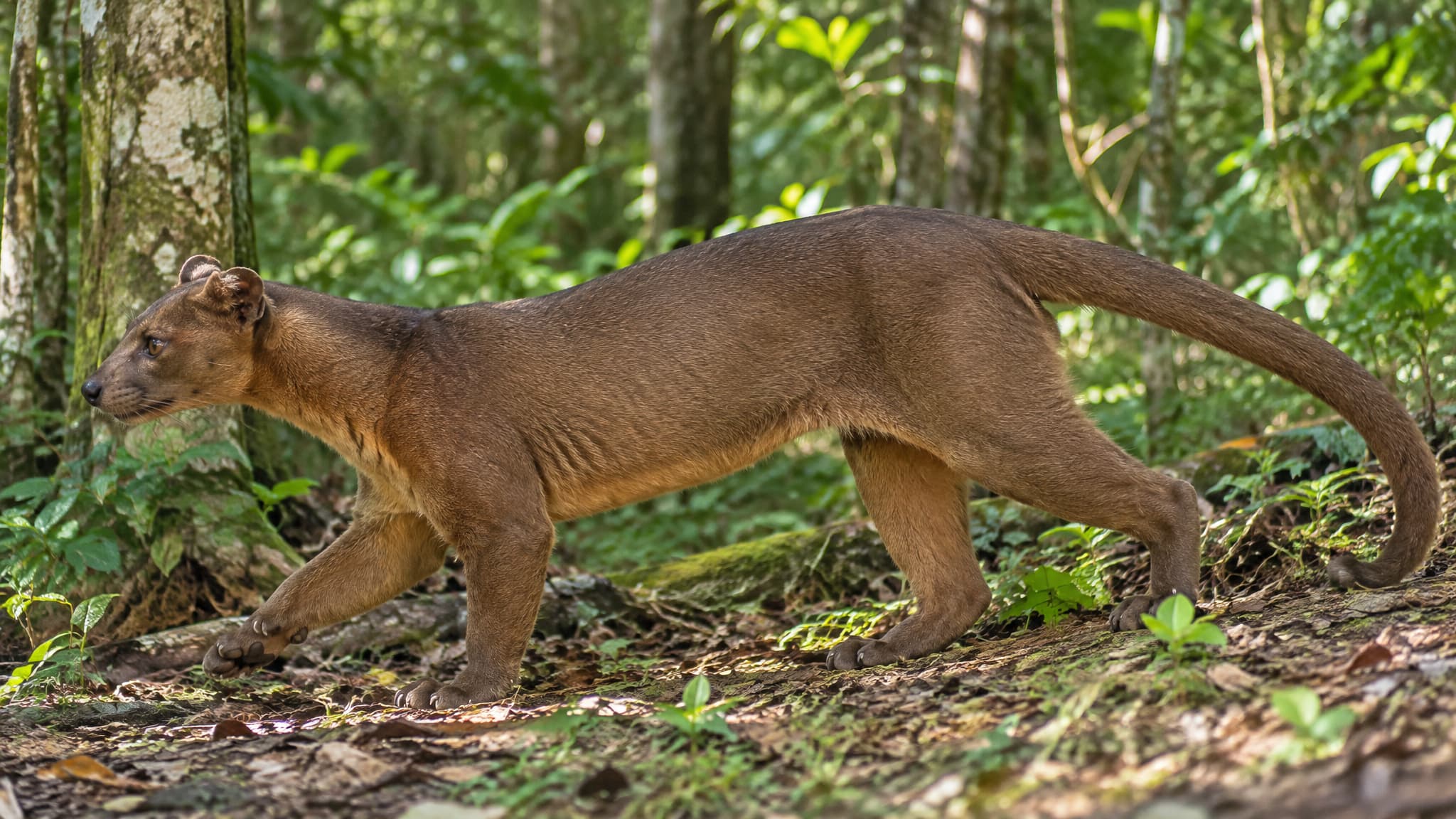
The fossa (Cryptoprocta ferox) is the largest native carnivore of Madagascar and the best-known member of the Eupleridae, the family of carnivorans found only on that island. It looks like a cross between a small cougar and a mongoose: a slender, muscular body, a short rounded head with large forward-facing eyes, rounded ears and a very long tail. The short, dense coat is usually reddish brown, and some individuals are dark. Adults measure 70–80 cm from head to rump, with a tail of 65–70 cm. Males weigh 6.2–8.6 kg and females 5.5–6.8 kg. The species lives only in Madagascar, where it has the widest range of any of the island's carnivores. It occurs in nearly every type of forest, from coastal lowlands up to about 2,000 m, and is found more often in humid forest than in dry forest. It avoids heavily disturbed land and the central high plateau. The fossa is an expert climber. Retractable claws, very flexible ankles that let it run down trunks headfirst and a long balancing tail let it chase prey through the canopy. Lemurs make up more than half of its diet, and it is the only predator able to kill the largest lemur species. It also takes tenrecs, rodents, lizards, birds and other small vertebrates. It is mostly solitary and active by day and by night. In Kirindy Forest, home ranges reached 26 km² for males and 13 km² for females, and individuals mark them with scent. Mating takes place mainly in September and October. Mating happens high in trees: a female may occupy the same tree for up to a week and mate with several males in turn, and a single mating can last nearly three hours. After a gestation of about 90 days she gives birth in a den to usually two to four young, sometimes up to six. The newborns weigh about 100 g and are blind and toothless. They are weaned at around 4.5 months, become independent after about a year and reach sexual maturity at three to four years. Fossas have lived up to 20 years in zoos; their lifespan in the wild is unknown. As Madagascar's top mammalian predator, the fossa helps shape populations of lemurs and other small animals. The IUCN lists it as Vulnerable. The main threat is the loss and fragmentation of its forests, and it is also hunted for bushmeat and killed in retaliation for raids on chicken coops. It is listed in CITES Appendix II.

View Details
Honey badger
Mammals

Honey badger

Mellivora capensis

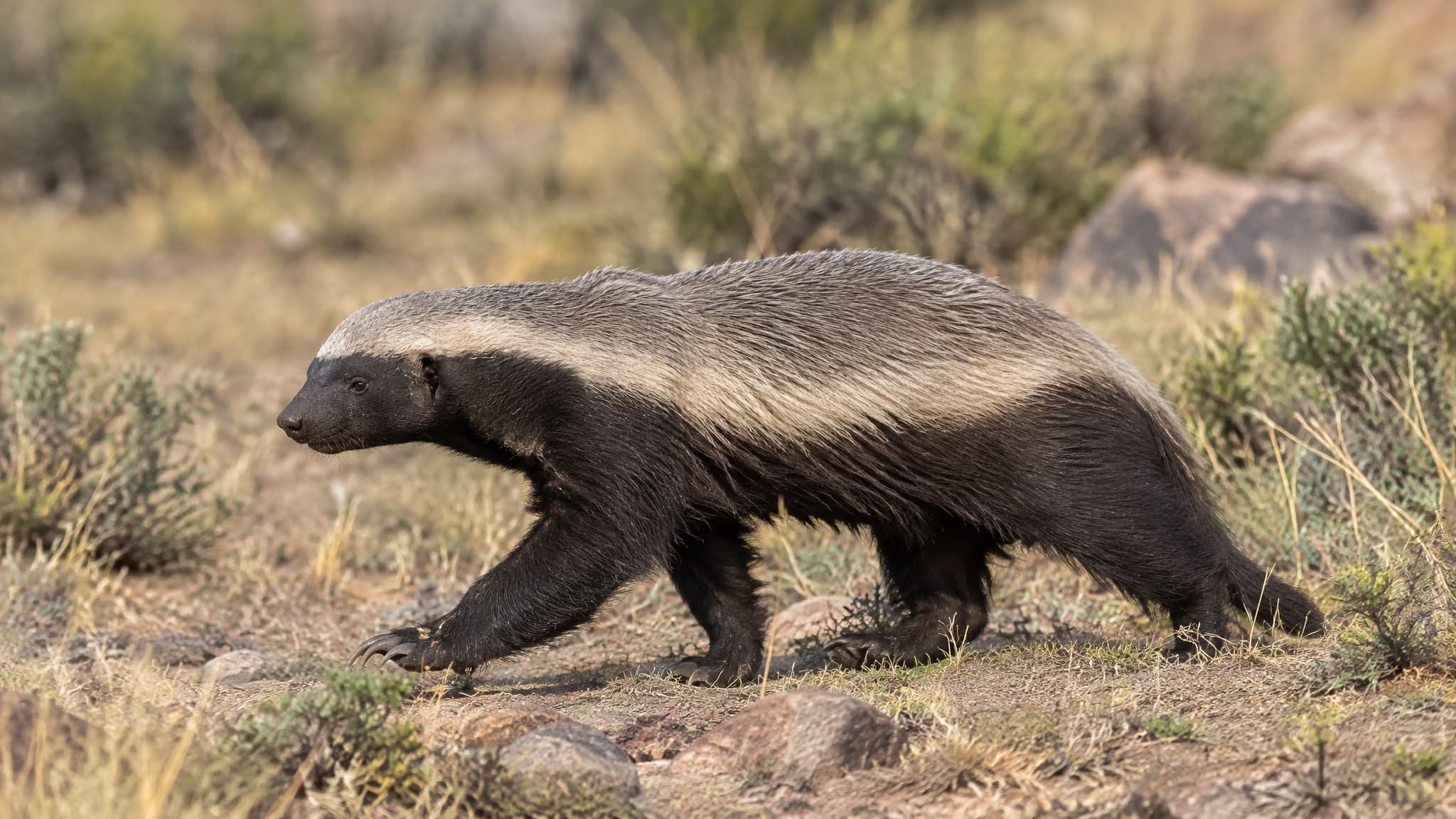
The honey badger, or ratel, is a stocky, low-slung member of the weasel family and the only living species of its genus, Mellivora. Adults measure 55 to 77 cm from head to rump, with a tail of 12 to 30 cm, and stand 23 to 28 cm at the shoulder. In Africa, males weigh 9 to 16 kg and females 5 to 10 kg. The coat is boldly two-toned: the lower body and legs are black, while a broad grey or white mantle runs from the crown down the back. Its small eyes, broad skull and thick, loose skin give it a tough look, and older males are often covered in scars. The species ranges across most of sub-Saharan Africa, north to southern Morocco and southwestern Algeria, and through the Arabian Peninsula, Iran and Western Asia to Turkmenistan and the Indian subcontinent. It lives in deserts, steppes, grasslands, woodlands, forests and rocky hills, from sea level up to about 4,000 m in the Bale Mountains of Ethiopia. It needs burrows or rock crevices for shelter. Honey badgers are opportunistic hunters with one of the least specialised diets in their family. They dig out rodents, lizards, snakes, frogs, insects and scorpions, take birds, eggs and tortoises, eat carrion, and add berries, roots and bulbs. They are famous for breaking into beehives to eat the larvae and honey. Mostly solitary and nomadic, they forage over long distances; in the Kalahari, males have home ranges of about 548 km² and females about 138 km². When threatened they charge fearlessly and release a foul-smelling secretion. Breeding has no fixed season. After a gestation of 50 to 70 days, the female gives birth to one or two cubs and raises them alone. The young are weaned at 2 to 3 months but stay with their mother for a year or more. Females mature at about 1 year and males at 2 to 3 years. Wild honey badgers typically live 7 to 8 years, and captive animals have reached about 24 to 26 years. By preying on rodents and insects, the honey badger helps keep their numbers in check, while lions, leopards and spotted hyenas occasionally prey on it. The IUCN lists it as Least Concern, but numbers are thought to be declining in places. The main threats are trapping and poisoning by beekeepers and livestock farmers, hunting for traditional medicine and bushmeat, and accidental deaths in predator control programmes.

View Details
Indian Rhinoceros
Mammals

Indian Rhinoceros

Rhinoceros unicornis

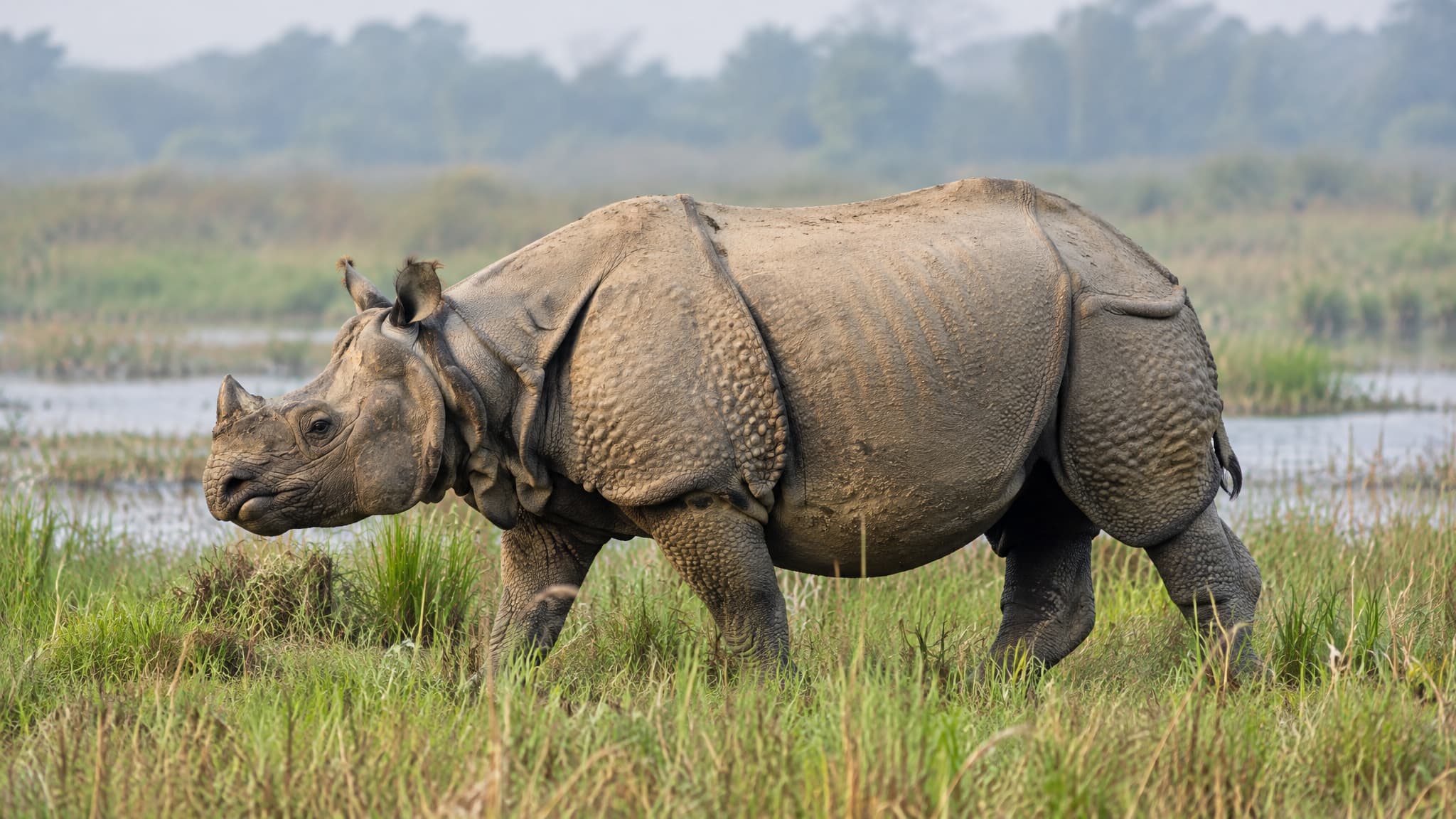
The Indian rhinoceros, also called the greater one-horned rhinoceros, is one of the largest land mammals alive. Its thick grey-brown skin forms deep folds over the shoulders, rump and legs and is studded with rivet-like bumps, giving it an armour-plated look. Adult males measure 3.7 to 3.8 m in head-body length, stand 1.70 to 1.86 m at the shoulder and average about 2,200 kg, while females are 3.1 to 3.4 m long and average about 1,600 kg. Both sexes carry a single horn of keratin on the snout, usually about 25 cm long, and a prehensile upper lip that grasps tall grass. The species once ranged across the northern Indian subcontinent from Pakistan to Bangladesh. Today it survives in 12 protected areas in northern and northeastern India and southern Nepal, mainly in the alluvial grasslands of the Terai and the Brahmaputra basin. It favours floodplains near large rivers, tall grass, reed beds, swamps and wooded meadows. This rhino is a grazer that needs about 150 to 200 kg of food a day. Grasses dominate its diet, supplemented by leaves, twigs, shrubs, flowers, fruit, aquatic plants and crops such as rice. It is mostly solitary, apart from mothers with calves, and feeds in the early morning, late afternoon and at night, resting in the heat of the day. Long wallows in mud and water cool it and protect its skin from sun and biting flies. Communal dung heaps and urine spraying mark its paths. It swims well and can charge at up to 55 km/h over short distances. Breeding happens all year round. After a gestation of about 16 months, the female gives birth to a single calf weighing 40 to 81 kg, which is weaned at 12 to 18 months. Females mature at 4 to 5 years and males at 7 to 8 years. Wild rhinos live 30 to 40 years, and animals in human care have reached 47 years. By grazing grasses, shrubs and young trees, the Indian rhino helps shape the vegetation of its floodplains. Common mynas and cattle egrets pick parasites from its skin folds, and Bengal tigers occasionally kill calves up to six months old. The IUCN lists the species as Vulnerable, and it is on CITES Appendix I. Fewer than 200 remained around 1900, but strict protection raised the count to 4,075 by March 2025, with 3,323 in India and 752 in Nepal. Poaching for horn, habitat loss and flooding remain threats, and with over 70% of all rhinos in Kaziranga National Park, a single disaster or disease outbreak could hit the species hard.

View Details
Short-beaked Echidna
Mammals

Short-beaked Echidna

Tachyglossus aculeatus

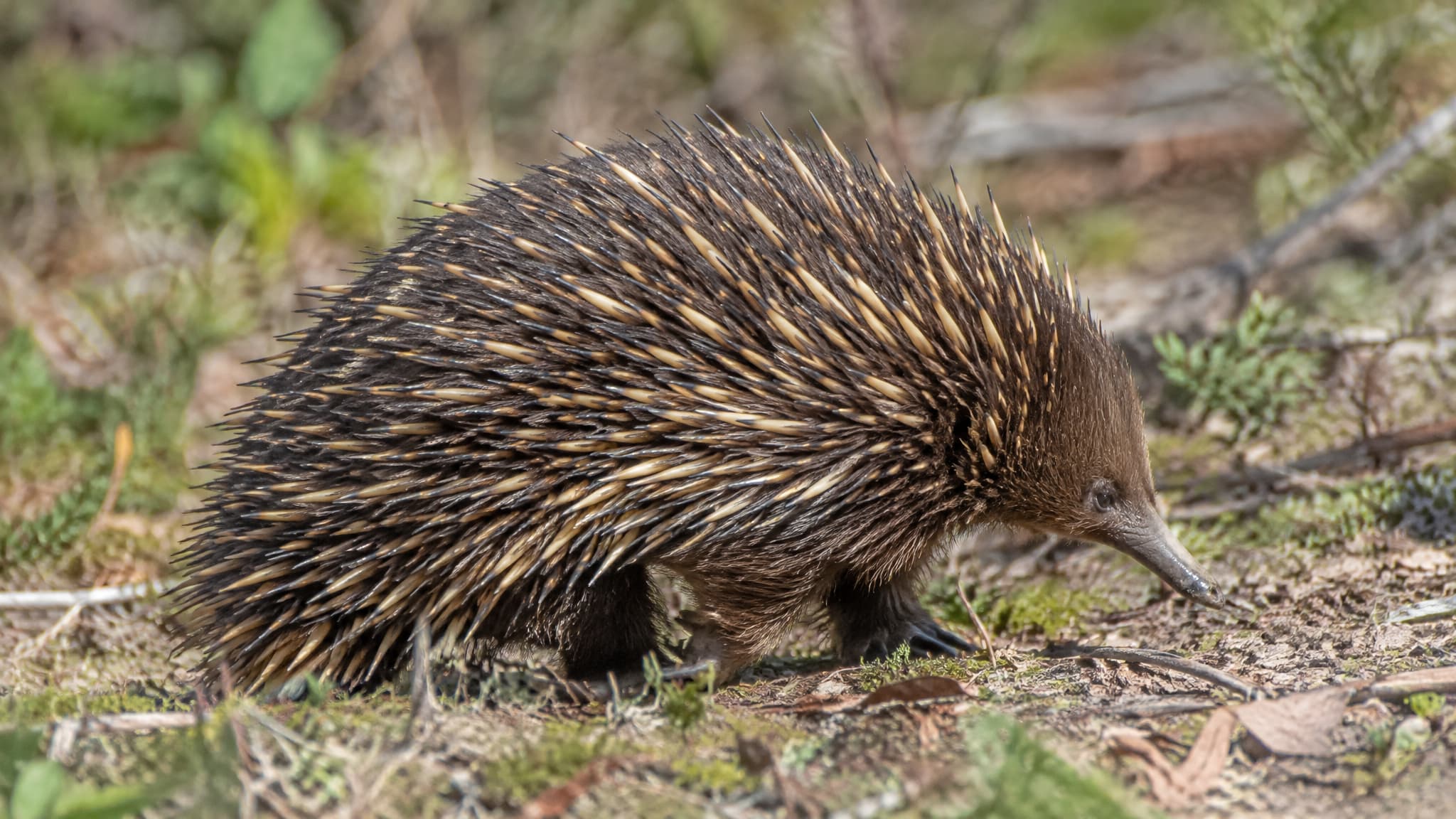
The short-beaked echidna is one of the few living monotremes, the egg-laying mammals. Adults usually measure 30 to 45 cm long and weigh 2 to 7 kg. Sharp spines cover the back and the stubby tail, mixed with fur that in the Tasmanian subspecies can be longer than the spines. It has a tubular snout, a long sticky tongue, no teeth and no external ears, and strong front claws built for digging. Males carry a non-venomous spur on each hind ankle, and females develop a pouch. It is the most widespread native mammal in Australia, found across the mainland, Tasmania and offshore islands such as Kangaroo Island, and it also lives in coastal and highland areas of eastern and southern New Guinea. It uses an unusually wide range of habitats, from forests rich in fallen, termite-filled logs to open woodland, savanna, grassland, arid country, farmland scrub and even outer suburbs. The echidna feeds mainly on ants and termites, and also takes beetle larvae and other invertebrates. It finds prey by smell and by electroreception in its snout, then breaks into nests and logs with its claws and laps up the insects with its tongue. Mostly solitary, it has overlapping home ranges rather than defended territories. In cold months it can enter torpor or hibernation, letting its already low body temperature fall sharply. When threatened it curls into a ball or digs in until only its spines show. During the breeding season several males may follow a single female in a line known as an echidna train. The female lays one soft-shelled egg directly into her pouch, where it hatches after about 10 days. The tiny hatchling, called a puggle, drinks milk secreted through pores, as monotremes have no nipples. It leaves the pouch at about two to three months, when its spines grow, and is weaned at about six months after being left in a nursery burrow. Echidnas live about 10 years on average in the wild, with records of around 40 years, and about 50 years in captivity. By digging foraging pits, echidnas turn and aerate the soil, trap leaf litter and help cycle nutrients, which is especially important in semi-arid landscapes. Their predators include dingoes, goannas, feral cats, red foxes and birds of prey, and most victims are young animals. The species is listed as Least Concern by the IUCN. In Australia, the main threats are road traffic and habitat destruction, while hunting has reduced numbers in parts of New Guinea.

View Details
Saiga
Mammals

Saiga

Saiga tatarica

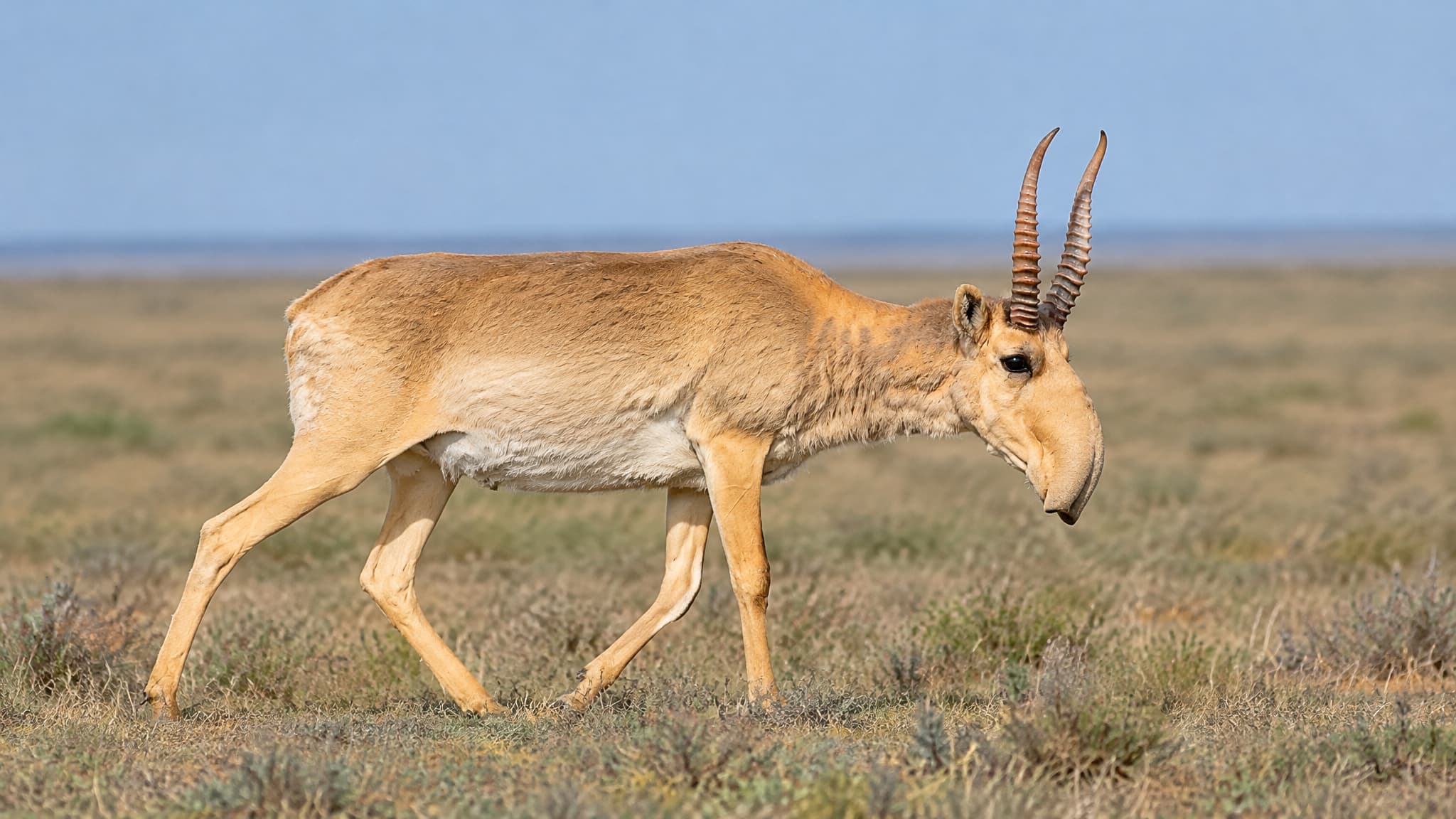
The saiga is a medium-sized antelope of the Eurasian steppes, instantly recognisable by its swollen, drooping nose with closely spaced, downward-pointing nostrils. Adults measure 100 to 140 cm from head to rump, stand 61 to 81 cm at the shoulder and weigh 26 to 69 kg. Only males carry horns: waxy, pale and ringed with 12 to 20 ridges, reaching 28 to 38 cm in the western form. The summer coat is short and yellowish red with a paler belly; in winter it grows thick, long and dull grey. Kazakhstan holds about 99% of the world's saigas, in populations on the Ustyurt Plateau, in Betpak-Dala and along the Ural River. Smaller groups live in Kalmykia and Astrakhan in Russia and in western Mongolia, and Ustyurt herds winter in Uzbekistan. The species prefers flat, open dry steppe and semi-desert and avoids hills and rugged ground. It has disappeared from Romania, Ukraine, Moldova and China. Saigas are grazers that feed on more than 100 plant species, mainly grasses, forbs, saltworts, sagebrush, prostrate summer cypress and steppe lichens, including some plants that are poisonous to other animals. They travel long distances between seasonal ranges, swim across rivers and move to escape snowstorms and droughts. Outside the rut they gather in herds of 30 to 40, grazing by day and resting at night in shallow scraped beds. The rut runs from late November to late December. Males defend harems of 5 to 10 females and fight hard, and in some years male mortality reaches 80 to 90%. After a gestation of about 4.6 to 5.1 months, females gather in large groups in spring to give birth, usually to twins. Calves begin grazing at 4 to 8 days old and are weaned at 2.5 to 4 months. Females can breed at 7 to 8 months, males at about 2 years. Average lifespan in the wild is about 10 to 12 years. As abundant grazers, saigas shape steppe vegetation and are prey for wolves, while foxes, eagles and ravens take calves. The species is listed as Near Threatened by the IUCN. Hunting for meat and for horn used in traditional Chinese medicine cut the Kazakh population to about 21,000 animals in 2003. In May 2015 more than 120,000 saigas died within weeks from infection by the bacterium Pasteurella multocida. Strict protection then allowed a dramatic recovery, with an estimated 3.9 million adults counted in Kazakhstan in spring 2025.

View Details
Sea otter
Mammals

Sea otter

Enhydra lutris

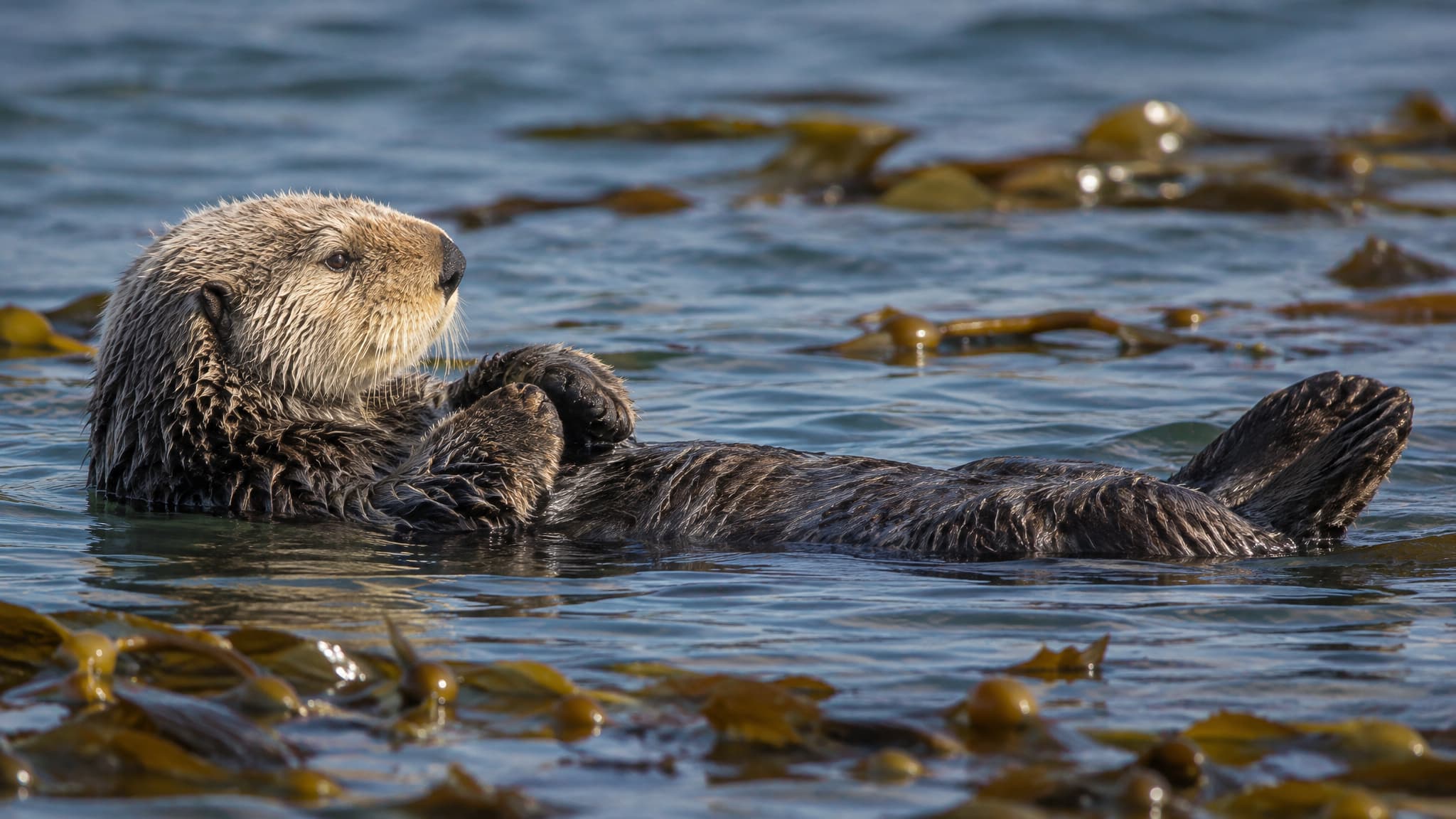
The sea otter is the heaviest member of the weasel family and one of the smallest marine mammals. Males usually weigh 22 to 45 kg and measure 1.2 to 1.5 m, while females weigh 14 to 33 kg and measure 1.0 to 1.4 m. Unlike seals and whales it has no insulating blubber. Instead it relies on a brown to reddish-brown coat with up to 150,000 hairs per square centimetre, the densest fur of any animal, which it grooms constantly to keep air trapped against the skin. The species lives along the coasts of the northern and eastern North Pacific, from the Kuril and Commander Islands across the Aleutians and Alaska to British Columbia, Washington and central California. Three subspecies are recognized: the Asian, northern and southern sea otters. It favours shallow coastal waters about 15 to 23 m deep, usually within 1 km of shore, often among giant kelp forests, and it can dive to at least 45 m. Sea otters feed mainly on marine invertebrates such as sea urchins, clams, mussels, crabs and other crustaceans, and also take some fish; more than 100 prey species are known. They eat at least 20 percent of their body weight each day, finding prey with sensitive whiskers and carrying it in loose skin pouches under the forelimbs. Floating on its back, an otter will crack hard shells against a rock held on its chest, making it one of the few tool-using mammals. Foraging dives usually last 50 to 90 seconds. At rest, otters gather in groups called rafts and sleep afloat, often wrapped in kelp so they do not drift away. Breeding takes place throughout the year. Delayed implantation stretches gestation to 4 to 12 months, and the female normally gives birth to a single pup weighing 1.4 to 2.3 kg; twins occur in about 2 percent of births, but usually only one survives. The mother alone raises the pup, which is weaned at about 6 months. Females mature at 4 to 5 years and males at 5 to 8 years. Wild males usually live 10 to 15 years and females 15 to 20 years, with a known maximum of 23 years in the wild. The sea otter is a classic keystone species. By eating sea urchins it keeps them from overgrazing kelp, and where otters disappear the forests can collapse into urchin barrens, taking much of the coastal biodiversity with them. Hunting for the fur trade from 1741 to 1911 cut a population once estimated at 150,000 to 300,000 down to only 1,000 to 2,000 animals. The international treaty of 1911 ended commercial hunting, and the species has since recovered to roughly two-thirds of its former range, with about 107,000 animals counted worldwide in 2004 to 2007. It is classed as Endangered by the IUCN. Oil spills such as the 1989 Exxon Valdez disaster, disease, suspected predation by killer whales in the Aleutians and conflict with fisheries remain major threats.

View Details
Sunda pangolin
Mammals

Sunda pangolin

Manis javanica

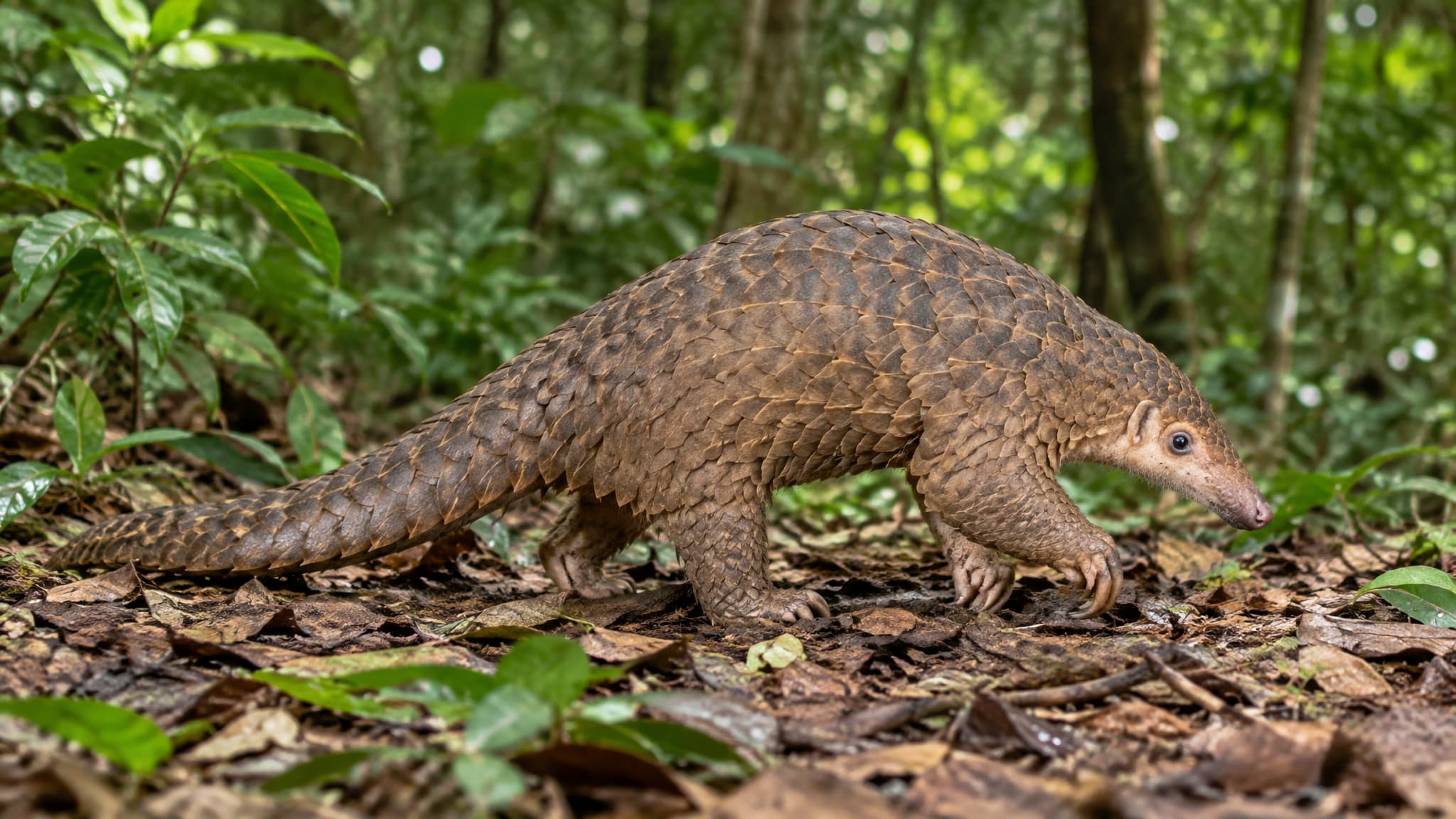
The Sunda pangolin, also called the Malayan pangolin, is a scaly mammal of Southeast Asia and one of eight living pangolin species. Its body is covered in overlapping keratin scales arranged in 17 to 19 rows across the midsection, with more than 20 rows along the tail. Adults measure 40 to 65 cm from head to rump, with a tail of 35 to 56 cm, and weigh up to 10 kg. Males are larger than females. Instead of teeth it has a long, sticky tongue that can reach about 25 cm. The species ranges through Myanmar, Thailand, Cambodia, Laos, Vietnam, Malaysia and Singapore, and across the islands of Sumatra, Java, Borneo and the Lesser Sunda Islands. It lives in primary and secondary forest, scrub and cultivated land such as gardens and rubber or oil palm plantations, from sea level up to about 1,700 m. It shelters in burrows it digs and in tree hollows, and it climbs well, using a prehensile tail. The Sunda pangolin is an extreme specialist that feeds only on ants and termites. It is nocturnal, shy and usually solitary, though pairs are sometimes seen. It travels on average 0.7 to 1.8 km per day while foraging. One radio-tracked female in Singapore used a home range of 6.97 ha. When threatened it rolls into a tight ball so that only its scales are exposed. Breeding is thought to take place in autumn, and young are born in a burrow during winter after a gestation of about 130 days. A female usually has a single young, rarely two, weighing 100 to 500 g at birth. The mother cares for it for about three months before weaning, and both sexes reach sexual maturity at about one year. There are no long-term studies of its lifespan. By eating huge numbers of social insects, an adult may consume about 70 million insects per year, which helps keep ant and termite populations in check. Its digging also aerates the soil. The Sunda pangolin is listed as Critically Endangered by the IUCN. It is heavily hunted for its scales, used in traditional medicine, and for its meat and skin, and more than 185,000 skins entered international trade between 1980 and 1985. Habitat loss and road traffic add to the pressure. Since 2016 all pangolins have been listed on CITES Appendix I.

View Details
Aye-aye
Mammals

Aye-aye

Daubentonia madagascariensis

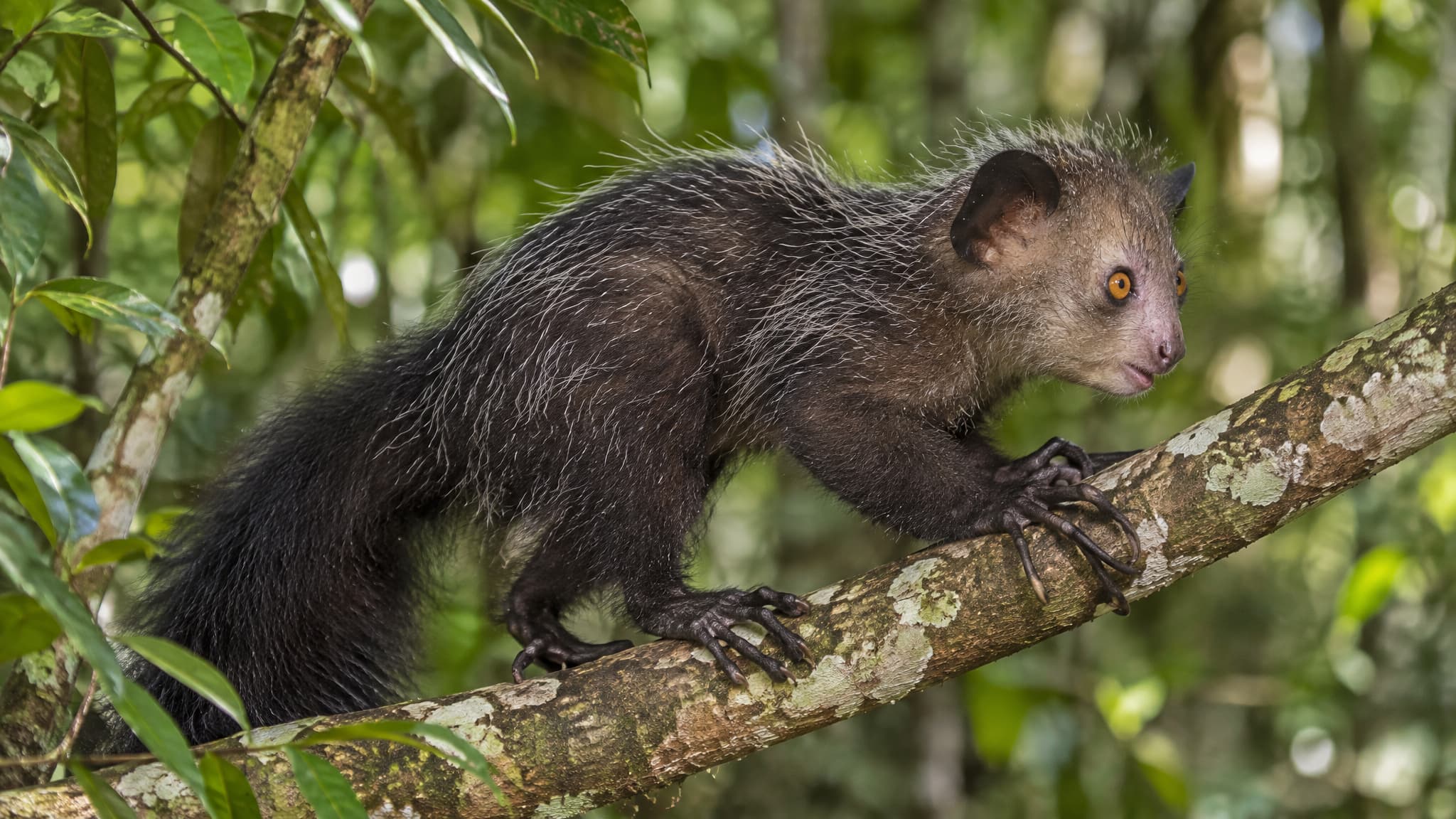
The aye-aye is a nocturnal lemur from Madagascar and the only living member of the family Daubentoniidae. Its continuously growing incisors once led early naturalists to class it among the rodents, but it is a strepsirrhine primate, and molecular studies place it as the oldest branch of the lemur lineage. Adults measure 36 to 43 cm from head to rump, carry a bushy tail of 56 to 61 cm and weigh 2.5 to 2.8 kg. Yellowish to brown fur with white-tipped hairs, a cat-like head with prominent ears and eyes, and long, slender fingers give it an unmistakable look, and the third finger is especially thin. The species is endemic to Madagascar, where it occurs mainly in the east and in the northwestern forests. It lives in primary and secondary rainforest and dry deciduous forest, and also uses plantations and, at times, dry scrub and mangroves. It keeps mostly to the upper canopy, where it builds leafy nests to sleep in during the day. The aye-aye is famous for percussive foraging. It taps branches with its middle finger, up to eight times per second, and listens for the hollow sound of insect tunnels. It then gnaws through the bark with its incisors and hooks out wood-boring beetle larvae with that thin finger. Its diet also includes fruit, seeds, nuts, nectar, plant exudates and fungi. It forages alone at night, and home ranges cover 30 to 50 ha for females and 100 to 200 ha for males. Females give birth to a single young after a gestation of 152 to 172 days, and usually breed only once every 2 to 3 years. The infant stays in the nest for up to two months and depends on its mother for a long time afterwards. In captivity, one female lived more than 23 years. By eating wood-boring larvae, the aye-aye fills a role that woodpeckers play elsewhere, and its fruit eating may help disperse seeds. The species is listed as Endangered. Its main threats are the loss of forest habitat to deforestation, hunting, and killings by people who see it as a crop pest or a bad omen. It was thought extinct in 1933 and rediscovered in 1957. Today it occurs in at least 16 protected areas, and captive breeding programs help support the species.

View Details
Narwhal
Mammals

Narwhal

Monodon monoceros

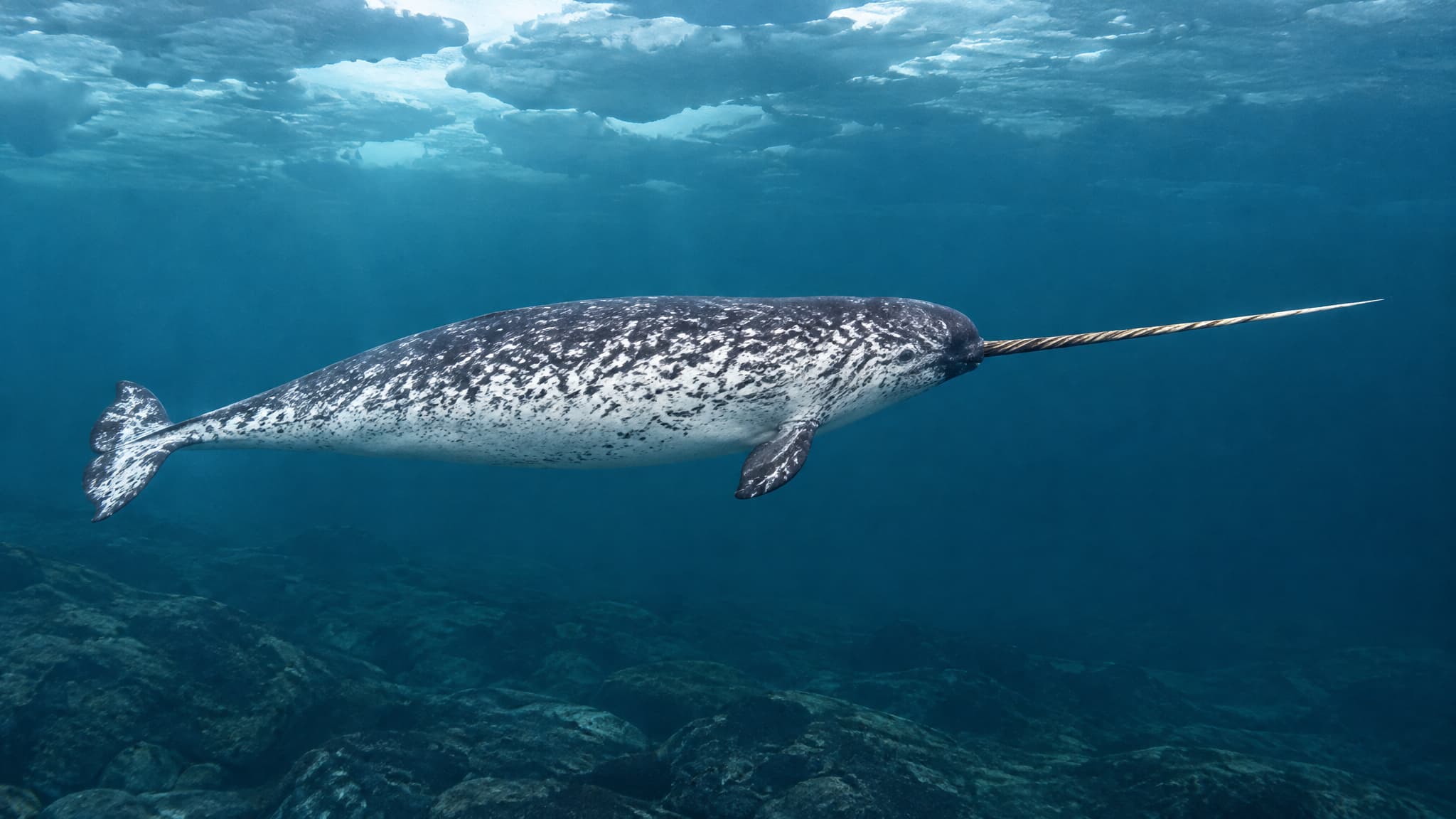
The narwhal is a medium-sized toothed whale of the high Arctic, famous for the long spiral tusk carried by most males. The tusk is an enlarged upper left canine that grows forward through the lip and twists in a left-handed spiral, reaching up to 3 m. Females usually keep both teeth hidden in the jaw, although tusked females and males with two tusks are occasionally recorded. Adults usually measure about 4 to 5 m and weigh 800 to 1,600 kg, with males larger than females. The body is robust, the head small and rounded, and there is no dorsal fin, only a low ridge along the back. Calves are grey, while adults are pale with dark mottling and old animals can look almost white. Narwhals live in the Arctic Ocean, mainly in its Atlantic sector, from the Canadian Arctic and Greenland to the waters off Russia, generally between 70° and 80° N. They follow the seasonal cycle of the sea ice: in summer they gather in coastal bays and deep fjords, and in winter they move offshore to dense pack ice, for example in Baffin Bay. The diet is dominated by fish such as Greenland halibut, Arctic cod and polar cod, with squid and shrimp also taken. Narwhals feed at or near the bottom in deep water, capturing prey by suction. They are exceptional divers, regularly reaching depths of about 1,500 m on dives that can last up to 25 minutes. They usually travel in small pods of 2 to 10 animals, but in summer these can join into gatherings of hundreds or even thousands. Mating takes place from March to May, and after a gestation of about 14 months a single calf is born, mostly in July and August. Newborns measure about 1.5 m and weigh around 80 kg, and they nurse for about 20 months. Females give birth every 2 to 3 years. Narwhals can live for about 50 years, and they are among the few animals known to go through menopause. As a deep-diving predator of fish and squid, the narwhal is part of the Arctic marine food web and is itself hunted by orcas, polar bears and Greenland sharks. The IUCN lists it as Least Concern, with a global population of about 170,000 animals, and it is included in CITES Appendix II. Threats include climate change and the loss of sea ice, regulated subsistence hunting by Arctic Indigenous peoples, shipping, pollution and deadly entrapment in suddenly freezing ice.

View Details
Large Flying Fox
Mammals

Large Flying Fox

Pteropus vampyrus

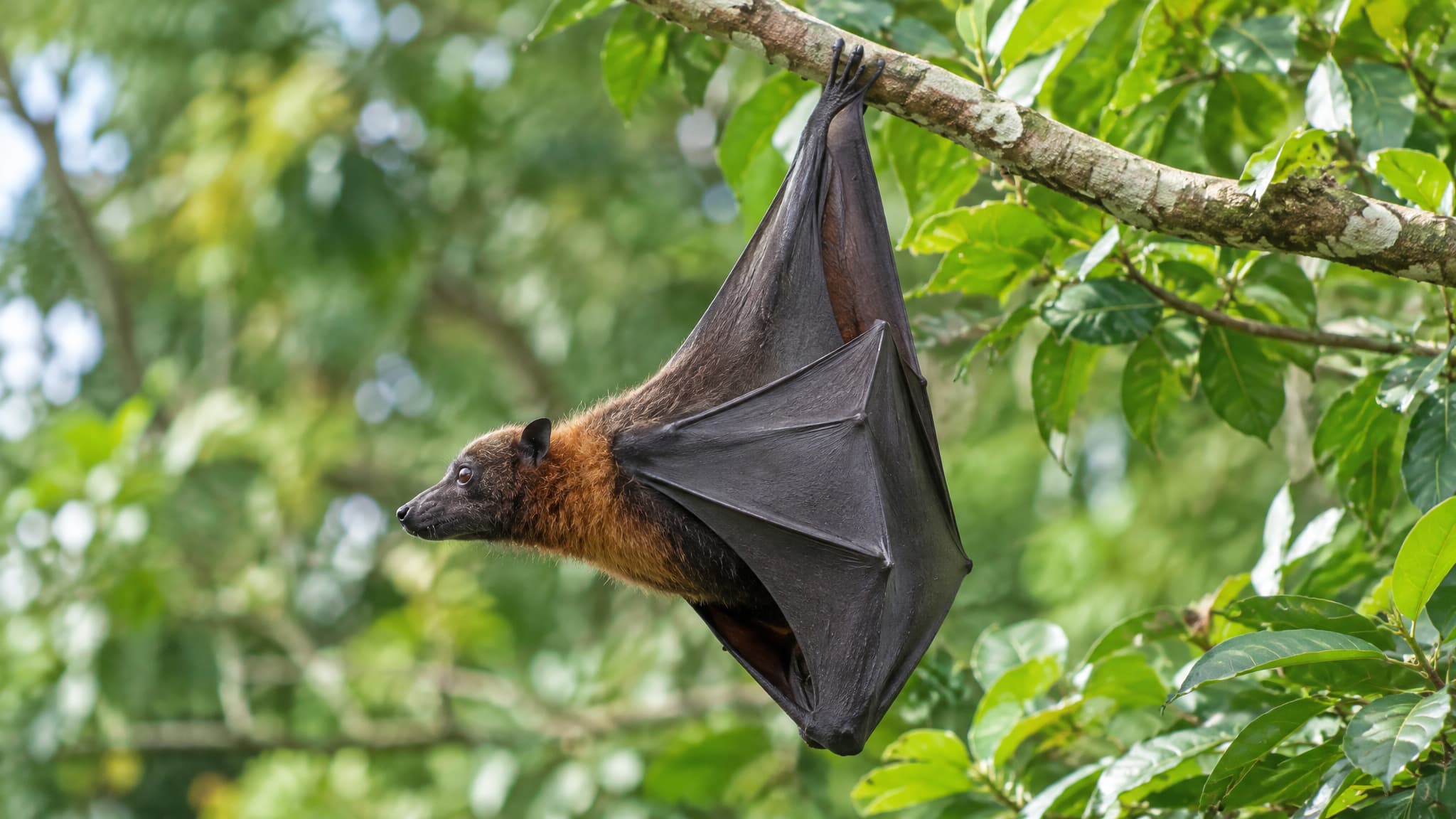
The large flying fox, also called the Malayan flying fox, is one of the largest bats in the world. Adults weigh 0.65–1.1 kg, measure 27–32 cm from head to rump, have a forearm of 180–220 mm and a wingspan of up to 1.5 m. Its fox-like face, pointed ears and lack of a tail give the genus its common name, and its body is covered in long, woolly fur. Males are larger than females and have thicker, stiffer fur. Like other Old World fruit bats, it finds its way by sight rather than by echolocation. The species lives in Southeast Asia, from the Malay Peninsula east to the Philippines and south through Sumatra, Java, Borneo and Timor. It uses primary and secondary forest, mangroves, swamps, coconut groves and mixed fruit orchards, and is recorded up to 1,370 m above sea level, although in some regions it favours lowlands and coasts. Colonies roost in large trees, sometimes for years at the same site, and can number in the thousands. The large flying fox is nocturnal. It leaves the roost around sunset, returns at dawn and may fly up to 50 km in a single night to reach feeding trees. It feeds on flowers, nectar, pollen and fruit such as figs, mangoes, bananas, rambutan and durian, and prefers flowers and nectar when they are available. Males defend harems of up to ten females, and roosts are noisy while feeding groups are quiet in flight. Breeding happens once a year and its timing varies by region; births peak in March and April in Thailand and in April and May in the Philippines. Gestation lasts 140–192 days and a female usually gives birth to a single pup, which is nursed for 2–3 months. Both sexes reach sexual maturity at about 2 years. Wild individuals live 15 years on average, and captive animals 15–30 years. By carrying pollen and seeds over long distances, the species pollinates trees such as durian and disperses seeds that help cleared forests regrow; it is often one of the few animals large enough to handle the biggest fruits it eats. It is also a natural reservoir of henipaviruses, including the Nipah virus behind the 1998 outbreak in Malaysia. The IUCN listed the large flying fox as Endangered in 2022. Intensive hunting for meat and traditional medicine, culling by fruit growers, roost disturbance and deforestation have reduced its colonies. In Peninsular Malaysia, licences issued from 2002 to 2006 allowed about 22,000 bats to be killed each year. The species is listed in CITES Appendix II.

View Details
Philippine tarsier
Mammals

Philippine tarsier

Carlito syrichta

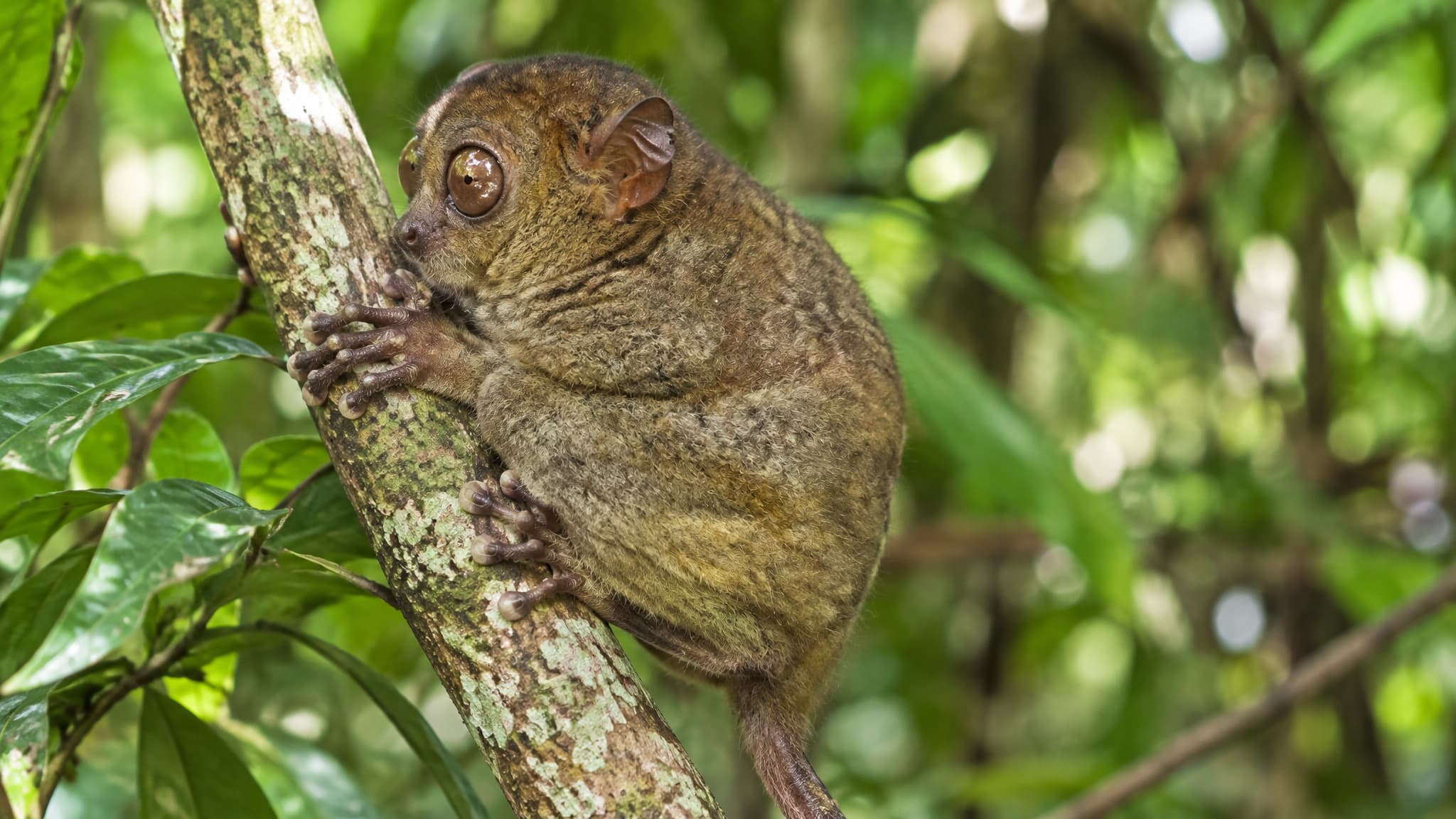
The Philippine tarsier (Carlito syrichta) is a tiny nocturnal primate with a head-and-body length of about 11.7 to 12.7 cm. Adult males weigh about 119 to 153 g and females about 110 to 132 g. Its slender tail is roughly twice as long as the body and nearly naked,, and its huge eyes are the largest relative to body size of any mammal. It lives only in the southeastern Philippines, mainly on Bohol, Samar, Leyte and Mindanao, with populations also on smaller islands such as Dinagat, Siargao, Maripipi and Basilan. It occupies primary and secondary forest from sea level to about 700 m, favoring dense, low vegetation. By day it rests in thick tangles of plants close to the ground, often around 2 m up, and uses a few regular sleeping sites near the edges of its range. Tarsiers are almost entirely insectivorous hunters. They catch live prey at night, especially crickets and grasshoppers, and also take beetles, butterflies and moths, ants, termites, spiders and small crustaceans, and occasionally small lizards and birds. Adults are shy and mostly solitary. Average home ranges are about 6.45 ha for males and 2.45 ha for females, and males usually travel farther each night, about 1.6 km against 1.1 km for females. A male's range overlaps those of several females. Gestation lasts about 180 days and ends with a single, well-furred infant whose eyes are already open. In captivity, newborns average about 23.2 g. Young can move about two days after birth, jump after about four, and soon start catching insects. Females provide nearly all care, and young reach sexual maturity at about two years. Captive animals have averaged 12 to 15 years of life, while lifespan in the wild is poorly documented. As a nocturnal predator of insects, the tarsier helps shape invertebrate communities in the forest understory, and it is in turn taken by owls and feral cats. The species is listed as Near Threatened by the IUCN and is on CITES Appendix II. The main threats are forest loss from logging and slash-and-burn farming and capture for the pet trade. Philippine law declared it a specially protected species in 1997, and sanctuaries on Bohol help protect it.

View Details
Platypus
Mammals

Platypus

Ornithorhynchus anatinus

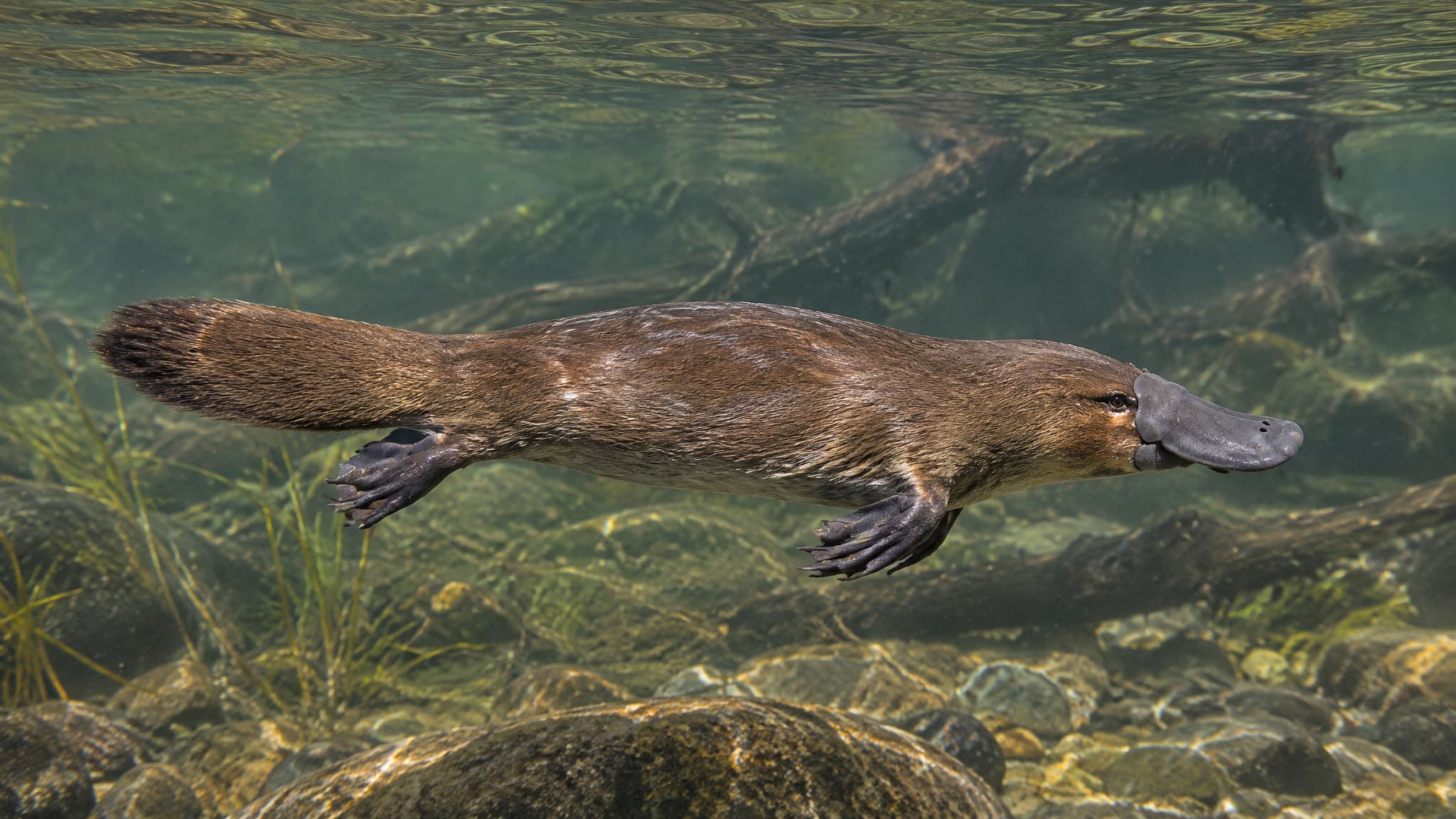
The platypus (Ornithorhynchus anatinus) is a semiaquatic, egg-laying mammal and one of only a few living monotremes. Its soft, leathery bill resembles a duck's, its broad flat tail stores fat, and its webbed feet and dense brown fur suit life in cold water. Adult males measure about 40–63 cm from bill to tail tip and weigh 0.8–3 kg, while females are smaller at 37–55 cm and 0.6–1.7 kg. Adults have no teeth, and the average body temperature of about 32 °C is lower than that of most placental mammals. The species lives in the fresh waters of eastern Australia, from Queensland to Tasmania, including King Island. It uses rivers, streams, lakes and ponds, foraging mostly in water 1–5 m deep, and rests in burrows dug into the banks. Platypuses hunt mainly at night. Underwater they close their eyes, ears and nostrils and find prey with the bill, which carries about 40,000 electroreceptors that detect the weak electric fields of moving animals. They probe the bottom for insect larvae, annelid worms, shrimp, crayfish, bivalves, tadpoles and fish eggs, storing food in cheek pouches and chewing it at the surface. Typical dives last 30–60 seconds, rarely up to 2 minutes, and an animal may spend about 12 hours a day foraging and eat around 20% of its body weight daily. The female digs a nesting burrow with several chambers and lays 1–3 leathery eggs, usually two, about 17 mm long. She incubates them for about 10 days and, lacking nipples, feeds the young on milk secreted onto her skin for 3–4 months. Adult males carry a venomous spur on each hind ankle that is very painful to people, and the venom is more plentiful in the breeding season. Lifespan averages 12–15 years; wild animals have been recaptured at 24 years old and captive ones may live up to 30 years. As a predator of bottom-dwelling invertebrates, the platypus is part of the food web of Australian streams and is itself taken by goannas, Murray cod, carpet snakes, eagles and introduced red foxes. A 1912 law ended the platypus fur trade. Today the species is assessed as Near Threatened, and its numbers are estimated to have fallen by about 30% since European settlement. Dams, pollution, urban runoff, drought, water extraction and drowning in fishing nets and traps are its main threats.

View Details
Japanese macaque
Mammals

Japanese macaque

Macaca fuscata

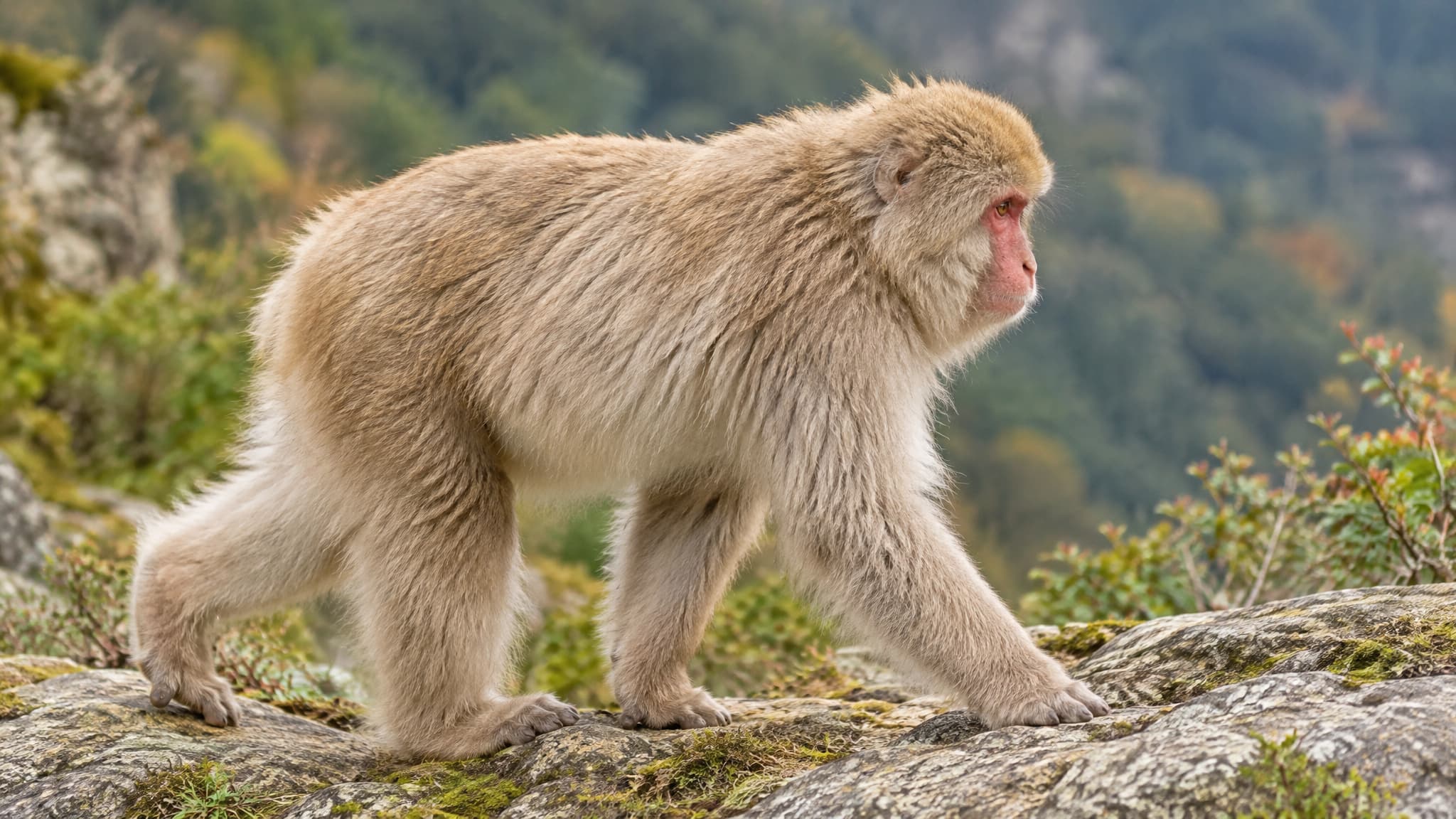
The Japanese macaque (Macaca fuscata), often called the snow monkey, is a stocky Old World monkey with thick brown to grey fur, a bare pinkish-red face and rump, and a stumpy tail. Adult males average about 57 cm in body length and 11.3 kg, while females average about 52.3 cm and 8.4 kg; the tail measures only about 92.5 mm in males and 79.1 mm in females. Animals from colder regions tend to be heavier. The species is endemic to Japan, living on Honshu, Shikoku and Kyushu and several smaller islands, but not Hokkaido. Its northernmost groups on the Shimokita Peninsula make it the most northerly non-human primate in the world, and the southernmost live on Yakushima, home of the subspecies M. f. yakui. It occupies subtropical evergreen forests in the south and cool temperate deciduous and subalpine forests in the north, and has been recorded up to 3,180 m. Japanese macaques are generalist omnivores. More than 213 plant species are on record in their diet, with fruit dominant in summer, flowers and young leaves in spring, and seeds, bark and mature leaves in winter, plus insects, eggs and fungi. Troops average about 41 animals, ranging from 10 to 161 in the wild. Groups are matrilineal: females stay for life and inherit their mother's rank, while males leave around 5 to 6 years of age. Famous learned traditions include sweet potato washing on Koshima Island and winter hot spring bathing at Jigokudani. Mating takes place roughly from September to April, and births from March to September. Gestation lasts about 171.7 days and usually produces a single infant, weaned by about 18 months. Females first come into estrus at about 3.5 years and males mature at about 4.5 years. The oldest known wild individuals reached 28 years for males and 32 years for females. As fruit eaters, the macaques disperse and also destroy seeds, and on Kinkazan Island the leaves they drop are eaten by sika deer. The IUCN lists the species as Least Concern; a 1989 study estimated about 114,431 wild animals. Hunting was banned in 1947, but conversion of natural forest into timber plantations and the culling of more than 20,000 crop-raiding monkeys each year remain concerns. An introduced population has lived in Texas since 1972.

View Details
Proboscis monkey
Mammals

Proboscis monkey

Nasalis larvatus

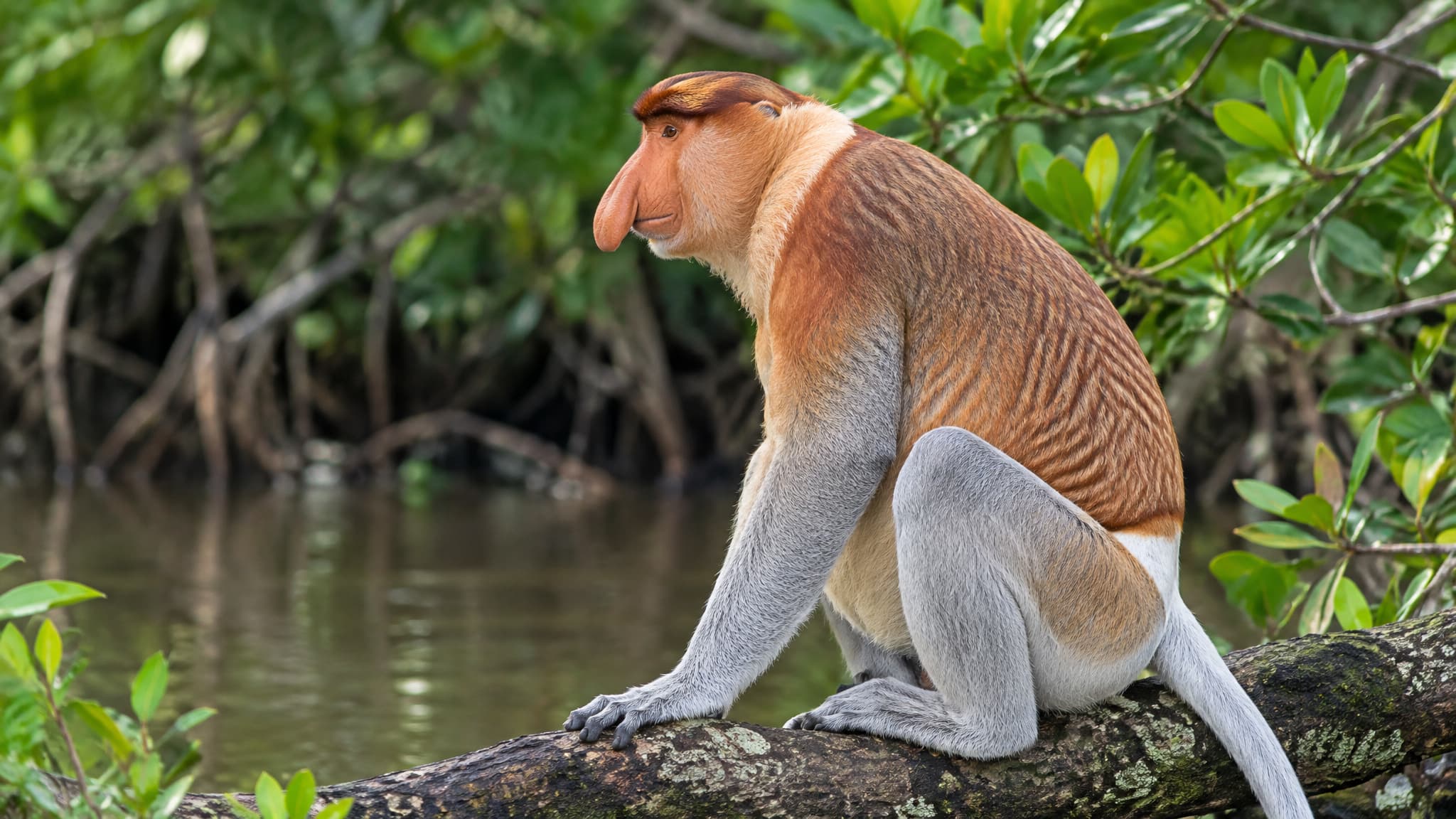
The proboscis monkey (Nasalis larvatus) is an Old World monkey of the subfamily Colobinae and one of the largest monkeys native to Asia. It is named for the long, fleshy nose of adult males, which can exceed 10 cm and hang below the mouth; females have a smaller nose and the young have upturned noses. The coat is reddish brown on the head and shoulders, paler on the body, with greyish limbs and a long tail of about 55 to 67 cm. Males are about twice the size of females: they measure 66 to 76 cm in head-body length and usually weigh 16 to 22.5 kg, while females measure 53 to 62 cm and weigh 7 to 12 kg. Both sexes have a large, rounded belly. The species is found only on Borneo, in Brunei, Indonesia and Malaysia, and the largest remaining populations are in Kalimantan. It lives in lowland coastal and riverside habitats, especially mangroves, swamp and peat forests and riverine forests, and it rarely moves more than about 1 km from water. Proboscis monkeys are herbivores. Across the year their diet is roughly 52% leaves, 40% fruit and 3% flowers, with insects only a tiny share, and they eat more than 90 plant species. Fruit dominates from January to May and leaves from June to December, with young leaves and unripe fruit preferred. A multi-chambered stomach lets bacteria break down tough plant material, and they sometimes regurgitate and rechew their food. They are active by day, spend most of their time in trees and are perhaps the most aquatic of all primates: with partly webbed fingers and toes they cross rivers and can swim up to 20 m underwater. They usually live in one-male groups of 3 to 19 animals, with one adult male, several females and their young; other males form all-male groups. At night groups gather in trees near the river, and they can join into bands of up to 60. Males honk to warn of danger and their large nose seems to amplify these calls. Gestation lasts about 166 days, sometimes more than 200, and a single infant of about 450 g is born with a blue face. It is weaned at about 7 months; females mature at about 5 years and males at about 7. Lifespan in the wild is not well known, but individuals have lived more than 20 years in captivity. As seed eaters and leaf browsers they shape the plants of mangrove and swamp forests, and they are prey for crocodiles, false gharials, Sunda clouded leopards and eagles. The IUCN lists the species as Endangered, and its numbers fell by more than half over roughly 40 years. The main threats are the loss of riverine and mangrove forest to logging, oil palm plantations, shrimp farms and fires, plus hunting. It is listed in CITES Appendix I and protected by law across Borneo.

View Details
Mandrill
Mammals

Mandrill

Mandrillus sphinx

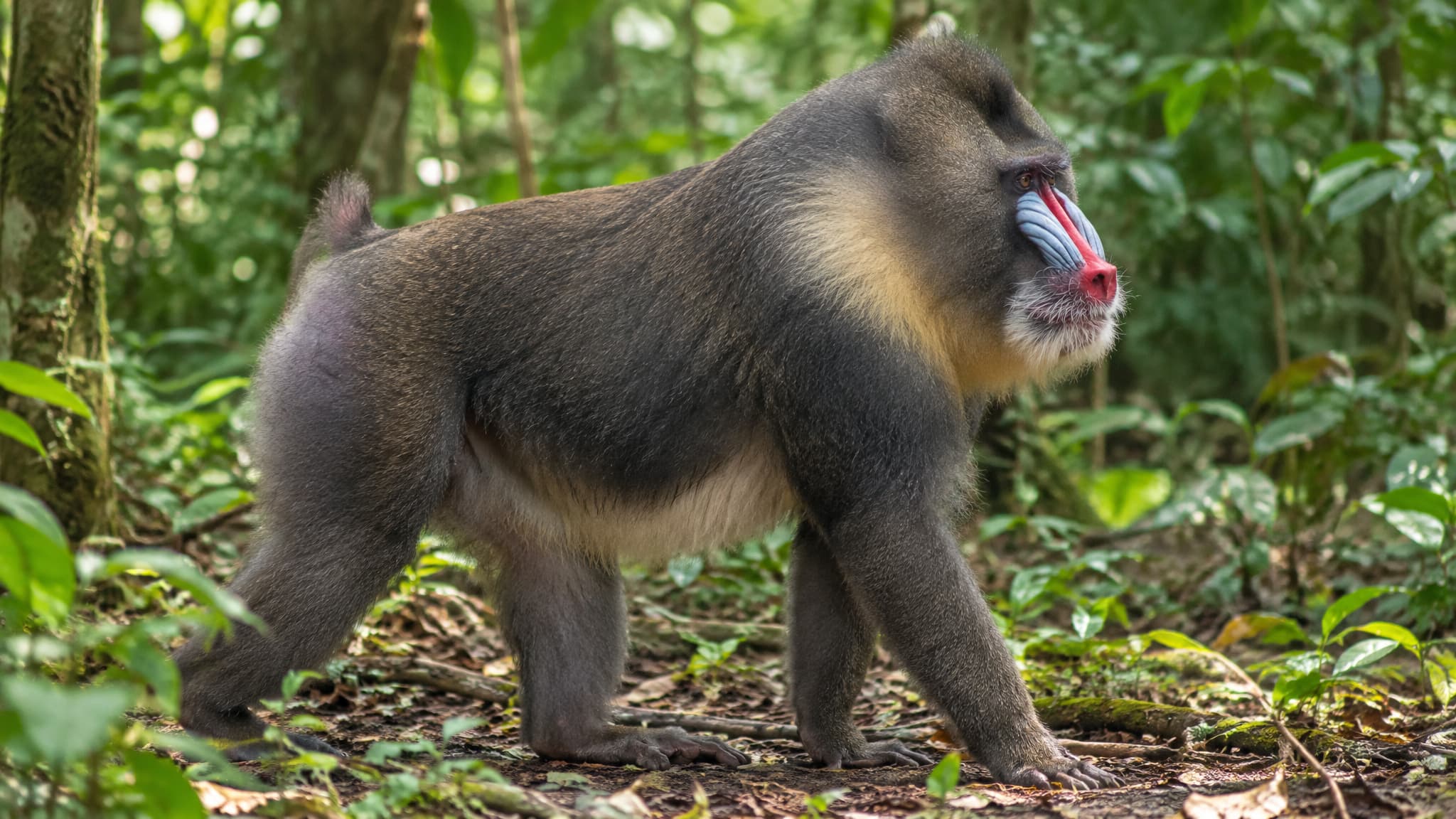
The mandrill (Mandrillus sphinx) is an Old World monkey of the family Cercopithecidae and is often called the largest monkey in the world. It is strongly sexually dimorphic. Adult males measure about 70–95 cm from head to rump and usually weigh 19–30 kg, with exceptional individuals reported at up to 54 kg; females measure about 55–70 cm and weigh 10–15 kg. The tail is a stub of only 7–10 cm. The coat is olive brown with paler underparts and a yellow-orange beard. Males have a bright red stripe down the muzzle, ridged blue cheeks, long canines of about 4.5 cm and a blue-to-purple rump; females and young are much duller. Mandrills live in west-central Africa: southern Cameroon, mainland Equatorial Guinea, Gabon and parts of the Republic of the Congo. The Sanaga River bounds the range to the north and the Ogooué and Ivindo rivers to the east, and Gabon holds the main stronghold. They prefer dense tropical rainforest, especially primary forest, but also use gallery forest, thick secondary bush, hills and the edges of fields. They forage mostly on the ground by day and climb into trees to sleep at night. The diet is varied but mostly plant-based. A study in Lopé National Park found about 51% fruit, 26% seeds, 8% leaves, 7% pith, 3% flowers and only 4% animal matter, and the species eats more than 100 plant species. Insects, snails, worms, frogs, lizards, rodents, birds and eggs are also taken. Females form the stable core of huge groups called hordes; in Lopé these averaged about 620 animals and reached 845, possibly the largest cohesive groups of any wild primate. Adult males are largely solitary and join hordes mainly in the breeding season. Gestation lasts about 175 days, and most births in the wild happen between January and March, in the rainy season. Females usually give birth to a single infant weighing about 640 g, which is weaned at around 230 days; the interval between births averages about 405 days. Females reach adult size at about 7 years and males at about 10. Wild mandrills are estimated to live about 12–20 years, while captive animals often reach 30–40 years, with a record of 46 years. By eating so much fruit, mandrills help disperse seeds and shape the forest understory. Leopards, crowned eagles, African rock pythons and chimpanzees prey on them. The IUCN lists the mandrill as Vulnerable, with a suspected decline of more than 30% over 24 years, and it is on CITES Appendix I. The main threats are bushmeat hunting, since their loud calls make groups easy to find, and the loss of forest to logging, farming, mining and settlement.

View Details
Sperm Whale
Mammals

Sperm Whale

Physeter macrocephalus

The sperm whale is the largest living toothed whale and a powerful deep-ocean predator. It is immediately recognizable by its enormous, squared head—about one-third of the body length—its narrow lower jaw, wrinkled skin behind the head, and low, rounded dorsal hump. Adults are generally dark gray, sometimes with pale patches on the underside. Its single blowhole sits to the left of the head rather than centrally, producing the species’ distinctive angled blow. Males are substantially larger than females and may reach about 52 feet (16 m) and 45 tons. This species occurs in deep waters of every ocean, from equatorial seas toward the edges of Arctic and Antarctic pack ice. Distribution changes with age and sex: females and calves commonly remain in warmer tropical waters, while mature males may range far into temperate and high-latitude seas. It is most associated with offshore waters where the seafloor drops away, allowing access to the deep-diving prey on which it depends. Sperm whales routinely make foraging dives to around 2,000 feet (610 m), often lasting about 45 minutes, then rest and breathe at the surface before diving again. Squid are important prey, alongside deep-water fishes, sharks, and skates. Sound is central to their underwater lives: their head contains the spermaceti organ, which helps focus sound. Females and young live in enduring social units, whereas young males depart to form bachelor groups and many large adult males become more solitary. Females mature at roughly nine years old and usually bear one calf after a gestation of about 14–16 months, with births commonly spaced five to seven years apart. Calves nurse for several years, and the species can live up to about 60 years. As a major predator of deep-ocean animals, the sperm whale is an important part of marine food webs. Commercial whaling caused severe historical declines; today, entanglement in fishing gear, ship strikes, underwater noise, marine debris, pollution, and changes affecting prey or habitat remain concerns. The species is globally classified as Vulnerable by the IUCN.

View Details
Blue whale
Mammals

Blue whale

Balaenoptera musculus

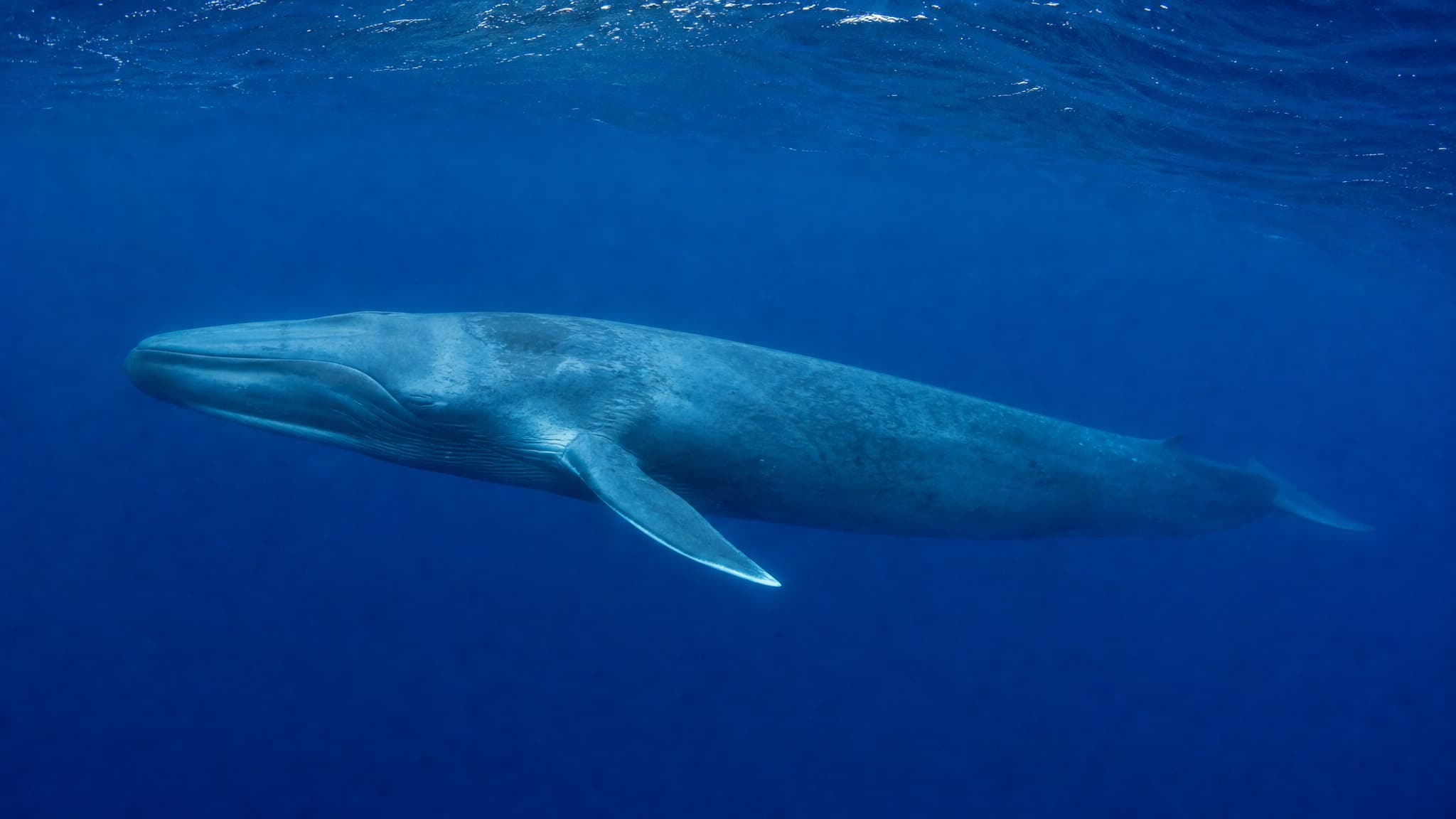
The blue whale is the largest animal known to have lived on Earth. Adults have an exceptionally long, streamlined body, usually mottled blue-gray; underwater, this coloration can appear distinctly blue. The head is broad and U-shaped, the dorsal fin is relatively small and far back on the body, and dozens of expandable grooves run along the throat and chest. Females are generally larger than males. The largest individuals may reach about 33 m (110 ft) and weigh well over 100 metric tons. This baleen whale occurs in nearly all of the world’s oceans, chiefly in offshore and pelagic waters, though its movements differ among populations and subspecies. Many blue whales undertake seasonal migrations, concentrating in productive higher-latitude feeding areas during summer and moving toward warmer temperate or tropical waters in winter. Some individuals or populations do not follow the same migratory pattern every year. Blue whales are filter-feeding carnivores that eat mainly krill—small, shrimp-like crustaceans. They lunge into dense prey swarms, take in a huge volume of seawater, then use their baleen plates and tongue to force water out while retaining prey. Their immense size makes their food demand extraordinary: a large animal can consume several tons of krill in a day during the feeding season. By feeding on krill and cycling nutrients through ocean waters, blue whales are important participants in marine food webs. Reproduction is slow. Pregnancy lasts roughly 10–12 months, usually producing one calf; calves nurse for about six to seven months, and females commonly calve at intervals of two to three years. Estimated lifespan is around 80–90 years. Commercial whaling devastated the species during the twentieth century. Although protected, it remains Endangered and faces hazards including collisions with vessels, entanglement in fishing gear, underwater noise, pollution, disturbance, and environmental changes that may affect krill and feeding habitat.

View Details
Indus river dolphin
Mammals

Indus river dolphin

Platanista minor

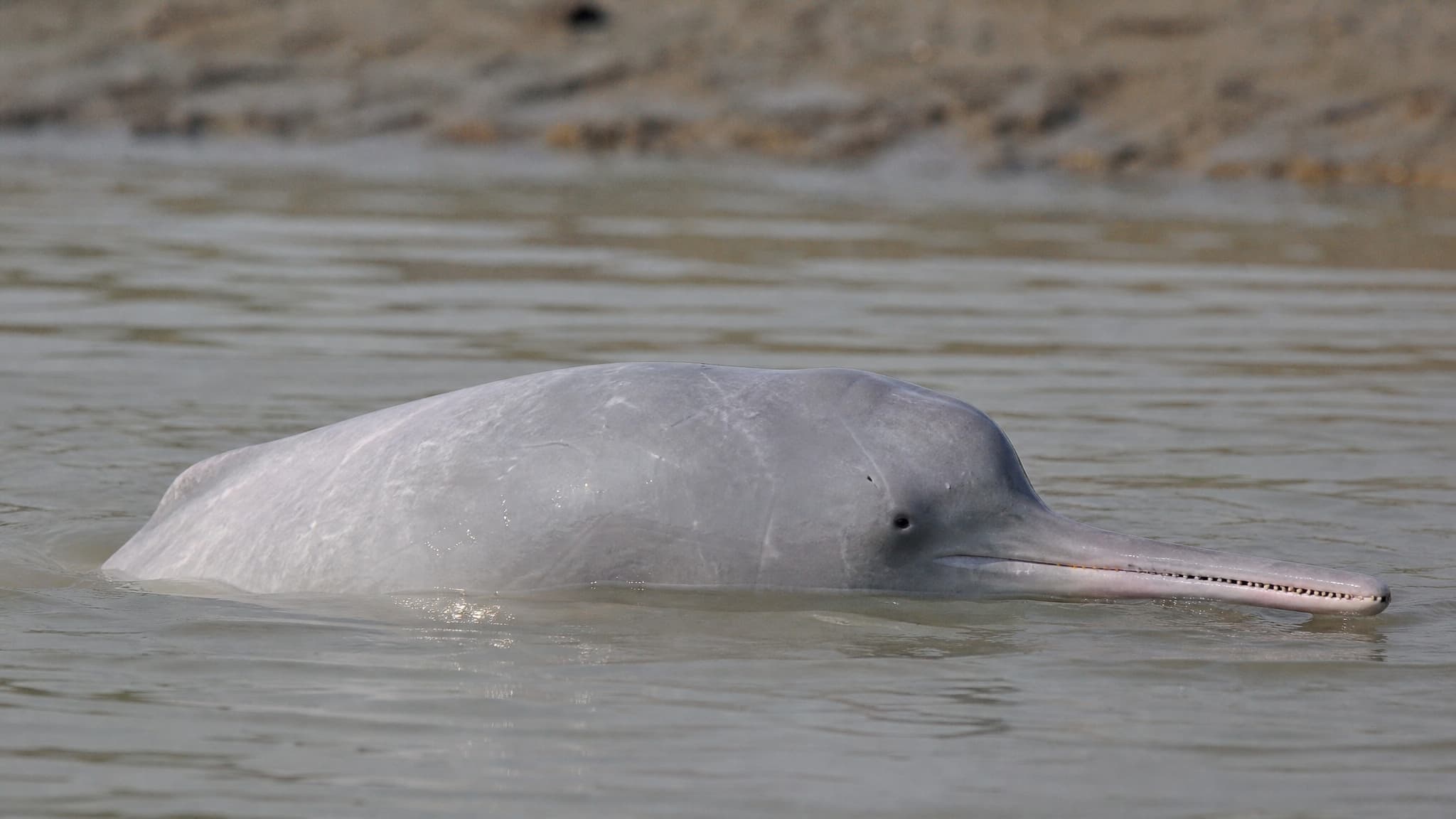
The Indus river dolphin (Platanista minor), locally known as the bhulan, is a freshwater toothed whale with a stocky gray body, pale underside, long narrow beak, and a small dorsal fin set far back on the body. Adults are usually about 2–2.5 m long, and females tend to be larger than males. Its tiny eyes have very limited function, an adaptation to the silty water in which it lives. It is now restricted chiefly to the middle and lower Indus River in Pakistan, with a small isolated population in India’s Beas River. It uses shallow, turbid freshwater channels, though it can move through main river channels and tributaries during seasonal floods. Dams, barrages, canals, and water extraction have divided what was once a much more continuous range. Nearly constant echolocation clicks allow this dolphin to orient itself, communicate, and locate prey where vision is ineffective. It generally occurs alone or in pairs, but temporary groups can form where feeding conditions are favorable. Its long, tooth-lined jaws help it capture fish, shrimps, clams, and other aquatic invertebrates, including prey found near the river bottom. Breeding can occur year-round. Females produce one calf after a long gestation and nurse it for roughly a year; individuals may live about 30 years. As a high-level freshwater predator, the species is an indicator of river health. It is Endangered, threatened by fragmented habitat, entanglement in fishing gear, dolphins trapped in irrigation canals, pollution, underwater noise, and vessel strikes.

View Details
Amazon river dolphin
Mammals

Amazon river dolphin

Inia geoffrensis

Amazon river dolphin The Amazon river dolphin, Inia geoffrensis, is a freshwater toothed whale widely known as the boto or pink river dolphin. It is the largest living river dolphin. Adults have a stout, flexible body, a long narrow snout bearing mixed tooth shapes, broad flippers, and a low dorsal ridge rather than a tall dorsal fin. Unlike most dolphins, its neck vertebrae are not fused, allowing remarkable head movement while weaving among submerged branches. Calves are generally gray; many adults become pink, blotched pink-and-gray, or darker gray. Males are typically larger and often pinker and more scarred than females. This species occurs in the Amazon and Orinoco drainage systems of Bolivia, Brazil, Colombia, Ecuador, Peru, and Venezuela. It uses main rivers, tributary channels, river mouths, lakes, rapids, and seasonally inundated floodplains. Seasonal water levels strongly shape its movements: during high water, botos enter flooded forests and plains, while lower water concentrates many animals and their fish prey in deeper main channels. Its flexible body and mobile flippers are especially useful in the tangled forest habitat. Botos are mainly solitary or travel in small, loose groups, although temporary feeding and breeding aggregations occur. They use echolocation as well as vision to find prey in often turbid water. Their broad diet is dominated by fishes, including cichlids, characins, croakers, and piranhas; they may also eat crustaceans and small turtles. As a high-level freshwater predator, the boto influences fish communities and may occasionally forage alongside tucuxis and giant otters. Reproduction is seasonal in much of the range. After a gestation of about 11 months, a female normally gives birth to one calf and provides prolonged nursing and care; calves may remain dependent for two to three years. Wild lifespan is insufficiently known, while healthy captive individuals have reached about 26 years. The species is listed as Endangered, facing bycatch and deliberate killing, pollution including mercury, dams and river fragmentation, vessel disturbance, and loss or degradation of floodplain and river habitat. Protecting connected, clean river systems is therefore central to its survival.

View Details
Baiji
Mammals

Baiji

Lipotes vexillifer

The baiji, also called the Yangtze River dolphin or Chinese river dolphin, was a distinctive freshwater cetacean of eastern China. It had a streamlined, pale blue-gray body with a whitish underside, rounded flippers, and a notably long, narrow beak that curved slightly upward. Females were generally larger than males; recorded adults measured roughly 1.4–2.5 m long and weighed about 42–167 kg. It was endemic to the middle and lower Yangtze (Changjiang) drainage, with historical records from the main river, connected lakes, and the neighboring Qiantang River. Baijis favored broad river reaches, especially eddies near sandbars, tributary mouths, and shallow water. Their small eyes were of limited use in the Yangtze’s turbid water, so they relied strongly on echolocation and acoustic signals. A fish-eating predator, the baiji searched muddy bottoms with its long beak and commonly foraged near sandbanks. It was usually encountered in pairs, though small groups could gather. Short dives, daytime feeding around eddies, and resting in slower water at night were reported. As a top-level consumer, it formed part of the Yangtze food web and was an important cultural symbol in China. Knowledge of reproduction remains incomplete. Females apparently produced one calf, about 80 cm long, at intervals near two years; estimates place gestation at 6–12 months and sexual maturity at 3–8 years. A documented animal reached at least 24 years old. The species crashed under fisheries bycatch, vessel strikes, river engineering, pollution, noise, and habitat degradation. No baiji was detected during a six-week survey of its historical Yangtze range in 2006, and no subsequent sighting has been verified; it is therefore regarded as Critically Endangered (Possibly Extinct).

View Details
Franciscana
Mammals

Franciscana

Pontoporia blainvillei

Franciscana The franciscana, also called the La Plata dolphin, is a small toothed cetacean distinguished by its exceptionally long, slender beak. Its back and flanks are gray-brown, while the underside is paler; the dorsal fin is small and rounded-triangular, and the broad flippers are often described as trapezoidal. Adult females are generally larger than males. This discreet dolphin is difficult to observe because it usually travels in small groups, avoids boats, and does not make conspicuous splashes at the surface. It is endemic to the southwestern Atlantic, occurring in coastal waters of Brazil, Uruguay, and Argentina, including parts of the Río de la Plata. Rather than being a true river dolphin, it is chiefly a nearshore marine species, although it also uses certain estuaries. It favors shallow, often turbid coastal waters—commonly within roughly 30–35 metres of depth—and its distribution is not continuous along the Brazilian coast. Franciscanas are opportunistic carnivores. They take a varied mix of small fishes, crustaceans, and cephalopods, with prey choice changing among regions and seasons. They forage in relation to local prey availability and tides, sometimes feeding cooperatively around schools of fish. As a mid-level marine predator, the species helps link populations of small coastal prey with larger predators; sharks and killer whales are documented natural predators. Females give birth to one calf after a gestation of about 10–11 months. Timing differs geographically: births are seasonal in southern portions of the range but may occur year-round farther north. Calves nurse for roughly 6–9 months, begin taking solid prey early in life, and both sexes mature young for cetaceans. Individuals may live around 13–20 years, with a maximum recorded age of 21 years. The main threat is accidental entanglement and drowning in gillnets, a severe risk for an animal that lives so close to heavily fished coasts. Coastal degradation, pollution, and loss of habitat compound this pressure. The species is globally listed as Vulnerable, while Brazil’s national conservation action plan identifies the toninha as Critically Endangered nationally and focuses on reducing bycatch and protecting habitat.

View Details
Harbor porpoise
Mammals

Harbor porpoise

Phocoena phocoena

The harbor porpoise is a compact, cold-water cetacean and one of the smallest porpoises. Adults usually measure about 1.4–2 m long, with females tending to be slightly larger than males. Its back is dark gray to nearly black, fading through gray flanks to a pale belly. A short, blunt snout, small spade-shaped teeth, and a triangular dorsal fin distinguish it from many dolphins; dark markings commonly run from the mouth or eye area toward the flippers. This species occurs across temperate, subarctic, and Arctic waters of the Northern Hemisphere. It ranges through coastal parts of the North Atlantic and North Pacific, with occurrences in the Baltic, Black, and Mediterranean regions. Harbor porpoises favor relatively shallow coastal waters—especially bays, estuaries, fjords, and river mouths—though some populations move farther offshore seasonally or travel into rivers. Usually inconspicuous and wary of boats, harbor porpoises are often seen alone or in pairs, although larger groups can gather where food is plentiful. They make high-frequency clicks for echolocation and feed chiefly on small schooling fishes such as herring and mackerel; squid and octopus are also taken. As active predators of small marine animals, they help transfer energy through coastal food webs. Females generally mature at about three to four years old. Mating is concentrated in summer in many areas, and births commonly occur from May through July after a gestation of roughly 10–11 months. A single calf is nursed for about 8–12 months, and the species can live for around 24 years. Globally it is listed as Least Concern, but entanglement in fishing gear, underwater noise, pollution, and localized population declines remain serious threats; Baltic animals are of particular conservation concern.

View Details
Collared peccary
Mammals

Collared peccary

Pecari tajacu

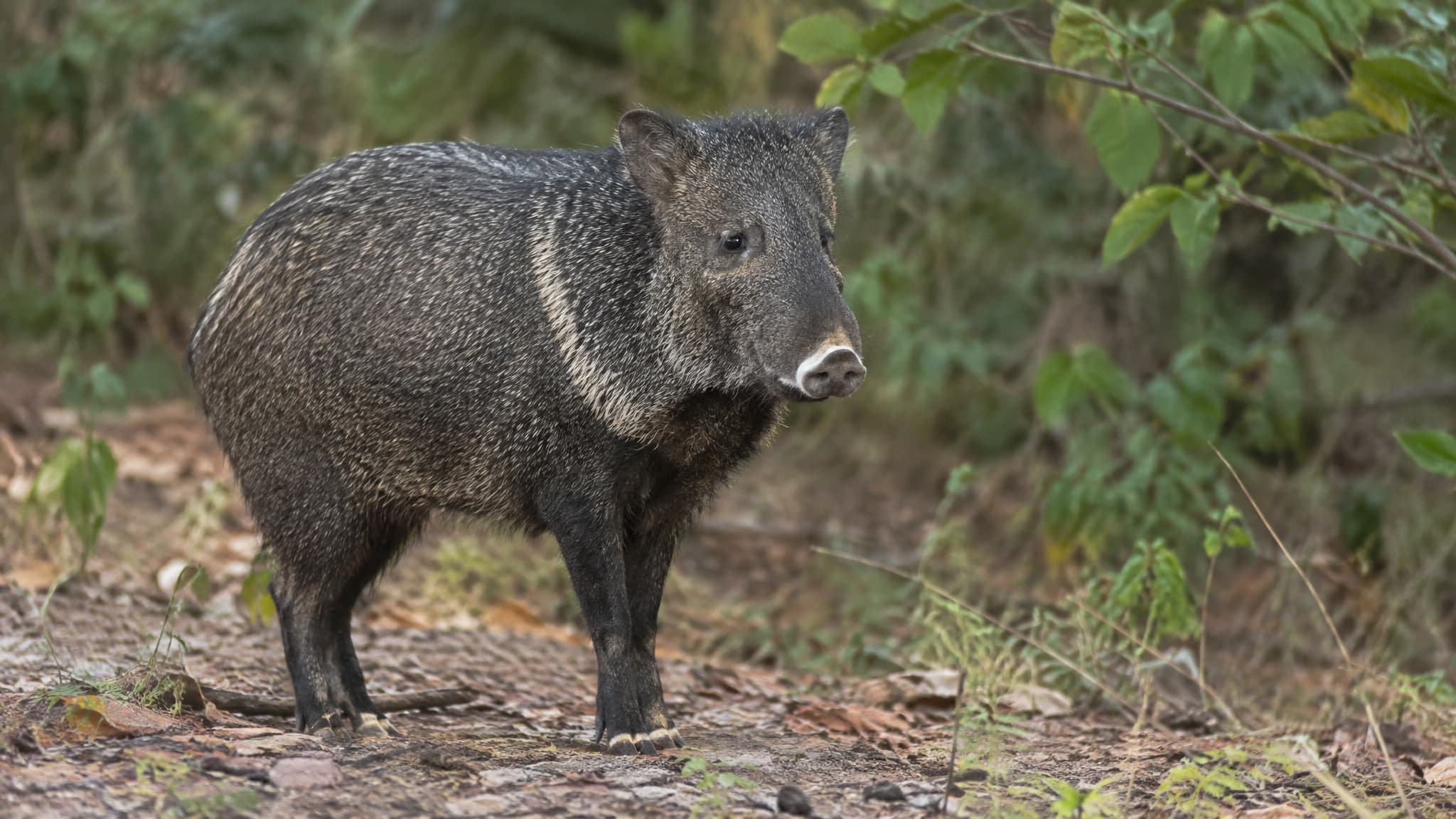
The collared peccary is a compact, pig-like hoofed mammal of the Americas, but it belongs to the distinct peccary family rather than the pig family. Adults usually have a coarse gray to blackish coat and a pale, often incomplete band around the neck and shoulders—the “collar” that gives the species its name. It has a broad snout, short legs, a very small tail, and lower canine teeth that form visible tusks. Its range extends from the southwestern United States through Mexico and Central America into much of South America, reaching northern Argentina. Collared peccaries occupy remarkably varied habitats: desert scrub, grassland, thorn forest, tropical forest, woodland, farmland edges, and rocky shelter sites. In Brazil it occurs across multiple biomes and is often called caititu or cateto. This social species generally lives in small herds, commonly using scent from a dorsal gland to recognize companions and mark shared areas. It is mainly active in cooler hours where temperatures are high. Its diet is flexible and largely plant-based, including fruits, seeds, roots, shoots, cacti, and other vegetation, supplemented with insects and other small animal matter. By eating fruits it can disperse seeds, while its wallows may create damp sites used by other animals. Females can breed throughout the year, although breeding peaks differ by region. After a gestation of roughly 142–151 days, they most often give birth to two young, which are weaned at about six weeks. Longevity is reported at up to about 24 years in captivity; survival in the wild is more variable. The species is globally assessed as Least Concern, but habitat loss, hunting, fragmentation, and pressures from invasive feral pigs can threaten populations locally.

View Details
Pampas deer
Mammals

Pampas deer

Ozotoceros bezoarticus

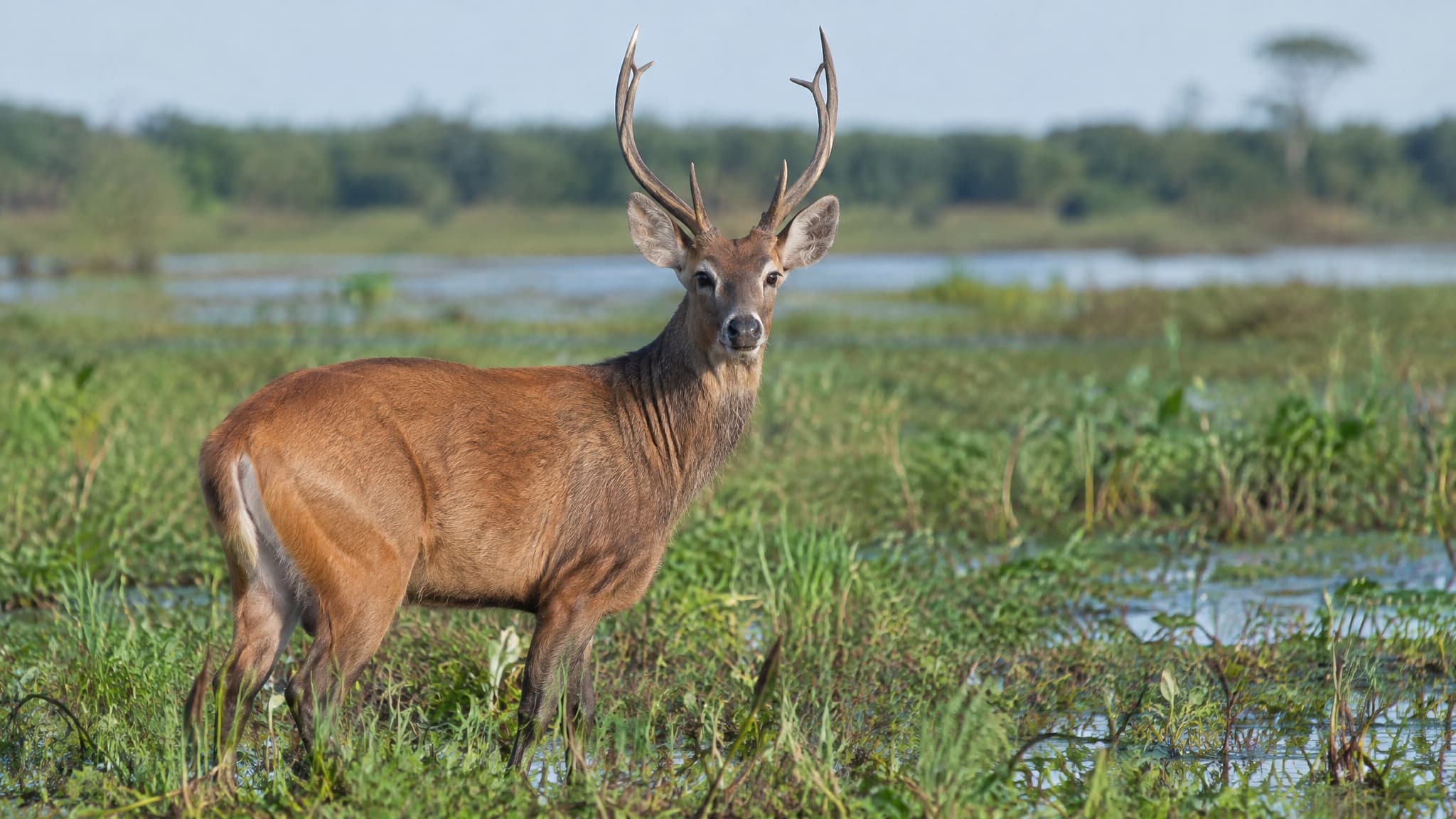
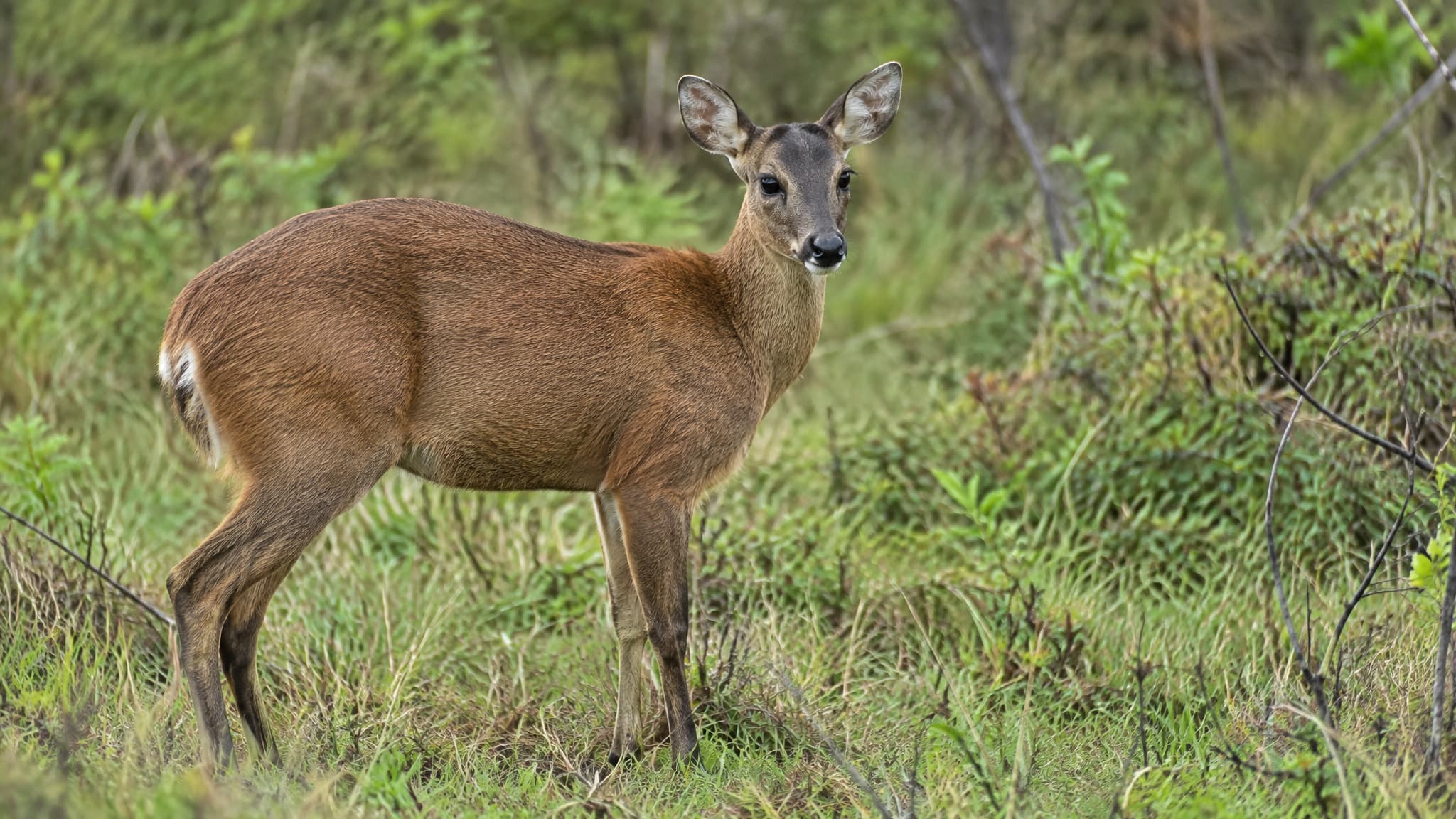
The pampas deer is a medium-sized South American deer and the sole living species in its genus. Its coat is generally tawny to reddish-brown above, with paler underparts and conspicuous white areas on the throat, belly, and around the tail. Males carry branched antlers, commonly with three points per antler, which are shed and regrown through a yearly cycle. In Brazil it is widely known as the veado-campeiro. Historically, this deer occupied extensive open landscapes in eastern and southern South America. Its modern distribution is fragmented into local populations in grasslands, savannas, seasonally flooded plains, and other low-elevation open habitats in countries including Argentina, Brazil, Paraguay, and Uruguay. It favors habitats with a mosaic of short vegetation, foraging sites, and cover, rather than dense forest. It is a ruminant herbivore that selectively feeds on nutritious, easily digested plant parts such as young leaves, shoots, flowers, and shrubs. Pampas deer are mostly sedentary. They may occur alone or in small, fluid groups, although larger temporary gatherings can form at favorable feeding grounds. They rest and ruminate in open areas when conditions are calm, and use scent and visual signals in social and reproductive interactions. Reproduction is seasonal in many populations, though timing varies geographically. Gestation lasts a little over seven months and a female normally gives birth to one fawn, which is concealed in cover during its earliest stage. The species helps shape grassland plant communities through selective browsing and serves as part of the food web of open South American ecosystems. Habitat conversion for agriculture and pasture, fragmentation, illegal hunting, disease transmission from domestic animals, and interactions with introduced species threaten remaining populations. Globally it is listed as Near Threatened, while some Brazilian subspecies receive stronger national threat categories.

View Details
Orca
Mammals

Orca

Orcinus orca

The orca, also called the killer whale, is the largest member of the dolphin family rather than a “true” baleen whale. Its bold black-and-white pattern includes a white underside, white patches behind and above the eyes, and a gray saddle patch behind the dorsal fin. Adults are powerfully built and sexually dimorphic: males are generally larger and carry a tall, nearly upright dorsal fin, while females’ fins are shorter and more curved. Orcas occur in every ocean, from polar pack-ice habitats to tropical seas, and are among the world’s most widely distributed cetaceans. They use open ocean, continental shelves, coastal waters, fjords, and occasionally shallow nearshore areas. They are not one uniform ecological type: geographically distinct populations, often called ecotypes, can differ in body form, calls, movements, prey, and hunting traditions. A highly social apex predator, the orca lives in groups known as pods. Many pods are long-lasting family units centered on maternal relatives. Their communication includes whistles, pulsed calls, and echolocation clicks; in some populations, calls form stable group dialects passed through generations. Hunting is often cooperative and can involve specialized tactics learned socially. Its diet is entirely carnivorous but remarkably variable. Some populations feed mainly on fish, including salmon; others hunt sharks, rays, seabirds, squid, seals, sea lions, dolphins, or even large whales. By influencing the abundance and behavior of prey, orcas can have major ecological effects across marine food webs. Females usually produce one calf after a gestation of roughly 15–18 months, with substantial maternal care and a long learning period. Lifespans can extend for many decades; females may live beyond 80 years, whereas males usually have shorter lives. Globally, Orcinus orca is listed as Data Deficient by the IUCN because population status and taxonomy vary among forms. Important threats to particular populations include prey depletion, chemical contaminants, underwater noise, vessel disturbance, and entanglement or other fisheries interactions.

View Details
Dusky dolphin
Mammals

Dusky dolphin

Lagenorhynchus obscurus

The dusky dolphin is a compact, agile oceanic dolphin recognized by its striking dark-and-pale pattern. Its back and tail are bluish-black to dark gray, the belly is white, and pale gray flank patches are crossed by darker diagonal bands. The short, subtly defined beak, dark lip line, long pointed flippers, and curved dorsal fin help distinguish it from other dolphins. Adults are generally about 1.8–2.1 m long. It occurs in cool to temperate Southern Hemisphere waters, in separated populations off southern South America, southern Africa, Australia, New Zealand, and several sub-Antarctic islands. It is especially associated with productive coastal and continental-shelf waters, although it may travel offshore and dive deeper to feed. Dusky dolphins eat small schooling fishes—such as anchovies, pilchards, and mackerel—as well as squid and crustaceans. They are highly social and often forage cooperatively, herding fish schools toward the surface; this can also attract seabirds that feed on the same prey. Groups may be small while resting but can combine into much larger feeding aggregations. They are celebrated for fast swimming, bow-riding, and energetic leaps. Mating is promiscuous, and reproductive timing differs among regions. Females normally bear one calf after roughly 11–13 months of gestation; nursing lasts about a year or longer, so births commonly occur at intervals of around two years. Longevity is incompletely known and varies among populations, but animals at least 22 years old have been recorded. As a mid-level marine predator, the species helps link dense schools of fish and squid with larger predators, including killer whales and some sharks. The IUCN lists it as Least Concern globally, but population information remains limited. Accidental capture in fishing gear, direct killing in parts of South America, and disturbance from poorly managed dolphin-watching are important threats in parts of its range.

View Details
Short-beaked common dolphin
Mammals

Short-beaked common dolphin

Delphinus delphis

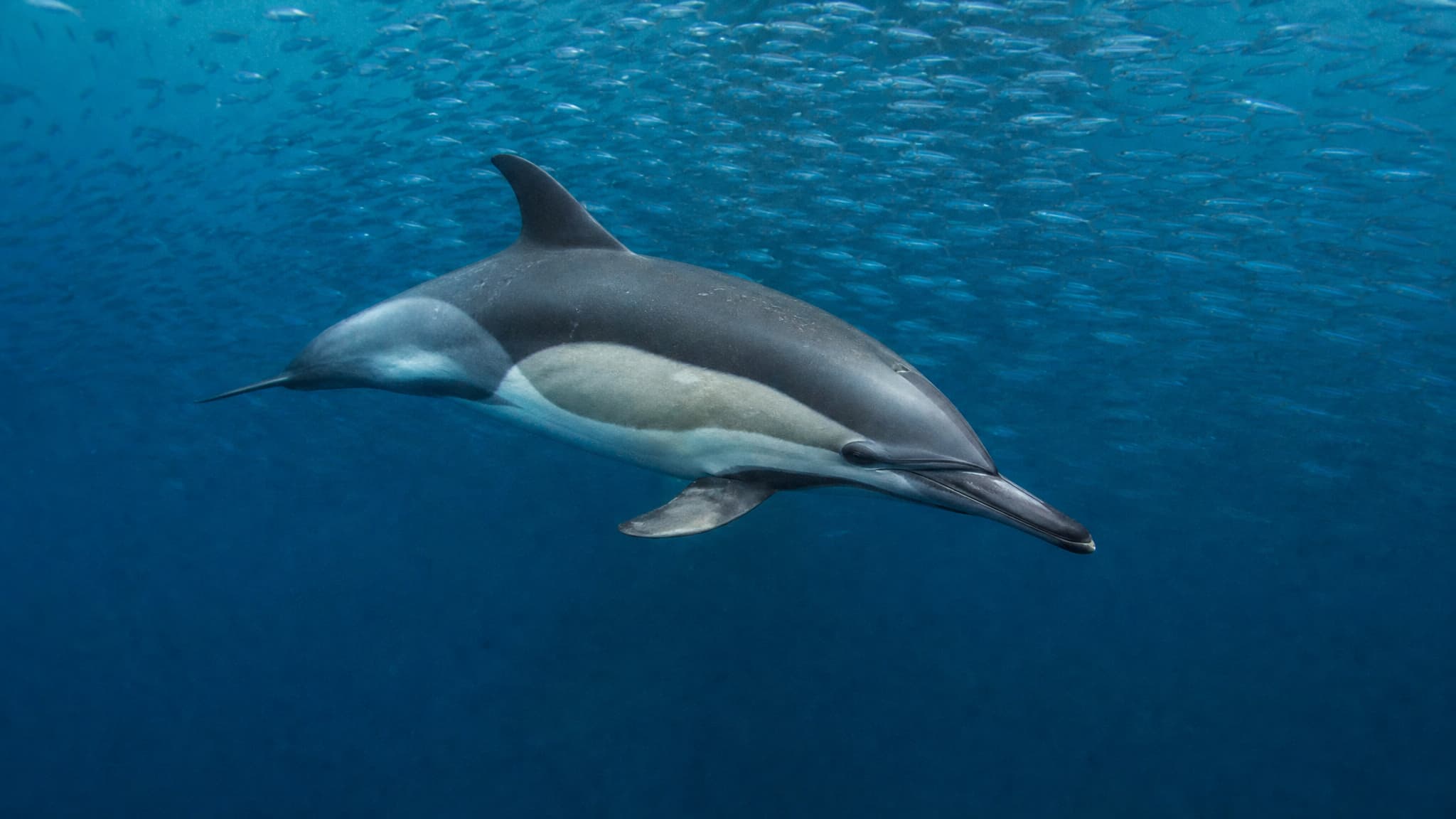
The short-beaked common dolphin (Delphinus delphis) is a sleek, highly social oceanic dolphin known for its striking, hourglass-like flank pattern. Adults are generally 1.8–2.4 m long, with males slightly larger than females. A dark gray to black cape covers the back, while yellowish-tan and pale gray panels brighten the sides; a dark stripe runs from the lower jaw toward the flipper. Its moderately long beak, rounded forehead, triangular dorsal fin, and many small pointed teeth help distinguish it from other dolphins. This species has a broad, near-global distribution in tropical, subtropical, and temperate seas. It occurs chiefly offshore but can use continental-shelf waters and coastal areas. Common dolphins often gather near continental slopes, seamounts, ridges, and currents such as the Gulf Stream, where nutrient-rich upwelling supports dense concentrations of prey. Pods commonly contain hundreds of dolphins and sometimes form aggregations of thousands. They are energetic swimmers, frequently leap, porpoise at the surface, and may ride a vessel’s bow wave. Sound is central to their lives: as toothed whales, they use clicks for echolocation and whistles and other calls for social communication. They may associate with tuna, seabirds, and other dolphin species where feeding opportunities overlap. Short-beaked common dolphins mainly eat schooling fishes and cephalopods, including squid. They often feed at night, when vertically migrating prey becomes more accessible near the surface, though they can make much deeper dives. As mobile mid-level predators, they help transfer energy from fish and squid populations to larger marine predators and are themselves vulnerable to attacks by sharks and killer whales. Females usually bear one calf every two to three years after a gestation of roughly 10–11 months. Calves nurse for about a year and may remain dependent on their mothers for longer. Lifespan is estimated at up to about 35 years. Globally the species is listed as Least Concern, yet bycatch and entanglement in fishing gear, hunting in some regions, vessel disturbance, noise, and pollution can seriously affect local populations.

View Details
Commerson's dolphin
Mammals

Commerson's dolphin

Cephalorhynchus commersonii

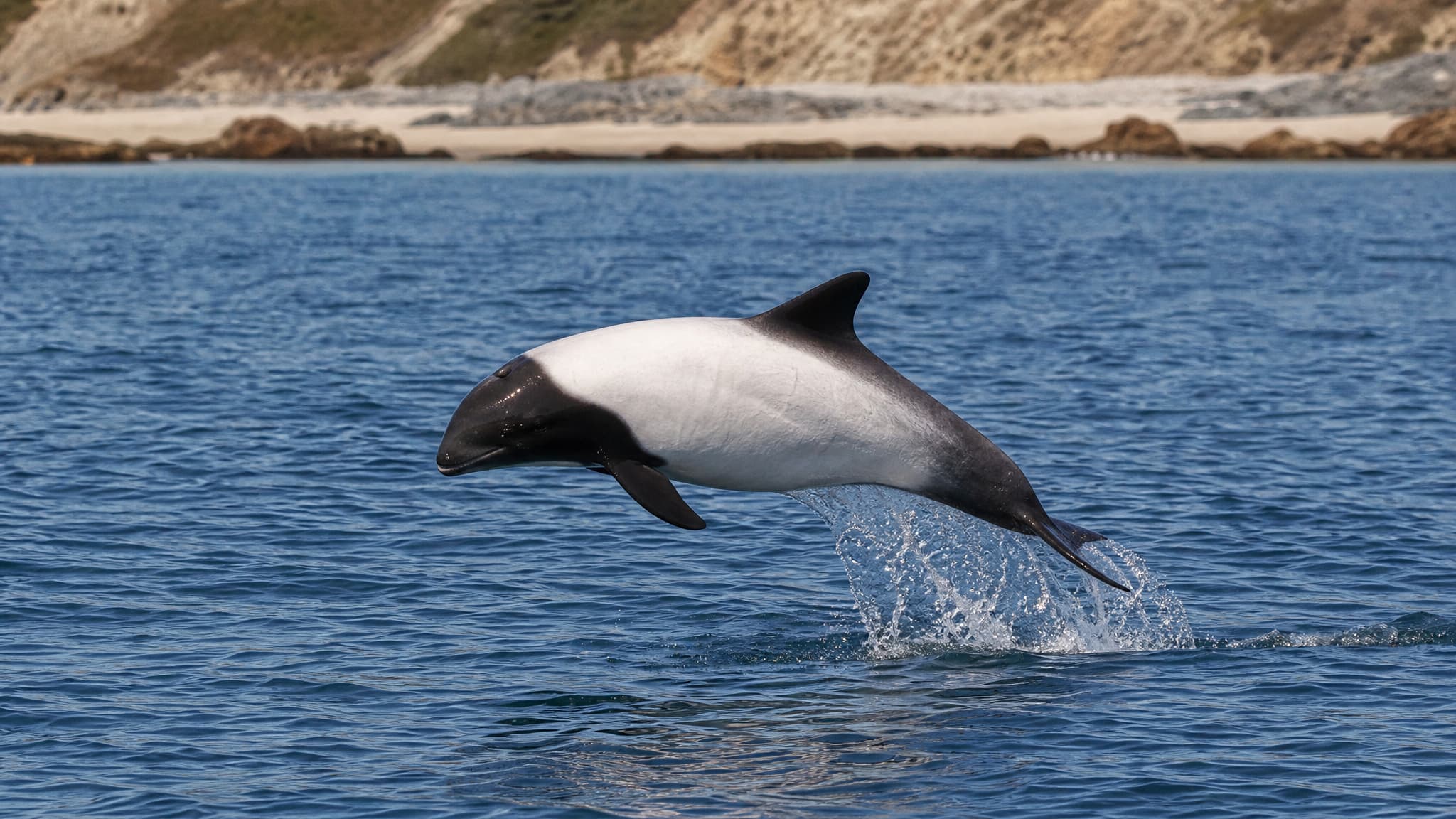
Commerson’s dolphin is a compact, small coastal dolphin famous for its sharply contrasting black-and-white pattern. Adults are usually about 1.2–1.5 m long and weigh roughly 35–65 kg, although some southern records give a slightly larger upper size. Its head is blunt, the beak is extremely short or indistinct, and its rounded flippers and low, rounded dorsal fin give it a porpoise-like outline. The white throat and body are set off by black on the head, fins, flukes, and parts of the sides; the form of the dark genital patch differs between sexes. Calves begin life in softer gray-and-black tones and develop the familiar high-contrast coloration over their first months. The species occurs in two widely separated cold-water regions. Most animals live around southern South America, including Patagonia, Tierra del Fuego, the Strait of Magellan, Cape Horn, and the Falkland Islands. A second, isolated population occurs around the Kerguelen Islands and nearby southern Indian Ocean waters. Commerson’s dolphins favor shallow continental-shelf and nearshore habitats—bays, harbors, estuaries, kelp beds, tidal channels, and river mouths—and generally remain within about 200 m depth. They may shift seasonally in response to prey movements and are often associated with strong tidal currents. An active, fast-swimming predator, this dolphin feeds opportunistically on small fishes, squid and octopus, mysid shrimps, and other bottom or midwater invertebrates. It may hunt alone, but cooperative herding is also documented: small groups can circle a school of fish or press prey toward shore. Individuals commonly occur in pairs or very small groups, though larger aggregations sometimes form. Echolocation supports navigation and prey detection, while their conspicuous behavior includes wave-riding, rapid turns, leaps, and interactions with vessels and other marine wildlife. Breeding is seasonal in southern populations, with mating reported from late September into February. Females normally produce one calf after about 10–12 months of gestation; newborns are delivered tail-first and remain close to their mothers while nursing. Females mature at roughly 5–8 years and males at about 6–9 years. Wild longevity is imperfectly known, but individuals have been recorded to at least 23 years, and captive animals have lived longer. As a mesopredator, the species links small fish and invertebrate communities to larger marine food webs. It is assessed as Least Concern, yet coastal gill-net and trawl bycatch, historical killing for food or bait, and marine contaminants remain important local concerns.

View Details
Hector's dolphin
Mammals

Hector's dolphin

Cephalorhynchus hectori

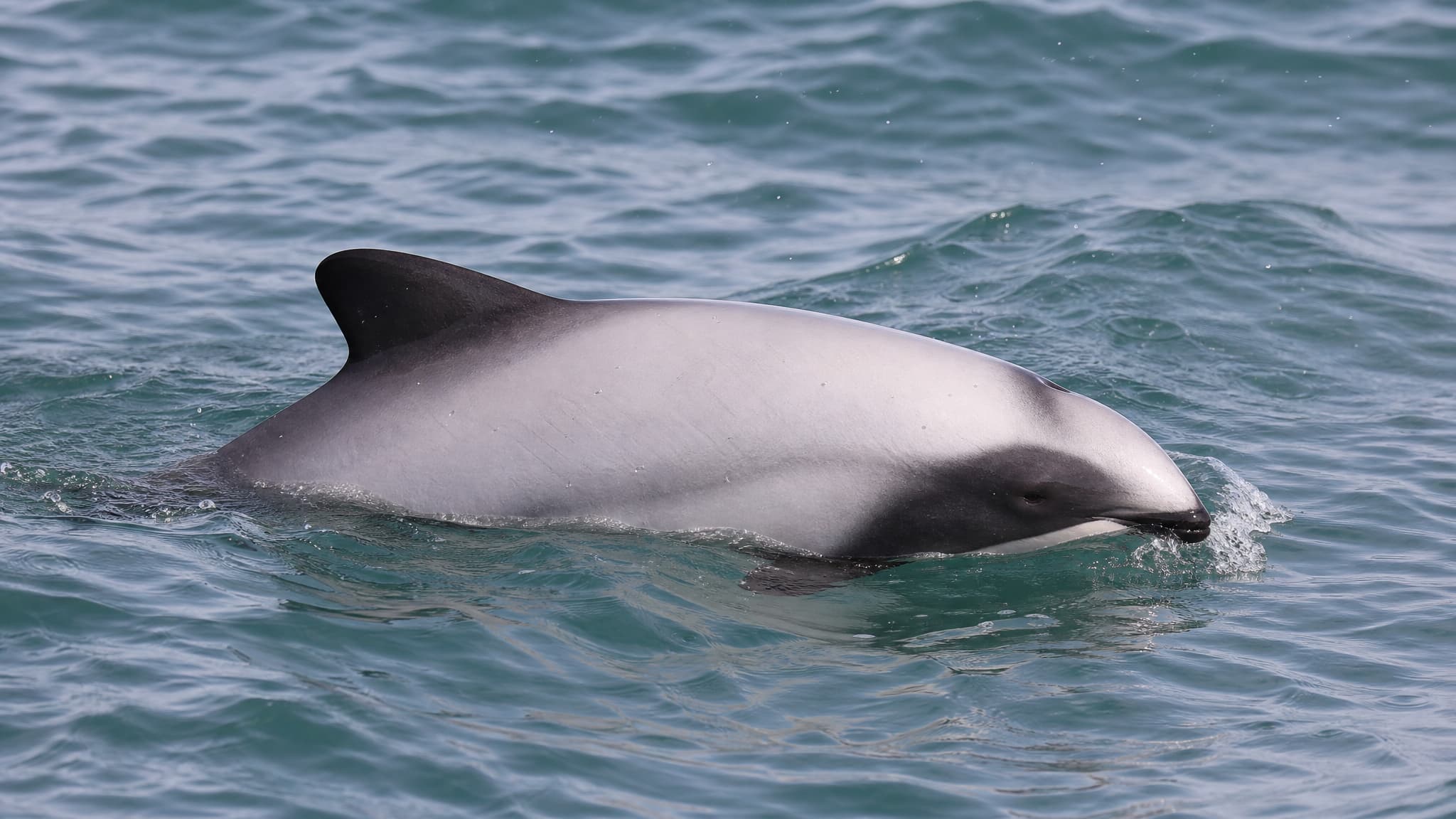
Hector’s dolphin is a compact coastal dolphin endemic to New Zealand and among the smallest living cetaceans. Adults are usually about 1.5 m long and weigh roughly 50–60 kg. Its most recognizable feature is the rounded dorsal fin, often compared with a Mickey Mouse ear. The body is pale grey, marked with black on the face, flippers, fin, and tail, plus a white underside and contrasting side stripes. The species lives in temperate, shallow coastal seas, generally close to shore and commonly in water under 90 m deep. Most animals occur around New Zealand’s South Island, while the very small Māui population occurs off the west coast of the North Island. Groups show strong fidelity to local areas, so neighboring coastal populations can remain relatively separated. Hector’s dolphins feed on small fishes, squid and other cephalopods, and crustaceans. They use echolocation to locate prey and navigate, make short dives, and usually travel in small social groups. As agile nearshore predators, they help link fish and invertebrate prey with larger marine predators and are indicators of the condition of New Zealand’s coastal ecosystems. Females mature at roughly 6–9 years of age and normally bear one calf at intervals of about two to four years. A calf can remain dependent on its mother for as long as two years, and the documented lifespan is at least 22 years. The species is listed as Endangered globally. Entanglement in commercial and recreational gillnets and trawls is the leading threat; disease, vessel strikes, underwater noise, pollution, habitat change, and its slow reproductive rate add to its vulnerability.

View Details
Pygmy Killer Whale
Mammals

Pygmy Killer Whale

Feresa attenuata

Pygmy killer whale The pygmy killer whale is a small, dark-bodied oceanic dolphin—not a miniature form of the killer whale. Adults can reach about 2.6 m (8.5 ft) in length and have a blunt, rounded head without a distinct beak, a tall curved dorsal fin, and comparatively long flippers with rounded tips. Its body is generally charcoal gray to black, often with paler gray or whitish areas around the lips, face, and underside. At sea it can be difficult to distinguish from the melon-headed whale and false killer whale, especially in brief or distant sightings. This species occurs widely, though patchily documented, in tropical and subtropical waters of the Atlantic, Indian, and Pacific oceans. It is usually associated with deep offshore water, but it may occur near islands and occasionally closer to shore. Sightings are uncommon, partly because the animals can be elusive and avoid vessels; consequently, much of what is known has come from strandings and a few long-term field studies, particularly around Hawai‘i. Pygmy killer whales are social toothed whales. Groups commonly contain a few to several dozen animals, although much larger aggregations have been reported. They communicate and orient in an acoustic environment, as do other dolphins, and underwater noise can disrupt activities dependent on sound. Evidence from stomach contents shows a carnivorous diet including fishes and cephalopods such as squid and octopus; some records also indicate predation on small cetaceans. By feeding on mid-water fishes and cephalopods, they function as upper-level predators in warm-water pelagic food webs. Reproduction remains incompletely documented. Females give birth to a single calf, reported at roughly 0.8 m long, but gestation length, breeding timing, and parental-care duration are not well established. Wild lifespan is also unknown; however, photo-identification research in Hawai‘i recorded at least one individual over a 21-year interval, showing that individuals can be long-lived. The species is globally assessed as Least Concern, yet important uncertainties remain because abundance and population trends are poorly known. Entanglement or capture in fishing gear, deliberate hunting in some regions, and anthropogenic ocean noise are recognized threats.

View Details
Short-finned pilot whale
Mammals

Short-finned pilot whale

Globicephala macrorhynchus

The short-finned pilot whale is a large, dark-colored oceanic dolphin rather than a baleen whale. It has a rounded, prominent melon, no conspicuous beak, a low sickle-shaped dorsal fin, and relatively short, narrow flippers. A pale gray-to-white, anchor-shaped chest patch and a gray saddle behind the dorsal fin are often visible. Males are substantially larger than females, reaching roughly 4–7 m in length. This species occurs around the world in warm temperate, subtropical, and tropical seas. It commonly uses deep water near continental slopes and shelves, although it may also occur offshore in the open ocean. It can be difficult to distinguish from the long-finned pilot whale at sea, especially where the two species’ ranges approach one another. Highly social and vocal, short-finned pilot whales live in stable, female-centered family groups, usually numbering dozens but sometimes hundreds. They communicate with clicks and whistles and make fast, deep dives to find prey. Squid is their principal food, supplemented by octopus and fishes; by feeding on deep-water cephalopods, they are important predators in offshore marine food webs. Females generally remain with their natal group, while males often disperse. A single calf follows a gestation of about 15 months and nurses for at least two years; births tend to be spaced about 5–8 years apart. Females may live to about 60 years and males about 45 years. The species is globally assessed as Least Concern, but it remains vulnerable to fishery bycatch, directed hunting in some places, vessel strikes, ocean noise, and mass-stranding events linked in part to its strong social cohesion.

View Details
Long-finned pilot whale
Mammals

Long-finned pilot whale

Globicephala melas

The long-finned pilot whale is a large, highly social oceanic dolphin rather than a true baleen whale. It is recognizable by its rounded, bulbous forehead, dark body, low curved dorsal fin, and exceptionally long, tapered flippers. Pale gray or whitish markings may form an eye stripe, a saddle behind the dorsal fin, and an anchor-like patch along the throat and belly. Males are markedly larger than females and may reach about 8.5 m in length. This species has an antitropical distribution: it occurs in temperate to subpolar waters of the North Atlantic and in southern oceans, while being largely absent from equatorial seas. It usually favors deep offshore water, continental slopes, and shelf edges, but may enter coastal areas seasonally. Its southern range includes waters off southern South America, southern Africa, Australia, New Zealand, and southeastern Brazil. Long-finned pilot whales live in close, maternally based pods, commonly numbering dozens of animals and sometimes gathering in much larger aggregations. They communicate with whistles and other sounds, use echolocation to find food, and may rest together at the surface in conspicuous aligned formations. Their strong social bonds are also thought to contribute to their tendency for mass strandings. They are carnivorous predators that feed especially on squid and other cephalopods, while also taking fish and crustaceans. Deep dives, often lasting 10–16 minutes, allow them to forage in dim water; much feeding may occur at night. By consuming substantial quantities of squid and fish, they are important predators in offshore marine food webs. Females usually mature at about eight years and males at roughly 12–13 years. A female generally produces one calf after a 12–16 month gestation, with births separated by approximately three to six years. Calves nurse for a prolonged period, and older females can help care for young. Females may live at least 60 years, whereas males commonly live around 35–45 years. Globally the species is assessed as Least Concern, but entanglement and hooking in fisheries, hunting in some areas, chemical contaminants, disease, and underwater noise remain important pressures.

View Details
Risso’s dolphin
Mammals

Risso’s dolphin

Grampus griseus

The Risso’s dolphin is a robust, medium-sized oceanic dolphin recognized by its rounded, almost beakless head, a vertical crease on the forehead, and a tall, curved dorsal fin. Adults measure roughly 2.6–4 m long and may weigh about 300–500 kg. Calves are dark gray to brown, but adults progressively become pale gray or nearly white. Their bodies often carry a dense network of pale tooth-rake scars from social interactions, plus marks left by squid, cookie-cutter sharks, and lampreys. This species occurs across temperate, subtropical, and tropical seas worldwide, including Brazilian waters. It usually favors deep offshore habitats, particularly around continental-shelf edges, slopes, and steep underwater terrain, although it can also enter shallower coastal areas. Risso’s dolphins can dive at least 300 m and remain submerged for up to about 30 minutes, but many dives are shorter. Squid is the principal food, supplemented by other cephalopods, fish, and krill. Much feeding occurs at night, when prey rises closer to the surface. They are social cetaceans, most often seen in groups of 10–30, though solitary animals and much larger aggregations have been recorded. Surface behavior can be conspicuous: individuals may breach, slap their flippers or tail, spyhop, and communicate using clicks and other sounds. As predators of squid and fish, they help transfer energy from deeper-water prey into the marine food web. Breeding and births can occur throughout the year, with seasonal peaks varying among regions. Gestation lasts approximately 13–14 months, and newborns are about 1.1–1.7 m long. The species is known to live at least 35 years. Globally, it is assessed as Least Concern, owing to its broad distribution, but it faces localized risks from entanglement in fishing gear, deliberate hunting in some areas, chemical contamination, and disruptive underwater noise. Its long life and high position in the food chain can make accumulated pollutants especially harmful.

View Details
Fraser's dolphin
Mammals

Fraser's dolphin

Lagenodelphis hosei

The Fraser’s dolphin is a compact, oceanic dolphin with a short but clearly defined beak, a small triangular dorsal fin, and relatively small flippers and tail flukes. Its back is bluish- to brownish-gray, while the underside is pale cream, white, or sometimes pinkish. A dark stripe runs from the eye along the flank toward the pectoral fin; it is generally broader and darker in adult males. Adults measure roughly 1.8–2.7 m and can weigh about 160–200 kg. This species occurs in warm temperate, subtropical, and tropical seas of the Atlantic, Indian, and Pacific Oceans. It is chiefly a pelagic dolphin, favoring deep offshore waters—often around steep continental slopes, narrow shelves, and productive upwelling zones. In places where deep water comes close to shore, it may also be encountered near coasts. Its offshore habits and at-times inconspicuous behavior mean that it remains less familiar than many coastal dolphins. Fraser’s dolphins are highly social and most often travel in tight schools of 10–100 animals, although aggregations of several hundred or even around 1,000 have been reported. Schools may form long, aligned swimming rows and can associate with other cetaceans. They make deep dives, reaching about 600 m, to capture mesopelagic fishes as well as squid, other cephalopods, and crustaceans. As a predator of organisms from deeper pelagic layers, the species is part of the food web connecting offshore surface waters with the mesopelagic zone. Females usually bear one calf after a gestation of about 10–12.5 months, with births reported mainly from spring through autumn in studied populations. Females mature at about 5–8 years and males at about 7–10 years; documented life expectancy is at least 18 years. The IUCN category is Least Concern, but the global population size and trend remain uncertain. Entanglement or capture in fishing gear—including gillnets, purse seines, trawls, and longlines—and directed hunting for meat or oil in parts of its range are important recorded pressures.

View Details
White-beaked Dolphin
Mammals

White-beaked Dolphin

Lagenorhynchus albirostris

The white-beaked dolphin is a robust, cold-water oceanic dolphin named for its short, thick beak, which commonly has pale or white lips and may be mottled gray. Adults are usually about 2.4–3.2 m long and weigh roughly 180–350 kg; males tend to be larger. Its back is dark gray to black, while irregular light-gray or white areas occur along the flanks, behind the dorsal fin, and on the belly. The tall, curved dorsal fin, dark flippers, and dark tail flukes are useful field marks. This species occurs across temperate and subpolar parts of the North Atlantic. Its range includes eastern North America from Massachusetts to Newfoundland, Greenland, Iceland, the British Isles, Scandinavia, and the Barents Sea, extending south in European waters to north of Portugal. It favors cool coastal and shelf waters, generally in water shallower than about 200 m, although it also travels offshore. Seasonal movements commonly take animals farther south and offshore in winter, then northward and nearer shore as summer ice recedes. White-beaked dolphins are energetic, social swimmers, most often encountered in groups of 5–30 but occasionally in much larger gatherings. They leap, breach, and may ride vessel-generated waves. They feed cooperatively at the surface and also forage near the seabed, taking schooling fishes such as cod, herring, haddock, hake, and whiting, as well as squid, octopus, shrimp, and crabs. As a mobile predator, the species helps link pelagic and bottom-associated prey within North Atlantic marine food webs. Females carry a single calf for about 11 months, with births generally recorded from May through September. Newborns are about 1.1–1.2 m long, and sexual maturity is reached at approximately 7–12 years. A dependable maximum lifespan has not been established. The species is assessed as Least Concern, but its global abundance remains uncertain. Entanglement in fishing gear, directed hunting in parts of the North Atlantic, and vessel, industrial, or military underwater noise are recognized threats; it is protected in U.S. waters under the Marine Mammal Protection Act.

View Details
Northern right whale dolphin
Mammals

Northern right whale dolphin

Lissodelphis borealis

The northern right whale dolphin is a streamlined oceanic dolphin distinguished by an extraordinary feature: it has no dorsal fin. Its upper body is glossy black, while a sharply contrasting white patch begins at the throat and extends along the underside toward the tail. Adults are slender, with a short beak and sloping forehead, and measure about 2–3 m (6.5–10 ft) long. Males are generally larger than females. This species inhabits deep, cool to warm-temperate waters of the North Pacific, broadly between about 30° and 50° N. Its range extends from Baja California and the Gulf of Alaska across the ocean to waters near Japan and Kamchatka. It usually occurs offshore or near the continental-shelf edge, but may approach the coast where submarine canyons bring deep water close to land. Seasonal shifts in distribution appear linked to changing water temperatures and prey. Northern right whale dolphins are notably social. Groups commonly contain roughly 100–200 animals, although gatherings of thousands have been reported, sometimes alongside Pacific white-sided dolphins, pilot whales, or other cetaceans. Fast, graceful swimmers, they can make low leaps and occasionally ride vessel wakes. They use clicks and pulsed calls, rather than the familiar whistles of many dolphins, and can dive for several minutes while foraging. Their food is mainly mesopelagic fish—especially lanternfishes—and cephalopods such as squid. By feeding on abundant midwater animals, they are predators within the North Pacific pelagic food web. Females carry one calf for about a year, with births apparently peaking in summer and at least two years generally separating calves. Sexual maturity is reached near age ten, and longevity is estimated at 42 years or more. The species is assessed as Least Concern globally, but it faces real local and historical pressures. Incidental capture and entanglement in driftnets, gillnets, and other fishing gear can injure or kill dolphins; underwater noise can also disrupt communication, echolocation, feeding, and orientation. Northern right whale dolphins are protected under the U.S. Marine Mammal Protection Act and listed in CITES Appendix II.

View Details
Southern right whale dolphin
Mammals

Southern right whale dolphin

Lissodelphis peronii

The southern right whale dolphin is a sleek oceanic dolphin of the Southern Hemisphere and one of the few dolphins with no dorsal fin or dorsal ridge. Adults have a strongly contrasting pattern: the back is black, while the front of the head, underside, flanks, and much of the flippers are white. The boundary between dark and light forms a distinctive sweeping curve along the body. Calves are less sharply patterned, often showing gray or brown tones before acquiring the adult coloration. It is a circumpolar species of cool-temperate and subantarctic seas, generally associated with the waters between subtropical and Antarctic convergence zones. It is principally pelagic, occurring far offshore over deep water, though it may approach coasts where deep water lies close to land. Records extend around southern South America, southern Africa, Australia, New Zealand, and the Southern Ocean; cold currents can carry it unusually far north along western continental coasts. Southern right whale dolphins are active, rapid swimmers. They usually travel in social groups, from small parties to very large schools that can exceed 1,000 animals, and may associate with dusky dolphins and pilot whales. Fast-moving groups make low, clean leaps and can slap their flukes or bodies on the surface. Their prey includes fishes and squid, especially lanternfishes, making them predators in the offshore food web. Scientific knowledge of reproduction remains limited. Sightings of calves are more frequent in winter and early spring, but a definite calving season, mating system, gestation period, and parental-care pattern have not been established. Published evidence is also insufficient to give a reliable lifespan in the wild. This lack of basic life-history information is important when interpreting population trends. The species is globally assessed as Least Concern, reflecting its broad distribution and the absence of evidence for a severe range-wide decline. Nevertheless, it is infrequently studied because it lives mainly offshore. Documented and potential pressures include incidental capture in fishing gear—particularly gillnets—and direct takes reported in parts of Peru and Chile. Continued monitoring of bycatch, strandings, and offshore populations is needed to detect threats that could be obscured by limited observations.

View Details
Irrawaddy dolphin
Mammals

Irrawaddy dolphin

Orcaella brevirostris

The Irrawaddy dolphin is a compact, round-headed toothed whale with a distinctive, almost beakless face. Its forehead is broad and bulging, the neck is unusually flexible, and a small triangular dorsal fin sits well back on the body. Adults are slate blue to gray above and paler below, with broad paddle-shaped flippers. They generally measure about 1.5–2.75 m long and can weigh more than 100 kg. Despite its name, this is not solely a river dolphin. Orcaella brevirostris occurs in tropical and subtropical South and Southeast Asia, from coastal waters of the Bay of Bengal through parts of Southeast Asia. It favors sheltered, turbid nearshore seas, estuaries, deltas, brackish lagoons, and some large rivers. Well-known inland groups occur in the Ayeyarwady, Mahakam, and Mekong river systems, while others live in places such as Chilika Lake and Songkhla Lake. Irrawaddy dolphins usually travel in small social groups and use acoustic signals, including echolocation, to navigate and locate prey in cloudy water. Their diet includes fishes, crustaceans, and cephalopods. In Myanmar's Ayeyarwady River, some dolphins have been documented cooperatively herding fish with cast-net fishers, a notable interaction in which both people and dolphins may gain feeding opportunities. As predators, they help link fish and invertebrate populations within coastal and river ecosystems. Females normally produce one calf after a gestation estimated at roughly 9–14 months, and young may nurse for about two years. Reproduction is slow, with births in some populations separated by several years; this makes losses of adults particularly serious. Wild individuals have been estimated to reach about 28–30 years or more. The species is globally Endangered, threatened chiefly by entanglement in fishing gear, prey depletion, pollution, vessel disturbance, and degradation or fragmentation of riverine and coastal habitat, including dams in some freshwater systems.

View Details
Australian snubfin dolphin
Mammals

Australian snubfin dolphin

Orcaella heinsohni

Australian snubfin dolphin The Australian snubfin dolphin, Orcaella heinsohni, is a small, coastal toothed whale distinguished by its rounded forehead, very short beak, flexible-looking neck, and small, curved dorsal fin. Adults are usually about 2.1–2.4 m long and weigh roughly 114–133 kg. Their blue-grey to grey body has a conspicuous pale belly, creating a three-part colour pattern that helps distinguish them externally from the closely related Irrawaddy dolphin. It occurs in tropical, nearshore waters of northern Australia and southern New Guinea, with records also extending to Indonesian waters. Rather than ranging far offshore, it favors sheltered, shallow bays, estuaries, tidal creeks, river mouths, seagrass areas, and reef-associated coastal waters—usually in water less than 30 m deep. This close association with the coast makes local groups especially exposed to human activity. Australian snubfin dolphins are social but are often seen in small groups, commonly while travelling or feeding. They use clicks and whistles for communication and echolocation. They are adaptable carnivores that take coastal fishes as well as squid, cuttlefish, other cephalopods, and crustaceans. As predators in estuarine and coastal food webs, they help link populations of smaller marine animals with the wider ecosystem. Knowledge of their breeding biology is still limited. A single calf is generally born after an estimated gestation of about 14 months, and calves remain dependent on their mothers for milk and protection. Individuals reach adult size at approximately four to six years; recorded longevity exceeds 20 years and may approach 28 years. Their slow life history and low reproductive output mean that deaths of adults can have lasting effects on small local populations. The species is assessed globally as Vulnerable. Entanglement and bycatch in fishing gear, especially gillnets, are major threats. Coastal construction, pollution, vessel disturbance or strikes, underwater noise, reduced prey, disease, and climate-driven degradation of seagrass, mangrove, and reef habitats add cumulative pressure. Protecting high-use shallow-water habitat and reducing fishery interactions are central conservation needs.

View Details
Melon-headed whale
Mammals

Melon-headed whale

Peponocephala electra

Melon-headed whale The melon-headed whale is a compact, dark-colored oceanic dolphin despite its common name. Adults are generally about 2–3 m long, with a robust, torpedo-shaped body, a small rounded forehead or “melon,” and virtually no visible beak. A dark cape lies across the back, while subtle darker facial patches and paler lips or throat markings may be present. Its pointed flippers and relatively tall, curved dorsal fin help distinguish it from the very similar pygmy killer whale. It occurs in warm tropical and subtropical seas around the world, usually over deep offshore water. In some places, however, it approaches islands and coasts where deep water lies close to shore. In Hawaiian waters, research recognizes a wide-ranging deep-water population and a smaller population associated with shallower coastal habitat around the island of Hawaiʻi. This is a highly social cetacean, commonly traveling in schools of hundreds and sometimes more than a thousand animals. Groups can be tightly coordinated and energetic, making quick, low leaps and occasionally associating with other dolphins. They tend to rest in the morning, socialize later in the day, and forage mainly at night. Their prey includes fish, squid, cuttlefish, and shrimp; like other toothed whales, they use sound and echolocation in their marine environment. Females mature at roughly seven years, while males mature later, at approximately 12–15 years. Gestation lasts about 12 months, a single calf is typical, and births are thought to recur every three to four years. Individuals may live up to about 45 years. As mid-level predators, melon-headed whales help link deep-water cephalopod and fish communities with larger marine food webs. The species is assessed as Least Concern globally, but its total worldwide abundance is not fully known. Risks include incidental capture in fisheries, directed hunts in a few areas, ocean noise, and pollution. Large groups can also be vulnerable to unusual near-shore entrapments or mass-stranding events, making protection of offshore habitat and reduction of human-caused marine disturbance important.

View Details
False killer whale
Mammals

False killer whale

Pseudorca crassidens

The false killer whale (Pseudorca crassidens) is a large, sleek oceanic dolphin—not a true whale and not an orca. Its name refers to skull features that resemble those of the killer whale. Adults are mostly black to very dark gray, sometimes with paler gray on the head or flanks. They have a rounded forehead, a long tapered body, a narrow blunt-tipped snout, and a tall, curved dorsal fin. The long flippers have a characteristic bend or hump along the leading edge. Males can reach about 6 m (20 ft), while females are usually smaller. This species occurs widely in tropical, subtropical, and warm-temperate waters of the Atlantic, Indian, and Pacific oceans. It is primarily an offshore, deep-water cetacean, but may also travel near islands, continental shelves, and coasts. Sightings occur irregularly across much of its range, whereas some island-associated populations show more localized movements. The false killer whale is the only living species in the genus Pseudorca. False killer whales are highly social, usually travelling in groups that can range from a few animals to many dozens. They use whistles and other vocalizations, as well as echolocation, to communicate and navigate. Fast, powerful swimmers, they may ride vessel wakes, bow-ride, and leap clear of the water. Their strong teeth and cooperative social behavior help them capture prey, and adults have been observed sharing or handling fish in ways that can help calves feed. They are carnivores that eat chiefly fish and squid, including large pelagic fishes such as tunas and mahi-mahi; in some areas they also take other dolphins or marine mammals. As upper-level predators, they help shape pelagic food webs. Much of their life history remains difficult to study because they live offshore. Available evidence indicates a long-lived species: females may live up to about 63 years and males about 58 years. Females generally produce a single calf after a gestation of roughly 15 months, with births spaced several years apart. Globally, the false killer whale is classified as Near Threatened. Reliable worldwide abundance estimates are limited, and some regional populations are small or declining. Major pressures include accidental hooking or entanglement in longline fisheries, removal of hooked fish or bait from lines that increases such interactions, pollutants, prey depletion, and direct hunting in a few places. The insular population around the main Hawaiian Islands is especially imperiled and receives additional U.S. legal protection.

View Details
Guiana dolphin
Mammals

Guiana dolphin

Sotalia guianensis

The Guiana dolphin is a small coastal member of the dolphin family, distinguished by its moderately long beak, compact body, and gray upperparts. Its flanks are gray and the underside is usually pale; the belly may flush pink when the animal is excited. Adults can reach roughly 2 m in length, while calves are born at about 75–98 cm. Males and females are not readily distinguishable in the field. It occurs in the western Atlantic from Honduras southward along the coasts of Central and South America to southern Brazil. Rather than inhabiting the open ocean, it favors shallow, productive nearshore waters: sheltered bays, estuaries, lagoons, river mouths, and mangrove-associated coastlines. Many local populations show strong site fidelity and may remain in the same coastal area year-round. Guiana dolphins usually travel in small, fluid groups, although larger gatherings occur in some places. They forage actively for fish and also take squid and shrimp. As a mid-level marine predator, they help transfer energy from fish and invertebrate prey through coastal food webs. Mothers remain closely associated with calves, nursing them and helping them acquire the skills needed to capture prey; maximum lifespan has been estimated at about 30–35 years, though longevity remains incompletely known. The species is globally listed as Near Threatened. Its close association with densely used coasts makes it vulnerable to accidental capture in fishing gear, vessel strikes and disturbance, underwater noise, chemical contamination, disease, and the loss or degradation of estuarine habitat. Brazil assesses it as Vulnerable nationally, reflecting documented declines and severe local pressures in parts of its range. Protecting mangroves, estuaries, and fishing practices that reduce bycatch is therefore central to its conservation.

View Details
Indo-Pacific humpback dolphin
Mammals

Indo-Pacific humpback dolphin

Sousa chinensis

Indo-Pacific humpback dolphin The Indo-Pacific humpback dolphin, Sousa chinensis, is a robust coastal dolphin distinguished by the low fatty ridge or “hump” beneath its dorsal fin. Adults are usually about 1.8–3 m long. Color varies greatly across its range: many animals are gray to brownish gray, while dolphins in parts of southern China and Southeast Asia can become pale, white, or white with a pink flush and darker speckles. The pink appearance is associated with blood vessels visible through relatively lightly pigmented skin, rather than with pink fur or scales. This species lives in warm, shallow nearshore waters of South and Southeast Asia, from the Bay of Bengal eastward to coastal China and south through the Indo-Malay region. It favors estuaries, river mouths, bays, mangrove-fringed coasts, sandy shallows, and reef-associated coastal habitat. Its distribution is patchy because it is closely tied to narrow belts of productive coastal water rather than the open ocean. Indo-Pacific humpback dolphins feed chiefly on fishes found near coasts, estuaries, and reefs; cephalopods are also eaten in some places. They usually occur alone or in small, changeable groups, although larger gatherings may form where prey is concentrated or around fishing activity. As predators in estuarine and coastal food webs, they link fish populations with the larger marine ecosystem and can signal the condition of heavily used shore habitats. Females generally bear a single calf after a gestation of roughly 10–12 months. Calves are around 1 m long at birth and depend extensively on their mothers; mother–calf associations can continue for several years. Available accounts indicate a long life history, with individuals capable of living for about 40 years or more, but slow reproduction makes local populations less able to recover from sustained losses. The species is globally assessed as Vulnerable. Entanglement in gillnets, trawls, and other fishing gear, along with coastal construction, land reclamation, vessel traffic, pollution, and degradation of estuaries, are major concerns. Because many populations are small, isolated, and live beside densely populated coasts, protecting intact estuaries and reducing bycatch are central conservation needs.

View Details
Indian Ocean humpback dolphin
Mammals

Indian Ocean humpback dolphin

Sousa plumbea

Indian Ocean humpback dolphin (Sousa plumbea) is a coastal dolphin distinguished by the low, broad hump that supports its dorsal fin. It has a long, narrow beak and a robust body, usually brownish gray to darker gray above with a paler underside; coloration and spotting vary with age and region. Adults are commonly about 2–2.8 m long, and males can be larger than females. This species lives extremely close to shore in the tropical and subtropical Indian Ocean. Its range extends from southern Africa along East Africa and through the Red Sea, Gulf of Aden, Arabian Sea, and Arabian/Persian Gulf to India and Sri Lanka. It favors shallow water, generally under about 20–25 m deep, including estuaries, river mouths, mangroves, lagoons, sheltered bays, rocky coasts, and shallow reefs. Indian Ocean humpback dolphins feed mainly on coastal and estuarine fishes, with cephalopods and crustaceans also documented in their diet. Their movements and feeding activity can follow tides, especially in mangrove deltas and near reefs, where rising water may make prey more accessible. As nearshore predators, they help link fish populations and food webs across estuarine, reef, and other coastal habitats. Females normally give birth to one calf after a gestation estimated at roughly 10–12 months. Newborns are about 1 m long. Research from South Africa indicates sexual maturity at about 7.5 years in males and 8 years in females, and suggests calving intervals near five years. Recorded maximum ages in that study were about 24 years for males and 17.7 years for females. The species is listed globally as Endangered. Its reliance on busy, shallow coastlines makes it particularly vulnerable to entanglement and capture in fishing gear, direct killing in some areas, prey depletion, coastal development, habitat degradation, chemical pollution, and vessel or construction noise. Many local populations are small, fragmented, and declining, so protecting coastal habitat and reducing fisheries interactions are central conservation needs.

View Details
Atlantic humpback dolphin
Mammals

Atlantic humpback dolphin

Sousa teuszii

The Atlantic humpback dolphin is a small, robust coastal dolphin distinguished by a conspicuous low hump of connective tissue beneath its small, rounded dorsal fin. Its beak is long and slender, the flippers are broad and rounded, and its colour is generally grey, often with a paler lower jaw and variable light mottling. It belongs to the oceanic-dolphin family, Delphinidae, but spends much of its life exceptionally close to shore. This species is endemic to the eastern Atlantic coast of western Africa. Its discontinuous range extends from Western Sahara south to Angola, although confirmed occurrence is patchy and many local groups are small. It uses shallow, tide-influenced coastal waters, estuaries, mangrove channels, river mouths, bays, and reefs—habitats that also place it in frequent contact with fisheries, ports, and coastal development. Atlantic humpback dolphins feed mainly on coastal and estuarine fishes, with cephalopods and crustaceans also recorded or considered likely prey. They use echolocation clicks and whistles, and their nearshore predation may help shape local food webs. Knowledge of their social behaviour, movements, abundance, and diet remains limited because dedicated studies are difficult and unevenly distributed across their range. Reproductive data are especially scarce. Available observations suggest that females have a single calf and that births may occur throughout the year, possibly with regional seasonal peaks. Like other humpback dolphins, the species is expected to reproduce slowly; an estimated generation length of 18.4 years has been used in conservation assessment. No well-supported maximum lifespan is available. The species is Critically Endangered. Entanglement and bycatch in gillnets are major threats, compounded in some places by deliberate hunting or retention for meat and bait. Habitat degradation from coastal construction, vessel traffic, pollution, and declining prey adds pressure to already fragmented populations. Protecting shallow coastal habitat, reducing unsafe fishing gear interactions, and maintaining local monitoring are central conservation needs.

View Details
Pantropical spotted dolphin
Mammals

Pantropical spotted dolphin

Stenella attenuata

The pantropical spotted dolphin is a slim, long-beaked oceanic dolphin named for the spots that become increasingly visible with age. Newborns are unspotted, while older animals may be densely marked with overlapping pale and dark spots. Adults are usually about 6–7 feet (1.8–2.1 m) long and can weigh roughly 250 pounds (113 kg). A dark dorsal cape and a beak with a pale or white tip are useful field marks, although it can be difficult to distinguish from some other spotted dolphins at sea. This species occurs throughout tropical and subtropical oceans around the world. It is principally an offshore dolphin, but some populations live nearer coasts; recognized forms include offshore and eastern-Pacific coastal animals. In the Hawaiian Islands, genetically differentiated populations occur around and between island groups. It uses waters from relatively shallow offshore zones during the day to deeper water at night. Pantropical spotted dolphins are highly social, commonly forming schools of hundreds to around a thousand individuals and sometimes associating with other cetaceans. They feed mainly on mesopelagic fishes and cephalopods, making deeper foraging dives after dark. As active predators of small nekton, they help transfer energy from midwater prey to larger marine food webs. Breeding and births can occur year-round. Sexual maturity is reached at about 11 years; gestation lasts about 11 months, nursing generally lasts around two years, and calves begin sampling solid food within their first several months. Calving intervals vary from roughly 2.5 to 4 years, and the reported maximum lifespan is 46 years. The global IUCN category is Least Concern, but this does not remove local risks: bycatch and entanglement, particularly in tuna purse-seine fisheries of the eastern tropical Pacific, have caused serious declines in some stocks. Hunting, harassment, and illegal feeding also affect certain populations.

View Details
Clymene dolphin
Mammals

Clymene dolphin

Stenella clymene

The Clymene dolphin is a small, sleek oceanic dolphin of the Atlantic. Adults are generally about 1.8–2 m long and weigh roughly 75–90 kg. Its pattern is distinctive: a pale belly, light-gray flanks, a dark gray back or “cape,” and a short, dark-tipped beak. Dark eye rings and a narrow line from the beak toward the melon can give the face a masked appearance. It is sometimes called the short-snouted spinner dolphin because it performs spinning leaps, although these are usually less dramatic than those of true spinner dolphins. This species is confined to tropical and subtropical Atlantic waters, from the western Atlantic and Caribbean through the Gulf of Mexico to West Africa, with records extending from the northeastern United States to southern Brazil. It is primarily an offshore cetacean, favoring deep water beyond the continental shelf rather than shallow coastal habitats. Clymene dolphins are social and travel in schools, sometimes in sex-segregated groups. They may associate with spinner dolphins and other small delphinids while remaining clustered with their own kind. Like other toothed whales, they use sound for communication, orientation, and echolocation. Their prey includes squid and deep-water fishes, making them mid-level predators that help transfer energy from mesopelagic prey into the wider marine food web. Females produce one calf, but the timing of breeding, gestation, weaning, and maximum lifespan remain incompletely known. Genetic and anatomical research indicates that the species probably arose through ancient natural hybridization involving striped and spinner dolphins, yet it is now a genetically distinct species. It is globally assessed as Least Concern, although entanglement in fishing gear, occasional hunting in parts of the Caribbean, and underwater noise remain documented threats. In U.S. waters it receives protection under the Marine Mammal Protection Act.

View Details
Striped Dolphin
Mammals

Striped Dolphin

Stenella coeruleoalba

Striped dolphin The striped dolphin is a sleek, medium-sized oceanic dolphin recognized by its sharply contrasting blue-gray back, pale underside, and dark stripes along the flanks. A prominent dark line runs from the eye toward the anus, while other markings extend around the eye and toward the flippers. Adults generally reach about 2.4–2.7 metres in length; males are usually somewhat larger and heavier than females. This species occurs in tropical and warm-temperate seas across the Atlantic, Indian, and Pacific oceans, including the Mediterranean and parts of the Caribbean. It usually favors deep offshore water, particularly around continental slopes, though it may also be encountered nearer shore. In United States waters it occurs in parts of the western Atlantic, Gulf of Mexico, Pacific coast, and around Hawaiʻi. Striped dolphins are fast, social, and conspicuously active at the surface. Schools may contain dozens to hundreds of animals, and some gatherings are much larger. They communicate with whistles and clicks, use echolocation, and commonly leap, spin, bow-ride, and breach. Their flexible carnivorous diet includes schooling fishes, squid and other cephalopods, and occasionally crustaceans; feeding can occur through much of the water column. Females typically bear one calf after a gestation of roughly a year, with births often occurring in summer or autumn. Calves nurse for about 12–18 months, and females generally produce a calf every three to four years. Individuals can live for several decades, with a reported maximum lifespan of up to 58 years. As a mobile predator, the species helps link populations of pelagic fish and cephalopods with larger marine food webs. The striped dolphin is classified as Least Concern, owing to its broad distribution and overall abundance, but it faces important regional pressures. Entanglement and bycatch in fishing gear, directed hunting in some areas, chemical contamination, prey depletion, and disease outbreaks can cause serious local losses. A Mediterranean morbillivirus outbreak in the early 1990s killed more than a thousand dolphins, illustrating the species’ vulnerability where pollution and other stressors affect health.

View Details
Atlantic spotted dolphin
Mammals

Atlantic spotted dolphin

Stenella frontalis

The Atlantic spotted dolphin is a medium-sized oceanic dolphin distinguished by a stout, streamlined gray body, a moderately long pale-tipped beak, a rounded melon, and a tall, curved dorsal fin. Adults typically reach about 1.9–2.3 m in length and may weigh roughly 110–143 kg. Its most recognizable feature is a changing pattern of spots: calves are born largely unspotted, while pale spots develop on the darker back and darker spots appear over the pale underside as the animal matures. This species occurs only in the Atlantic Ocean, from warm-temperate to tropical waters. It is found along the eastern coast of North America, through the Gulf of Mexico and Caribbean, south toward Brazil and Uruguay, and also off western Africa and Atlantic islands such as the Azores and Canaries. It often uses continental-shelf and coastal waters, though some populations range farther offshore; around the Bahamas it may occur over very shallow sand flats. Atlantic spotted dolphins are highly social, fast-moving toothed whales. Groups commonly contain 5–50 animals, though larger gatherings can form. They communicate with whistles, clicks, bubble displays, and body movements, and they use echolocation to orient themselves and locate food. Their diet includes small fish, squid and other cephalopods, as well as invertebrates; dolphins may coordinate their movements while pursuing prey. They are conspicuous swimmers that leap, ride bow waves, and sometimes associate with bottlenose dolphins. Females bear one calf at a time. Sexual maturity is reached at approximately 8–15 years, and calves can nurse for several years while learning to forage and socialize within their group. A reliable maximum lifespan has not been established. The species is globally assessed as Least Concern, but that category does not remove local risks: entanglement in fishing gear, vessel and industrial noise, disturbance or illegal feeding, chemical contamination, marine debris, and occasional direct hunting can injure or kill dolphins. As an active predator of small marine animals, it is part of Atlantic food webs and can reflect the condition of coastal and shelf ecosystems.

View Details
Spinner Dolphin
Mammals

Spinner Dolphin

Stenella longirostris

Spinner Dolphin The spinner dolphin is a slim, small-to-medium oceanic dolphin recognized by its long, narrow beak, recurved flippers, and highly variable dorsal fin. Many individuals show a three-part color pattern: dark gray across the back, paler gray on the sides, and a light belly. Adult size differs among geographic forms, but the species is commonly about 1.2–2.1 m long. Its famous aerial displays—leaping clear of the water while rotating—gave it its English name; a single leap may involve several revolutions. This dolphin occurs widely in tropical and warm-temperate waters of the Atlantic, Indian, and Pacific oceans. It is often associated with deep water and productive oceanographic features, yet island-associated populations may use sheltered, shallow bays and reefs as daytime resting habitat. Four subspecies are generally recognized: Gray’s or Hawaiian spinner dolphin, eastern spinner dolphin, Central American spinner dolphin, and dwarf spinner dolphin. Their form, coloration, and coastal or offshore habits vary across this broad range. Spinner dolphins are social and form fluid schools. In many populations they forage principally at night, following the vertical migration of prey from deeper water toward the surface and sometimes diving to roughly 400 m. Their food includes mesopelagic fishes—especially lanternfishes—along with squid, shrimp, and other crustaceans. Clicks support echolocation, while splashes, spins, and other aerial behaviors are important components of communication; spinning may also help dislodge external hitchhikers. Females bear a single calf after a gestation of about 11 months, usually at intervals near three years. Nursing often continues for one to two years, and lifespan is around 20 years, with some wild animals recorded beyond 25 years. As mid-level marine predators, spinner dolphins link deep scattering-layer prey with larger predators and are often associated with tuna in the eastern tropical Pacific. Globally the species is Least Concern, but entanglement and bycatch, vessel strikes, noise, marine debris, habitat degradation, and intensive wildlife-viewing pressure can threaten local populations. The eastern subspecies, S. l. orientalis, is of particular conservation concern.

View Details
Rough-toothed dolphin
Mammals

Rough-toothed dolphin

Steno bredanensis

The rough-toothed dolphin is a streamlined oceanic dolphin recognized by its long, gently tapering head. Unlike many dolphins, it has no sharp boundary between the rounded forehead (melon) and beak, giving the head a notably conical profile. Its body is generally dark gray above, paler below, often with pale mottling; the lips and much of the lower jaw can appear white or pinkish. Large pointed flippers and a prominent, moderately curved dorsal fin are further useful field marks. The name refers to fine vertical ridges on its teeth. This species occurs around the world in tropical, subtropical, and warm-temperate seas, broadly between about 40° north and 35° south. It is principally associated with deep offshore water, though it may also occur nearer coasts in some regions. In Brazil it is known as the golfinho-de-dentes-rugosos and has been recorded along the coast. Rough-toothed dolphins usually travel in close social groups, often numbering roughly 10–20 animals, though group sizes differ among populations. They may associate with other cetaceans and rely on sound for communication, orientation, and echolocation. Their food includes fishes, squid, and octopus. As active mid-level marine predators, they help transfer energy from schooling fish and cephalopods through ocean food webs. Knowledge of reproduction remains limited. Individuals reach sexual maturity at approximately 10–14 years, and documented longevity is at least 36 years. The species is assessed globally as Least Concern, but its total worldwide population is unknown. Entanglement in fishing gear, deliberate killing in parts of its range, chemical contamination, and underwater noise are important concerns. Like other marine mammals, it is vulnerable to disruption where vessel traffic, industrial activity, or fisheries overlap with its habitat.

View Details
Indo-Pacific bottlenose dolphin
Mammals

Indo-Pacific bottlenose dolphin

Tursiops aduncus

The Indo-Pacific bottlenose dolphin is a coastal dolphin distinguished by its streamlined, dark gray to slate-blue upper body, paler underside, curved dorsal fin, and moderately long, slender beak. Adults often develop dark speckles on the belly, especially with age. It is generally smaller and more delicately built than the common bottlenose dolphin (Tursiops truncatus), although reliable identification at sea can be difficult where the two occur together. Its range spans warm-temperate and tropical coastal waters of the Indian Ocean and western Pacific, extending from southern Africa and the Red Sea eastward to Japan and Australia. It favors shallow bays, estuaries, reefs, lagoons, and nearshore waters, usually remaining over the continental shelf rather than far offshore. Many communities show strong site fidelity, using relatively restricted home ranges whose use can shift with tides, seasons, and prey movements. This is a social, toothed whale that commonly travels in small groups, often around 5–15 animals. It communicates with whistles, body contact, and echolocation clicks, using returning echoes to locate prey and navigate. Fish make up most of its diet, supplemented by cephalopods. Individuals may hunt cooperatively, herding fish or using shallow-water tactics that vary among local populations. As a mid-to-upper-level coastal predator, it helps link fish populations, sharks, parasites, and productive reef and estuarine food webs. Females usually bear a single calf after roughly 12 months of gestation. Calves are born tail-first, swim immediately, nurse for years, and remain closely associated with their mothers even after weaning. Females mature earlier than males, and adults can live for more than 40 years. Male alliances may cooperate in access to females. The species is globally listed as Near Threatened: bycatch in fishing gear, coastal habitat degradation, prey depletion, pollution, vessel activity, and disturbance from tourism can be serious pressures, particularly for small, resident coastal populations.

View Details
Tamanend’s bottlenose dolphin
Mammals

Tamanend’s bottlenose dolphin

Tursiops erebennus

Tursiops erebennus, the Tamanend’s bottlenose dolphin, is a marine dolphin of the western North Atlantic. It was long treated as the coastal form of the common bottlenose dolphin, T. truncatus, but genetic and skeletal evidence supported recognition as a separate species. It is generally smaller and less robust than the offshore T. truncatus with which it may occur; reliable identification of individuals at sea can nevertheless be difficult. This dolphin uses nearshore continental-shelf waters, estuaries, bays, and inlets along the eastern United States. Its well-supported core range extends from Florida north to about Long Island, New York, although the precise limits of the species farther south and in adjoining Caribbean and Gulf waters remain under study. Some coastal groups move seasonally in response to water temperature and prey, while others show local site fidelity. Like other bottlenose dolphins, it is an intelligent, air-breathing odontocete that uses echolocation and hearing to find prey and coordinate with companions. Small groups—often fewer than 15 animals in some coastal areas—feed chiefly on fishes, including sciaenids such as Atlantic croaker, spot, and weakfish. By transferring energy from fish populations to higher trophic levels, it is an important coastal predator and a useful indicator of estuarine ecosystem condition. Females give birth to a single calf after a roughly year-long gestation, and maternal care continues through nursing and a prolonged learning period. Detailed, species-specific lifespan estimates have not yet been established following its recent taxonomic recognition; related coastal bottlenose dolphins can live for several decades. Entanglement in fishing gear, vessel disturbance, contaminants, habitat degradation, disease, and harmful algal toxins can threaten local populations. The species is currently listed as Not Evaluated by the IUCN.

View Details
Common bottlenose dolphin
Mammals

Common bottlenose dolphin

Tursiops truncatus

The common bottlenose dolphin is a robust, streamlined marine dolphin with a short, distinct beak, a curved dorsal fin, pointed flippers, and broad tail flukes. Its back is usually dark gray and grades to paler gray sides and a light belly. Adults commonly measure about 1.8–4 m long; males are generally larger than females. A fatty forehead structure, the melon, helps focus sound used in echolocation. It occurs widely in tropical, subtropical, and warm-temperate seas of the Atlantic, Pacific, and Indian oceans, as well as the Mediterranean and Black seas. The species occupies offshore waters but is also familiar in coastal environments including bays, estuaries, lagoons, sounds, and the lower reaches of large rivers. Some populations remain resident while others make seasonal movements. This is a social, flexible predator living in shifting fission–fusion groups, from a few dolphins to much larger aggregations. It communicates with whistles, burst sounds, touch, and body displays, and uses echolocation to navigate and locate prey. Its diet differs among regions but mainly includes fish, squid, crustaceans, and other marine invertebrates. Individuals may hunt alone or cooperatively, using learned local techniques. Females usually bear one calf after roughly 12 months of gestation and nurse it for about 18–20 months; births are separated by several years. Mothers provide prolonged care, and calves learn movement, foraging, and social behavior from them and other dolphins. Reported lifespan is commonly 40–60 years, though it varies among populations and individuals. As an upper-level coastal and marine predator, this dolphin can influence prey communities and serves as an indicator of ecosystem conditions. Globally it is assessed as Least Concern, but particular populations may face serious local pressures. Major threats include fishing-gear entanglement and ingestion, chemical contaminants, harmful algal toxins, habitat alteration, vessel strikes, underwater noise, oil-related pollution, and illegal feeding or harassment.

View Details
Okapi
Mammals

Okapi

Okapia johnstoni

The okapi is a large, forest-dwelling ruminant and the giraffe’s only living close relative. Its velvety coat is rich reddish brown to dark chestnut, while bold cream-and-black horizontal stripes mark the upper legs and hindquarters. These stripes break up its outline in the shadowy understory and help calves follow their mothers. Large mobile ears detect faint sounds, and males usually carry two short, skin-covered bony horns called ossicones. Okapis are endemic to the Democratic Republic of the Congo, where they inhabit dense tropical rainforest, especially the central and northeastern forests. They use established paths through tangled vegetation and are generally solitary, although individual home ranges can overlap. Their thick, oily fur sheds rain effectively in the humid forest environment. A browser and ruminant, the okapi feeds chiefly on leaves, shoots, buds, twigs, and some fruit. Its long, flexible prehensile tongue strips foliage from branches and selects food from the understory. Okapis also consume mineral-rich clay or other materials that may supplement their diet. They are quiet and elusive; scent marks, body posture, and low-frequency vocal signals contribute to communication. Breeding can occur throughout the year. After a gestation of roughly 14 to 16 months, a female usually gives birth to one calf, which spends much of its early life concealed in a nest site. Captive individuals may live about 15 to 30 years, while longevity in the wild is less certain. As a large herbivore, the species helps shape forest vegetation and is prey for leopards. The okapi is classified as Endangered, threatened principally by forest loss and fragmentation, illegal hunting, human encroachment, and instability within parts of its range.

View Details
Red Panda
Mammals

Red Panda

Ailurus fulgens

The red panda (Ailurus fulgens), also called the lesser panda or firefox, is a small tree-dwelling mammal. It is the only living member of the family Ailuridae. It has thick rusty-red fur, black legs and belly, a white face with reddish tear marks, and a long bushy tail with ringed bands. The tail helps it balance and keeps it warm in cold weather. Adults are roughly the size of a large house cat. Red pandas live in cool, damp mountain forests with a dense bamboo understory in the eastern Himalayas and southwestern China. They are found in Nepal, India, Bhutan, Myanmar and China, usually at high elevations. The IUCN treats it as a single species with two subspecies: the Himalayan red panda (A. f. fulgens) and the Chinese red panda (A. f. styani). Although it belongs to the order Carnivora, the red panda eats mostly bamboo leaves and shoots. It also eats fruit, acorns, roots and sometimes eggs or small animals. A wrist bone has grown into a false thumb that helps it grip bamboo. Bamboo is poor in nutrients, so the red panda has a slow metabolism and spends long hours resting. It is mostly solitary and most active at dawn, at dusk and at night. Mating happens in winter. After a pregnancy of about 134 days, the female gives birth to a small litter in a nest inside a tree hollow or rock crevice. The cubs stay with their mother for months. In the wild red pandas live for about 8 to 10 years, and zoo animals often live longer. Red pandas eat huge amounts of bamboo and also spread seeds from the fruit they eat, which shapes the forest understory. Their health reflects the condition of temperate Himalayan forests. IUCN lists the species as Endangered. The main threats are habitat loss and fragmentation, livestock grazing, poaching, the pet trade, and diseases spread by domestic dogs.

View Details
Sand cat
Mammals

Sand cat

Felis margarita

The sand cat is a small, pale-coated wild cat specially adapted to true desert. It has a broad head, conspicuously large low-set ears, short legs, and a long tail marked with dark rings and a black tip. Its fur is sandy yellow to gray-brown, with faint darker markings on the limbs and face, providing camouflage against desert ground. Dense blackish hair covers the footpads, insulating them from hot or cold sand and helping the cat move over loose surfaces with little trace. It occurs discontinuously across North Africa, the Arabian Peninsula, and parts of Southwest and Central Asia. Rather than occupying all deserts, it favors extremely dry sandy or stony plains and valleys with sparse vegetation and ground suitable for digging. It shelters in shallow burrows during severe heat or cold. Large ears and highly developed hearing help it detect prey moving beneath the surface. Primarily solitary and nocturnal or crepuscular, the sand cat is an opportunistic carnivore. Its prey includes gerbils and other small rodents, hares, birds, reptiles, insects, spiders, and sometimes venomous snakes. It can obtain much of its water from prey, an important adaptation where open water is scarce. By hunting small vertebrates and invertebrates, it helps shape desert food webs; it may itself be preyed upon by owls, jackals, and snakes. Breeding timing differs among regions and appears linked to climate and food availability. Gestation lasts roughly 59–67 days, and litters commonly contain two to four kittens, although larger litters have been recorded. Young become independent at about six to eight months and may mature during their first or second year. Wild lifespan is poorly known, while cats in human care may live to about 13 years. The IUCN lists the species as Least Concern globally, but habitat degradation, declining prey, trapping, disease and predation associated with domestic animals, and limited population data remain important concerns.

View Details
Pantanal cat
Mammals

Pantanal cat

Leopardus braccatus

The Pantanal cat is a small South American wild cat, roughly domestic-cat sized and often reported at about 3 kg. Its coat is generally brownish, marked with dark facial stripes and body patterning. A particularly useful field character is the strongly dark, often fully black “booted” lower legs and feet, which help distinguish it from closely related pampas-cat taxa. Under the modern species-level treatment, it occurs chiefly in open habitats of central Brazil, Paraguay, eastern Bolivia, and northern Argentina. It is associated especially with the Cerrado and Pantanal, but records also come from ecotones and mosaics involving Caatinga and Atlantic Forest. It uses grasslands, savannas, seasonally wet areas, scrub, and woodland edges; some individuals occur in pasture or other modified landscapes. This cat is a carnivorous, ground-hunting predator. Published dietary evidence includes small mammals, ground birds, lizards, and snakes. It likely helps regulate populations of small vertebrates in open South American ecosystems. Available observations suggest activity can be diurnal or crepuscular, though detailed species-specific behavioral studies remain scarce. Reproductive knowledge is limited. Older accounts for the former broader L. braccatus concept report litters of one to three kittens after a gestation of about 80–85 days; reported longevity is around nine years in the wild and up to 16.5 years in captivity. Conversion of native grassland and wetland habitats to agriculture and cattle pasture, road mortality, and fragmentation are important concerns. The species is currently Not Evaluated on the IUCN Red List as a separately recognized species.

View Details
Ka’apor capuchin
Mammals

Ka’apor capuchin

Cebus kaapori

The Ka’apor capuchin is a small, gracile capuchin monkey of the family Cebidae. In Brazil it is also known as the caiarara or caiarara-ka’apor. It belongs to the untufted capuchin genus Cebus, rather than Sapajus, the genus used for the robust, tufted capuchins. Its coat is generally agouti brownish-gray above, with a conspicuously silvery-gray throat; the long tail assists balance but is not prehensile. A measured male type specimen had a head-and-body length of 46.5 cm, a 51 cm tail, and a mass of 3.05 kg. This primate is endemic to Brazil’s eastern Amazon, chiefly in eastern Pará and western Maranhão, south of the Amazon River. It occurs in the heavily altered Belém area of endemism and the wider “arc of deforestation.” It uses lowland dense rainforest, including primary and secondary forest, and has also been recorded in estuarine floodplain forest and mangroves near the Pará coast. Although it can be found in disturbed remnants, it appears highly sensitive to habitat alteration and fragmentation. It is diurnal and mainly arboreal. Field research on one group documented a strongly fruit-based diet: arils and fruit pulp accounted for 74% of feeding records, with arthropods and seeds providing important supplements. The monitored group travelled about 2.17 km per day on average while ranging through its forest area. Small groups have been reported, but the species remains poorly studied and population density is low across surveyed sites. By moving through the canopy and consuming many fruits, the Ka’apor capuchin is likely an important disperser of seeds within the forest remnants it inhabits. Direct species-specific evidence on mating, gestation, infant development, and maximum lifespan is still scarce; these should not be assumed from better-studied capuchin relatives. The species is Critically Endangered. Brazil’s 2024 assessment attributes its decline to severe forest loss and degradation, fragmentation, hunting, and fire; it estimated an 85.28% reduction from 1972 to 2020. Remaining strongholds include Indigenous territories and the Gurupi Biological Reserve, but protecting connected forest, reducing hunting, and preventing further degradation are essential to its survival.

View Details
Black-fronted Titi
Mammals

Black-fronted Titi

Callicebus nigrifrons

Black-fronted titi The black-fronted titi is a small New World monkey of southeastern Brazil. It has a grizzled gray-brown to buffy coat, with blackish fur across the forehead, crown, ears, sides of the face, and chin. Its dark facial markings contrast with paler cheek hairs, while the hands and feet are dark and the long, densely furred tail is orange to rusty brown. Males and females are very similar in body size and coloration. This titi is endemic to Brazil, occurring chiefly in Minas Gerais, Rio de Janeiro, northern São Paulo, and the far south of Espírito Santo. It lives in Atlantic Forest and transition zones toward the Cerrado, from lowlands to about 1,000 m. It can persist in regenerating and disturbed woods, including isolated fragments, although such persistence does not remove the costs of fragmentation. Fruit makes up most of its diet, supplemented with leaves, flowers, and small amounts of arthropods. Black-fronted titis are active, arboreal foragers, and their fruit feeding probably contributes to the movement of seeds through forest remnants. They are socially monogamous and territorial, generally living in small family groups of two to six animals; pairs and families use calls and social behavior to maintain contact and defend their area. Females and males mature at roughly two to three years. A pair normally produces one infant after a gestation of about five to six months, usually at intervals of around a year. In titi monkeys, the adult male is an important caregiver and commonly carries the young except when it nurses. Reliable longevity data specific to this species remain limited; a 25-year captive value sometimes associated with it concerns a related titi species rather than a confirmed record for this one. The IUCN lists the black-fronted titi as Near Threatened globally. Its population is declining because forests throughout its range have been converted or divided by agriculture, cattle ranching, logging, urban expansion, fires, and infrastructure. Small, disconnected groups can also face road mortality, electrocution, domestic dogs, and local disappearance. It occurs in numerous protected areas and is included in CITES Appendix II, but conserving and reconnecting native forest remains central to its future.

View Details
Southern muriqui
Mammals

Southern muriqui

Brachyteles arachnoides

The southern muriqui (Brachyteles arachnoides), also called the woolly spider monkey, is a large New World monkey found only in Brazil. It has thick, soft fur ranging from beige to yellowish brown, a rounded head and dark bare skin on the face, hands, feet, and underside of the tail tip. Its elongated arms, hook-like hands, and exceptionally long prehensile tail are adaptations for an almost entirely arboreal life. It is among the largest living platyrrhine primates. This species is endemic to the Atlantic Forest of southeastern Brazil, occurring in Rio de Janeiro, São Paulo, Minas Gerais, and Paraná. It uses forest canopy in evergreen, semideciduous, and disturbed Atlantic Forest remnants, but fragmentation isolates populations and makes movement between forests difficult. Southern muriquis are diurnal and highly social. Their diet is mainly fruit, supplemented by young leaves, flowers, seeds, bark, lianas, and epiphytes; leaf feeding becomes more important when ripe fruit is scarce. By swallowing and transporting seeds, they act as important primary dispersers for canopy trees, contributing to the regeneration of mature forest. They have a generally tolerant, low-aggression social system. Females commonly disperse from their birth group, whereas males tend to remain with it. Gestation lasts about seven to eight months and usually produces one infant; births are spaced roughly three years apart. Reported longevity is up to 32 years. The species is globally Critically Endangered, principally because of habitat loss, degradation and fragmentation, hunting and capture, disease outbreaks such as yellow fever, and climate-related habitat change.

View Details
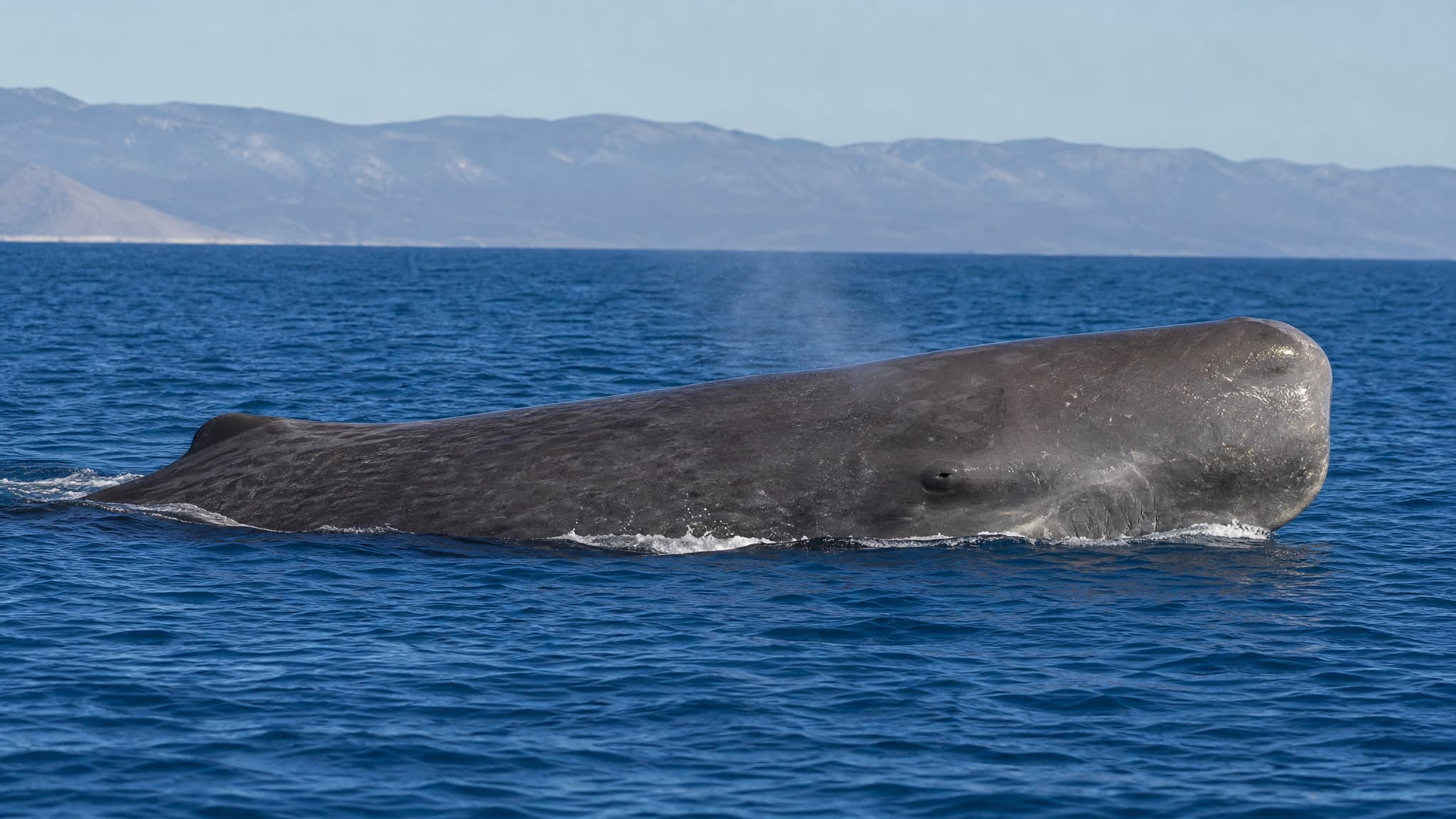
Central Chilean colocolo
Mammals

Central Chilean colocolo

Leopardus colocola

The Central Chilean colocolo is a small, elusive wild cat of central Chile, also called the colocolo or Central Chilean pampas cat. The spelling Leopardus colocolo occurs widely in older works, but current mammal taxonomies recognize Leopardus colocola. It is a member of the South American small-cat genus Leopardus, rather than a leopard. Its coat is variable, typically showing yellowish-brown, gray, or reddish tones with darker markings; the short, ringed tail and barred legs can help distinguish it from other Chilean cats. Modern revision of the former pampas-cat complex restricts this species to Chile. In central Chile it has been recorded in Mediterranean shrublands, open woodland, deciduous and hygrophilous forest, coastal desert, Andean steppe, vineyards, and forestry plantations. These records show considerable ecological flexibility, although observations in heavily modified land may represent movement between remaining native patches rather than permanent use of all altered habitats. It is a solitary carnivore whose ecological role is that of a small terrestrial predator. Rodents and other small vertebrates are expected to be important prey, and Chilean food-web research also records it among native predators of introduced European rabbits. Direct observations remain scarce, so broad claims about daily activity, social organization, home range, reproduction, or longevity should be treated cautiously; these aspects need further species-specific study. Habitat conversion and fragmentation are important conservation concerns in central Chile, where agriculture, urban growth, plantations, roads, and free-ranging domestic animals can increase pressure on a cat already difficult to detect. Because the taxon was recently separated from the wider pampas-cat complex, the Mammal Diversity Database lists L. colocola as Not Evaluated on the IUCN Red List at this newly delimited species level. Protecting connected native vegetation and improving camera-trap and genetic monitoring are especially valuable for clarifying its distribution and conservation needs.

View Details
Six-banded armadillo
Mammals

Six-banded armadillo

Euphractus sexcinctus

The six-banded armadillo (Euphractus sexcinctus), also called the yellow armadillo, is a sturdy South American xenarthran with a pale yellowish to gray-brown armored shell. Its carapace usually has six to seven movable middle bands, although the count can vary. Large plates protect its broad, flattened head, while sparse hair emerges between the bony scales. Strong foreclaws, five-toed feet, and a robust jaw suit it to digging and to eating a broad range of foods. It occurs east of the Andes in South America, including much of Brazil and parts of neighboring countries. It is most associated with open habitats—savannas, grasslands, and seasonally dry landscapes—but can also use wetter savannas and habitat edges. Individuals excavate their own burrows, commonly in soils that permit digging; these shelters provide refuge from weather and danger. This is an opportunistic omnivore rather than a specialist insect-eater. Invertebrates, especially ants and termites, are important foods, but it also takes fruit, tubers, palm nuts, carrion, and occasionally small vertebrates. It is generally solitary and mainly active by day, though it may emerge at night. Scent glands near the tail are used in territorial marking, and an animal disturbed at close range may defend itself with claws and teeth, although escape and burrow use are more typical responses. Females prepare nests in burrows and usually produce one to three young after a gestation of roughly 60–64 days. Young are born with closed eyes, develop rapidly, and reach sexual maturity at about nine months. Captive individuals have lived for more than two decades, but reliable wild lifespan data are limited. By digging burrows and consuming insects and carrion, the species influences soil processes and local food webs; abandoned burrows can also become shelter for other small animals. It is assessed as Least Concern, although local pressures include hunting, persecution near crops, and habitat alteration.

View Details
Red-handed howler monkey
Mammals

Red-handed howler monkey

Alouatta belzebul

The red-handed howler monkey is a medium-sized New World monkey recognizable by its mostly black to very dark-brown coat and contrasting reddish, orange, or chestnut hands and feet. Some individuals also show warmer tones on the tail tip, forehead, or back. Males are generally larger than females, and both sexes have the long, grasping tail characteristic of atelid monkeys. Its enlarged hyoid apparatus and specialized vocal tract help produce the deep roars, barks, and grunts for which howler monkeys are famous. Alouatta belzebul is endemic to Brazil. Its range is disjunct: populations occur in eastern Amazonian forest and in remnants of northeastern Atlantic Forest. It uses arboreal habitats, including mature and secondary forest, and spends most of its time high in the canopy. Forest fragmentation can isolate groups because this monkey depends on tree cover for travel, resting, and feeding. It is mainly a leaf-eater, especially selecting young leaves, but it also eats fruit, flowers, bark, and other plant material. Fruit may become especially important when available. By consuming fruits and moving through the canopy, it can disperse seeds; its leaf-based diet also links it closely to the productivity and seasonal food supply of its forest habitat. Soil eating has been recorded in some populations, possibly in relation to nutritional needs or the processing of chemically defended leaves. Red-handed howlers are diurnal and live in small social groups, often with one or two adult males, several females, and their offspring. They rest for long periods, an energy-saving pattern suited to digesting foliage. Loud calls help neighboring groups assess one another and may reduce the need for costly direct fights over food, space, or mates. Breeding can occur throughout the year. Females usually bear one infant after a gestation of about 187 days, with births commonly separated by one to two years; maternal care is extensive. Species-specific longevity in the wild is poorly documented, but howler monkeys are generally estimated to live roughly 15–20 years. The species is assessed as Vulnerable: habitat loss and fragmentation, hunting, and degradation of both Amazonian and Atlantic Forest landscapes remain major pressures.

View Details
Northern tiger cat
Mammals

Northern tiger cat

Leopardus tigrinus

The northern tiger cat (Leopardus tigrinus) is a very small, elusive Neotropical wild cat, widely known as the oncilla or little spotted cat. It has a slender build, relatively large ears, and short fur that ranges from light brown to grayish. Dark, black-edged rosettes cover the body; the pale underside is also spotted, and the tail bears dark rings and a dark tip. Melanistic, almost-black individuals are documented. Adults generally weigh about 1.5–3 kg, with males usually larger. This species occurs from northeastern Brazil through much of northern South America, with isolated populations reported farther north into Central America. It uses a broad elevational range, from lowlands to roughly 3,200 m. Forest is its principal habitat, including tropical, premontane, montane, and cloud forests; it may also occupy scrub, savanna, and altered landscapes such as plantations. Despite being an able climber, it is primarily a ground-dwelling cat. Northern tiger cats are chiefly nocturnal, secretive, and usually solitary outside reproduction. Their prey consists mainly of small mammals, especially rodents, as well as birds and, in some areas, lizards. As a small predator, the species likely contributes to regulation of small-vertebrate populations, although its ecological role remains incompletely studied. Knowledge of wild reproduction is limited. Captive observations indicate a gestation of about 74–76 days and usually one kitten, though litters can contain up to three. Young are weaned at around three months and become independent near four months; females mature at about two years and males at roughly 18 months. Reported wild longevity is about 10–14 years. The IUCN lists L. tigrinus as Vulnerable, with a declining population trend. Forest loss and fragmentation are central threats, compounded by roads, illegal capture and trade, hunting, and conflict where cats take poultry. Its conservation also depends on accurate identification: the southern tiger cat, Leopardus guttulus, was separated from L. tigrinus and must not be treated as the same species.

View Details
Marsh Deer
Mammals

Marsh Deer

Blastocerus dichotomus

The marsh deer is South America’s largest deer and the only living species in the genus Blastocerus. Adults have a heavy-bodied but long-legged build, usually reddish brown in warmer months and darker brown in winter. Black lower legs and muzzle markings contrast with pale rings around the eyes. Males carry large, multi-tined antlers, while both sexes have exceptionally broad, spreading hooves with an interdigital membrane—an adaptation that improves support on soft, waterlogged ground. This deer is native to South America, occurring in Argentina, Bolivia, Brazil, Paraguay, and Peru; it has disappeared from Uruguay. Its strongholds are associated with major river basins and floodplains, including the Pantanal. It uses marshes, swamps, seasonally inundated savannas, and dense wetland vegetation near permanent water. Seasonal flooding shapes its movements: animals spread across flooded landscapes when water is abundant and concentrate near reliable cover and water in drier periods. Marsh deer are herbivorous browsers and grazers. Their food includes aquatic and riverside plants, leaves, grasses, and other browse; analyses indicate that grasses and legumes can be important dietary components. They are often most active around dawn and dusk, though local activity may shift with season and human disturbance. Individuals are commonly solitary or occur in small groups, and their feeding helps link wetland plant production to the broader floodplain food web. Females normally give birth to a single fawn, which is born without the spotted coat familiar in many deer species. Breeding timing varies among populations, although rutting has often been reported in October and November; births have been recorded in more than one seasonal window. A species-specific lifespan is not securely documented in the consulted sources. The marsh deer is listed globally as Vulnerable by the IUCN, with a declining trend driven chiefly by wetland conversion and drainage, hydroelectric dams and altered flood regimes, habitat fragmentation, poaching, and disease exposure from livestock.

View Details
Brazilian three-banded armadillo
Mammals

Brazilian three-banded armadillo

Tolypeutes tricinctus

The Brazilian three-banded armadillo is a small, distinctive armadillo endemic to Brazil. Known locally as the tatu-bola, it has a rounded brown carapace made of bony plates, with three flexible bands across the middle. Its compact body, pointed muzzle, sturdy foreclaws, and armored head and tail allow it to close itself into a near-complete ball—a defense unusual among armadillos. Adults are generally about 21–30 cm in head-and-body length and weigh roughly 1–1.6 kg. Rather than relying mainly on digging deep shelter burrows, it uses cover and existing refuges in its dry, seasonal landscape. It is usually solitary and is most active around dusk and at night, when temperatures are less severe. This specialized insect-eater feeds chiefly on ants and termites, using its long sticky tongue and relatively light skull. By consuming colonial insects and moving through soil and ground cover, it forms part of the food web of Brazil’s drylands. Its armor offers strong protection, but it can still be vulnerable to large predators and, especially, human pressures. Breeding is seasonal in available accounts, and females produce one or two young after a gestation of approximately three to four months. Newborns have softer, pinkish armor that hardens as they grow. A lifespan of up to 17 years has been reported in captivity; longevity in the wild remains poorly documented. The species occurs principally in the Caatinga and parts of the Cerrado. Habitat conversion, degradation, road mortality, and hunting threaten its populations. It is assessed globally as Vulnerable, while Brazil lists it as Endangered, making protection of remaining native dry forest, scrub, and grassland habitat particularly important.

View Details
Black-and-gold howler
Mammals

Black-and-gold howler

Alouatta caraya

Identification The black-and-gold howler is a large New World monkey distinguished by striking sexual dichromatism. Adult males have an almost entirely black coat, whereas adult females are yellowish to olive-blond; young are born golden. It has a long, powerful prehensile tail with a bare tactile patch below, used like an extra grasping limb among branches. Its enlarged hyoid apparatus helps produce the species’ resonant, far-carrying howls. Range and habitat Alouatta caraya occurs in central-southern South America: eastern Bolivia, Brazil, Paraguay, and northern Argentina. It uses a range of wooded habitats, including gallery forest, semi-deciduous and deciduous forest, and seasonally dry woodland near savanna. Although strongly arboreal, it may descend during dry conditions to drink or feed. Diet and behavior Leaves make up most of its diet, supplemented with fruit, flowers, and buds. Leaf fermentation provides energy but supports a low-energy lifestyle, so these monkeys rest for much of the day and travel relatively slowly. They live in social groups, often of several individuals, and their group calls advertise location and may help space neighboring groups apart. Reproduction, ecology, and conservation Females generally give birth to one infant after a gestation of about 187 days and provide prolonged care; infants remain dependent for roughly a year. Recorded captive longevity is about 20 years. As a canopy-dwelling folivore and fruit eater, the species contributes to forest food webs and can disperse some seeds. It is listed as Near Threatened globally, with forest conversion and fragmentation—especially from agriculture and cattle production—among the principal pressures; hunting and capture also affect some populations.

View Details
Southern Tiger Cat
Mammals

Southern Tiger Cat

Leopardus guttulus

Southern Tiger Cat The southern tiger cat, Leopardus guttulus, is a small South American wild cat with a compact, domestic-cat-sized build. Its coat varies from pale yellow to yellowish brown and carries dark, often rounded rosettes; the underside is paler and spotted. The tail is relatively short, thick, and frequently ringed. Rounded ears are black on the back with a pale central spot, and melanistic—almost entirely black—individuals are relatively common. It occurs primarily in southern and southeastern Brazil, with records extending into Paraguay and northeastern Argentina. It uses an unusually broad range of terrestrial settings, including Atlantic and subtropical forests, deciduous and mixed pine forests, savannas, coastal vegetation, and some disturbed landscapes. Even where it occurs beside agriculture, it depends on retained natural cover and tends to hunt along habitat edges rather than deep inside cropland. This is mainly a solitary, secretive predator, most active at night and around dawn or dusk, although it may also move during daylight. Small mammals, birds, and lizards make up much of its prey, usually animals under 100 g but sometimes larger prey. By hunting these small vertebrates, it functions as a small-predator component of forest and savanna food webs. Documented home ranges vary widely, about 2–25 km², and may be enlarged where the cat avoids larger competing felids such as the ocelot. Females usually produce one kitten per litter, occasionally two. A reliable maximum lifespan in the wild has not been established; the IUCN assessment instead estimates a generation length of about 4–5 years. Genetic evidence recognized L. guttulus as distinct from the northern tiger cat, L. tigrinus, in 2013. The global IUCN assessment lists it as Vulnerable with a decreasing trend. Habitat loss and fragmentation are major pressures, compounded in some areas by road mortality, conflict, disease risks associated with domestic animals, and hybridization with Geoffroy's cat.

View Details
White-lipped peccary
Mammals

White-lipped peccary

Tayassu pecari

The white-lipped peccary is a robust, pig-like Neotropical mammal and the only living species in the genus Tayassu. Adults have a large head, elongated snout, short tail, slender legs, and coarse dark-brown to blackish coat. Its defining feature is the pale white band around the lower jaw and cheeks, often accompanied by pale hair inside the ears. Adults commonly weigh about 25–40 kg; juveniles are more reddish-brown and become dark-coated as they mature. It ranges from southern Mexico through Central America and much of South America to northern Argentina. The species occupies tropical and subtropical forests, seasonally dry woodland, savannas, scrub, and Chaco habitats, generally requiring broad areas of connected cover and dependable water. Dense vegetation, caves, and rocky sites can provide shelter, and fragmentation can isolate herds from the extensive landscapes they need. White-lipped peccaries are highly social, mobile omnivores. Mixed-sex herds may contain dozens to hundreds of animals and move widely in response to changing food and water availability. They feed chiefly on fruits, seeds, roots, leaves, and fungi, while also taking invertebrates and, occasionally, small vertebrates, eggs, or carrion. Scent glands, vocal calls, and conspicuous tooth-clacking help maintain contact and coordination within a herd; jaguars and pumas are important natural predators. Females can breed throughout the year, although seasonal peaks occur in some regions. After roughly 156–162 days of gestation, a female usually gives birth to two young; newborns can run within hours and follow their mother soon afterward. Wild longevity averages about 13 years. By rooting, trampling, consuming seeds, and sometimes dispersing small viable seeds, large herds reshape forest-floor conditions and plant recruitment, making the species an important ecosystem engineer. The white-lipped peccary is globally Vulnerable. Hunting, habitat loss, roads, forest fragmentation, and disease contribute to severe local declines and disappearances. Its reliance on large, connected habitat and its tendency to gather in large, detectable herds can make populations especially susceptible to human pressure. Conserving extensive protected areas, ecological corridors, and effective hunting controls is therefore particularly important.

View Details
Hoary fox
Mammals

Hoary fox

Lycalopex vetulus

The hoary fox is a small, slender South American canid and the only carnivore endemic to Brazil. Its coat is predominantly grayish or silvery, with a pale underside, reddish-buff ears and legs, a dark stripe along the back, and a dark tail tip. Adults are roughly 59–64 cm in head-and-body length and generally weigh about 2.5–4 kg. Its short muzzle, small carnassial teeth, and broad molars distinguish it from many more strongly meat-eating foxes. This species occurs in Brazil, especially in the open habitats of the Cerrado and adjoining grassland, scrub, and savanna mosaics. It uses campo limpo, campo sujo, pasture, and wooded savanna, and may shelter or rear young in burrows originally excavated by armadillos. Although it can occur in human-modified landscapes, conversion and fragmentation of native grasslands affect the quality and continuity of its habitat. Despite being a member of the dog family, the hoary fox is notably insect-oriented. Termites, especially Syntermes, are major foods; grasshoppers, beetles, small vertebrates, and seasonal fruits supplement the diet. It is therefore an omnivore with strong insectivorous adaptations. By consuming insects and small vertebrates—and by eating fruit—it can influence prey populations and may contribute to seed dispersal in Cerrado ecosystems. Hoary foxes are usually solitary outside reproductive associations and can be active by day, at dusk, or at night. Reproduction is seasonal; births in central Brazil have been recorded mainly from July through September. Litters are commonly reported as two to four young, though wider variation has been documented. Knowledge of parental care and wild lifespan remains incomplete, reflecting how comparatively little studied this discreet canid is. Globally, the species has been assessed as Least Concern, but it is classified as Vulnerable on Brazil’s national threatened-species list. Important pressures include loss and degradation of Cerrado habitat, road mortality, conflict with people and domestic animals, and disease risks associated with dogs. Protecting connected native grassland and savanna habitats is central to its long-term conservation.

View Details
Brown howler monkey
Mammals

Brown howler monkey

Alouatta guariba

The brown howler monkey (Alouatta guariba) is a large, sturdy New World monkey of the Atlantic Forest, recognized by its resonant calls and grasping tail. Its coat ranges from brown to reddish or orange-brown; the face and ears are dark and relatively bare. Males are generally larger than females, and the sexes can differ subtly in coat tone. Like other howlers, it has an enlarged hyoid apparatus and specialized vocal tract, allowing its low roars to carry roughly 1–2 km through forest. This species occurs chiefly in southeastern and eastern Brazil and reaches far northeastern Argentina, especially Misiones Province. It uses Atlantic Forest habitats from lowland to montane forest, including semideciduous woods, gallery forests, and areas associated with Paraná pine (Araucaria angustifolia). It is strongly arboreal, spending much of its time in the upper canopy, where dense foliage offers food, resting sites, and cover. Brown howlers are diurnal and live in small social groups, often with a dominant adult male and several females, although group composition varies. They move deliberately on branches rather than swinging beneath them, and devote a large part of the day to resting—an energy-saving strategy suited to a leaf-rich diet. Leaves, particularly young leaves when available, form a major part of their food; flowers, shoots, lianas, and fleshy fruits are also eaten. Fruit feeding makes them contributors to seed dispersal. Females usually give birth to a single infant after a gestation of about six months. The infant is carried by its mother and is generally weaned near one year of age; females may reproduce at intervals of roughly 22 months. Reported wild longevity is about 15–20 years. Their loud calls help maintain contact and signal occupancy of an area, while their feeding and seed dispersal link them closely to forest regeneration. The IUCN lists A. guariba as Vulnerable, and its overall population is decreasing. Forest loss and fragmentation are major threats, compounded in some regions by illegal capture and severe mortality during yellow-fever outbreaks. Protecting connected Atlantic Forest remnants, preventing hunting and pet trade, and monitoring disease are important for the species’ persistence.

View Details
Margay
Mammals

Margay

Leopardus wiedii

The margay is a small, elegant spotted wild cat of the American tropics. It resembles a slim ocelot, but is generally more lightly built and is especially recognizable by its exceptionally long tail, large feet, and broad eyes. Its coat ranges from grayish-brown to cinnamon above, with dark spots or rosettes often arranged in lengthwise rows; the underparts are pale to white. Adults commonly weigh about 2.3–4.9 kilograms. This species occurs from northern Mexico through Central America and much of South America, reaching Uruguay and northern Argentina. It is strongly associated with forests, including tropical and subtropical evergreen, deciduous, seasonally flooded, and cloud forests. Although it can occur in altered landscapes and some plantations, it is usually most closely tied to wooded cover and is generally uncommon across much of its range. Margays are chiefly solitary and territorial, with most activity at night but some daytime movement. They are superb climbers: flexible hind ankles can rotate markedly, helping them grip branches, descend trunks headfirst, or briefly hang from a hind foot. Despite these specialized skills and their tendency to rest in trees, research summarized by the IUCN Cat Specialist Group indicates that they also travel and hunt extensively on the ground. Their diet is varied and consists mainly of small mammals, with birds, reptiles, amphibians, eggs, arthropods, and occasionally fruit also eaten. By preying on small vertebrates in forest food webs, the margay is one component of the Neotropical small-carnivore community. It may compete with, and be vulnerable to killing by, the larger ocelot where both species occur. Females usually produce one or two kittens after a gestation of roughly 76–84 days. Much of the detailed reproductive information comes from captive animals, and field ecology remains comparatively poorly known. Captive individuals may live for more than two decades. The margay is listed globally as Near Threatened, principally because forest loss and fragmentation affect its preferred habitat; its low reproductive rate may compound these pressures. International trade is prohibited under CITES Appendix I.

View Details
Hourglass Dolphin
Mammals

Hourglass Dolphin

Cephalorhynchus cruciger

The hourglass dolphin is a small, stocky oceanic dolphin named for the striking pale markings on each side of its otherwise dark body. A white patch runs from behind the beak toward the flank, and another extends from behind the dorsal fin toward the tailstock; together they can resemble an hourglass. Its belly is largely white, while the back, beak outline, flippers, flukes, and strongly curved dorsal fin are black. Adults documented from the small available sample measured roughly 1.6–1.8 m long and weighed about 74–94 kg. It has a circumpolar Southern Ocean distribution, occurring in Antarctic and sub-Antarctic waters of the Atlantic, Indian, and Pacific oceans. This is chiefly a pelagic species, seldom encountered near land, and it is especially associated with cold water around the Antarctic Convergence. Recorded sightings span a broad latitudinal range, but most occur in remote waters between about 45°S and 65°S. Hourglass dolphins eat small fishes, squid, and probably some crustaceans. Stomach records include mesopelagic lanternfish and squid remains. They are social and may gather in feeding groups at the surface, sometimes alongside other cetaceans; seabirds such as albatrosses and petrels can congregate over these events. As active mid-level to upper-level predators, they link Southern Ocean forage species with larger marine predators. Very little is known directly about their courtship, calving season, calf development, or longevity. Like other dolphins, they are live-bearing and mothers nurse their young, but species-specific reproductive estimates should not be inferred from relatives. The IUCN currently lists the species as Least Concern under its former name, Lagenorhynchus cruciger. Its vast, inaccessible range may reduce some direct pressures, although incidental capture in fishing gear has been recorded and changes to Southern Ocean ecosystems remain relevant uncertainties.

View Details
Chilean dolphin
Mammals

Chilean dolphin

Cephalorhynchus eutropia

The Chilean dolphin, also known as the black dolphin, is a small, stocky coastal dolphin with a blunt, nearly beakless head, rounded flippers, and a low triangular dorsal fin. Adults are generally about 1.6 m long. Despite its alternate name, its body is not uniformly black: dark gray fins, back, and flukes contrast with paler gray sides and head, plus conspicuous whitish areas on the throat, behind the flippers, and around the belly. It occurs principally along the cold temperate coast of Chile, from the central coast south through the intricate channels and fjords of Patagonia and Tierra del Fuego. This is an inshore specialist, favoring shallow bays, channels, estuaries, river mouths, tidal rips, and waters near steep coastal drop-offs. It may enter brackish estuaries and travel a short distance up rivers. Chilean dolphins usually travel in small groups of a few animals, although larger gatherings are occasionally recorded. Often shy around boats, they use acoustic communication and echolocation to orient and find prey. Their diet includes small schooling fishes, squid, and crustaceans; as a coastal predator, they help transfer energy from these prey populations through nearshore marine food webs. Knowledge of its breeding biology remains limited. Mating is reported in early winter, with calves born in spring; females generally produce one calf at intervals of roughly two years and reach sexual maturity at about five to nine years. Maternal care includes nursing and prolonged association while young learn movement and foraging skills. Its own longevity is not well documented. The Chilean dolphin is assessed as Near Threatened. Entanglement in coastal gillnets is a major concern, while intentional killing, disturbance, habitat alteration, and the expansion of aquaculture may add pressure in parts of its restricted coastal range. Its close association with estuaries, fjords, and shallow shorelines makes local protection and bycatch reduction especially important.

View Details
Heaviside’s dolphin
Mammals

Heaviside’s dolphin

Cephalorhynchus heavisidii

Heaviside’s dolphin Heaviside’s dolphin (Cephalorhynchus heavisidii) is a compact, blunt-headed dolphin of the south-west African coast. Adults average about 1.74 m long and commonly weigh 60–70 kg. Its large triangular dorsal fin, rounded paddle-like flippers, dark grey-and-black upper body, and bold white belly markings give it a distinctive appearance; from a distance, it can be mistaken for a very small orca. It occurs only in the south-eastern Atlantic, from southern Angola through Namibia to western South Africa. It is strongly associated with cool, productive coastal waters of the Benguela Current, generally close to shore and usually in water shallower than 100 m. This is an active, social toothed whale, most often encountered alone, in pairs, or in small groups. It uses echolocation while hunting and eats fish and cephalopods, including hake, kingclip, gobies, squid, and octopus. Its movements can track the daily vertical movements of prey, with dolphins often spending mornings nearer shore. Females usually produce one calf after a gestation of roughly 10–11 months and reproduce only every few years. Calves are about 85 cm long at birth. Sexual maturity is reached at about 5–9 years by females and 6–9 years by males; available estimates place wild longevity at roughly two decades, although life-history data remain limited. As a coastal predator, it helps link fish and cephalopod populations within the Benguela marine food web. The species is listed as Near Threatened. Entanglement in gillnets and other inshore fishing gear is a major concern, alongside illegal or opportunistic hunting, vessel disturbance, pollution, and climate-driven change to its unusually restricted cold-water habitat.

View Details
Golden lion tamarin
Mammals

Golden lion tamarin

Leontopithecus rosalia

The golden lion tamarin is a small New World monkey instantly recognizable by its silky orange-to-reddish-gold coat and the long mane framing its dark, mostly bare face. Its hands have claw-like nails rather than the flattened nails typical of many primates, an adaptation that helps it probe bark, crevices, and tangled vegetation while searching for food. Adults have a compact body and a tail longer than the body, but males and females are broadly similar in appearance. (animaldiversity.org) This species is native only to southeastern Brazil, where it inhabits lowland coastal Atlantic Forest. It is strongly arboreal, moving through vines and branches in dense forest and using tree cavities as sheltered night sleeping sites. Golden lion tamarins are active by day and live in small, territorial family groups, usually centered on a breeding pair and their offspring. Scent marking and a varied vocal repertoire help maintain contact and signal danger or territorial defense. (animaldiversity.org) An omnivore, the tamarin eats fruit as well as insects, spiders, snails, small vertebrates, eggs, and other available foods. Its slender fingers are used in careful extractive foraging. Fruit feeding also makes it an ecologically meaningful seed disperser: a field study found that it consumed fruits from dozens of plant species and dispersed viable seeds of many of them. (animaldiversity.org) Reproduction is cooperative. A dominant pair normally breeds, females commonly give birth to twins after roughly 130–135 days of gestation, and fathers and other relatives assist with carrying and caring for young. Wild individuals can live at least 15 years. The species is classified as Endangered; forest clearing, fragmentation, and conversion for agriculture, ranching, resource extraction, and urban growth remain major threats. Captive breeding, reintroductions, habitat protection, and forest-corridor work have been central to its recovery efforts. (animaldiversity.org)

View Details
Maned wolf
Mammals

Maned wolf

Chrysocyon brachyurus

The maned wolf is a distinctive South American canid with a foxlike head, oversized upright ears, a reddish-orange coat, a black mane along the neck and back, and exceptionally long dark legs. It is the largest canid in South America, but its slim body and long limbs make it look very different from a gray wolf. Despite its English name and superficial resemblance to a fox, it is neither a true wolf nor a fox; it is the only living member of the genus Chrysocyon. It occurs mainly in central and eastern South America, especially Brazil, as well as parts of Bolivia, Paraguay, Argentina, and Peru. The species is closely associated with the Cerrado and other open or mixed landscapes, using grasslands, savannas, shrublands, wetland edges, and forest margins. Its long legs are well suited to moving through tall grasses and help it scan above low vegetation. Maned wolves are mostly solitary, although an adult male and female may occupy and defend a shared territory. They are chiefly crepuscular and nocturnal, resting in dense cover by day. Communication includes scent marking and a low, far-carrying bark. Their diet is notably omnivorous for a large canid: small mammals, birds, reptiles, eggs, insects and other invertebrates are eaten alongside roots and fruit. The wolf apple (Solanum lycocarpum) is an especially important food in much of its range. Breeding pairs interact more closely during the reproductive season, but the young are generally raised in concealed, above-ground natal sites amid thick vegetation. Litters usually contain a few pups after a gestation of roughly two months. Captive individuals may live around 13 years on average and up to about 15 years. By consuming both prey and fruit, the species is an important omnivorous predator and plant consumer within South American open habitats. The maned wolf is globally classified as Near Threatened. Conversion of native grasslands and savannas to agriculture, habitat fragmentation, road mortality, persecution, and disease risks linked to domestic dogs all affect populations. Conserving large, connected mosaics of Cerrado, grassland, wetland, and forest-edge habitat is central to its long-term survival.

View Details
Amazonian manatee
Mammals

Amazonian manatee

Trichechus inunguis

The Amazonian manatee is a fully aquatic sirenian and the only manatee species restricted to freshwater. Its dark gray to nearly black, thick skin commonly bears an irregular white or pinkish patch on the belly, although this marking can be reduced or absent. It has a broad, rounded paddle-like tail, wide flippers, a small head with a downturned snout, and sensitive bristles on the face and body. Unlike some other manatees, it lacks nails on the flippers; the epithet inunguis means “without nails.” Adults can reach roughly 2.8–3 m in length and weigh about 420–450 kg. This species is endemic to the Amazon Basin. It occurs in rivers, tributaries, floodplain lakes, channels, and seasonally inundated forests from the western Amazon to the river’s Atlantic outlet. Rather than defending a territory, it follows the annual flood cycle: during high water it uses flooded várzea habitats with abundant plants, and in the dry season it tends to occupy deeper river channels and permanent lakes. Its secretive habits and the turbid water in much of its range make wild animals difficult to observe. An herbivore, the Amazonian manatee uses its flexible, bristled lips to crop and manipulate aquatic vegetation. Its foods include grasses, water lettuce, water hyacinths, and other riverine plants; floating palm fruits may also be eaten. Feeding is especially important during the flood season, when newly inundated vegetation is available. During seasonal low water, individuals may endure long periods with little or no feeding. By consuming and moving among aquatic plants, the species contributes to the functioning of floodplain food webs and nutrient cycling. Breeding can occur throughout the year. Gestation lasts about a year, and a single calf is typical. The calf remains closely associated with its mother, often travelling beside her or on her back, for more than two years. Longevity in the wild is incompletely known, though about 30 years has been reported; captive records demonstrate survival beyond 12 years. The species is globally listed as Vulnerable. Historic commercial hunting severely reduced populations, while present threats include illegal hunting, entanglement, boat strikes, dams and other habitat fragmentation, deforestation and sedimentation, pollution, and disturbance from development in the Amazon Basin.

View Details
Crab-eating Raccoon
Mammals

Crab-eating Raccoon

Procyon cancrivorus

The crab-eating raccoon, Procyon cancrivorus, is a medium-sized procyonid of Central and South America. It is also known as the southern or South American raccoon. Adults typically have a head-and-body length of about 54–65 cm, a 25–38 cm ringed tail, and a mass of roughly 3–7 kg; males average larger than females. Its dark facial mask, brown to grayish coat, dark legs, and alternating tail bands give it the familiar raccoon-like appearance. Despite its English name, crabs are only part of a flexible omnivorous diet. Fruit can be important, alongside insects and other invertebrates, crustaceans, fish, frogs, small reptiles, eggs, and other small vertebrates. Highly sensitive forepaws help it locate and manipulate food, particularly near water. It is mainly nocturnal and generally solitary, though individuals may tolerate one another at concentrated feeding sites. This species ranges from Costa Rica south through much of tropical and subtropical South America to Uruguay and northern Argentina. It uses primary and secondary forests, Amazonian habitats, Chaco vegetation, and wetlands, but is especially associated with rivers, lagoons, swamps, and other water-rich places that provide food and den sites. In Brazil it occurs in all biomes and is widely called mão-pelada, “bare hand,” referring to its sparsely furred, dexterous paws. Breeding is seasonal in studied populations, with one litter per year. After a gestation of approximately 60–73 days, females give birth in sheltered dens such as hollow trees, rock crevices, or abandoned burrows; litters usually contain 2–7 young. The mother alone provides care, and young become independent at around eight months. Species-specific longevity in the wild remains poorly documented. As an omnivore, the crab-eating raccoon participates in wetland and forest food webs both as a consumer of small animals and fruit and as potential prey for larger predators. The IUCN lists it as Least Concern, reflecting its broad distribution, although its reliance on waterside habitats makes the maintenance of intact wetlands, forest cover, and safe movement corridors important locally.

View Details
Common marmoset
Mammals

Common marmoset

Callithrix jacchus

The common marmoset, also called the white-tufted-ear marmoset, is a small New World monkey recognized by its conspicuous white ear tufts, pale forehead blaze, dark face, and grey-brown body. Its long tail is distinctly ringed in light and dark bands. Adults typically weigh about 300–360 g; the body measures roughly 12–15 cm, excluding the much longer tail. This primate is native to northeastern Brazil, with its native distribution associated with the coastal region from Piauí and Ceará to Pernambuco. It uses forest edges and a variety of wooded habitats, and can also occur in plantations and altered landscapes. People have introduced it to other Brazilian states, where it may establish populations outside its original range. Common marmosets are active by day, arboreal, and highly social. Groups commonly contain several related animals and depend on vocal, tactile, and scent communication. Their diet is especially adapted to plant exudates: specialized lower incisors help them gouge bark to obtain gum and sap. They also eat insects, spiders, fruit, flowers, nectar, and occasionally small vertebrates, eggs, or nestlings. By consuming both plant and animal foods, they participate in food webs as mobile foragers and potential seed dispersers. Breeding is cooperative. A group may include one breeding female and more than one male; fathers and older siblings routinely carry and help care for infants. Gestation lasts about 143–148 days, and twins are usual. Sexual maturity is reached at about one year of age. Reported average lifespan is around 10 years in the wild, with longer survival possible in captivity. The species is assessed as Least Concern. Nevertheless, deforestation and habitat change affect native northeastern populations. In regions where it has been introduced, its adaptable habits, predation on small animals, and potential hybridization or competition with other marmosets can create conservation problems for local wildlife.

View Details
Lowland paca
Mammals

Lowland paca

Cuniculus paca

The lowland paca is a large, heavy-bodied Neotropical rodent with a broad head, small rounded ears, short sturdy legs, and an almost invisible tail. Its coarse coat is brown to reddish-brown or dark brown, set off by several longitudinal rows of white spots along each side; the throat and underside are paler. Adults commonly measure about 60–80 cm in head-and-body length and weigh roughly 7–15 kg. Its unusually expanded cheekbones contain resonating chambers that may enhance its vocal sounds. This species occurs from eastern and southeastern Mexico through Central America and much of northern and central South America, reaching Paraguay, northern Argentina, and southeastern Brazil. It occupies tropical and subtropical forests, including primary and secondary woodland, forest edges, and some plantations. Pacas are especially associated with streams, ponds, and other watercourses. They shelter by day in burrows, hollow logs, root tangles, or natural cavities, often maintaining multiple entrances and concealed escape routes. Mostly solitary and nocturnal, a paca follows familiar paths while foraging after dark. It is primarily a fruit-eater, taking fallen fruit as well as seeds, nuts, leaves, roots, and tubers; seasonal food shortages can lead it to browse more foliage. It is a capable swimmer and often escapes danger by rushing into water. As both a consumer of fruits and seeds and prey for larger carnivores, it contributes to forest food webs and can influence the fate of the plants whose fruits it uses. Breeding can occur throughout the year in much of its range. Females usually produce one well-developed young, with twins being unusual; newborns have open eyes and can walk soon after birth. Young nurse for weeks to several months and generally reach sexual maturity within their first year. Wild longevity is often reported at about 12–13 years, with longer lives recorded in captivity. The species is globally listed as Least Concern, owing to its broad distribution, but intensive hunting for meat, habitat conversion, and forest fragmentation threaten populations locally.

View Details
Ocelot
Mammals

Ocelot

Leopardus pardalis

The ocelot is a medium-sized, strongly built wild cat and one of the largest species in the genus Leopardus. Its short coat ranges from pale yellowish or tawny to grayish, patterned with dark-edged rosettes, spots, and elongated stripes. A white underside, bold facial markings, rounded ears with pale central patches, and a ringed, relatively short tail help distinguish it from the longer-tailed margay. It occurs from the southern United States through Central America and much of South America to northern Argentina. Ocelots occupy tropical and subtropical forests, dry woodland, scrub, savanna, mangroves, and wetlands, but dense vegetation is a particularly important feature of their habitat. They may use altered landscapes, yet broad, connected cover is vital for movement and shelter. Usually solitary and chiefly nocturnal or crepuscular, the ocelot hunts by stealth and relies on keen night vision, hearing, and smell. Its varied carnivorous diet includes rodents and other small mammals, birds, reptiles, amphibians, fish, and invertebrates; it can also take larger prey on occasion. As a mesopredator, it helps regulate prey populations and forms part of food webs that also include larger cats. Females raise the young alone after a gestation of roughly 79–85 days, commonly producing one to three kittens in a concealed den. Young become independent at around one year of age. Wild lifespan is often reported as about 7–10 years, while captive individuals may live considerably longer. The species is assessed as Least Concern overall, but local populations are affected by habitat loss and fragmentation, road kills, and conflict associated with poultry or livestock predation.

View Details
Southern brown brocket
Mammals

Southern brown brocket

Subulo gouazoubira

The southern brown brocket, also called the gray brocket, is a small-to-medium New World deer with a compact body, relatively short legs, and a straight-backed silhouette. Its coat ranges from grayish brown to reddish brown; paler underparts and the conspicuously white underside of the tail are useful field marks. Adult males carry simple, unbranched antlers. Adults are typically about 85–105 cm in head-and-body length and commonly weigh roughly 8–25 kg, although dimensions vary across its extensive range. It occupies a broad variety of Neotropical landscapes, including woodland edges, savannas, scrub, Chaco, wetlands, transitional forest, and cultivated areas that retain patches of cover. It usually relies on forest, thickets, or other dense vegetation for shelter even where it feeds in more open ground. Geographic limits reported under the older name Mazama gouazoubira require care, because taxonomic work has separated or reassessed some populations formerly assigned to this deer. This is generally a shy, mostly solitary deer, most active around dusk, at night, or in sheltered daytime cover. It is a flexible herbivore and browser: fruit can be a major seasonal food, while leaves, shoots, buds, flowers, twigs, bark, roots, and—in dry places—cactus or bromeliad fruits supplement its diet. By consuming fruit as well as browse, it participates in plant–animal food webs and may contribute to the movement of seeds. Females can breed throughout the year, though births may peak outside the coldest or driest months in some regions. Gestation lasts about 206–220 days and nearly always produces one spotted fawn, which remains hidden early in life; weaning occurs at about six months. Wild longevity has been estimated at up to 13 years. Habitat conversion and fragmentation, hunting, vehicle strikes, fire, and contact with livestock or domestic animals can threaten local populations. It is generally assessed as Least Concern under its former name, but local declines and differing regional listings make habitat protection important.

View Details
Brazilian porcupine
Mammals

Brazilian porcupine

Coendou prehensilis

The Brazilian porcupine, Coendou prehensilis, is a medium-sized New World porcupine distinguished by its long, muscular prehensile tail, an adaptation for gripping branches. Its body is protected by short, barbed quills: the dorsal crest has chiefly tricolored spines, while the rump has mostly bicolored spines. Adults are generally pale yellowish with darker brown markings and sparse brown hair; the tail is unspined and helps stabilize the animal in the canopy. Modern taxonomic work has substantially narrowed the meaning of this name. Rather than the formerly assumed broad South American animal, C. prehensilis is now treated as endemic to the northern Atlantic Forest of Brazil, north of the São Francisco River. Confirmed records are from Alagoas, Paraíba, and Pernambuco, in the Pernambuco Endemism Center. It is a forest-dependent, arboreal rodent, although it can persist in degraded and urban forest fragments. This porcupine is chiefly nocturnal and usually solitary. It spends most of its time in trees, using its tail and long claws to climb, feed, and rest among branches. Its diet is herbivorous, centered on fleshy fruits, leaves, and seeds; broader studies of the former species complex also document bark, buds, flowers, and other plant material. By consuming fruit and seeds, it may contribute to plant dispersal, while its quills provide an effective defense against predators. Direct natural-history studies on the narrowly defined species remain limited. Information from closely related populations formerly included in the C. prehensilis complex indicates a gestation of roughly 200 days and one precocial young. Newborns are well developed but remain nutritionally dependent for about 15 weeks. Longevity is incompletely known for the revised species; prehensile-tailed porcupines in human care are often reported to live about 12–17 years. Brazil's 2024 assessment lists C. prehensilis as Near Threatened. Its small, fragmented range is affected by conversion of forest to agriculture—especially sugar-cane cultivation—urban expansion, and hunting or retaliatory killing. Continued loss and isolation of Atlantic Forest remnants may severely fragment its population, making habitat protection, monitoring, and taxonomically informed field surveys important conservation priorities.

View Details
Crab-eating Fox
Mammals

Crab-eating Fox

Cerdocyon thous

The crab-eating fox is a medium-sized South American canid, also called the crab-eating zorro or savanna fox. Despite its English name, it is not specialized for eating crabs. It has a compact, fox-like build, a long pointed muzzle, rounded ears, and comparatively short, sturdy legs. Its coat is generally grizzled gray-brown, often with darker hairs along the back; the face, ears, and legs can be reddish, while the throat and belly are paler. Dark ear tips, legs, and tail tip are characteristic. Adults commonly weigh about 5–8 kg. It occurs across much of northern, central, and eastern South America, from Colombia and Venezuela through the Guianas, Brazil, Bolivia, Paraguay, Uruguay, and northern Argentina. This adaptable species uses savannas, open woodland, forest edges, scrub, wetlands, and some human-modified landscapes. It is often associated with mosaics of cover and open ground rather than the interior of continuous rainforest. A nocturnal and crepuscular omnivore, the crab-eating fox searches for food alone or with its mate. Its diet changes with local and seasonal availability and can include fruit, insects, crabs and other crustaceans, amphibians, reptiles, fish, birds, small mammals, carrion, and other accessible foods. This flexible feeding strategy explains why “crab-eating” captures only one part of its ecology. By preying on small animals and consuming fruits, it can influence prey populations and may contribute to seed dispersal. Stable pairs are typical, and both parents participate in rearing young. Breeding may occur throughout the year, with regional peaks; gestation lasts roughly 52–59 days. Litters usually contain three to six pups. The young are born helpless, open their eyes at around two weeks, begin taking solid food after about a month, and are weaned at about three months. Captive individuals have lived for approximately 11.5 years; lifespan in the wild is less certain. The species is assessed as Least Concern globally. Its broad range and ecological flexibility support that status, but local populations can still face persecution, road mortality, habitat conversion, and disease risks associated with domestic dogs. It is included in CITES Appendix II, which regulates international trade.

View Details
Brown capuchin
Mammals

Brown capuchin

Sapajus apella

The brown capuchin, Sapajus apella, is a robust New World monkey distinguished by a dark cap of coarse hair, dark sideburns and noticeable tufts above the ears. Its coat can range from light brown or yellow-brown to nearly black, usually with paler shoulders and underparts; the hands, feet and long prehensile tail are dark. Adults are stockily built with powerful jaws suited to hard foods, and males are substantially larger than females. This capuchin occurs east of the Andes in northern and central South America. Its modernly recognized range includes parts of Colombia, Venezuela, the Guianas, Brazil, Ecuador, Peru and Bolivia. It occupies a variety of tropical forest settings, including humid lowland forest, gallery forest, secondary growth and some disturbed woodland. Although primarily arboreal, it may descend to the ground while feeding, traveling or playing. Brown capuchins are active by day and live in social groups structured around dominance relationships. They communicate with calls, facial signals, touch and scent marking, and social grooming helps maintain group bonds. Their omnivorous diet is fruit-rich but flexible: seeds, nuts, other plant material, insects, eggs and small vertebrates may all be eaten. Strong jaws allow them to exploit large fruits and tough plant foods, while their fruit consumption also makes them important seed dispersers in forest ecosystems. Females usually produce one infant after a gestation of about 150–160 days; twins are uncommon. Infants cling to their mother early in life, and group members may respond to a separated infant's calls. Females commonly remain in their birth group, whereas males disperse on reaching maturity. Wild longevity is incompletely known, but individuals in captivity may reach about 45 years. The IUCN classifies S. apella as Least Concern, though localized populations can still be affected by forest loss, hunting and capture for the pet trade.

View Details
Azara's agouti
Mammals

Azara's agouti

Dasyprocta azarae

Azara’s agouti Azara’s agouti is a medium-sized, terrestrial caviomorph rodent with a slim, arched body, large head and eyes, small rounded ears, long sturdy hind legs, and an extremely short tail. Adults measure roughly 42–57 cm in head-and-body length and weigh about 1.3–4 kg. Its short, coarse coat is often darker over the back and paler—whitish, yellowish, or pale orange—on the underside; the hairs over the rear of the back can be longer. It occurs in east-central and southern Brazil, eastern Paraguay, and northeastern Argentina. It uses tropical and subtropical forests with dense cover, often near water, but can also appear in cultivated land and gardens. In the Brazilian Pantanal, its use of forested areas changes seasonally and is especially associated with the availability of acuri palms during the dry season. Primarily diurnal and ground-dwelling, this alert agouti walks well, runs rapidly, and can swim. It shelters in hollow logs, among tree roots, or in river and stream banks. Fruits and seeds form the core of its food, supplemented by leaves, stems, and roots. Evidence from feeding trials also shows that it can take animal food such as eggs or small birds, so its diet is not exclusively plant-based. By handling, consuming, and sometimes moving seeds, Azara’s agouti is part of forest food webs and may contribute to plant regeneration where cached or dropped seeds survive. Knowledge of its wild social life and breeding is still limited. Reports suggest pairs may occupy defended areas; gestation is estimated at about 120 days, with usually two or three young born in a den and nursed for several months. A recorded maximum lifespan is 11.8 years in captivity. The species is globally assessed as Data Deficient, reflecting important gaps in population and ecological information. Habitat conversion and hunting for meat can reduce local populations. In Argentina, it is listed nationally as Near Threatened, emphasizing that its conservation outlook can differ across its range.

View Details
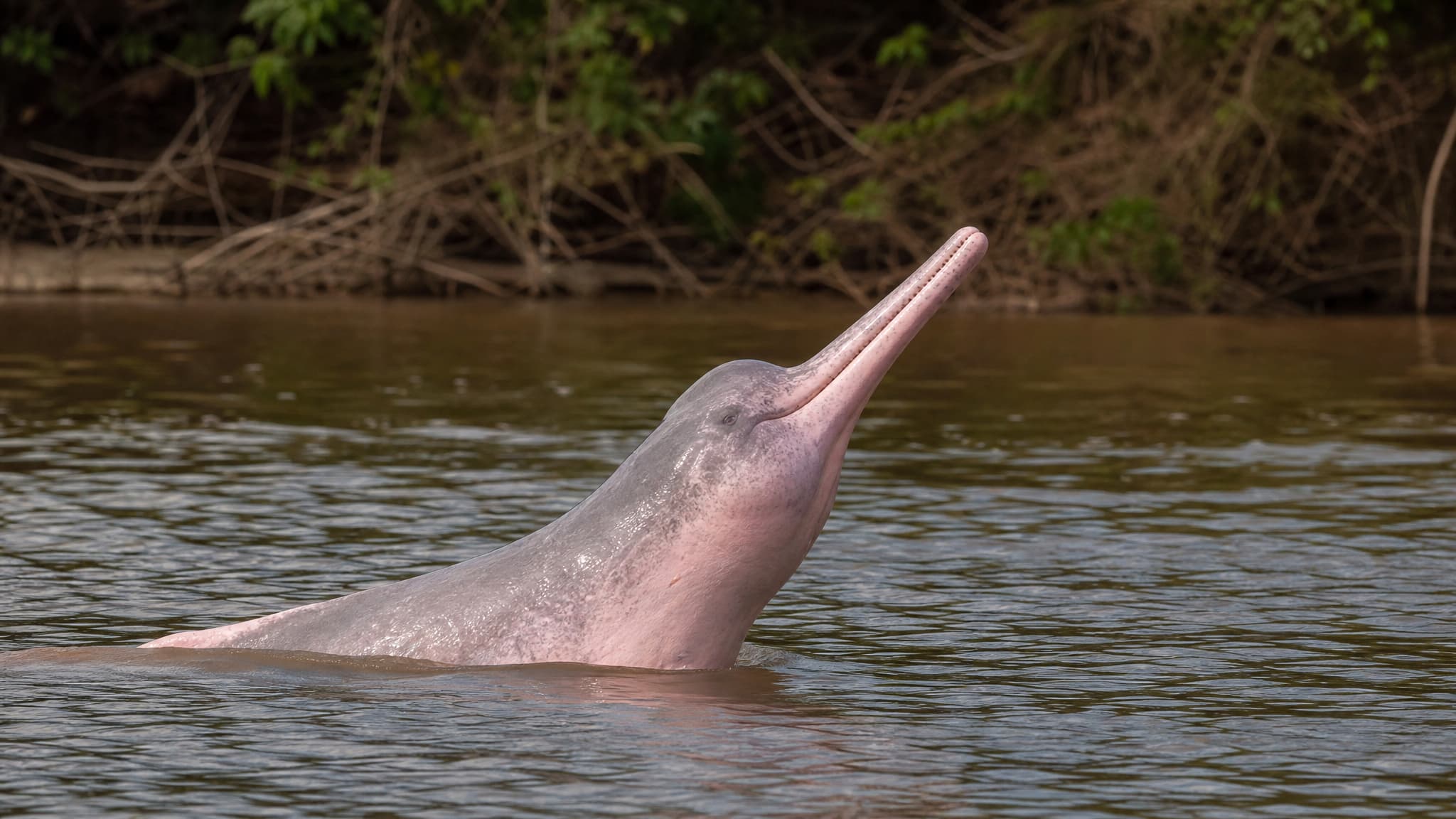
Tayra
Mammals

Tayra

Eira barbara

Tayra The tayra (Eira barbara) is a medium-sized member of the weasel family, Mustelidae, native to the Neotropics. It has a long, flexible body, a robust head, rounded ears, relatively long legs with strong claws, and a long bushy tail that helps it balance in trees. Most adults are dark brown to blackish, often with a paler grayish or yellow-brown head and neck. A cream, white, or orange throat patch is common but variable and may be absent. Head-and-body length is roughly 52–71 cm, and adults generally weigh about 2.7–7 kg. Its range extends from Mexico through Central America and much of South America, reaching northern Argentina; it also occurs on Trinidad. Tayras use a broad range of densely vegetated habitats, including tropical and subtropical forests, gallery forest, secondary growth, forest fragments, plantations, and sometimes areas close to settlements. They are agile both on the ground and in the canopy, taking shelter in hollow trees, burrows, caves, or dense vegetation. They occur from lowlands to around 2,400 m elevation. An opportunistic omnivore, the tayra eats small mammals, birds and eggs, reptiles, insects and other invertebrates, fruit, and honey. It is usually solitary, though pairs and females with young may be seen. Activity is chiefly diurnal or crepuscular, and its climbing ability allows it to hunt and forage among branches as well as on the forest floor. By preying on small animals and consuming fruit, it participates in food webs as both a mesocarnivore and a potential disperser of seeds. Reproductive details in the wild remain incompletely known. Reported gestation is about 63–70 days, and litters commonly contain two or three young. The female raises the offspring in a sheltered den; males do not appear to provide parental care. Captive animals have lived about 16–18 years, while wild lifespan is uncertain. Globally, the species is assessed as Least Concern, reflecting its wide distribution and ecological flexibility. Nevertheless, deforestation, conversion to pasture, hunting, and persecution following poultry or crop raids can threaten populations locally; a 2026 Atlantic Forest study found higher occupancy farther from pasture areas.

View Details
Southern Tamandua
Mammals

Southern Tamandua

Tamandua tetradactyla

The southern tamandua, also called the lesser or collared anteater, is a medium-sized South American anteater. It has a narrow, elongated snout, no teeth, powerful forelimbs with prominent claws, and a long prehensile tail whose underside is largely bare for gripping branches. Adults usually have a body length of about 53.5–80 cm, plus a 40–59 cm tail, and weigh roughly 4.5 kg. Coat color varies geographically: many southern animals show a bold black “vest” over the shoulders and back, while northern and western populations may be paler or nearly uniform in color. This species occurs east of the Andes across much of South America and on Trinidad, ranging from Colombia and Venezuela south to northern Argentina and Uruguay. It uses rainforest, other humid and dry forests, savannas, scrub, mangroves, and habitats near watercourses; records extend to about 2,000 m elevation. Although it can travel on the ground, it is an adept climber and often rests in tree hollows. Southern tamanduas are usually solitary and chiefly nocturnal, though they may also be active by day. They locate prey largely by smell, tear into nests with their claws, and use a sticky tongue that may reach 40 cm to gather ants and termites. Bees and honey are also eaten. Their specialized feeding helps regulate colonies of social insects, while their claws and tail make them well suited to moving through both trees and terrestrial cover. When threatened, an individual may brace itself against a tree or rock and strike or grasp with its strong forelimbs; it can also hiss and release a strong odor. After a gestation of approximately 130–150 days, the female generally gives birth to one young. The infant rides on its mother’s back during its early months and remains associated with her for around a year. Reported captive lifespan is about nine years. The species is assessed as Least Concern globally, reflecting its broad distribution, but local populations can be affected by habitat loss and degradation, wildfires, road mortality, hunting, and capture for the pet trade.

View Details
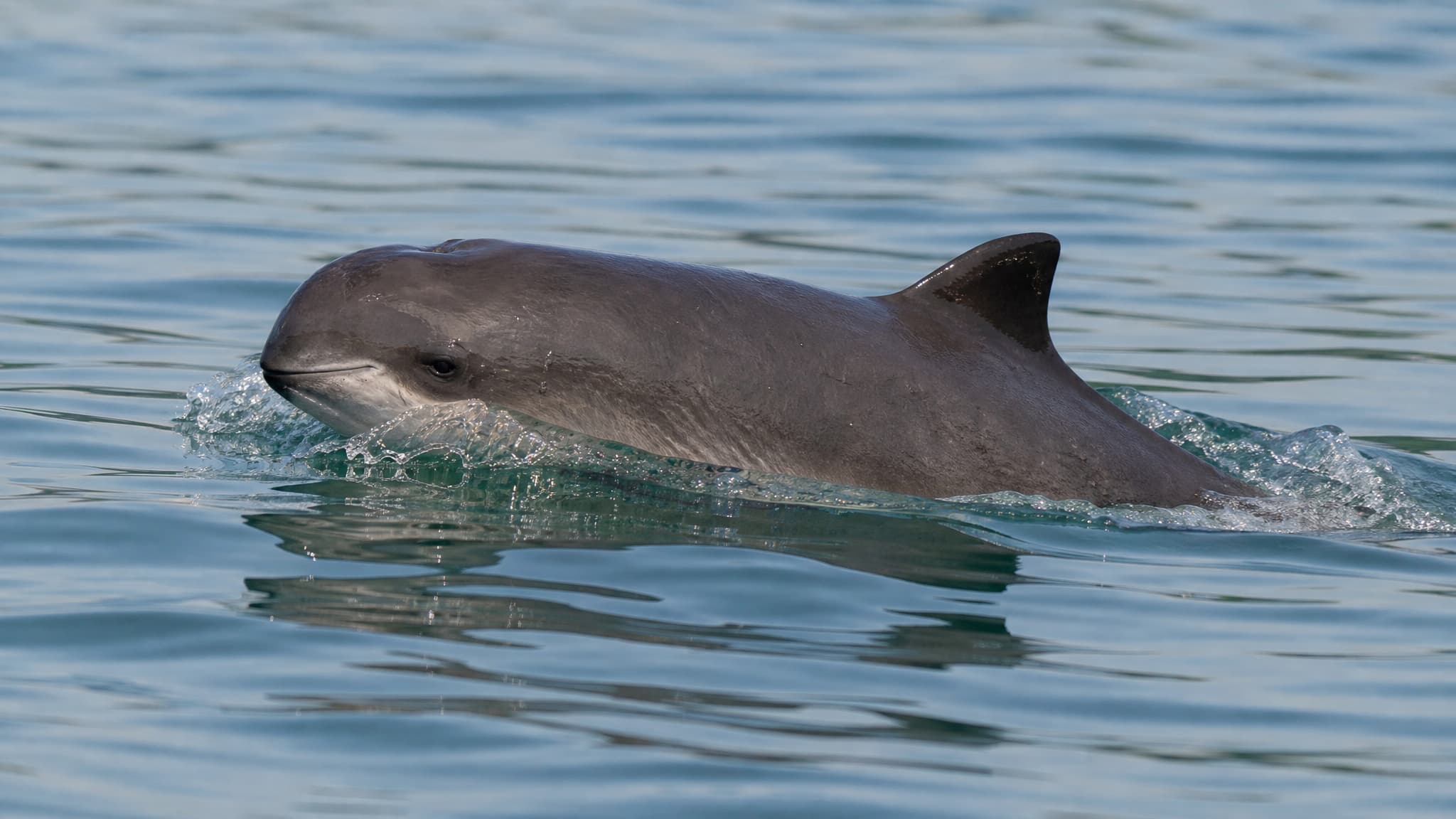
Neotropical river otter
Mammals

Neotropical river otter

Lontra longicaudis

The Neotropical river otter is a semi-aquatic mustelid with a streamlined, low-slung body, short sturdy legs, fully webbed toes, and a long, tapering tail used in swimming. Its coat is short, dense, and glossy grayish brown, usually paler on the throat and underside; pale silvery to yellowish markings may show on the muzzle and lips. Males are generally larger than females. It occurs from Mexico through Central America and much of South America, reaching Uruguay, Paraguay, and northern Argentina. It lives beside permanent freshwater—rivers, streams, lakes, and lagoons—and may also use coastal settings where freshwater is available. Dense riparian vegetation is important, and resting or breeding shelters can include bank burrows, cavities among rocks or roots, vegetation cover, and sometimes caves. Usually solitary, this otter communicates with scent marks deposited at conspicuous places near water and also makes whistles, hums, and alarm-like calls. It is an agile swimmer and diver. Fish are its principal prey, while crustaceans, mollusks, aquatic insects, amphibians, reptiles, birds, and small mammals supplement the diet when available. As a freshwater predator, it helps shape aquatic food webs and its presence depends on functioning waterside habitat. Breeding timing varies geographically. Gestation is reported at about 56 days, with litters of one to five young—most often two or three. Cubs are born furred but blind, later emerge from the den and begin swimming with their mother; females provide the recorded parental care. Reliable wild-longevity figures were not established by the consulted sources. The species is globally classified as Near Threatened. Habitat loss and fragmentation, water pollution, conflict with fisheries and fish farms, accidental entanglement in fishing gear, and hydroelectric development are important threats. In Brazil, an ICMBio assessment likewise classified it as Near Threatened, emphasizing the risks posed by deforestation and degradation of freshwater systems.

View Details
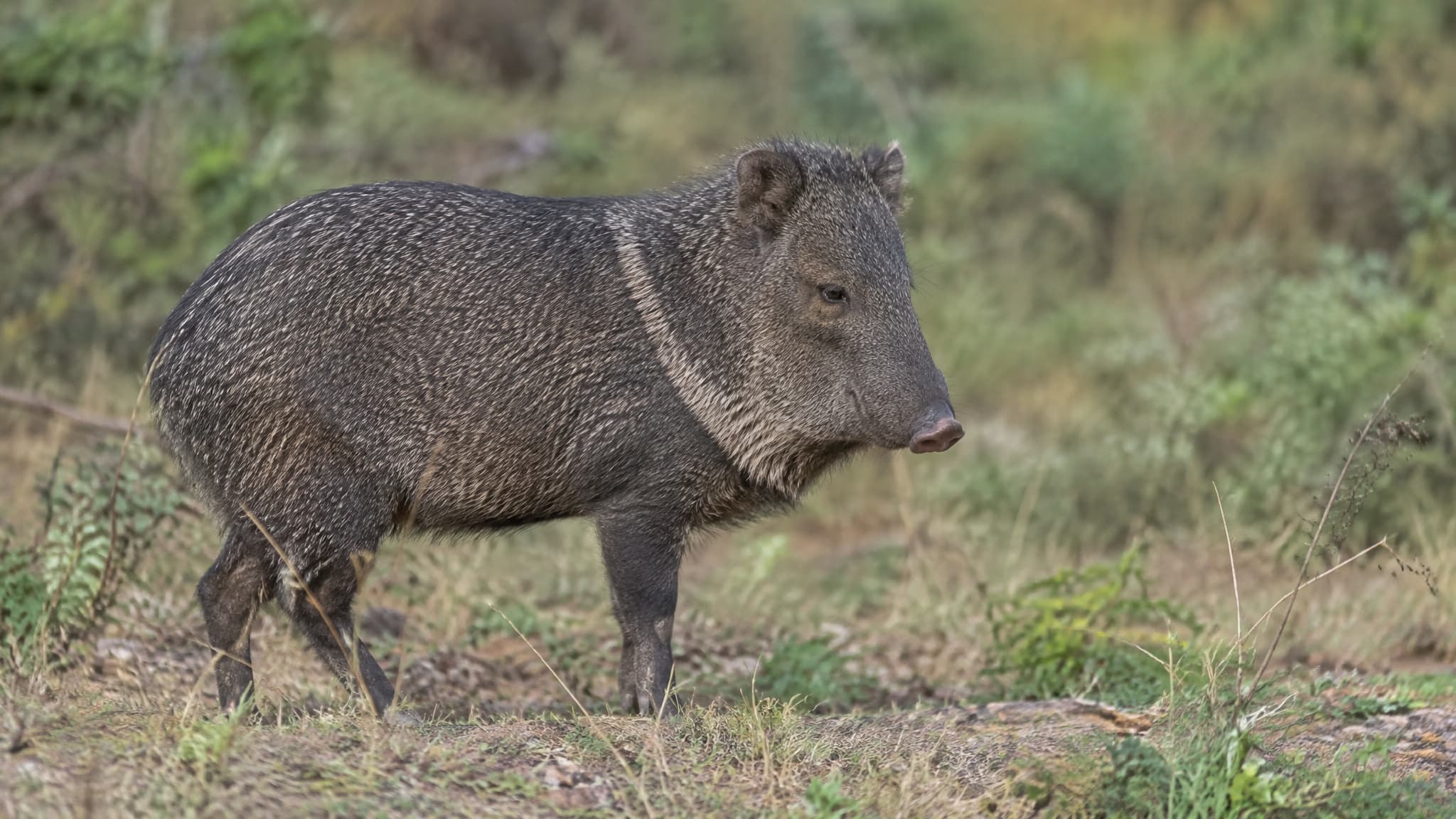
Kinkajou
Mammals

Kinkajou

Potos flavus

The kinkajou (Potos flavus) is a medium-sized, nocturnal tree-dwelling mammal in the raccoon family, Procyonidae. It has dense golden-brown to olive-brown fur, a rounded head, large dark eyes adapted to low light, short limbs, and a long fully prehensile tail. Its flexible body, reversible hind feet, and grasping tail make it an agile but deliberate climber; it can even hang beneath branches while feeding. It occurs from southern Mexico through Central America and across much of northern and central South America, reaching Brazil. Kinkajous use several forest types, including humid tropical forest, secondary forest, seasonally dry woodland, Amazonian forest, and Atlantic Forest. They spend most of their lives in the canopy and usually rest by day in tree hollows, dense branch forks, or other sheltered arboreal sites. Although classified in the order Carnivora, the species is chiefly a fruit-eater. Figs and other ripe fruits are important foods, supplemented according to season by nectar, flowers, and insects. It forages mainly at night, often alone, but individuals may share feeding trees or daytime dens. By carrying and passing viable seeds, kinkajous contribute to tropical-forest regeneration; nectar feeding may also transfer pollen between flowers. Females can breed throughout the year, with timing often linked to local fruit availability. A pregnancy lasts roughly 98–120 days and usually produces one young, which is weaned at about two months and becomes independent after several months. Wild longevity is difficult to measure, while captive animals may live for 20–40 years. The species is assessed as Least Concern, but deforestation, forest degradation, hunting or capture, and exposure to diseases from domestic animals can threaten local populations.

View Details
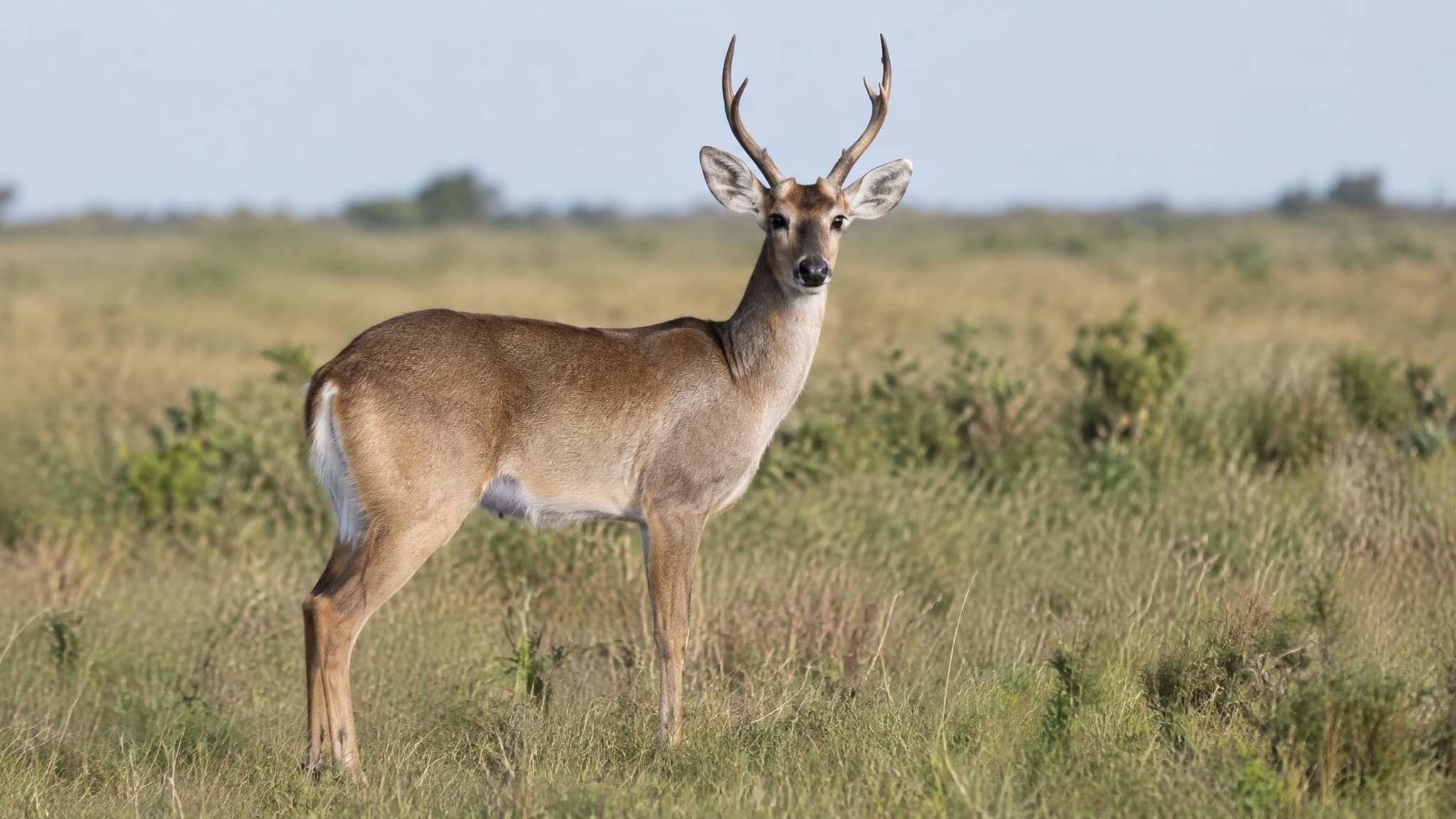
Red-faced spider monkey
Mammals

Red-faced spider monkey

Ateles paniscus

The red-faced spider monkey—also called the Guianan spider monkey or red-faced black spider monkey—is a large, long-limbed New World monkey. Its coat is chiefly glossy black, contrasting with the largely hairless reddish to pinkish face that gives the species its common name. The head is small relative to the body, while the arms, legs, and prehensile tail are exceptionally long. That tail acts as a secure fifth limb, helping the monkey balance, suspend itself, and move through high branches. Adults measure roughly 54 cm in head-and-body length and weigh about 8–9 kg. It occurs north of the Amazon River in Brazil, French Guiana, Guyana, and Suriname. Red-faced spider monkeys occupy dense tropical forest, especially the middle and upper canopy; observations indicate that they spend most of their time high above the ground. Intact forest with a tall, connected canopy is particularly important, because their specialized arboreal travel is poorly suited to crossing open, cleared landscapes. Fruit is the core of its diet, supplemented with leaves, flowers, seeds, fungi, and occasional insects. By swallowing fruits or carrying them between feeding trees, it contributes to seed dispersal and therefore to the regeneration and plant diversity of the forest. Groups may include a few dozen individuals but regularly divide into smaller, shifting feeding and travel parties—a fission–fusion social system. They are diurnal and communicate with calls, postures, branch-shaking, and scent-related social investigation. Reproduction is slow. Gestation lasts about 226–232 days, normally producing one infant; successful mothers may not give birth again for approximately four years, and young remain closely dependent on their mothers for years. Wild longevity may reach nearly 38 years, while a captive individual has lived to 46. The species is listed as Vulnerable: hunting for bushmeat, forest loss and fragmentation, and its low reproductive rate can combine to cause declines from which local populations recover slowly.

View Details
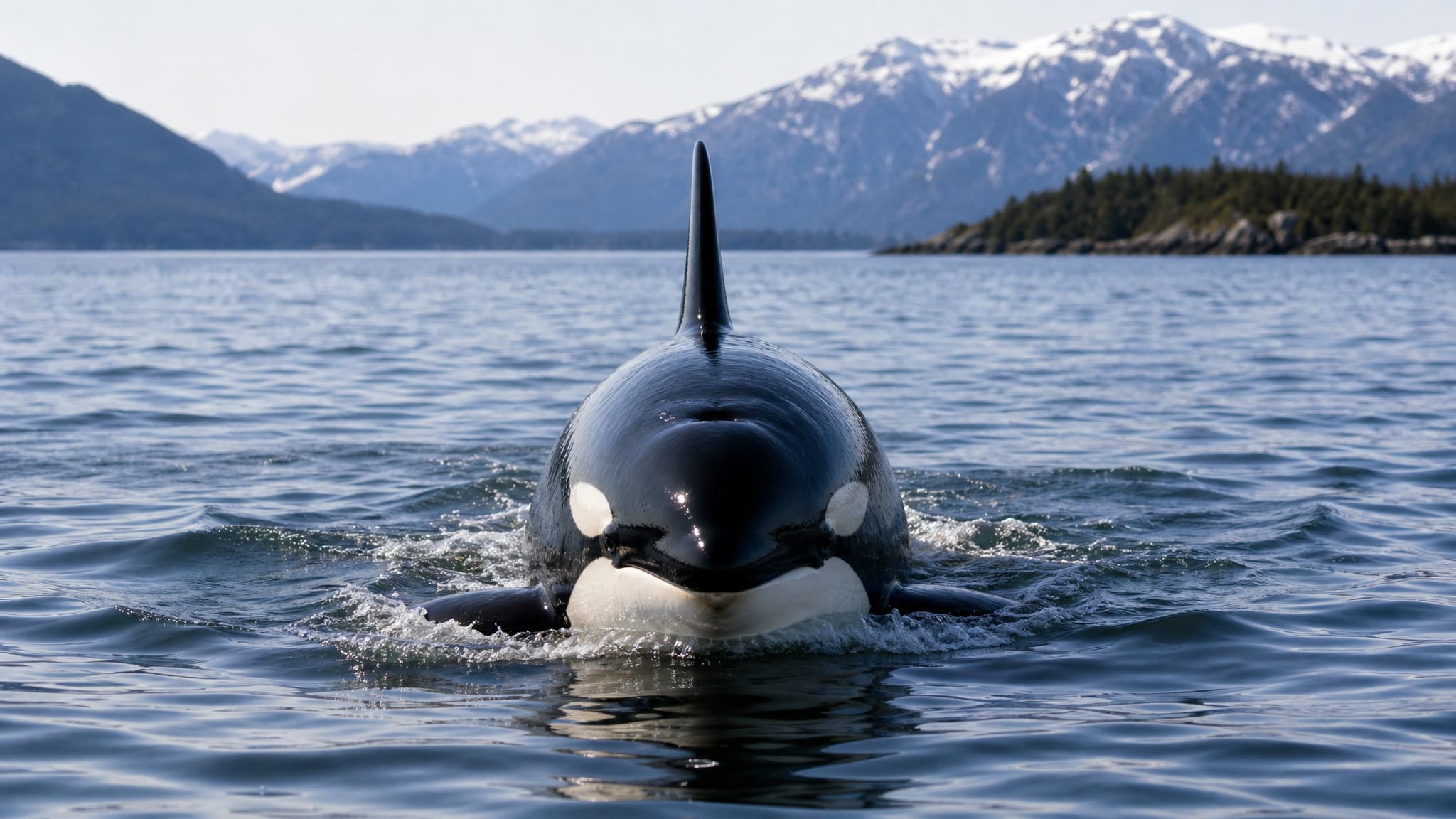
Giant armadillo
Mammals

Giant armadillo

Priodontes maximus

Giant armadillo The giant armadillo is the largest living armadillo. Its dark gray to brown, banded carapace covers the back, while the underside is paler, pinkish, and wrinkled. A long, tapered head, robust tail, and huge middle claws on the forefeet give it a distinctive profile. Adults commonly weigh around 27 kg, though substantially heavier animals are known; total body length can approach a metre before the tail. This secretive mammal occurs east of the Andes in northern and central South America, including Brazil, the Guianas, Venezuela, Colombia, Ecuador, Peru, Bolivia, Paraguay, and northern Argentina. It uses a broad range of terrestrial environments: rainforest, savanna, seasonally flooded plains, scrubby woodland, and other places where suitable soil and insect colonies are available. In Brazil it is widely known as the tatu-canastra. Usually solitary and chiefly nocturnal, giant armadillos excavate deep resting burrows with their powerful claws. They feed mainly on termites and ants, tearing into nests and mounds; worms, carrion, and small vertebrates are occasional foods. Their digging aerates soil, and abandoned burrows can provide shelter and cooler refuges for other animals, making the species an important ecosystem engineer. Reproductive behavior remains poorly documented. Females generally produce one young, occasionally two, after a gestation of roughly four months. Young depend on their mother for several months and may become independent at about four to six months; sexual maturity is reported at roughly 9–12 months. Reported wild longevity is about 12–15 years. The species is assessed as Vulnerable globally. Habitat conversion and fragmentation, especially for agriculture, together with hunting and killing by people, are major pressures. Its large space requirements, low encounter rate, and dependence on intact landscapes make protection of habitat and reduction of persecution particularly important.

View Details
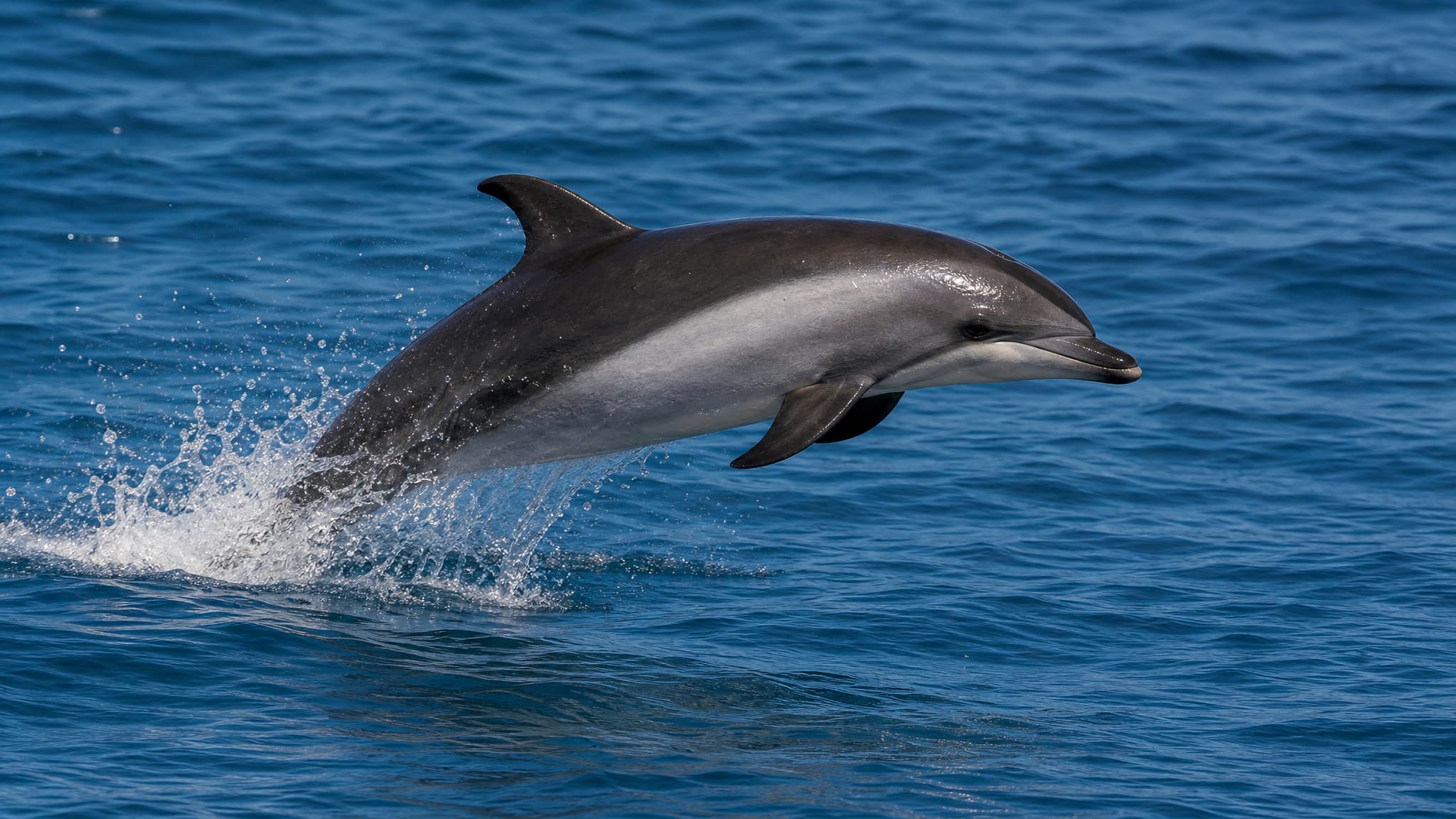
Guianan squirrel monkey
Mammals

Guianan squirrel monkey

Saimiri sciureus

The Guianan squirrel monkey is a small, slender New World monkey with a gray to olive-gray coat, vivid yellowish limbs, and a long, non-prehensile tail. Its white facial mask and dark muzzle give the face a distinctive expression; the tail may curl over the shoulder while the animal rests. Adults have a body length of roughly 30 cm, with a tail that is longer than the body. Like other primates, it has nails rather than claws, and males have especially large upper canines. This species occurs in the Guianas—Guyana, Suriname, and French Guiana—and in northern Brazil. In Brazil it is found north of the Amazon River, from the Branco and Negro river region eastward to the Atlantic coast, including Roraima, Amazonas, Pará, and Amapá. It uses primary and secondary tropical forest, gallery forest, forest edges, and other wooded habitats, usually traveling through the middle levels of the forest but sometimes descending lower. Active by day and highly agile, Guianan squirrel monkeys move through branches in social troops that can be very large. Females and their young form the social core, while males have a dominance hierarchy and social relationships shift with the breeding season. The species is an omnivore with a strong reliance on fruit and insects; it also takes spiders and other arthropods, along with leaves and seeds. By consuming fruits and searching widely for food, it contributes to food-web connections and may help disperse seeds. Breeding is seasonal. After a gestation of about 160–170 days, a female normally gives birth to one infant, which she nurses and protects; males do not provide direct parental care. Females can mature at about 2.5 years and males around 4 years. Reported average lifespan is about 21 years, including records from wild populations. The IUCN status is Least Concern, but local populations can still be affected by forest loss, hunting, and capture for the pet trade or research.
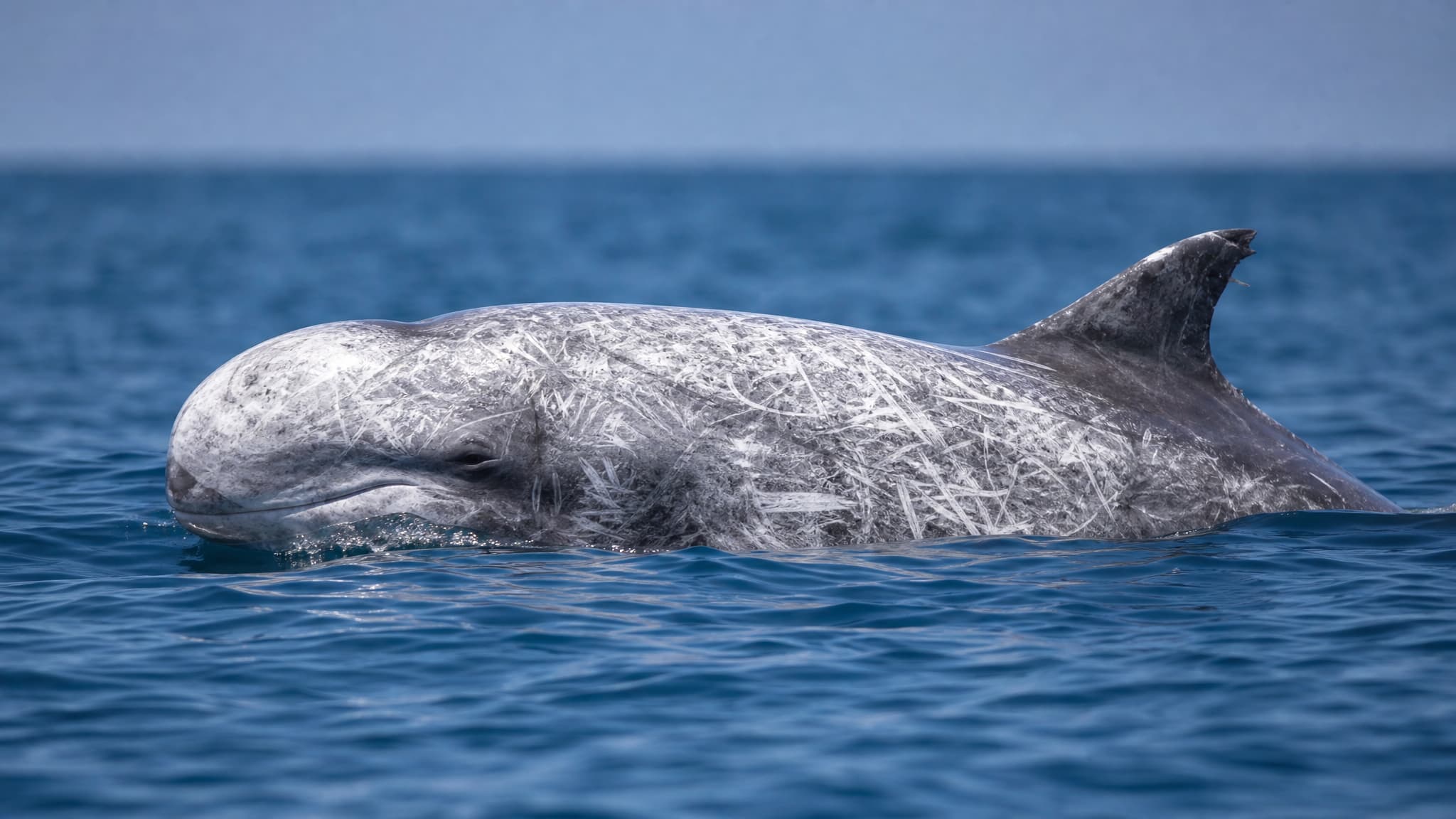
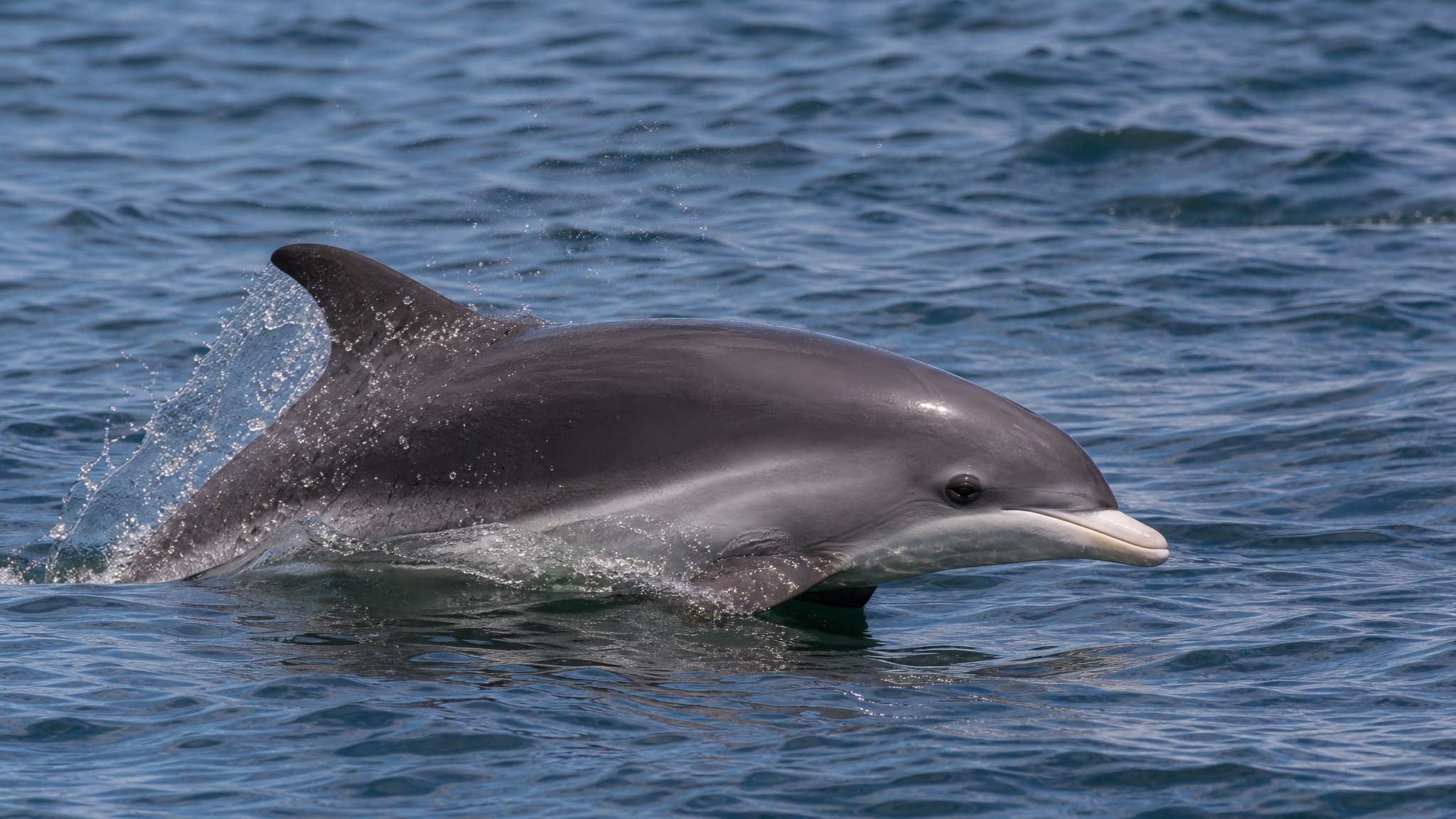
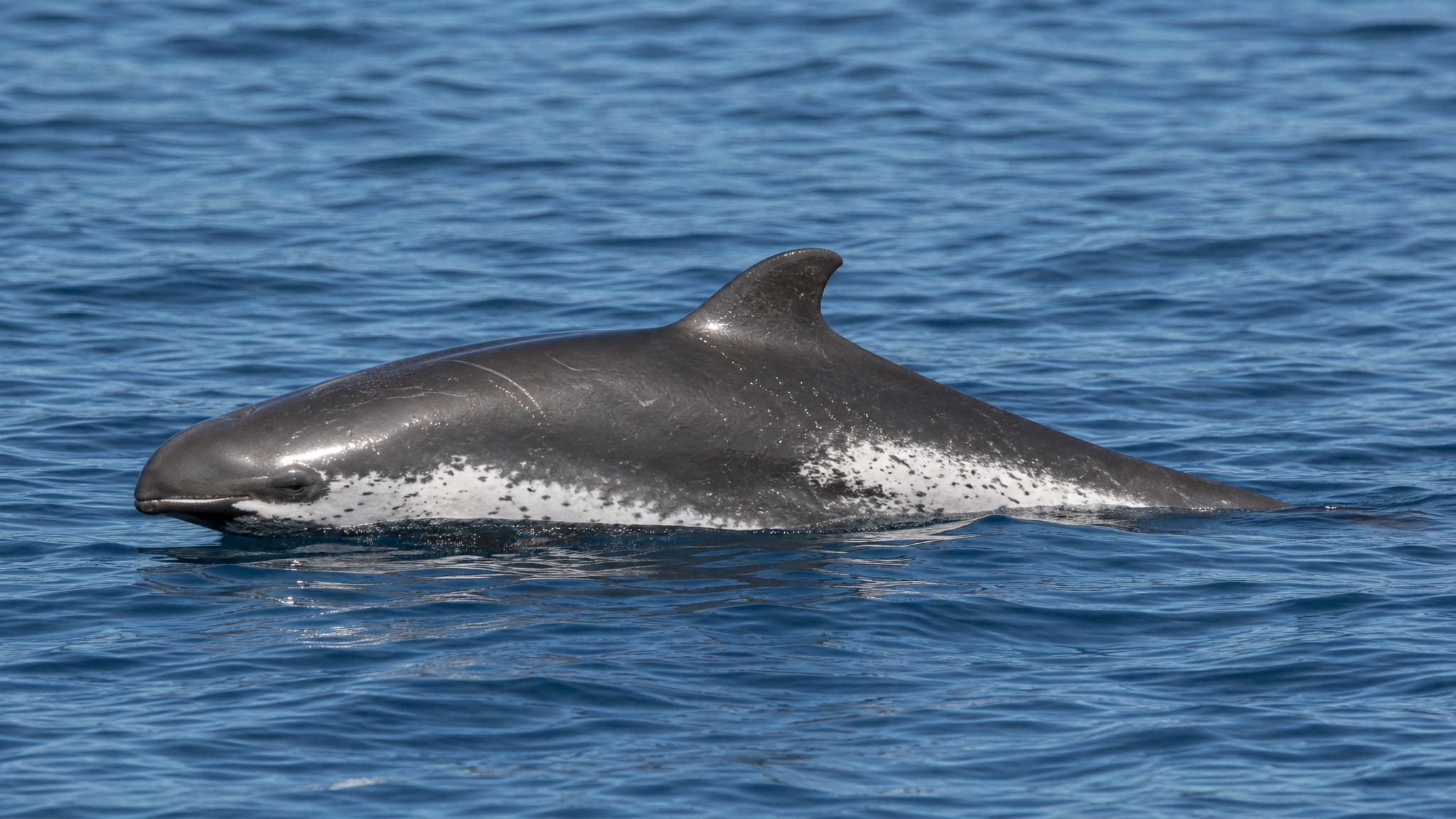
View Details