Superb lyrebird
Menura novaehollandiae
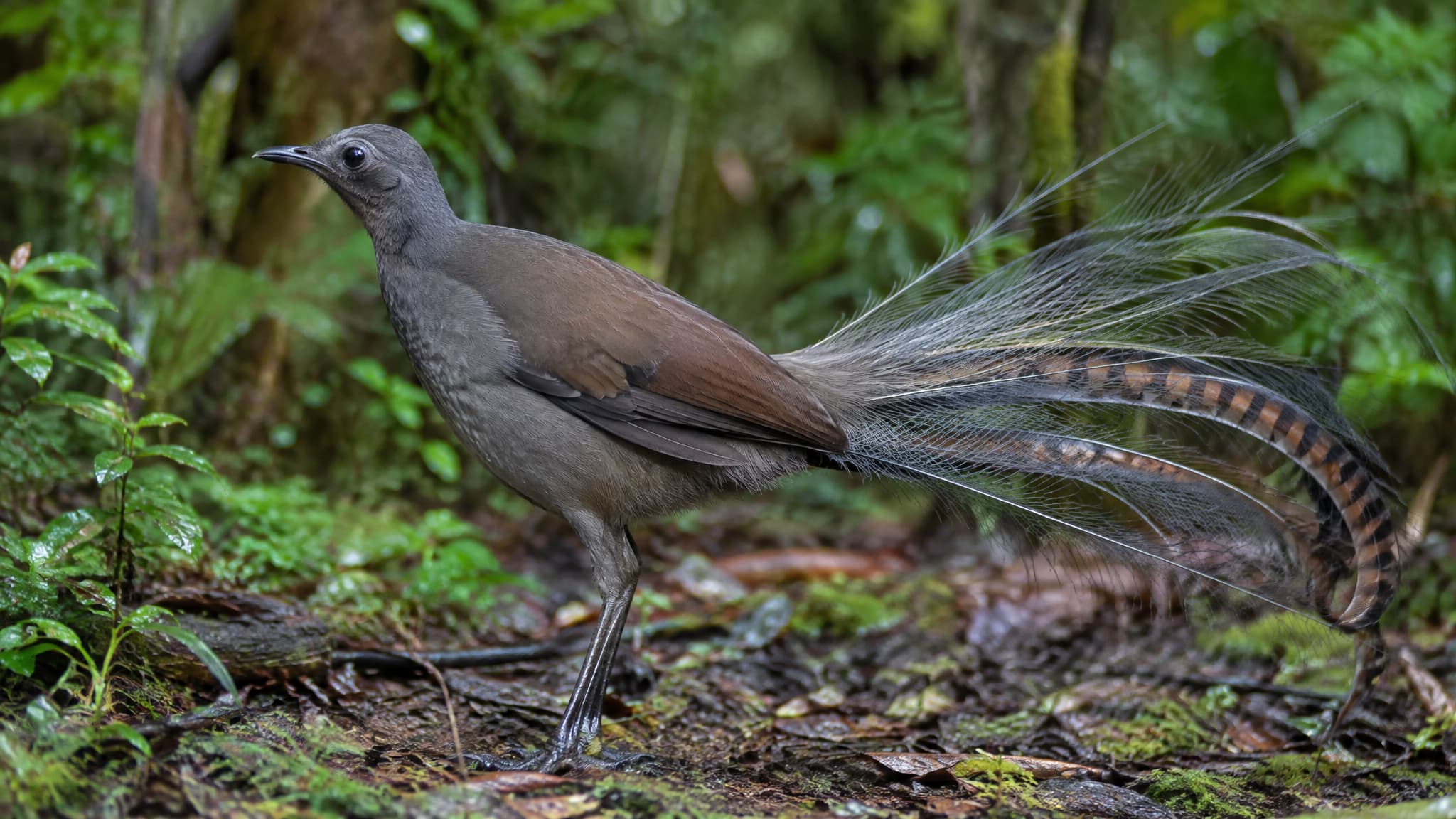
The superb lyrebird (Menura novaehollandiae) is a large ground-dwelling songbird of southeastern Australia and one of only two lyrebird species, the other being the rarer Albert's lyrebird. It ranks among the largest passerines: females measure about 86 cm and males about 1 m in total length, and an adult male's tail can reach 70 cm. Females weigh about 0.9 kg and males about 1.1 kg. The upperparts are dark brown, the underparts greyish brown and the flight feathers tinged with red. The male's tail has sixteen feathers, including two broad, curved outer plumes shaped like a lyre; females have shorter, plainer tails. The species lives in wet forest and rainforest with deep, moist leaf litter, from southern Victoria to southeastern Queensland, including wet eucalypt woodland in eastern New South Wales. Birds were introduced to southern Tasmania between 1934 and 1954, and that population is now thriving. Lyrebirds spend most of their time on the ground, fly weakly and only when in danger, and roost in trees at night. Lyrebirds forage by raking through soil and leaf litter with their strong feet, eating earthworms, insects, spiders and other invertebrates, along with some seeds and fungi. Turning over so much soil makes them ecosystem engineers of the forest floor. Adults are mostly solitary and territorial. The species is famous for its mimicry: an estimated 70 to 80% of a male's vocalisations copy other sounds, mostly other birds, and females mimic too, for example when defending the nest. Breeding takes place in winter, from June to October. Each male builds and defends several circular display mounds, where he sings and fans his tail over his head to court females, and he mates with several of them. The female alone builds a domed nest of sticks, lays a single egg and incubates it for up to seven weeks. The chick stays in the nest about six weeks, and the mother keeps caring for it for several months after it fledges. Females mature at 6 to 7 years and males at 7 to 9 years. Lyrebirds can live up to 20 years. The IUCN lists the superb lyrebird as Least Concern, and it is common across most of its range. It was once hunted for its tail feathers and lost habitat, but protection has stabilised its numbers. Current threats include introduced red foxes and feral cats, urban development, vehicle collisions and natural predators such as goshawks, sparrowhawks and currawongs.
View Details