
Red-handed howler monkey
Alouatta belzebul
 AI-generated
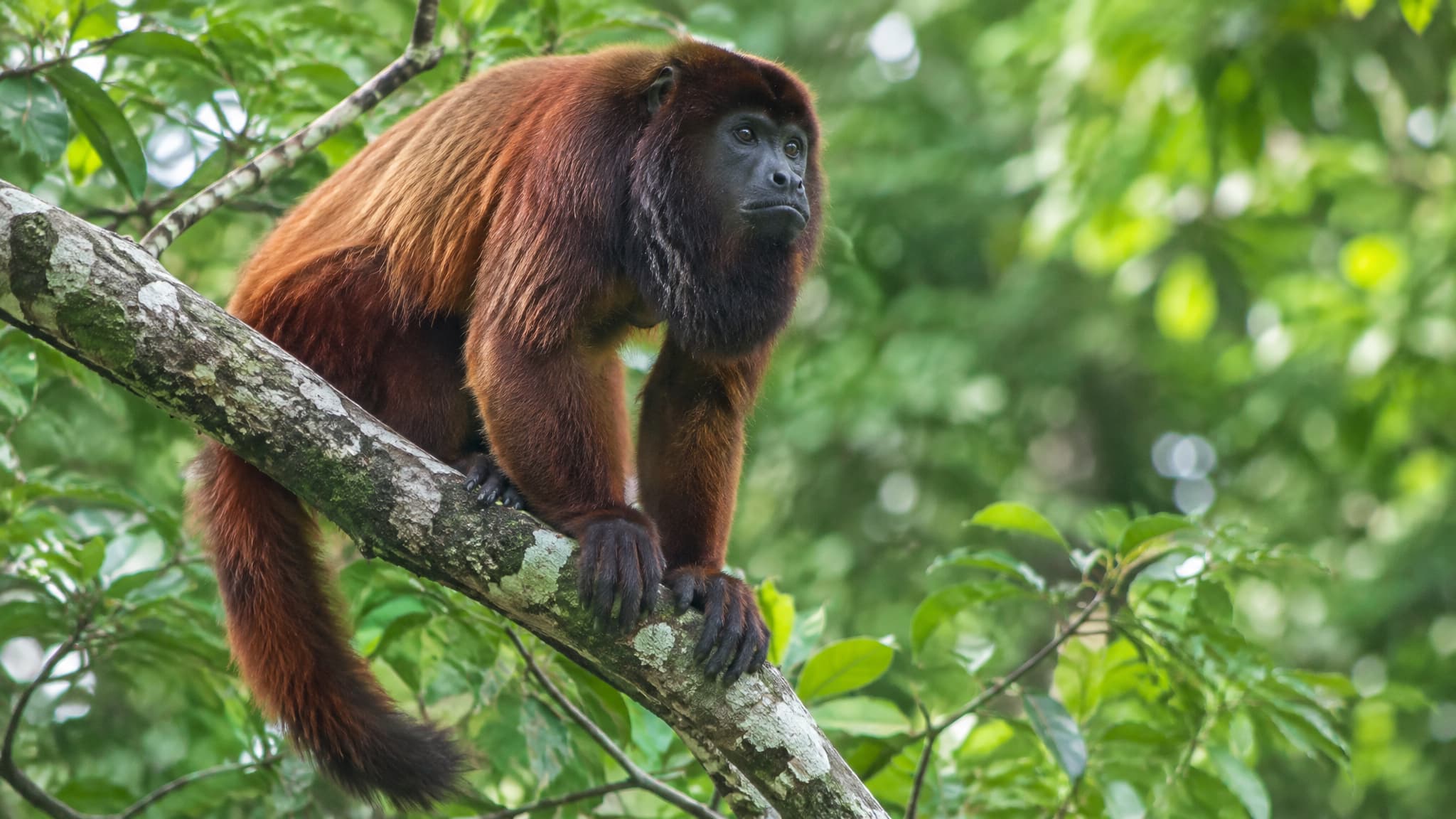
A red-handed howler monkey sits astride a lichen-covered branch in dense green forest, showing a dark face, reddish-brown coat, long limbs, and a hanging tail.
The red-handed howler monkey is a medium-sized New World monkey recognizable by its mostly black to very dark-brown coat and contrasting reddish, orange, or chestnut hands and feet. Some individuals also show warmer tones on the tail tip, forehead, or back. Males are generally larger than females, and both sexes have the long, grasping tail characteristic of atelid monkeys. Its enlarged hyoid apparatus and specialized vocal tract help produce the deep roars, barks, and grunts for which howler monkeys are famous.
Alouatta belzebul is endemic to Brazil. Its range is disjunct: populations occur in eastern Amazonian forest and in remnants of northeastern Atlantic Forest. It uses arboreal habitats, including mature and secondary forest, and spends most of its time high in the canopy. Forest fragmentation can isolate groups because this monkey depends on tree cover for travel, resting, and feeding.
It is mainly a leaf-eater, especially selecting young leaves, but it also eats fruit, flowers, bark, and other plant material. Fruit may become especially important when available. By consuming fruits and moving through the canopy, it can disperse seeds; its leaf-based diet also links it closely to the productivity and seasonal food supply of its forest habitat. Soil eating has been recorded in some populations, possibly in relation to nutritional needs or the processing of chemically defended leaves.
Red-handed howlers are diurnal and live in small social groups, often with one or two adult males, several females, and their offspring. They rest for long periods, an energy-saving pattern suited to digesting foliage. Loud calls help neighboring groups assess one another and may reduce the need for costly direct fights over food, space, or mates.
Breeding can occur throughout the year. Females usually bear one infant after a gestation of about 187 days, with births commonly separated by one to two years; maternal care is extensive. Species-specific longevity in the wild is poorly documented, but howler monkeys are generally estimated to live roughly 15–20 years. The species is assessed as Vulnerable: habitat loss and fragmentation, hunting, and degradation of both Amazonian and Atlantic Forest landscapes remain major pressures.



