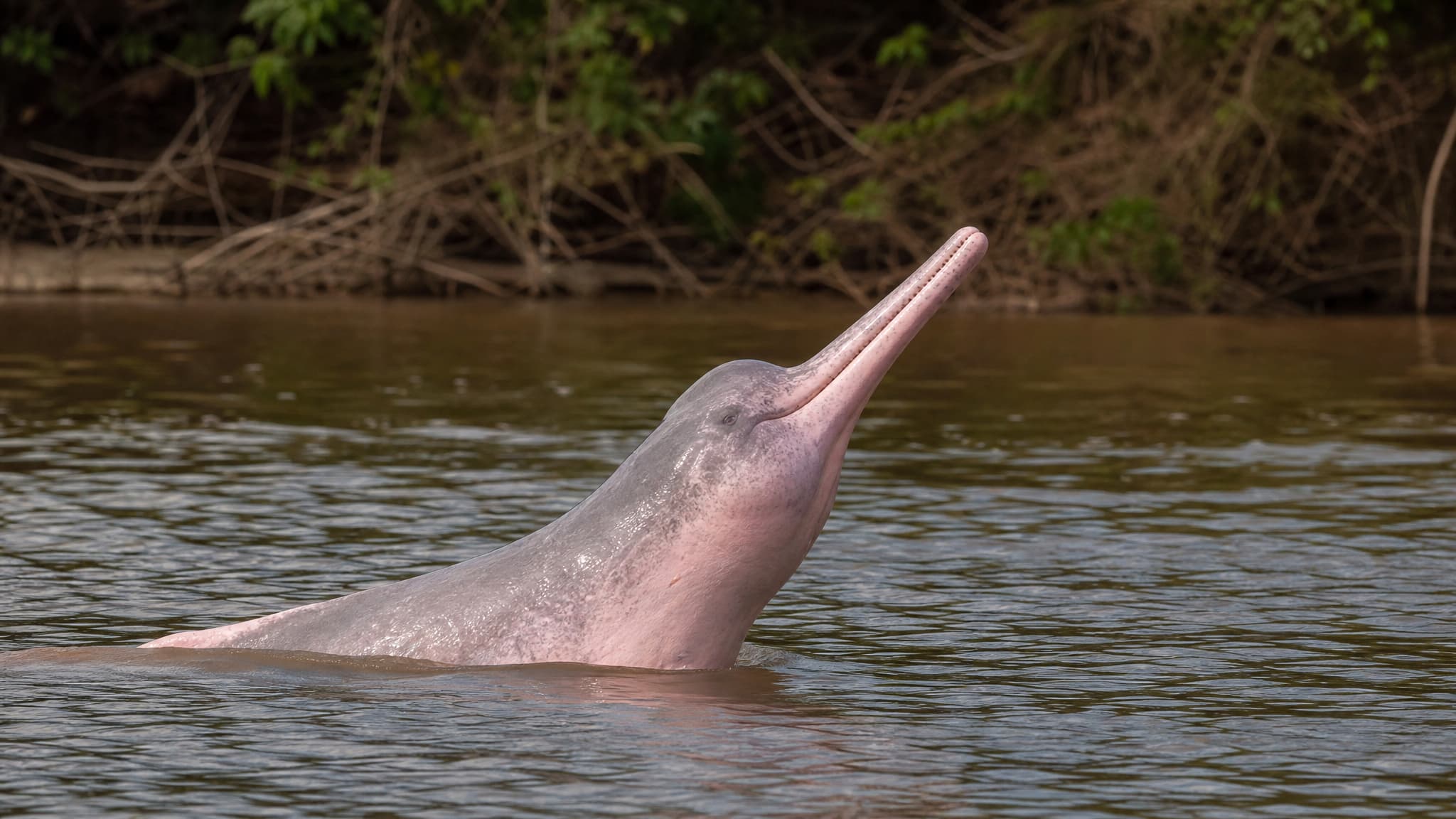
Amazonian manatee
Trichechus inunguis
 AI-generated
An Amazonian manatee swims in side profile above a vegetated underwater bottom, with its rounded snout, small eye, broad foreflippers, and paddle-shaped tail visible.
The Amazonian manatee is a fully aquatic sirenian and the only manatee species restricted to freshwater. Its dark gray to nearly black, thick skin commonly bears an irregular white or pinkish patch on the belly, although this marking can be reduced or absent. It has a broad, rounded paddle-like tail, wide flippers, a small head with a downturned snout, and sensitive bristles on the face and body. Unlike some other manatees, it lacks nails on the flippers; the epithet inunguis means “without nails.” Adults can reach roughly 2.8–3 m in length and weigh about 420–450 kg.
This species is endemic to the Amazon Basin. It occurs in rivers, tributaries, floodplain lakes, channels, and seasonally inundated forests from the western Amazon to the river’s Atlantic outlet. Rather than defending a territory, it follows the annual flood cycle: during high water it uses flooded várzea habitats with abundant plants, and in the dry season it tends to occupy deeper river channels and permanent lakes. Its secretive habits and the turbid water in much of its range make wild animals difficult to observe.
An herbivore, the Amazonian manatee uses its flexible, bristled lips to crop and manipulate aquatic vegetation. Its foods include grasses, water lettuce, water hyacinths, and other riverine plants; floating palm fruits may also be eaten. Feeding is especially important during the flood season, when newly inundated vegetation is available. During seasonal low water, individuals may endure long periods with little or no feeding. By consuming and moving among aquatic plants, the species contributes to the functioning of floodplain food webs and nutrient cycling.
Breeding can occur throughout the year. Gestation lasts about a year, and a single calf is typical. The calf remains closely associated with its mother, often travelling beside her or on her back, for more than two years. Longevity in the wild is incompletely known, though about 30 years has been reported; captive records demonstrate survival beyond 12 years. The species is globally listed as Vulnerable. Historic commercial hunting severely reduced populations, while present threats include illegal hunting, entanglement, boat strikes, dams and other habitat fragmentation, deforestation and sedimentation, pollution, and disturbance from development in the Amazon Basin.