
Black-and-gold howler
Alouatta caraya
 AI-generated
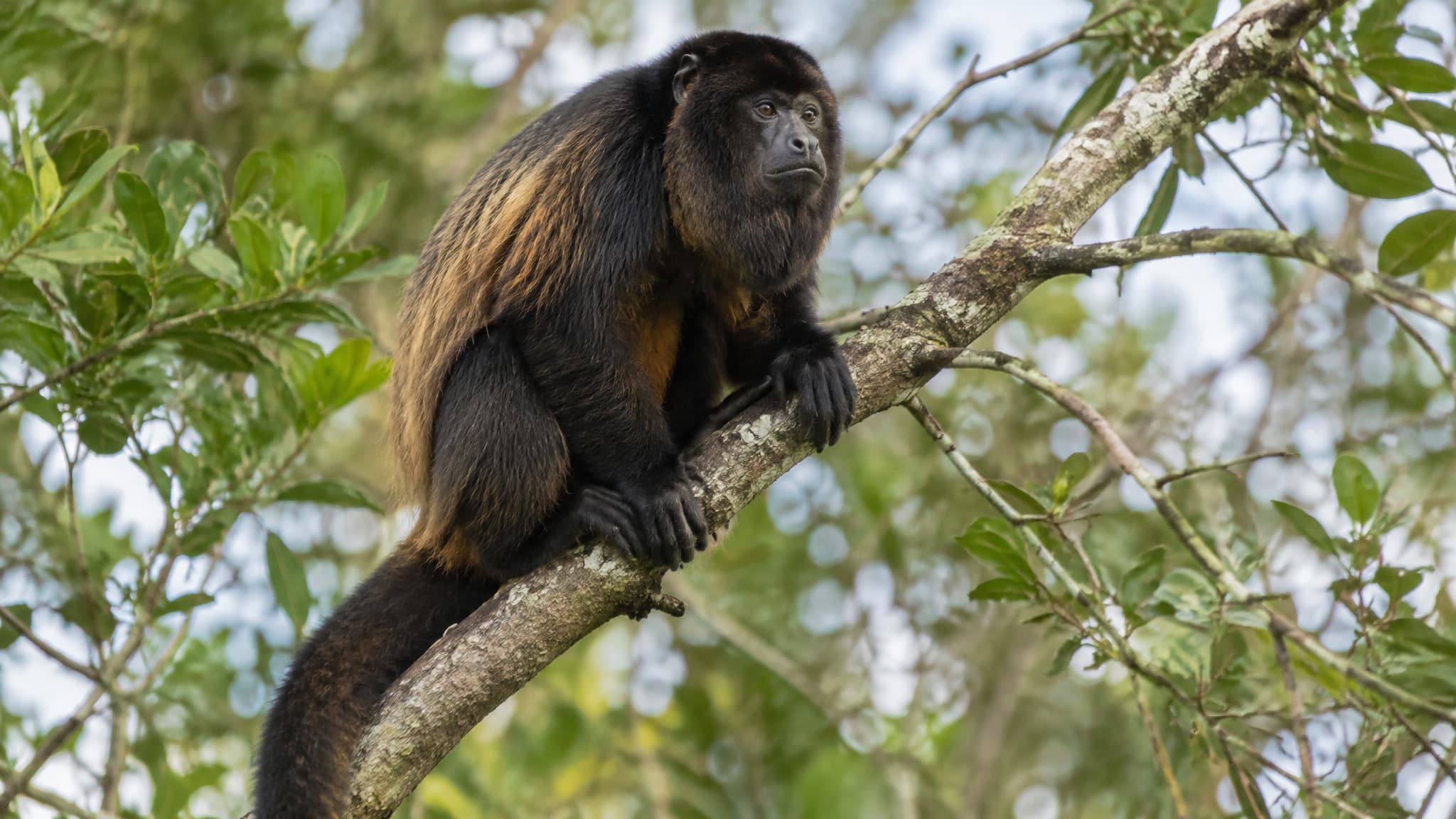
A black-and-gold howler sits astride a lichen-covered branch in the leafy forest canopy, gripping it with its hands and feet. Its shaggy black coat has golden-brown fur along the flanks, and a long tail hangs below.
Identification
The black-and-gold howler is a large New World monkey distinguished by striking sexual dichromatism. Adult males have an almost entirely black coat, whereas adult females are yellowish to olive-blond; young are born golden. It has a long, powerful prehensile tail with a bare tactile patch below, used like an extra grasping limb among branches. Its enlarged hyoid apparatus helps produce the species’ resonant, far-carrying howls.
Range and habitat
Alouatta caraya occurs in central-southern South America: eastern Bolivia, Brazil, Paraguay, and northern Argentina. It uses a range of wooded habitats, including gallery forest, semi-deciduous and deciduous forest, and seasonally dry woodland near savanna. Although strongly arboreal, it may descend during dry conditions to drink or feed.
Diet and behavior
Leaves make up most of its diet, supplemented with fruit, flowers, and buds. Leaf fermentation provides energy but supports a low-energy lifestyle, so these monkeys rest for much of the day and travel relatively slowly. They live in social groups, often of several individuals, and their group calls advertise location and may help space neighboring groups apart.
Reproduction, ecology, and conservation
Females generally give birth to one infant after a gestation of about 187 days and provide prolonged care; infants remain dependent for roughly a year. Recorded captive longevity is about 20 years. As a canopy-dwelling folivore and fruit eater, the species contributes to forest food webs and can disperse some seeds. It is listed as Near Threatened globally, with forest conversion and fragmentation—especially from agriculture and cattle production—among the principal pressures; hunting and capture also affect some populations.



