Brown howler monkey
Alouatta guariba
 AI-generated
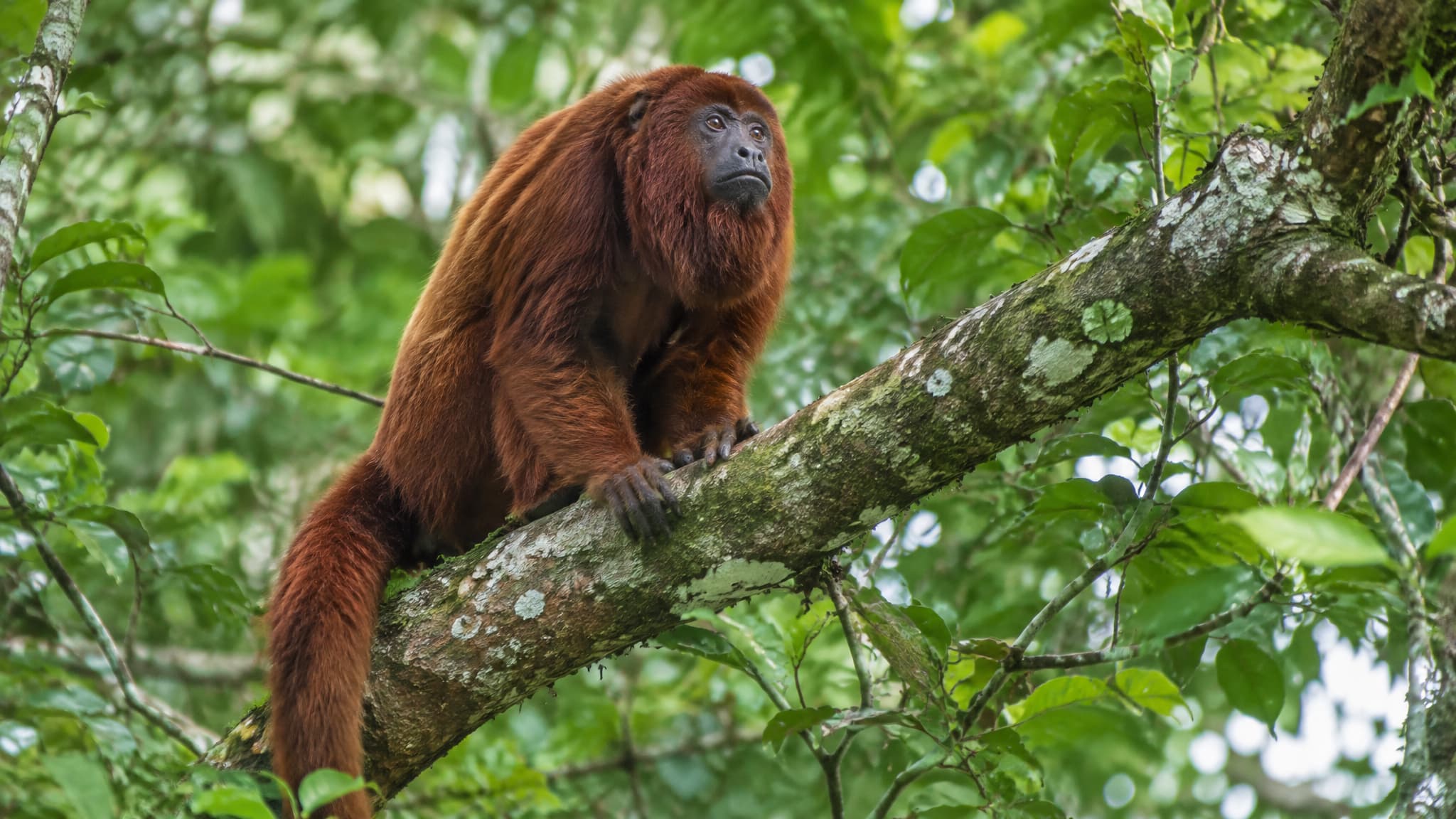
A brown howler monkey sits astride a lichen-covered branch in dense green forest, gripping the branch with its hands while its long, reddish-brown tail hangs downward. Its dark, hairless face contrasts with the thick reddish coat and beard-like fur around the cheeks and chin.
The brown howler monkey (Alouatta guariba) is a large, sturdy New World monkey of the Atlantic Forest, recognized by its resonant calls and grasping tail. Its coat ranges from brown to reddish or orange-brown; the face and ears are dark and relatively bare. Males are generally larger than females, and the sexes can differ subtly in coat tone. Like other howlers, it has an enlarged hyoid apparatus and specialized vocal tract, allowing its low roars to carry roughly 1–2 km through forest.
This species occurs chiefly in southeastern and eastern Brazil and reaches far northeastern Argentina, especially Misiones Province. It uses Atlantic Forest habitats from lowland to montane forest, including semideciduous woods, gallery forests, and areas associated with Paraná pine (Araucaria angustifolia). It is strongly arboreal, spending much of its time in the upper canopy, where dense foliage offers food, resting sites, and cover.
Brown howlers are diurnal and live in small social groups, often with a dominant adult male and several females, although group composition varies. They move deliberately on branches rather than swinging beneath them, and devote a large part of the day to resting—an energy-saving strategy suited to a leaf-rich diet. Leaves, particularly young leaves when available, form a major part of their food; flowers, shoots, lianas, and fleshy fruits are also eaten. Fruit feeding makes them contributors to seed dispersal.
Females usually give birth to a single infant after a gestation of about six months. The infant is carried by its mother and is generally weaned near one year of age; females may reproduce at intervals of roughly 22 months. Reported wild longevity is about 15–20 years. Their loud calls help maintain contact and signal occupancy of an area, while their feeding and seed dispersal link them closely to forest regeneration.
The IUCN lists A. guariba as Vulnerable, and its overall population is decreasing. Forest loss and fragmentation are major threats, compounded in some regions by illegal capture and severe mortality during yellow-fever outbreaks. Protecting connected Atlantic Forest remnants, preventing hunting and pet trade, and monitoring disease are important for the species’ persistence.