
Amazon river dolphin
Inia geoffrensis
 AI-generated
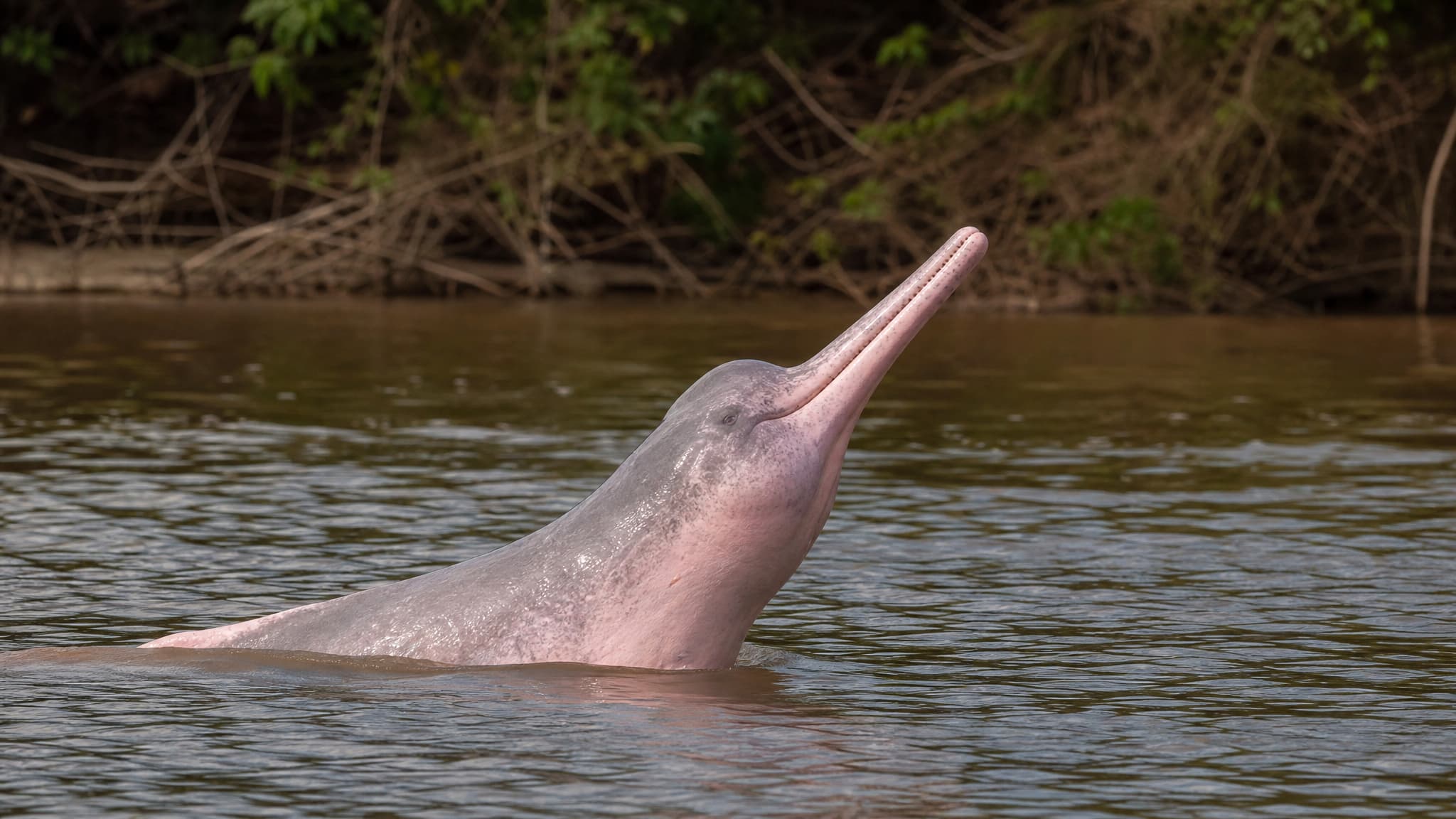
A pink river dolphin rises steeply from brown river water, with its head and very long rostrum above the surface against a wooded bank; the visible skin is mottled pink-gray. The rostrum appears unusually doubled or split, making the anatomy uncertain.
Amazon river dolphin
The Amazon river dolphin, Inia geoffrensis, is a freshwater toothed whale widely known as the boto or pink river dolphin. It is the largest living river dolphin. Adults have a stout, flexible body, a long narrow snout bearing mixed tooth shapes, broad flippers, and a low dorsal ridge rather than a tall dorsal fin. Unlike most dolphins, its neck vertebrae are not fused, allowing remarkable head movement while weaving among submerged branches. Calves are generally gray; many adults become pink, blotched pink-and-gray, or darker gray. Males are typically larger and often pinker and more scarred than females.
This species occurs in the Amazon and Orinoco drainage systems of Bolivia, Brazil, Colombia, Ecuador, Peru, and Venezuela. It uses main rivers, tributary channels, river mouths, lakes, rapids, and seasonally inundated floodplains. Seasonal water levels strongly shape its movements: during high water, botos enter flooded forests and plains, while lower water concentrates many animals and their fish prey in deeper main channels. Its flexible body and mobile flippers are especially useful in the tangled forest habitat.
Botos are mainly solitary or travel in small, loose groups, although temporary feeding and breeding aggregations occur. They use echolocation as well as vision to find prey in often turbid water. Their broad diet is dominated by fishes, including cichlids, characins, croakers, and piranhas; they may also eat crustaceans and small turtles. As a high-level freshwater predator, the boto influences fish communities and may occasionally forage alongside tucuxis and giant otters.
Reproduction is seasonal in much of the range. After a gestation of about 11 months, a female normally gives birth to one calf and provides prolonged nursing and care; calves may remain dependent for two to three years. Wild lifespan is insufficiently known, while healthy captive individuals have reached about 26 years. The species is listed as Endangered, facing bycatch and deliberate killing, pollution including mercury, dams and river fragmentation, vessel disturbance, and loss or degradation of floodplain and river habitat. Protecting connected, clean river systems is therefore central to its survival.



