Atlantic white-sided dolphin
Leucopleurus acutus
 AI-generated
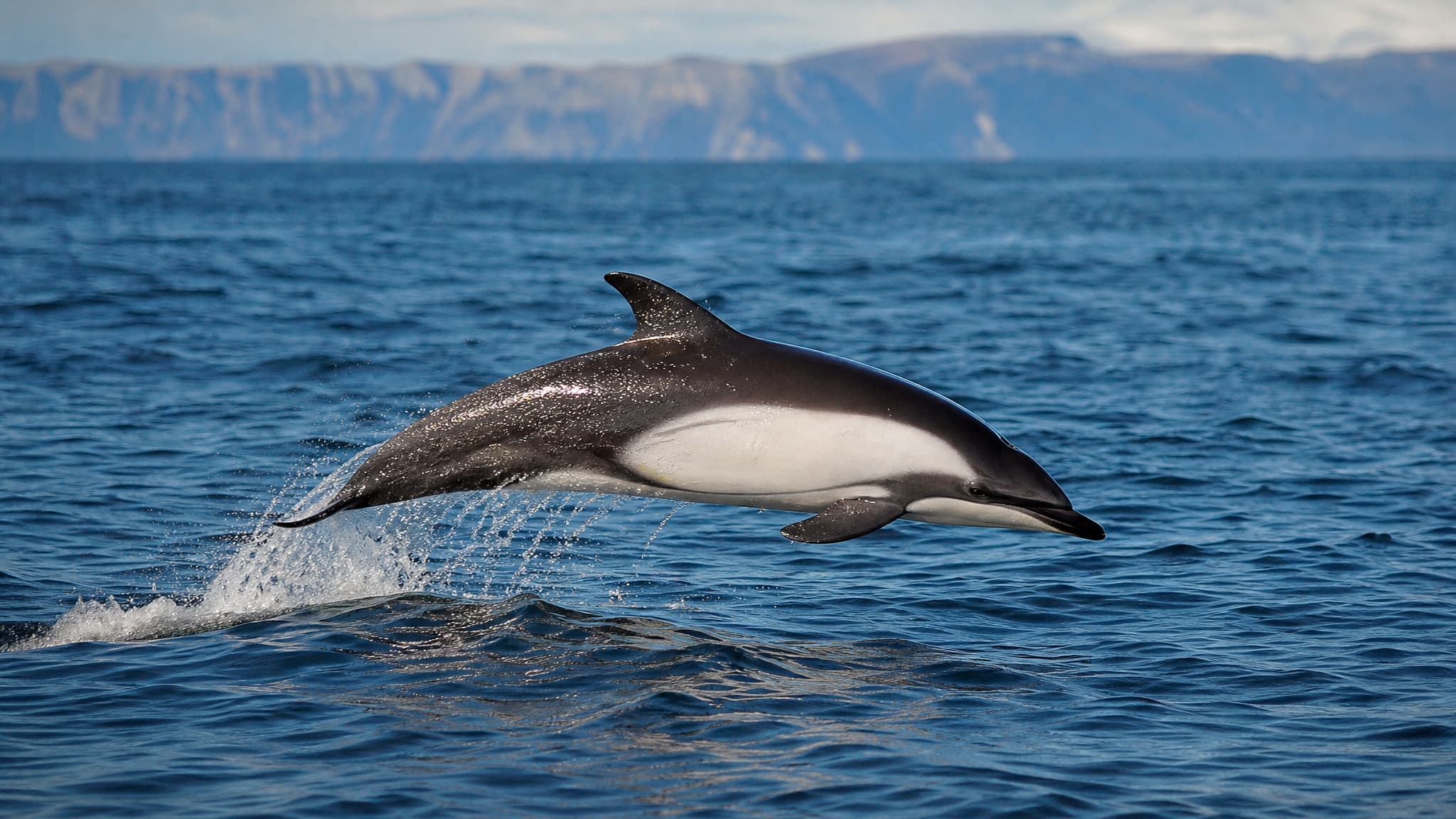
An Atlantic white-sided dolphin leaps above rolling blue seawater, showing its streamlined dark back, pale flank, curved dorsal fin, pectoral fin, and pointed beak; a mountainous coastline is visible in the background.
The Atlantic white-sided dolphin is a robust, medium-sized oceanic dolphin of the North Atlantic. Adults usually measure about 2.4–2.7 m long and can weigh roughly 160–230 kg, with males tending to be slightly larger. Its striking pattern is a key field mark: a dark gray to black cape covers the back, the belly is white, and a pale white patch and yellowish-tan flank stripe contrast with lighter gray sides. It has a short beak, dark upper lip, pale lower lip, and a tall, curved dorsal fin.
It inhabits cool-temperate to subpolar North Atlantic waters, ranging broadly from the northeastern United States and Canada across Greenland, Iceland, the Faroe Islands, and the British Isles to northern Europe. It occurs most often over continental shelves, shelf edges, and slopes, generally in cold water, but may also use offshore pelagic habitat. Seasonal movements are reported in parts of its range, with animals tending to occur farther inshore and northward in summer and farther offshore and southward in winter.
This is a fast, social, and conspicuously active dolphin. Groups commonly contain five to 50 animals, though much larger aggregations occur; mixed groups may include other dolphins and large whales. Individuals often leap, breach, and ride waves. They use echolocation and grasp prey with numerous small conical teeth, feeding on schooling and bottom-associated fishes such as herring, mackerel, cod, hake, smelt, and sand lance, as well as squid and shrimp. By concentrating and consuming these prey, the species is an active mid-level predator in North Atlantic marine food webs.
Females generally mature between about six and 12 years of age. Following a gestation of approximately 10–12 months, they give birth to one calf, usually from late spring through early autumn; calves may nurse for up to 18 months. Recorded longevity is at least 27 years. The species is globally assessed as Least Concern, although abundance trends remain uncertain in several areas. Entanglement in fishing gear, direct hunting in parts of the North Atlantic, and underwater noise are documented threats; pollution and climate-driven changes in prey or habitat may add pressure.