
Australian humpback dolphin
Sousa sahulensis
 AI-generated
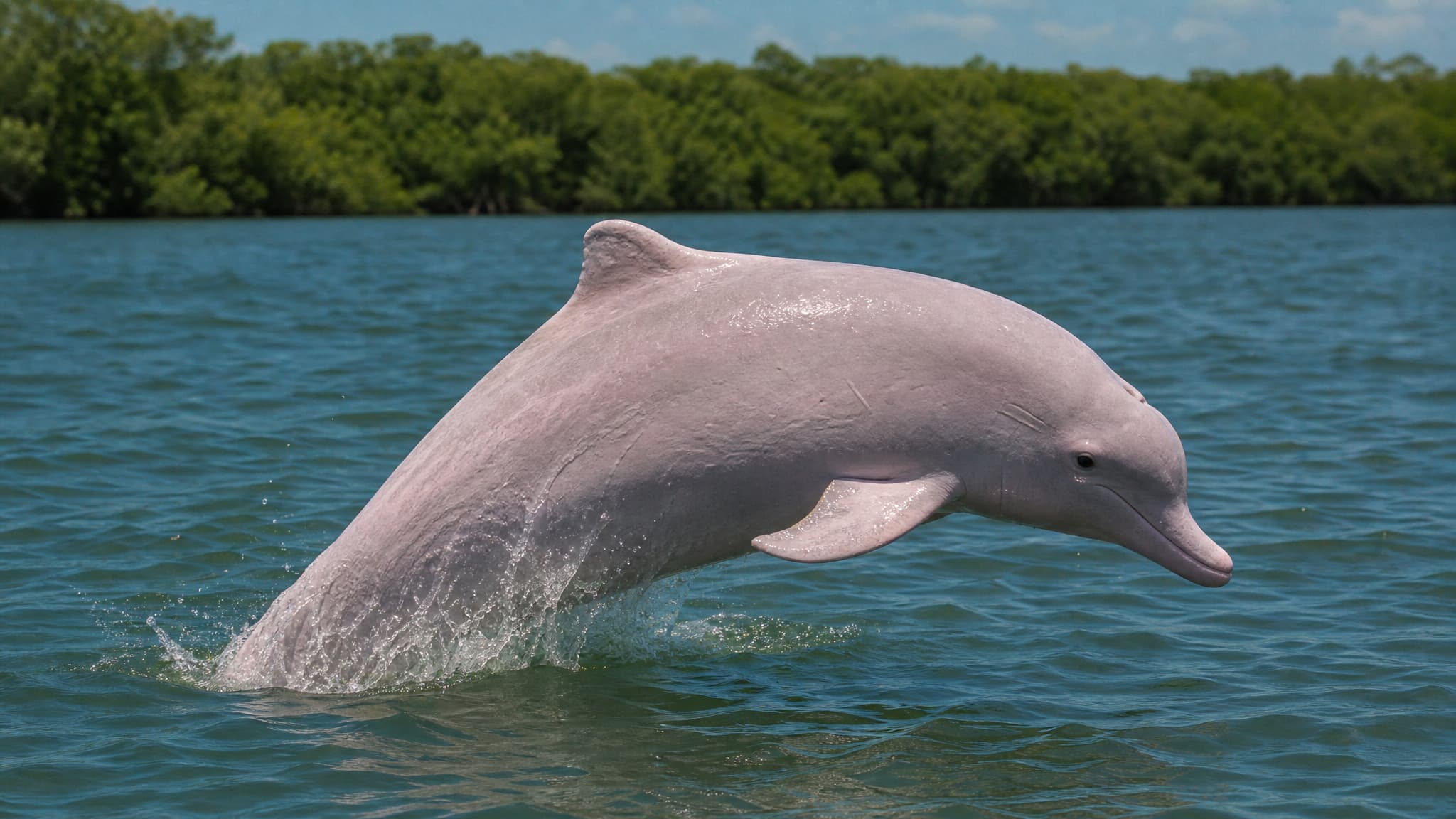
An Australian humpback dolphin breaches in coastal water, with its body arched above the surface, a prominent rounded dorsal hump, a visible pectoral flipper, and a slender beak; a tree-lined shore is in the background.
The Australian humpback dolphin is a coastal odontocete distinguished by its sturdy grey body, long and slender beak, broad flippers, and low triangular dorsal fin with a notably wide base. Adults can reach about 2.7 m (8.9 ft), with males usually a little larger than females. The back is dark grey and the belly paler, often divided by a diffuse diagonal colour boundary; many adults acquire pale scars and dark flecks. Despite its common name, it lacks the pronounced dorsal hump seen in some related Sousa dolphins.
It occurs in tropical and subtropical inshore waters of the Sahul Shelf, from Shark Bay in Western Australia around northern Australia to the Queensland–New South Wales border, and into southern New Guinea. It generally stays close to land, especially in shallow, often turbid water. Estuaries, tidal rivers and creeks, sheltered bays, sandbanks, mudflats, seagrass beds, rocky shores, reefs, and island coasts are all used.
This dolphin is an opportunistic generalist predator. It feeds mainly on fishes associated with coastal and estuarine habitats, while cephalopods and bivalves are also recorded in stomach contents. Individuals forage in a variety of settings, including shallow flats and seagrass meadows. Its flexible, fission–fusion social system means that group membership can change, although stable associations and local site fidelity occur.
Reproduction is slow, which limits recovery after losses. Available evidence suggests that females mature at roughly 9–10 years and males at 12–14 years; pregnancy lasts around 10–12 months. A mother usually bears one calf, which remains dependent for at least two years, and births may be spaced about 2–4 years apart. Longevity is thought to exceed 40 years, although species-specific life-history information remains incomplete.
As a nearshore predator, the species is part of estuarine and coastal food webs and depends on productive mangrove and seagrass-linked prey habitats. It is assessed as Vulnerable globally. Small, spatially structured local populations, restricted shallow-water habitat, and slow reproduction increase its susceptibility to gillnet bycatch and entanglement, vessel interactions and noise, coastal development, pollution, habitat degradation, and climate-related changes.



