
Aye-aye
Daubentonia madagascariensis
 AI-generated
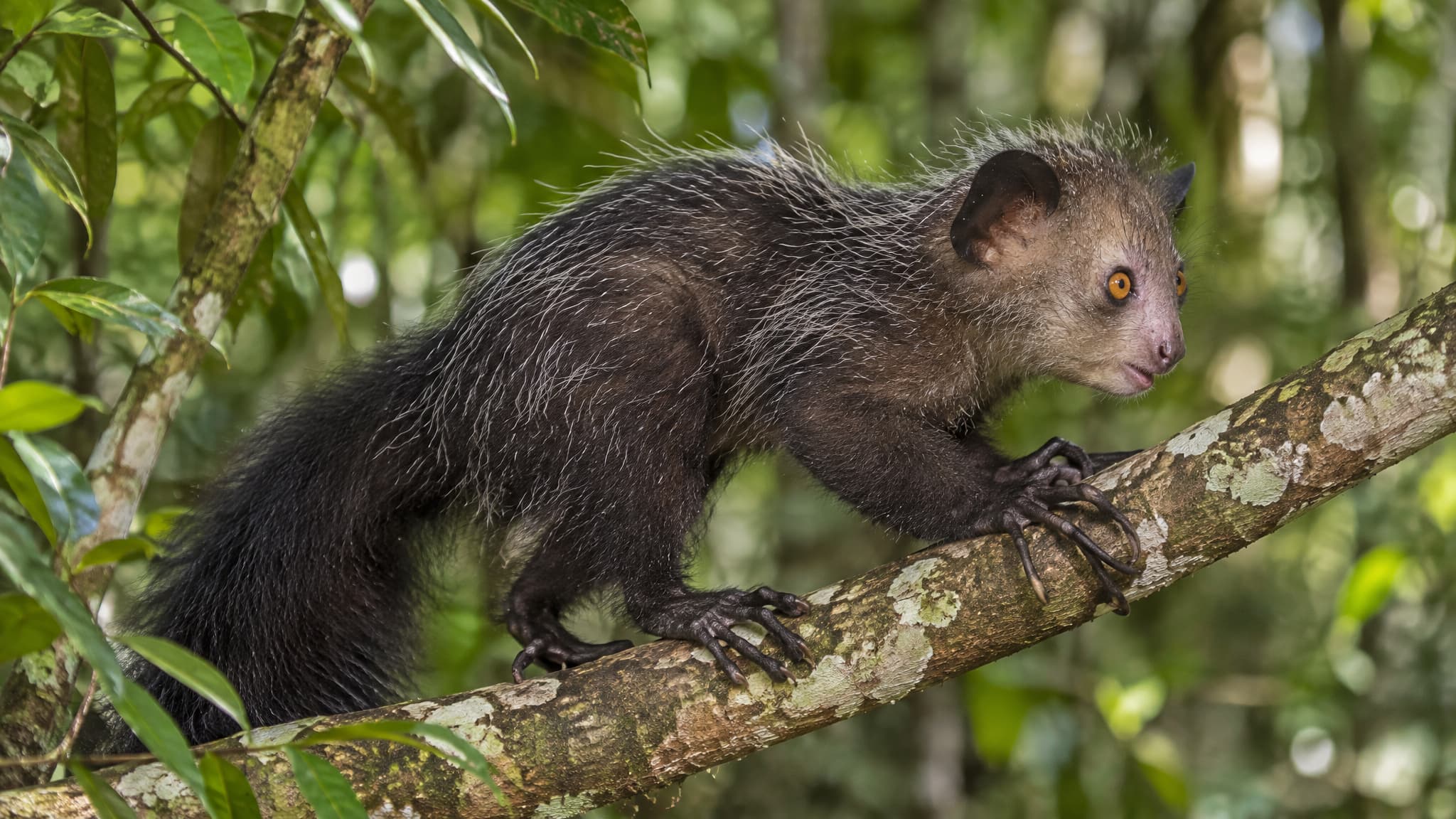
An aye-aye moves along a lichen-covered tree branch in dense green forest, showing its shaggy dark coat, large ears, golden eyes, and elongated fingers.
The aye-aye is a nocturnal lemur from Madagascar and the only living member of the family Daubentoniidae. Its continuously growing incisors once led early naturalists to class it among the rodents, but it is a strepsirrhine primate, and molecular studies place it as the oldest branch of the lemur lineage. Adults measure 36 to 43 cm from head to rump, carry a bushy tail of 56 to 61 cm and weigh 2.5 to 2.8 kg. Yellowish to brown fur with white-tipped hairs, a cat-like head with prominent ears and eyes, and long, slender fingers give it an unmistakable look, and the third finger is especially thin.
The species is endemic to Madagascar, where it occurs mainly in the east and in the northwestern forests. It lives in primary and secondary rainforest and dry deciduous forest, and also uses plantations and, at times, dry scrub and mangroves. It keeps mostly to the upper canopy, where it builds leafy nests to sleep in during the day.
The aye-aye is famous for percussive foraging. It taps branches with its middle finger, up to eight times per second, and listens for the hollow sound of insect tunnels. It then gnaws through the bark with its incisors and hooks out wood-boring beetle larvae with that thin finger. Its diet also includes fruit, seeds, nuts, nectar, plant exudates and fungi. It forages alone at night, and home ranges cover 30 to 50 ha for females and 100 to 200 ha for males.
Females give birth to a single young after a gestation of 152 to 172 days, and usually breed only once every 2 to 3 years. The infant stays in the nest for up to two months and depends on its mother for a long time afterwards. In captivity, one female lived more than 23 years.
By eating wood-boring larvae, the aye-aye fills a role that woodpeckers play elsewhere, and its fruit eating may help disperse seeds. The species is listed as Endangered. Its main threats are the loss of forest habitat to deforestation, hunting, and killings by people who see it as a crop pest or a bad omen. It was thought extinct in 1933 and rediscovered in 1957. Today it occurs in at least 16 protected areas, and captive breeding programs help support the species.



