Ball Python
Python regius
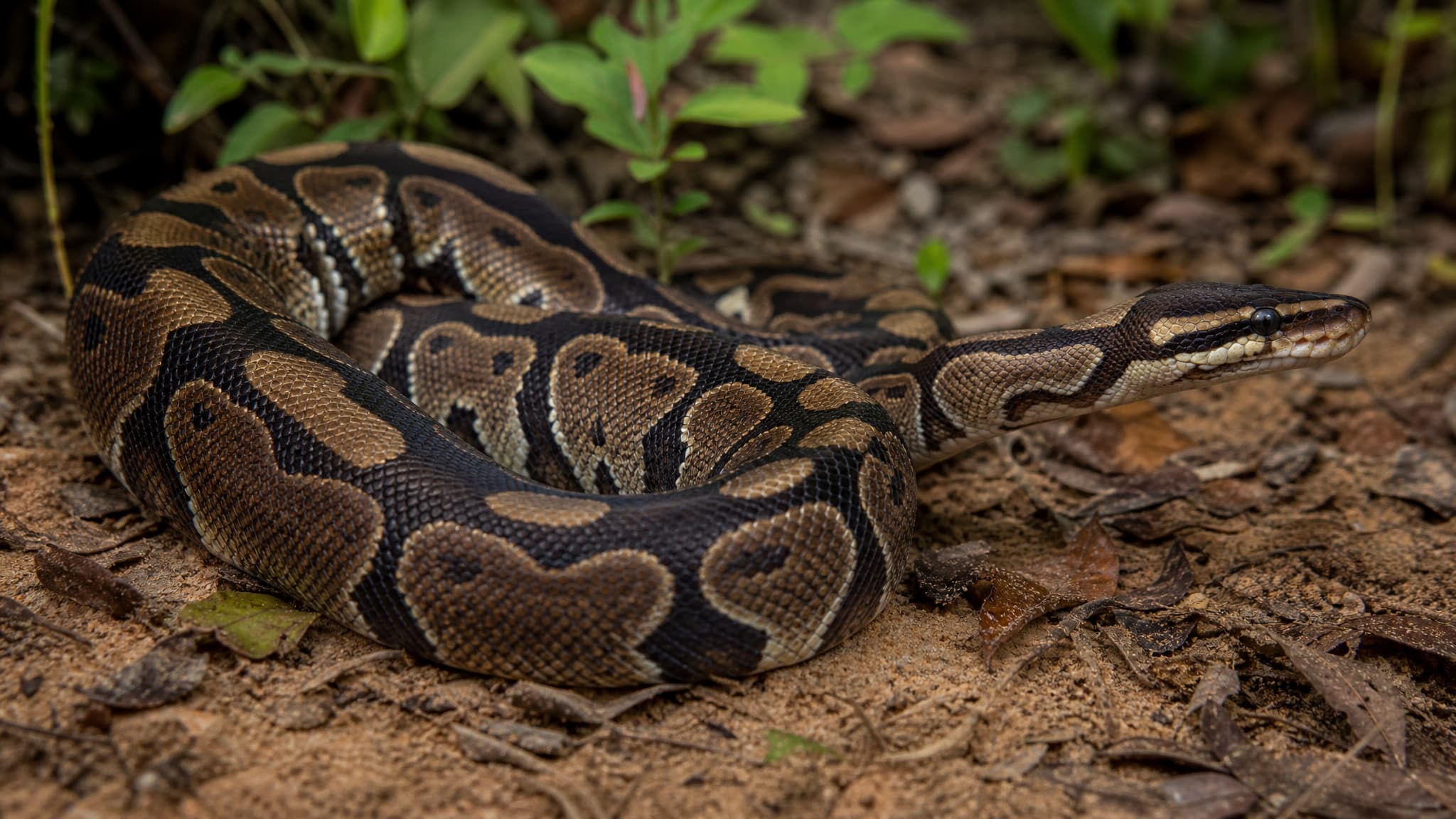 AI-generated
A thick-bodied ball python is tightly coiled on a leaf-littered forest floor, with its head extended to the right. Its dark brown-and-tan patterned scales, rounded head, and visible eye are clearly shown.
The ball python, also called the royal python, is a compact, nonvenomous constricting snake native to Africa. Its scientific name is Python regius; “regius” means royal. It has a notably muscular body, a relatively narrow neck, and a broad head. Wild animals usually display irregular dark-brown to nearly black blotches separated by lighter brown or tan markings, with a pale cream belly. The species is famous for its defensive posture: rather than fleeing or striking repeatedly, it often curls into a tight ball and shelters its head within its coils.
Adults commonly measure about 0.9–1.5 m (3–5 ft), although larger individuals occur. Females tend to become larger than males. Like other pythons, it is ectothermic and has heat-sensitive pits along its lips that help it detect warm-bodied prey. Many striking color and pattern forms exist in captivity, but these selectively bred morphs should not be mistaken for naturally distinct species.
Its native range extends across much of West and Central Africa, from Senegal eastward through countries including Ghana, Togo, Benin, Nigeria, Cameroon, and into parts of central Africa. Ball pythons use savannas, grasslands, open woodland, farmland with cover, and burrow systems. They are mostly terrestrial and frequently hide in mammal burrows or other sheltered spaces, though they can climb. Activity is often greatest around dusk and dawn or at night.
This ambush predator feeds chiefly on small mammals, especially rodents. It strikes quickly, grips prey with rear-curved teeth, and uses constriction before swallowing the animal whole. By preying on rodents, it contributes to food-web balance and can help limit agricultural pests. Adults are generally solitary except during breeding; young snakes may be vulnerable to birds of prey, carnivorous mammals, other snakes, and people.
Ball pythons lay eggs. A female coils around her clutch and remains with it during incubation, providing protection and helping regulate conditions through muscular activity. Clutches may contain roughly 1–11 eggs, and hatchlings are independent after emergence. Wild longevity is often reported at about 10 years, while captive individuals commonly live around 20 years and sometimes substantially longer. The species is listed as Near Threatened, with habitat change, persecution, and intensive collection for the pet trade among important pressures in parts of its range.