Big-headed Turtle
Platysternon megacephalum
 AI-generated
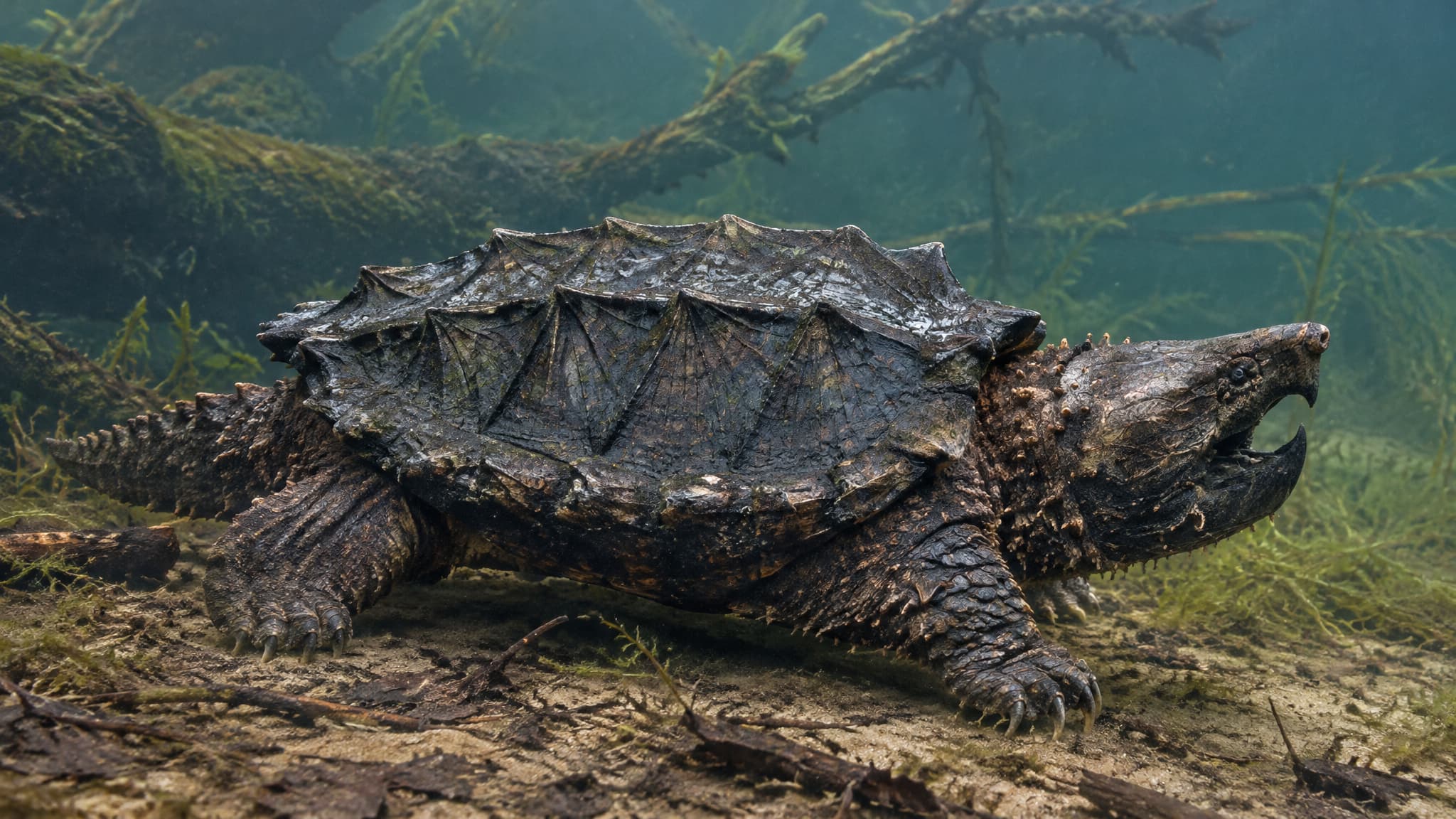
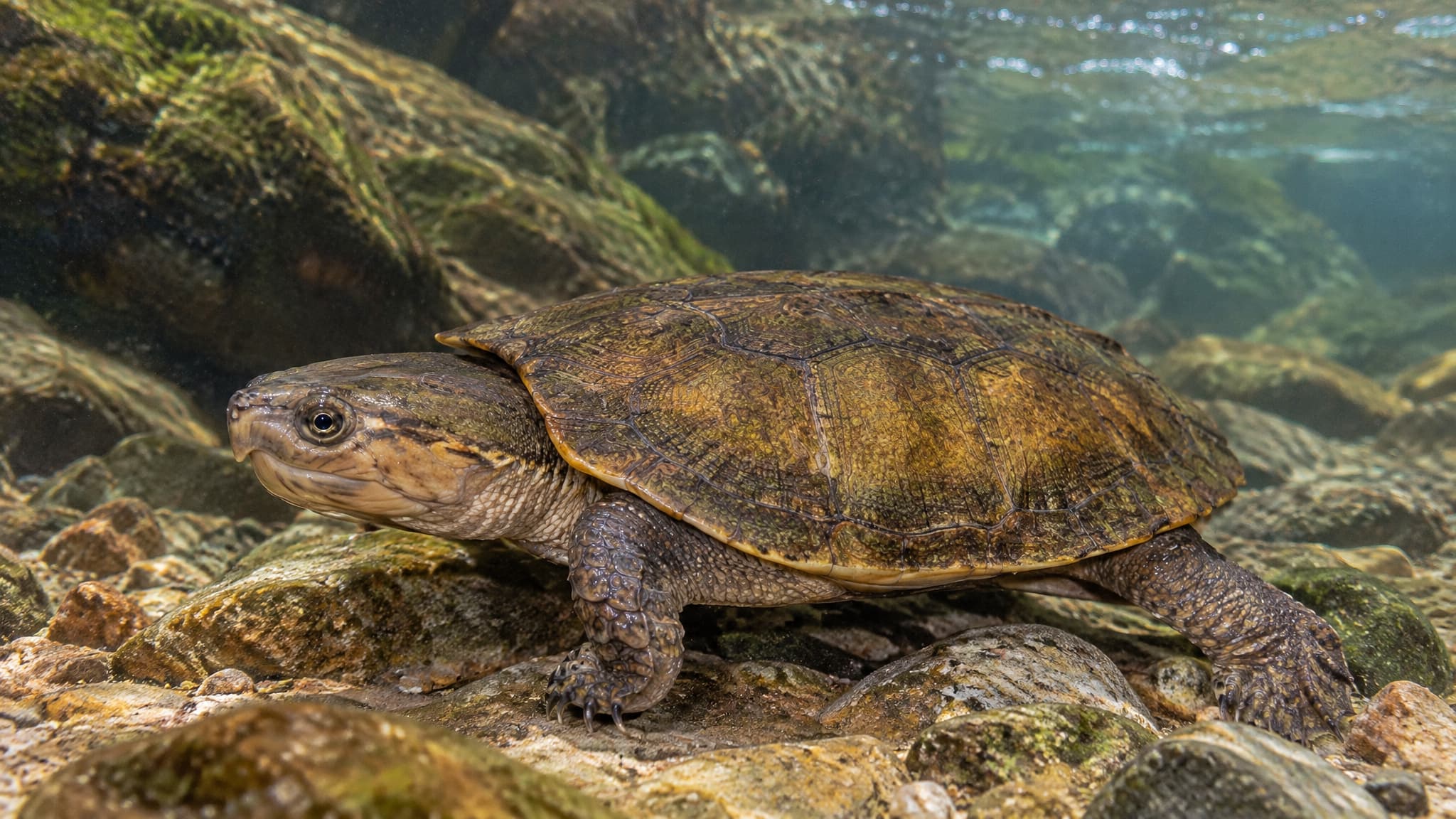
A Big-headed Turtle rests on a rocky streambed underwater, with its broad head, hooked beak, patterned domed shell, and sturdy clawed limbs clearly visible.
The big-headed turtle (Platysternon megacephalum) is a small freshwater turtle named for its enormous, triangular head, which is so broad that it cannot be pulled back into the shell. Adults usually have a flattened carapace of 15 to 18 cm, reaching about 20 cm, and a total length of up to 40 cm including the long, scaly tail. The shell is yellowish to brown, the plastron is reduced and greyish-yellow, and the head ends in a strongly hooked beak. Juveniles are brighter, with an orange plastron and yellow stripes behind the eyes that fade with age.
This entry follows the 2025 revision by Liang and colleagues, adopted by the Reptile Database, which splits the former species in three. In this narrow sense, P. megacephalum lives in southern and eastern China, including Hainan and Hong Kong, and in northern Vietnam. The Myanmar and Thailand populations are now a separate species, Platysternon peguense, and a lineage from western Guangxi was described as Platysternon baiseensis. The turtle occupies rocky hill and mountain streams with clear, shaded, fast-flowing water, often in pools along cascades, where the water stays cool at about 12 to 17 °C. It reportedly becomes dormant when temperatures fall below 10 °C.
Big-headed turtles are mostly nocturnal and spend the day hidden under rocks or underwater. They are weak swimmers but capable walkers and climbers that can scale steep rock, and they hiss and bite hard when handled. Once considered a strict carnivore that eats fish, crabs, frogs, molluscs and worms, the species is now known to be omnivorous: its droppings hold both animal remains and plant matter, especially the stones of Machilus fruits. Eating both prey and fallen fruit, it links streamside forest and stream food webs.
Little is known about its breeding in the wild. Females are reported to lay only one or two white, elongated eggs, about 37 by 22 mm. In captivity, a male lived about 15 years.
The IUCN lists the big-headed turtle as Critically Endangered in a 2021 assessment that predates the 2025 split and covered both P. megacephalum and P. peguense. Heavy collection for food markets and the pet trade, illegal trade and habitat loss have made it rare across much of its range.