Black Caiman
Melanosuchus niger
 AI-generated
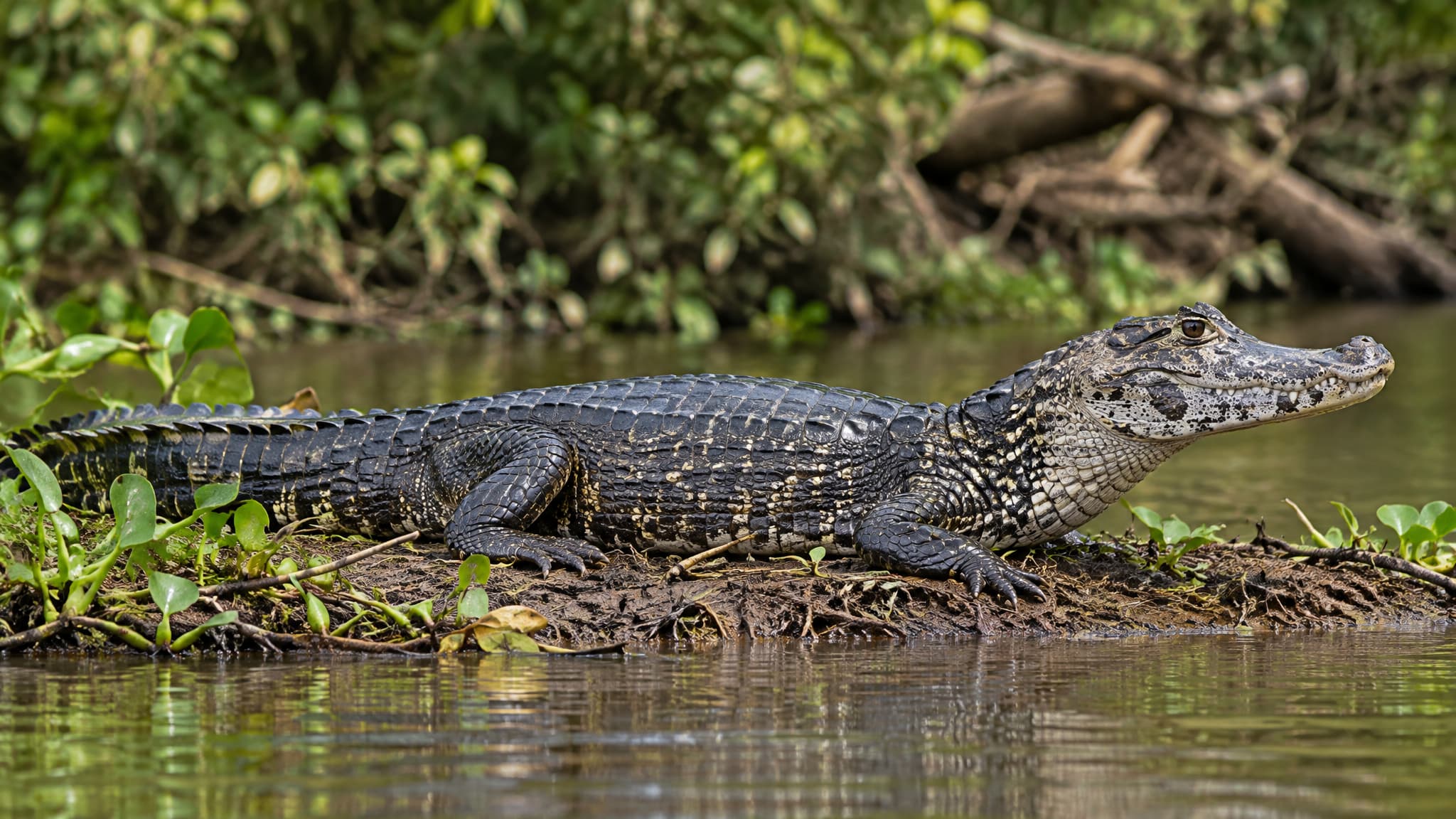
A Black Caiman rests on a muddy, plant-lined riverbank beside calm water, with its head raised and broad snout, armored back, four visible limbs, and long tail clearly shown.
The black caiman (Melanosuchus niger) is the largest member of the alligator family (Alligatoridae) and the biggest predator in the Amazon basin. It is the only living species in the genus Melanosuchus. Adult males average about 4 m long. Specimens up to about 5 m are recorded, and some reports describe even larger animals.
Its scaly skin ranges from charcoal to nearly jet-black. Paler bands, white to yellowish, cross the body and tail, and the lower jaw has grey or brown banding. Juveniles are lighter, with bright yellow bands that may remain into adulthood. Compared with other caimans, it has a larger, heavier head with a distinctive skull shape, and its powerful jaws hold 72 to 76 teeth. The dark colouring is thought to help camouflage it during night hunts and to absorb heat.
The species lives only in the Amazon basin of South America. Its range includes Brazil, Bolivia, Colombia, Ecuador, Peru, Guyana and French Guiana. It favours slow-moving rivers, lakes, oxbows, black-water swamps, flooded savannas and seasonally flooded forest, and it often uses steep banks.
The black caiman is mainly nocturnal and mostly solitary outside the breeding season. Hatchlings eat small fish, frogs, crustaceans and insects. As they grow, they switch to larger fish such as piranhas and catfish, which stay important prey for adults along with molluscs. Adults also take turtles, snakes, birds and mammals, including capybaras and deer. Studies suggest that the largest individuals may focus on mammals.
Nesting takes place in the dry season. The female builds a mound of vegetation, mud and soil near the water and digs an egg chamber with her hind feet. She lays about 30 to 65 hard-shelled eggs, with an average near 40, which incubate for roughly two to three months. Nest temperature decides the sex of the hatchlings. Females usually stay near the nest, open it when the young emerge and watch over them for a time. Juveniles may fall prey to jaguars and green anacondas. Wild lifespan is poorly documented, and captive males have averaged about 13 years.
As the top predator of the Amazon, the black caiman may act as a keystone species. During the 20th century, hunting for its valuable hide cut its numbers drastically, by up to 99% according to one estimate. Since protection began, many populations have recovered strongly, and the IUCN now lists it as Least Concern. Remaining threats include illegal hunting, collection of its eggs and killing for use as fishing bait.