Black-fronted Titi
Callicebus nigrifrons
 AI-generated
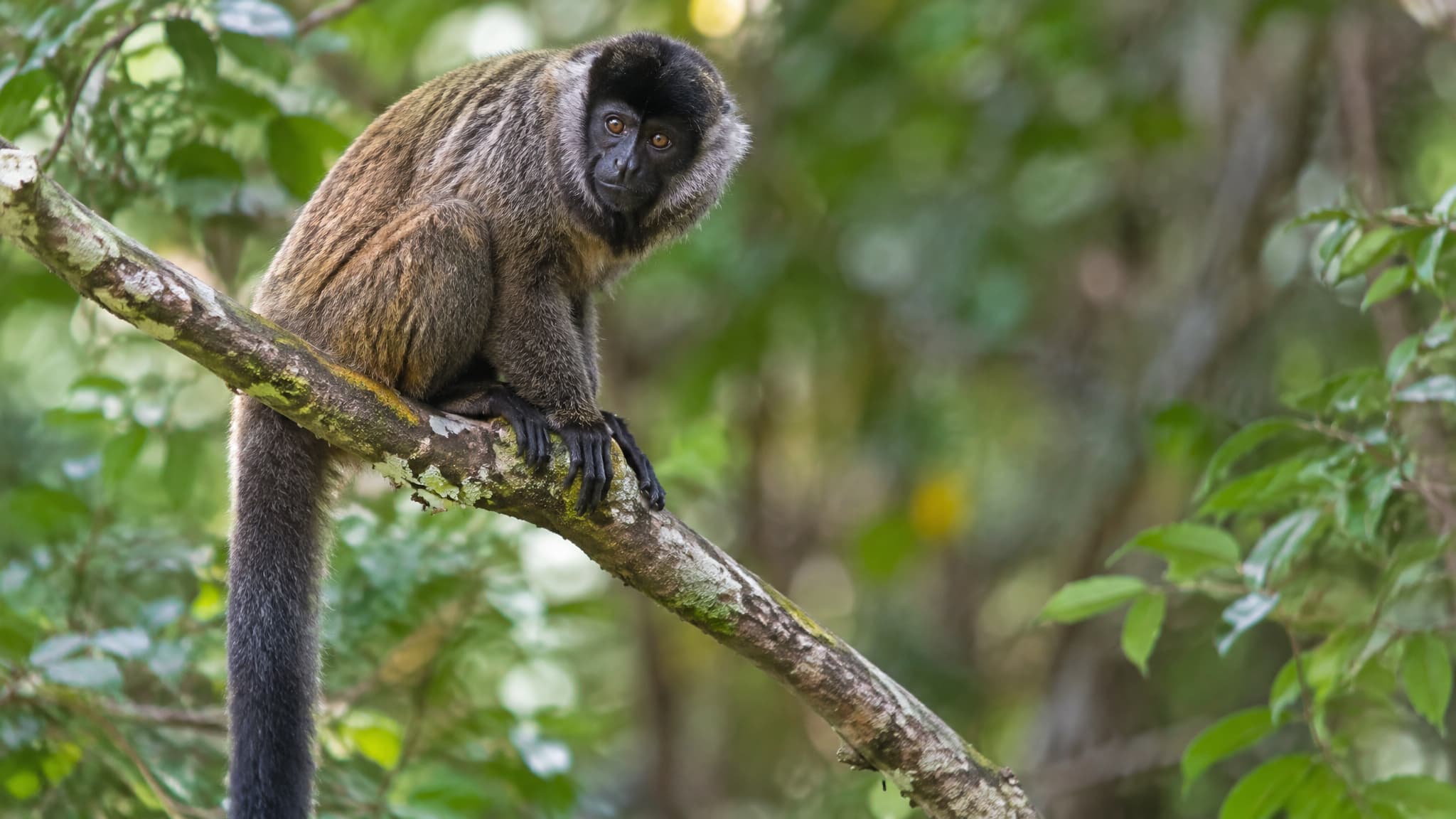
A black-fronted titi sits crouched on a mossy branch in lush forest vegetation, facing the camera with its black forehead, dark face, pale cheek fur, and long hanging tail visible.
Black-fronted titi
The black-fronted titi is a small New World monkey of southeastern Brazil. It has a grizzled gray-brown to buffy coat, with blackish fur across the forehead, crown, ears, sides of the face, and chin. Its dark facial markings contrast with paler cheek hairs, while the hands and feet are dark and the long, densely furred tail is orange to rusty brown. Males and females are very similar in body size and coloration.
This titi is endemic to Brazil, occurring chiefly in Minas Gerais, Rio de Janeiro, northern São Paulo, and the far south of Espírito Santo. It lives in Atlantic Forest and transition zones toward the Cerrado, from lowlands to about 1,000 m. It can persist in regenerating and disturbed woods, including isolated fragments, although such persistence does not remove the costs of fragmentation.
Fruit makes up most of its diet, supplemented with leaves, flowers, and small amounts of arthropods. Black-fronted titis are active, arboreal foragers, and their fruit feeding probably contributes to the movement of seeds through forest remnants. They are socially monogamous and territorial, generally living in small family groups of two to six animals; pairs and families use calls and social behavior to maintain contact and defend their area.
Females and males mature at roughly two to three years. A pair normally produces one infant after a gestation of about five to six months, usually at intervals of around a year. In titi monkeys, the adult male is an important caregiver and commonly carries the young except when it nurses. Reliable longevity data specific to this species remain limited; a 25-year captive value sometimes associated with it concerns a related titi species rather than a confirmed record for this one.
The IUCN lists the black-fronted titi as Near Threatened globally. Its population is declining because forests throughout its range have been converted or divided by agriculture, cattle ranching, logging, urban expansion, fires, and infrastructure. Small, disconnected groups can also face road mortality, electrocution, domestic dogs, and local disappearance. It occurs in numerous protected areas and is included in CITES Appendix II, but conserving and reconnecting native forest remains central to its future.