
Black mamba
Dendroaspis polylepis
 AI-generated
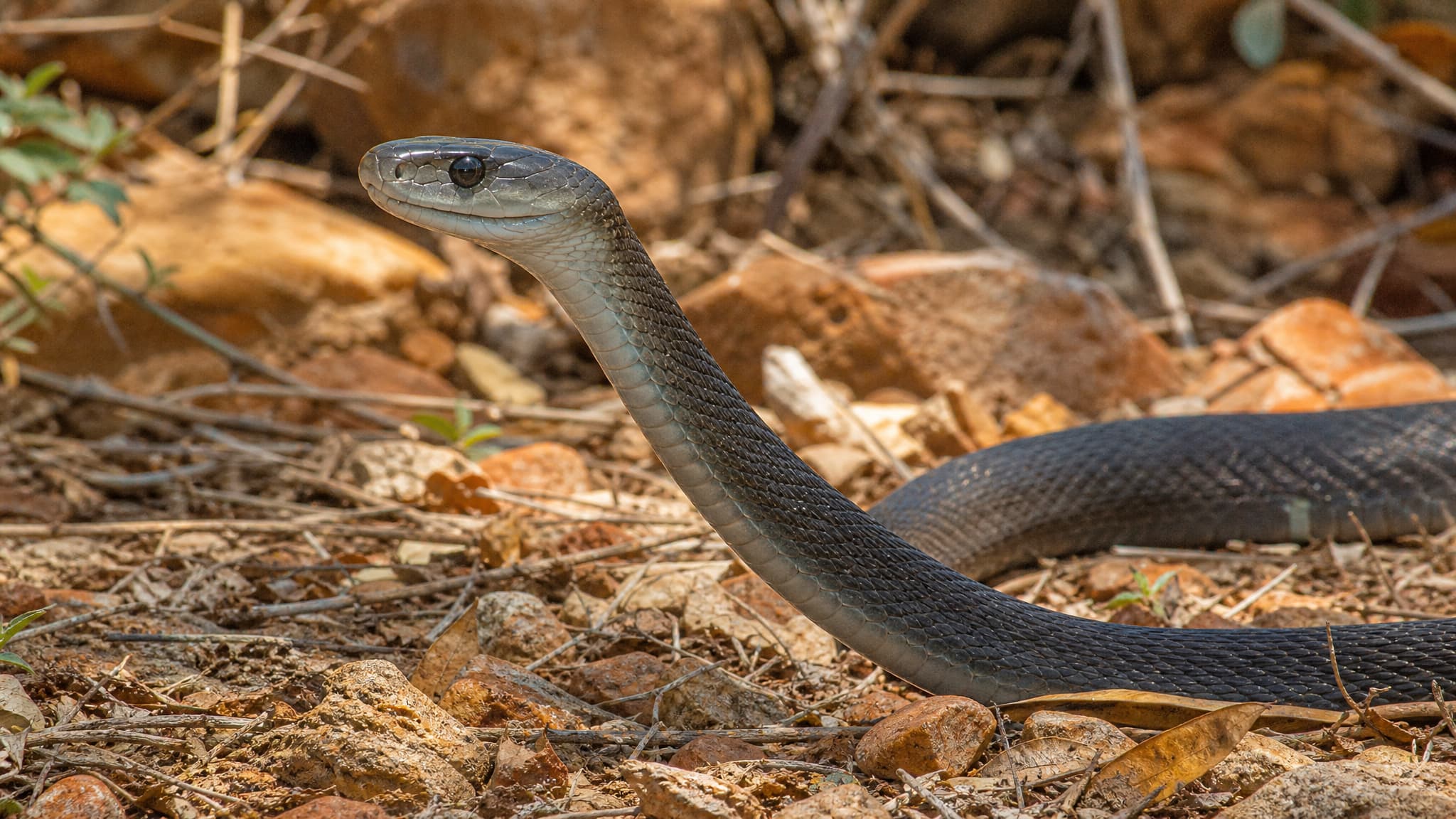
A dark, slender snake raises its head and anterior body above dry leaf litter and rocks, with smooth gray scales on the head and a bluish-gray underside visible.
The black mamba is a large, slender, highly venomous African snake. Its name refers not to its body—which is usually gray, olive, brownish, or khaki—but to the blue-black interior of its mouth. When threatened and unable to retreat, it may raise the front of its body, spread a narrow neck-flap, gape, and hiss as a warning. Adults commonly measure about 2–3 m long, and their elongated, coffin-shaped head and smooth scales give them a distinctive profile.
It occurs widely across much of sub-Saharan Africa, from eastern and southern regions to parts of central and western Africa. Black mambas favor wooded savanna, rocky slopes, riverine woodland, and other warm terrestrial habitats with secure refuges such as hollow trees, crevices, termite mounds, or abandoned burrows. Although capable climbers, they spend much of their time on the ground and may repeatedly use a familiar shelter.
This is chiefly a diurnal, solitary predator. It hunts mainly small mammals—including rodents, squirrels, and hyraxes—and also takes birds. It uses venom to immobilize prey, then swallows it whole. By consuming small vertebrates, black mambas help regulate prey populations, particularly rodents. They generally avoid people where escape is possible, but their potent neurotoxic venom makes any bite a medical emergency requiring immediate professional treatment.
Breeding is seasonal. Males compete for access to females, and females lay clutches of roughly 6–17 eggs in protected sites; hatchlings receive no parental care. Incubation is reported at about 80–90 days. Wild longevity remains poorly documented, while captive records include an individual living up to 11 years. The species is assessed as Least Concern, reflecting its broad range, but local animals can still be affected by habitat disturbance and deliberate killing driven by fear of venomous snakes.



