Black spiny-necked turtle
Acanthochelys spixii
 AI-generated
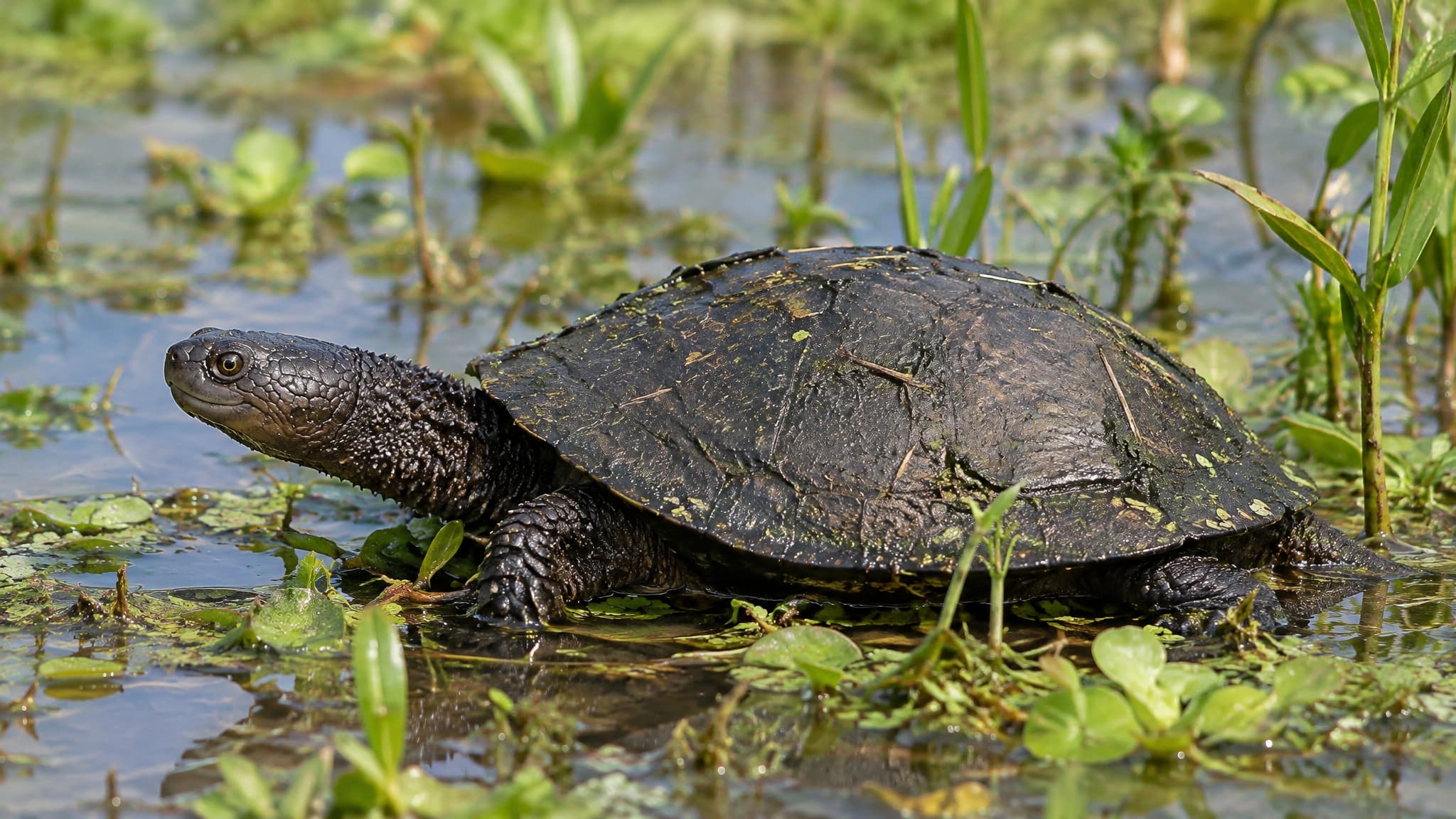
A black, spiny-necked turtle rests in shallow, plant-filled water, with its head extended to the left and its dark, algae-flecked shell and textured neck clearly visible.
The black spiny-necked turtle (Acanthochelys spixii), also called Spix's sideneck turtle, is a medium-sized side-necked turtle of the family Chelidae. Its name comes from the prominent, horny conical tubercles that stud the top and upper sides of the neck. The adult carapace is mainly black, sometimes dark reddish-brown, elliptical and broader towards the rear, with a deep groove running down the middle of the back. The plastron is black or dark brownish-black, and the head, legs and tail are black, dark brown or grayish brown. The eyes have bright yellow irises, there are two short chin barbels, and the webbed feet carry five claws in front and four behind. Hatchlings are black with red or deep orange spots on the edge of each marginal scute and orange or red blotches on the plastron.
The largest recorded animals in Brazil measure 180 mm in straight carapace length for females and 178 mm for males, and a Uruguayan female reached 202 mm and 1 kg. Cerrado populations are smaller, averaging 128 mm and 247 g in males and 139 mm and 330 g in females. Males have a concave plastron and a longer tail, while females have a deeper shell.
The species lives in southeastern Brazil (from Bahia and Goiás to Rio Grande do Sul), Uruguay and northeastern Argentina (Corrientes), from sea level to 1082 m. It favors swamps, ponds and other shallow, slow or still water, often rich in submerged plants, and also turns up in rice fields, urban parks and residential areas. It is mainly nocturnal and becomes more active as air and water warm. When ponds dry out it can bury itself about 50 cm deep and presumably estivates underground.
The diet is made up mainly of insects, especially aquatic ones, supplemented with tadpoles, fish, snails and spiders. In Brazil nesting runs from February to May, and in Brasília mating has been seen in the rainy season, between November and December. Clutches hold 4 to 8 nearly round eggs about 25 to 27 mm long, buried around 4 cm deep. Three eggs followed in captivity took 587 to 615 days to hatch, including a period of arrested development, which may be the longest incubation of any South American chelid. Hatchlings measure 31 to 32 mm and weigh about 5 g. Its lifespan has not been recorded.
As a predator of aquatic insects and prey for larger animals, the turtle is part of the food web of shallow wetlands. TTWG 2025 lists it as Vulnerable on the IUCN Red List, up from Near Threatened in 1996. The main threats are habitat loss from urbanization, deforestation and farming, including rice cultivation around coastal lagoons in Rio Grande do Sul, as well as road deaths, illegal capture for the pet trade and exposure to agrochemicals. Only 34.8% of its Brazilian range still holds natural habitat.