
Marsh Deer
Blastocerus dichotomus
 AI-generated
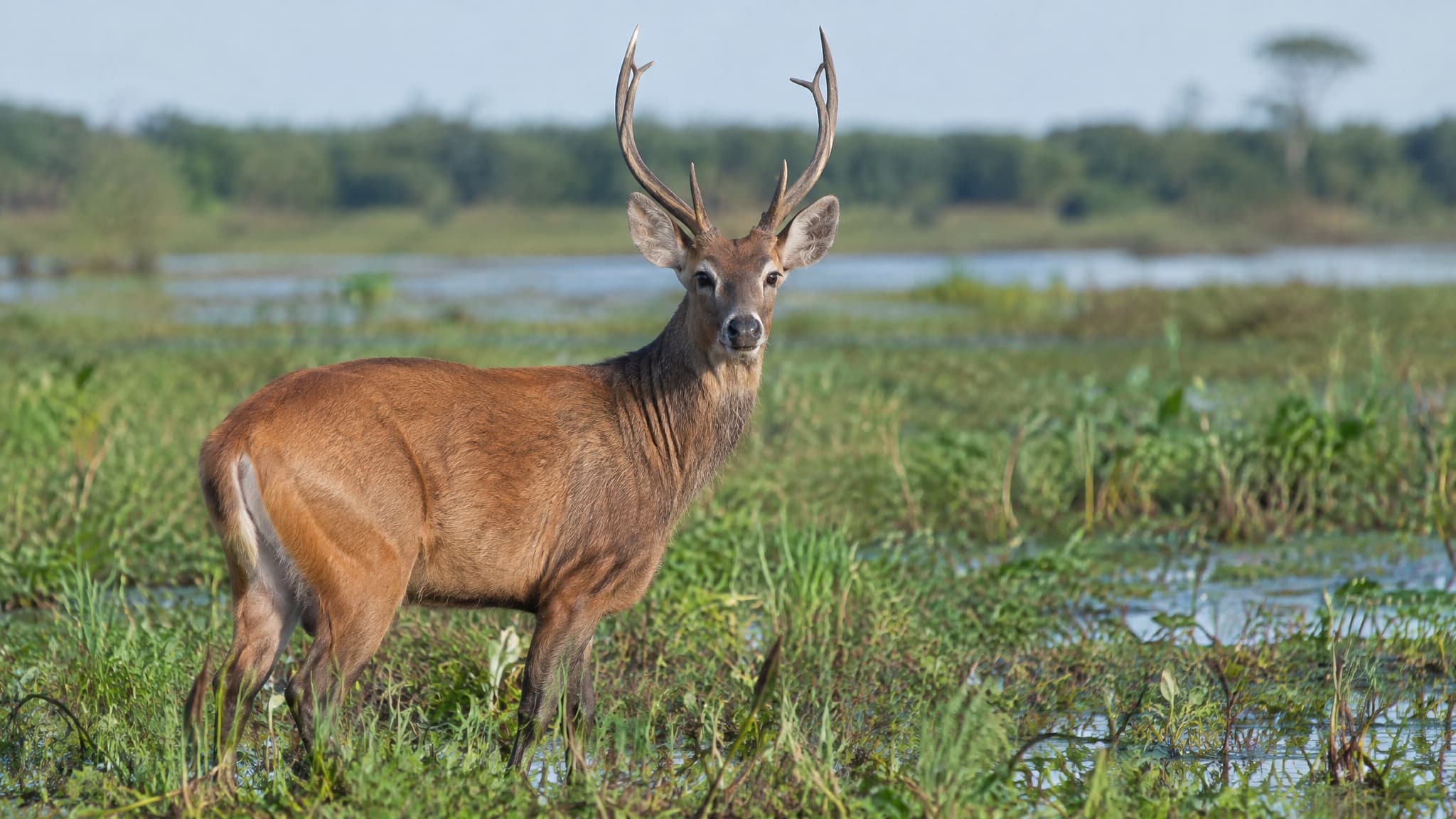
A male Marsh Deer stands facing the camera in shallow marshland, with its reddish-brown coat, dark lower legs, large ears, and branching antlers clearly visible. Aquatic vegetation and open water surround the animal.
The marsh deer is South America’s largest deer and the only living species in the genus Blastocerus. Adults have a heavy-bodied but long-legged build, usually reddish brown in warmer months and darker brown in winter. Black lower legs and muzzle markings contrast with pale rings around the eyes. Males carry large, multi-tined antlers, while both sexes have exceptionally broad, spreading hooves with an interdigital membrane—an adaptation that improves support on soft, waterlogged ground.
This deer is native to South America, occurring in Argentina, Bolivia, Brazil, Paraguay, and Peru; it has disappeared from Uruguay. Its strongholds are associated with major river basins and floodplains, including the Pantanal. It uses marshes, swamps, seasonally inundated savannas, and dense wetland vegetation near permanent water. Seasonal flooding shapes its movements: animals spread across flooded landscapes when water is abundant and concentrate near reliable cover and water in drier periods.
Marsh deer are herbivorous browsers and grazers. Their food includes aquatic and riverside plants, leaves, grasses, and other browse; analyses indicate that grasses and legumes can be important dietary components. They are often most active around dawn and dusk, though local activity may shift with season and human disturbance. Individuals are commonly solitary or occur in small groups, and their feeding helps link wetland plant production to the broader floodplain food web.
Females normally give birth to a single fawn, which is born without the spotted coat familiar in many deer species. Breeding timing varies among populations, although rutting has often been reported in October and November; births have been recorded in more than one seasonal window. A species-specific lifespan is not securely documented in the consulted sources. The marsh deer is listed globally as Vulnerable by the IUCN, with a declining trend driven chiefly by wetland conversion and drainage, hydroelectric dams and altered flood regimes, habitat fragmentation, poaching, and disease exposure from livestock.



