Boa constrictor
Boa constrictor
 AI-generated
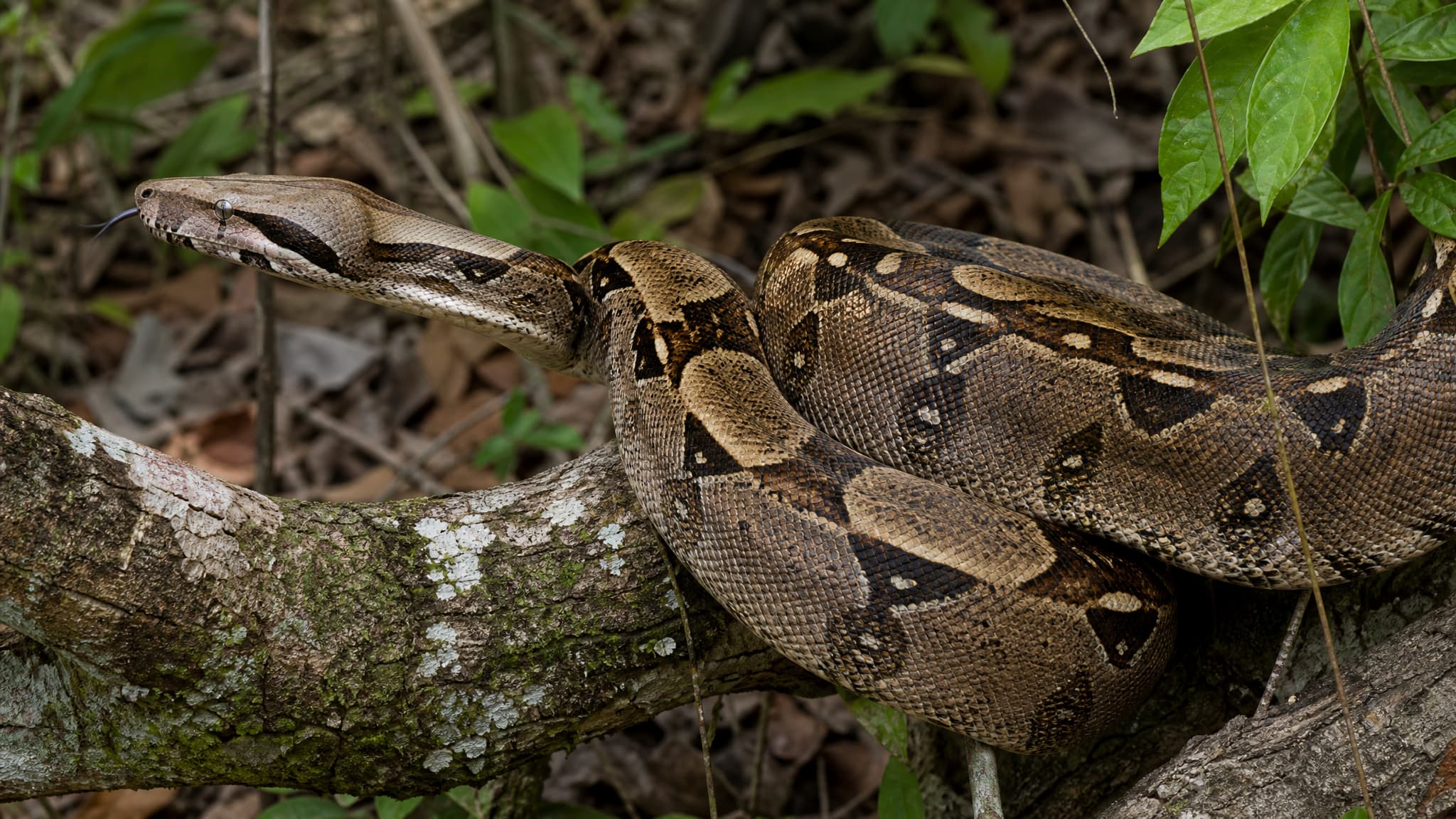
A boa constrictor rests coiled around a moss-covered tree branch in a leafy forest, with its head extended to the left and its forked tongue visible. Its robust patterned body and pale underside are clearly shown.
The boa constrictor (Boa constrictor) is a large, nonvenomous New World snake with a muscular, heavy-bodied build. Adults are commonly about 2–3 m long, though exceptionally large individuals may exceed 4 m; females are generally larger than males. Its ground color ranges from cream to brown, overlaid with dark saddle-like blotches that often become richer reddish brown toward the tail. Dark side markings and characteristic head stripes add to its variable pattern.
This species occurs principally in northern and central South America, including the Guianas, Venezuela, Colombia, Peru, Bolivia, Brazil, Paraguay, and northern Argentina, as well as Trinidad and Tobago and some nearby islands. It uses rainforest edges and clearings, woodland, savanna, dry forest, scrub, riverside habitats, and agricultural landscapes. Boas can climb, especially when young, but also travel effectively on the ground and may shelter in mammal burrows.
Usually solitary and most active at dusk or at night, a boa constrictor is an ambush predator. It detects chemical cues with its forked tongue and vomeronasal organ, then strikes and coils around prey. Rather than using venom, it subdues prey through constriction before swallowing it whole. Mammals and birds form much of the diet, but amphibians, reptiles, eggs, and bats may also be taken. By preying on rodents and other small vertebrates, it is an important regulator within many tropical food webs.
Females retain developing young internally and give birth to live, fully formed offspring. Breeding often coincides with the local dry season; gestation lasts roughly 5–8 months, and litters can range from about 10 to 64 young. Newborns are independent almost immediately. Wild individuals may live around two decades, while well-kept captive animals can live substantially longer. Habitat conversion, road mortality, killing by people, skin harvest, and wildlife trade can affect populations. The species is listed here as Not Evaluated by IUCN, although international trade regulation and the conservation needs of distinct populations remain important.