
Urutu
Bothrops alternatus
 AI-generated
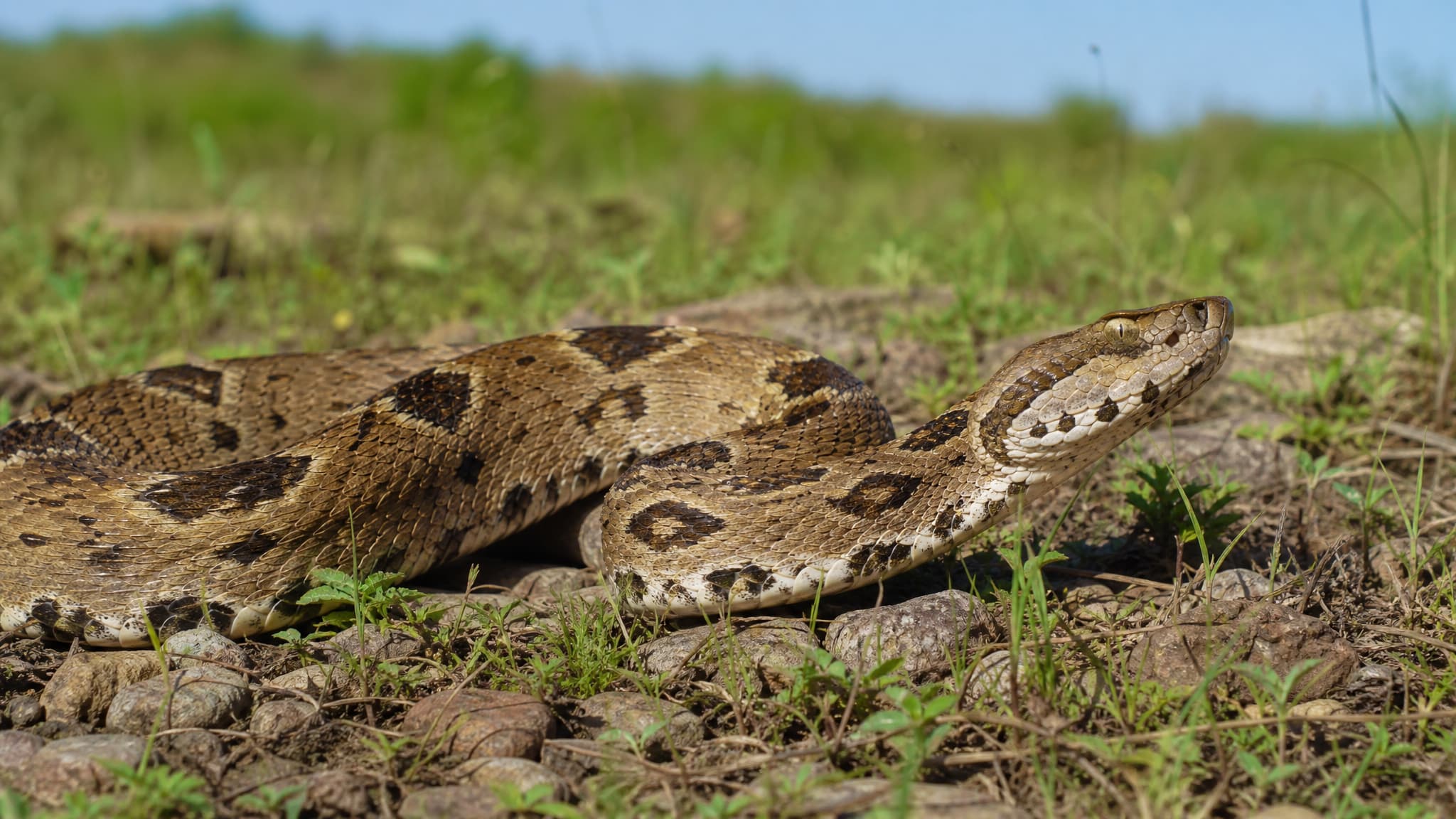
A stout, patterned snake lies in broad coils on rocky ground amid short grass, with its head raised and angled to the right. The visible body shows keeled scales, dark blotches, and a pale, heavily marked lower jaw and throat.
Urutu
Bothrops alternatus, the urutu or crossed pit viper, is a large, stout-bodied venomous snake of southern and central-eastern South America. It is a pit viper: a member of the viper family with heat-sensitive facial pits used in detecting warm-blooded prey. Adults commonly remain below 1.5 m (about 5 ft), though larger individuals occur. Its ground-color pattern combines gray, brown, black, and cream, with a row of dark, alternating, hook-like side markings. Some individuals show a cross-shaped mark on the crown, inspiring names such as “cruzeiro.”
The species occurs in Brazil, Paraguay, Uruguay, and much of northern and central Argentina. It is mainly terrestrial and uses moist, open environments—grasslands, savannas, wetlands, rocky fields, and woodland near watercourses—but may also persist in agricultural, rural, suburban, and urbanized landscapes. Its cryptic pattern helps it remain concealed among vegetation and leaf litter.
Urutus are ambush predators with a notably mammal-focused diet. Studies of wild specimens found that rodents and other small mammals form the overwhelming majority of recorded prey; birds and amphibians are taken only occasionally. This makes the snake an important predator of small mammals, including rodents in natural and modified habitats. Like other venomous pit vipers, it should never be handled: bites can be medically serious and require prompt professional treatment.
Reproduction is live-bearing rather than egg-laying. In a subtropical Brazilian study, females produced litters of five to 20 young, averaging 12. The species’ lifespan in the wild has not been established well enough in the consulted references to give a dependable figure. It is assessed as Least Concern globally, reflecting its broad distribution, but wetland drainage, habitat conversion, road mortality, and persecution of snakes can create local risks.



