Jararaca
Bothrops jararaca
 AI-generated
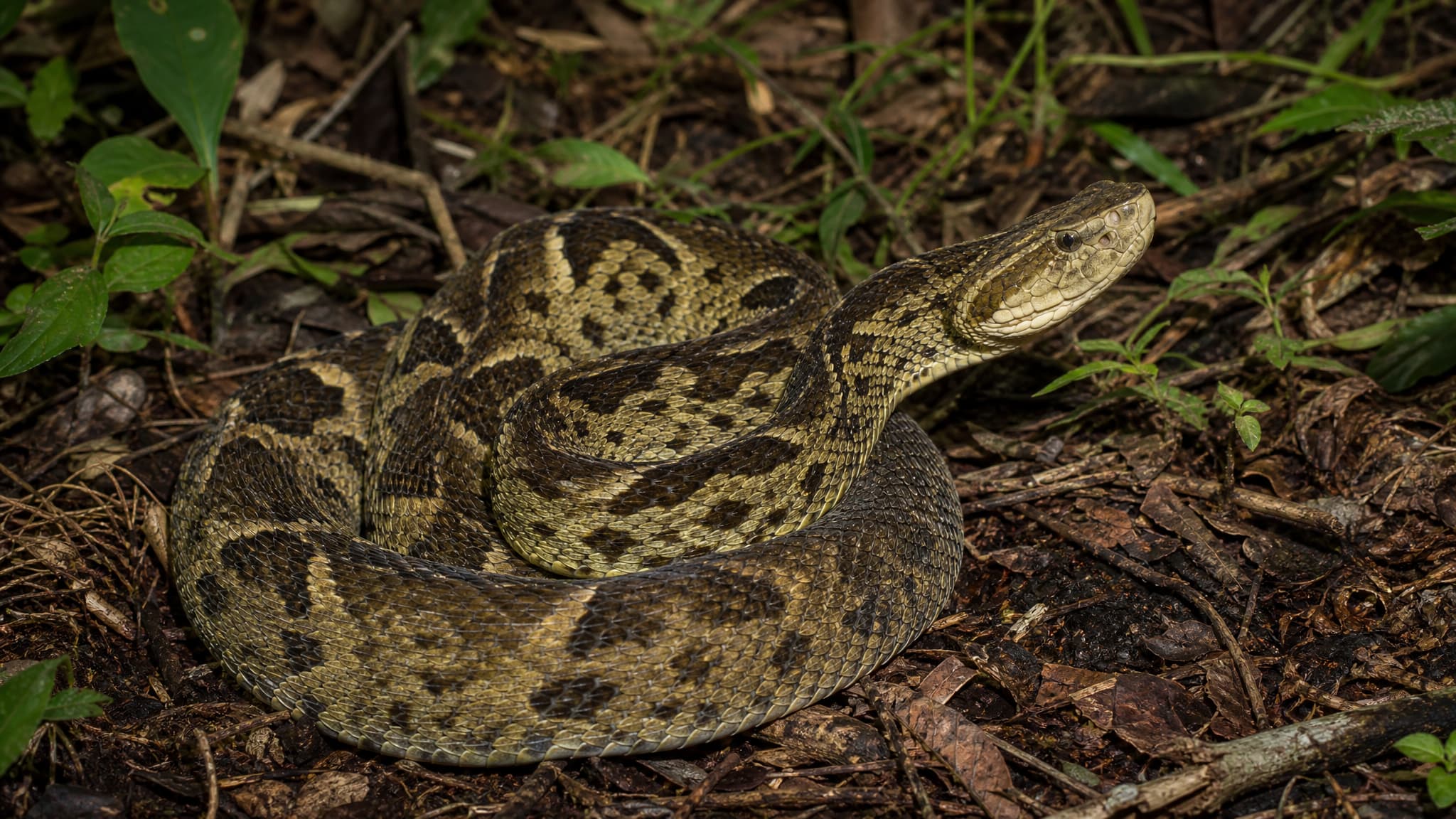
A Jararaca is tightly coiled on the leaf-littered forest floor, with its broad, keeled-scaled head raised and facing right.
Bothrops jararaca, commonly called the jararaca or jararaca lancehead, is a venomous pit viper of eastern and southern South America. It is a medium-sized, stout-bodied snake with a broad, distinctly triangular head, vertically elliptical pupils, and heat-sensing pits between the eyes and nostrils. Females are usually larger than males and can approach 1.5 m in total length. Its coloration is notably variable: brown, olive, gray, yellowish, or greenish backgrounds may carry a series of dark, horseshoe-like side markings.
The species is closely associated with the Atlantic Forest region. Its range extends through southeastern and southern Brazil, from southern Bahia to Rio Grande do Sul, with occurrences in adjacent northeastern Paraguay and Argentina’s Misiones Province. It uses forest, forest edges, dense secondary vegetation, and some modified landscapes, including plantations and rural surroundings. Adults are chiefly terrestrial, whereas young snakes more often climb into low vegetation or other elevated cover.
Jararacas are primarily ambush predators. They often wait coiled and motionless, especially after dark, before striking quickly at prey. Diet changes markedly with age: juveniles commonly take amphibians, lizards, and large arthropods such as centipedes, while adults feed mainly on small mammals and may also eat birds. As a predator of small vertebrates, the species is part of the Atlantic Forest food web; it is also preyed upon by other animals, including birds and some mammals.
Reproduction is live-bearing: embryos develop inside the female, and newborns are independent and already venomous. Mating and reproductive timing are seasonal, with births commonly recorded from late summer into autumn in southern Brazil. Litters vary, but roughly 8–14 young are often reported. Females invest heavily in reproduction and may not breed every year. Reliable longevity data are limited; individuals have been documented living at least 6.5 years in captivity.
The jararaca is assessed as Least Concern, reflecting its broad distribution and continued presence in a range of habitats, although deforestation, fragmentation, road mortality, and persecution can affect local populations. It is medically important because its venom can cause serious envenomation. Encounters should be managed from a safe distance: people should never attempt to handle or kill a suspected jararaca, and any bite requires immediate emergency medical care.