Jararacussu
Bothrops jararacussu
 AI-generated
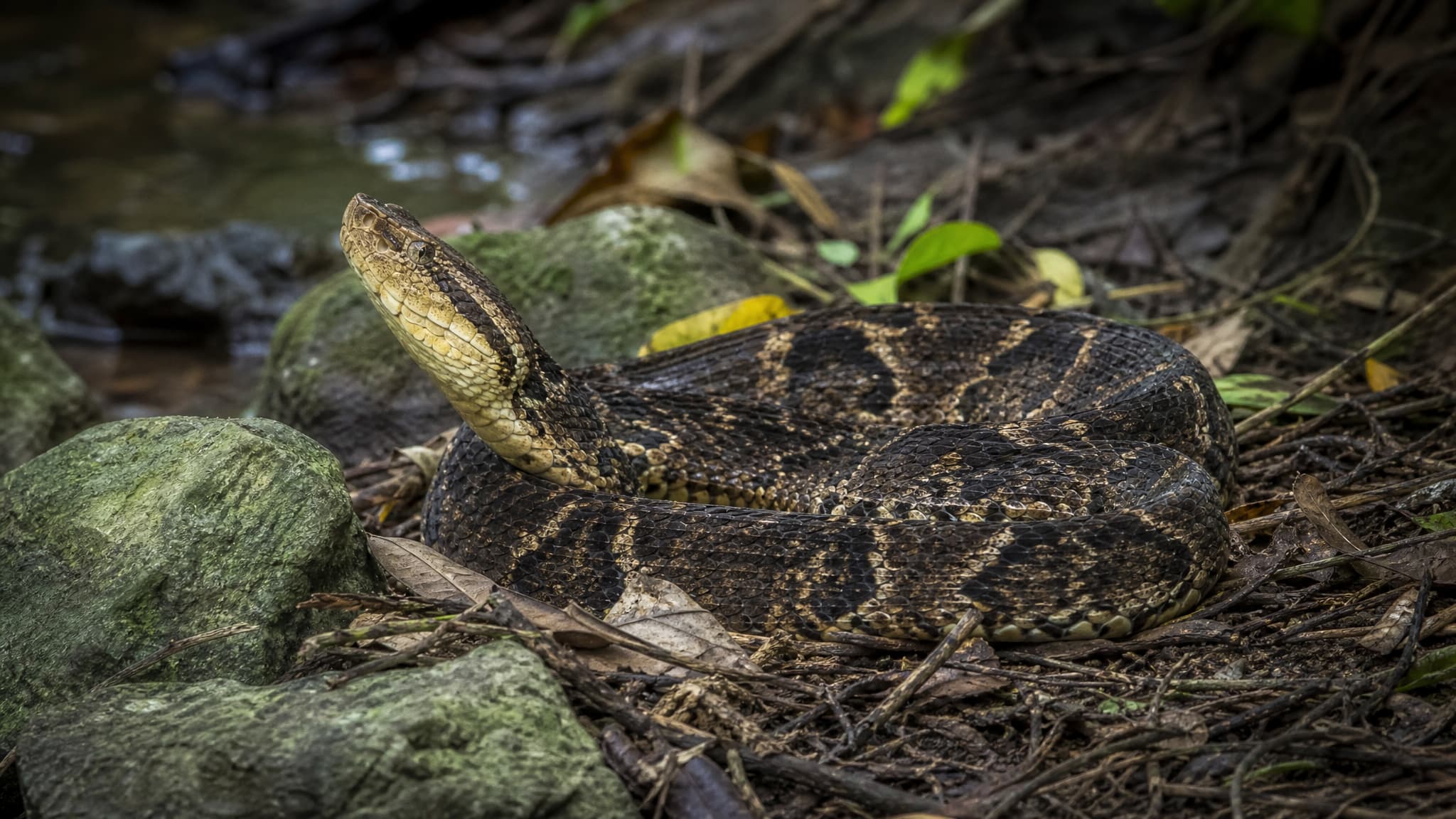
A robust, dark-patterned snake is tightly coiled on a leaf-littered forest floor beside mossy rocks and shallow flowing water, with its head raised and keeled scales clearly visible.
The jararacussu, also called jararacuçu, is a large, heavy-bodied South American pit viper. It is the largest species currently placed in the genus Bothrops, with some individuals reported to reach about 2.2 m in total length. Its camouflage varies with age and sex, helping it blend into leaf litter and dense vegetation. Like other pit vipers, it has heat-sensitive facial pits and solenoglyphous fangs that fold back when the mouth is closed. It is venomous and should never be handled.
This snake is associated principally with the Atlantic Forest and occurs from southern Bahia through southern Brazil, as well as in adjoining Paraguay and northeastern Argentina. Records also extend to southeastern Bolivia. It uses humid forest environments, including dense and seasonal forests, stream margins, forest interiors and edges; it may also occur in disturbed or open vegetation near forest. It is chiefly terrestrial and can be difficult to detect because its cryptic pattern and low local densities conceal it well.
Jararacussus are ambush predators active both by day and at night, though they are often described as mostly nocturnal. Their food changes as they grow. Young snakes feed especially on frogs and may wiggle the tail as a lure to draw visually oriented prey within striking range. Adults take small mammals, frogs and lizards, and occasionally other snakes. By preying on vertebrates, this viper is both a predator within Atlantic Forest food webs and a link transferring energy from small animals to larger consumers.
Reproduction is live-bearing: embryos develop within the female and young are born rather than laid as eggs. Females grow substantially larger than males and larger females generally produce more offspring. Mating is concentrated in autumn; females can store sperm, and births occur from summer into autumn. Reported litters are large, with published figures ranging roughly from 13 to 73 young. Wild longevity has not been well established. The IUCN and Brazil’s national assessment have listed the species as Least Concern, but Atlantic Forest habitat loss, fragmentation and deliberate killing remain relevant pressures, while important gaps in population knowledge persist.