Brazilian lancehead
Bothrops moojeni
 AI-generated
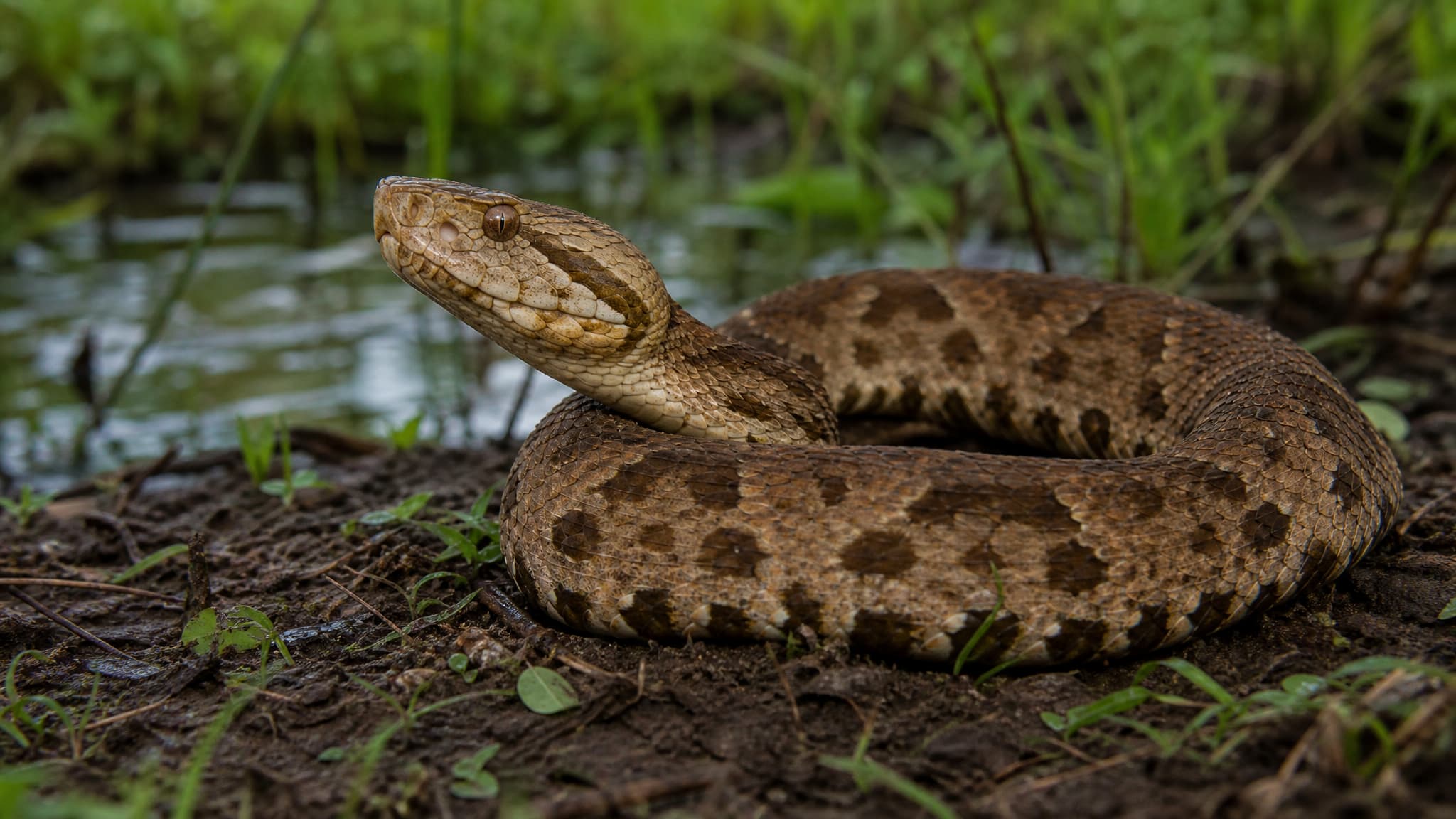
A robust, brown-patterned lancehead is coiled on damp soil beside shallow water, with its head raised and turned left. Its broad triangular head, vertical pupil, keeled scales, and pale underside are visible.
Bothrops moojeni, the Brazilian lancehead, is a large, venomous pit viper of the family Viperidae. It has the broad, triangular head and heat-sensing loreal pits characteristic of lanceheads. Adults are generally grayish to brown, marked with darker, roughly triangular side blotches; the underside is usually pale and comparatively unmarked. Young snakes often have a whitish or yellowish tail tip, which becomes darker with age.
It occurs chiefly in central and southeastern Brazil, with records extending into eastern Bolivia, eastern Paraguay, and northeastern Argentina. Within the Cerrado region it is especially associated with gallery forest, wet grassland, flooded open ground, and other vegetation bordering watercourses, though it can occasionally use drier savanna habitats.
This species is mostly terrestrial and is commonly active at night, although daytime activity is documented. It is an ambush predator that uses venom to subdue prey. Its diet changes markedly as it grows: juveniles chiefly take ectothermic prey such as frogs and lizards, while larger adults consume more mammals—especially rodents—and sometimes birds, snakes, or other prey. The light tail tip of juveniles is used in caudal luring, helping attract potential prey.
Females grow larger and heavier than males, a difference linked to reproductive output. The species gives birth to live young rather than laying shelled eggs. Reproduction is seasonal: ovarian activity begins in the dry season, and births are concentrated in the rainy season, commonly around December and January in the Cerrado study area. Recorded litters ranged from 3 to 32 offspring and increased with female size. Wild lifespan has not been reliably established.
As both predator and prey, the Brazilian lancehead participates in food webs of Cerrado wetlands and riparian forests, notably by preying on small vertebrates. It is assessed as Least Concern, reflecting its broad distribution, but local populations can still be affected by conversion and fragmentation of Cerrado and streamside habitats. It is medically important: bites from this snake require urgent professional medical care and should never be managed with home remedies.