
Brazilian three-banded armadillo
Tolypeutes tricinctus
 AI-generated
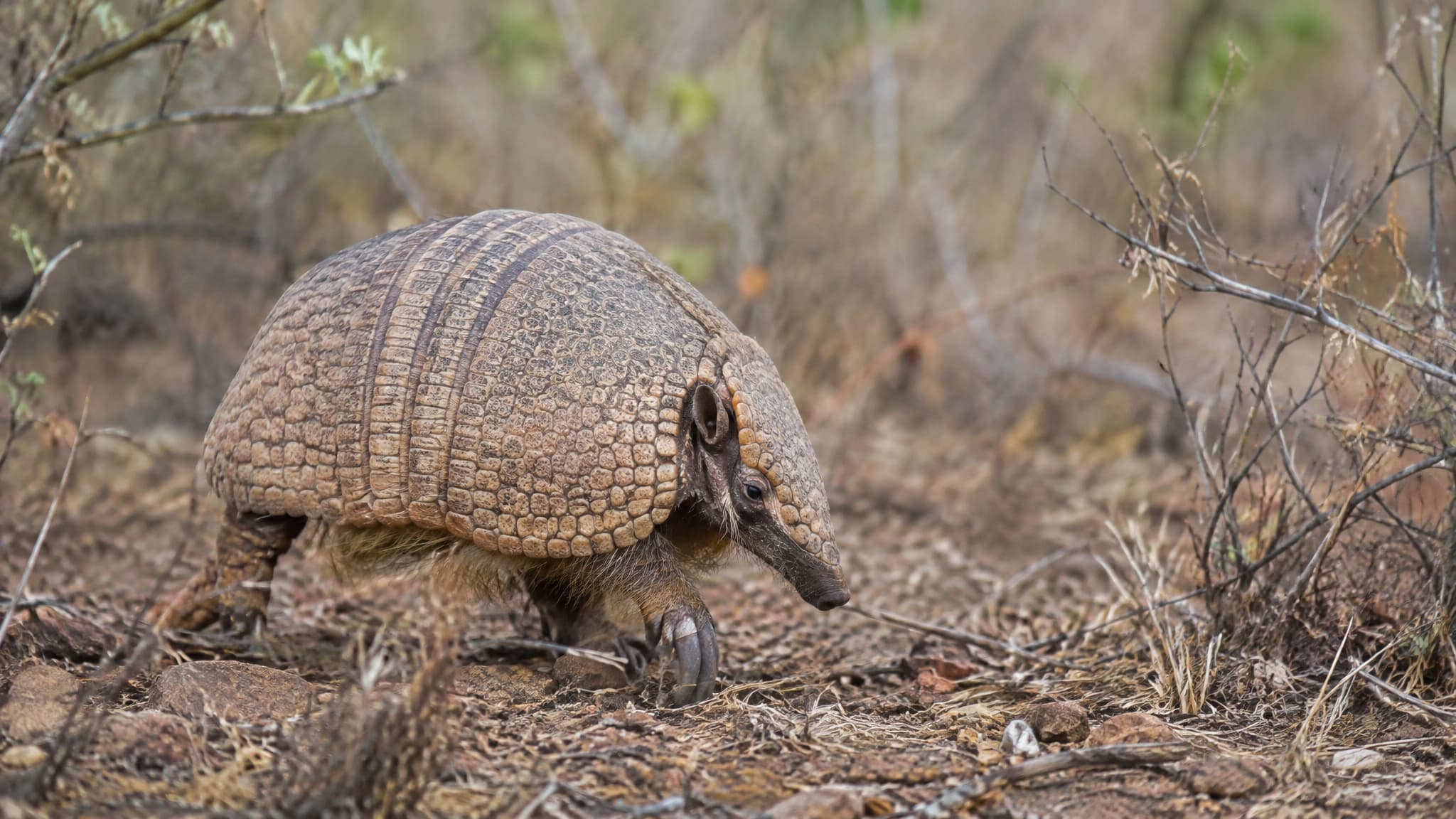
A Brazilian three-banded armadillo moves through dry scrubland in side profile, with its head lowered and its segmented, banded shell, pointed snout, and sturdy claws visible.
The Brazilian three-banded armadillo is a small, distinctive armadillo endemic to Brazil. Known locally as the tatu-bola, it has a rounded brown carapace made of bony plates, with three flexible bands across the middle. Its compact body, pointed muzzle, sturdy foreclaws, and armored head and tail allow it to close itself into a near-complete ball—a defense unusual among armadillos.
Adults are generally about 21–30 cm in head-and-body length and weigh roughly 1–1.6 kg. Rather than relying mainly on digging deep shelter burrows, it uses cover and existing refuges in its dry, seasonal landscape. It is usually solitary and is most active around dusk and at night, when temperatures are less severe.
This specialized insect-eater feeds chiefly on ants and termites, using its long sticky tongue and relatively light skull. By consuming colonial insects and moving through soil and ground cover, it forms part of the food web of Brazil’s drylands. Its armor offers strong protection, but it can still be vulnerable to large predators and, especially, human pressures.
Breeding is seasonal in available accounts, and females produce one or two young after a gestation of approximately three to four months. Newborns have softer, pinkish armor that hardens as they grow. A lifespan of up to 17 years has been reported in captivity; longevity in the wild remains poorly documented.
The species occurs principally in the Caatinga and parts of the Cerrado. Habitat conversion, degradation, road mortality, and hunting threaten its populations. It is assessed globally as Vulnerable, while Brazil lists it as Endangered, making protection of remaining native dry forest, scrub, and grassland habitat particularly important.



