
Brown-throated Three-toed Sloth
Bradypus variegatus
 AI-generated
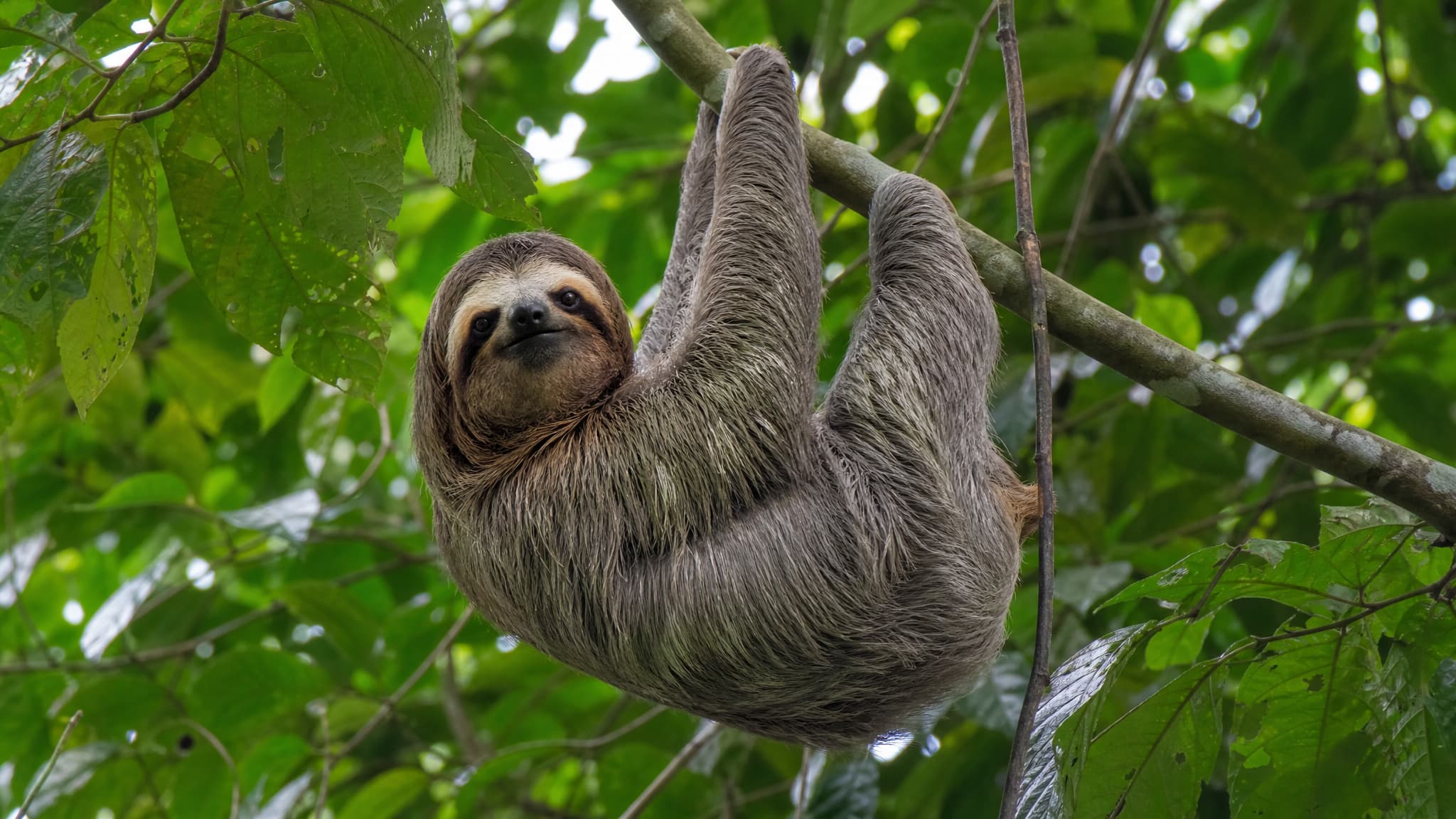
A Brown-throated Three-toed Sloth hangs curled around a branch in dense green rainforest foliage, with its shaggy gray-brown coat, dark facial mask, and rounded face clearly visible. Its limbs are raised and wrapped around the supporting branches, while the claws are mostly obscured.
The brown-throated three-toed sloth is a medium-sized, tree-dwelling mammal recognizable by its rounded head, short snout, long shaggy coat, and three large claws on each limb. Adults are usually about 60 cm long and weigh roughly 3.5–5.2 kg. Brown fur on the throat and face helps distinguish it from other Bradypus sloths; males also commonly bear a contrasting dark-and-orange patch on the mid-back. Algae growing among the grooved outer hairs can give the coat a greenish cast and improve camouflage in foliage.
It ranges from Honduras through much of Central and northern-to-central South America, including Brazil, Colombia, Venezuela, Ecuador, Peru, Bolivia, Paraguay, and northern Argentina. It occupies tropical and subtropical forest canopies, from lowland rainforest and swamps to semi-deciduous and cloud forests, reaching at least 2,400 m in elevation. Although strongly arboreal, it can swim well and occasionally descends to the ground, notably to defecate.
This sloth is a slow-moving, mostly solitary herbivore. Leaves are its principal food, especially those of Cecropia trees, supplemented by flowers and fruit. A low-energy lifestyle and specialized digestive system suit this fibrous diet. Individuals may be active by day or night, resting suspended from branches for long periods. Its fur supports a small community of algae and invertebrates, while the sloth itself is prey for harpy eagles, owls, and wild cats.
Females generally produce one young after a gestation of about five to eight months. The infant clings to its mother’s underside, nurses for several months, and gradually becomes independent; males do not provide parental care. Wild longevity is often reported as 30–40 years. The species is assessed as Least Concern, owing to its broad range and some tolerance of altered habitats, but deforestation, forest fragmentation, capture, vehicle collisions, and contact with electrical infrastructure can endanger local populations.



