
Bush Dog
Speothos venaticus
 AI-generated
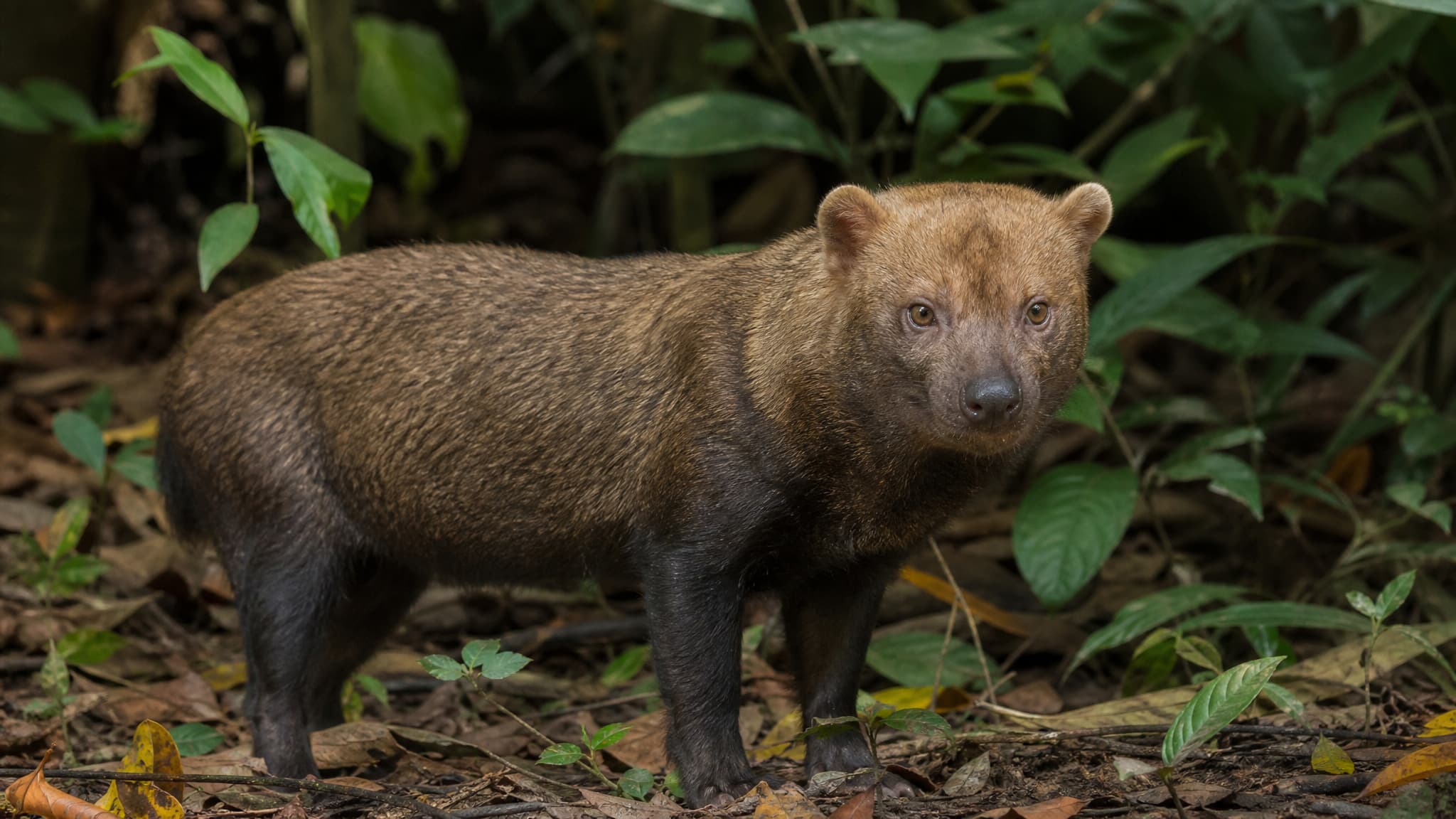
A bush dog stands on the leaf-littered forest floor, facing the camera, with a compact body, short legs, rounded ears, and a reddish-brown head fading to a darker coat. Dense green vegetation surrounds the animal.
The bush dog is a distinctive, compact wild canid of Central and South America. It has short, sturdy legs, a broad head with a short muzzle, small rounded ears, and a relatively short tail. Its dense coat is usually reddish or golden brown over the head and forebody, becoming darker brown to blackish toward the hindquarters; a paler throat patch may be present. Adults are roughly 57–75 cm in head-and-body length and commonly weigh about 4–8 kg. Partial webbing between the toes is an important adaptation for its frequent use of wet ground and water.
This elusive species has a discontinuous Neotropical distribution from Panama south through much of northern and central South America to northeastern Argentina. It occurs in forests, savannas, seasonally flooded landscapes, and other habitats with access to dense cover and water. In Brazil it is associated with the Amazon, Cerrado, Pantanal, and Atlantic Forest. Though its range is broad on a map, bush dogs tend to occur at low densities and are rarely detected.
Bush dogs are highly social for small canids, usually traveling in pairs or family groups that may contain several individuals. They are mainly active by day and communicate with a varied vocal repertoire, including high-pitched contact calls. They are specialized carnivores that hunt rodents such as agoutis and pacas, as well as armadillos, terrestrial birds, and occasionally larger prey including peccaries, capybaras, or deer. Cooperative hunting helps groups handle prey larger than a single dog.
A dominant breeding pair is typical, and social relationships can suppress reproduction by subordinate females. After a gestation of roughly 65–80 days, the female gives birth in a den, often a burrow or hollow log, to one to six pups. Other group members may assist in care. Captive individuals have lived for around 10–14 years, while longevity in the wild remains poorly known. As a predator, the bush dog contributes to the regulation of vertebrate prey populations.
The species is globally classified as Near Threatened, while in Brazil it is classified as Vulnerable. Habitat conversion and fragmentation, loss of connected forest and wetland cover, reduced prey, persecution, and diseases transmitted by domestic dogs are major concerns. Protecting large connected landscapes, maintaining healthy prey communities, and limiting contact with free-ranging dogs are therefore important for its conservation.



