Broad-snouted caiman
Caiman latirostris
 AI-generated
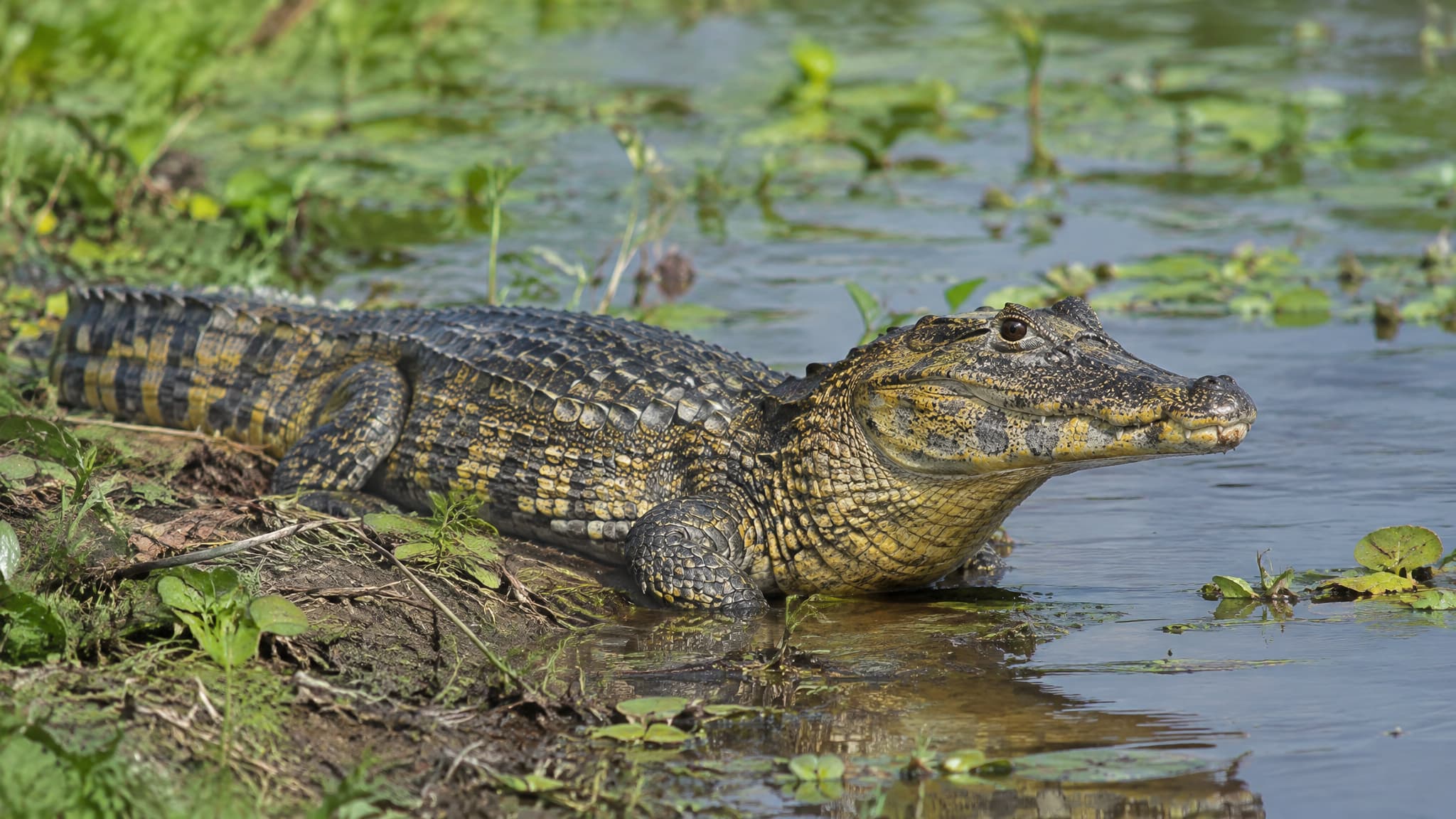
A broad-snouted caiman rests partly submerged at the edge of a vegetated pond, facing right. Its broad blunt snout, raised dorsal scutes, yellow-speckled flanks, and yellowish throat are clearly visible.
Broad-snouted caiman
The broad-snouted caiman is a medium-sized South American crocodilian distinguished by its notably wide, flattened snout. Adults are generally dark brown, olive, or greenish, often with darker markings; the throat and underside can show yellow coloration, inspiring the Brazilian name jacaré-do-papo-amarelo. Males are usually larger than females. Reported maximum length is about 3.5 m, although many individuals are smaller.
It occurs in Bolivia, Brazil, Paraguay, Uruguay, and northern Argentina. Within Brazil it is associated with the Caatinga, Cerrado, Atlantic Forest, and Pampa, and has also been introduced to the Pantanal. It favors still or slow waters and vegetated wetlands, including marshes, ponds, oxbow lakes, mangroves, and sometimes human-modified waters such as drainage channels and livestock ponds.
An ectothermic, semi-aquatic ambush predator, it feeds mainly on aquatic snails, fish, amphibians, crustaceans, insects, and other small animals. Larger caimans can take larger vertebrate prey. Its broad jaws are useful for crushing mollusks. By preying on animals in wetland food webs, it is part of the ecological balance of these aquatic systems.
Breeding is seasonal and commonly coincides with rainy periods. Females build and guard nests, laying roughly 20–50 eggs; hatching occurs after about 70 days. As in other crocodilians, incubation temperature affects the sex of the hatchlings. Nest and hatchling protection has been recorded, and parental care may continue briefly after emergence. A maximum lifespan of 22 years has been reported in captivity, while wild longevity is less certain.
The species is assessed in Brazil as Least Concern, reflecting its broad distribution and ability to use some altered habitats. Nevertheless, wetland drainage, deforestation, water pollution, fragmentation, egg collection, and illegal hunting can harm local populations and reduce connectivity between them. Protection of wetlands and enforcement against illegal harvest remain important for its long-term conservation.