
Capybara
Hydrochoerus hydrochaeris
 AI-generated
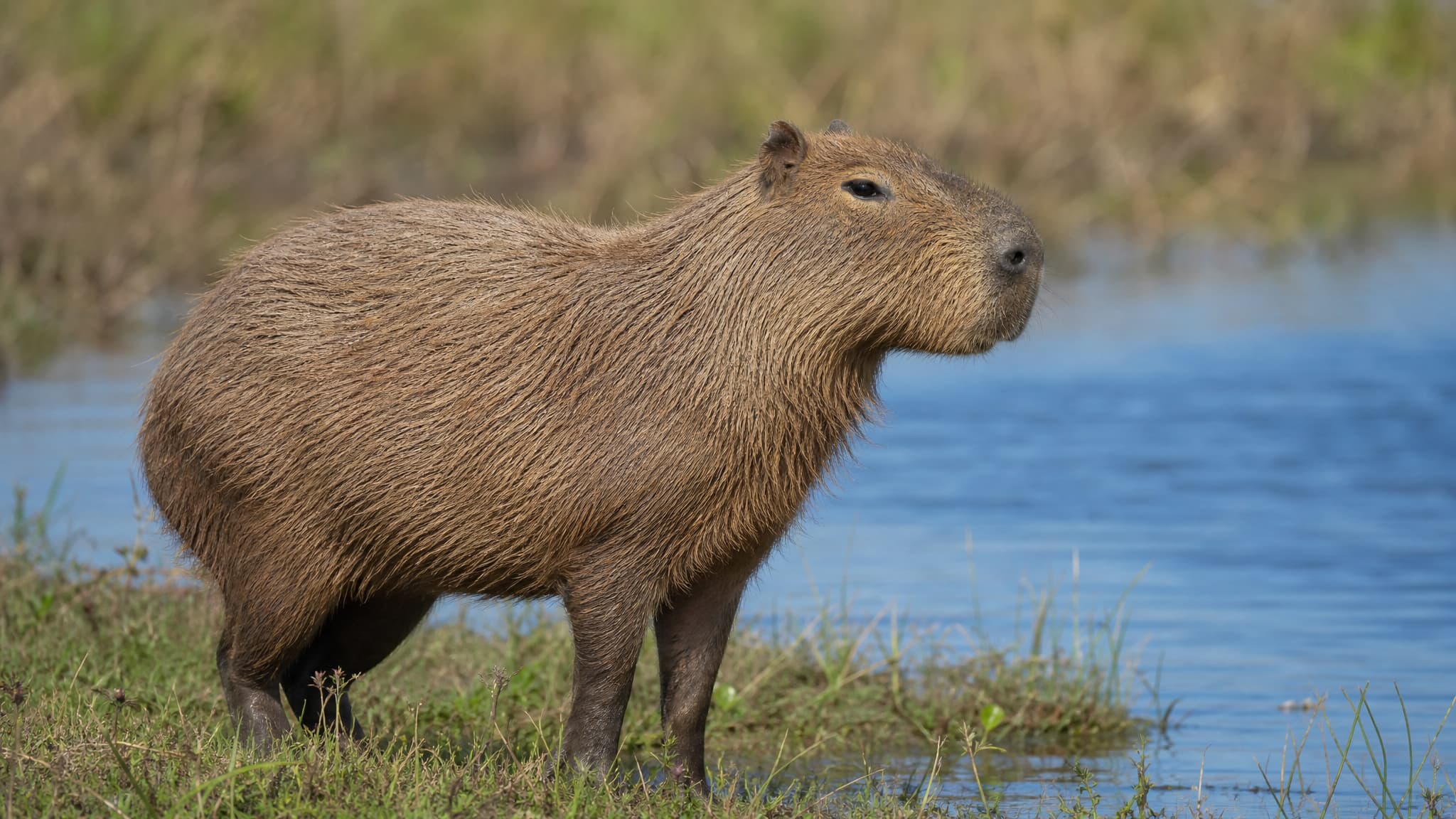
A capybara stands in side profile on a grassy, muddy bank beside blue water. Its coarse brown fur, small rounded ears, blunt muzzle, and short sturdy legs are clearly visible.
Hydrochoerus hydrochaeris, the capybara or greater capybara, is the world’s largest living rodent. Adults have a heavy, barrel-shaped body, a blunt and broad head, short rounded ears, almost no visible tail, and coarse brown to reddish-brown fur. Their eyes, ears, and nostrils sit high on the head, while partly webbed feet make them exceptionally well adapted to life at the water’s edge. Adults commonly measure about 107–134 cm in head-and-body length and weigh roughly 35–66 kg.
This South American species occurs east of the Andes, from Colombia, Venezuela, the Guianas, Ecuador, and Peru south through Brazil, Bolivia, Paraguay, Uruguay, and much of Argentina. It is closely tied to reliable water, inhabiting flooded grasslands, marsh margins, riverbanks, lakeshores, savannas, and lowland forests. In Brazil it occurs in every state, but is generally absent from smaller drainage systems in the driest regions.
Capybaras are social, semi-aquatic herbivores. They usually live in mixed groups, often around ten adults but sometimes many more where water and forage are concentrated. Grasses and aquatic plants form the core of their diet, supplemented at times by bark or fruit. They are also coprophagous, re-ingesting feces to obtain nutrients from difficult-to-digest plant material. Groups communicate with calls and scent marks, and use water as refuge from heat and predators.
Females give birth to precocial young after a gestation of about 150 days, commonly in litters of two to eight. Newborns can stand and walk soon after birth and begin grazing within their first week, though they nurse for about three months. Wild capybaras average about six years of life and may reach around ten years; captive animals can live longer.
As a large grazer and abundant prey animal, the capybara helps shape wetland and grassland vegetation and supports predators such as jaguars, caimans, and anacondas. Birds may remove parasites or feed on insects disturbed by grazing animals. The species is assessed as Least Concern, although local populations can be affected by hunting, wetland loss, water pollution, road mortality, and conflict in heavily altered landscapes.



