Loggerhead sea turtle
Caretta caretta
 AI-generated
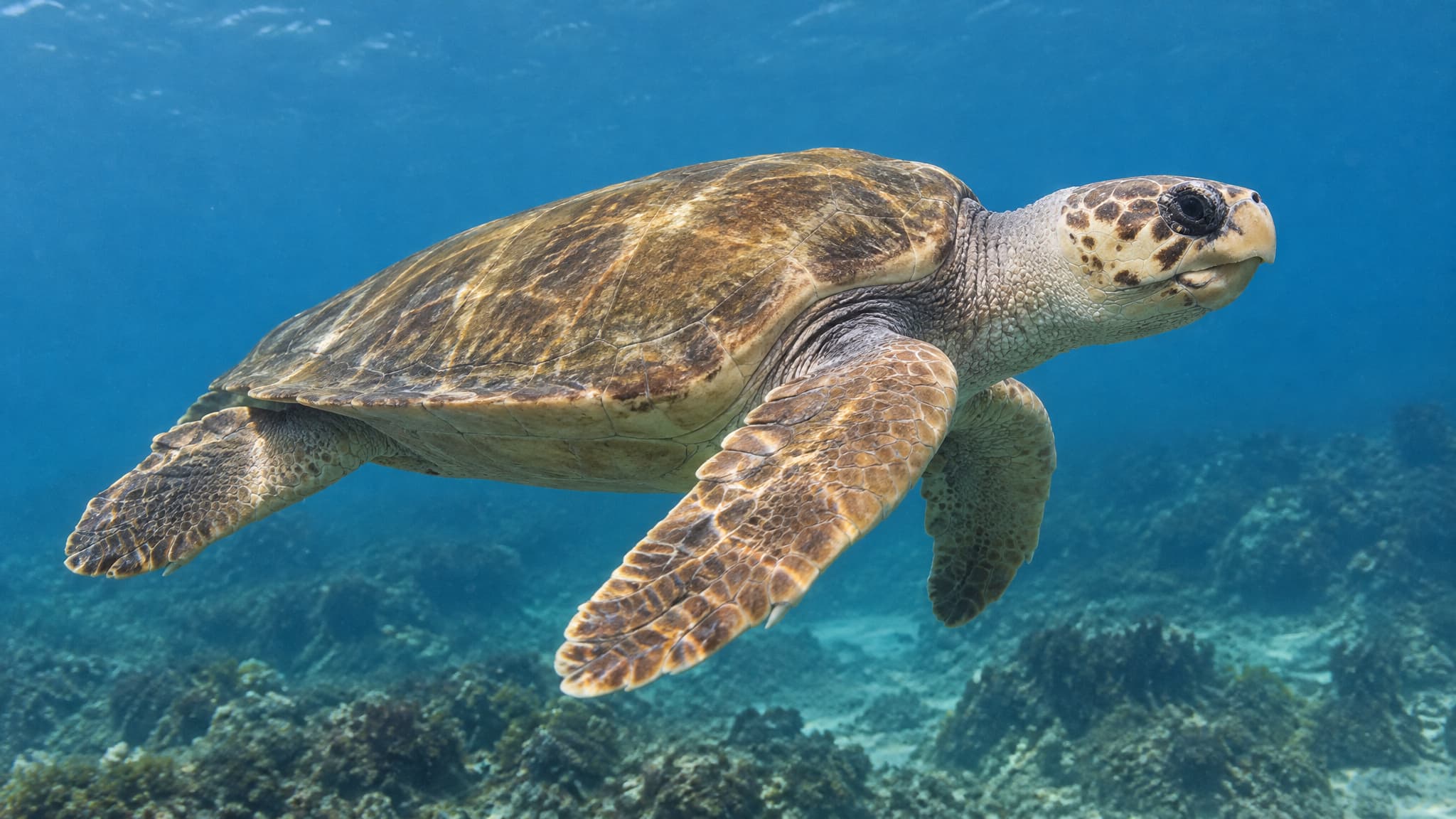
A sea turtle swims horizontally through clear blue water above a coral reef, with its broad head, patterned shell, and extended front flippers visible.
The loggerhead sea turtle (Caretta caretta) is a large hard-shelled sea turtle named for its oversized head and powerful jaws, which let it crush shellfish. Adults average about 90 cm in carapace length and about 135 kg, and in Brazil Projeto TAMAR records individuals of up to 136 cm curved carapace length and 180 kg. The slightly heart-shaped carapace is reddish brown, the underside is pale yellow, and hatchlings are dark brown. Adult males have longer tails and claws than females.
Loggerheads live in subtropical and temperate waters of the Atlantic, Pacific and Indian oceans and the Mediterranean Sea, and the species has the widest nesting range of any sea turtle. Young turtles spend roughly 7 to 15 years in the open ocean, often drifting with floating Sargassum mats, before moving to continental shelves, bays and estuaries to forage. In Brazil, priority nesting areas lie on the northern coast of Rio de Janeiro, Espírito Santo, Bahia and Sergipe, with about 9,000 nests per season.
Ocean-going juveniles eat jellyfish, salps, pyrosomes and other floating prey. Coastal juveniles and adults feed mainly on bottom-dwelling invertebrates such as whelks, conchs, bivalves, crabs and horseshoe crabs, and they occasionally take sponges, fish or algae. Loggerheads are mostly active by day, can stay submerged for long periods and make long migrations, with some Pacific turtles crossing the whole ocean.
Maturity comes late, at roughly 17 to 35 years of age. Females return to nest near the beach where they hatched, usually every 2 to 3 years, and nest alone at night. Each season they lay 3 to 5 clutches about two weeks apart, with around 100 eggs per clutch, and incubation takes about 80 days. Nest temperature sets the sex of the hatchlings: warmer sand produces more females. Lifespan in the wild is estimated at 47 to 67 years.
As a large predator of shellfish and other bottom invertebrates, the loggerhead is an important consumer in coastal seafloor food webs. The species is listed as Vulnerable by the IUCN and in CITES Appendix I. The main threat at sea is bycatch in longlines, gillnets and trawls. On land, coastal development, artificial lighting, beach erosion and egg predation reduce nesting success, while plastic debris, boat strikes and warmer sand that skews sex ratios add further pressure.