Painted turtle
Chrysemys picta
 AI-generated
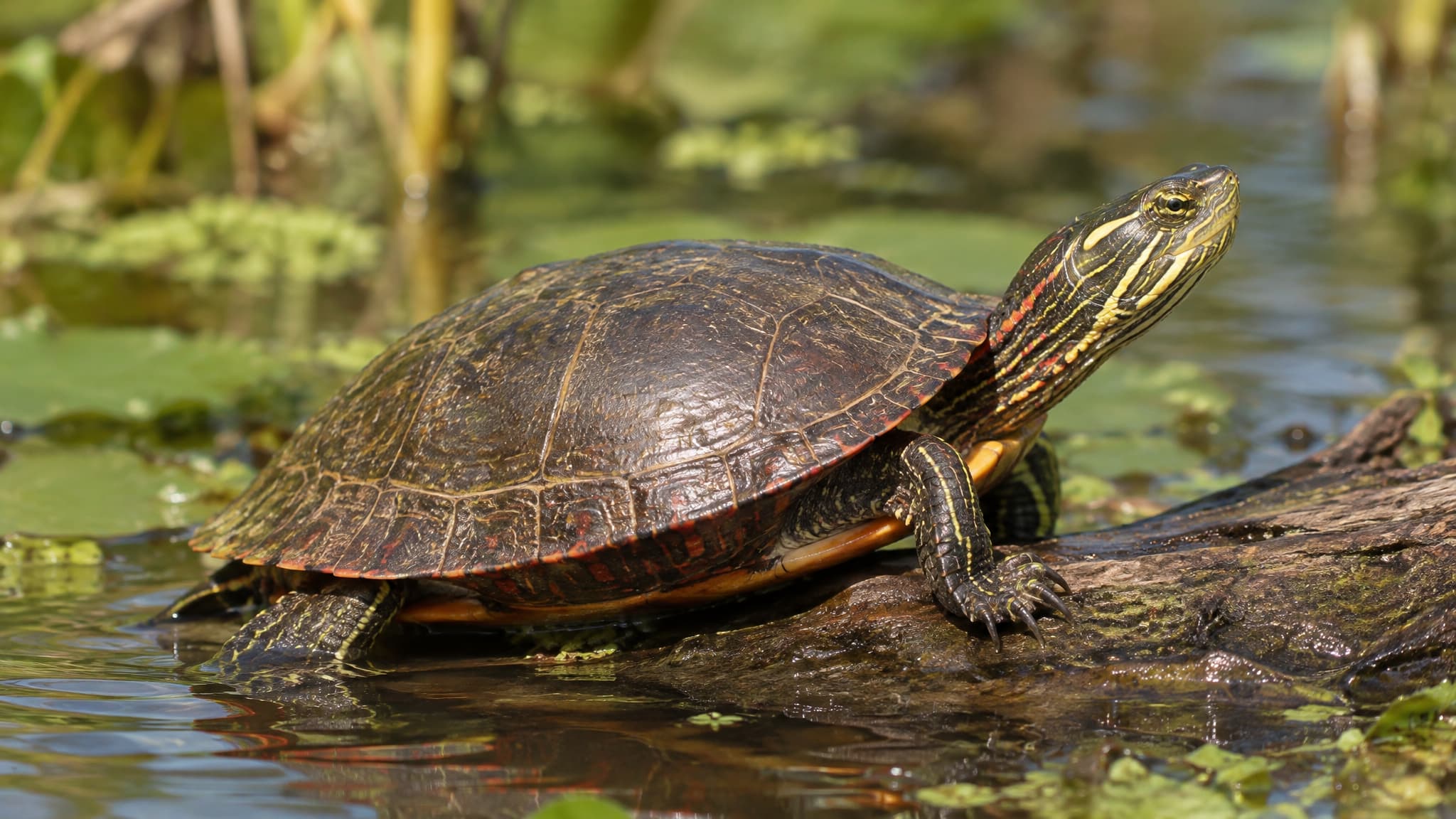
A painted turtle rests on a partially submerged log at the edge of a pond, with its head raised and yellow-striped face, red shell edging, and long-clawed forelimb visible.
The painted turtle (Chrysemys picta) is a small freshwater turtle of the family Emydidae and the most abundant turtle in North America. Its smooth, rather flat dark carapace is edged with red markings, and the skin of the head, neck and legs carries bright yellow and red stripes. Adults usually measure about 13 to 25 cm in carapace length; females are larger than males, and the biggest recorded females, from the western subspecies, reach 26.6 cm. Average weight is about 500 g for females and 300 g for males. The 2025 checklist of the Turtle Taxonomy Working Group recognizes three subspecies: the eastern (C. p. picta), midland (C. p. marginata) and western (C. p. bellii) painted turtles, while the southern painted turtle is treated as a separate species, Chrysemys dorsalis.
The species ranges from southern Canada across most of the United States to Chihuahua in northern Mexico, and western populations live as high as 1,800 m. It favours quiet, shallow and slow-moving fresh water with a soft muddy bottom and plenty of vegetation, such as ponds, lakes, marshes, swamps and the calm stretches of rivers and streams. Released pets have founded populations outside the native range, including in Germany, Spain, Indonesia and the Philippines.
Painted turtles are omnivores. Adults eat aquatic plants and algae as well as insects, crustaceans, small fish and carrion, while juveniles are mostly carnivorous and become more herbivorous as they grow. They are well known for basking, sometimes with as many as 50 turtles crowded onto a single log. In winter they rest buried in the mud at the bottom of ponds and lakes, and they survive long periods without oxygen: about 170 days for the western subspecies, 150 for the midland and 125 for the eastern.
Mating takes place in spring and autumn, and females dig nests on land between late May and mid-July. A clutch holds about 4 to 15 eggs, and a female may lay up to five clutches a year, two being a normal average. Eggs hatch after 72 to 80 days in the wild, and nest temperature determines the sex of the young. Females usually mature at 6 to 10 years, males earlier. Hatchlings can survive freezing thanks to supercooled blood and ice-resistant skin. Only about 19% survive from egg to their first birthday, but wild adults can live more than 55 years.
As predators of small fish, crustaceans and other invertebrates, painted turtles play an important part in North American freshwater food webs, and they are themselves food for many animals. Raccoons, snakes and crows take eggs and hatchlings, and raccoons are also the main predators of adults. The species is listed as Least Concern by the IUCN, but the loss of ponds and wetlands and deaths on roads have reduced some local populations.