Brazilian porcupine
Coendou prehensilis
 AI-generated
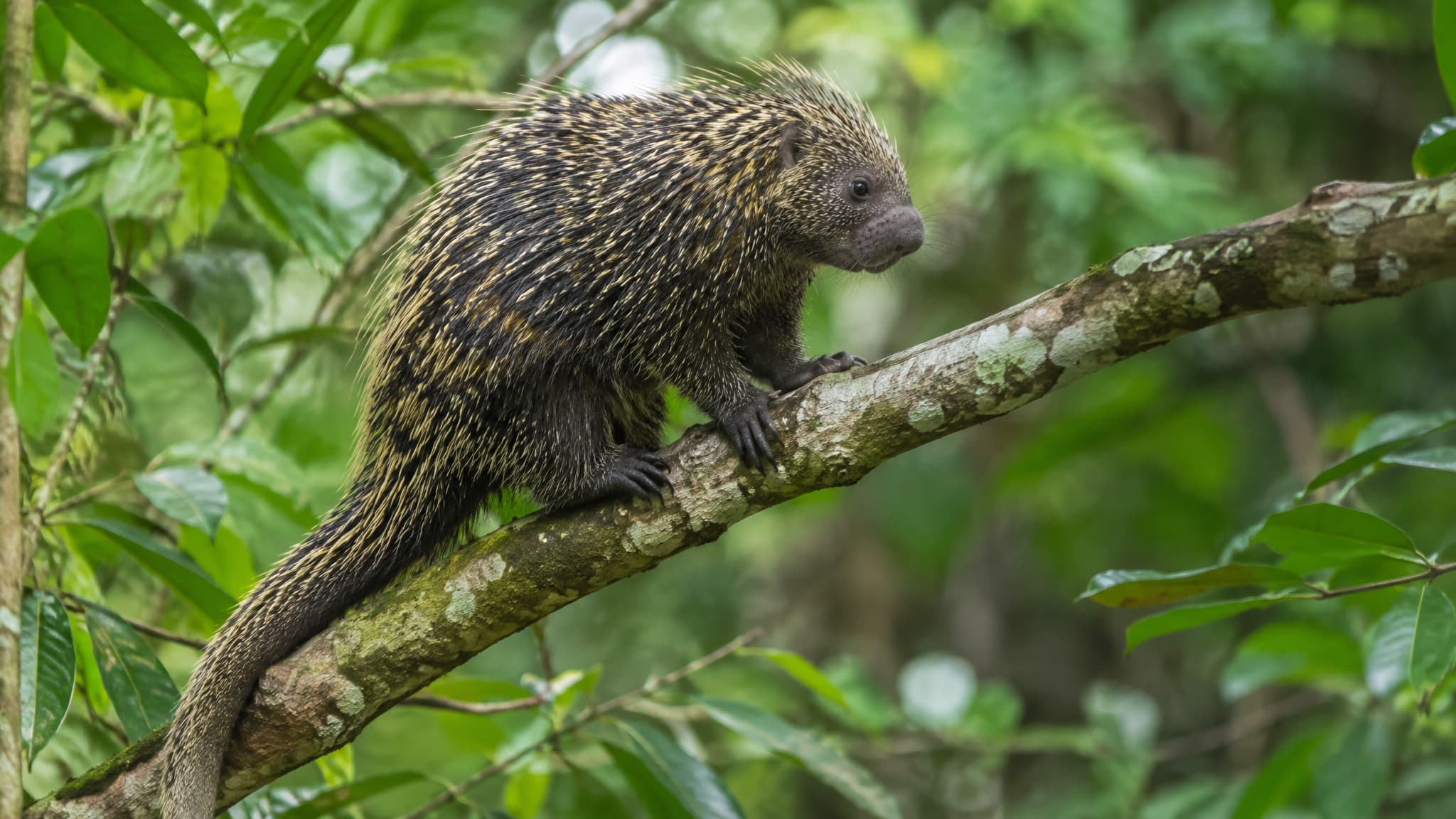
A Brazilian porcupine sits on a mossy branch in dense green forest, facing right. Its dense black-and-golden quills, rounded snout, dark eye, and long tail are clearly visible.
The Brazilian porcupine, Coendou prehensilis, is a medium-sized New World porcupine distinguished by its long, muscular prehensile tail, an adaptation for gripping branches. Its body is protected by short, barbed quills: the dorsal crest has chiefly tricolored spines, while the rump has mostly bicolored spines. Adults are generally pale yellowish with darker brown markings and sparse brown hair; the tail is unspined and helps stabilize the animal in the canopy.
Modern taxonomic work has substantially narrowed the meaning of this name. Rather than the formerly assumed broad South American animal, C. prehensilis is now treated as endemic to the northern Atlantic Forest of Brazil, north of the São Francisco River. Confirmed records are from Alagoas, Paraíba, and Pernambuco, in the Pernambuco Endemism Center. It is a forest-dependent, arboreal rodent, although it can persist in degraded and urban forest fragments.
This porcupine is chiefly nocturnal and usually solitary. It spends most of its time in trees, using its tail and long claws to climb, feed, and rest among branches. Its diet is herbivorous, centered on fleshy fruits, leaves, and seeds; broader studies of the former species complex also document bark, buds, flowers, and other plant material. By consuming fruit and seeds, it may contribute to plant dispersal, while its quills provide an effective defense against predators.
Direct natural-history studies on the narrowly defined species remain limited. Information from closely related populations formerly included in the C. prehensilis complex indicates a gestation of roughly 200 days and one precocial young. Newborns are well developed but remain nutritionally dependent for about 15 weeks. Longevity is incompletely known for the revised species; prehensile-tailed porcupines in human care are often reported to live about 12–17 years.
Brazil's 2024 assessment lists C. prehensilis as Near Threatened. Its small, fragmented range is affected by conversion of forest to agriculture—especially sugar-cane cultivation—urban expansion, and hunting or retaliatory killing. Continued loss and isolation of Atlantic Forest remnants may severely fragment its population, making habitat protection, monitoring, and taxonomically informed field surveys important conservation priorities.