
Commerson's dolphin
Cephalorhynchus commersonii
 AI-generated
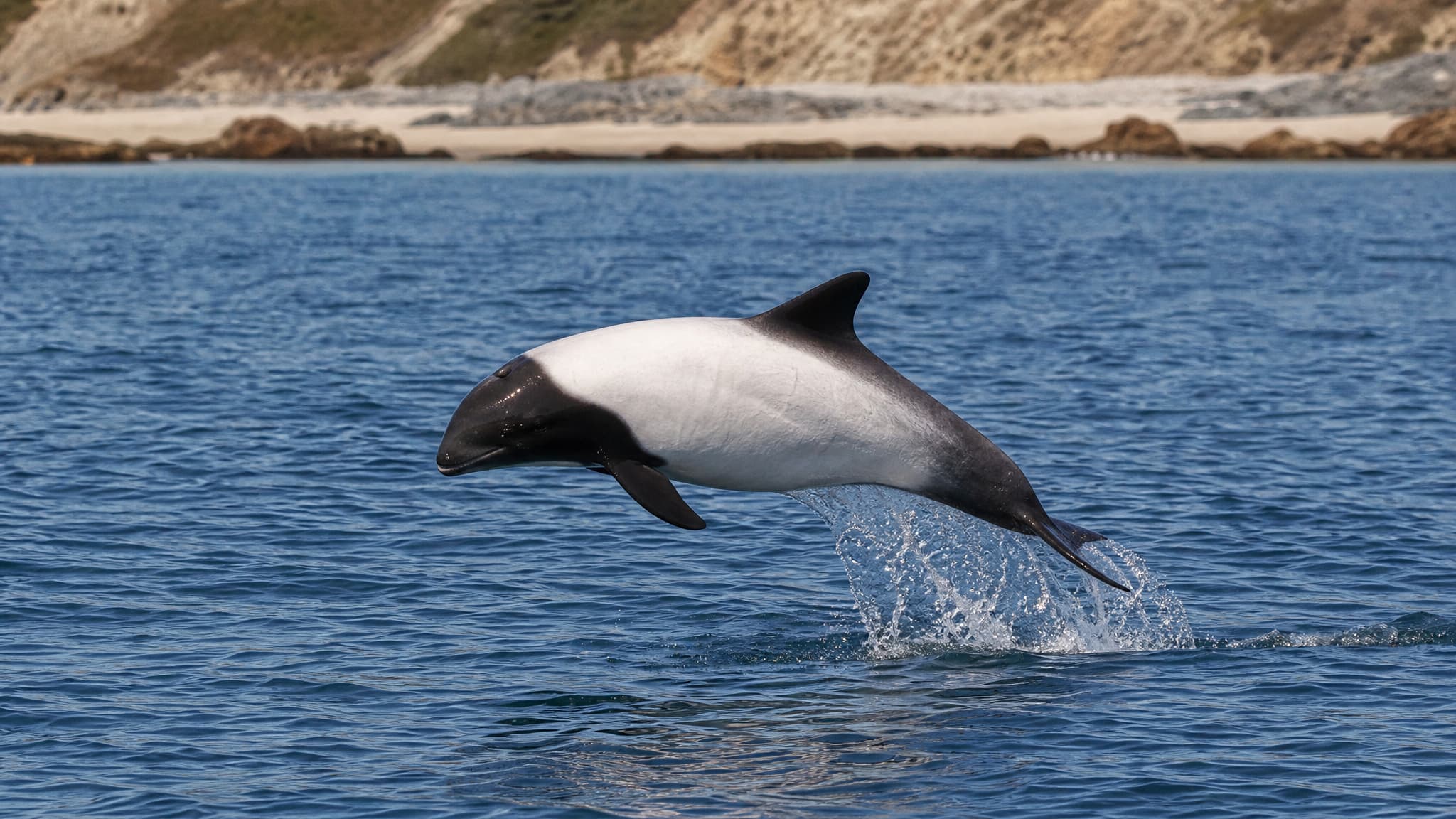
A black-and-white dolphin is captured breaching above coastal water, with its pectoral fin, dorsal fin, tail flukes, and short snout visible.
Commerson’s dolphin is a compact, small coastal dolphin famous for its sharply contrasting black-and-white pattern. Adults are usually about 1.2–1.5 m long and weigh roughly 35–65 kg, although some southern records give a slightly larger upper size. Its head is blunt, the beak is extremely short or indistinct, and its rounded flippers and low, rounded dorsal fin give it a porpoise-like outline. The white throat and body are set off by black on the head, fins, flukes, and parts of the sides; the form of the dark genital patch differs between sexes. Calves begin life in softer gray-and-black tones and develop the familiar high-contrast coloration over their first months.
The species occurs in two widely separated cold-water regions. Most animals live around southern South America, including Patagonia, Tierra del Fuego, the Strait of Magellan, Cape Horn, and the Falkland Islands. A second, isolated population occurs around the Kerguelen Islands and nearby southern Indian Ocean waters. Commerson’s dolphins favor shallow continental-shelf and nearshore habitats—bays, harbors, estuaries, kelp beds, tidal channels, and river mouths—and generally remain within about 200 m depth. They may shift seasonally in response to prey movements and are often associated with strong tidal currents.
An active, fast-swimming predator, this dolphin feeds opportunistically on small fishes, squid and octopus, mysid shrimps, and other bottom or midwater invertebrates. It may hunt alone, but cooperative herding is also documented: small groups can circle a school of fish or press prey toward shore. Individuals commonly occur in pairs or very small groups, though larger aggregations sometimes form. Echolocation supports navigation and prey detection, while their conspicuous behavior includes wave-riding, rapid turns, leaps, and interactions with vessels and other marine wildlife.
Breeding is seasonal in southern populations, with mating reported from late September into February. Females normally produce one calf after about 10–12 months of gestation; newborns are delivered tail-first and remain close to their mothers while nursing. Females mature at roughly 5–8 years and males at about 6–9 years. Wild longevity is imperfectly known, but individuals have been recorded to at least 23 years, and captive animals have lived longer. As a mesopredator, the species links small fish and invertebrate communities to larger marine food webs. It is assessed as Least Concern, yet coastal gill-net and trawl bycatch, historical killing for food or bait, and marine contaminants remain important local concerns.



