Common bottlenose dolphin
Tursiops truncatus
 AI-generated
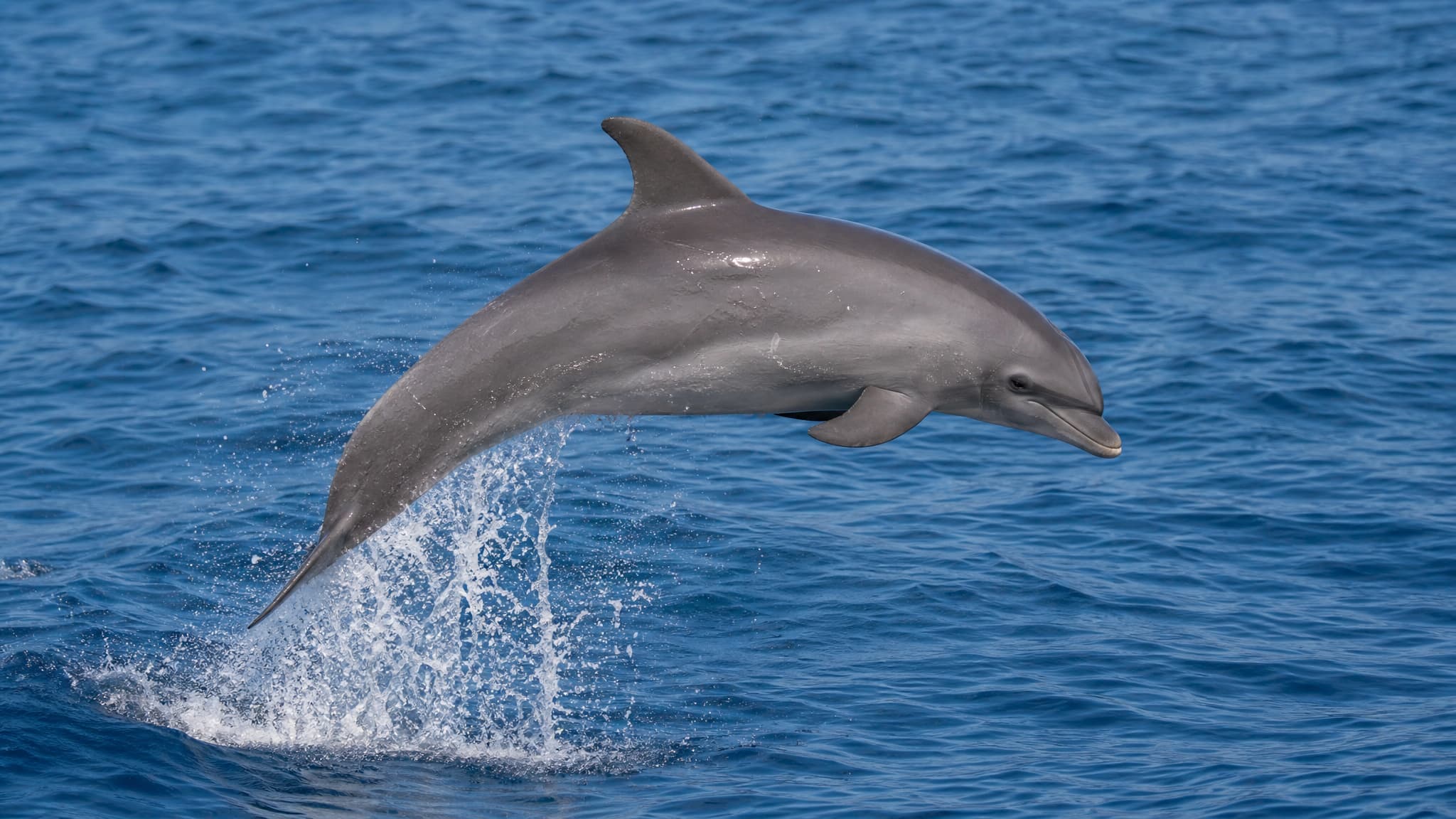
A common bottlenose dolphin leaps in an arc above the open sea, with its dorsal fin, eye, beak, and one pectoral fin visible amid a splash.
The common bottlenose dolphin is a robust, streamlined marine dolphin with a short, distinct beak, a curved dorsal fin, pointed flippers, and broad tail flukes. Its back is usually dark gray and grades to paler gray sides and a light belly. Adults commonly measure about 1.8–4 m long; males are generally larger than females. A fatty forehead structure, the melon, helps focus sound used in echolocation.
It occurs widely in tropical, subtropical, and warm-temperate seas of the Atlantic, Pacific, and Indian oceans, as well as the Mediterranean and Black seas. The species occupies offshore waters but is also familiar in coastal environments including bays, estuaries, lagoons, sounds, and the lower reaches of large rivers. Some populations remain resident while others make seasonal movements.
This is a social, flexible predator living in shifting fission–fusion groups, from a few dolphins to much larger aggregations. It communicates with whistles, burst sounds, touch, and body displays, and uses echolocation to navigate and locate prey. Its diet differs among regions but mainly includes fish, squid, crustaceans, and other marine invertebrates. Individuals may hunt alone or cooperatively, using learned local techniques.
Females usually bear one calf after roughly 12 months of gestation and nurse it for about 18–20 months; births are separated by several years. Mothers provide prolonged care, and calves learn movement, foraging, and social behavior from them and other dolphins. Reported lifespan is commonly 40–60 years, though it varies among populations and individuals.
As an upper-level coastal and marine predator, this dolphin can influence prey communities and serves as an indicator of ecosystem conditions. Globally it is assessed as Least Concern, but particular populations may face serious local pressures. Major threats include fishing-gear entanglement and ingestion, chemical contaminants, harmful algal toxins, habitat alteration, vessel strikes, underwater noise, oil-related pollution, and illegal feeding or harassment.