Common marmoset
Callithrix jacchus
 AI-generated
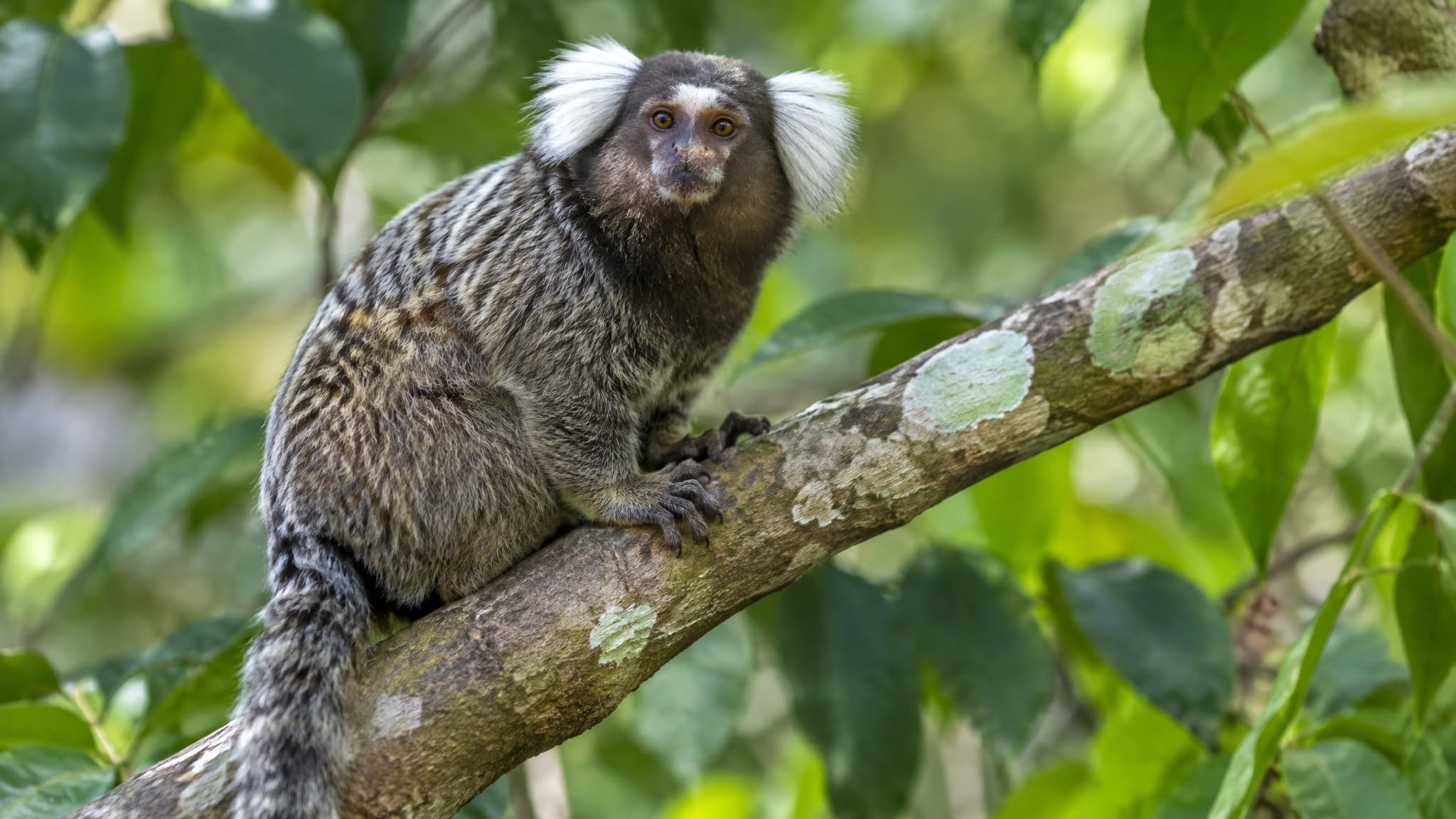
A common marmoset perches on a lichen-covered branch in leafy forest vegetation, facing the camera. Its prominent white ear tufts, dark-and-white facial pattern, striped coat, and long banded tail are clearly visible.
The common marmoset, also called the white-tufted-ear marmoset, is a small New World monkey recognized by its conspicuous white ear tufts, pale forehead blaze, dark face, and grey-brown body. Its long tail is distinctly ringed in light and dark bands. Adults typically weigh about 300–360 g; the body measures roughly 12–15 cm, excluding the much longer tail.
This primate is native to northeastern Brazil, with its native distribution associated with the coastal region from Piauí and Ceará to Pernambuco. It uses forest edges and a variety of wooded habitats, and can also occur in plantations and altered landscapes. People have introduced it to other Brazilian states, where it may establish populations outside its original range.
Common marmosets are active by day, arboreal, and highly social. Groups commonly contain several related animals and depend on vocal, tactile, and scent communication. Their diet is especially adapted to plant exudates: specialized lower incisors help them gouge bark to obtain gum and sap. They also eat insects, spiders, fruit, flowers, nectar, and occasionally small vertebrates, eggs, or nestlings. By consuming both plant and animal foods, they participate in food webs as mobile foragers and potential seed dispersers.
Breeding is cooperative. A group may include one breeding female and more than one male; fathers and older siblings routinely carry and help care for infants. Gestation lasts about 143–148 days, and twins are usual. Sexual maturity is reached at about one year of age. Reported average lifespan is around 10 years in the wild, with longer survival possible in captivity.
The species is assessed as Least Concern. Nevertheless, deforestation and habitat change affect native northeastern populations. In regions where it has been introduced, its adaptable habits, predation on small animals, and potential hybridization or competition with other marmosets can create conservation problems for local wildlife.