Crab-eating Fox
Cerdocyon thous
 AI-generated
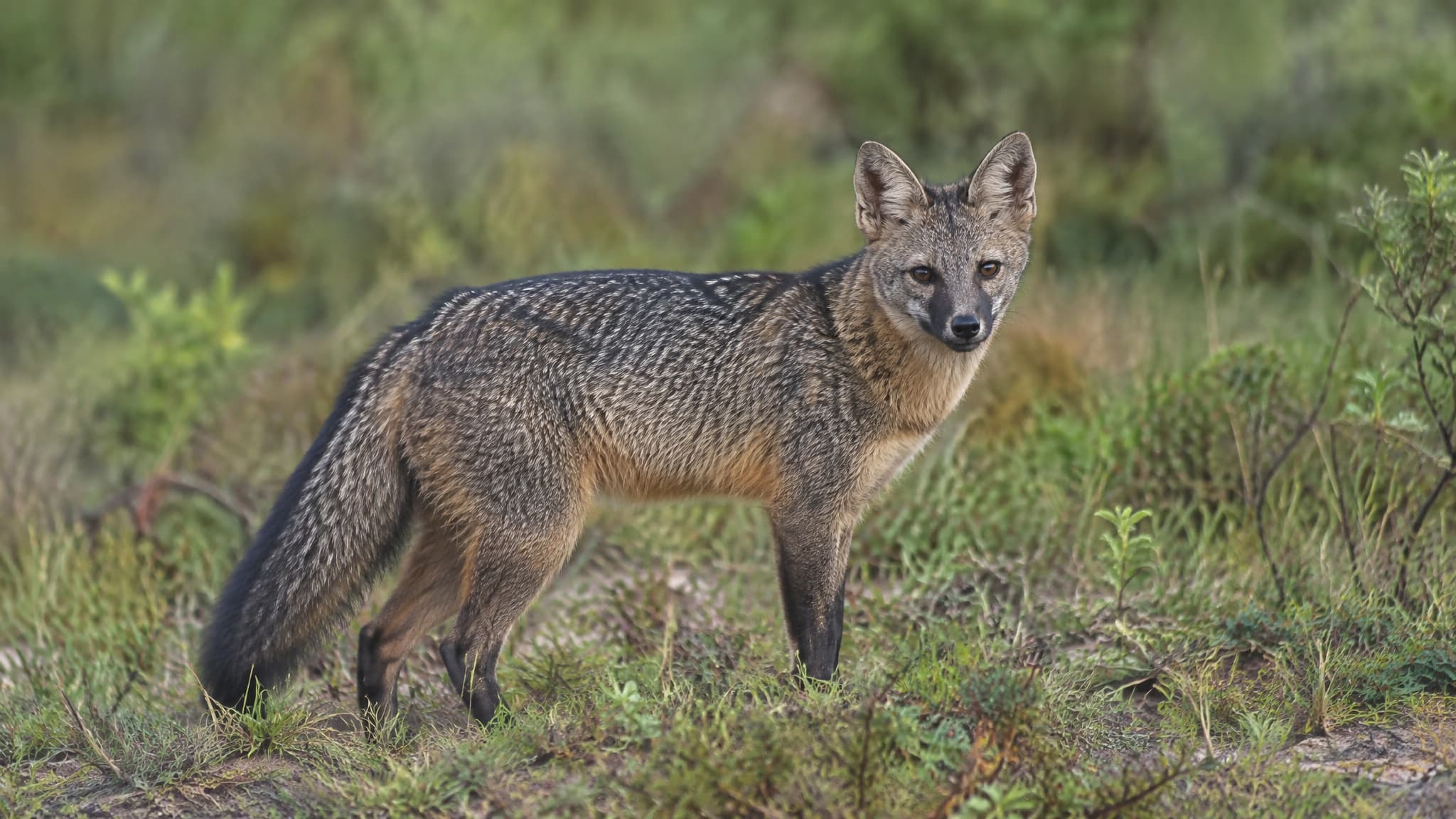
A crab-eating fox stands alert in grassy scrubland, facing slightly toward the camera. Its large upright ears, dark muzzle, grizzled gray-brown coat, and bushy tail are clearly visible.
The crab-eating fox is a medium-sized South American canid, also called the crab-eating zorro or savanna fox. Despite its English name, it is not specialized for eating crabs. It has a compact, fox-like build, a long pointed muzzle, rounded ears, and comparatively short, sturdy legs. Its coat is generally grizzled gray-brown, often with darker hairs along the back; the face, ears, and legs can be reddish, while the throat and belly are paler. Dark ear tips, legs, and tail tip are characteristic. Adults commonly weigh about 5–8 kg.
It occurs across much of northern, central, and eastern South America, from Colombia and Venezuela through the Guianas, Brazil, Bolivia, Paraguay, Uruguay, and northern Argentina. This adaptable species uses savannas, open woodland, forest edges, scrub, wetlands, and some human-modified landscapes. It is often associated with mosaics of cover and open ground rather than the interior of continuous rainforest.
A nocturnal and crepuscular omnivore, the crab-eating fox searches for food alone or with its mate. Its diet changes with local and seasonal availability and can include fruit, insects, crabs and other crustaceans, amphibians, reptiles, fish, birds, small mammals, carrion, and other accessible foods. This flexible feeding strategy explains why “crab-eating” captures only one part of its ecology. By preying on small animals and consuming fruits, it can influence prey populations and may contribute to seed dispersal.
Stable pairs are typical, and both parents participate in rearing young. Breeding may occur throughout the year, with regional peaks; gestation lasts roughly 52–59 days. Litters usually contain three to six pups. The young are born helpless, open their eyes at around two weeks, begin taking solid food after about a month, and are weaned at about three months. Captive individuals have lived for approximately 11.5 years; lifespan in the wild is less certain.
The species is assessed as Least Concern globally. Its broad range and ecological flexibility support that status, but local populations can still face persecution, road mortality, habitat conversion, and disease risks associated with domestic dogs. It is included in CITES Appendix II, which regulates international trade.