
South American rattlesnake
Crotalus durissus
 AI-generated
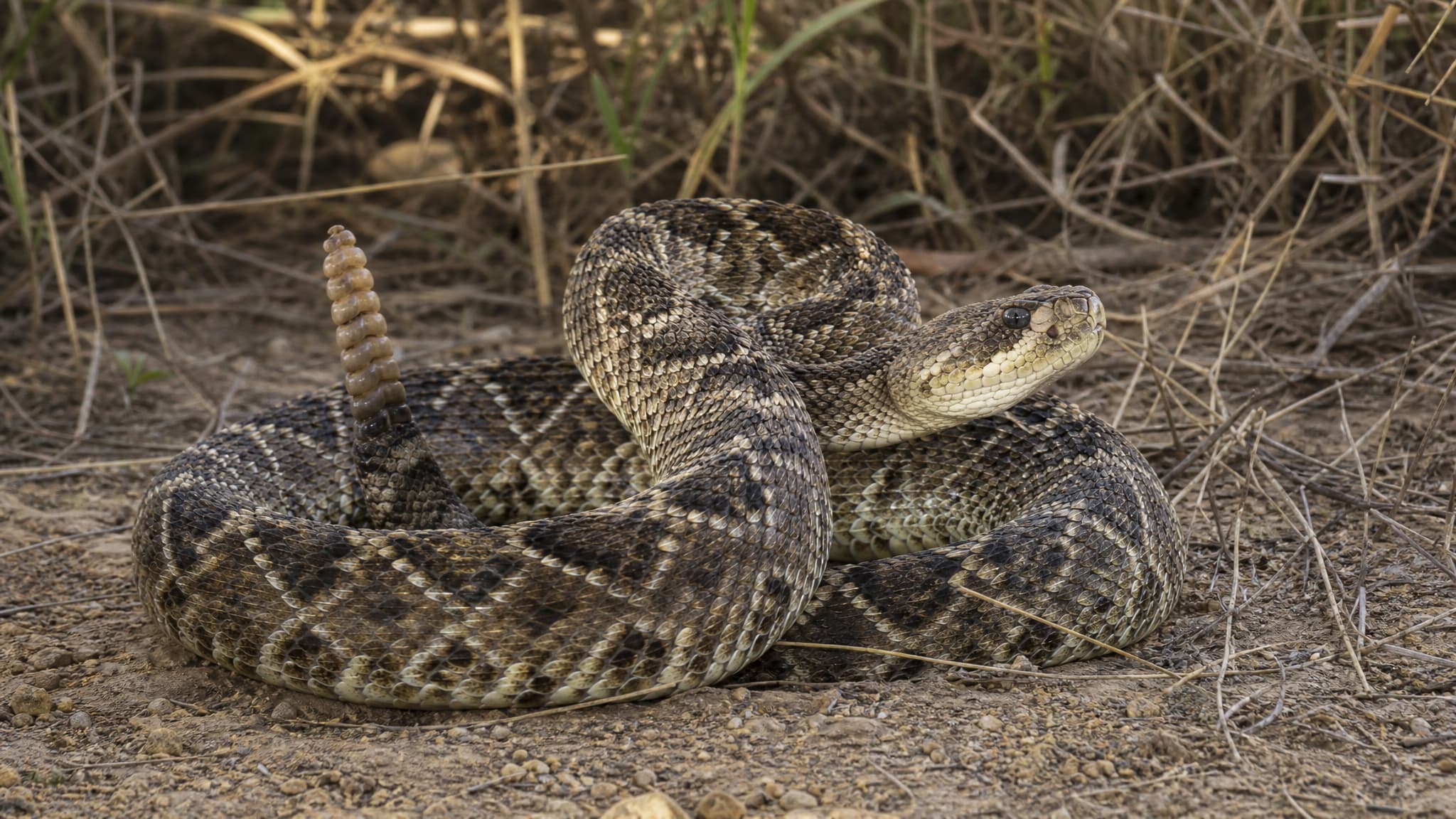
A South American rattlesnake lies coiled on dry, rocky ground among sparse grasses, with its head raised and segmented rattle held upright. Its broad, patterned body, keeled scales, dark eye, and pale facial markings are clearly visible.
The South American rattlesnake, Crotalus durissus, is a venomous pit viper recognized by the keratinous rattle at the end of its tail. It is usually a robust, brownish to grayish snake with darker dorsolateral markings that often form diamond-like shapes. Adults may exceed 1.5 m in some populations. The rattle is a warning device, not an age counter: segments are added with skin sheds and may also break off.
This species occurs broadly in South America, with records from countries including Argentina, Bolivia, Brazil, Colombia, Guyana, Paraguay, Suriname, Uruguay, Venezuela, and French Guiana; its precise range and classification have been revised as members of the wider C. durissus group were separated. In Brazil, it is the country’s only rattlesnake species. It is strongly associated with open habitats, including Cerrado and Caatinga vegetation, grasslands, savannas, pasture, and some agricultural landscapes.
It is mainly terrestrial and nocturnal. Like other pit vipers, it detects prey using heat-sensitive facial pits as well as chemical and visual cues. It feeds chiefly on small mammals—especially rodents—while lizards, birds, marsupials, and other reptiles may also be taken. A central-Brazil dietary study found rodents made up roughly three quarters of recorded prey. By consuming rodents, the snake is an important predator in open-land food webs.
Breeding is seasonal and varies across its range. Males may perform ritualized combat, rising and pressing against rivals rather than normally biting them. Females give live birth after internal development; litter size and timing differ among populations, with published Brazilian accounts reporting an average of about 14 young and a Costa Rican study reporting a higher mean. A documented captive longevity record is 19.8 years, while wild lifespan is less well quantified. The IUCN lists the species as Least Concern, but habitat conversion, killing by people, and localized population declines remain concerns. Its venom can cause severe medical emergencies, so people should keep their distance and seek urgent professional care after any suspected bite.



