
Lowland paca
Cuniculus paca
 AI-generated
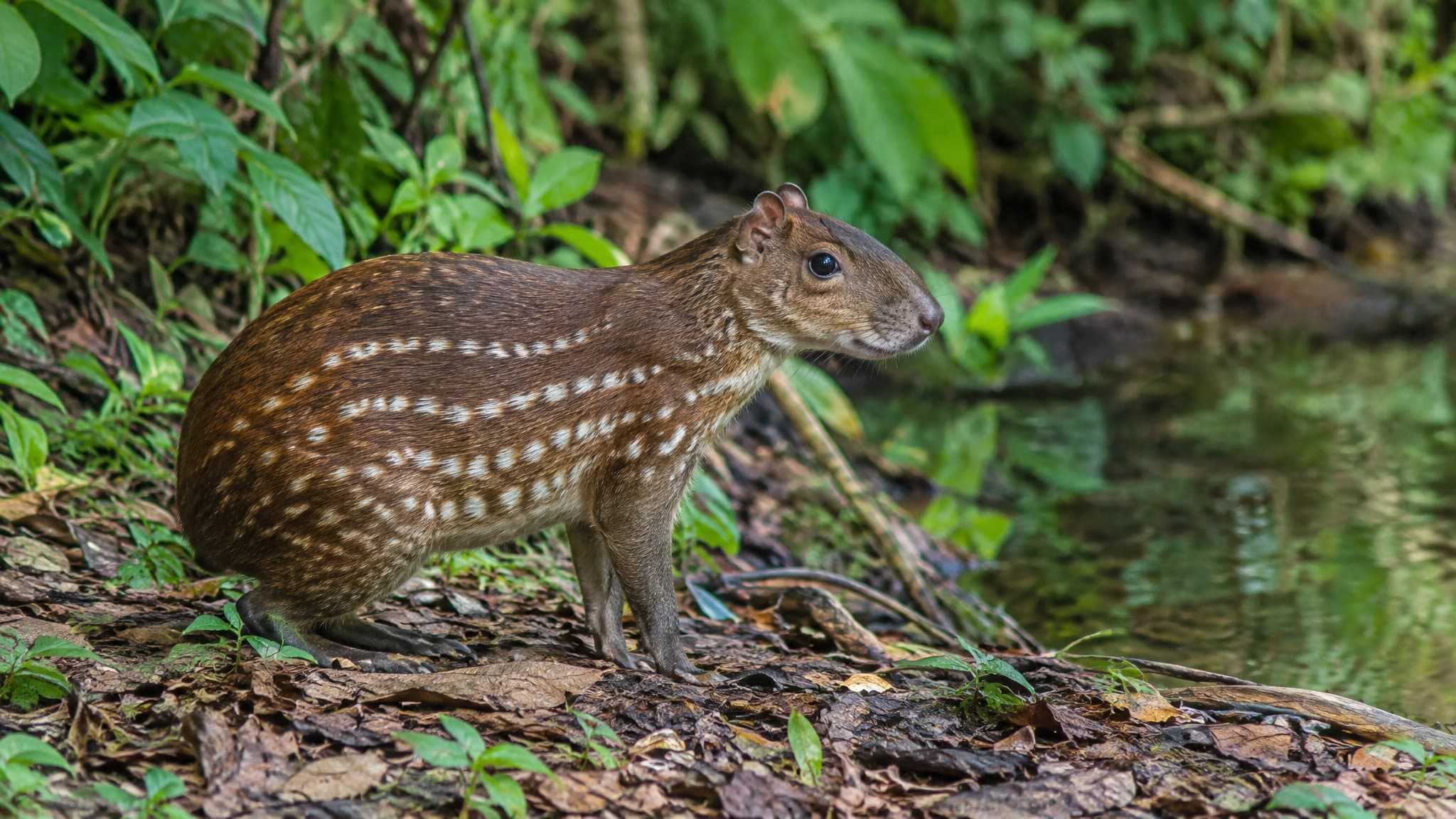
A lowland paca stands in side profile on a leaf-covered forest bank beside a stream, showing its robust body, rounded ears, blunt muzzle, and rows of white flank spots.
The lowland paca is a large, heavy-bodied Neotropical rodent with a broad head, small rounded ears, short sturdy legs, and an almost invisible tail. Its coarse coat is brown to reddish-brown or dark brown, set off by several longitudinal rows of white spots along each side; the throat and underside are paler. Adults commonly measure about 60–80 cm in head-and-body length and weigh roughly 7–15 kg. Its unusually expanded cheekbones contain resonating chambers that may enhance its vocal sounds.
This species occurs from eastern and southeastern Mexico through Central America and much of northern and central South America, reaching Paraguay, northern Argentina, and southeastern Brazil. It occupies tropical and subtropical forests, including primary and secondary woodland, forest edges, and some plantations. Pacas are especially associated with streams, ponds, and other watercourses. They shelter by day in burrows, hollow logs, root tangles, or natural cavities, often maintaining multiple entrances and concealed escape routes.
Mostly solitary and nocturnal, a paca follows familiar paths while foraging after dark. It is primarily a fruit-eater, taking fallen fruit as well as seeds, nuts, leaves, roots, and tubers; seasonal food shortages can lead it to browse more foliage. It is a capable swimmer and often escapes danger by rushing into water. As both a consumer of fruits and seeds and prey for larger carnivores, it contributes to forest food webs and can influence the fate of the plants whose fruits it uses.
Breeding can occur throughout the year in much of its range. Females usually produce one well-developed young, with twins being unusual; newborns have open eyes and can walk soon after birth. Young nurse for weeks to several months and generally reach sexual maturity within their first year. Wild longevity is often reported at about 12–13 years, with longer lives recorded in captivity. The species is globally listed as Least Concern, owing to its broad distribution, but intensive hunting for meat, habitat conversion, and forest fragmentation threaten populations locally.



