
D'Orbigny's slider
Trachemys dorbigni
 AI-generated
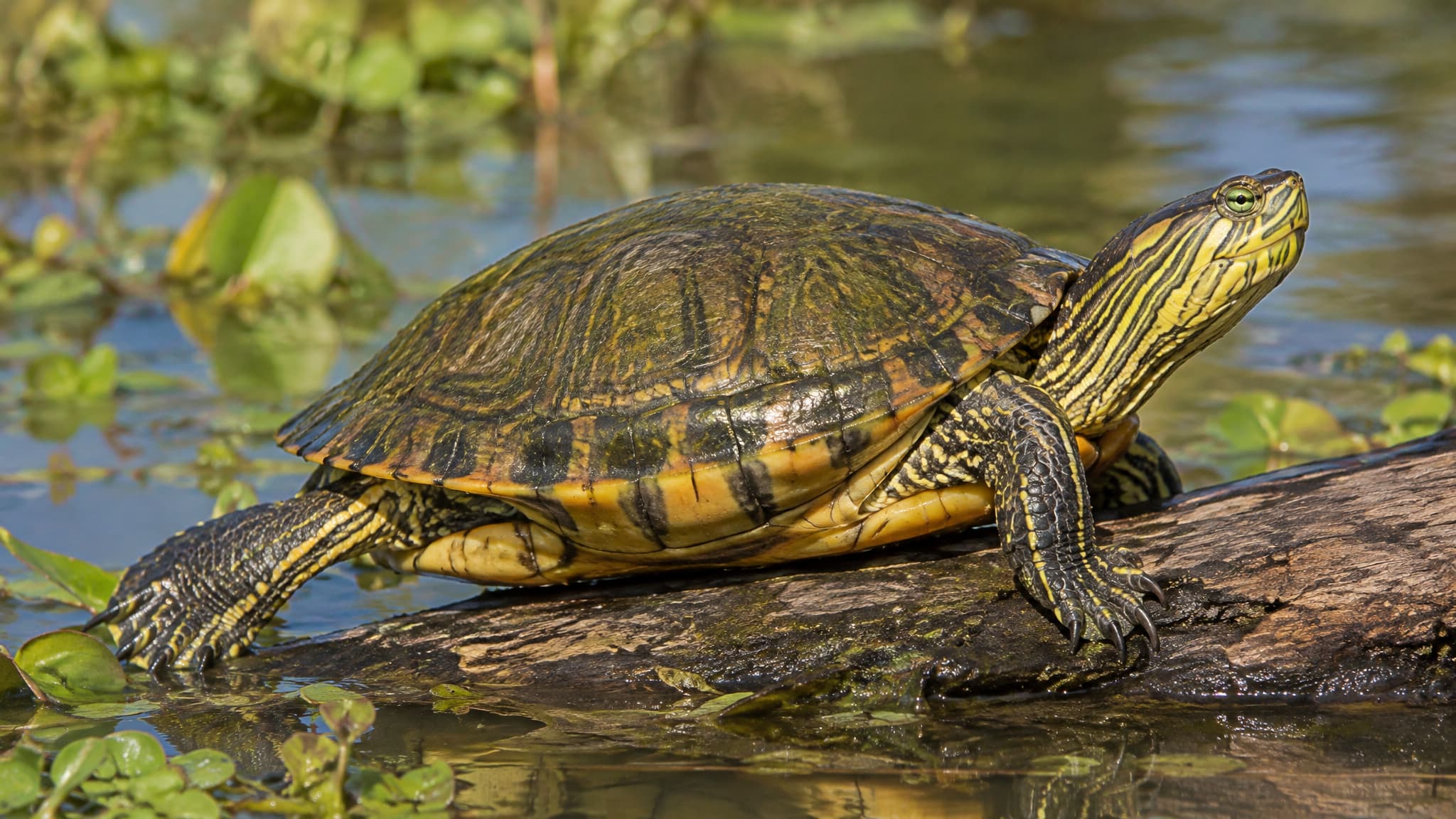
A striped freshwater turtle rests partly on a fallen log at the edge of a plant-filled pond, with its head raised and webbed, clawed limbs extended. Its dark, patterned shell and yellow-lined head and neck are clearly visible.
D'Orbigny's slider (Trachemys dorbigni), also called the black-bellied slider, is a freshwater turtle of the family Emydidae described by Duméril and Bibron in 1835 from Buenos Aires and named after the French naturalist Alcide d'Orbigny. It was long treated as a subspecies of the North American slider, Trachemys scripta, but is now recognised as a separate South American species.
Juveniles have a green carapace with bright yellow or orange marks. Adults are olive green to brown, with yellow or orange bars on the shell and a yellow or orange stripe along the jaw and temple; females stay olive, while males darken with a melanism that begins around maturity. Females are the larger sex, reaching a maximum carapace length of about 25.5 cm and up to about 2.5 kg, against about 21.5 to 23 cm in males. Hatchlings measure about 3.6 cm.
The native range covers Rio Grande do Sul in southern Brazil, Uruguay and northeastern Argentina, from lowlands up to about 170 m. It is the most abundant turtle of Rio Grande do Sul, living in ponds, reservoirs, lakes, lagoons, marshes, streams and slow rivers with soft bottoms, plenty of aquatic plants and basking sites, and it also persists in urban areas. Released pets have established it in many other Brazilian states and in Córdoba, Argentina.
D'Orbigny's slider is an omnivore that leans heavily on plants: in one study vegetation made up 85.3% of the food eaten, including green algae and floating ferns such as giant salvinia. It also takes molluscs, worms, small crustaceans, fish and amphibians. Most active around dawn and dusk, it spends much time basking, especially in colder months, and moves within a home range of about 1.74 ha. Tegus and black vultures prey on it, and its varied diet links plant and animal food webs in the wetlands.
Mating takes place from April to July, and females nest from September to February, laying up to two clutches a season about 43 days apart. Average clutches of 8.2 and 10.9 eggs have been reported, with up to 19 eggs, each weighing about 14.9 g. Nests are dug in sandy or clay soil, on average about 60 m from water. Incubation lasts 2 to 4 months, and warmer nests produce more females. Males mature at 4 to 5 years and females at 4 to 7 years. Lifespan has not been recorded for this species; the related red-eared slider has lived 41.3 years in captivity.
The main threats are the pet trade, which takes eggs and juveniles, habitat loss and fragmentation, polluted rivers, cleared riverside forest and farming over nesting areas; protecting a strip of about 94 m from the water's edge would cover 90% of nests. Releasing the species into the wild is prohibited in Brazil. The 2025 IUCN turtle checklist lists it as Near Threatened in a new Red List assessment, after earlier Least Concern evaluations.



