Emerald Tree Boa
Corallus caninus
 AI-generated
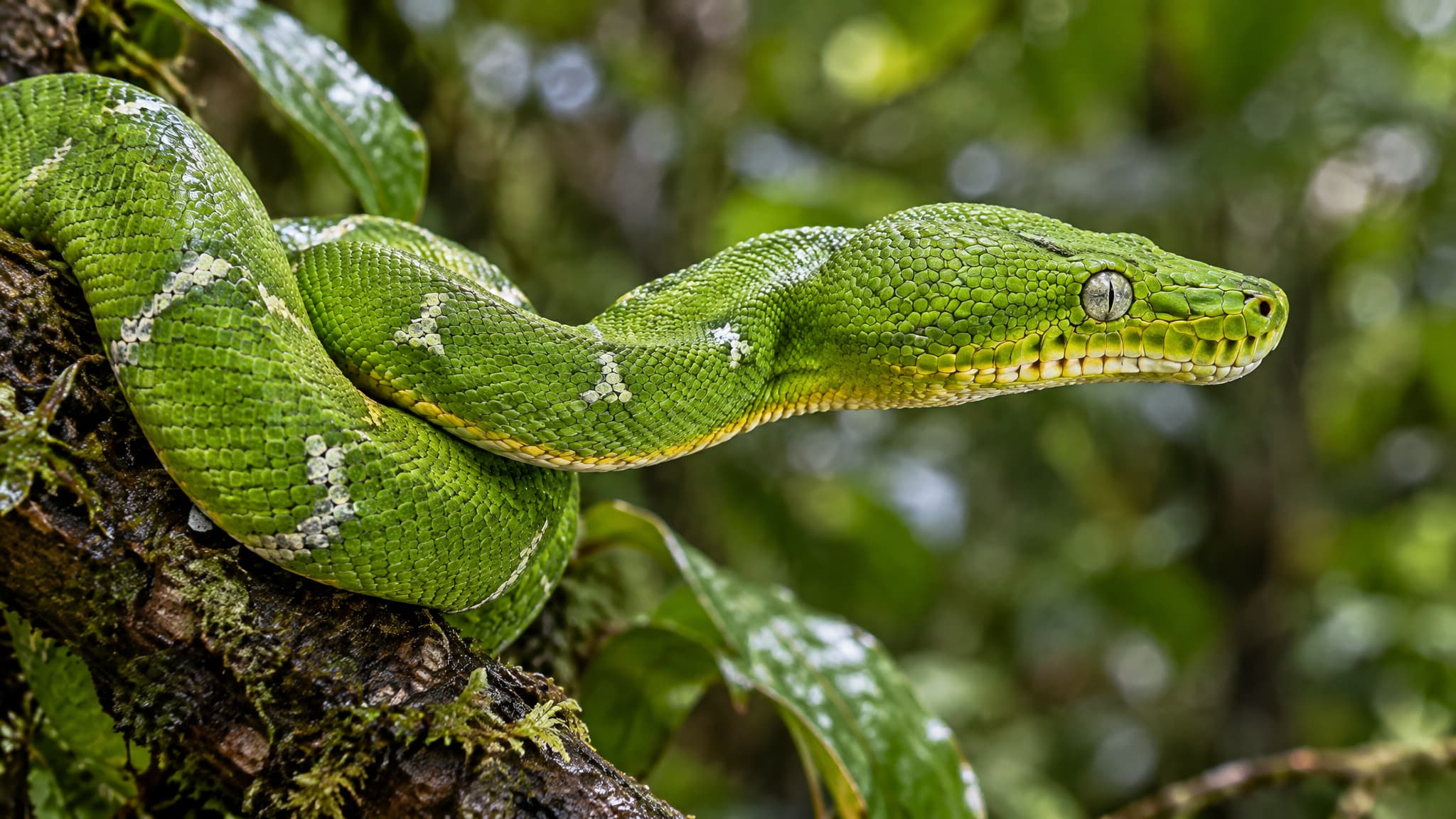
An emerald-green tree boa is tightly coiled around a moss-covered branch, with its head extended to the right. Its keeled scales, pale dorsal markings, large eye, and pale-edged lower jaw are clearly visible against blurred rainforest foliage.
The emerald tree boa (Corallus caninus) is a non-venomous, tree-dwelling constrictor from South America. Adults are usually about 1.5 to 2 m long and weigh roughly 1.5 to 2 kg. They are bright green on top, often with white scales forming a broken stripe or row of spots along the back, and the belly is pale yellow or white. The head is large, with gold or green eyes, vertical pupils and deep heat-sensing pits along both lips.
Since a 2009 taxonomic revision, the name C. caninus covers only the populations of the Guiana Shield. That means Guyana, Suriname, French Guiana, southern and eastern Venezuela, and northern Brazil north of the Amazon River and east of the Rio Negro, at elevations up to about 200 m. The closely related Amazonian populations are now treated as Corallus batesii. The species lives in wet lowland rainforest and spends nearly all its time in trees.
The boa hunts at night. By day it rests coiled over a branch with its head in the middle of the coil. After dark it anchors itself with its prehensile tail and hangs its head downward, waiting for prey passing below or birds landing nearby. Its lip pits sense the body heat of warm-blooded animals, and long, backward-curving teeth grip the prey before it is constricted. Its diet includes small mammals, especially rodents, plus birds, lizards and frogs. It lives alone outside the breeding season.
The species gives birth to live young after a gestation of about 6 to 7 months, and females usually breed every other year. Litters average around 10 young but can reach about 20, and newborns may be up to 30 cm long. Hatchlings are red, orange or yellow, sometimes mixed with green. They turn green at about 10 to 12 months old. Sexual maturity comes later than in many other boas. Reported lifespans range from about 12 years to 15–20 years in human care.
As a predator, the emerald tree boa may help keep rodent numbers in check. Its only documented predator is the crested eagle (Morphnus guianensis), though juveniles probably fall prey to many larger animals. The IUCN lists the species as Least Concern. It is covered by CITES trade controls, and the main concerns are forest loss and collection for the pet trade.