European pond turtle
Emys orbicularis
 AI-generated
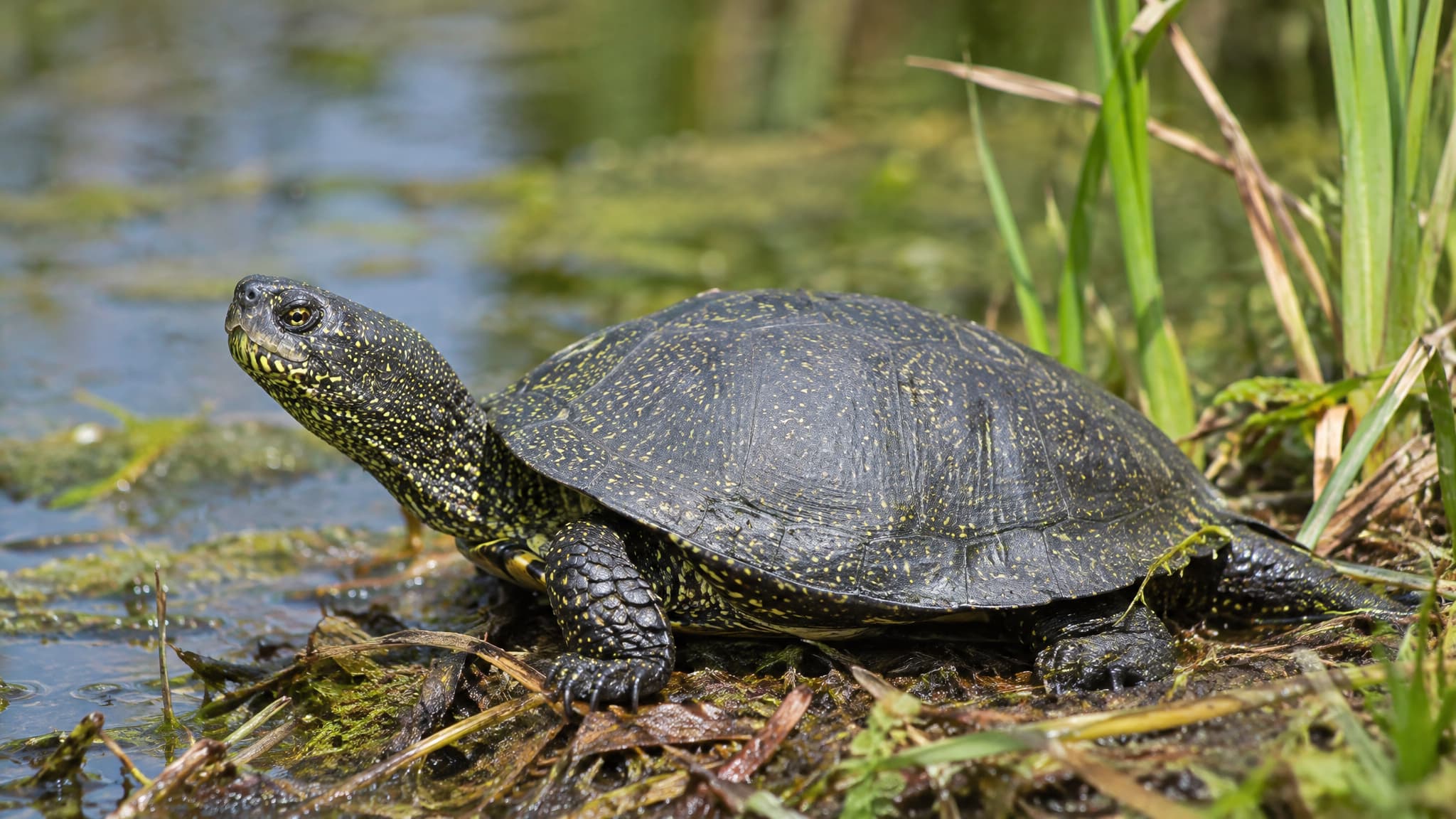
A European pond turtle rests at the edge of a shallow, vegetation-lined pond with its head raised and legs extended; yellow spotting is visible across its dark domed shell, head, and limbs.
The European pond turtle (Emys orbicularis) is a small, long-lived freshwater turtle of the family Emydidae. Its carapace is dark brown to blackish, often with a greenish tinge, and is marked with yellow spots or fine streaks; the head, neck and limbs are dark with yellow dots, and the plastron is yellowish and hinged. Females are larger than males: the TTWG 2025 checklist gives a maximum straight carapace length of 21.0 cm for males and 23.2 cm for females, and adults weigh about 400 to 700 g. Hatchlings have a rounder, slightly keeled, uniformly dark shell.
It is native to southern, central and eastern Europe, North Africa from Morocco to Tunisia, and western and central Asia east to Kazakhstan and Turkmenistan. It has disappeared from Belgium and Luxembourg and has been reintroduced in Switzerland, the Netherlands and the Czech Republic. It lives in ponds, lakes, marshes, slow-moving streams and other still waters, favouring shallow, food-rich wetlands surrounded by woodland, and it also enters brackish water. On land it may travel 1 km, and occasionally up to 4 km, from water.
The species is active by day and spends long hours basking on logs, stones and banks, but in the wild it is extremely shy and cautious, and it can stay underwater for many hours. Adults feed mainly on animal prey taken in the water, such as aquatic insects, worms, tadpoles, frogs and small fish, and they also eat some aquatic plants. Juveniles are the most carnivorous. During the cold season it hibernates buried in the mud at the bottom of ponds, for up to seven months a year, and stops eating.
Mating takes place from spring to early summer. Females leave the water to dig a nest in open, raised, sandy ground and often return to the same nesting site each year. A clutch holds about 8 to 10 eggs, each 15 to 25 mm long, and incubation lasts about 90 to 100 days; some embryos spend the winter in the nest and hatch the following spring. Sex depends on incubation temperature: eggs below 25 °C produce males and eggs above 30 °C produce females. Sexual maturity comes at about 5 to 6 years, and the usual lifespan is 40 to 60 years, rarely more than 100 years.
As a predator of invertebrates, amphibians and small fish, the turtle is part of freshwater food webs, while its eggs and hatchlings feed herons, gulls, cormorants, foxes, rats and predatory fish. It is listed as Near Threatened worldwide and in Europe, and as Vulnerable in the European Union. Habitat destruction, roads, pollution, siltation, hunting, egg collecting and competition with introduced sliders (Trachemys) have caused steep declines; it is close to extinction in Germany and is considered France's most endangered reptile. Following the TTWG 2025 checklist, it includes seven subspecies, while the Sicilian pond turtle (Emys trinacris) is a separate species.