Sea otter
Enhydra lutris
 AI-generated
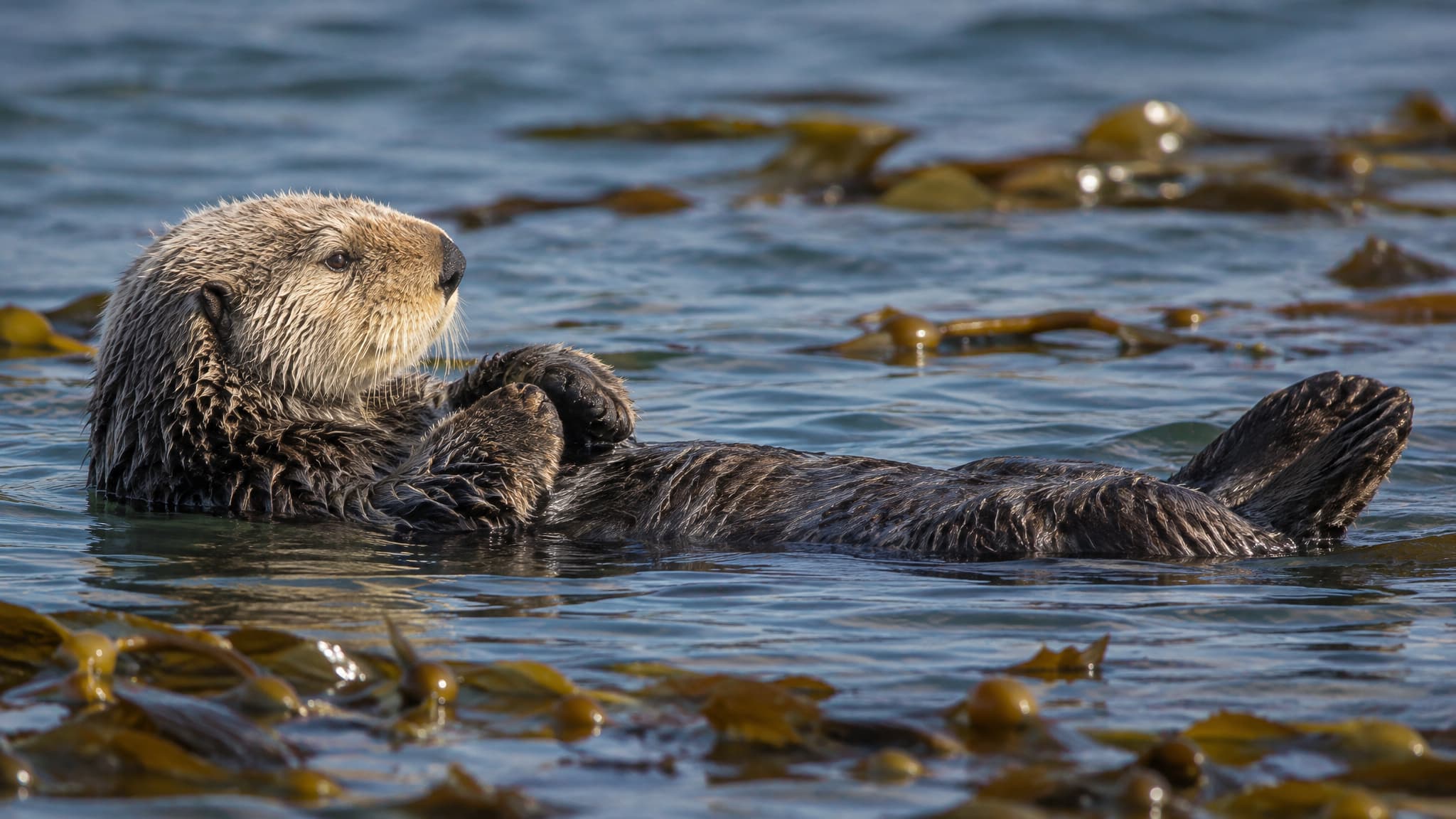
A sea otter floats on its back in coastal water, surrounded by kelp, with its forepaws raised and its hind feet visible above the surface. Its dense wet fur, rounded head, small ears, dark nose, and whiskered muzzle are clearly visible.
The sea otter is the heaviest member of the weasel family and one of the smallest marine mammals. Males usually weigh 22 to 45 kg and measure 1.2 to 1.5 m, while females weigh 14 to 33 kg and measure 1.0 to 1.4 m. Unlike seals and whales it has no insulating blubber. Instead it relies on a brown to reddish-brown coat with up to 150,000 hairs per square centimetre, the densest fur of any animal, which it grooms constantly to keep air trapped against the skin.
The species lives along the coasts of the northern and eastern North Pacific, from the Kuril and Commander Islands across the Aleutians and Alaska to British Columbia, Washington and central California. Three subspecies are recognized: the Asian, northern and southern sea otters. It favours shallow coastal waters about 15 to 23 m deep, usually within 1 km of shore, often among giant kelp forests, and it can dive to at least 45 m.
Sea otters feed mainly on marine invertebrates such as sea urchins, clams, mussels, crabs and other crustaceans, and also take some fish; more than 100 prey species are known. They eat at least 20 percent of their body weight each day, finding prey with sensitive whiskers and carrying it in loose skin pouches under the forelimbs. Floating on its back, an otter will crack hard shells against a rock held on its chest, making it one of the few tool-using mammals. Foraging dives usually last 50 to 90 seconds. At rest, otters gather in groups called rafts and sleep afloat, often wrapped in kelp so they do not drift away.
Breeding takes place throughout the year. Delayed implantation stretches gestation to 4 to 12 months, and the female normally gives birth to a single pup weighing 1.4 to 2.3 kg; twins occur in about 2 percent of births, but usually only one survives. The mother alone raises the pup, which is weaned at about 6 months. Females mature at 4 to 5 years and males at 5 to 8 years. Wild males usually live 10 to 15 years and females 15 to 20 years, with a known maximum of 23 years in the wild.
The sea otter is a classic keystone species. By eating sea urchins it keeps them from overgrazing kelp, and where otters disappear the forests can collapse into urchin barrens, taking much of the coastal biodiversity with them.
Hunting for the fur trade from 1741 to 1911 cut a population once estimated at 150,000 to 300,000 down to only 1,000 to 2,000 animals. The international treaty of 1911 ended commercial hunting, and the species has since recovered to roughly two-thirds of its former range, with about 107,000 animals counted worldwide in 2004 to 2007. It is classed as Endangered by the IUCN. Oil spills such as the 1989 Exxon Valdez disaster, disease, suspected predation by killer whales in the Aleutians and conflict with fisheries remain major threats.