Rainbow boa
Epicrates cenchria
 AI-generated
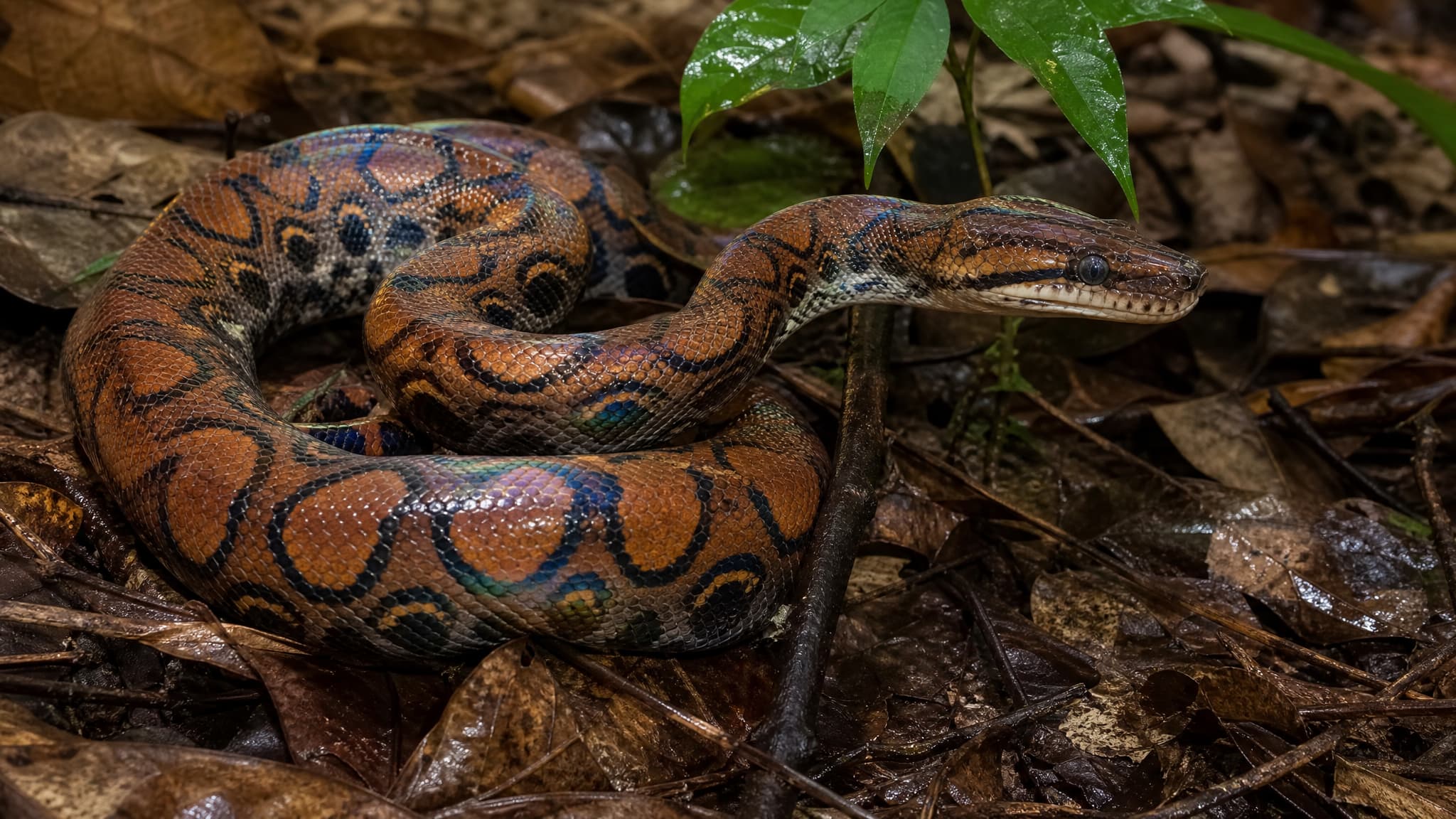
A rainbow boa is coiled on wet leaf litter beneath low green vegetation, with its head raised to the right and iridescent, patterned scales visible along the body.
Epicrates cenchria, the rainbow boa or Brazilian rainbow boa, is a nonvenomous Neotropical boa distinguished by extraordinarily iridescent scales. Microscopic ridges on the scales refract light, producing a rainbow sheen that is especially striking after shedding. Adults are usually reddish brown to orange-brown, with three dark head stripes, dark dorsal rings or blotches, and rounded lateral markings. They are medium-sized boas, commonly about 1.2–2.0 m long; females generally become longer and heavier-bodied than males.
This species occurs across much of northern and central South America, including the Amazon Basin and parts of the Brazilian Atlantic Forest. Verified records extend through Bolivia, Brazil, Colombia, Ecuador, French Guiana, Guyana, Peru, Suriname, and Venezuela. It occupies humid tropical forest, forest edges, and sometimes nearby savannas. Although largely terrestrial, it also uses low shrubs and branches, making it a semi-arboreal hunter in many settings.
Rainbow boas are solitary and chiefly active at night. They locate prey using chemical cues, vision, and heat-sensitive facial pits, then ambush and kill it by constriction rather than venom. Their diet includes rodents and other small mammals, birds and eggs, lizards, amphibians, and other small vertebrates. As predators of rodents and other vertebrates, they contribute to food-web balance in tropical forests and adjacent habitats.
Females retain developing young internally and give birth to live young, rather than laying externally incubated eggs. Breeding is seasonal; males may engage in ritual combat for mating access. Litters vary widely, with roughly 1–30 young reported, and newborns are relatively well developed. Sexual maturity is linked strongly to body size and is often reached after several years. Wild lifespan has been estimated at roughly 7–12 years, while animals in human care may live 20 years or longer.
The species is assessed as Least Concern because of its broad distribution, apparently stable populations, and occurrence in protected areas. Nonetheless, local pressures can include forest conversion, road mortality, and collection for the pet trade. Its brilliant coloration has made it a frequent captive species, so preventing illegal trade and never releasing captive snakes are important safeguards.