
False killer whale
Pseudorca crassidens
 AI-generated
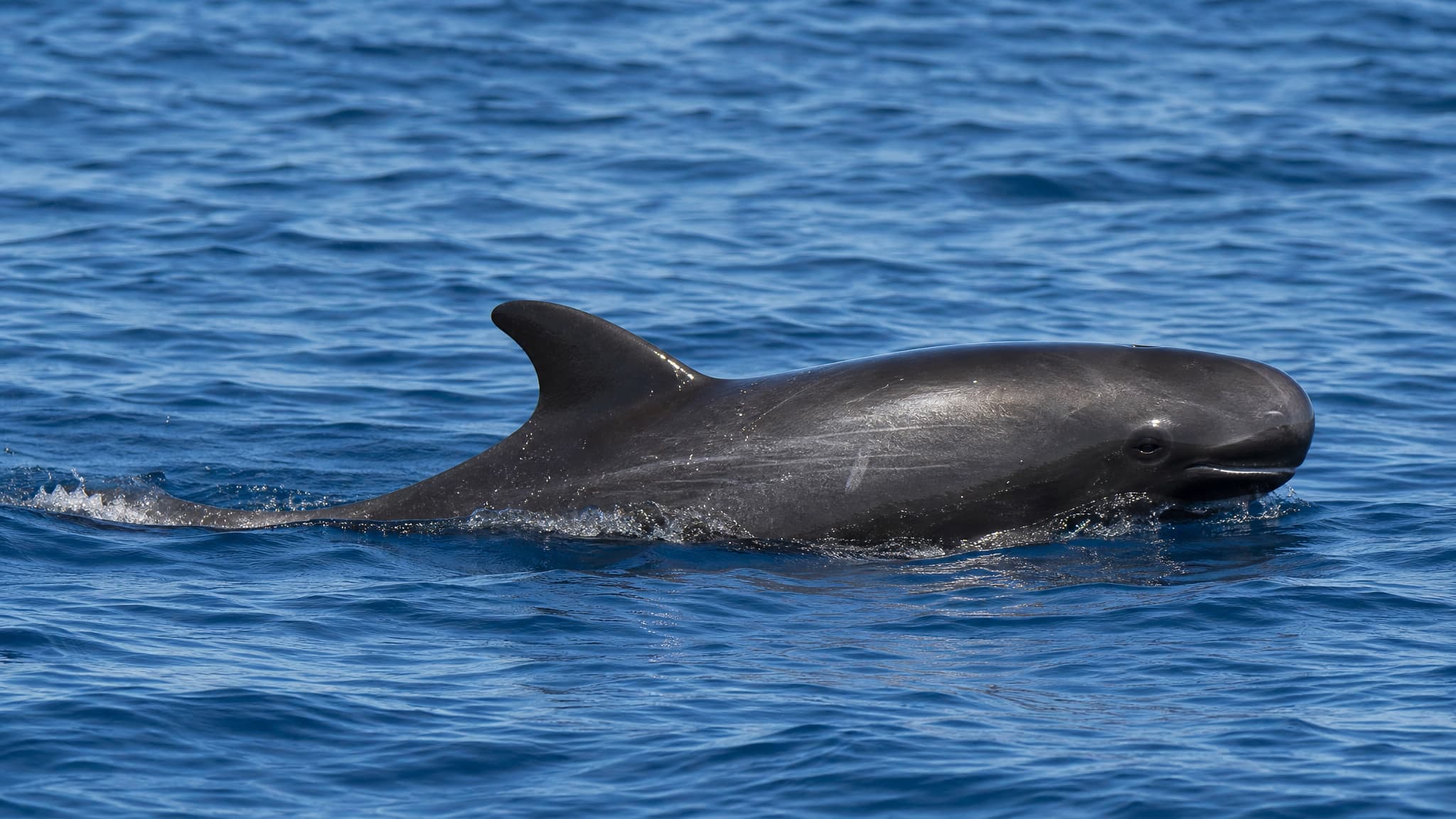
A false killer whale swims side-on at the ocean surface, showing a dark, streamlined body, rounded head, and prominent curved dorsal fin.
The false killer whale (Pseudorca crassidens) is a large, sleek oceanic dolphin—not a true whale and not an orca. Its name refers to skull features that resemble those of the killer whale. Adults are mostly black to very dark gray, sometimes with paler gray on the head or flanks. They have a rounded forehead, a long tapered body, a narrow blunt-tipped snout, and a tall, curved dorsal fin. The long flippers have a characteristic bend or hump along the leading edge. Males can reach about 6 m (20 ft), while females are usually smaller.
This species occurs widely in tropical, subtropical, and warm-temperate waters of the Atlantic, Indian, and Pacific oceans. It is primarily an offshore, deep-water cetacean, but may also travel near islands, continental shelves, and coasts. Sightings occur irregularly across much of its range, whereas some island-associated populations show more localized movements. The false killer whale is the only living species in the genus Pseudorca.
False killer whales are highly social, usually travelling in groups that can range from a few animals to many dozens. They use whistles and other vocalizations, as well as echolocation, to communicate and navigate. Fast, powerful swimmers, they may ride vessel wakes, bow-ride, and leap clear of the water. Their strong teeth and cooperative social behavior help them capture prey, and adults have been observed sharing or handling fish in ways that can help calves feed.
They are carnivores that eat chiefly fish and squid, including large pelagic fishes such as tunas and mahi-mahi; in some areas they also take other dolphins or marine mammals. As upper-level predators, they help shape pelagic food webs. Much of their life history remains difficult to study because they live offshore. Available evidence indicates a long-lived species: females may live up to about 63 years and males about 58 years. Females generally produce a single calf after a gestation of roughly 15 months, with births spaced several years apart.
Globally, the false killer whale is classified as Near Threatened. Reliable worldwide abundance estimates are limited, and some regional populations are small or declining. Major pressures include accidental hooking or entanglement in longline fisheries, removal of hooked fish or bait from lines that increases such interactions, pollutants, prey depletion, and direct hunting in a few places. The insular population around the main Hawaiian Islands is especially imperiled and receives additional U.S. legal protection.



