Flatback sea turtle
Natator depressus
 AI-generated
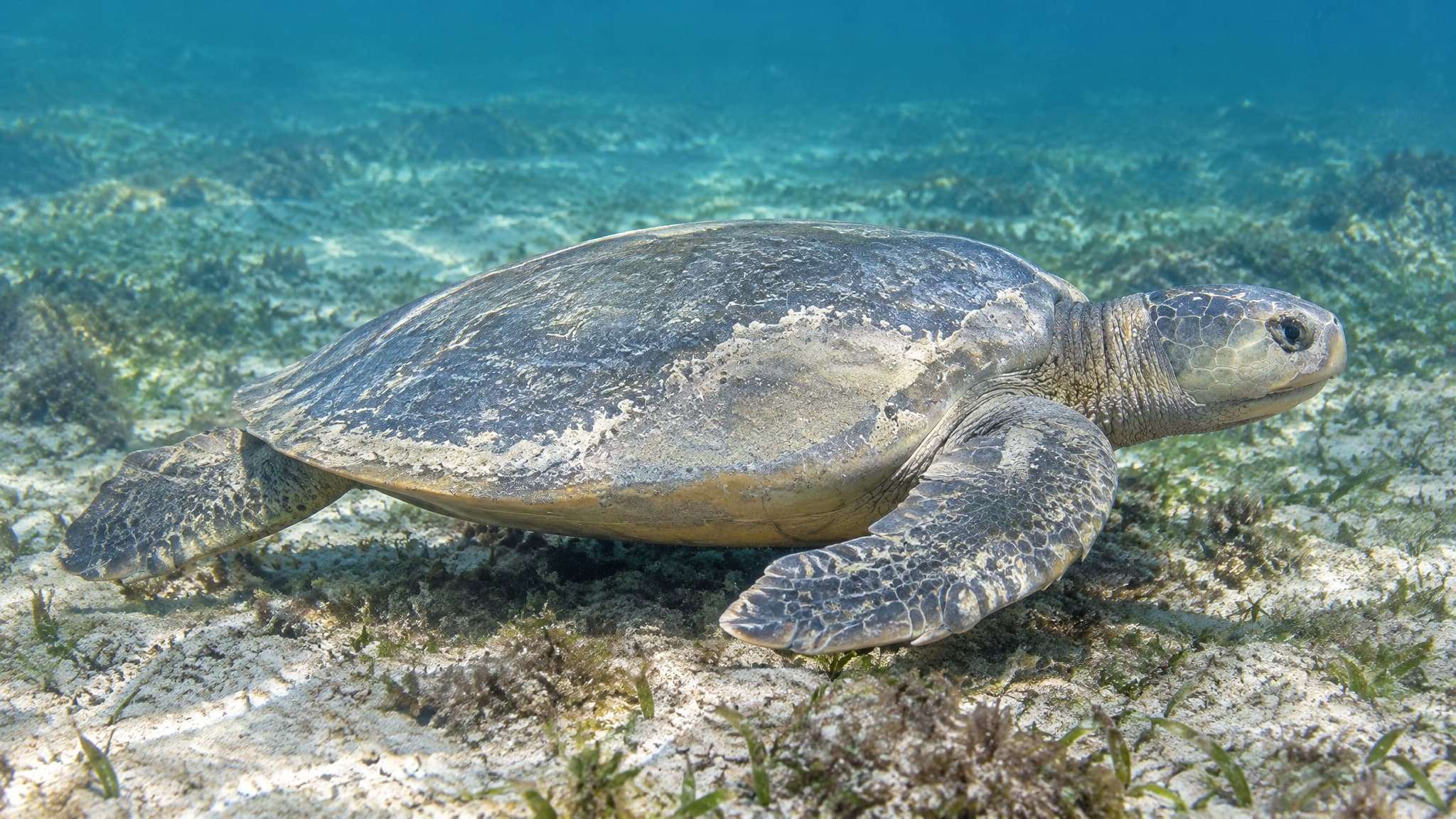
A flatback sea turtle swims just above a sandy, seagrass-covered seabed in clear shallow water, viewed in side profile. Its broad, flattened oval shell, scaled head, and large front flippers are clearly visible.
The flatback sea turtle (Natator depressus) is the only species in the genus Natator of the family Cheloniidae. It owes its name to its low, smooth shell, whose edges curl upward and which is much thinner than that of other sea turtles, so it can crack under fairly small pressures. The carapace is olive green or grey-green and the plastron pale yellow; the head has a single pair of prefrontal scales and the carapace four pairs of costal scutes. Adults usually measure 76 to 96 cm and weigh 70 to 90 kg, and the TTWG checklist gives maximum curved carapace lengths of 93.1 cm for males and 100 cm for females. Females grow larger than males and have shorter tails.
It has the smallest range of any sea turtle. It lives in the coastal waters of northern Australia, from Western Australia through the Northern Territory and the Gulf of Carpentaria to the Torres Strait and eastern Queensland, and also reaches the coasts of Papua New Guinea and Indonesia. It stays on the continental shelf, in shallow soft-bottomed areas and inshore bays, typically in water 60 m deep or less, and nests only on Australian beaches.
The flatback is mainly carnivorous. It hunts sea cucumbers, soft corals, jellyfish, shrimp, molluscs, bryozoans and other invertebrates in shallow water and only rarely eats seagrass. Adults rest near rocks or under ledges, and they can stay submerged for hours, though for less time when stressed.
Females nest every 2 to 3 years and lay about three clutches per season, roughly 15 days apart. Each clutch holds about 50 eggs, the fewest of any sea turtle, but eggs and hatchlings are large, and hatchlings have a carapace of about 60 mm. Incubation takes about 42 days. Nests below 29 °C produce males and above 29 °C females. In southern Queensland nesting runs from October to January, with hatching from December to late March and a peak in February, while in the north it nests year-round; Mon Repos, near Bundaberg, is a major rookery. Maturity is reached somewhere between 7 and 50 years of age.
Through its feeding the flatback likely shapes the invertebrate communities of shallow coastal seabeds, and it is food for many predators. Dingoes, red foxes, feral dogs and feral pigs dig up nests; crabs, seabirds and fish take hatchlings; and sharks and saltwater crocodiles prey on adults.
On the IUCN Red List the species is Data Deficient, after being listed as Vulnerable earlier, and it is on CITES Appendix I. The Australian government lists it as Vulnerable. Threats include bycatch in trawls, gillnets, ghost nets and crab pots, coastal development and beach damage, vehicle ruts that trap hatchlings, pollution and climate change. Indigenous Australians may harvest eggs and meat for non-commercial purposes only.