Fossa
Cryptoprocta ferox
 AI-generated
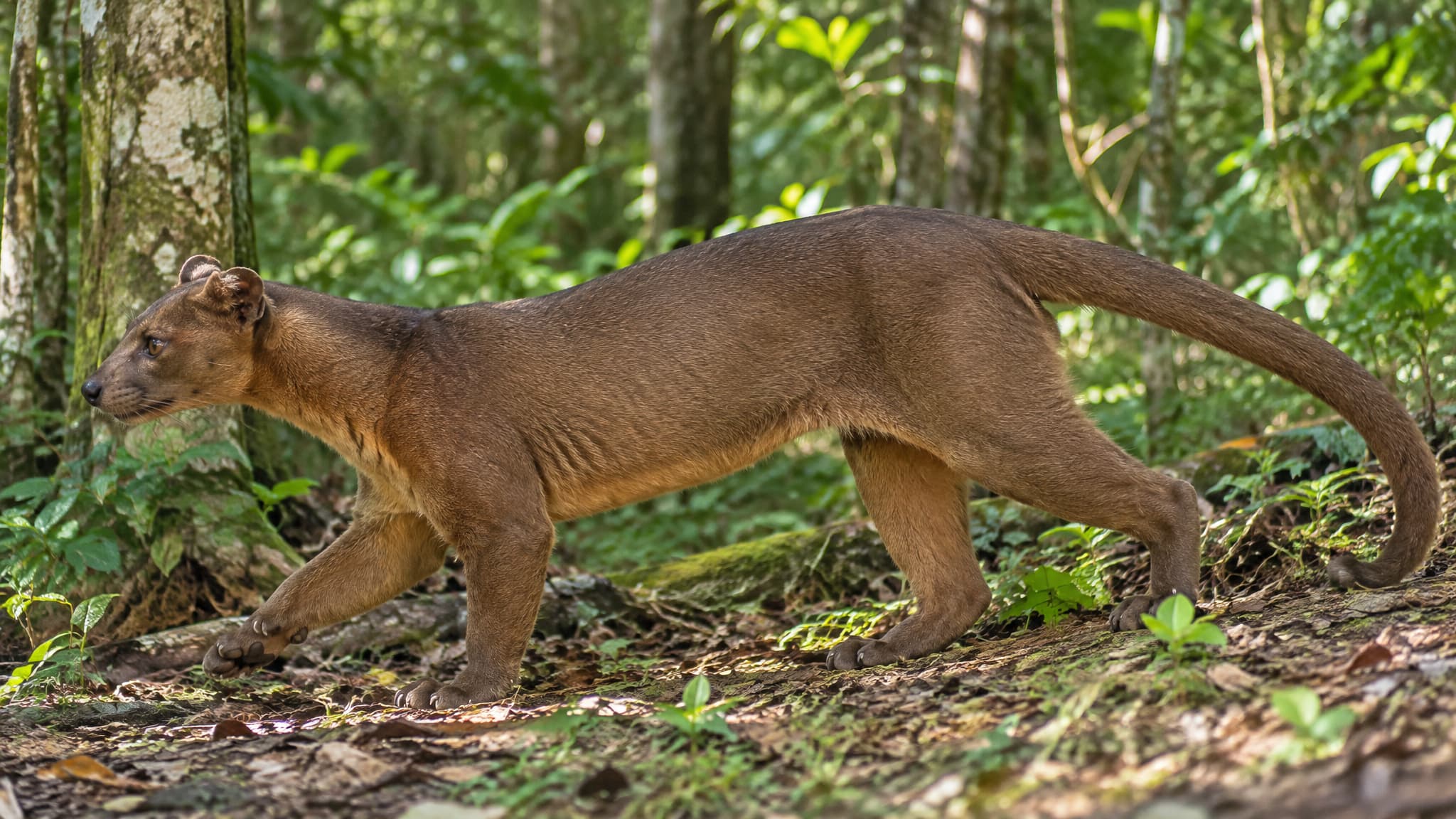
A fossa walks leftward through a sunlit forest, showing its elongated body, short rounded ears, sturdy legs, and long tapering tail.
The fossa (Cryptoprocta ferox) is the largest native carnivore of Madagascar and the best-known member of the Eupleridae, the family of carnivorans found only on that island. It looks like a cross between a small cougar and a mongoose: a slender, muscular body, a short rounded head with large forward-facing eyes, rounded ears and a very long tail. The short, dense coat is usually reddish brown, and some individuals are dark. Adults measure 70–80 cm from head to rump, with a tail of 65–70 cm. Males weigh 6.2–8.6 kg and females 5.5–6.8 kg.
The species lives only in Madagascar, where it has the widest range of any of the island's carnivores. It occurs in nearly every type of forest, from coastal lowlands up to about 2,000 m, and is found more often in humid forest than in dry forest. It avoids heavily disturbed land and the central high plateau.
The fossa is an expert climber. Retractable claws, very flexible ankles that let it run down trunks headfirst and a long balancing tail let it chase prey through the canopy. Lemurs make up more than half of its diet, and it is the only predator able to kill the largest lemur species. It also takes tenrecs, rodents, lizards, birds and other small vertebrates. It is mostly solitary and active by day and by night. In Kirindy Forest, home ranges reached 26 km² for males and 13 km² for females, and individuals mark them with scent.
Mating takes place mainly in September and October. Mating happens high in trees: a female may occupy the same tree for up to a week and mate with several males in turn, and a single mating can last nearly three hours. After a gestation of about 90 days she gives birth in a den to usually two to four young, sometimes up to six. The newborns weigh about 100 g and are blind and toothless. They are weaned at around 4.5 months, become independent after about a year and reach sexual maturity at three to four years. Fossas have lived up to 20 years in zoos; their lifespan in the wild is unknown.
As Madagascar's top mammalian predator, the fossa helps shape populations of lemurs and other small animals. The IUCN lists it as Vulnerable. The main threat is the loss and fragmentation of its forests, and it is also hunted for bushmeat and killed in retaliation for raids on chicken coops. It is listed in CITES Appendix II.