
Fraser's dolphin
Lagenodelphis hosei
 AI-generated
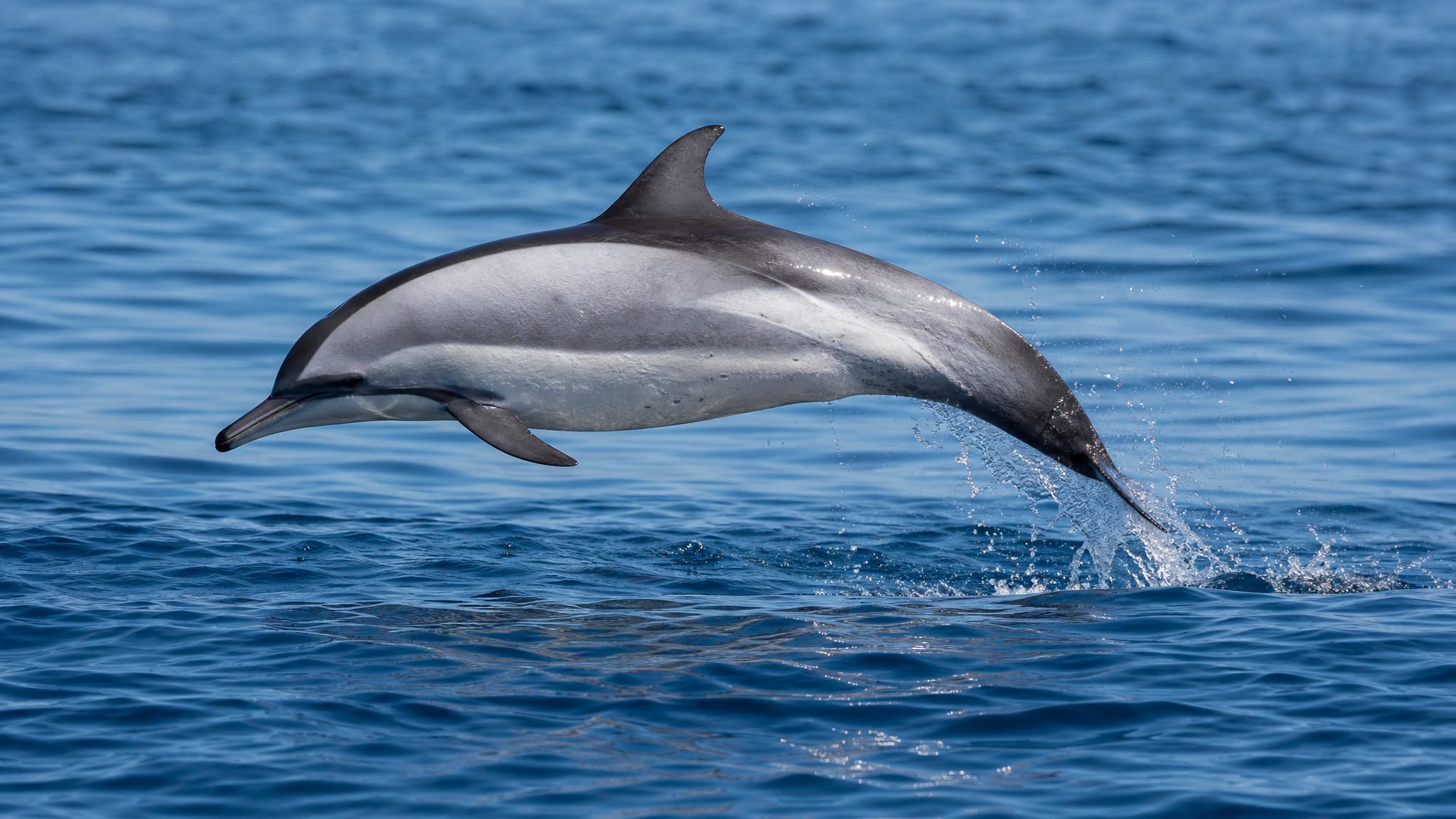
A dolphin is captured in profile, leaping horizontally above the open sea with its dorsal fin, pectoral flipper, long beak, and tail visible. Water droplets trail behind the arched body as it re-enters the water.
The Fraser’s dolphin is a compact, oceanic dolphin with a short but clearly defined beak, a small triangular dorsal fin, and relatively small flippers and tail flukes. Its back is bluish- to brownish-gray, while the underside is pale cream, white, or sometimes pinkish. A dark stripe runs from the eye along the flank toward the pectoral fin; it is generally broader and darker in adult males. Adults measure roughly 1.8–2.7 m and can weigh about 160–200 kg.
This species occurs in warm temperate, subtropical, and tropical seas of the Atlantic, Indian, and Pacific Oceans. It is chiefly a pelagic dolphin, favoring deep offshore waters—often around steep continental slopes, narrow shelves, and productive upwelling zones. In places where deep water comes close to shore, it may also be encountered near coasts. Its offshore habits and at-times inconspicuous behavior mean that it remains less familiar than many coastal dolphins.
Fraser’s dolphins are highly social and most often travel in tight schools of 10–100 animals, although aggregations of several hundred or even around 1,000 have been reported. Schools may form long, aligned swimming rows and can associate with other cetaceans. They make deep dives, reaching about 600 m, to capture mesopelagic fishes as well as squid, other cephalopods, and crustaceans. As a predator of organisms from deeper pelagic layers, the species is part of the food web connecting offshore surface waters with the mesopelagic zone.
Females usually bear one calf after a gestation of about 10–12.5 months, with births reported mainly from spring through autumn in studied populations. Females mature at about 5–8 years and males at about 7–10 years; documented life expectancy is at least 18 years. The IUCN category is Least Concern, but the global population size and trend remain uncertain. Entanglement or capture in fishing gear—including gillnets, purse seines, trawls, and longlines—and directed hunting for meat or oil in parts of its range are important recorded pressures.



